Meltable Inventory Is Back at Amazon FBA (2026): The Product-by-Product Return Schedule
R
RenéFreelance Amazon Editor
|
14 min read
For about a year, chocolate, gummies and a handful of other heat-sensitive products could not go into Amazon FBA in the US at all. That changed on August 28, 2026, when Amazon announced that meltable inventory is accepted again, but not all at once and not for every meltable product on the same day. The return runs on a two-phase schedule by product type, confirmed on Amazon's own Meltable FBA inventory help page. Below is exactly which products come back when, how to check whether your own ASIN is on the meltable list, and why this matters most for sellers planning holiday chocolate gifting right now.
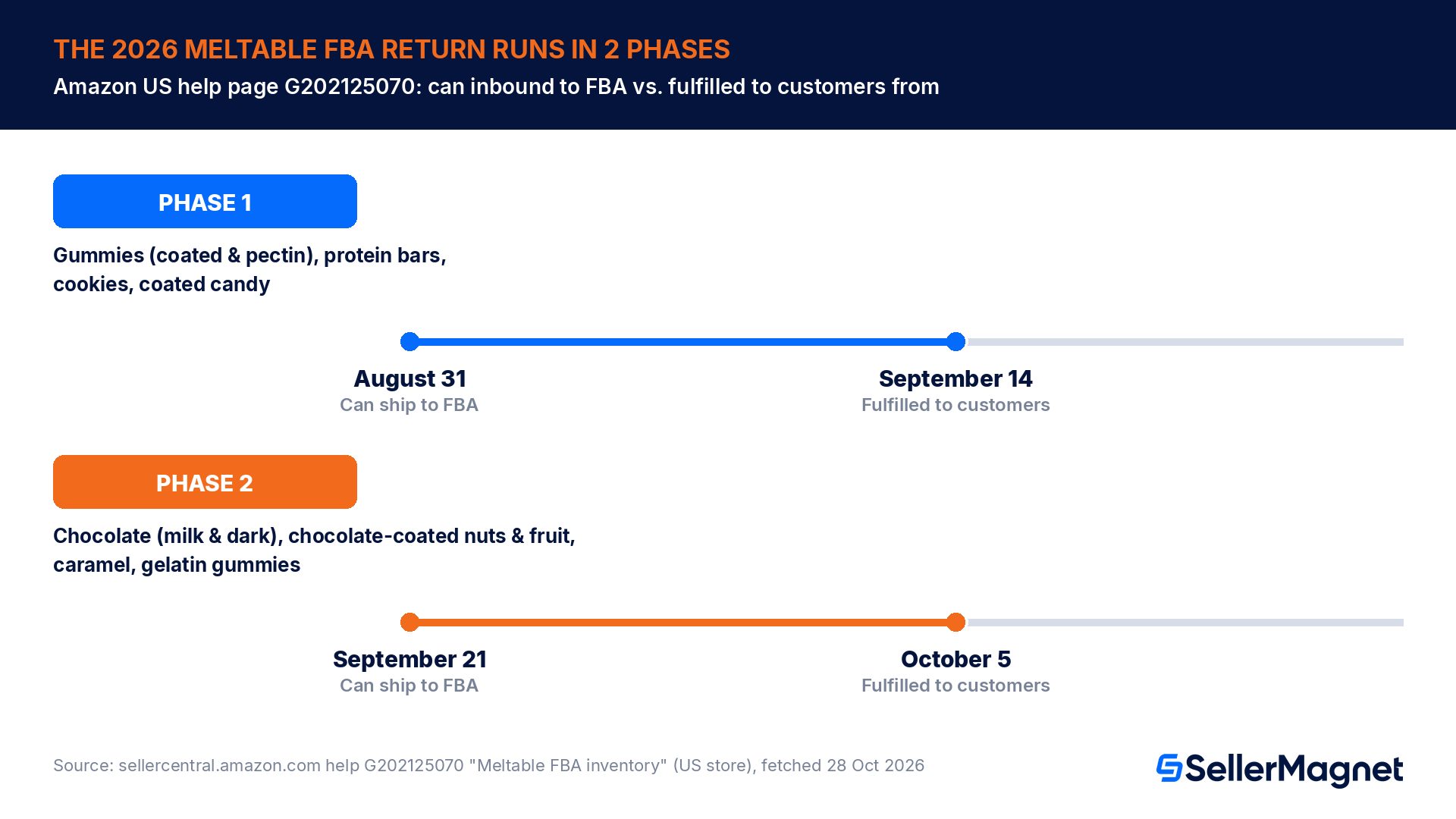
Amazon brought meltable inventory back to US FBA in 2 phases. Gummies, protein bars, cookies and coated candy could ship from August 31, 2026 and reach customers from September 14, 2026. Chocolate, chocolate-coated nuts and fruit, caramel and gelatin gummies followed from September 21, 2026 (ship) and October 5, 2026 (orders). Check your exact ASIN against Amazon's Meltable ASINs list before you create a shipment.
What changed on August 28, 2026?
Amazon's Meltable FBA inventory help page states the policy in one sentence: "Amazon fulfillment centers will only accept meltable products as Sellable inventory after August 31, 2026, based on product type. Meltable inventory stored in or arriving at our fulfillment centers before the acceptable date may be marked unfulfillable or disposed of for a fee." That single rule packs 2 separate changes together: FBA is open again, and when it opens depends on what kind of meltable product you sell.
Amazon defines "meltable" directly on that page: "heat-sensitive consumable products that have a high risk of melting when exposed to storage or transit temperatures at or above 155 degrees Fahrenheit, including but not limited to chocolate, gummies, and select jelly- and wax-based products." The phrase "including but not limited to" matters: the category is defined by the product's own melting behavior, not by a fixed list of names, so a wax-based candle or a jelly-based supplement can be classified as meltable even though the help page never names it directly.
This is a US change, not a global one
We fetched the identical help page ID on Amazon's UK store to check whether other marketplaces got the same update. The UK version describes a completely different, long-standing seasonal rule (meltable products accepted only roughly mid-October to end of April each year, with chocolates, gums and probiotics never fulfilled through FBA from mid-May to the end of September). There is no August 2026 return schedule on it at all. Treat the 2 phases below as a US FBA policy, and check your own store's help page before assuming it applies elsewhere.
The two-phase return schedule
Amazon's help page lists the schedule under "Selling meltable inventory through seller-fulfillment", because that section explains what to do while a product is still outside its FBA window: "Gummies (coated & pectin), protein bars, cookies, and coated candy ASINs can be inbounded to FBA starting August 31, 2026 and will begin to be fulfilled by Amazon starting September 14, 2026. All chocolate (milk, dark), coated chocolate nuts, fruit, caramel, and gelatin gummies ASINs can be inbounded to FBA starting September 21, 2026 and will begin to be fulfilled by Amazon starting October 5, 2026." The 2 product groups are not interchangeable: a chocolate-coated candy bar that looks similar to a coated gummy can land in a different phase depending on which ingredient Amazon classifies it under.
Phase
Products
Can ship to FBA from
Fulfilled to customers from
Phase 1
Gummies (coated and pectin), protein bars, cookies, coated candy
August 31, 2026
September 14, 2026
Phase 2
Chocolate (milk and dark), chocolate-coated nuts and fruit, caramel, gelatin gummies
September 21, 2026
October 5, 2026
Notice the gap inside each phase: inbound shipping opens 14 days before Amazon starts fulfilling customer orders from that stock in both phases. That gap is Amazon's own receiving and putaway buffer, not a mistake in the announcement, so a unit that ships on the first eligible day will not necessarily reach a buyer on that same day. Plan your inbound shipment to land in the first week of the ship window, so your stock is already checked in by the time customer orders start.
How to check whether your own ASIN is eligible
The schedule tells you when a product category can come back. It does not tell you whether your specific ASIN is classified as meltable at all, and that classification is what actually blocks or unblocks a shipment. Amazon's help page says: "You may download the Meltable ASINs list, which will be updated periodically. ASINs on the list are considered meltable and will be subject to the inbound restrictions noted above." The practical sequence is simple but easy to skip under holiday deadline pressure.
How to check and ship a meltable ASIN to FBA
Download the current Meltable ASINs list. - Amazon's Meltable FBA inventory help page links a downloadable list that is updated periodically; search it for every ASIN you plan to ship.
Match the ASIN to its phase. - If it is a gummy, protein bar, cookie or coated candy, use the August 31, 2026 / September 14, 2026 dates. If it is chocolate, a chocolate-coated nut or fruit, caramel or a gelatin gummy, use the September 21, 2026 / October 5, 2026 dates.
Create the shipment in Send to Amazon. - Only once the ASIN's ship date has arrived. Shipments created or arriving before the acceptable date can be marked unfulfillable or disposed of for a fee, so do not pre-stage inventory at the fulfillment center ahead of schedule.
Keep selling through seller-fulfillment until then. - Amazon's own guidance is to continue selling with your own cold-pack capabilities or an appropriate carrier until the ASIN's FBA window opens, rather than letting the listing go dark.
Watch for suppression even after the window opens. - A meltable ASIN inside its eligible window can still be suppressed if Amazon's quality standards are not met, so pack and label exactly the way you did when the product was last approved.
If you think an ASIN is misclassified
Not every borderline product belongs on the meltable list, and Amazon gives sellers a documented way to challenge a classification. The help page states: "If you believe your ASIN is incorrectly listed as Meltable, you can submit documentation to Selling Partner Support for consideration before April 15, 2027." The letter has to be on manufacturer letterhead and must include 4 specific pieces of information.
The specific ASIN.
Explicit confirmation that the ASIN can be stored at a maximum temperature of 155 degrees Fahrenheit for extended periods of time.
The temperature at which the ASIN actually loses integrity.
A point of contact for verification.
A successful review is not a permanent shield
Amazon's help page adds a direct warning: "Even with such documentation, Amazon continues to reserve the right to suppress offers if a product receives customer complaints that it arrives melted." A manufacturer letter can get a wrongly classified ASIN off the list, but real customer complaints about a melted arrival can still trigger suppression afterward, review or no review. Treat packaging and transit protection as an ongoing requirement, not a one-time paperwork exercise.
Removal, disposal dates and the fee waiver
The same help page carries 2 more dates sellers should not confuse with the return schedule above. On removing meltable inventory from fulfillment centers, it states: "Any meltable inventory remaining in Amazon fulfillment centers on May 1, 2026 may be disposed of for a fee. You may submit a Removal order for meltable inventory before April 15, 2027." These are the standing removal rules for stock that stayed in a fulfillment center outside its allowed window; they sit on the page as written, independent of the August 2026 return announcement above them, so check your own fulfillment center's removal deadline rather than assuming it moved.
There is also a seller-favorable detail easy to miss: "Amazon will waive the Low-Inventory-Level fee for meltable products between April 15 and October 5." After a long FBA lockout, meltable ASINs are exactly the kind of listing that can trip a low-inventory-level charge once stock finally starts moving again, so this waiver window is worth noting next to your restock plan rather than discovering it on an invoice.
Why this matters now: Q4 chocolate and holiday gifting
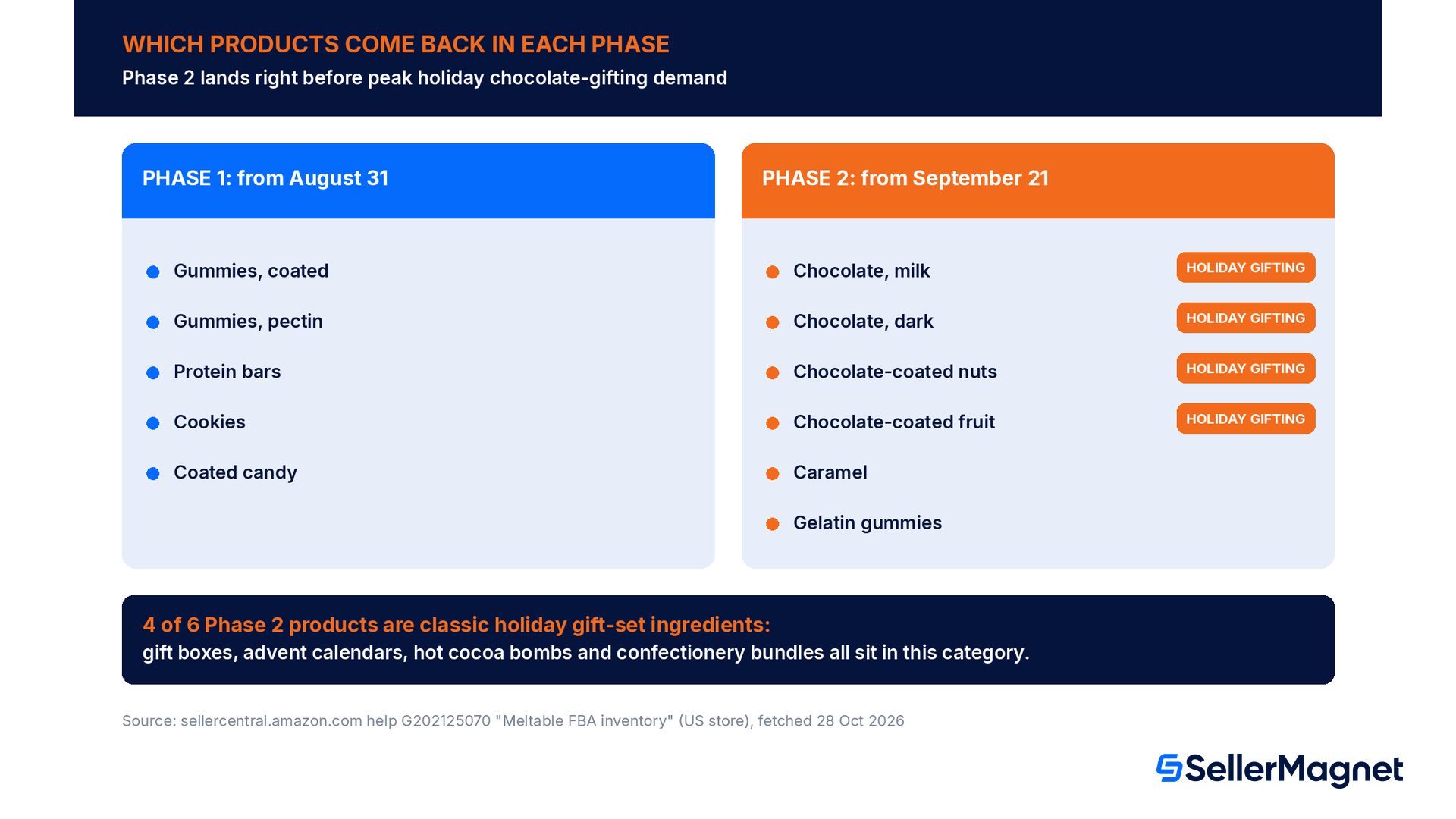
The timing is not a coincidence for sellers. Chocolate-coated nuts and fruit, caramel and gelatin gummies, exactly the Phase 2 category, are core ingredients in holiday gift sets, advent calendars, hot cocoa bombs and confectionery bundles. Under the ban, those products were pushed entirely onto seller-fulfillment through the one stretch of the year that generates the most gifting demand. The Phase 2 reopening on September 21, 2026 lands with just enough runway before peak holiday shopping to matter, but only if the ASIN is actually prepped, checked against the Meltable ASINs list and shipped in that first window rather than queued behind other Q4 inbound shipments.
Worked example (illustrative): a seller holding 500 units of a chocolate gift-box SKU that has been selling through a cold-pack 3PL at roughly $1.85 per unit in extra handling and carrier cost during the ban spends about $925.00 to move that one batch outside FBA. Moving the same batch into FBA once the Phase 2 window opens does not just restore Prime eligibility and Buy Box competitiveness; it also removes that per-unit cost on every future replenishment for the rest of the season, as long as the ASIN stays off the Meltable ASINs list or ships inside its approved window.
Before and after: what a meltable ASIN could do under the ban versus now
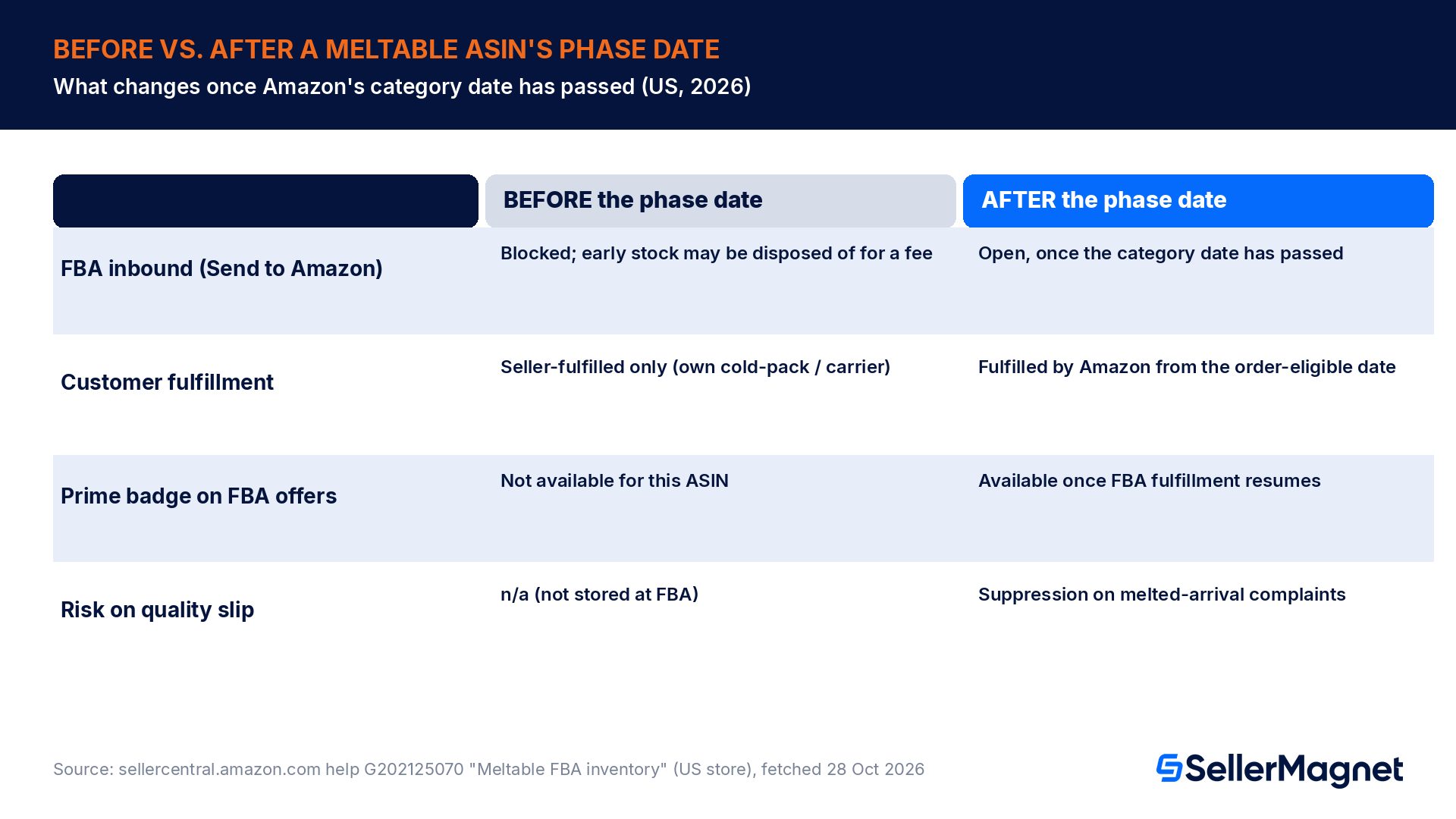
The practical difference is less about the word "meltable" and more about which fulfillment paths were actually open to a given ASIN on a given day. The table below lines up the state before August 31, 2026 against the state once an ASIN's phase window has opened.
Before the ASIN's phase date
After the ASIN's phase date
FBA inbound (Send to Amazon)
Blocked; stock arriving early may be marked unfulfillable or disposed of for a fee
Open, once the ASIN's category date has passed
Customer fulfillment
Seller-fulfilled only, with your own cold-pack capability or carrier
Fulfilled by Amazon from the category's order-eligible date
Prime badge on FBA offers
Not available through FBA for this ASIN
Available once FBA fulfillment resumes for the ASIN
Risk if quality standards slip
n/a (not stored at FBA)
Offer suppression on customer complaints of a melted arrival, even with a prior review approval
Planning the restock around both phases
Treat the two phases as two separate restock projects rather than one event. Phase 1 products reopen first and give you a dry run: confirm the ASIN is off the Meltable ASINs list, create a modest Send to Amazon shipment timed to land inside the ship window, and watch how quickly Amazon starts fulfilling customer orders from it. That run tells you how much lead time your own supply chain actually needs before the busier Phase 2 window opens 3 weeks later.
Phase 2 is where the holiday math matters most. Chocolate, chocolate-coated nuts and fruit, caramel and gelatin gummies are gifting staples, and the order-eligible date of October 5, 2026 leaves a tighter runway into peak shopping than Phase 1 gets. Build the shipment plan backward from your own expected sell-through date rather than forward from the announcement date: if an inbound shipment typically takes a week to check in and you want FBA fulfillment live before the first big promotional weekend, the Send to Amazon shipment needs to leave your warehouse well before September 21, 2026, not on it.
Sellers who stock both a Phase 1 and a Phase 2 product in the same gift bundle face an extra wrinkle: the bundle as a whole cannot be fully FBA-fulfilled until the later of the two components clears its own date. A gift set pairing coated candy (Phase 1) with a chocolate bar (Phase 2) only becomes fully FBA-eligible once the chocolate component reaches its own order-eligible date, even though the candy component could have shipped weeks earlier on its own.
Where SellerMagnet fits
Nothing here replaces checking your own ASINs against Amazon's Meltable ASINs list; that classification and its exceptions come only from Amazon. What SellerMagnet can do is help you time the restock itself. The inventory forecast shows days of stock left, the expected stockout date and the units to send, based on your real sales velocity (included from the Growth tier). For an ASIN that has been seller-fulfilled through months of a ban, that forecast tells you exactly how much buffer stock to send in the first FBA-eligible week, instead of guessing a restock quantity from memory.
For the rest of the Q4 inbound picture, see our guides to Amazon's Q4 inventory deadlines, FBA storage fees and stranded inventory. If you also store stock in Amazon Warehousing and Distribution, note that meltable items are excluded from AWD altogether; our AWD versus FBA storage guide covers that separate restriction, which is not the same rule as the FBA return schedule above. And if a meltable ASIN also happens to fall into a dangerous goods category, check our dangerous goods listing questions guide as well, since the 2 compliance paths are independent of each other.
Common mistakes to avoid
Shipping a Phase 2 product (chocolate, chocolate-coated nuts and fruit, caramel, gelatin gummies) using the Phase 1 date. The 2 categories open on different days, and early arrivals can be marked unfulfillable or disposed of for a fee.
Assuming the return applies outside the US. The identical help page ID on the UK store describes a different, older seasonal rule with no 2026 reopening at all.
Skipping the Meltable ASINs list check because the category date has passed. The date opens the category; the list determines whether your specific ASIN is still classified as meltable at all.
Treating a successful misclassification review as a permanent shield. Amazon can still suppress the offer later on verified customer complaints of a melted arrival.
Confusing the May 1, 2026 and April 15, 2027 removal and review dates with the August/September reopening dates; they are separate rules on the same help page.
Forgetting the Low-Inventory-Level fee waiver window (April 15 to October 5) when planning the first restock after months of forced seller-fulfillment.
When can meltable inventory go back into Amazon FBA in 2026?
On a two-phase schedule. Gummies (coated and pectin), protein bars, cookies and coated candy could ship to FBA from August 31, 2026 and reach customers from September 14, 2026. Chocolate (milk and dark), chocolate-coated nuts and fruit, caramel and gelatin gummies followed from September 21, 2026 (ship) and October 5, 2026 (orders), per Amazon's Meltable FBA inventory help page.
What does Amazon consider "meltable"?
Heat-sensitive consumable products with a high risk of melting when exposed to storage or transit temperatures at or above 155 degrees Fahrenheit, including but not limited to chocolate, gummies, and select jelly- and wax-based products. Amazon maintains a downloadable Meltable ASINs list, and any ASIN on it is subject to the inbound restrictions regardless of the exact product name.
Does this apply outside the United States?
Not based on what we checked. The same help page ID on Amazon's UK store describes a different, older, purely seasonal rule, with products accepted roughly mid-October to end of April each year and no 2026 return schedule at all. Check your own store's version of the Meltable FBA inventory help page before assuming the US dates in this article apply to your marketplace, because the underlying policy itself is not the same.
How do I know if my specific ASIN is classified as meltable?
Download Amazon's Meltable ASINs list from the Meltable FBA inventory help page and check every ASIN you plan to ship against it before creating a Send to Amazon shipment. The list is updated periodically, so recheck it before each inbound shipment of anything that could reasonably be considered heat-sensitive, not only chocolate and gummies.
Can I challenge a meltable classification?
Yes. Submit documentation to Selling Partner Support before April 15, 2027: a letter on manufacturer letterhead naming the ASIN, confirming it can be stored at a maximum of 155 degrees Fahrenheit for extended periods, stating the temperature at which it actually loses integrity, and giving a point of contact. Amazon still reserves the right to suppress the offer later if customers report a melted arrival.
What happens if I ship a meltable ASIN to FBA before its phase date?
Amazon's help page says meltable inventory stored in or arriving at fulfillment centers before the acceptable date may be marked unfulfillable or disposed of for a fee, with no guaranteed grace period for an early shipment. Keep selling through seller-fulfillment, using your own cold-pack capability or an appropriate carrier, right up until the ASIN's category date actually arrives, and build a few days of buffer into your Send to Amazon plan.
Is there a fee break for meltable products once they are back in FBA?
Amazon waives the Low-Inventory-Level fee for meltable products between April 15 and October 5 each year. That waiver matters most for the first restock after an extended period of forced seller-fulfillment, when a meltable ASIN's FBA inventory level can look artificially low to Amazon's systems simply because the product was locked out of FBA, not because the seller under-stocked it, so the waiver removes a penalty that would otherwise be unfair.
Stop Juggling Tools. SellerMagnet Combines Everything You Need.