Amazon SIPP Certification 2026: How to Enroll, Test and Stay Certified
R
RenéFreelance Amazon Editor
|
15 min read
A box with no Amazon box around it, just the product's own branded packaging, drops straight onto a customer's doorstep. That is Ships in Product Packaging (SIPP), formerly known as Ships in Own Container (SIOC), and Amazon pays for it: a per-unit fulfillment fee saving on standard-size units, a lower base fee on bulky units, and from 15 January 2026 a packaging fee of $1.51 to $4.04 on bulky units that are not enrolled. That fee-side math is its own topic. This guide covers the side almost nobody explains in one place: how a seller actually gets a product certified in the first place, what Amazon's own 17-drop self-test sequence requires versus when a paid ISTA-6 lab report is mandatory, how enrollment actually works inside Seller Central's SIPP portal, and the damage-rate monitoring that can pull a certified ASIN back out of the program without warning. None of these mechanics change often: the program has run as SIOC, then FFP, then SIPP since 2008, and the testing and enrollment steps below are the same ones Amazon's own seller-enrollment guide and packaging-certification PDFs describe today.
Ships in Product Packaging (SIPP), formerly Ships in Own Container (SIOC), is Amazon's FBA program that lets a seller ship a product in its own branded packaging with no Amazon box, bag, or filler added, in exchange for a per-unit fulfillment fee saving. Certification needs either a free self-test (17 drops from 46 cm and 92 cm) for non-fragile products or a paid ISTA-6A lab report for fragile, liquid, or sharp items, then enrollment through Seller Central's SIPP portal by region (North America or Europe). It runs in 7 marketplaces (US, Canada, UK, Germany, France, Italy, Spain), requires a minimum product size of 6 x 4 x 0.375 inches, and Amazon continuously monitors damage rates on certified ASINs, decertifying any that fail to hold up.
SIPP, SIOC and FFP are the same program under three names
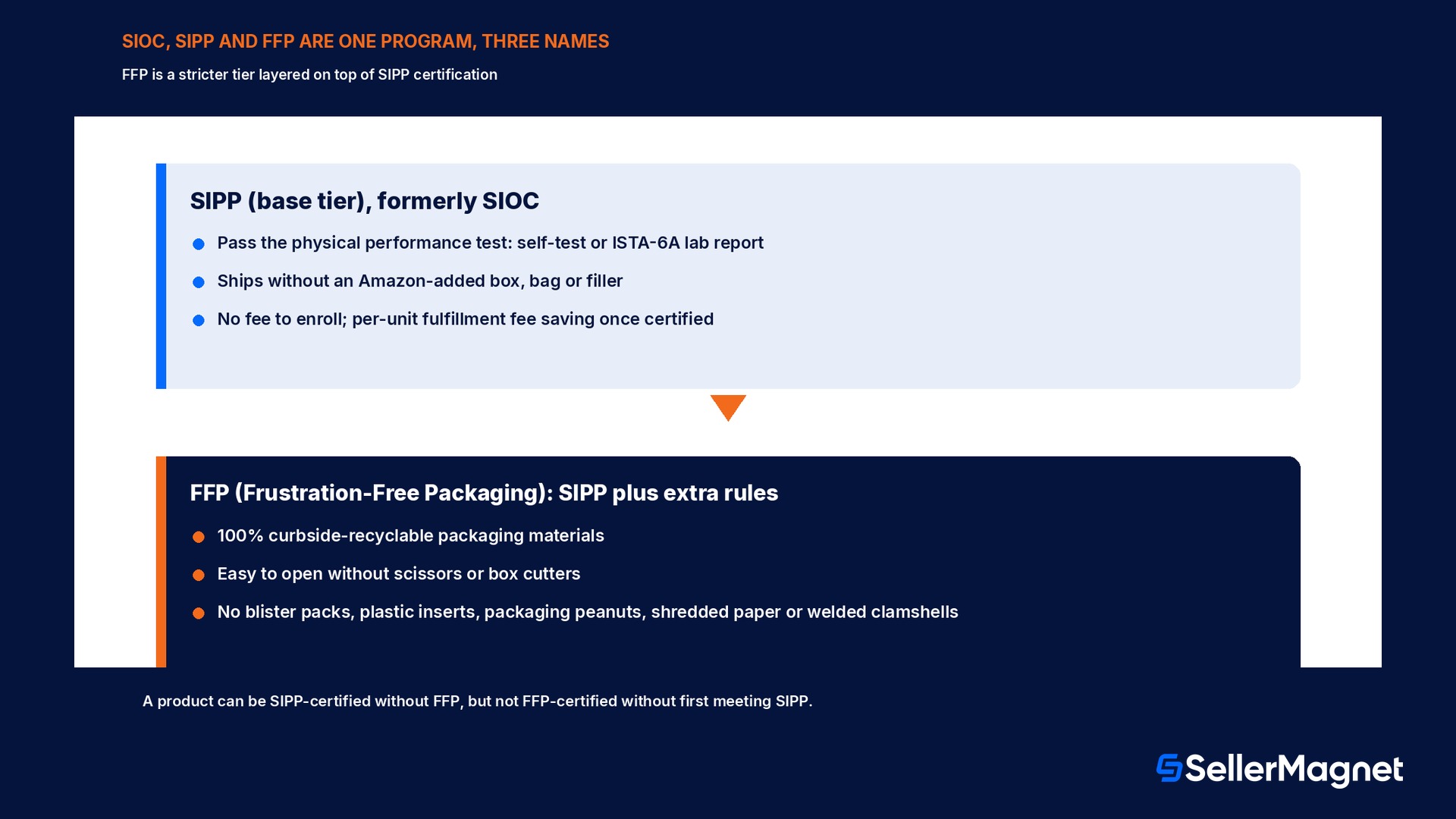
Amazon's own FAQ settles a question that confuses a lot of sellers searching old forum threads: the packaging certification standards for SIPP are exactly the same as SIOC, because Amazon simply rebranded Ships in Own Container (SIOC) to Ships in Product Packaging (SIPP) to better describe the program's objective. SIOC launched in 2008; the program was renamed SIPP, and sellers may still run into the older FFP or SIOC terminology inside program materials describing differences in certification tier, not different programs. Frustration-Free Packaging (FFP) is the one real tier split: it is SIPP certification PLUS a stricter set of material and usability rules layered on top, not a separate program. A product can be SIPP-certified without being FFP-certified, but not the other way around.
Tier
What it requires
Customer-facing signal
SIPP (base)
Passes the physical performance test (self-test or ISTA-6A lab report); ships without an Amazon-added box, bag or filler
Checkout shows a message that the item ships in its own packaging; a no-cost option to add Amazon packaging anyway
FFP (on top of SIPP)
100% curbside-recyclable materials, easy-open without scissors/box cutters, no blister packs, plastic inserts, packaging peanuts, shredded paper or welded clamshells
Frustration-Free Packaging badge/branding
Where it runs and what qualifies
SIPP is open in exactly 7 marketplaces: the United States, Canada, United Kingdom, Germany, France, Italy, and Spain; a seller selling the same ASIN outside those 7 stores gets no SIPP option there at all. The minimum size gate applies regardless of packaging structure, rigid or flexible: 6 x 4 x 0.375 inches. Enrollment only ever shows ASINs that are currently buyable through FBA by that seller; an out-of-stock ASIN or one without an active FBA listing will not appear as eligible in the portal, so a product has to be live and sellable before it is even worth starting the test.
Gate
Requirement
Marketplaces
US, Canada, UK, Germany, France, Italy, Spain (7 total); no other store
Minimum size
6 x 4 x 0.375 inches, rigid or flexible packaging
FBA status
ASIN must be currently buyable through FBA; out-of-stock or no active FBA offer = not shown as eligible
Enrollment fee
None; costs only come from packaging changes and, if required, the ISTA-6A lab report
Which test you need: free self-test or a paid ISTA-6A lab report
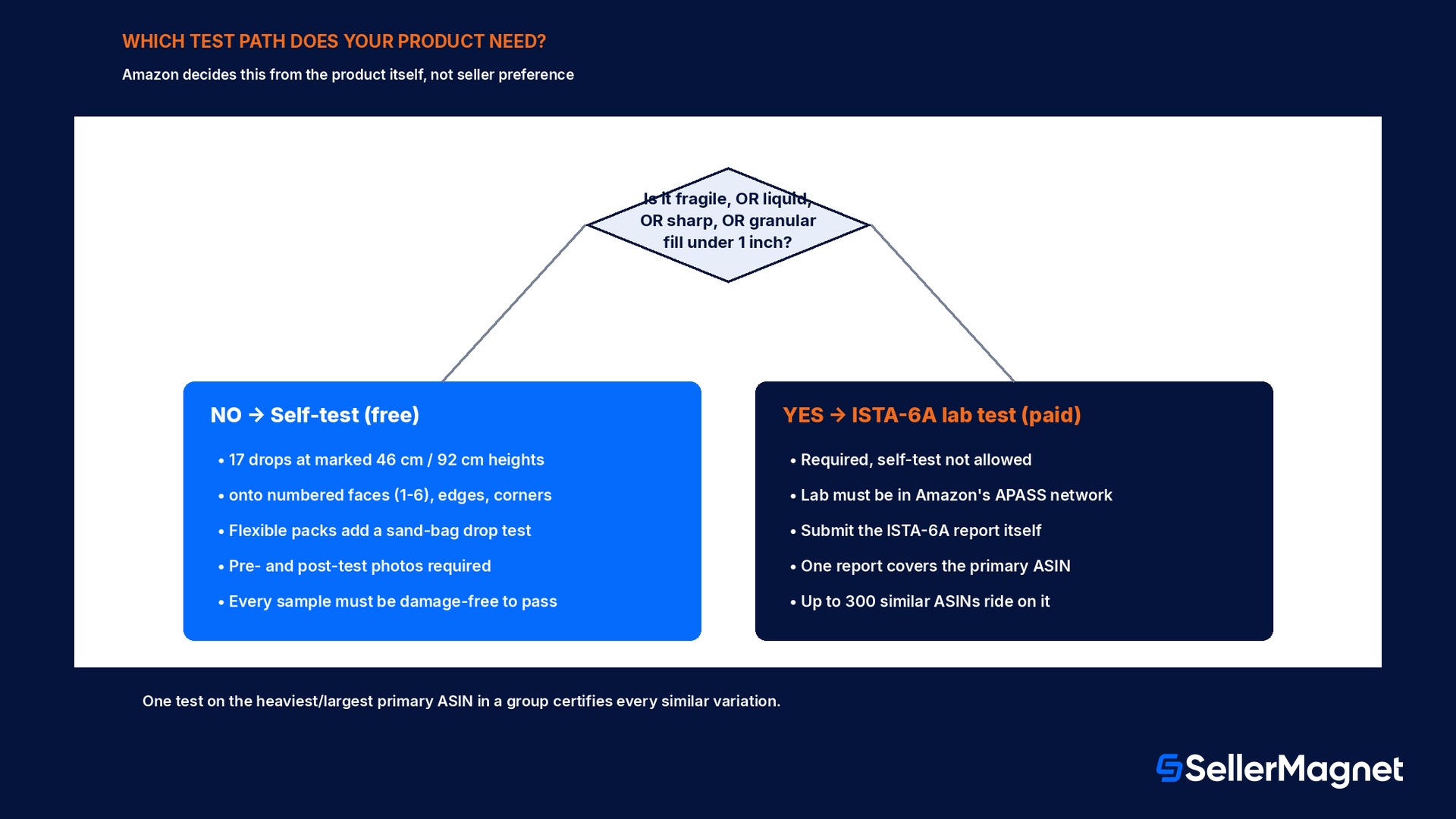
Amazon draws the self-test/lab-test line on the product itself, not on seller preference. A product can self-test only if it is non-fragile, contains no liquids or sharp items, and is not granular with a particle diameter under 1 inch; a product that is fragile, OR contains sharp items, OR contains liquids cannot self-test at all and must submit a lab report from an ISTA-6 lab inside Amazon's APASS network. Only one test report is needed per product group: the test runs on the primary ASIN, defined as the heaviest and largest product in that group, and once it passes, every physically similar secondary ASIN or variation (grouped by size, weight, material, packaging, and product-to-packaging ratio) can be certified under that same report without a separate test, up to 300 ASINs searchable in one enrollment batch.
Self-test
ISTA-6A lab test
Who can use it
Non-fragile, no liquids, no sharp items, no granular fill under 1 inch diameter
Required for fragile, liquid, sharp, or sub-1-inch granular products; optional for anyone else
Cost
Free (your own packaging and labor)
Paid, through an ISTA-6 lab in Amazon's APASS network
Procedure
17 drops at marked 46 cm / 92 cm heights onto numbered faces, edges and corners (flexible packaging adds a sand-bag material-strength drop)
Lab runs the ISTA-6A protocol and issues the report; seller submits it, not a self-recorded result
What you submit
Pre-test and post-test photos of packaging and product, numbering 1 to 6 per the required sequence
The ISTA-6A lab report itself
Inside the self-test: the 17-drop sequence
Amazon's own instructions number the box's faces 1 through 6, starting on the largest side and rotating the package right for faces 1 to 4, with the two remaining sides numbered 5 and 6; that same numbered package is used for every drop in the sequence, never swapped mid-test. Two pre-test photos of the undamaged package come first. Then the box is dropped 17 times from one of two marked heights, 46 cm (18 inches) or 92 cm (36 inches), onto a specific face, edge, or corner each time, in Amazon's fixed order: mostly edge and corner drops from 46 cm, with drops 8 and 16 the two 92 cm face drops (drop 16 lands on the most fragile face). Flexible (bag) packaging adds a third step beyond numbering and drop-testing: a fresh 23 x 16 x 8 cm corrugate "hazard box" holding a 2 kg (3 lb) bag of sand is dropped from 92 cm directly onto the flexible package, and it has to avoid puncturing the material or damaging the item inside. A pass needs every single dropped sample to come through with no visible damage or breakage, no loss of function or utility, and no compromised seal or tape; a customer-acceptable minor wear mark not covered by those three failure conditions is the only kind of cosmetic change the test tolerates.
The numbering decides the drop order, not the other way around
A self-test photographed and recorded with faces numbered in a different order than Amazon's fixed starting rule (largest side first, then rotate right) produces a technically-passed test that still gets rejected on documentation review, because the submitted drop sequence no longer matches the required orientation table. Number the box before touching the drop sequence, not after.
Enrolling through the SIPP portal, step by step
Enrollment happens region by region inside Seller Central, never globally in one click: North America and Europe are separate enrollment regions, each reached through its own country's sellercentral domain SIPP page. Inside the portal, the Eligible Products tab lists Amazon's recommended product groupings for that seller's catalog, the marketplace each group is eligible in, and the per-unit fee savings the group would unlock; clicking Edit product group and enroll on any row opens the group editor. ASINs can be searched and added individually, pasted as a list, or added up to 300 at a time (anything beyond that returns an error), and Amazon filters the group view into All, Recommended, Added by you, Eligible to enroll, and Certified ASINs so a seller can see at a glance what still needs a test. If the primary ASIN in a group is already certified, finishing enrollment needs nothing more than picking a first arrival date; if it is not yet certified, the seller chooses packaging type (rigid or flexible) and test path (self-test or ISTA-6A lab test) and attaches either the self-test photos or the lab report before confirming. The Enrolled Products tab afterward shows every group's certified, decertified, or in-process status, searchable by ASIN, SKU, or FNSKU, alongside the date certified or decertified, the store, and the per-unit benefit. One enrollment inheritance worth knowing: ASINs already SIPP-certified for standard FBA orders automatically carry that certification into Multi-Channel Fulfillment and Buy with Prime orders too, with no separate enrollment step.
Certification is not permanent: how decertification works
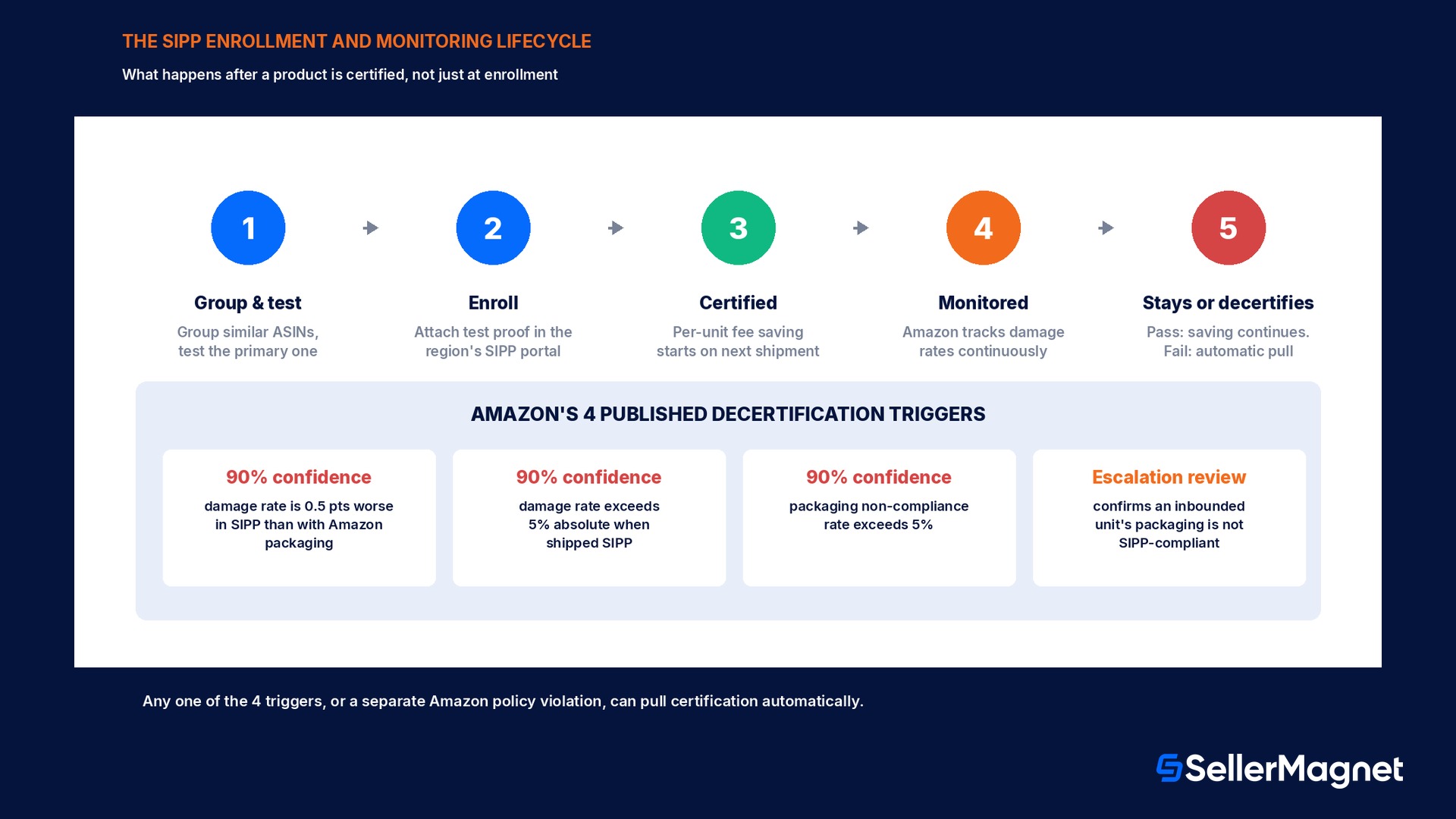
Amazon's own Decertification help page states the mechanism plainly: a product can be decertified from the SIPP program either by Amazon or by the seller, and every SIPP-certified product has to keep meeting damage rate limits that Amazon continues to monitor after the one-time test passes. Amazon publishes exactly four events that can trigger it: 90% confidence the damage rate is 0.5 percentage points worse shipped in SIPP packaging than it would be in Amazon-added packaging, 90% confidence the damage rate exceeds 5% when shipped SIPP, 90% confidence the packaging non-compliance rate exceeds 5%, or a standard escalation process confirming an inbounded unit's packaging is not SIPP-compliant; any policy violation can also trigger decertification separately from these four. A seller can also choose to unenroll a certified ASIN at any time through the Enrolled Products tab's Unenroll button, which Amazon reviews and approves within 3 business days. Either path removes the per-unit fee saving the moment it takes effect, and from 15 January 2026 a decertified bulky unit also starts paying the $1.51 to $4.04 packaging fee described in SellerMagnet's separate guide to the 2026 SIPP fee changes, so a decertification is not just a lost discount, it can flip straight into a new cost on the next shipment. Re-enrollment is possible: fix the packaging issue, update the packaging, then re-enroll the product from the Enrolled Products tab.
The damage-rate math runs on a confidence level, not a simple average
Three of Amazon's four decertification triggers are phrased as '90% confidence', which means a handful of damaged units out of a small shipped volume can trip the rule faster than the same raw damage count would on a high-volume ASIN, since the statistical confidence crosses the line sooner on thinner sample sizes. A supplier swap, a thinner box stock, or a quietly smaller cushioning insert after certification is the most common real-world cause of a damage rate climbing into one of these four triggers, since nothing in the enrollment portal re-tests a certified ASIN unless the packaging itself is resubmitted.
Mistakes that stall or reverse a SIPP certification
Running the self-test on a product that actually qualifies as fragile under Amazon's own grouping rules (a set where 50% or more of the pieces are fragile counts the whole set as fragile), which gets the self-test result rejected and forces a restart with a paid ISTA-6A lab report.
Numbering the box faces out of Amazon's required order (largest face first, then rotate right for faces 1-4) before running the 17-drop sequence, which desynchronizes the submitted photos from the required orientation table on review.
Trying to enroll an ASIN that is out of stock or has no active FBA offer; the portal simply will not show it as eligible, so the test effort happens before the enrollment step can even accept it.
Changing a certified product's packaging materials or supplier without re-testing, then hitting one of Amazon's four decertification triggers (damage rate or non-compliance rate crossing the published confidence thresholds) months later, since nothing re-tests a certified ASIN unless the packaging itself is resubmitted.
Assuming FFP and SIPP are two separate programs to choose between, rather than FFP being SIPP certification plus a stricter recyclability and no-blister/no-peanuts materials layer on top.
Testing every product variation separately instead of grouping them: one test on the correctly identified primary (heaviest/largest) ASIN in a group certifies every physically similar secondary ASIN without a repeat test.
Where the fee savings actually show up
The per-unit fulfillment fee saving SIPP certification unlocks, and the packaging fee it protects against, both land inside the same fulfillment fee line a seller already reconciles per unit. SellerMagnet's Fee Calculator models both sides of that line from the same dimensional-weight and size-tier inputs the SIPP program itself uses to set the discount or the packaging-fee band, so a seller can see the per-unit swing of certifying a specific ASIN before running a single drop test.
Once a product is enrolled, the real question becomes whether the saving is actually landing shipment after shipment, and whether a quiet decertification already happened. SellerMagnet's Analytics dashboard tracks per-unit fulfillment fees over time at the ASIN level, which is the fastest way to notice a certified ASIN's fee line jump back up the same week Amazon's own monitoring pulled its certification, rather than discovering it a full settlement cycle later.
Pre-enrollment checklist
SIPP enrollment: from eligible ASIN to certified
Confirm the ASIN is live - The product must be currently buyable through FBA; out-of-stock ASINs or ones without an active FBA offer will not show as eligible in the portal at all.
Group similar products - Amazon recommends groupings by size, weight, material, packaging, and product-to-packaging ratio inside the Eligible Products tab; group variations together so only the primary (heaviest/largest) ASIN needs a test.
Pick the test path - Self-test if the product is non-fragile with no liquids, sharp items, or granular fill under 1 inch diameter; otherwise an ISTA-6A lab report from an APASS-network lab is required.
Run the test and document it - Self-test: number the box's faces 1-6, take pre-test photos, complete the 17-drop sequence at 46 cm/92 cm, take post-test photos. Lab test: submit the product and packaging to the lab and receive the ISTA-6A report.
Enroll in the portal - In the region's SIPP page, open the product group, attach the test photos or lab report (skip this if the primary ASIN in the group is already certified), and pick a first arrival date.
Monitor the Enrolled Products tab - Check certification status, date, store, and per-unit benefit by ASIN/SKU/FNSKU; Amazon continues to track damage rates on certified ASINs after enrollment, not only at the test.
ASIN confirmed buyable through FBA right now, not out of stock and not missing an active FBA offer.
Product and packaging measured against the 6 x 4 x 0.375 inch minimum.
Fragility/liquid/sharp-item/granular-fill status checked honestly against Amazon's self-test eligibility rule before picking a test path.
Similar ASINs and variations grouped by size, weight, material, packaging, and product-to-packaging ratio so only the primary ASIN needs a test.
Box faces numbered 1-6 in Amazon's required order (largest face first, rotate right) before any drop, with pre-test photos taken first.
17-drop sequence run at the correct 46 cm/92 cm heights and orientations, or an ISTA-6A lab report obtained from an APASS-network lab.
Enrollment completed in the correct region (North America or Europe) for every marketplace the ASIN sells in.
Enrolled Products tab bookmarked for ongoing monitoring, not just checked once at enrollment.
Is SIPP the same thing as SIOC?
Yes. Amazon rebranded Ships in Own Container (SIOC) to Ships in Product Packaging (SIPP) to better describe the program's goal; the certification standards did not change, and the FFP and SIOC terms still appear in some program materials to describe certification differences, not separate programs.
Does it cost anything to enroll in SIPP?
There are no Amazon fees to enroll. The real costs, if any, are updating packaging to meet SIPP requirements and, only if the product is fragile, liquid, sharp, or granular under 1 inch, the paid ISTA-6A lab test that a self-test cannot substitute for.
Which marketplaces support SIPP?
Seven: the United States, Canada, United Kingdom, Germany, France, Italy, and Spain. A seller enrolls region by region (North America or Europe) rather than marketplace by marketplace.
Do I have to test every size variation of the same product separately?
No. Test the primary ASIN, the heaviest and largest in the group; every physically similar secondary ASIN or variation grouped with it by size, weight, material, packaging, and product-to-packaging ratio can be certified under that same report, up to 300 ASINs in one enrollment batch.
What makes a product ineligible for the free self-test?
Being fragile, containing liquids, containing sharp items, or being granular with a particle diameter under 1 inch. Any one of those forces an ISTA-6A lab report instead; a set where 50% or more of its pieces are fragile counts the whole set as fragile for this rule.
Can Amazon decertify a product without the seller doing anything wrong?
Yes. Amazon publishes four specific triggers: 90% confidence the damage rate is 0.5 percentage points worse than with Amazon packaging, 90% confidence it exceeds 5% absolute, 90% confidence packaging non-compliance exceeds 5%, or a confirmed non-compliant inbound review; a seller can also choose to unenroll a certified ASIN at any time, independent of Amazon's own monitoring.
Does SIPP certification carry over to Multi-Channel Fulfillment or Buy with Prime orders?
Yes, automatically. An ASIN already SIPP-certified for standard FBA orders is certified for MCF and Buy with Prime orders too, with no separate enrollment step required.
Is Frustration-Free Packaging a different program from SIPP?
No, it is a stricter tier on top of SIPP certification: 100% curbside-recyclable materials, easy-open without scissors or box cutters, and no blister packs, plastic inserts, packaging peanuts, shredded paper, or welded clamshells. A product can be SIPP-certified without meeting FFP's extra material rules, but not FFP-certified without first meeting SIPP's.
Stop Juggling Tools. SellerMagnet Combines Everything You Need.