Amazon Attribution 2026: What It Measures and Pays
R
RenéFreelance Amazon Editor
|
15 min read
A seller running Facebook ads, Google search ads, or an email campaign that links straight to an Amazon product page has no way to know which of those links actually turned into a sale, not from Amazon's own dashboards anyway. Seller Central shows total orders and total sessions, but it does not know a shopper arrived from last Tuesday's Instagram post versus this week's Google Shopping ad. Amazon Attribution closes that gap: a free, self-service measurement tool that generates a tracking tag for any non-Amazon link, then reports back detail page views, add-to-carts, and sales for exactly that tag once the shopper lands on Amazon. It is not the same tool as the Brand Referral Bonus program, which pays a cash bonus on sales those same tagged links drive; Attribution is the measurement layer underneath it, and a seller can use Attribution without ever enrolling in the bonus program, though the two are designed to be used together. This guide works through who is actually eligible to use it, how the tags and campaigns are structured, the exact conversion metrics Amazon reports back, a worked example of what tagged data does to a real budget reallocation decision, and the bulk-upload limits and mistakes that trip up a first campaign.
Amazon Attribution is a free, self-service measurement tool for professional sellers enrolled in Brand Registry, vendors, agencies, and Kindle Direct Publishing authors. It generates a tracking tag for any non-Amazon marketing link, search, social, display, video, email, or third-party affiliate, and reports back detail page views, add-to-carts, and sales once a shopper clicks through to a product detail page or Store on Amazon. It is a separate tool from the Brand Referral Bonus program, which pays an average 10% bonus on sales Attribution-tagged links drive; Attribution only measures, it does not pay a bonus by itself.
What is Amazon Attribution, and what is it not?
Amazon Attribution is a free, self-service advertising and analytics measurement solution built for one specific blind spot: marketing a brand runs off Amazon that still points a shopper back to a product detail page or Store on Amazon. Create a campaign, generate a tag for each ad, link, or button in a non-Amazon placement, and Amazon reports the on-Amazon activity that tag produced, detail page views, add-to-carts, and sales, broken down by publisher, channel, and campaign. It measures both paid and organic traffic across 6 channel types: search, social, display, video, email, and third-party affiliate marketing. The one thing it is routinely confused with is the Brand Referral Bonus program, a separate enrollment that pays an average 10% bonus on product sales those same tagged links drive; Attribution is the measurement layer the bonus program reads from, not the program itself, and a seller gets the measurement dashboards whether or not they ever enroll in the bonus. Access runs through the advertising console, alongside a seller's existing self-service ad campaigns, or through Amazon Ads Agent for a more conversational setup.
Who can actually use Amazon Attribution?
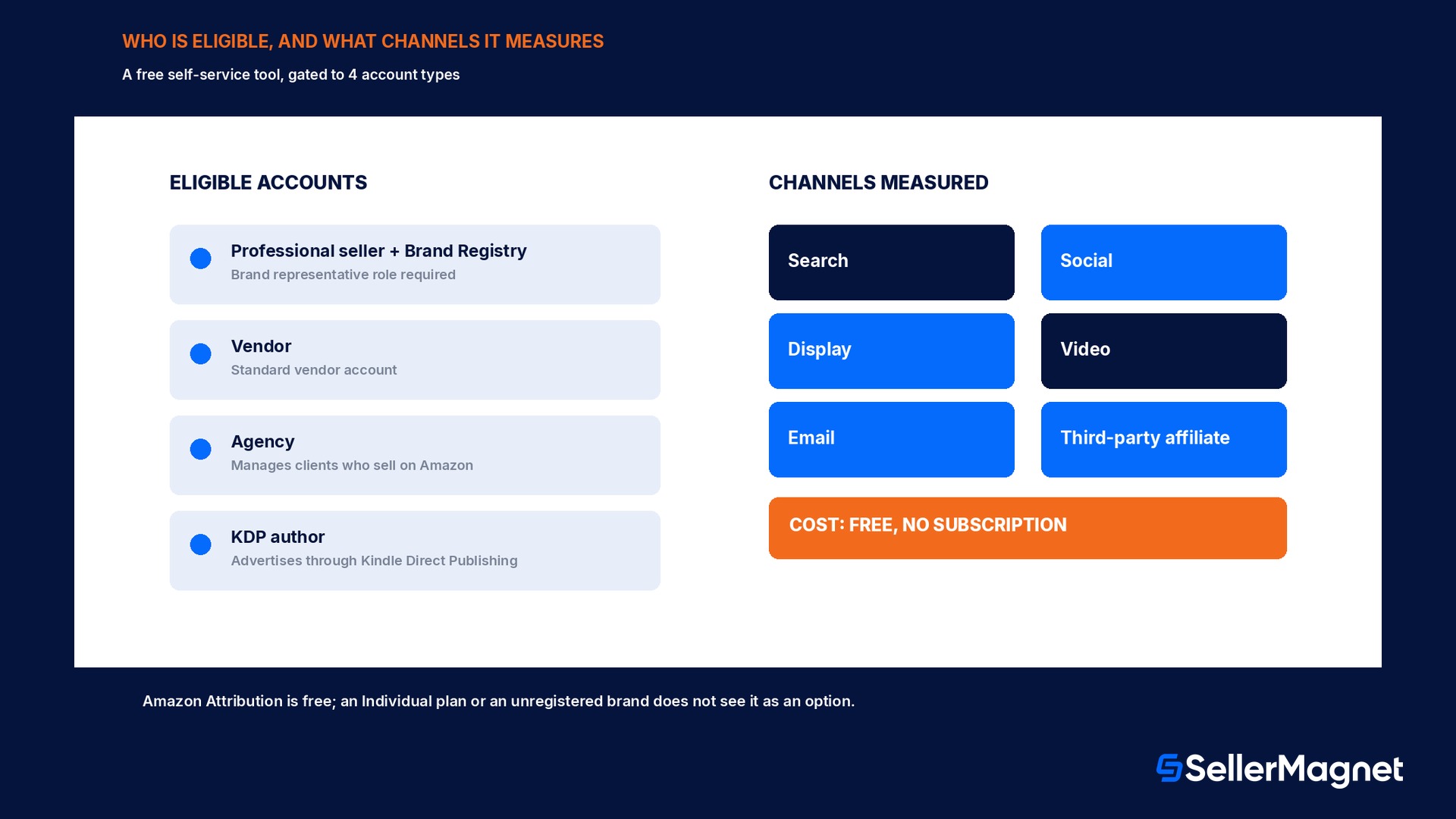
Amazon's own eligibility page draws the line narrower than the "any seller" framing some third-party guides use. Four account types qualify: professional sellers enrolled in Amazon Brand Registry who hold a brand representative role on at least one brand, vendors, advertising agencies managing campaigns on behalf of clients who sell products on Amazon, and Kindle Direct Publishing authors who advertise. A seller on an Individual selling plan, or one not yet enrolled in Brand Registry, does not see Attribution as an option in the advertising console regardless of ad spend. There is no minimum ad budget or sponsored-ads requirement stated for sellers specifically, but Amazon's own description ties eligibility to accounts that already use sponsored ads and sell in the Amazon store, so a brand-new account with no sales history and no running campaigns is the least likely to have full access unlocked on day one.
Account type
Requirement
Professional seller
Enrolled in Amazon Brand Registry, with a brand representative role on the brand
Vendor
Standard vendor account
Agency
Manages campaigns for clients who sell products on Amazon
KDP author
Advertises through Kindle Direct Publishing
Cost
Free; no separate license or subscription fee
How a campaign, a tag, and a click-through URL fit together
Every Attribution campaign is a collection of ad groups tracking conversions for the same set of products, and every individual ad, link, or button inside a non-Amazon placement gets its own tag, a macro-enabled tracking code generated per publisher and client rather than a separate full tag for every single ad. Building a campaign starts with the click-through URL, the Amazon destination the tag points to once clicked: a specific product detail page when the goal is driving sales for that product, or a Store page when the goal is building consideration across a wider catalog. Amazon then adds the products shown on that destination to the campaign automatically, so a seller is not maintaining a separate product list by hand alongside the tag. Campaigns can be created for any channel, paid or organic: search engine results, social posts or ads, display placements, video, email, and third-party affiliate links. Amazon's own best practice is to create a separate tag for every individual ad, link, or button rather than one tag per channel, because a shared tag collapses the exact comparison, which creative or which placement actually converted, that is the entire reason to measure in the first place.
Check for tracked traffic 2 days after launch, then review weekly
Amazon's own guidance is to confirm a new campaign is driving measurable traffic 2 days after the tags go live, catching a broken or mistyped tag early, then to check performance on a weekly cadence after that rather than daily, since attribution data accumulates over the full path from click to purchase.
What does Amazon actually report back, metric by metric?
Amazon Attribution's reporting dashboard and downloadable reports expose a specific set of named metrics, and knowing which one answers which question matters more than reading all of them at once. Detail page views counts how many times the advertised product's own page was viewed after a tagged click. Add to cart counts how many times a promoted product was added to a cart after a tagged click. Purchases counts how many times any amount of a promoted product appears in a purchase event, including Subscribe and Save subscriptions and video rentals. New-to-brand purchases and new-to-brand product sales isolate first-time buyers of the brand over a 1-year lookback window, separating a tagged campaign's reach into existing customers it reactivated versus genuinely new ones it created. Brand halo metrics, marked with a BH suffix, track conversions on other products from the same brand that were not themselves the promoted product, capturing a campaign's spillover effect on the rest of the catalog rather than only the advertised SKU. Each core metric also has a Total version (total add to carts, total detail page views, total product sales) that adds the brand halo number to the promoted-product number, giving the full brand-level impact of a single tagged click rather than just the one SKU it pointed to.
Metric
What it counts
Detail page views
Views of the advertised product's detail page after a tagged click
Add to cart
Times the promoted product was added to cart after a tagged click
Purchases
Times any amount of the promoted product appears in a purchase event
Product sales
Total sales value (local currency) of the promoted product after a tagged click
New-to-brand purchases
First-time brand purchases over a 1-year lookback window
Brand halo (BH)
Conversions on other products from the same brand, excluding the promoted product
Total product sales
Promoted-product sales plus brand halo sales combined
Matching metrics to the stage of the shopping journey
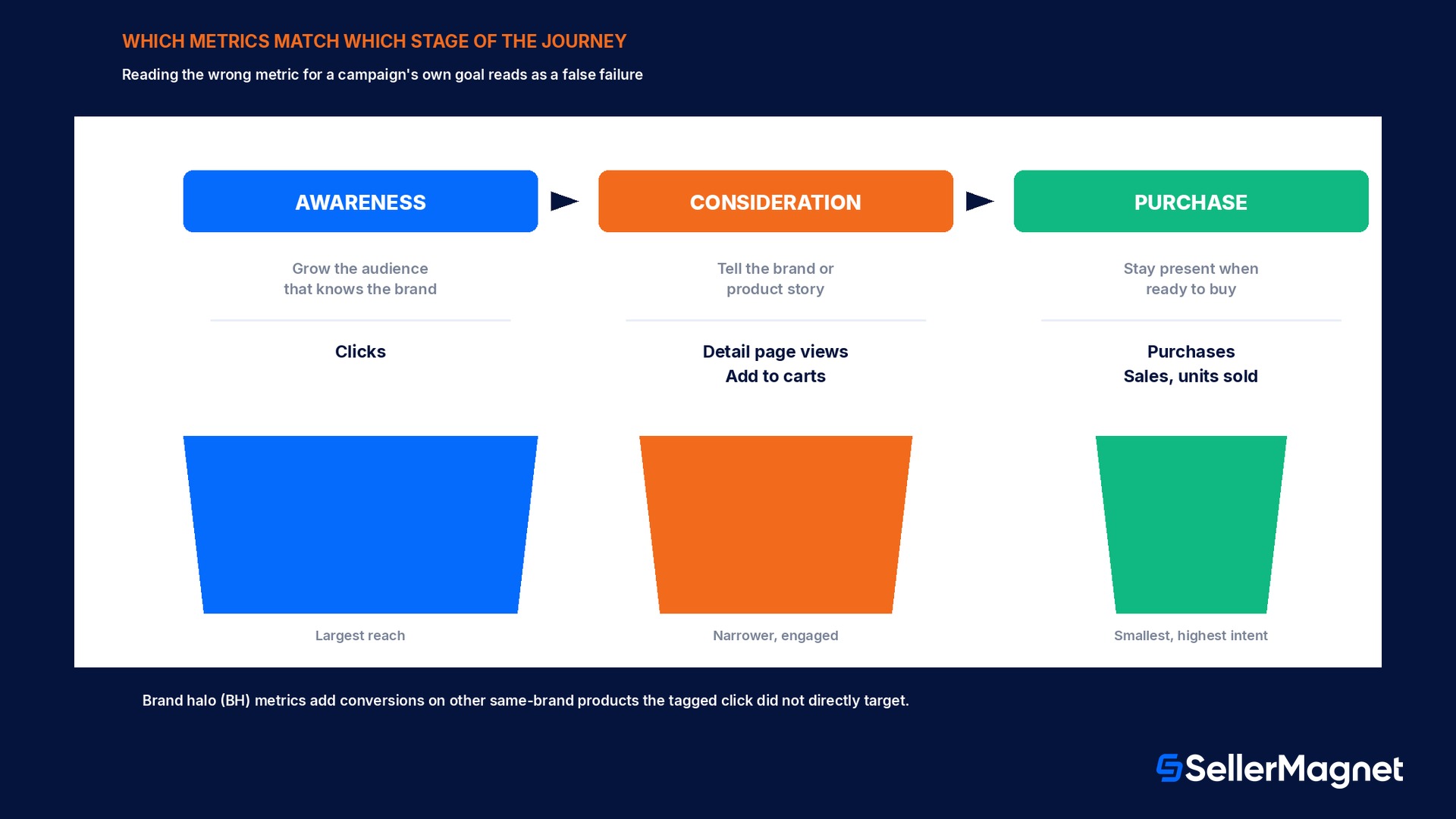
Amazon groups its own metrics into 3 shopping-journey stages so a campaign built for awareness is not judged on a purchase metric it was never meant to move. Awareness-stage campaigns, built to grow the total audience that knows a brand exists, are read on clicks. Consideration-stage campaigns, built to tell the product or brand story once a shopper is already aware, are read on detail page views and add-to-carts. Purchase-stage campaigns, built to stay present at the moment a shopper is ready to buy, are read on purchases, sales, and units sold. Checking a consideration campaign's click count alone, or a purchase campaign's detail-page-view count alone, answers the wrong question for that campaign's actual goal.
Shopper journey stage
Campaign goal
Relevant metrics
Awareness
Grow the total audience aware of the brand
Clicks
Consideration
Tell the brand or product story
Detail page views, add to carts
Purchase
Stay present when the shopper is ready to buy
Purchases, sales, units sold
Worked example: what tagged data does to a real budget reallocation
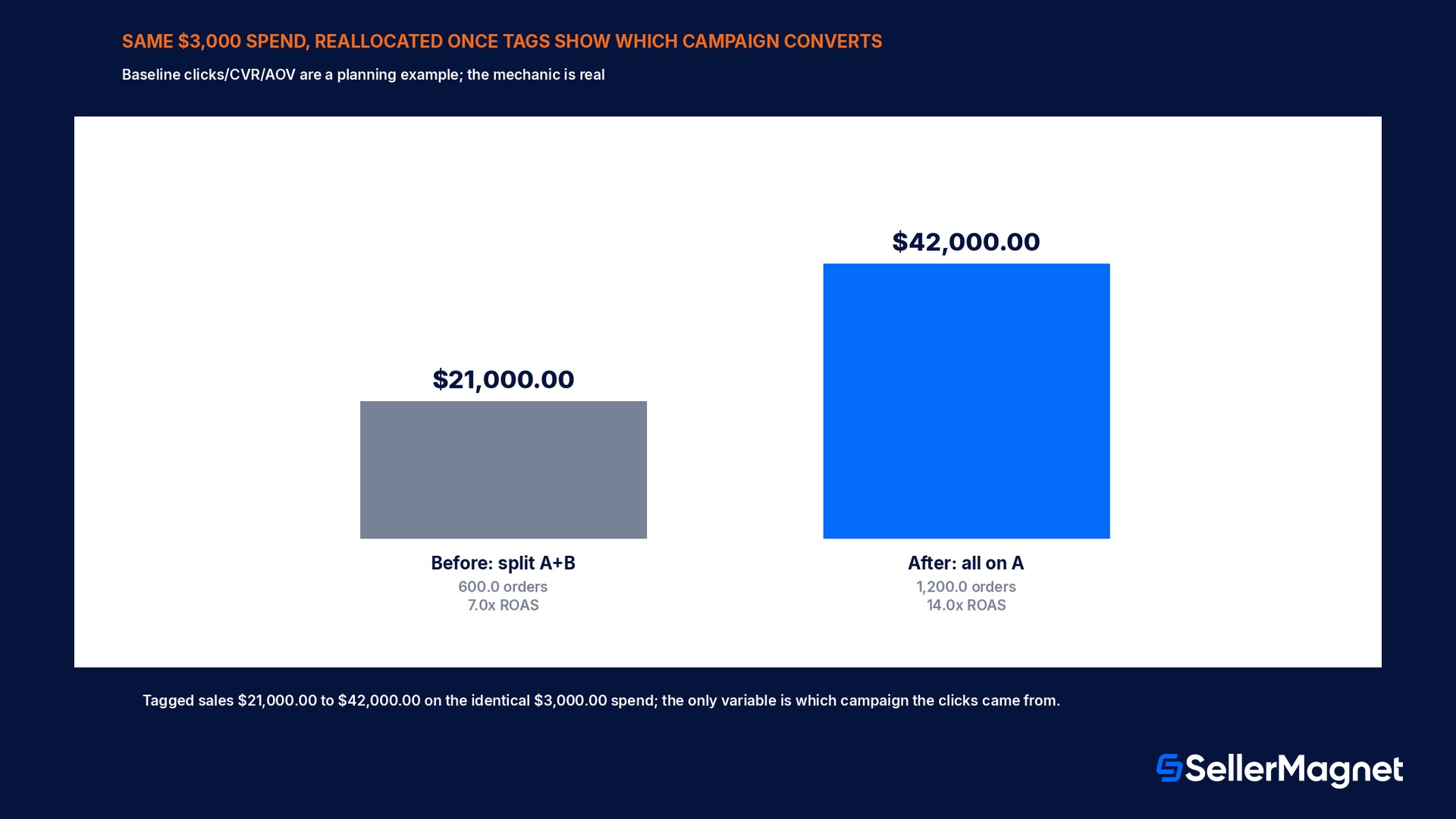
Take a brand running 2 simultaneous off-Amazon campaigns at the same $0.20 cost per click, both linking to the same Amazon product page, for a combined 15,000 monthly clicks and $3,000.00 monthly spend (clearly a seller's own account numbers for this example, not an Amazon-published figure). Without Attribution tags, Seller Central shows total orders and total sessions for the product, with no way to split that total back out by which campaign sent which click. Tag both campaigns separately and the picture splits: Campaign A sends 5,000 clicks at an 8% tagged conversion rate for 400.0 purchases, and Campaign B sends 10,000 clicks at a 2% tagged conversion rate for 200.0 purchases; at a $35.00 average order value that is $14,000.00 in tagged sales from Campaign A and $7,000.00 from Campaign B, a combined $21,000.00 on the $3,000.00 spend, a 7.0x return. Reallocating the full $3,000.00 budget to Campaign A's $0.20 cost per click instead, now that the tagged data shows which campaign actually converts, buys 15,000 clicks at the same 8% rate for 1,200.0 purchases and $42,000.00 in sales, a 14.0x return on the identical spend. Nothing about the total ad budget changed between the two scenarios; the only variable is which campaign the clicks were bought from, a decision the seller could not make with any confidence before the tags existed.
Before: split across both campaigns
After: reallocated to Campaign A
Monthly spend
$3,000.00
$3,000.00
Clicks
5,000 (A) + 10,000 (B) = 15,000
15,000 (all on Campaign A's $0.20 CPC)
Tagged conversion rate
8% (A), 2% (B)
8%
Purchases
400.0 (A) + 200.0 (B) = 600.0
1,200.0
Tagged sales
$14,000.00 (A) + $7,000.00 (B) = $21,000.00
$42,000.00
Return on ad spend
7.0x
14.0x
The click and conversion numbers are planning assumptions
The clicks, conversion rates, and $35.00 average order value above are sample figures for illustration; a real brand substitutes its own tagged campaign numbers from the Attribution reporting dashboard. What is not an assumption is the mechanism: without separate tags, the 2 campaigns' results are invisible to each other inside a single Seller Central order total, so the reallocation decision in this example cannot be made with any evidence at all until the tags exist.
The Brand Referral Bonus program is a separate enrollment, not part of Attribution itself
Amazon Attribution measures; it does not, by itself, pay anything. The Brand Referral Bonus program is the separate enrollment that pays a bonus, averaging 10% of product sales, on sales those Attribution-tagged links actually drive, and a seller has to enroll in that program on top of using Attribution to receive it. The two are designed to work together, the bonus program reads its numbers from the same tagged traffic Attribution measures, but a seller can run Attribution campaigns purely for the reporting insight without ever claiming a bonus, and the exact bonus mechanics, category rates, and enrollment steps are their own topic covered in full in SellerMagnet's dedicated Brand Referral Bonus guide rather than repeated here.
Bulk upload limits, the Attribution API, and best practices before launch
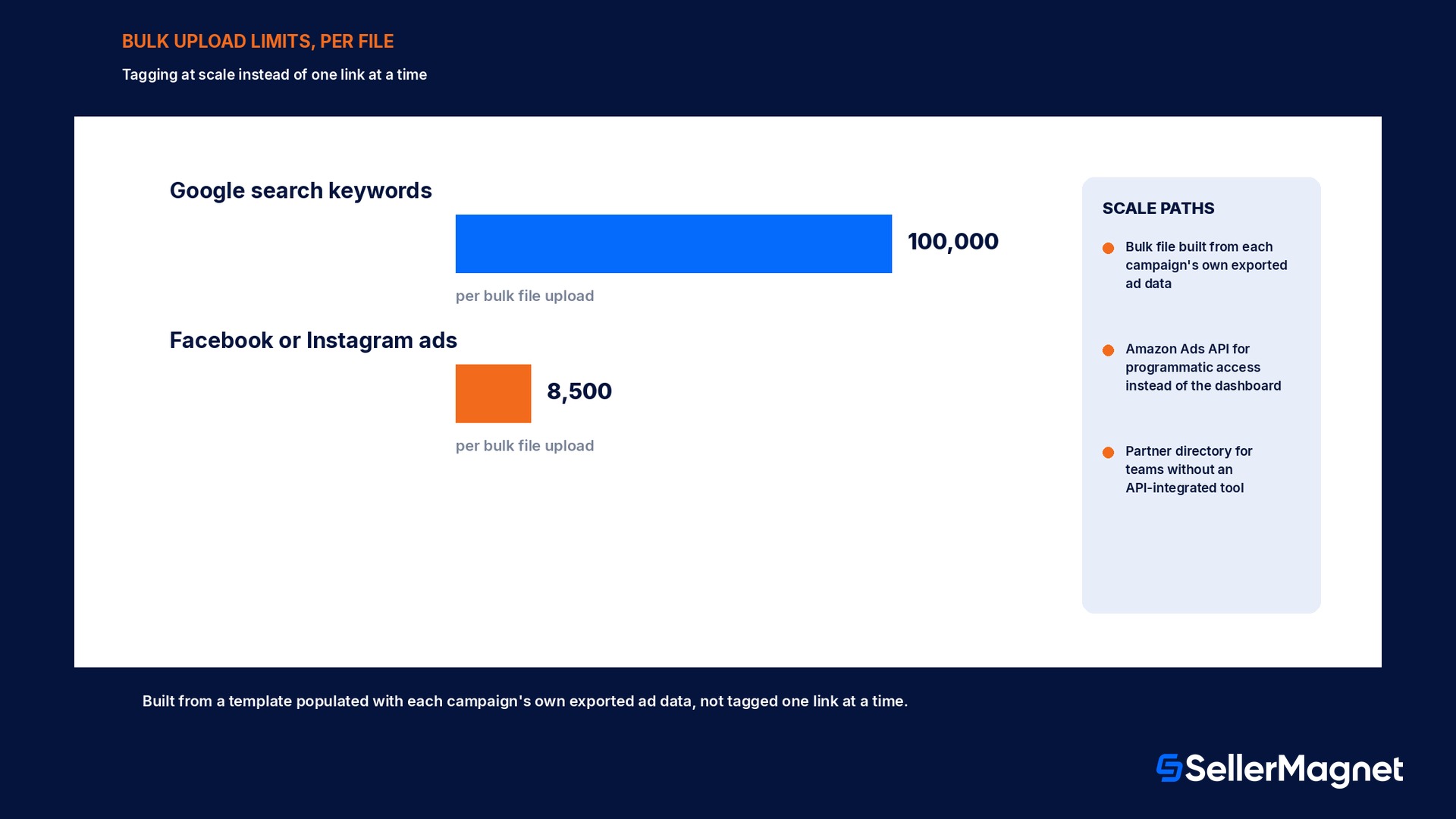
Tagging links one at a time works for a handful of placements, but a seller running search ads at scale has a bulk path instead: the bulk upload option measures up to 100,000 Google search keywords or 8,500 Facebook or Instagram ads in a single file upload, built from a template populated with each campaign's existing ad data exported from its own platform. For advertisers and agencies already using an API-integrated tool, the Amazon Ads API gives programmatic access to the same measurement data instead of working through the reporting dashboard by hand; a partner directory lists tool providers for teams not yet integrated. Amazon's own stated best practices before launch: create one campaign per advertised product or measurement goal rather than one broad campaign for everything, build a separate ad group per strategy (awareness, consideration, purchase) so the funnel-stage metrics line up cleanly, choose the click-through URL based on the goal (a product detail page for a sales goal, a Store for a broader consideration goal), and tag every individual ad, link, and button rather than sharing one tag across several placements.
Bulk upload path
Limit per file
Google search keywords
Up to 100,000 keywords
Facebook or Instagram ads
Up to 8,500 ads
What mistakes make tagged data useless even after it is collected?
Sharing one tag across several ads or placements. A shared tag collapses exactly the comparison Attribution exists to make; Amazon's own best practice is a separate tag per individual ad, link, or button.
Assuming Attribution pays a bonus by itself. Attribution only measures; the Brand Referral Bonus program is a separate enrollment that pays the bonus on the sales Attribution tags measure.
Checking a consideration-stage campaign's purchase numbers, or a purchase-stage campaign's click count. Each funnel stage is read on its own matching metrics; checking the wrong stage's metric reads as a failed campaign that may not actually be failing at its real goal.
Linking every tag to the Store instead of a specific product page, or vice versa, regardless of the campaign's actual goal. The click-through URL should match the goal: a product detail page for a sales-focused campaign, the Store for a broader consideration campaign.
Not checking for tracked traffic 2 days after launch. A mistyped or broken tag can run for weeks showing zero attributed activity before anyone notices, when a 2-day check would have caught it immediately.
Trying to tag every placement by hand at scale instead of using bulk upload. The bulk path measures up to 100,000 Google search keywords or 8,500 Facebook/Instagram ads per file, built for exactly the volume hand-tagging cannot handle.
What can and can't SellerMagnet do with Attribution data?
Amazon Attribution itself, its tag generation, its campaign builder, and its reporting dashboard live entirely inside Amazon's advertising console; no third-party tool, including SellerMagnet, creates or reads Attribution tags on a brand's behalf. Where SellerMagnet's PPC management fits is the decision layer on top of the same campaigns described in the worked example above: once Attribution's tagged data shows which off-Amazon channel or creative actually converts, that is the input for where to shift spend next, the same reallocation decision walked through step by step above.
Profit Analytics then tracks what happens to the resulting orders after the budget shift, margin and repeat-purchase behavior per SKU, rather than stopping at the attributed sales number alone; a campaign that wins on tagged revenue but loses on margin is a different decision than one that wins on both.
Checklist before launching a first Amazon Attribution campaign
How to confirm an Amazon Attribution campaign is set up to produce a real answer, not noise
Confirm the account type qualifies - Professional seller enrolled in Brand Registry with a brand representative role, vendor, agency, or KDP author; an Individual plan or unregistered brand does not see Attribution as an option.
Pick the click-through URL to match the campaign's actual goal - A specific product detail page for a sales goal, a Store page for a broader consideration goal; products are added to the campaign automatically from this URL.
Create one tag per individual ad, link, or button, never one shared tag per channel - A shared tag collapses the exact comparison between creatives or placements that Attribution exists to measure.
Group ad groups by funnel stage (awareness, consideration, purchase) - Each stage is read on different metrics; mixing them inside one ad group makes the reporting ambiguous.
Check for measurable tracked traffic 2 days after launch - Catches a broken or mistyped tag before weeks of real spend run with zero attributed data.
Decide separately whether to also enroll in the Brand Referral Bonus program - Attribution measures either way; the bonus, averaging 10% of tagged sales, requires its own separate enrollment.
Is Amazon Attribution free?
Yes. Amazon Attribution is a free, self-service measurement tool. There is no license fee or subscription cost to use it.
Who is eligible to use Amazon Attribution?
Professional sellers enrolled in Amazon Brand Registry with a brand representative role, vendors, advertising agencies managing campaigns for clients who sell on Amazon, and Kindle Direct Publishing authors who advertise.
Does Amazon Attribution pay a bonus on the sales it measures?
No. Attribution only measures. The Brand Referral Bonus program is a separate enrollment that pays an average 10% bonus on product sales that Attribution-tagged links drive.
What channels can an Amazon Attribution campaign measure?
Any paid or organic non-Amazon channel: search, social, display, video, email, and third-party affiliate marketing.
What is the bulk upload limit for Amazon Attribution tags?
Up to 100,000 Google search keywords or 8,500 Facebook or Instagram ads can be measured in a single bulk file upload.
How long after launch should I check if Amazon Attribution tags are working?
Amazon's own guidance is to confirm tracked traffic is flowing 2 days after launch, then review performance on a weekly basis after that.
What does a brand halo (BH) metric measure?
Conversions on other products from the same brand, not the specific promoted product itself, capturing a campaign's spillover effect on the rest of the catalog.
Stop Juggling Tools. SellerMagnet Combines Everything You Need.