A seller shipping wooden furniture, rubber phone cases, or a cocoa-based snack bar into the EU can get a Seller Central notice asking for something called Due Diligence Information, and the instinct is to treat it like another routine compliance form. It is not routine, and it is not new paperwork invented by Amazon: it is the EU Deforestation Regulation (EUDR), a law that bans placing seven specific commodities, cattle, cocoa, coffee, palm oil, rubber, soy and wood, and products made from them, on the EU market unless the operator can prove with plot-level geolocation data that nothing in the supply chain was grown on land deforested after 31 December 2020. The regulation has already been delayed twice, most recently in December 2025, which is exactly why so many sellers still treat it as a someday problem rather than a dated one: the real enforcement date is now 30 December 2026 for medium and large operators, with 30 June 2027 for micro and small enterprises. This guide works through which products are actually in scope, the three-step due diligence process and the plot geolocation it requires, how Amazon's own Invoice by Amazon program layers its own Due Diligence Information requirement on top of the EU law, a worked example of what happens when only some of a shipment's lots have valid paperwork, and the exemptions and mistakes that most often trip up a seller who thought they were already covered.
The EU Deforestation Regulation (EUDR) is an EU law that bans placing cattle, cocoa, coffee, palm oil, rubber, soy, wood or listed products made from them on the EU market unless the operator proves, with plot-level geolocation data, that the commodity was not grown on land deforested after 31 December 2020 and was produced legally. After a December 2025 amendment, it applies from 30 December 2026 for medium and large operators and traders, and from 30 June 2027 for micro and small enterprises. On Amazon, keeping an affected ASIN enrolled in Invoice by Amazon additionally requires submitting Due Diligence Information for that product.
What the EUDR actually bans, and which products are in scope
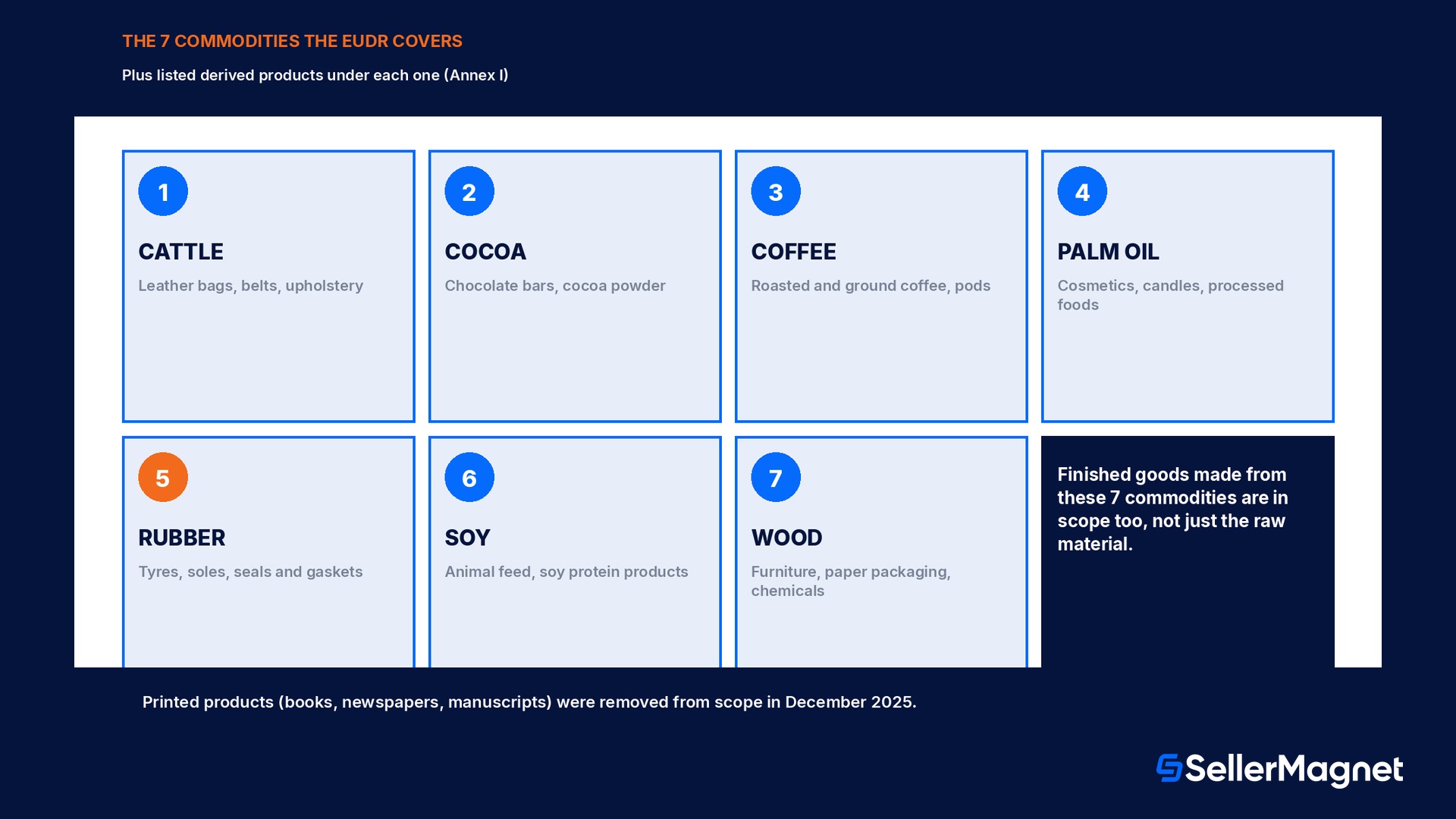
The EU Deforestation Regulation, formally Regulation (EU) 2023/1115, entered into force on 29 June 2023 and targets the seven commodities the European Commission names as most associated with global deforestation: cattle, cocoa, coffee, palm oil, rubber, soy and wood. The ban is not on the raw commodity alone; Annex I of the Regulation lists specific derived products under each one, so the rule reaches well past a farm gate and into finished goods a seller actually lists on Amazon. A rubber tree is in scope, and so is a pair of rubber-soled shoes; a cocoa bean is in scope, and so is a chocolate bar; raw timber is in scope, and so is wooden furniture, paper-based packaging and several wood-derived chemicals. The December 2025 amendment removed one category, printed products such as books, newspapers and manuscripts, from scope, but the rest of Annex I still applies. The practical test for a seller is not 'do I sell a tree or a cow' but 'does my product's bill of materials contain any of these seven commodities, in any derived form, anywhere in Annex I', and that test has to be run per product, not per supplier.
Commodity
Example raw form
Example Amazon-sold products in scope
Cattle
Live cattle, hides
Leather bags, belts, furniture upholstery
Cocoa
Cocoa beans
Chocolate bars, cocoa powder, confectionery
Coffee
Green coffee beans
Roasted and ground coffee, coffee pods
Palm oil
Crude palm oil
Cosmetics, candles, processed foods
Rubber
Natural rubber latex
Tyres, rubber soles, rubber seals and gaskets
Soy
Soybeans
Soy-based animal feed, soy protein products
Wood
Raw timber
Furniture, paper packaging, wood-based chemicals
Printed products were removed from scope in December 2025
Printed books, newspapers, images, manuscripts, typescripts and plans on paper no longer fall under the EUDR after the December 2025 amendment. Every other wood-derived product in Annex I, including paper packaging that is not itself a printed product, is still in scope.
The real deadline: 30 December 2026, after two delays
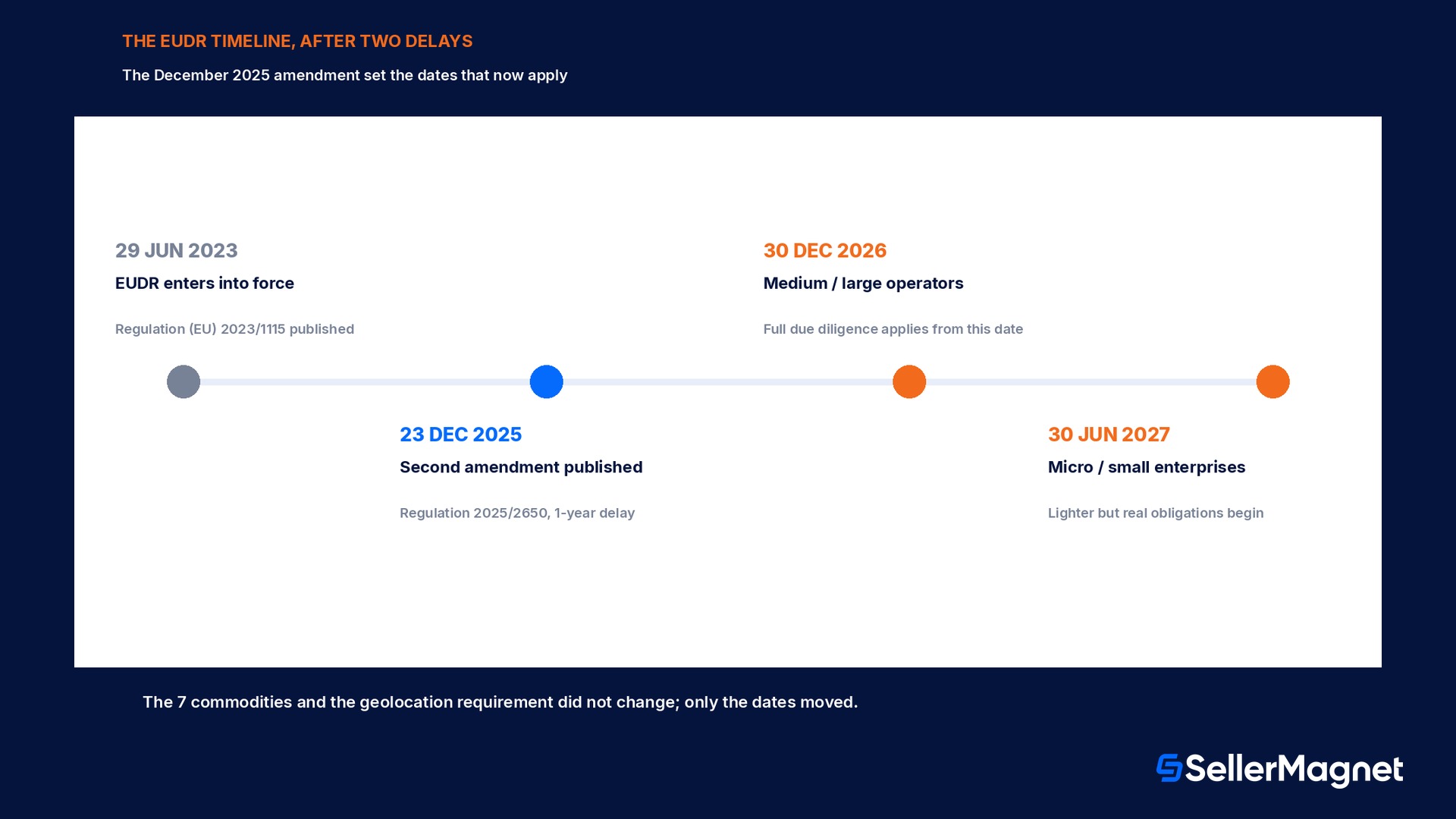
The EUDR has already slipped twice, and that history is exactly why the current date deserves to be taken at face value rather than assumed to move again. The original application date was 30 December 2024. A first delay (Regulation 2024/3234) pushed it to 30 December 2025 for medium and large operators, with 30 June 2026 for micro and small enterprises. A second, more significant amendment, Regulation 2025/2650, was adopted by the European Parliament and the Council on 17 and 18 December 2025 and published in the Official Journal on 23 December 2025, pushing the dates out one more year: 30 December 2026 for medium and large operators and traders, 30 June 2027 for micro and small enterprises. A separate date, 30 December 2027, applies only to newly added commodities or products that a future delegated act brings into Annex I; it does not move the existing deadlines. The European Commission is also required to complete a mandatory simplification review by 30 April 2026, which means some of the operational detail below could still be refined before the December 2026 date arrives, but the dates themselves, and the seven commodities in scope, are not part of that review.
Milestone
Date
EUDR enters into force
29 June 2023
First delay sets medium/large date
30 December 2025 (superseded)
Second amendment adopted
17 to 18 December 2025 (Regulation 2025/2650)
Application date: medium and large operators/traders
30 December 2026
Application date: micro and small enterprises
30 June 2027
Commission simplification review due
30 April 2026
Newly added Annex I products come into scope
30 December 2027
The three-step due diligence process, and the geolocation it requires
An operator placing an in-scope product on the EU market for the first time, or exporting it from the EU, has to run due diligence before that happens, and the Regulation breaks it into three concrete steps rather than a single declaration. Step one is information gathering: the commodity or product, its quantity in net mass (or a supplementary unit such as item count where one applies), the country of production, and, critically, the geolocation of every plot of land where the relevant commodity was produced. For cattle specifically, the geolocation requirement points to every establishment where the animals were kept rather than a plot of land; for every other commodity in Annex I, it is the plot itself. Step two is a risk assessment built on that information, checking the complexity of the supply chain and the risk that the product is mixed with material of unknown origin or from a higher-risk country. Step three is identifying mitigation measures that bring any non-negligible risk down to negligible before the product goes on the market. If even one of the declared plots shows deforestation or forest degradation after 31 December 2020, the Regulation automatically disqualifies every relevant commodity and product tied to that plot, not just the specific shipment where it was first spotted. Operators that source exclusively from countries the EU's benchmarking system classifies as low risk can skip steps two and three entirely under a 'simplified due diligence' path, keeping only documentation to show the low-risk sourcing on request.
Worked example: when only some lots of a shipment have valid paperwork
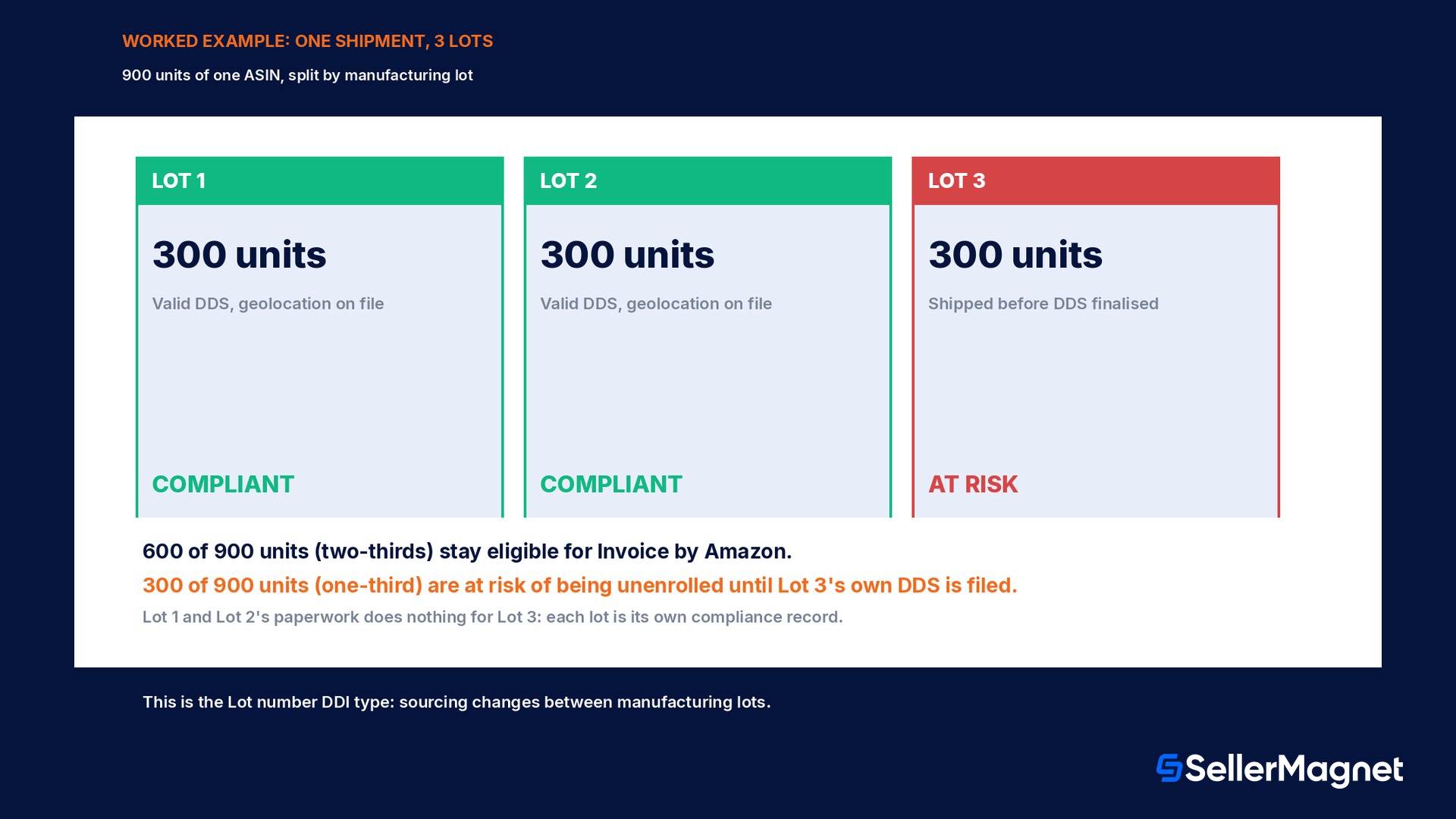
A seller importing wooden furniture into the EU is a useful worked example because wood sourcing commonly changes between manufacturing runs, which is exactly the case the Regulation's due diligence statement (DDS) and Amazon's own Due Diligence Information (DDI) system are built to handle at the lot level rather than the product level. Say the seller ships 900 units of one wooden furniture ASIN to Amazon fulfilment centres in the EU, arriving as 3 separate manufacturing lots of 300 units each, sourced from 3 different timber suppliers across 2 production runs. Lot 1 (300 units) and Lot 2 (300 units) each have a complete due diligence statement on file, with valid DDS reference and verification numbers tied to their specific plot geolocations. Lot 3 (300 units) shipped before its supplier's DDS was finalised. Under a lot-level DDI type, each lot is its own compliance record: 600 of the 900 units, exactly two-thirds, have the paperwork needed to stay eligible, while the remaining 300 units, one-third of the shipment, do not. That is not a rounding problem or a formality: on the EU law side, placing Lot 3's units on the market without a valid due diligence statement is itself a breach for that batch, and on Amazon's side, a lot without matching DDI stays at risk of being unenrolled from Invoice by Amazon even while Lots 1 and 2 remain fully eligible. The fix is not a single blanket submission; it is getting Lot 3's own DDS finalised and its own DDI record submitted, because the other two lots' paperwork does nothing for it.
Amazon's own layer: Due Diligence Information and keeping Invoice by Amazon
National competent authorities enforce the EU regulation itself, not Amazon. Amazon separately runs its own compliance gate on top of it for one specific program, Invoice by Amazon (IBA), where Amazon issues the invoice on the seller's own behalf. To keep an in-scope ASIN enrolled in IBA, Amazon requires the seller to submit a DDI record for it through the Product compliance page in Seller Central, and that record has to include an ASIN, a DDI ID, a DDI type, plus either an exemption reason, a set of DDS reference and verification numbers, or full commodity information. Amazon gives sellers two DDI type choices, and the choice is not cosmetic: it determines how Amazon links the paperwork to physical shipments and what the seller has to do in each advance shipment notification (ASN) afterward.
DDI type
When to use it
ASN action required
Product (Universal)
Sourcing is fixed: every future unit will come exclusively from the plots declared today
None; applies automatically to current inventory and all future shipments
Lot number
Sourcing can change between manufacturing lots (new supplier, new plot, new commodity origin)
Include the lot number and matching product identifier (ASIN, EAN, GTIN or SKU) in every ASN
A product-level exemption still needs its own DDI record
If a specific batch qualifies for an exemption under the EU regulation, the seller still has to submit a DDI record for it in Seller Central, including the basic ASIN and DDI type information and the specific exemption reason. Skipping the DDI submission entirely, on the assumption that an exemption means no paperwork is needed, is treated the same as never submitting at all.
Downstream operators, traders and the simplified regime
Not every business in the chain is a primary operator carrying full due diligence obligations. The December 2025 amendment formally defines a 'downstream operator' as one that places on the market a product manufactured by processing a relevant product that was already placed on the EU market under someone else's due diligence statement or simplified declaration, a chocolate manufacturer buying cocoa that already cleared due diligence, or a furniture maker buying timber already covered by a supplier's simplified declaration, for instance. Downstream operators and traders do not submit their own due diligence statements; instead they have to collect and retain, for five years, their suppliers' contact details, the due diligence statement reference numbers or declaration identifiers tied to the products they received, and the contact details of whoever they supplied those products to next. Downstream operators and traders that are not SMEs additionally have to register that information in the EU's central information system, and if they receive concrete, substantiated evidence that a product does not comply, they have to verify the upstream due diligence before placing it on the market and inform the competent authority. SMEs in that same position only need to inform the authority, without the added verification step. This distinction matters for an Amazon seller who sources finished goods rather than raw commodities: a seller buying already-finished wooden furniture from a manufacturer, rather than buying raw timber and having it manufactured to spec, may be a downstream operator with lighter recordkeeping duties rather than a primary operator required to run the full three-step process from scratch, though that classification depends on the specific supply relationship and is worth confirming rather than assuming.
Mistakes that stall EUDR or DDI compliance
Assuming the December 2025 delay removed the obligation rather than postponed it. The dates moved to 30 December 2026 and 30 June 2027; the seven commodities, the geolocation requirement and the due diligence steps did not change.
Treating one supplier's due diligence statement as covering every future shipment from them. A Product (Universal) DDI type only applies when every future unit will come from the exact plots declared today; a supplier that changes sourcing even once needs a Lot number DDI type instead, or the record stops matching reality.
Submitting a DDI record with no DDS numbers and no exemption reason. Amazon's own requirement is that every in-scope ASIN has one of: DDS reference and verification numbers, an exemption reason, or full commodity information; leaving all three blank is treated as non-submission.
Confusing an exemption with no obligation at all. A batch that genuinely qualifies for an exemption still needs its own DDI record stating the exemption reason; it is not the same as having nothing to submit.
Not re-checking which role applies after a supply chain change. Switching from buying finished goods (likely a downstream operator) to buying raw commodities and having them manufactured (a primary operator) changes which obligations apply, and the change is easy to miss if due diligence status is only checked once.
Geolocating the wrong thing for cattle-derived products. For cattle and products made from cattle that were fed with other relevant products, the Regulation requires the geolocation of every establishment where the animals were kept, not a plot of land; applying the plot-of-land rule used for cocoa, coffee, palm oil, rubber, soy and wood to a cattle product is a factual, not a formatting, error.
What SellerMagnet can and cannot do about this
Submitting a due diligence statement to the EU's TRACES Information System, and submitting the matching Due Diligence Information to Amazon's Product compliance page, both happen directly between the operator, the EU authority, and Amazon; no third-party tool, including SellerMagnet, files that paperwork or has a role in Amazon's or a competent authority's verification of it. Where SellerMagnet's Analytics dashboard helps is in the same per-batch discipline EUDR's lot-level DDI records require: it already tracks cost of goods sold per purchase batch (FIFO) rather than one blended average, so a seller who sources an in-scope commodity in lots can keep a running record of which purchase batch maps to which supplier and shipment, the same granularity a Lot number DDI record needs, instead of reconstructing it from invoices after Amazon asks. The Fee Calculator does not touch deforestation compliance at all; it is listed here only so a seller does not confuse it with a compliance tool, since it covers referral and FBA fees, not product-origin documentation.
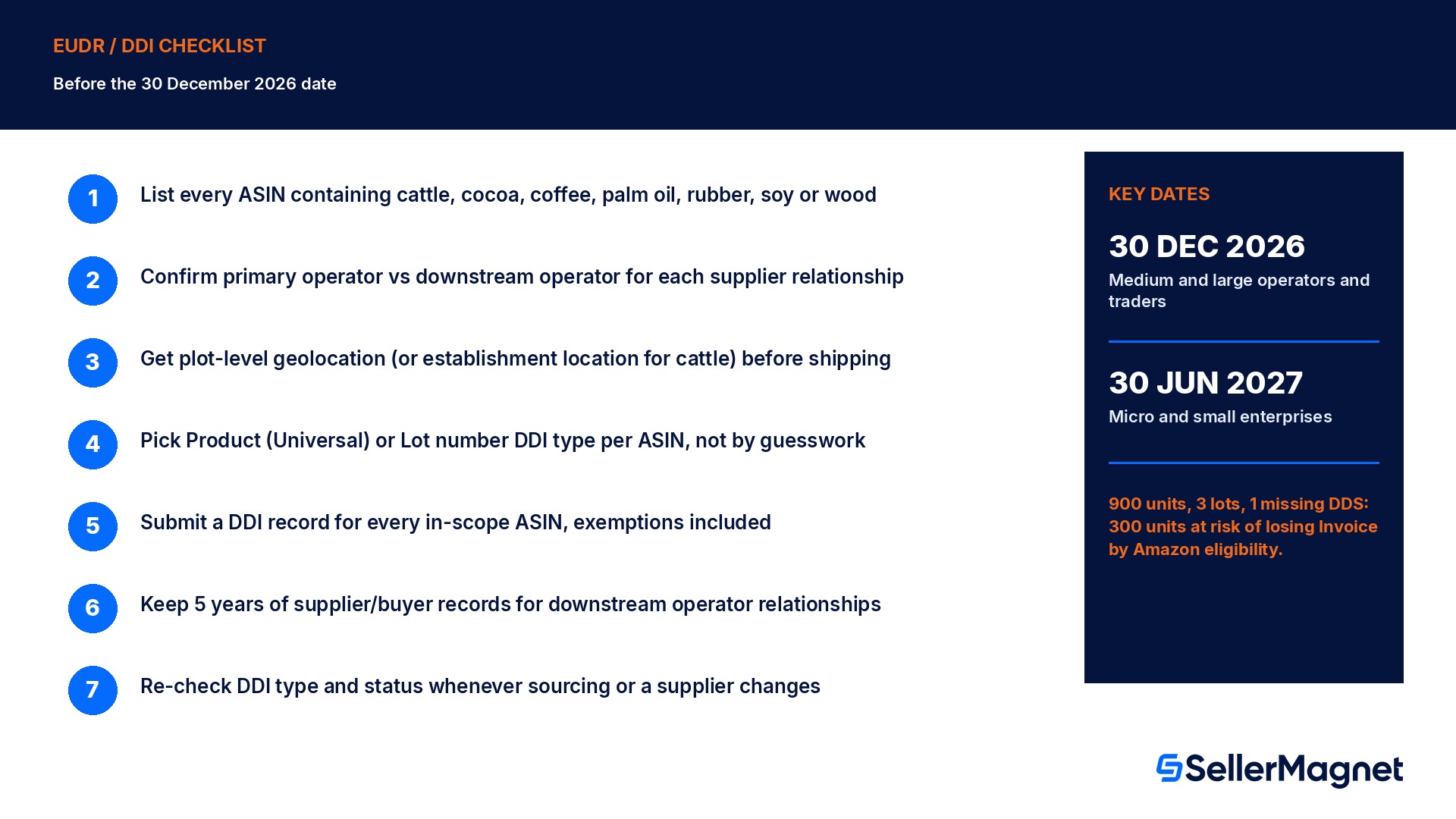
Checklist before the December 2026 date
How to prepare an in-scope Amazon listing for the EUDR
List every ASIN whose bill of materials contains cattle, cocoa, coffee, palm oil, rubber, soy or wood, in any Annex I derived form - Check finished-good ingredients and materials, not just raw commodity listings; leather, rubber soles and wood packaging all count.
Confirm whether the business is a primary operator or a downstream operator for each sourcing relationship - Buying raw commodities to manufacture is primary; buying already-finished goods covered by someone else's due diligence statement may be downstream, with lighter recordkeeping instead of full due diligence.
For primary operator products, get plot-level geolocation from each supplier before the next shipment - For cattle-derived products, get the establishment location instead of a plot; a missing geolocation blocks the whole due diligence statement.
Check whether sourcing is fixed or changes between lots, and pick the matching DDI type in Seller Central - Product (Universal) for permanently fixed sourcing; Lot number for sourcing that changes between manufacturing runs.
Submit a DDI record for every in-scope ASIN, even ones that qualify for an exemption - State the exemption reason explicitly; an ASIN with no DDI record at all is treated as unsubmitted, exemption or not.
For downstream operator relationships, keep 5 years of supplier and buyer contact details and statement reference numbers - Non-SME downstream operators and traders must also register this information in the EU's central information system.
Re-check the DDI type and due diligence status whenever a supplier, plot or sourcing pattern changes - A Product (Universal) record that no longer matches reality after a sourcing change is a compliance gap, not a paperwork delay.
What exactly is the EU Deforestation Regulation (EUDR)?
It is Regulation (EU) 2023/1115, an EU law banning the sale, import or export of cattle, cocoa, coffee, palm oil, rubber, soy, wood and listed derived products on the EU market unless proven deforestation-free, legally produced, and covered by a due diligence statement with plot-level geolocation data.
When does the EUDR actually apply to sellers?
From 30 December 2026 for medium and large operators and traders, and from 30 June 2027 for micro and small enterprises, after a December 2025 amendment delayed the dates by one year from the previous 30 December 2025 / 30 June 2026 schedule.
Does the EUDR only cover raw commodities like timber and cocoa beans?
No. Annex I of the Regulation lists specific derived products under each of the 7 commodities, so finished goods such as wooden furniture, leather bags, rubber-soled shoes and chocolate bars are in scope, not just the raw commodity. Printed products such as books and newspapers were removed from scope in December 2025.
What is Due Diligence Information (DDI), and how is it different from a due diligence statement (DDS)?
A DDS is the formal statement an operator submits to the EU's TRACES Information System under the EUDR itself. DDI is Amazon's own record, submitted separately through Seller Central's Product compliance page, that links an ASIN's DDS reference numbers (or exemption) to Amazon's Invoice by Amazon program.
What happens if a shipment has no valid due diligence paperwork?
Under the EU regulation, a batch with no valid due diligence statement cannot legally be placed on the EU market. On Amazon specifically, an ASIN or lot without matching DDI information is at risk of being unenrolled from Invoice by Amazon, even if other lots of the same ASIN remain compliant.
Does sourcing from a low-risk country remove all due diligence obligations?
No. Operators sourcing exclusively from EU-classified low-risk countries can use a lighter 'simplified due diligence' path and skip the full risk-assessment and mitigation steps, but they still have to keep documentation proving the low-risk sourcing and must still submit the required due diligence or simplified declaration information.
What is a downstream operator, and do they have fewer obligations?
A downstream operator places products on the market that were manufactured from material already covered by someone else's due diligence statement or simplified declaration. They do not submit their own due diligence statement, but must keep 5 years of supplier/buyer contact records and reference numbers, with non-SMEs also registering that information centrally.
Stop Juggling Tools. SellerMagnet Combines Everything You Need.