Amazon Product Launch Plan 2026: Validate Before You Manufacture
R
RenéFreelance Amazon Editor
|
13 min read
On October 7, 2026, Amazon's Seller Forums announced upgrades to Product Opportunity Explorer and a new product launch plan inside Seller Central, aimed at the two moments a new product is most likely to fail: picking the idea, and the first 90 days after it goes live. Amazon frames the stakes with its own number: new product launches accounted for 16% of all third-party US sales last year, so for many sellers the next launch is also the biggest lever they have. Of the 3 pieces Amazon announced, only one is live today: a seller can now bring their own product idea into Product Opportunity Explorer, describe it and a price point, and test it against real customer purchase signals before paying a manufacturer. The other 2, Amazon surfacing product ideas directly and a personalized first-90-days launch plan, are described as coming in the next few months and coming soon, with no fixed date given for either. This guide works through exactly what each of the 3 pieces does, what is live versus still pending, the 2 performance numbers Amazon published and what they do and do not prove, a worked example of what the published sales multiplier does to a real launch forecast, and how the plan's own incentives connect to the separate FBA New Selection program.
Amazon's new product launch plan is a 3-part set of Seller Central tools announced October 7, 2026: validating a seller's own product idea in Product Opportunity Explorer before manufacturing (live now), Amazon surfacing product ideas directly based on search demand (coming in the next few months), and a personalized first-90-days launch plan with recommendations for listing quality, fulfillment, and advertising (coming soon). Amazon states sellers who validate before launch see 2 times higher first-90-day sales, and that new launches drove 16% of third-party US sales last year.
What Amazon actually announced: 3 pieces, 2 timelines
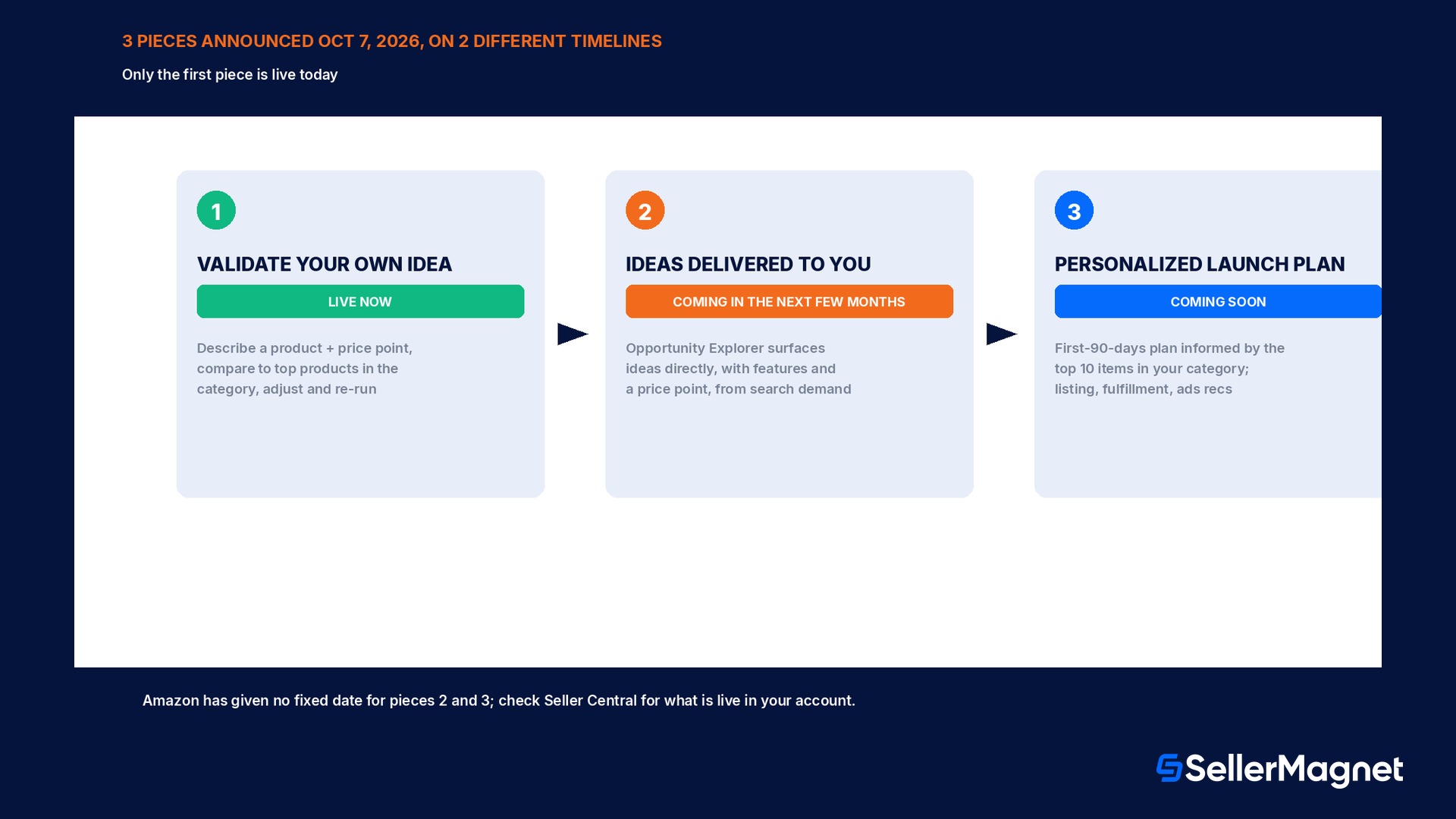
Amazon's own Seller Forums announcement, posted October 7, 2026 by its News_Amazon account, describes new enhancements to Product Opportunity Explorer and a new product launch plan in Seller Central, pitched as helping a seller find the next product, validate demand before spending a dollar, and launch with a proven plan. Only the first of the 3 pieces is described as available today. Validating a seller's own idea is live now inside Product Opportunity Explorer: describe the product and the price point under consideration, see how it compares to top products already selling in that category, then adjust features or characteristics and re-run the analysis until landing on a version worth building, all before any manufacturing spend. Amazon surfacing ideas directly is described as coming in the next few months: Opportunity Explorer will start pushing product ideas to a seller unprompted, mapped out with the features customers want and a recommended price point, based on what shoppers are already searching for. The personalized launch plan is described as coming soon, with no fixed date: a first-90-days plan in Seller Central informed by what is working for the top 10 items in a seller's own category.
Piece
Status (as announced Oct 7, 2026)
What it does
Validate your own idea
Live now
Test a product idea and price point against real purchase signals before manufacturing
Ideas delivered to you
Coming in the next few months
Opportunity Explorer surfaces ideas directly, with features and a price point, from real search demand
Personalized launch plan
Coming soon
First-90-days plan informed by the top 10 items in your category, with recommendations after the product is buyable
How does the idea-validation step work today?
The live piece sits inside Product Opportunity Explorer, which a seller already reaches from Seller Central's Growth menu. Rather than only browsing the niches Amazon has already identified from existing search-and-purchase behavior, a seller can now bring an idea that does not exist as a listing yet: describe the product, pick a price point under consideration, and the tool compares that hypothetical against the top products already selling in the matching category, using the same real customer purchase signals Opportunity Explorer's niche view is built on. The workflow is iterative by design: adjust a feature, a characteristic, or the price point, re-run the comparison, and repeat until the result looks like something worth building. Nothing about this step commits a seller to anything; it is a free comparison against real catalog data run entirely before the first sample is ordered or the first unit is tooled, which is the exact moment Amazon's own framing says a launch mistake is cheapest to catch.
This step is distinct from Opportunity Explorer's existing niche view
SellerMagnet's separate Product Opportunity Explorer guide covers how Amazon defines a niche and its unmet-demand opportunities from existing search behavior; this new piece instead tests an idea a seller brings in that is not reflected in any niche yet, against the same underlying purchase-signal data.
What the 2 pending pieces will add once they ship
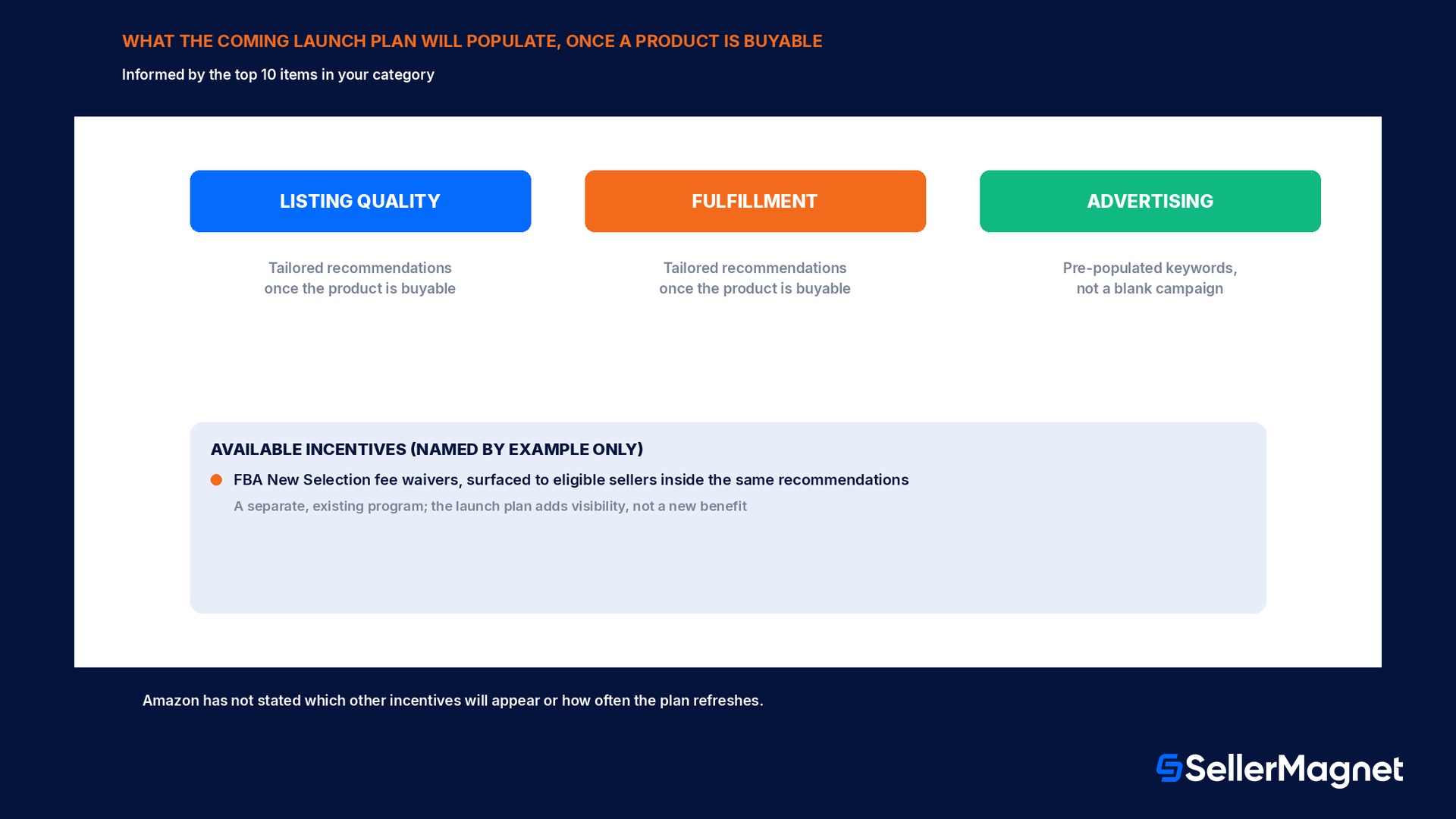
Ideas delivered to you reverses the direction of the live step: instead of a seller typing in an idea to test, Opportunity Explorer will push ideas directly, each one already mapped out with the specific features customers want and a recommended price point, built from what shoppers are already searching for right now. Amazon has not given a release date beyond coming in the next few months. The personalized launch plan goes further than product selection into the first 90 days after a product is buyable: Amazon describes it as informed by what is working for the top 10 items in a seller's own category, and once the new product is live it will populate tailored recommendations across 3 areas, listing quality, fulfillment, and advertising, with keywords pre-populated rather than built from scratch, plus visibility into available incentives such as FBA New Selection fee waivers. Amazon's announcement names that incentive only as an example; it has not stated which other incentives will surface, how the plan ranks a recommendation as key, or how often the plan refreshes.
Launch-plan recommendation area
What Amazon says it populates
Listing quality
Tailored recommendations once the product is buyable
Fulfillment
Tailored recommendations once the product is buyable
Advertising
Pre-populated keywords rather than a blank campaign
Incentives
Available offers named by example only; FBA New Selection fee waivers given as the one named instance
What do the 2 numbers Amazon published actually prove?
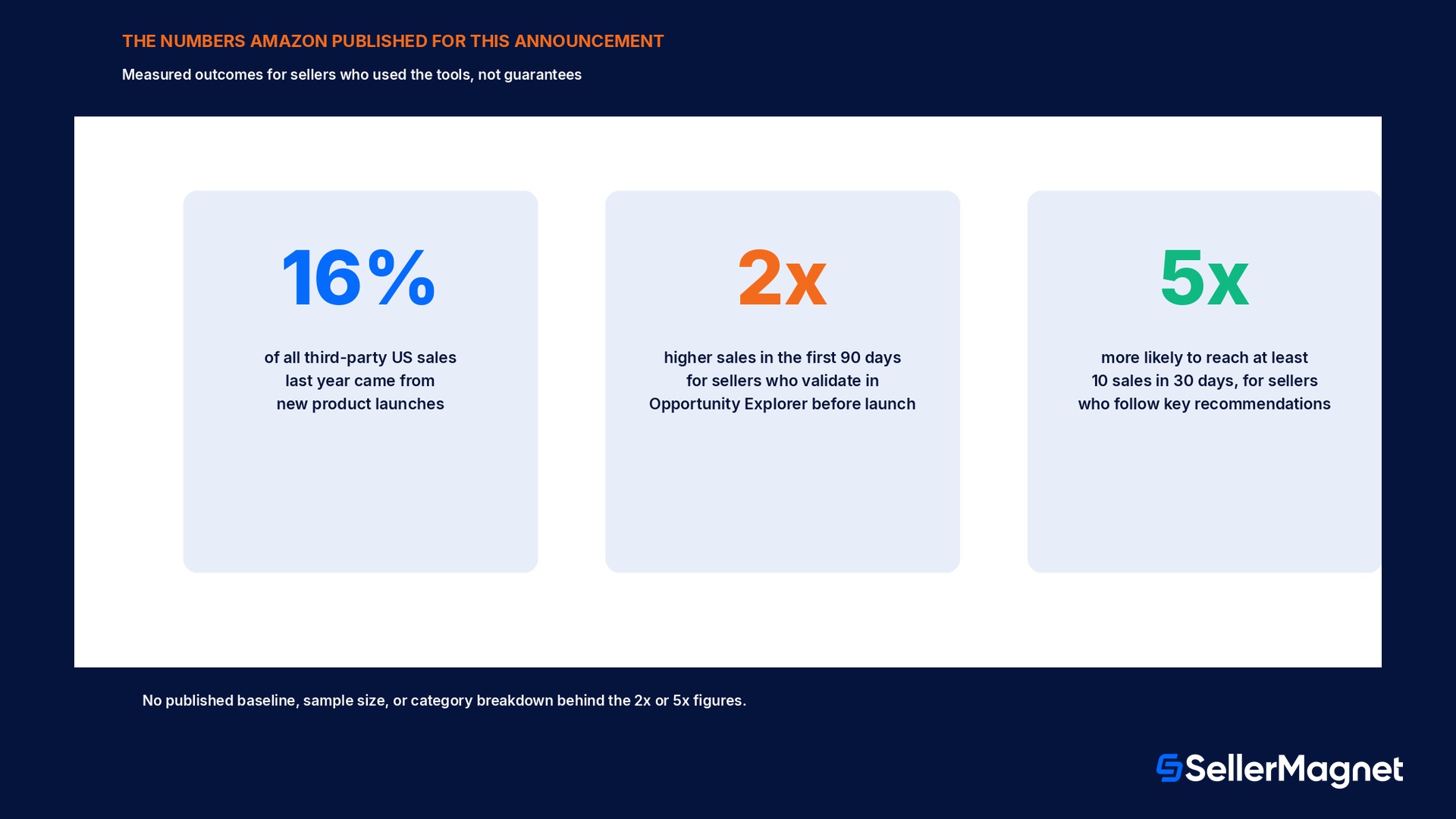
Amazon's announcement backs the pitch with 2 specific performance claims, and reading them precisely matters more than repeating the headline figure. The first: sellers who use Opportunity Explorer before launch see 2 times higher sales in their first 90 days. The second: sellers who follow the launch plan's key recommendations are 5 times more likely to achieve at least 10 sales in their first 30 days. Both numbers compare sellers who chose to use the tools against sellers who did not, a correlation rather than a controlled experiment; Amazon has not published the underlying sample size, the categories measured, or the baseline sales figure the 2 times multiplier is relative to. Sellers who research before launching also tend to be more experienced and better funded on average, so part of the measured gap may come from that difference rather than from the tool itself, and neither claim is a statement about profit: a launch that doubles first-90-day sales while spending heavily on the ads the plan also recommends can still end up less profitable than a slower one. None of that makes the published numbers meaningless, since they are Amazon's own measured outcomes rather than a marketing estimate; it means they describe what happened for sellers who used the tools, not a guarantee of what will happen for any specific seller who starts using them today.
Worked example: what the published 2x multiplier does to a launch forecast
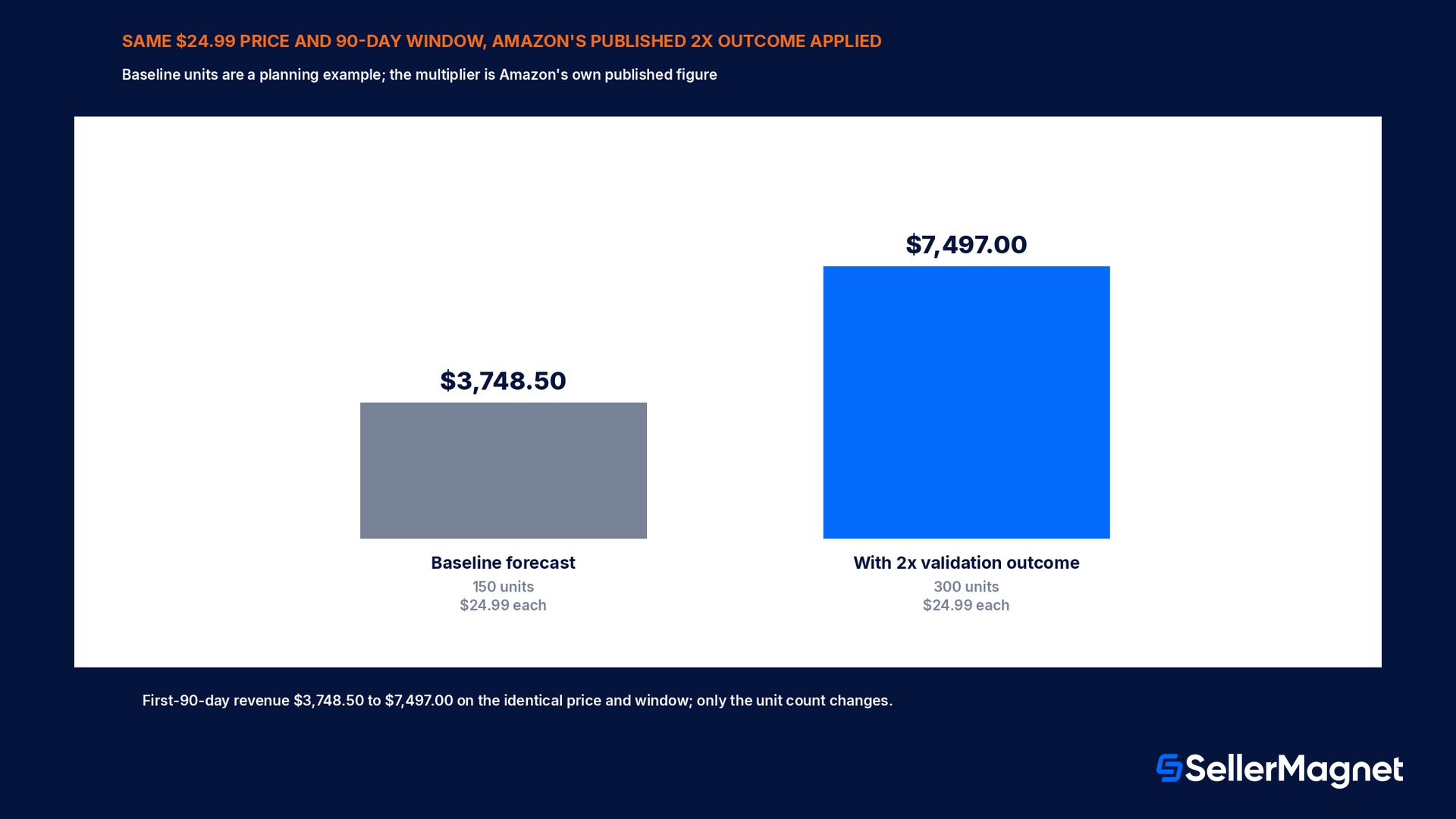
Take a seller planning a single new SKU at a $24.99 retail price, who forecasts 150 units sold across the first 90 days without using the validation step (a seller's own planning assumption for this example, not an Amazon-published baseline; Amazon has not published a baseline sales figure for any category). At that baseline, 150 units at $24.99 is $3,748.50 in first-90-day revenue. Applying Amazon's own published multiplier for sellers who validate an idea in Opportunity Explorer before launch, 2 times higher sales in the first 90 days, to that same 150-unit baseline produces 300 units and $7,497.00 in revenue on the identical price point and identical 90-day window; nothing about the per-unit price or the time frame changed, only the number of units sold under Amazon's stated outcome for sellers who validate before launching. The separate 5-times claim, that sellers who follow the launch plan's key recommendations are 5 times more likely to reach at least 10 sales in 30 days, is a probability about hitting an early sales threshold rather than a revenue multiplier, and is kept separate here rather than stacked on top of the 2x figure, since Amazon published the two as distinct claims about different outcomes, not as a combined effect.
Baseline forecast (seller's own planning assumption)
With Amazon's published 2x validation outcome
Retail price
$24.99
$24.99
Units sold, first 90 days
150
300
First-90-day revenue
$3,748.50
$7,497.00
The 150-unit baseline is an illustration, not Amazon data
The 150-unit, 90-day baseline above is a planning assumption chosen to show the mechanics of Amazon's own published 2x figure; a real seller substitutes their own forecast for the SKU. What is not an assumption is the multiplier itself: Amazon states it as the measured outcome for sellers who used Opportunity Explorer's validation step before launching, compared against sellers who did not.
How do the launch plan's incentives connect to FBA New Selection?
FBA New Selection fee waivers, the one incentive Amazon names as an example of what the coming launch plan will surface, are not a new benefit created by the launch plan; the FBA New Selection program is its own existing, separately enrolled program that already offers a discounted 10% referral fee on a new parent ASIN's first 100 units sold and 5% on the next 100, free monthly storage on the first 200 units for 120 days, waived return-processing costs on up to 200 units, and Vine and coupon credits, gated behind a Professional selling plan and a minimum 300 Inventory Performance Index score. What the launch plan adds is visibility rather than a new program: surfacing an incentive a seller already qualifies for inside the same first-90-days recommendations, instead of a seller having to discover and enroll in it separately. The program's full eligibility rules, fee tiers, and enrollment steps are covered in full in SellerMagnet's dedicated FBA New Selection program guide rather than repeated here.
What mistakes turn these tools into noise instead of a better launch?
Treating the 2x and 5x figures as a guarantee for any specific launch. Both numbers compare sellers who chose to use the tools against sellers who did not; Amazon has not published the baseline, sample, or categories behind either figure.
Confusing the 2x sales claim with a profit claim. Higher first-90-day sales while spending heavily on the advertising the plan also recommends is not automatically a more profitable launch.
Waiting for the personalized launch plan before validating an idea. The idea-validation step inside Product Opportunity Explorer is live today; the launch plan itself is still described only as coming soon, with no fixed date.
Assuming FBA New Selection fee waivers are automatic once the launch plan ships. The program still requires its own separate enrollment, a Professional selling plan, and a 300+ Inventory Performance Index score.
Validating a product idea once and never re-running it. The tool is built to be iterative: adjust a feature or the price point and re-run the comparison rather than treating the first result as final.
Skipping the comparison against top products in the category. The validation step's value is the side-by-side against what is already selling, not the seller's own idea viewed in isolation.
Where SellerMagnet fits once a launch idea is validated
Amazon's validation step, idea delivery, and launch plan all live inside Seller Central; no third-party tool, including SellerMagnet, creates or reads those recommendations directly. Where SellerMagnet's Listing Optimizer fits is the listing-quality side of the same first-90-days window the coming launch plan is built around: turning a validated idea into a listing that matches what already converts in that category, the same comparison the validation step itself is based on.
PPC Manager then handles the advertising keywords a launch plan will pre-populate, building and adjusting the actual campaigns rather than stopping at the suggested keyword list, and Profit Analytics tracks what the resulting sales do to real margin once the new SKU is live, since Amazon's own 2x and 5x figures describe sales and sales-threshold outcomes, not profit.
Checklist before planning a launch around Amazon's new tools
How to use the new launch tools without over-reading the published numbers
Run the live validation step before ordering samples or tooling - Describe the idea and price point in Product Opportunity Explorer, compare it against top products in the category, and iterate before any manufacturing spend.
Do not plan a launch date around the 2 pending pieces - Amazon has given no fixed date for idea delivery (next few months) or the personalized launch plan (soon); check Seller Central directly for what is live in your account.
Read the 2x and 5x figures as comparisons, not guarantees - Both compare sellers who used the tools against sellers who did not, with no published baseline, sample, or category breakdown.
Separately confirm FBA New Selection eligibility - A 300+ Inventory Performance Index score and a Professional selling plan are required regardless of whether the launch plan surfaces the fee waiver.
Track margin alongside the sales multiplier - Higher first-90-day sales from validating an idea or following launch-plan advertising recommendations is not the same measurement as profit.
Re-run the validation step after any real change to the idea - A new price point, feature, or characteristic changes the comparison; the tool is built for iteration, not a single pass.
Is Amazon's new product launch plan live yet?
Not yet. Of the 3 pieces Amazon announced October 7, 2026, only the idea-validation step inside Product Opportunity Explorer is live; the personalized first-90-days launch plan is described only as coming soon, with no fixed date.
What can I do today in Product Opportunity Explorer that I could not before?
Bring your own product idea and price point that does not exist as a listing yet, compare it against top products already selling in the category, and adjust and re-run the comparison before spending on manufacturing.
Does using Opportunity Explorer before launch guarantee 2 times higher sales?
No. Amazon states sellers who used it before launch saw 2 times higher sales in their first 90 days, comparing sellers who used the tool against sellers who did not; it is a measured outcome, not a guarantee for any individual launch.
What share of Amazon's third-party sales come from new product launches?
Amazon states new product launches accounted for 16% of all third-party US sales last year.
Are FBA New Selection fee waivers a new benefit from the launch plan?
No. FBA New Selection is its own existing, separately enrolled program; the coming launch plan is described as surfacing that incentive to eligible sellers, not creating a new one.
What will the personalized launch plan recommend once it ships?
Amazon describes recommendations across 3 areas once a new product is buyable: listing quality, fulfillment, and advertising with pre-populated keywords, plus visibility into available incentives such as FBA New Selection fee waivers.
What does the 5 times more likely claim actually measure?
Amazon states sellers who follow the launch plan's key recommendations are 5 times more likely to achieve at least 10 sales in their first 30 days, a probability of reaching that early threshold, not a sales or revenue multiplier.
Stop Juggling Tools. SellerMagnet Combines Everything You Need.