Product Opportunity Explorer is usually described as Amazon showing you the gaps. Read the definition Amazon publishes and the claim is narrower: unmet demand opportunities are "collections of similar search terms that have lower conversion rates than the benchmark". That is a measurement, not a verdict. A search term converting below its benchmark can mean nothing good exists, or that the search means several different things, or that shoppers expect a different price. The tool reports the number. Deciding which of those it is remains your job.
Product Opportunity Explorer is Amazon's product research tool inside Seller Central, found under Growth. It groups search terms into niches based on what customers view or buy after searching, then reports metrics such as search volume, yearly growth, number of products and average rating. Its unmet demand opportunities are groups of similar search terms whose conversion rates are lower than the benchmark. That is a measurement rather than a confirmed gap in the market, and only some of its explanations are opportunities.
What is a niche, in Amazon's own definition?
A cluster assembled from behaviour, not a category drawn in advance. Amazon's Product Opportunity Explorer page says it plainly: "We create niches by grouping search terms based on the products customers view or purchase after searching." Its seller blog states the same idea as a definition, calling a niche "a collection of search terms and products that represent a specific customer need". The order matters. The products came first, the clicks came second, and the niche is the shape those clicks left behind.
A niche describes what shoppers found, not what they wanted
If a niche is grouped by the products customers viewed or purchased after searching, then it is constructed entirely from the selection that already existed. A need that no current product serves well will still be grouped against whatever shoppers clicked instead, because there was nothing else to click. That is not a flaw in the tool, it is what behavioural clustering is, but it does mean a niche is evidence about the catalogue as much as about the customer.
What does unmet demand actually mean here?
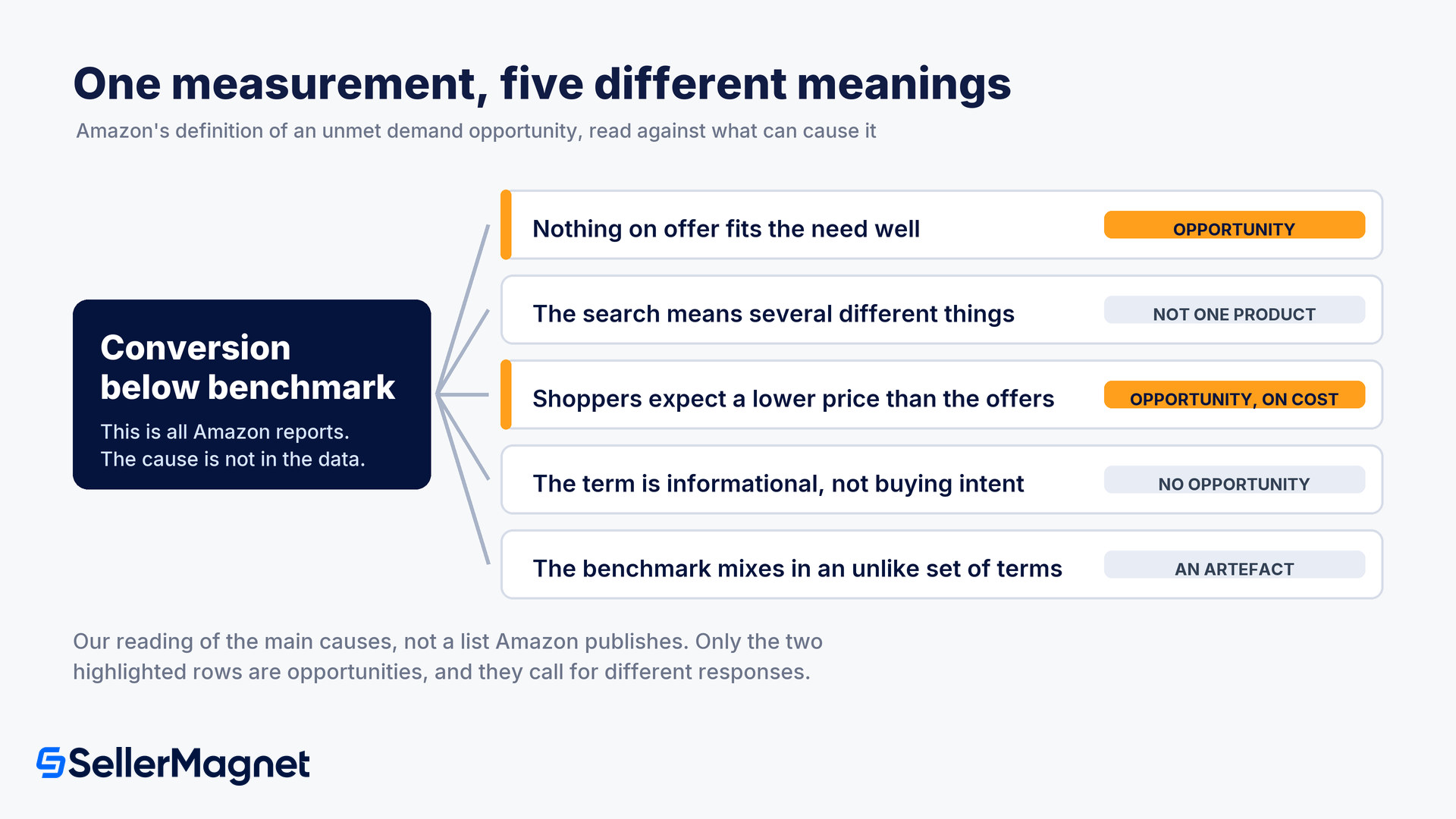
A conversion rate below a benchmark, and nothing more than that. The published definition is that the tool surfaces "unmet demand opportunities, which are collections of similar search terms that have lower conversion rates than the benchmark". It is worth sitting with how much that leaves open. A conversion rate is presumably the share of searches that end in a purchase, though Amazon defines neither it nor the benchmark on these pages; a benchmark is some comparison set Amazon has chosen. A group of terms can fall below that line for reasons that point in completely different directions, and the table below is our reading of the main ones rather than a list Amazon publishes.
Why conversion might be below benchmark
What it would mean for you
How to tell
Nothing on offer fits the need well
A genuine product opportunity
Read the reviews on the top-clicked products for a repeated complaint
The search means several different things
No single product can convert it
Check whether the clicked products belong to unrelated categories
Shoppers expect a lower price than the offers
An opportunity, but on cost not features
Compare the price of clicked products with what sells in adjacent niches
The term is informational, not buying intent
No opportunity at all
Look for how-to or comparison language in the terms themselves
The benchmark mixes in an unlike set of terms
An artefact, not a signal
Check whether the niche's terms are genuinely similar to each other
Only the first and third rows are opportunities, and they call for different responses. The fourth is a trap that looks identical in the data: a term people search to learn something will convert badly forever, and no amount of better product will fix it. This is why the label is the beginning of the work rather than the end of it. Amazon is telling you where conversion is low, which is a fact about the past, and the inference from there to a product worth launching is entirely yours. Telling buying language from browsing language is a skill of its own, and our guide to keyword research covers how to read the difference.
Amazon says so itself, in the disclaimer
The same page that advertises the tool sets the limit on it: Product Opportunity Explorer "is intended to provide you with general information" and "should not be a substitute for your own judgment about demand". That sentence is doing real work. It is the difference between a tool that finds opportunities and a tool that reports measurements which may indicate opportunities, and Amazon has chosen the second description.
What changed with the AI additions?
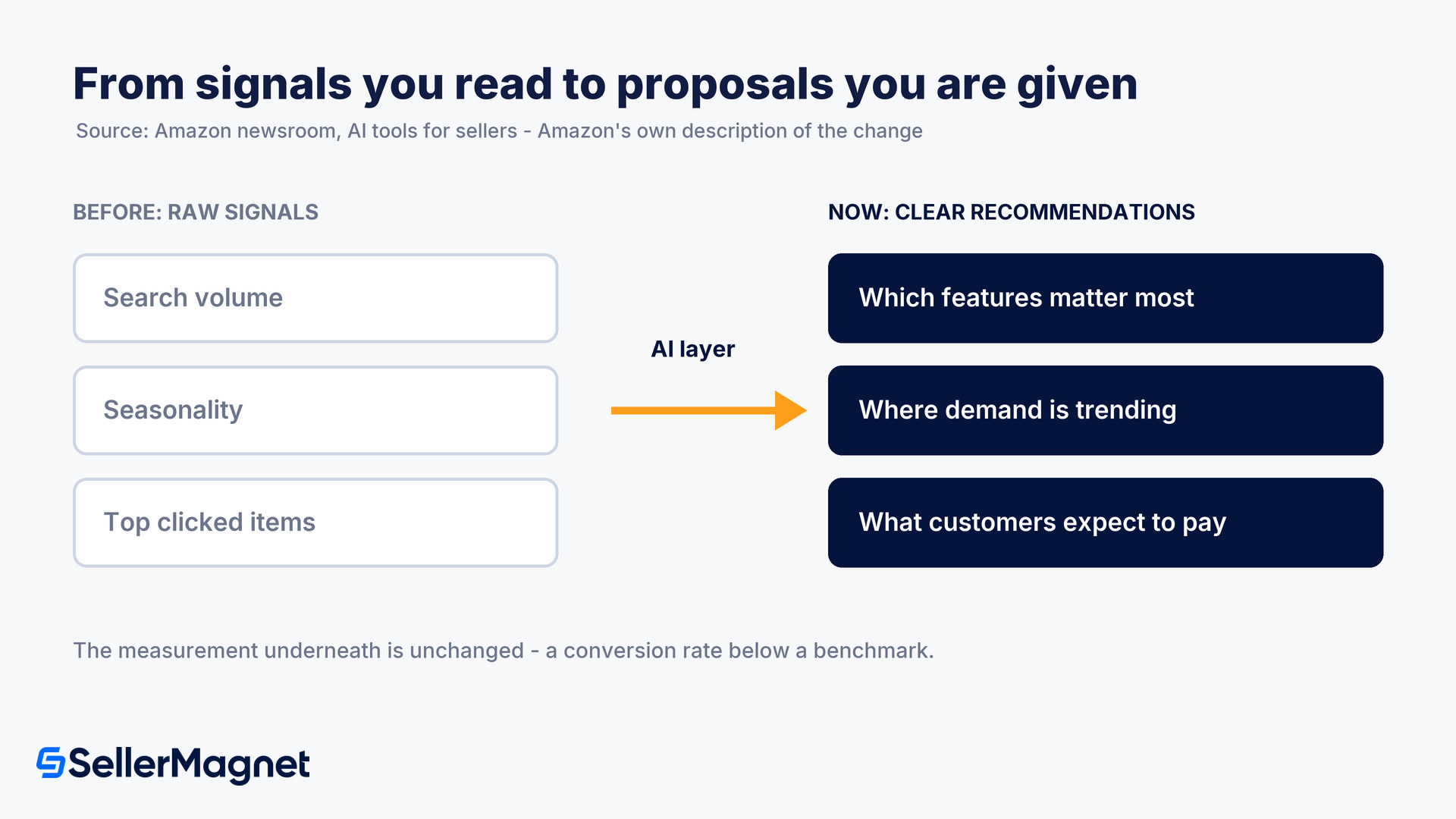
The output moved from signals to proposals, which is a change of kind rather than degree. Amazon's newsroom piece on AI tools for sellers describes the previous version as surfacing "raw signals like search volume, seasonality, and 'top clicked' items", and the current one as analysing "billions of customer interactions - searches, clicks, and purchases" and translating them "into clear recommendations" covering "which features matter most, where demand is trending, and what customers expect to pay". The scale figure is Amazon's own and is not broken down anywhere we could find.
Unmet Demand Insights "identifies potential gaps in selection where customers are searching but not finding the products they want", and goes further than the old label by generating "AI-powered product proposals and demand forecasts".
Niche Product Overview "highlights opportunities in smaller, high-potential categories bolstered by metrics like search volume, must-have features, and pricing benchmarks".
The named metrics for a niche on Amazon's seller blog are search volume, yearly growth, out-of-stock rate, the percentage of Prime offers, the percentage of Sponsored Products ads, the number of reviews, the number of products and the average rating.
Most of those are named without a definition on that page, so treat the exact basis of each as unverified until you can see it in the interface.
No launch date, rollout schedule or eligibility rule appears on that newsroom page, so whether a given account has these capabilities yet is something to check in Seller Central rather than assume.
A proposal is more useful than a signal and easier to be wrong about. "Customers are searching but not finding the products they want" is a strong interpretive claim, and it reads like the same underlying measurement as the conversion definition, now stated as a conclusion rather than an observation. Amazon does not say what either capability is computed from. The upgrade does not add information about why conversion is low; it adds a confident reading of it. The useful discipline is to treat a generated proposal the way you would treat a colleague's suggestion with no working shown, and go back to the reviews and the clicked products to check it.
How current is any of this?
Weekly for the numbers, monthly for the groupings. Amazon's seller blog states the cadence exactly: "Niche metrics are refreshed at the beginning of each week, and new niches are created at the start of each month." Those are two different clocks and the second one is the constraining one. A genuinely new pattern of search behaviour cannot appear as a niche until the start of a month, which means the fastest-moving opportunities are structurally the last to show up in the tool, and will arrive with the metrics of their first partial month attached.
That schedule also sets a ceiling on how much edge the tool can give you. The tool sits in Seller Central under Growth, and Amazon lists the Professional selling plan at "$39.99/month + selling fees" on the same page. Whoever has it is looking at niches refreshed on the same schedule as everyone else. The data is not scarce, so the advantage cannot come from having it. It comes from reading a below-benchmark conversion rate correctly while someone else reads it as an instruction. Starting the search somewhere the list does not reach is one answer, and our guide to finding profitable B2B products works through one such segment.
The 2.5x figure is a marketing claim, not a measurement you can check
Amazon states that "New products launched using insights from Product Opportunity Explorer have 2.5x higher sales potential in their first three months". No methodology, sample or period is published alongside it on that page, and the comparison group is not described. There is also an obvious selection effect: sellers who research before launching differ from sellers who do not, in ways that would raise first-quarter sales regardless of which tool they used. Treat it as a reason to look, not as an expected return.
How to read a niche without being led by it
Check the search terms are genuinely alike - A niche is a grouping, and the grouping is what the benchmark compares against. Scan the terms in it and ask whether a single product could plausibly satisfy all of them. If they split into two or three intents, the low conversion rate may be describing the grouping rather than the market.
Separate buying intent from information seeking - Terms that read like questions, comparisons or how-to phrases convert badly because they are not purchases yet. They will sit in the same below-benchmark bucket as a real gap and look exactly like one. Strip them out before you judge the rest.
Read the reviews on the products people clicked - Because the niche was built from the products customers viewed or bought, the clicked set is the current answer to the search. A repeated complaint across those reviews is the most direct evidence that the need is real and unserved, and it is the one input the conversion rate cannot give you.
Check the price gap before the feature gap - A low conversion rate can simply mean the offers cost more than shoppers expected. That is still an opportunity, but it is a cost-structure opportunity rather than a product-design one, and the two need entirely different plans. Compare the clicked products' prices against what converts in adjacent niches.
Date your snapshot - Metrics refresh weekly and new niches are created monthly, so a reading has an age. Write down when you looked, and when you revisit, check whether the niche itself has been redefined rather than assuming the same numbers describe the same thing.
The question that turns a niche into a decision
For the top-clicked products in a niche, what is the single most repeated complaint in their reviews, and could you fix it at a price shoppers in that niche already pay? If you can answer both halves, you have a product thesis that the conversion rate supports rather than one it merely permits. If you can answer neither, a low conversion rate on its own is not a reason to launch.
Research tools tell you where to look, and the launch decision is settled later, in the numbers a product actually produces. The gap between a promising niche and a profitable SKU is fees, returns and advertising cost per unit, and that gap only becomes visible once the first units ship. Keeping cost of goods, fees and margin against each ASIN from the first order is what lets you tell a good niche read from a lucky one. SellerMagnet's profit analytics track that per product from the start.
What does Amazon mean by unmet demand?
Amazon defines unmet demand opportunities as collections of similar search terms with conversion rates below the benchmark. It is a measurement of conversion, not a confirmation that no suitable product exists.
What is a niche in Product Opportunity Explorer?
Amazon groups search terms into niches based on the products customers view or purchase after searching them, and describes a niche as a collection of search terms and products representing a specific customer need.
How often does the data update?
Niche metrics refresh at the beginning of each week, and new niches are created at the start of each month.
Where do I find Product Opportunity Explorer?
In Seller Central, open the main menu, select Growth and then Product Opportunity Explorer. Amazon lists the Professional selling plan at $39.99 per month plus selling fees.
What metrics does it report for a niche?
Amazon names search volume, yearly growth, out-of-stock rate, the share of Prime offers, the share of Sponsored Products ads, the number of reviews, the number of products and the average rating, mostly without publishing formal definitions on those pages.
Can I rely on it to pick a product?
Amazon says the tool provides general information and should not be a substitute for your own judgement about demand, so treat its output as evidence to interpret rather than a recommendation to follow.
Stop Juggling Tools. SellerMagnet Combines Everything You Need.