Amazon Listing Protection 2026: Eligibility and Rollout
R
RenéFreelance Amazon Editor
|
17 min read
Amazon announced Listing Protection at Accelerate 2026, its annual seller conference held in Seattle in September 2026, as a change to how the company enforces listing policy violations. For as long as most sellers have sold on Amazon, a flagged listing has gone dark first and the appeal has come second, which means a seller discovers a policy problem only after the listing, and the sales and search rank attached to it, is already gone. Listing Protection reverses that order for a specific group of sellers: in most cases, a flagged listing now stays live while the seller fixes the issue or disputes it, with a clear description of what triggered the flag and a defined path to challenge a mistake. Claire O'Donnell, Amazon's vice president of Selling Partner Trust and Store Integrity, described the goal on stage as giving sellers a decision window rather than an automatic takedown: your business keeps running while we review. This guide works through exactly what Listing Protection changes, who is eligible for it today, how it is tied to the existing Account Health Assurance program, what it does not cover, and the rollout dates Amazon has committed to in the US, the EU and the UK.
Amazon Listing Protection, announced at Accelerate 2026, is an enforcement change that keeps a flagged listing live in most cases while the seller fixes or disputes the violation, instead of removing the listing first. It reaches sellers through the existing Account Health Assurance program (Account Health Rating of 250 or higher for 6 months, plus a verified emergency contact), reaching all eligible US sellers by the end of 2026 and expanding worldwide in 2027.
What Amazon actually changed with Listing Protection
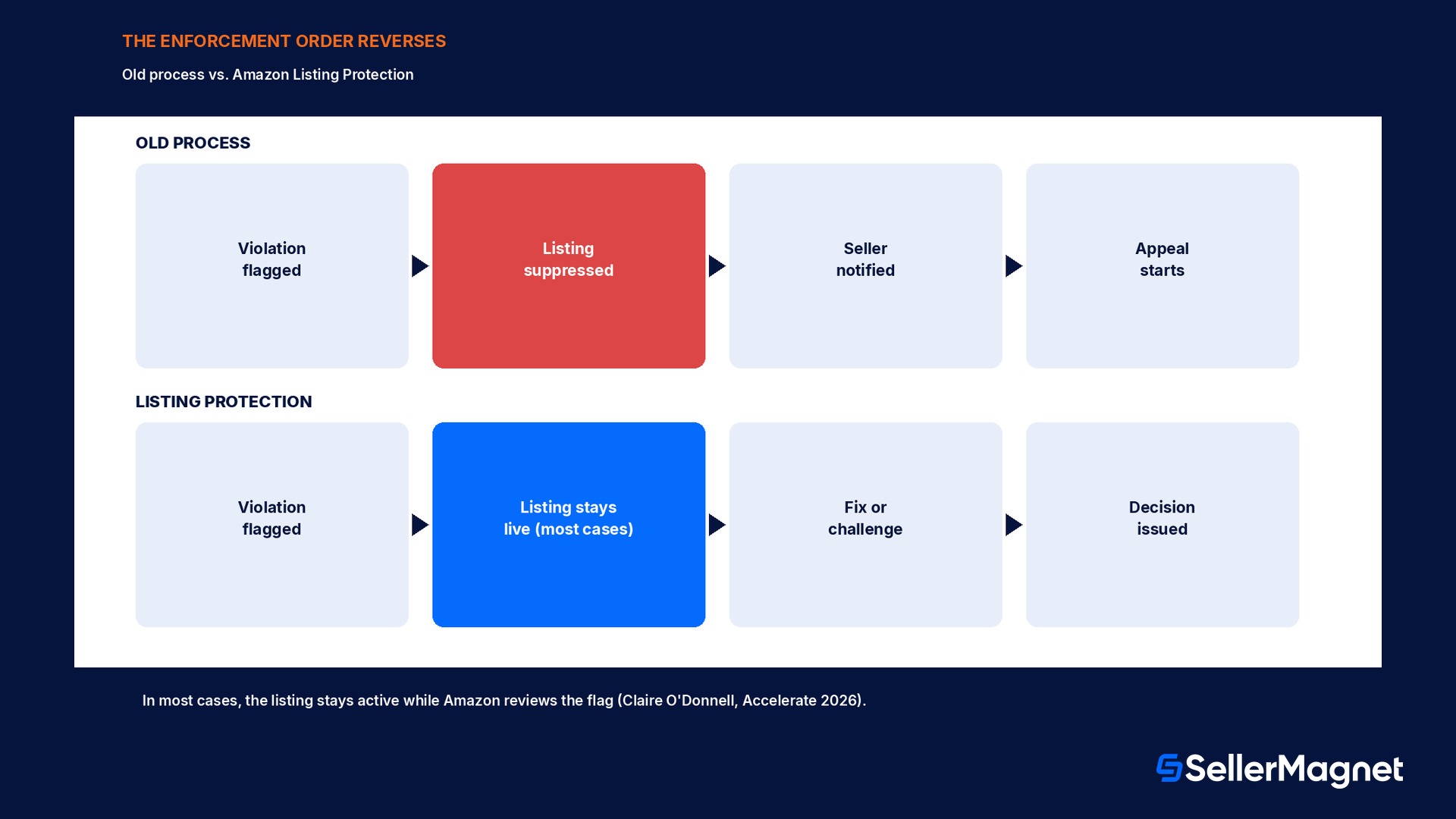
Before Listing Protection, Amazon's enforcement order for a listing-level policy violation was takedown first, appeal second: a system or a human reviewer flags a violation, the listing is suppressed or removed, and the seller only then gets the chance to fix the underlying issue and request reinstatement, a process that can take anywhere from a day to considerably longer depending on the violation and the category. During that entire window the listing earns no sales and loses whatever organic search rank it had built, and that rank does not fully come back the moment the listing is reinstated. Listing Protection, announced on stage at Accelerate 2026 by Claire O'Donnell, Amazon's vice president of Selling Partner Trust and Store Integrity, reverses the two steps for sellers who qualify: when a violation is flagged, in most cases the listing stays active while Amazon reviews it, the seller receives the specific reason for the flag rather than a generic notice, and the seller gets a defined path to fix the issue or formally challenge it. O'Donnell's own framing of the change on stage was direct: in most cases, your listing stays active until we issue a decision, and your business keeps running while we review. The word choice matters here: Amazon's own public language is in most cases, not always, which leaves room for violation types Amazon has not published a full exception list for, and this guide treats that distinction as a real limit rather than small print to skip past.
Who actually gets Listing Protection, and how?
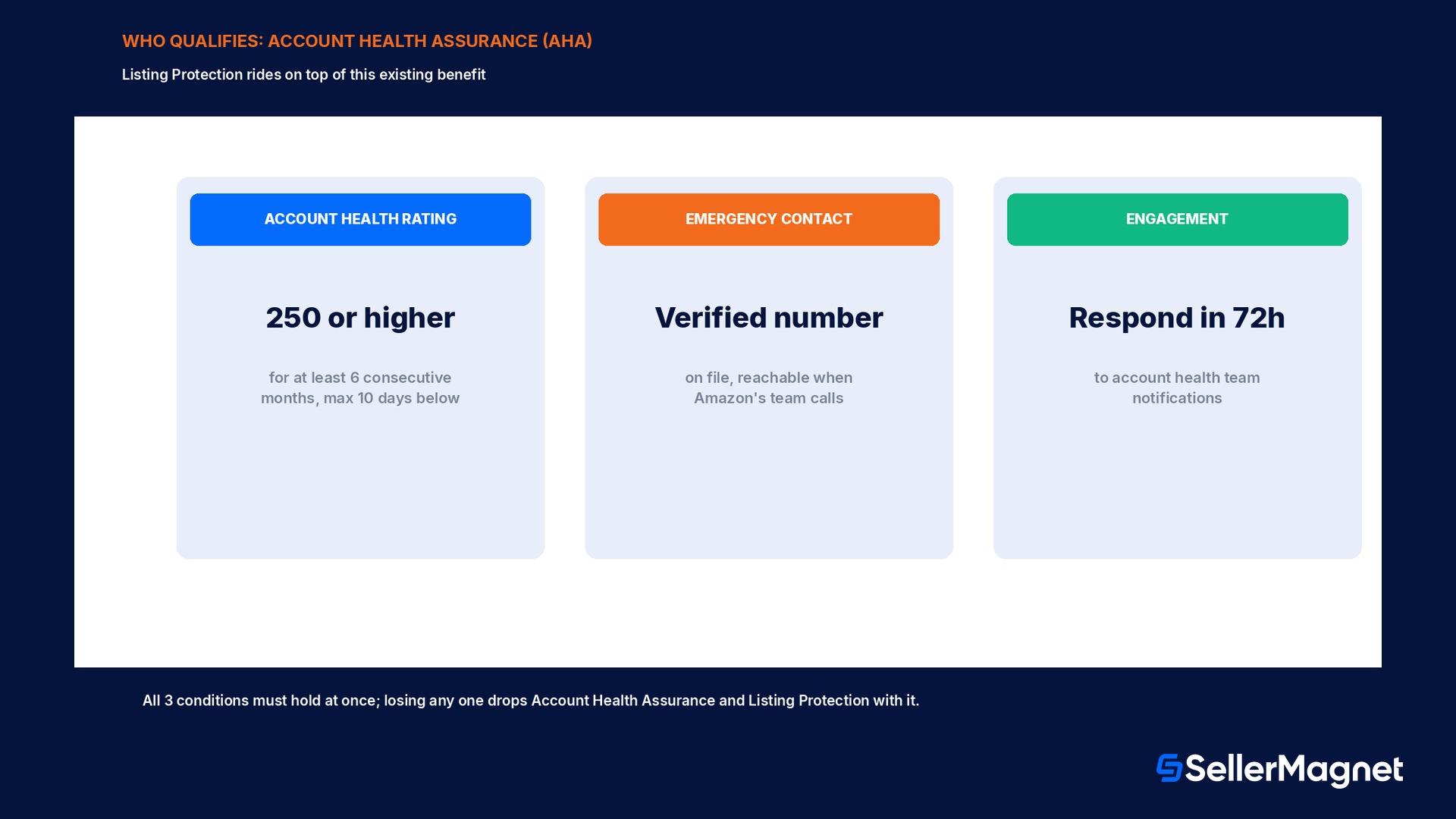
Listing Protection is not something a seller separately applies for or toggles on. It is delivered as an extension of Account Health Assurance (AHA), a benefit Amazon already runs for professional sellers who consistently maintain a high Account Health Rating. Amazon's own Account Health Assurance FAQ, published on Seller Central, sets out the exact bar: AHA is available to professional sellers who maintain an Account Health Rating (AHR) of 250 or higher for at least 6 months, with no more than 10 cumulative days below 250 during that window, and who have a valid emergency contact number on file. A seller who meets the AHR requirement but has not set an emergency contact gets an email from Amazon saying they qualify and asking them to add one before enrollment completes; the contact number has to stay current, since it is also the number Amazon's Account Health team calls when a serious issue needs a response. Staying eligible for AHA, and therefore for Listing Protection, carries the same three ongoing requirements: keep the AHR from falling below 250 for more than 10 consecutive days, keep the emergency contact verified, and engage with Amazon's account health team within 72 hours of being notified that an issue needs the seller's input. A seller's current enrollment status shows on the Account Health page in Seller Central, under Performance, where an Account Health Assurance panel in the corner of the page states directly whether the account is enrolled or at risk of losing eligibility.
AHA requirement
Exact bar
Account Health Rating (AHR)
250 or higher for at least 6 consecutive months, with no more than 10 cumulative days below 250 in that window
Emergency contact
A valid, verified emergency contact number on file in Seller Central, reachable when Amazon's account health team calls
Ongoing engagement
Respond to an account health team notification within 72 hours whenever Amazon flags an issue that needs the seller's input
Where it shows
Performance -> Account Health -> the Account Health Assurance panel states enrolled, eligible-pending-contact, or at risk
A seller account below AHR 250 is not left with nothing
Listing Protection and AHA are extra benefits layered on top of the standard Amazon enforcement and appeal process, not a replacement for it. A seller below the AHR 250 threshold keeps the same right to appeal a takedown that has always existed; what they do not get yet is the reversed order where the listing stays live during that appeal.
When does Listing Protection actually roll out?
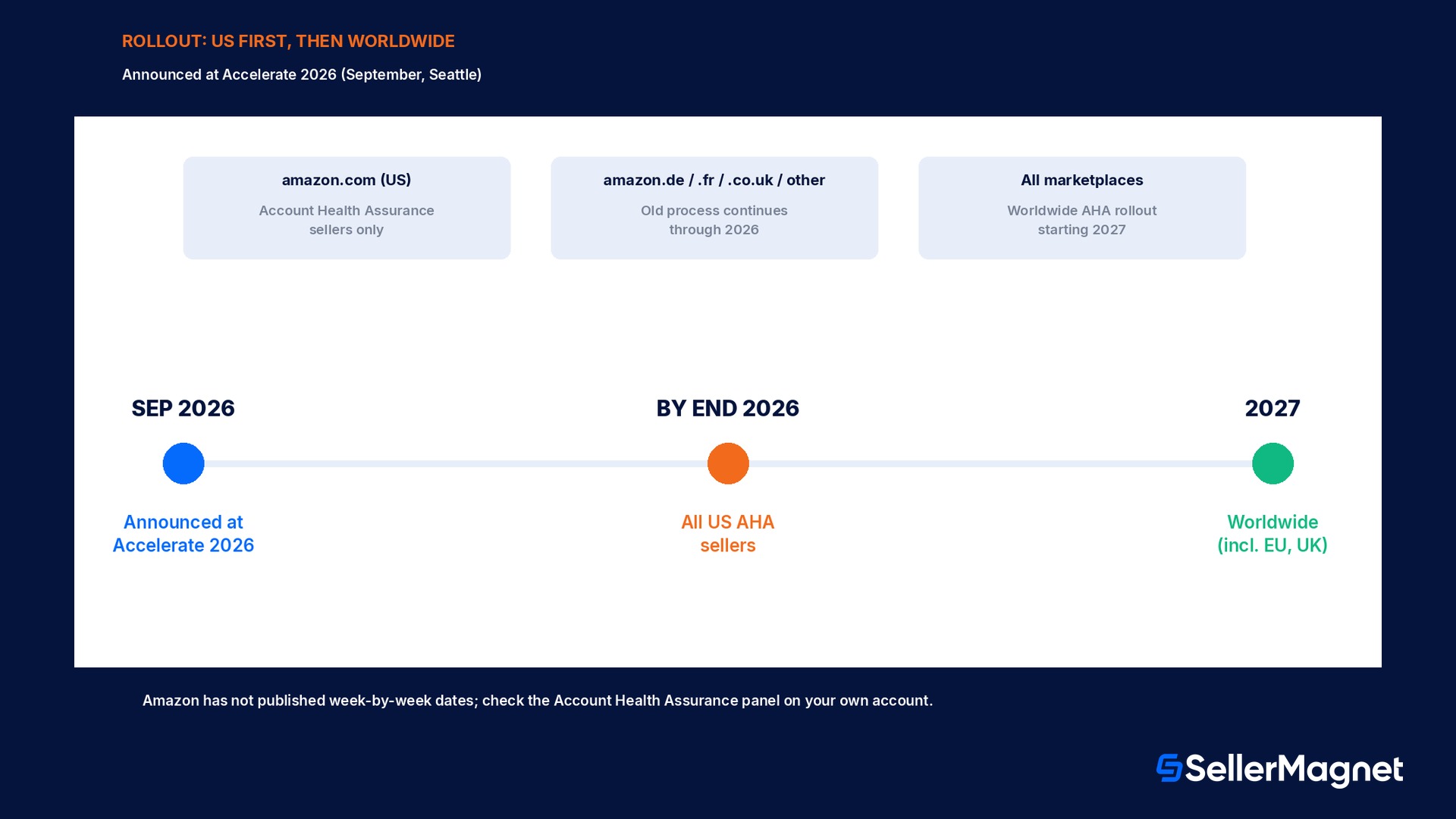
Amazon's Accelerate 2026 recap, published on its own sellingpartners.aboutamazon.com site, gives two concrete rollout commitments rather than a single blanket date. Listing Protection will reach all Account Health Assurance sellers in the US by the end of 2026, and it will reach AHA sellers worldwide in 2027. That means a seller selling only on amazon.com who already qualifies for AHA should expect to see the feature arrive on their account sometime before the close of 2026, while a seller selling on amazon.de, amazon.co.uk, amazon.fr or any other non-US marketplace should plan on the existing takedown-first process continuing through 2026 and watch for a 2027 rollout date instead. Amazon has not published a week-by-week schedule for either wave, which is consistent with how Amazon has rolled out other Account Health Assurance features in the past: gradually, account by account, rather than as a single simultaneous switch-on. The practical consequence for any seller reading this before the feature has reached their own account is to treat the Account Health Assurance panel on the Account Health page as the actual source of truth for whether Listing Protection is live on that specific account, rather than assuming based on the calendar date alone.
Market
Listing Protection rollout
Prerequisite
United States
All Account Health Assurance sellers by the end of 2026
AHA enrollment (AHR 250+ for 6 months, verified emergency contact)
EU, UK and other non-US marketplaces
2027 (exact dates not yet published)
Same AHA enrollment, expected to be required in those markets too
Sellers not enrolled in AHA
Existing takedown-first, appeal-second process continues
n/a; appeal rights are unchanged
What actually happens when a listing is flagged?
For an AHA-enrolled seller once Listing Protection has reached their account, Amazon's own description of the sequence, and the independent trade coverage of the same Accelerate 2026 session, line up on the same shape. A policy violation is flagged against a listing, by an automated system or a human reviewer, the same detection step that has always existed. Instead of immediately suppressing or removing the listing, Amazon notifies the seller with the specific reason for the flag, not a generic policy-violation notice, and in most cases leaves the listing active while the seller responds. The seller then has two paths: fix the underlying issue directly, which closes the matter once Amazon confirms the fix, or formally dispute the flag if the seller believes it is incorrect. Trade coverage of the same announcement describes the dispute path as three seller disputes allowed every 180 days, each reviewed by a specialist team rather than an automated system, with most sellers hearing a decision back within about 24 hours; Amazon's own public materials describe the review and decision step without stating that specific numeric cadence, so this guide treats the exact dispute count and the 24-hour figure as reported detail rather than as a number quoted directly from Amazon's own published FAQ. Either path ends well for the seller: if the underlying issue gets fixed, or the dispute wins, the listing simply keeps running with no suppression gap at all. If the deadline passes unresolved, or the dispute does not win, the listing is still removed, just later than it would have been under the old process.
A grace period is not an automatic pass
Every account of Listing Protection, from Amazon's own recap to third-party trade coverage, uses the same qualifier: in most cases. Amazon has not published a full list of violation types that fall outside that grace period, but the consistent trade-press framing is that a serious safety or authenticity complaint is less likely to get the same live-while-under-review treatment as a routine listing content issue, such as a missing attribute or an overstated claim in a bullet point.
Why Amazon is making this change now
Listing Protection did not arrive in isolation. At the same Accelerate 2026 conference, Amazon said it had eliminated 37 million reasons for sellers to contact support over the prior year, the largest reduction of its kind in the company's history, and the broader theme of the event, repeated across nearly every session, was using AI to remove operational load that has historically kept small, independent sellers small. Mary Beth Westmoreland, Amazon's vice president of Worldwide Selling Partner Experience, framed the whole conference around a single idea: independent sellers do not lack ideas, they lack time, and more than 60 percent of everything sold in Amazon's store already comes from those independent sellers. A listing going dark over a flag that turns out to be wrong, or a flag that is right but fixable in minutes, is exactly the kind of operational interruption that theme targets: it costs a seller sales and search rank for a problem that, under the new sequence, can often be resolved without the listing ever going offline at all. Seen against that backdrop, Listing Protection reads less like an isolated enforcement tweak and more like the trust-and-compliance side of the same push toward giving a seller's time back that produced Seller Assistant's autonomous monitoring and the new auto-optimizing advertising tools announced at the same event.
What does Listing Protection not change?
Listing Protection changes the sequence of enforcement, not the substance of it, and three things stay exactly as they were before the feature existed. First, the violation itself is not erased by getting a grace period: if a seller does not fix the issue or loses a challenge, Amazon still removes the listing, just after the review window rather than before it. Second, Listing Protection protects the listing, not the seller's Account Health Rating: a confirmed violation still counts against the AHR the same way it always did, and a seller who racks up enough confirmed violations can fall below the 250 threshold and lose AHA, and Listing Protection along with it, even though no single listing takedown happened the old abrupt way. Third, the feature is explicitly listing-level, not account-level: Account Health Assurance already covers the account-level case, the 72-hour window to work with Amazon before an account-wide deactivation; Listing Protection is the same philosophy applied one layer down, to an individual flagged listing rather than the whole selling account. A seller who treats a Listing Protection grace period as proof the violation was not real, and ignores the notification instead of fixing or challenging it within whatever window the notice specifies, ends up in the same removed-listing position the old process would have put them in, just a bit later.
Listing Protection versus the old process, side by side
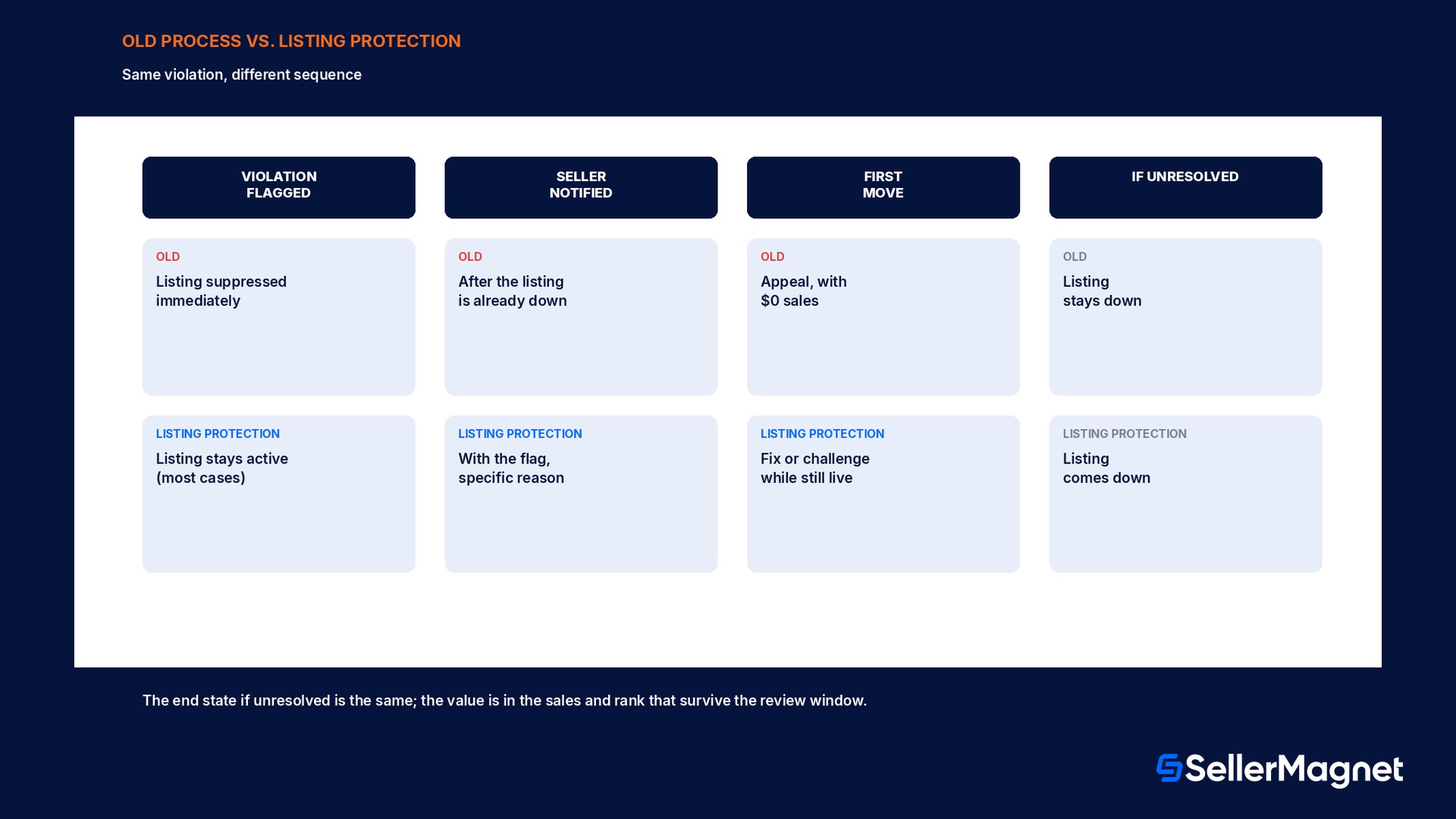
The clearest way to see what changed is to line up the old sequence against the new one for the same type of flagged violation. Under the process every seller has dealt with until now, a flag leads straight to suppression or removal, the seller finds out from a performance notification after the listing is already down, and the appeal that follows is the seller's first chance to present a fix or a counter-argument, during which the listing earns zero sales and loses search rank that will not fully return on reinstatement. Under Listing Protection, the flag leads first to a specific notification describing exactly what triggered it, the listing in most cases stays live through that notification and the response window, and the seller's fix or challenge happens while the listing is still earning sales rather than after it has already gone dark. The end state if the seller does nothing, or loses a challenge, converges back to the same place in both processes: the listing comes down. The entire value of Listing Protection is in the sales and rank that survive the review window when the issue is minor, fixable, or simply wrong, which on a routine, correctable listing content flag is the overwhelming majority of real-world cases sellers actually encounter.
Step
Old process (no AHA / no Listing Protection)
Listing Protection (AHA-enrolled, feature live)
Violation flagged
Listing suppressed or removed immediately
Listing in most cases stays active
Seller notified
After the listing is already down
With the flag, describing the specific reason
Seller's first move
Appeal, with the listing already earning $0
Fix the issue or formally challenge it while still live
How to actually prepare for it before it reaches your account
Because Listing Protection rides on top of an existing program rather than introducing a new one, preparing for it is almost entirely the same work Amazon already asks of Account Health Assurance sellers, just worth taking more seriously given what now depends on it. The first and most direct lever is the Account Health Rating itself: a seller sitting close to the 250 line should treat every open performance notification as something to resolve immediately rather than something to let sit, since the 10-day cumulative grace window before losing AHA eligibility is not large and does not reset itself. The second lever is the emergency contact number on file; it has to be a number someone actually answers, not a line that goes to voicemail, since Amazon's account health team calling that number within a 72-hour response requirement is itself one of the ongoing conditions for staying enrolled. The third lever is documentation, and it is the one sellers skip most often because nothing forces it until a flag has already arrived: supplier invoices covering at least the past year, safety and compliance test reports for the category, required certificates, brand authorization letters if the seller is not the brand owner, and clear photographs of product labels and warning text, organized per ASIN rather than scattered across email threads, so that a genuine dispute can be filed with evidence attached on day one rather than assembled under time pressure after the grace period has already started counting down.
Mistakes that waste the grace period Listing Protection gives you
Assuming Listing Protection applies to every account automatically. It is delivered through Account Health Assurance; an account below AHR 250, or missing a verified emergency contact, is still on the old takedown-first process.
Treating the US end-of-2026 date as a worldwide date. Amazon's own rollout commitment splits the US (end of 2026) from the rest of the world (2027); an EU or UK account should not assume the feature has arrived just because the calendar reads 2026.
Ignoring a flag because the listing is still live. In most cases is not always, and a window that expires unanswered ends in the exact same removal the old process would have produced, just later.
Burning a challenge on a flag that is simply correct. Reported guidance describes a limited number of challenges in a 180-day window; spending one on a violation that genuinely needs a straightforward fix wastes it for a flag that is actually wrong.
Letting the emergency contact number go stale. A number nobody answers breaks the 72-hour engagement requirement that keeps AHA, and therefore Listing Protection, active in the first place.
Having no compliance documents ready per ASIN. A dispute decided by a specialist team is decided on the documentation submitted; assembling invoices and certificates after a flag arrives costs exactly the time the grace period was meant to buy back.
Confusing listing-level protection with account-level protection. Listing Protection covers one flagged listing; it does not replace the separate 72-hour Account Health Assurance window that applies to an account-wide deactivation risk.
Where SellerMagnet fits around Listing Protection
Amazon runs Listing Protection and Account Health Assurance entirely inside Seller Central; no third-party tool, including SellerMagnet, enrolls a seller in either program or changes how Amazon's own enforcement reviews a flagged listing. What SellerMagnet's tools support is the preparation and the response around that review. Listing Optimizer is where a listing's attributes, bullet points and claims get checked against Amazon's own content rules before a flag ever happens, which is the single most effective way to reduce how often a routine content violation reaches the Account Health Rating at all. Analytics Dashboard tracks the Account Health Rating's trend over time on the same account-health page Amazon itself uses, which is the practical way to notice an AHR drifting toward the 250 line weeks before it becomes a real AHA eligibility problem, rather than discovering it the day a flag arrives.
Competitor Tracker is useful in a related but distinct way: when a flag stems from a listing claim or an attribute that a seller copied from how competitors describe a similar product, tracking which of those competitor listings have themselves been flagged or changed over time is a fast way to tell whether a claim is a category-wide habit Amazon is currently cracking down on, rather than a one-off mistake specific to a single listing.
Checklist before Listing Protection reaches your account
How to get ready for Amazon Listing Protection
Check your current Account Health Assurance status - Seller Central -> Performance -> Account Health; the Account Health Assurance panel states enrolled, eligible-pending-contact, or at risk of losing eligibility.
Confirm the Account Health Rating is comfortably above 250 - AHA requires AHR 250+ for 6 consecutive months with no more than 10 cumulative days below 250; resolve open performance notifications before they push the rating down.
Verify the emergency contact number is current and answered - A number nobody picks up breaks the 72-hour engagement requirement that keeps AHA, and Listing Protection with it, active.
Build a compliance folder per ASIN now, not after a flag - Supplier invoices from the last 12 months, safety/compliance test reports, required certificates, brand authorization letters, and clear label and warning photographs.
Write a short internal rule for fix versus challenge - Save limited challenges for flags that are clearly wrong; fix anything that is genuinely a real, correctable listing issue.
Assign someone to watch performance notifications daily - A grace period nobody notices inside its response window is worth exactly as much as no grace period at all.
What is Amazon Listing Protection?
An enforcement change announced at Amazon's Accelerate 2026 conference: a flagged listing stays active in most cases while the seller fixes or disputes the violation, instead of being suppressed or removed first and appealed afterward.
How do I get Listing Protection on my account?
It is not a separate signup. It reaches sellers through Account Health Assurance, which requires an Account Health Rating of 250 or higher for at least 6 months and a valid, verified emergency contact number on file.
When does Listing Protection reach my account?
Amazon has committed to reaching all Account Health Assurance sellers in the US by the end of 2026, with worldwide rollout, including the EU and UK, following in 2027. Check the Account Health Assurance panel on your own Account Health page for your account's actual status.
Does Listing Protection mean my listing can never be removed?
No. The grace period applies in most cases, not all, and if a violation is not fixed or a challenge fails, the listing is still removed. It buys time to resolve a genuine issue; it does not erase the violation.
How many times can I challenge a flagged violation?
Reported trade coverage describes three seller challenges allowed every 180 days, reviewed by a specialist team, with most sellers hearing back within about 24 hours; confirm the exact number shown on your own account, since Amazon's own public FAQ does not state that cadence directly.
Does a Listing Protection grace period affect my Account Health Rating?
A confirmed violation still counts against the Account Health Rating the same way it always did. Listing Protection changes when the listing comes down, not whether the violation affects the rating that determines ongoing AHA eligibility.
Stop Juggling Tools. SellerMagnet Combines Everything You Need.