Amazon Launchpad 2026: Fees, Eligibility and Terms
R
RenéFreelance Amazon Editor
|
18 min read
Amazon Launchpad is a separate, opt-in program that gives startup and emerging brands a dedicated storefront, onboarding support, marketing consultations and global expansion help, in exchange for a 5% referral fee premium on top of the standard referral fee schedule and a 12-month minimum commitment. It is not a free upgrade and it is not automatic: a seller applies, Amazon reviews the brand on a case-by-case basis, and only brand-owned products already registered in Brand Registry and fulfilled through Fulfillment by Amazon or Seller Fulfilled Prime qualify. Because the extra 5% applies to all sales in every store where the brand has a Launchpad storefront, not only to units sold through that storefront, the real cost of joining is easy to underestimate until it is run against actual sales. This guide works through exactly who qualifies, what the 5% premium costs on a real revenue number, the 12-month commitment and the automatic 5-year program end that most sellers never read in the terms, and how enrollment differs between the US/Canada/Mexico stores, the 6-store EU group, the UK, Australia and India.
Amazon Launchpad is an opt-in program for startup and emerging brands that provides a dedicated storefront, onboarding support, marketing consultations and global expansion help. It costs a 5% referral fee premium on all sales in stores with a Launchpad storefront, requires Brand Registry enrollment and Fulfillment by Amazon or Seller Fulfilled Prime, carries a 12-month minimum commitment, and automatically ends on its 5th anniversary.
What Amazon Launchpad actually is and who can apply
Amazon's own program terms describe Launchpad as support for brands and startup companies that sell and deliver innovative products to Amazon customers, through tools and services such as onboarding support, marketing consultations, enhanced brand and merchandising support, account support, and global expansion opportunities. It is not a certification or a badge added to an existing listing; it is a separate enrollment tied to the brand's selling account, with its own storefront pages on the matching Amazon store, for example amazon.co.uk/launchpad, amazon.de/launchpad or amazon.it/launchpad. Amazon reviews every application case by case, looking for innovative brands with a unique selling point and what Amazon's own program page calls an exclusive story, across any product category. A seller does not need to be brand new to Amazon to apply; an existing seller with an established catalog can apply the same product lines to the program, provided every other requirement is met. The name Launchpad is also used loosely in seller forums to describe the general idea of launching a new product, which is a different thing entirely from this specific, paid, opt-in program with its own terms document; a seller searching for general launch advice and a seller evaluating this program are asking two different questions, and this guide covers only the named program and its published terms.
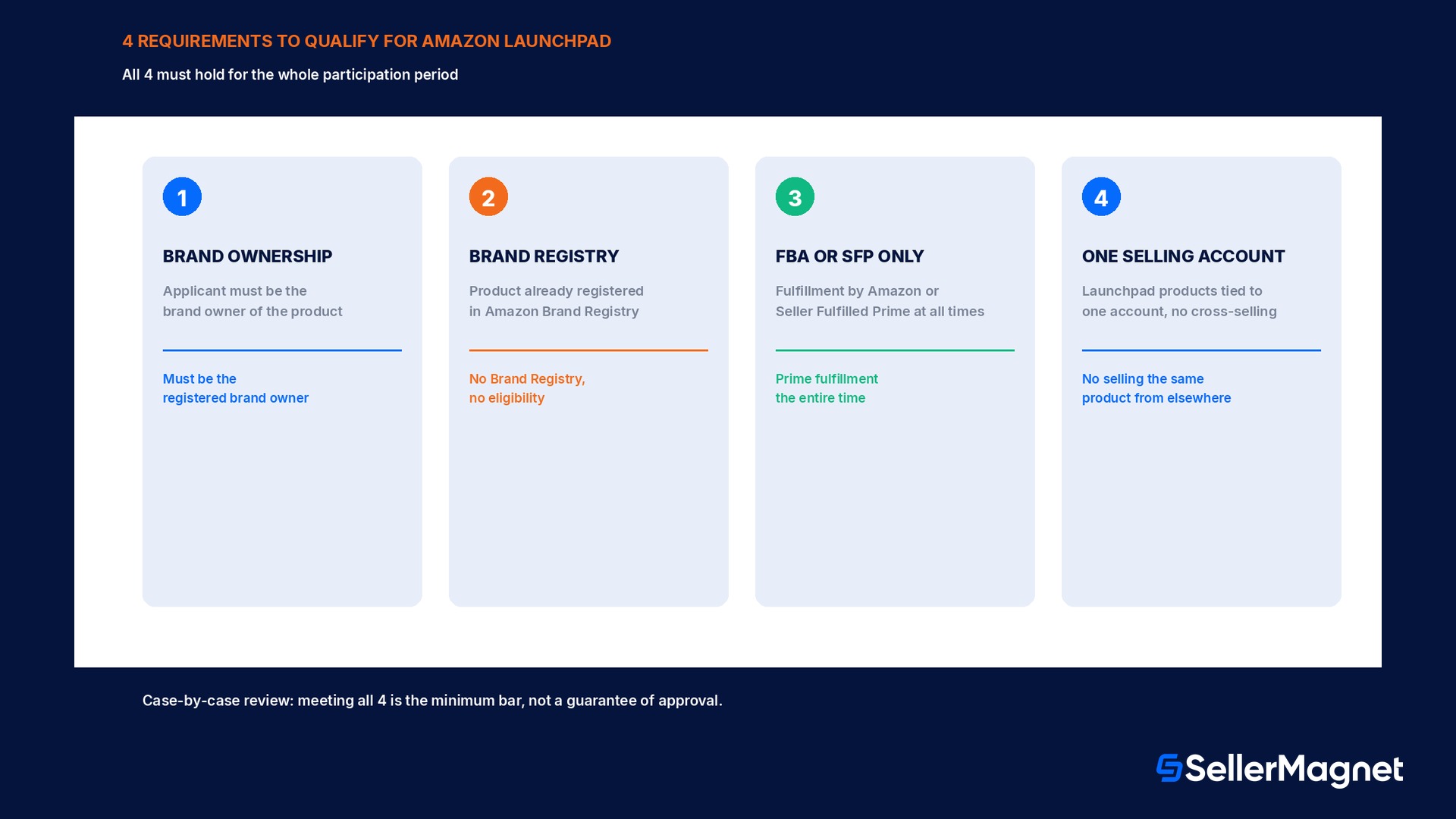
Requirement
What it means
Brand ownership
The applicant must be the brand owner of the product for it to be eligible for program benefits
Brand Registry
Every eligible product must be registered in Amazon Brand Registry
Fulfillment method
Orders must be fulfilled through Fulfillment by Amazon or Seller Fulfilled Prime at all times during participation, to keep the Prime badge on Launchpad listings
Account linkage
Participation is linked to one selling account; products under Launchpad listings cannot be sold through a different selling account belonging to the same seller
Review
Amazon evaluates each application case by case against its own innovation and brand-story criteria; there is no published automatic-approval threshold
Who Launchpad is built for, and who it is not built for
Reading the eligibility list and the benefit list together points to a specific kind of applicant. Amazon's description targets brands and startup companies with an innovative, story-driven product, not simply any brand owner with a Brand Registry listing and Prime-eligible fulfillment; those two requirements are the minimum bar to be considered, not a guarantee of approval, since the program is still reviewed case by case against Amazon's own innovation and brand-story criteria. A brand selling a commodity product with no distinctive design, story, or category-first feature is less likely to be the kind of applicant Amazon is describing, even if it technically meets every listed requirement, because the storefront and marketing benefits are built around a brand narrative that a commodity listing does not have much of to tell. On the other side, a brand that already has a large, established presence through other merchandising programs may find the extra 5% premium harder to justify than a true early-stage brand still building its first storefront presence, since the marginal value of one more storefront placement shrinks the more visibility a brand already has elsewhere on Amazon. A useful self-check before applying is whether the brand could describe its product in one sentence that a shopper has not heard about a dozen similar listings already; if that sentence is hard to write, the 5% premium is buying a storefront placement for a story that is not yet distinctive enough for Amazon's own review criteria to reward it, regardless of how clean the Brand Registry and fulfillment checkboxes look on paper.
Why does the 5% referral fee premium apply to more than storefront sales?
The single biggest cost of Launchpad is written into Amazon's own program terms in one sentence: referral fees applicable to all sales made in stores where Launchpad has a storefront, and associated with the seller's account, carry a 5% premium in addition to the standard referral fee described in the applicable Business Solutions Agreement. Two words matter more than the rest of that sentence. The first is all: the premium is not limited to orders placed through the dedicated Launchpad storefront page; it applies to every sale of the enrolled product in that store, including sales that come from normal search, category browsing, or advertising that never touches the storefront. The second is stores, plural: since a brand's Launchpad enrollment is store-scoped (UK enrollment covers all 6 EU stores at once, the US covers US/Canada/Mexico, Australia and India are separate), the 5% premium applies independently in every store where the brand has an active Launchpad storefront, stacking across regions rather than being a single flat percentage of global revenue. The premium is also calculated on top of whatever referral fee the product's category already carries, rather than replacing it; a product in a low-fee category and a product in a high-fee category both gain the same additional 5 percentage points, but that flat addition is a larger relative jump for a category that already sits at a low rate than for one already near the top of Amazon's referral fee schedule.
The 5% is on top of the referral fee, not on top of revenue
Amazon's program terms describe the premium as additive to the Referral Fees described in the Business Solutions Agreement, not as a flat 5% of the sale price. In practice this means the extra cost scales with whatever the product's own category referral fee rate already is: it is a percentage-of-a-percentage, which is exactly why the worked example below converts it into an actual dollar figure rather than quoting 5% on its own.
Worked example: what the 5% premium costs on a real revenue number
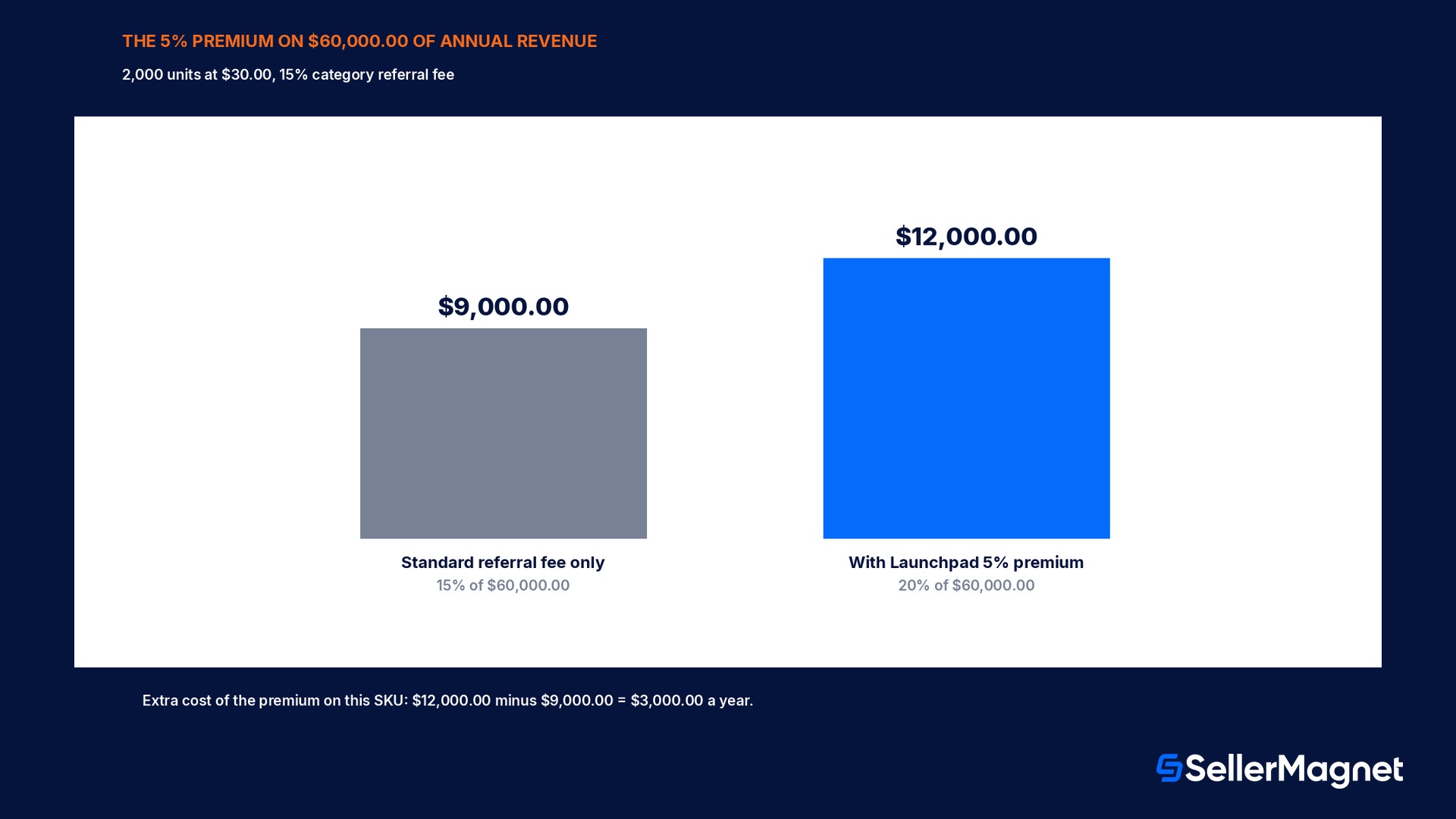
Take a seller with one Launchpad-enrolled SKU retailing at $30.00, in a product category with a standard 15% referral fee, selling 2,000 units a year in a single store with an active Launchpad storefront. Annual revenue on that SKU is 2,000 multiplied by $30.00, or $60,000.00. At the standard 15% referral fee alone, before Launchpad, the referral fee owed is 15% of $60,000.00, which is $9,000.00. Once the product is enrolled in Launchpad in that store, the effective referral fee rate becomes 15% plus the 5% premium, or 20% of the same $60,000.00, which is $12,000.00. The premium itself, the extra cost of being in Launchpad on this one SKU in this one store, is $12,000.00 minus $9,000.00, exactly $3,000.00 a year, or 5% of the $60,000.00 revenue figure (since the premium is a flat 5 percentage points of revenue, written as 5% of the referral-fee base, which for a straight referral fee schedule is the sale price itself). That $3,000.00 has nothing to do with whether a single unit sold through the Launchpad storefront page itself; it is owed on every one of the 2,000 units sold anywhere in that store for as long as the product stays enrolled.
Standard referral fee only
With the Launchpad 5% premium
Referral fee rate
15%
20%
Annual revenue (2,000 units at $30.00)
$60,000.00
$60,000.00
Referral fee owed
$9,000.00
$12,000.00
Extra cost from Launchpad
$3,000.00
Scale this to the real SKU before applying
The $30.00 price, 2,000-unit volume and 15% category rate above are a planning example chosen to show the mechanics of the premium, not a published Amazon baseline. A seller evaluating Launchpad should run this same calculation against the actual category referral fee rate and actual projected volume for every store the brand would enroll in, since the premium stacks independently per store. A seller selling the same SKU through both the UK-anchored EU group and a separate North American enrollment, for instance, would run this $3,000.00-style calculation twice, once per region group, rather than once for the brand as a whole, since each group carries its own revenue base and its own referral fee category rate.
What happens if you want to leave Launchpad early, or stay past 5 years?
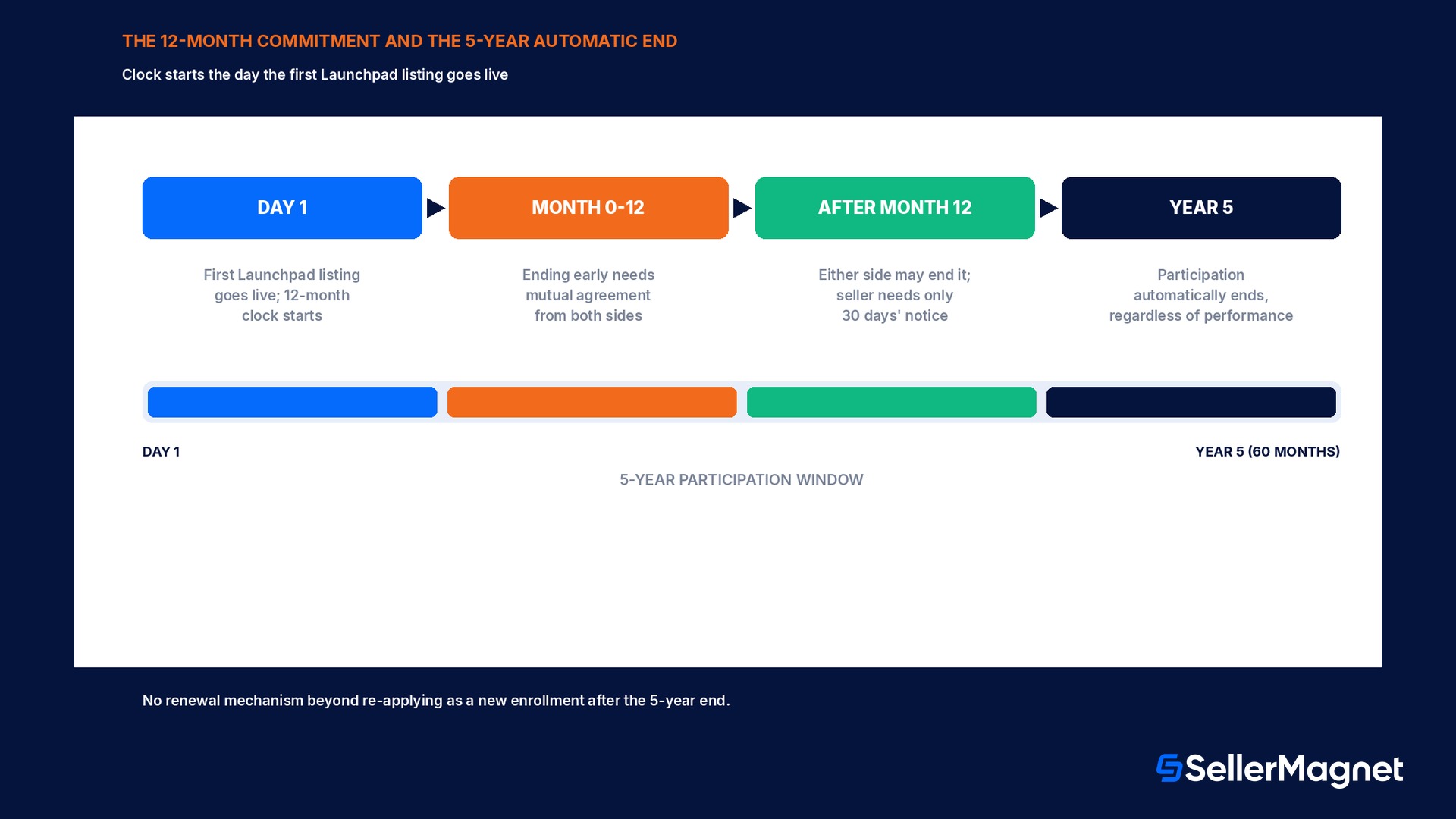
Launchpad is a reciprocal commitment, not an open enrollment a seller can cancel on a whim the week after joining. Amazon's program terms set a reciprocal 12-month commitment, starting from the date the seller creates listings on an Amazon Launchpad storefront, during which Amazon devotes resources to enhancing and supporting the brand. Within that first 12 months, ending the participation requires both sides to mutually agree; a seller cannot unilaterally exit before the 12 months are up except by that mutual agreement. After the 12-month mark passes, a seller gains a one-sided right to cancel: 30 days' written notice through Seller Central, email, or the Contact Us form ends participation without needing Amazon's agreement. Separately, and regardless of how well the enrollment performs, Amazon's terms state that participation automatically terminates on the 5th anniversary of the date the seller created the brand's first Launchpad storefront listings. That 5-year clock runs whether or not the seller has ever invoked the post-12-month cancellation right, and the terms describe no renewal or extension mechanism beyond re-applying as a new enrollment after the automatic end. Amazon's terms also give it a separate, narrower right to end participation on 30 days' notice if it materially breaches its own obligations and fails to cure the breach after the seller raises it formally, which is a different exit path from the ordinary mutual-agreement or post-12-month notice routes described above and applies in the seller's favor specifically when Amazon itself falls short of the support commitments it describes.
Milestone
What happens
Day 1: first Launchpad listing goes live
The 12-month minimum commitment clock starts
Month 0 to 12
Ending participation requires mutual agreement between the seller and Amazon
After month 12
Either side may end participation; the seller needs only 30 days' written notice
Year 5 (60 months)
Participation automatically terminates on this anniversary, regardless of performance
Does enrolling in one Amazon store cover every Amazon store?
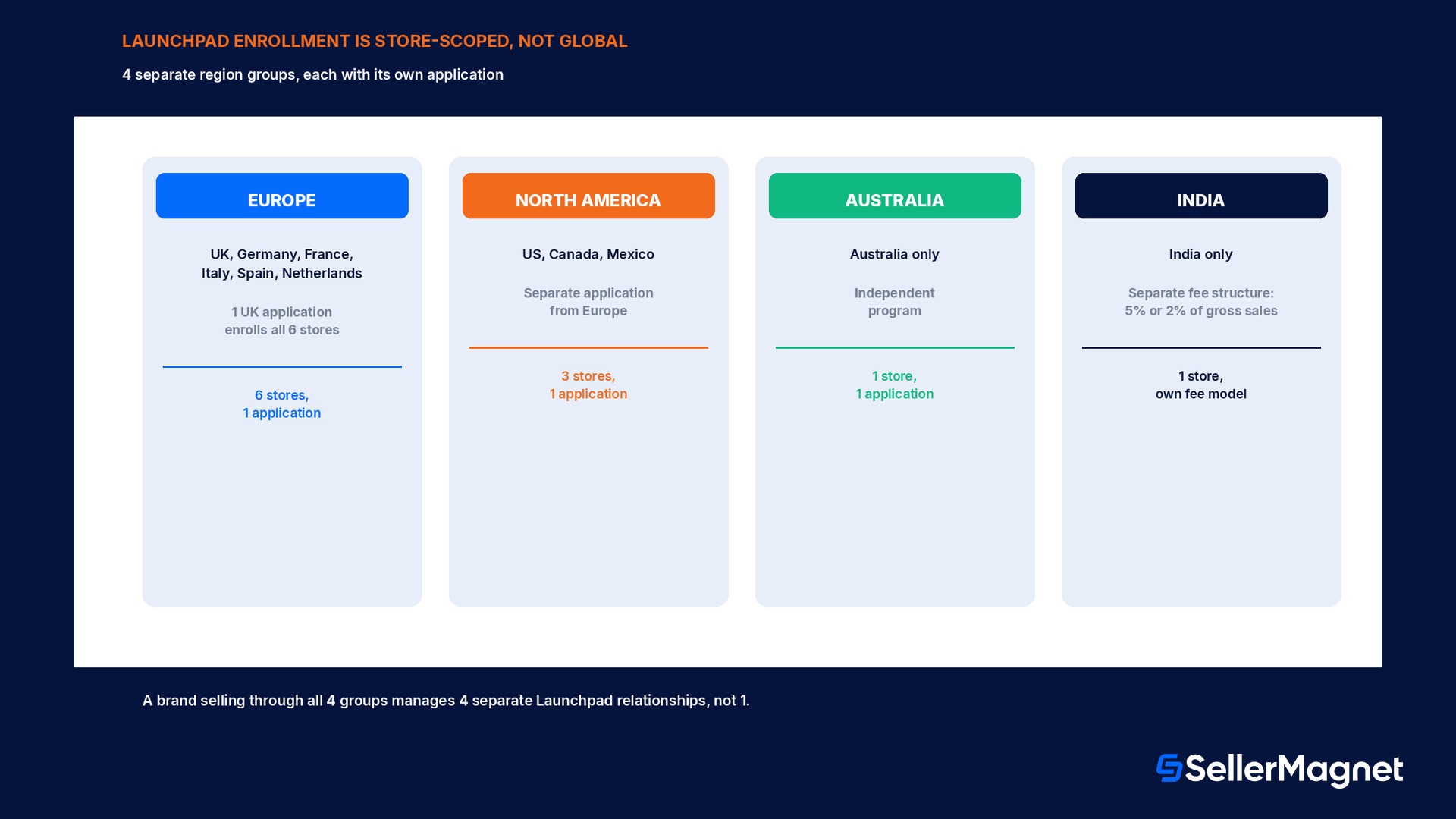
A brand does not join Launchpad once and appear everywhere; enrollment is tied to specific Amazon stores, and the grouping is uneven across regions. Signing up for Launchpad on the UK store automatically enrolls the brand into all 6 European Launchpad stores at the same time, UK, Germany, France, Italy, Spain and the Netherlands, with no separate application needed for any of the 5 others once the UK enrollment is approved. The three North American stores, the US, Canada and Mexico, sit in a separate group from Europe: a brand already enrolled in the European group still needs to re-enroll separately with Amazon Launchpad for the North American stores if it wants a presence there, and the same applies in reverse. Australia and India each run their own independent Launchpad program with its own separate application and, in India's case, its own distinct benefit structure (a participation fee tiered at 5% or 2% of gross shipped sales rather than a flat 5% referral fee premium, plus a free Amazon Launchpad Marketing Package once a Perfect Launch Checklist is met), so a seller operating in both Europe and India needs to treat the two as fully separate enrollments with separate terms, not one global program. A brand that sells the same SKU through all 3 groups, Europe, North America and one of Australia or India, is in effect managing 3 separate Launchpad relationships with 3 separate commitment clocks, 3 separate review processes, and in India's case a different fee mechanic entirely, which is a materially bigger operational commitment than the single word program suggests.
Region group
Stores covered
Enrollment
Europe
UK, Germany, France, Italy, Spain, Netherlands
One application via the UK store auto-enrolls all 6
North America
US, Canada, Mexico
Separate application from the European group
Australia
Australia only
Separate, independent program application
India
India only
Separate program with a different fee structure (5% or 2% of gross shipped sales, tiered)
What the 5% premium is actually buying
Amazon's own program description lists onboarding support, marketing consultations, enhanced brand and merchandising support, account support, and global expansion opportunities to help brands maximize their success on Amazon. In practice, the most visible benefit is the dedicated Launchpad storefront itself, a branded page on the Amazon store (such as amazon.co.uk/launchpad) that showcases enrolled products alongside other Launchpad brands, giving a startup brand a merchandising placement it could not otherwise buy directly. Account management and marketing teams work with enrolled brands to improve product visibility, though Amazon's public terms do not commit to a specific cadence, number of consultations, or guaranteed placement beyond the storefront itself. None of the described benefits include a discount on standard referral fees, waived FBA fees, or any other fee reduction; every fee a product already owes under the standard fee schedule continues to apply in full, with the 5% premium added on top rather than offset by any benefit on the other side of the ledger. Amazon's listings also note that products under Launchpad continue to be discovered through normal search the same way any other listing is, since enrollment changes merchandising and fee treatment, not the underlying search and ranking algorithm; a seller should not expect a direct search-ranking boost from the storefront placement alone, only the additional discovery surface the storefront page itself provides to shoppers who browse it directly.
How is a Launchpad storefront different from a regular, free Amazon Store?
Every brand already registered in Amazon Brand Registry can build a free Amazon Store, a multi-page storefront with its own URL, product grids and content modules, without any referral fee premium and without any minimum commitment; Amazon's own published figures for Stores cite meaningful lift from having one at all, including higher purchase likelihood and larger average order value for shoppers who visit a Brand Store. A Launchpad storefront is a different, narrower page type layered on top of that: it lives on a Launchpad-specific URL alongside other enrolled brands rather than as the brand's own standalone Store, it is reviewed and granted case by case rather than opened to every Brand Registry member automatically, and it is the one that carries the 5% referral fee premium and the 12-month and 5-year commitment terms described above. A brand is not forced to choose one or the other: a regular, free Store and a Launchpad enrollment can coexist, and a seller deciding between spending effort on the free Store page versus applying for the reviewed, paid Launchpad program should weigh the free option's zero ongoing cost against Launchpad's narrower eligibility bar, its own dedicated cross-brand placement, and its account-management and marketing-consultation support, which the free Store option does not include.
What does applying to Amazon Launchpad actually involve?
Amazon's own program pages describe the application step itself as straightforward: a seller fills in a program enrollment application through Seller Central, naming the brand, the products under consideration, and the story behind the brand's innovation. What happens after submission is where the process becomes genuinely a review rather than a formality. Amazon states it evaluates applications on a case-by-case basis against its stated criteria, innovative brands in any product group with a unique selling point and an exclusive story that want to optimize their potential globally, and does not publish a scoring rubric, an average approval rate, or a guaranteed response time beyond a general window, commonly cited as around ten days for sellers who already sell on Amazon to hear back. A rejected application is not described as permanently disqualifying; a brand can reapply later, for instance after strengthening its Brand Registry presence, refining its product story, or building a sales history that better demonstrates the innovation Amazon is evaluating for. Because the review criteria are qualitative rather than numeric, two brands with identical referral-fee math and identical eligibility checkboxes can receive different outcomes, which is also why running the fee math in advance matters even before an application is submitted: a brand that is not approved has spent no money on the premium, but a brand that is approved and then wants to exit inside the first 12 months is bound by the reciprocal commitment regardless of how the fee math eventually plays out.
What mistakes make Launchpad cost more than it is worth?
Running the 5% premium against storefront sales only. The premium applies to every sale of the enrolled product in that store, not just orders placed through the Launchpad storefront page itself.
Enrolling in Europe and assuming North America is covered. The UK application covers all 6 EU stores at once, but the US, Canada and Mexico group needs its own separate application.
Trying to exit inside the first 12 months without Amazon's agreement. The reciprocal 12-month commitment requires mutual agreement to end early; the one-sided 30-day notice right only starts after month 12.
Forgetting the 5-year automatic end. Participation terminates on the 5th anniversary of the first Launchpad listing regardless of how the brand is performing, with no stated renewal path other than a fresh application.
Switching fulfillment away from Fulfillment by Amazon or Seller Fulfilled Prime mid-enrollment. The Prime-fulfillment requirement applies at all times during participation, not only at the point of approval.
Applying before Brand Registry is complete. Products must already be registered in Amazon Brand Registry to be eligible; Launchpad does not include or expedite brand registration.
Assuming India's terms match the US or EU terms. India runs a tiered participation fee (5% or 2% of gross shipped sales) rather than the flat 5% referral fee premium used elsewhere, and ties benefits to a separate Perfect Launch Checklist.
Where SellerMagnet fits before and after enrolling
Amazon reviews and approves Launchpad applications directly; no third-party tool, including SellerMagnet, submits or influences that case-by-case decision. Where SellerMagnet's Fee Calculator fits is exactly the question this guide's worked example answers manually: running the real category referral fee rate and real projected volume for a candidate SKU, in every store the brand is considering enrolling in, to see the actual dollar cost of the 5% premium before applying rather than after the 12-month commitment has already started.
Once enrolled, Listing Optimizer helps a Launchpad-eligible listing earn the storefront placement Amazon's account teams work with, PPC Manager keeps advertising spend aligned with a product whose referral fee has already increased by 5 percentage points, and Profit Analytics tracks whether the storefront exposure and marketing support are actually moving enough incremental volume to justify the premium on an ongoing basis, store by store, since the premium is charged independently in each store where the brand holds a Launchpad storefront. A brand that is simultaneously enrolled in the European group and separately in the North American group benefits from tracking margin per store rather than as one blended global number, since a Launchpad enrollment that comfortably pays for itself in one store through strong storefront-driven volume can still be a net cost in a second store where the same product sells mostly through ordinary search and advertising rather than the storefront page itself.
Checklist before applying to Amazon Launchpad
How to evaluate an Amazon Launchpad application before submitting it
Confirm Brand Registry and fulfillment status first - The product must already be in Amazon Brand Registry and fulfilled through Fulfillment by Amazon or Seller Fulfilled Prime; Launchpad does not grant either.
Run the 5% premium against real revenue, not the storefront alone - Multiply projected annual revenue in each target store by 5 percentage points to see the actual dollar cost, since the premium applies to all sales in that store.
Check which region group the application covers - A UK application covers all 6 EU stores at once; US/Canada/Mexico, Australia and India each need their own separate application.
Read the 12-month and 5-year terms before the first listing goes live - The clock for both the mutual-agreement period and the automatic 5-year end starts the day the first Launchpad listing is created.
List what the storefront realistically adds beyond standard listings - Amazon's terms describe onboarding, marketing consultations, and storefront placement, not a referral fee discount or any other fee reduction.
Decide per store, not globally - Because the premium and the commitment terms are store-scoped, a brand can evaluate Europe, North America, Australia and India as separate decisions rather than one global yes or no.
What does Amazon Launchpad cost beyond standard selling fees?
A 5% referral fee premium in addition to the standard referral fee schedule, applied to all sales of the enrolled product in every store where the brand has an active Launchpad storefront, not only storefront-driven sales.
Who is eligible for Amazon Launchpad?
The applicant must be the brand owner, the product must already be registered in Amazon Brand Registry, and orders must be fulfilled through Fulfillment by Amazon or Seller Fulfilled Prime at all times during participation.
Can I cancel Amazon Launchpad whenever I want?
Not in the first 12 months: that period is a reciprocal commitment that can only end early by mutual agreement. After 12 months, a seller can end participation with 30 days' written notice.
Does Amazon Launchpad ever end automatically?
Yes. Participation automatically terminates on the 5th anniversary of the date the seller's first Launchpad storefront listings went live, regardless of performance.
If I enroll in the UK store, am I enrolled everywhere in Europe?
Yes for the EU group: UK enrollment auto-enrolls the brand into all 6 European Launchpad stores (UK, Germany, France, Italy, Spain, Netherlands) without a separate application for each.
Does my European Launchpad enrollment cover the US store too?
No. The US, Canada and Mexico stores form a separate region group from Europe and need their own separate Launchpad application.
Is Amazon Launchpad in India the same program as in the US or EU?
No. India runs its own separate program with a tiered participation fee of 5% or 2% of gross shipped sales rather than the flat 5% referral fee premium used in the US and EU, plus its own Perfect Launch Checklist and Marketing Package.
Does Launchpad reduce any other Amazon selling fees?
No. Amazon's published program terms describe onboarding support, marketing consultations and storefront placement as the benefits; they do not include a discount on FBA fees or any other fee reduction, so every standard fee still applies in full alongside the 5% premium.
Stop Juggling Tools. SellerMagnet Combines Everything You Need.