Amazon Late Shipment Rate 2026: The 4% Limit and How to Stay Under It
R
RenéFreelance Amazon Editor
|
16 min read
Account Health has a tile most FBM sellers glance at only after it has already turned red: Late Shipment Rate. Amazon's own help page states the policy in one unambiguous line, sellers must maintain a late shipment rate under 4% to sell on Amazon, and a rate above that line can mean suspension of Fulfilled by Merchant selling privileges or deactivation of specific seller-fulfilled offers. The metric only applies to orders a seller ships themselves; FBA orders never count toward it. What trips up a surprising number of sellers is not a sudden collapse in shipping discipline, it is the math: LSR is measured over rolling 10-day and 30-day windows, and on a 10-day window with modest order volume, a single missed shipment can be the difference between comfortably compliant and already in breach. This guide works from Amazon's own Late Shipment Rate help page to lay out exactly how the rate is calculated, what counts as late, what happens above 4%, how LSR sits alongside the other FBM shipping metrics on the same dashboard, and a worked comparison of why low-volume sellers hit the ceiling faster than their order count would suggest.
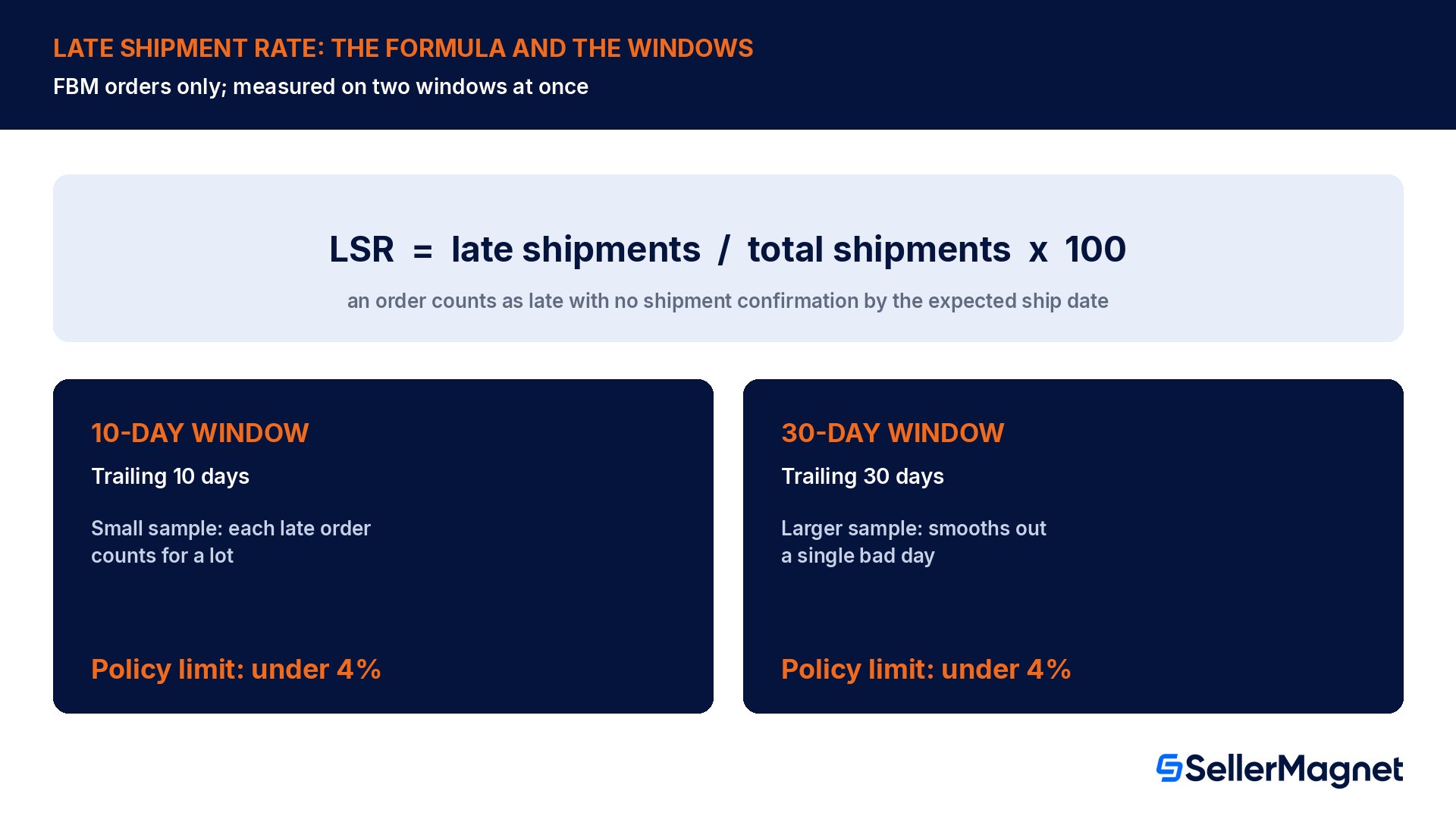
Late Shipment Rate (LSR) is the percentage of a seller's Fulfilled by Merchant orders that were shipped after the expected ship date, measured over rolling 10-day and 30-day periods. Amazon requires sellers to keep LSR under 4%; above that, Amazon can suspend FBM selling privileges or deactivate the specific seller-fulfilled offers with the worst late-shipment record. LSR excludes FBA orders entirely and only applies to orders the seller ships themselves.
What Late Shipment Rate actually measures
Amazon's Late Shipment Rate help page defines an order as shipped late when there is no shipment confirmation by the expected ship date, the date Amazon's system calculated at order time based on the seller's stated handling time. LSR is the percentage of orders shipped late out of total orders, and Amazon measures it over two separate windows at once, a trailing 10-day period and a trailing 30-day period, rather than a single calendar-month tally. The metric only applies to seller-fulfilled orders; FBA orders carry their own separate fulfillment metrics and never factor into LSR at all. A high LSR generally tracks with a higher rate of late deliveries, meaning deliveries that miss the promise date a customer actually saw at checkout, which is the real-world consequence the policy is built to prevent. Expected ship dates are adjusted for national holidays, so a seller is not penalized for a date that fell on a day carriers were closed. Because the clock starts from the handling time a seller sets on the listing itself, two sellers shipping the identical order on the identical calendar day can land on opposite sides of late or on time, depending only on whether their stated handling time matched what their fulfillment process could realistically deliver.
Window
What it covers
Policy threshold
Trailing 10-day
The most recent 10 days of seller-fulfilled orders, the window where a small sample size makes each late order weigh heavily
Under 4%
Trailing 30-day
The most recent 30 days of seller-fulfilled orders, a larger sample that smooths out single bad days
Under 4%
What happens above 4%, and why it compounds
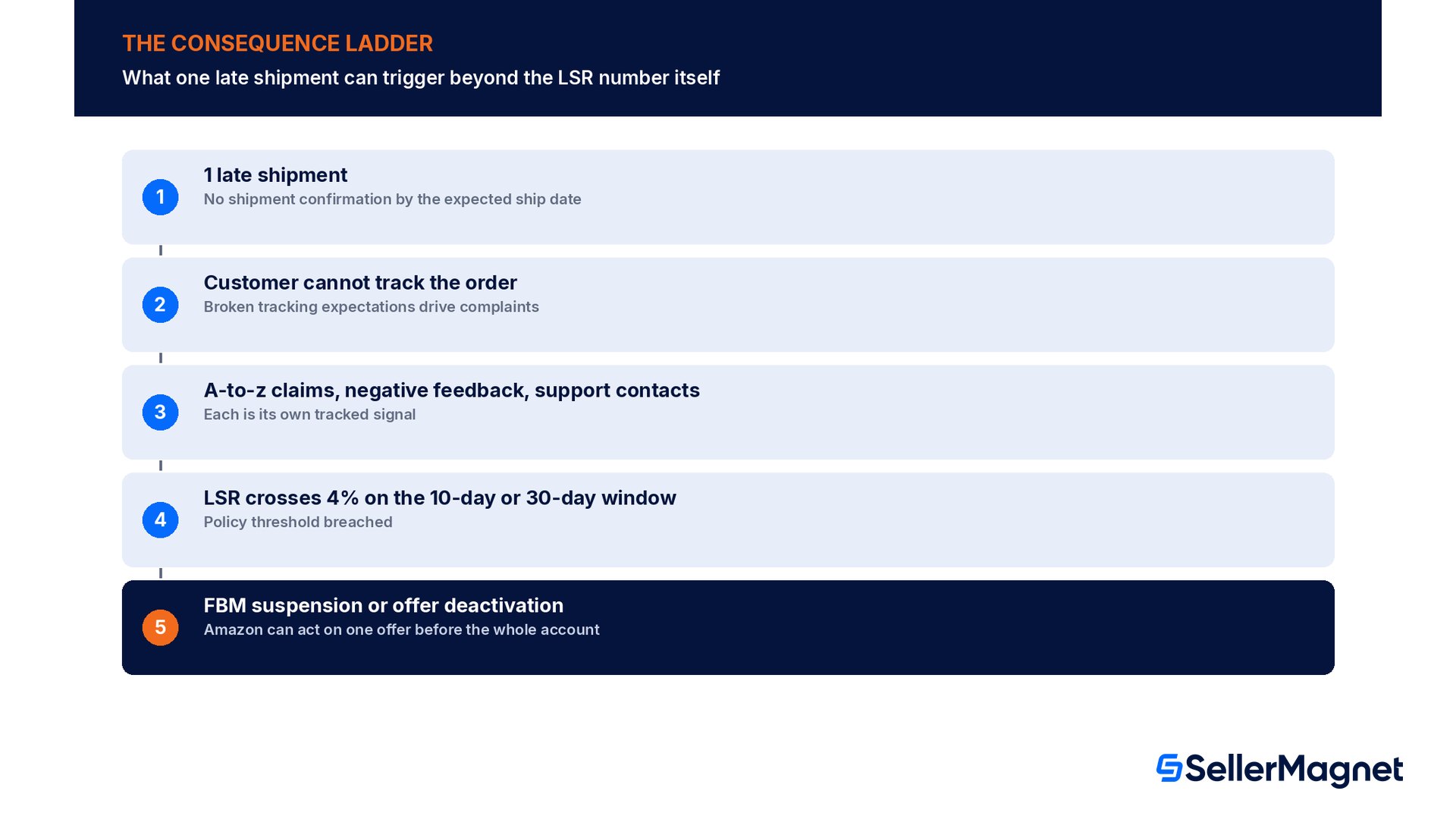
Amazon's policy line is direct: sellers must maintain an LSR under 4% to sell in the Amazon store, and an LSR above 4% may result in suspension of Fulfilled by Merchant selling privileges, or deactivation of the specific seller-fulfilled offers carrying a history of late shipments. Amazon states it closely monitors listings shipped late and may remove an individual offer if it sees a history of multiple late shipments in a compressed time period, which means the consequence can land on one problem ASIN before it ever threatens the whole account. The knock-on effects reach further than the metric itself: a confirmed-late shipment prevents a customer from tracking their order accurately online, and Amazon's own marketplace guidance ties that directly to increased A-to-z Guarantee claims, more negative feedback, more customer service contacts and a measurably worse customer experience, each of which is its own separate signal Amazon already tracks on a seller's account. None of those downstream signals wait for the LSR number itself to cross 4%; a single late order can generate a customer complaint and a feedback hit well before enough similar orders accumulate to move the rate, so the practical cost of a late shipment starts well before the policy threshold does. Those same customer contacts and A-to-z claims also feed Order Defect Rate, a separate contractual metric, which is one more reason a late-shipment problem rarely stays contained to the LSR tile alone.
If an offer is deactivated
Amazon's help page describes the recovery path: from the Account Health dashboard's Other policy violations section, a seller can follow the Submit appeal flow and the online reinstatement instructions for the affected seller-fulfilled offers. Fixing the underlying shipping workflow before appealing matters more than the appeal text itself, since the same report that documents the late shipments is also the evidence Amazon's review process is likely to check against.
The low-volume trap: why a thin order count hits the ceiling faster
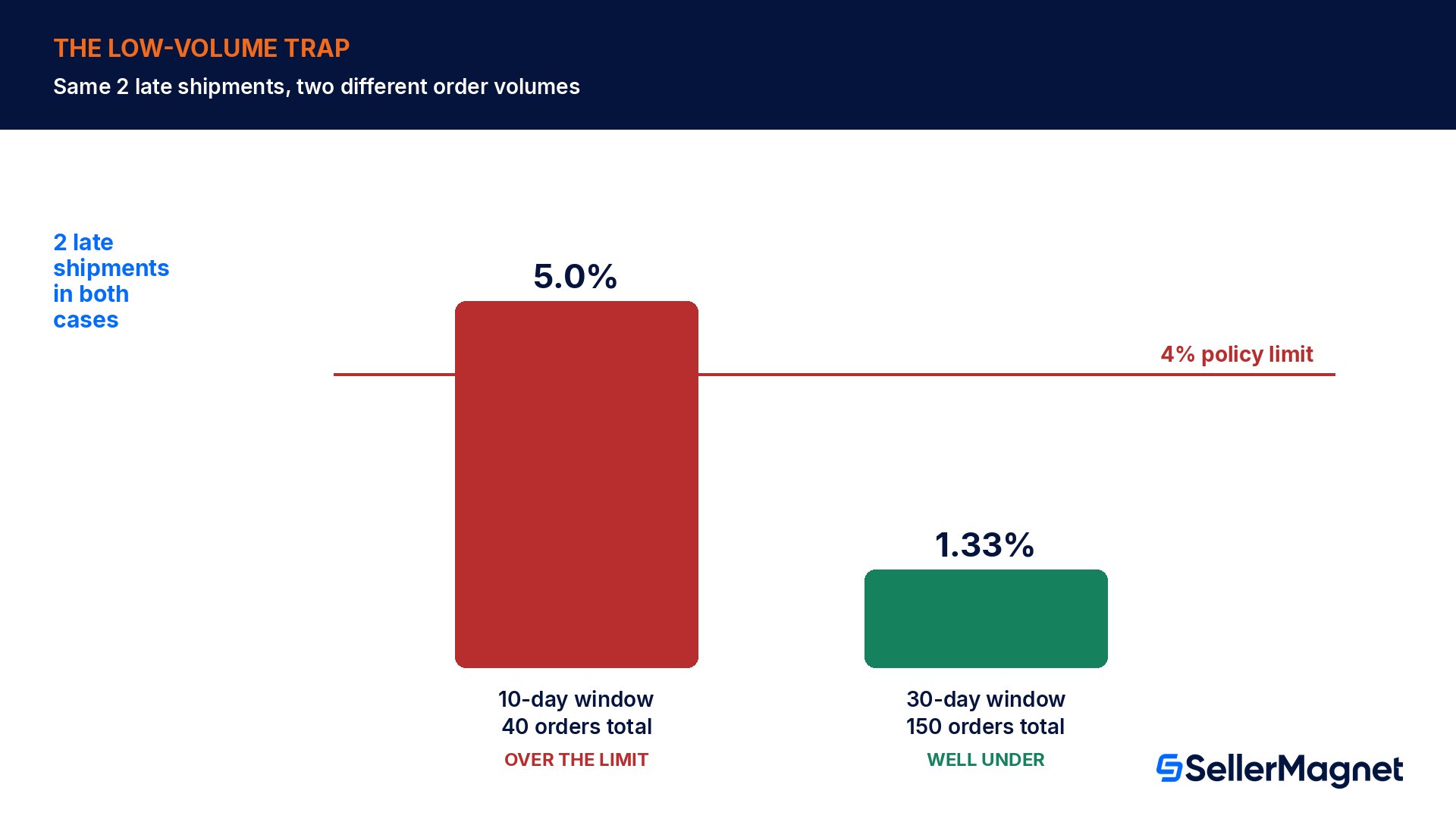
The part of LSR that surprises sellers most is not the 4% number, it is how little room a thin order count leaves. Take a seller shipping 40 orders in a 10-day window, a realistic volume for a smaller FBM catalog or a slower category. Two late shipments in that window is 2 out of 40, 5.0%, already over the 4% line on the 10-day read even though it is only 2 orders. To stay at or under 4% on that same 40-order window, the seller can have at most 1 late shipment, 2.5%; a second late shipment in the same 10 days is an automatic breach of the 10-day threshold regardless of how clean the rest of the month looked. Now take the identical 2 late shipments and spread them across a 30-day window with 150 total orders instead of 40: the rate drops to 1.33%, comfortably compliant. The orders did not get faster and the mistakes did not get smaller; the denominator did. A seller running a thin, low-volume catalog is structurally closer to the 4% ceiling than a seller moving the same absolute number of late orders through a much larger order count, which is exactly why the 10-day window needs its own daily attention, not just a monthly glance at the 30-day number. This is also why a seller launching a new FBM listing, where the first few weeks naturally carry a thin order count, is at the highest structural risk of an early breach even with a genuinely careful shipping process, simply because the 10-day denominator starts small.
Scenario
Window
Late orders
Total orders
LSR
Status
Low-volume 10-day read
10-day
2
40
5.0%
Over the 4% limit
Same mistakes, 30-day read
30-day
2
150
1.33%
Well under the limit
Maximum late orders to stay compliant on the 40-order window
10-day
1
40
2.5%
Still compliant
A worked recovery: cutting late shipments in half on a bigger catalog
Scale the same math up to a seller running 250 seller-fulfilled orders over a 30-day period who starts at 14 late shipments, a 5.6% LSR, already over the 4% policy line and at risk of offer deactivation. The fix is not a single dramatic change; it is catching the orders that are about to go late before the expected ship date passes, which is the exact gap an opt-in late-shipment alert is built to close. If that seller cuts late shipments from 14 down to 8, a reduction of 6 orders achieved by acting on an alert at the 12-hour or 24-hour mark instead of discovering the miss after the fact, the 30-day LSR moves to 3.2%, back under the 4% threshold on the same 250-order volume. Nothing about the order count or the product mix changed; what changed is how many of the at-risk orders got caught inside the handling-time window instead of after it closed. The same 6-order improvement also pulls the rolling 10-day window down in step, since the 10-day figure is simply a shorter, more recent slice of the same underlying order stream; a seller does not need to run two separate fixes for the two windows, fixing the root cause of lateness improves both readings together.
State
Late orders
Total orders (30-day)
LSR
vs. 4% limit
Before: late orders caught only after the fact
14
250
5.6%
Over
After: 6 orders caught via a 12h/24h alert before the ship-date deadline
8
250
3.2%
Under
LSR is one of four FBM shipping metrics, not the only one
Late Shipment Rate does not sit alone on the Account Health dashboard. Amazon tracks seller-fulfilled performance across four separate metrics, each with its own window and its own threshold, and a seller fixated on LSR alone can still trip one of the other three. Pre-fulfillment Cancel Rate (CR), the percentage of seller-cancelled orders out of total orders over a trailing 7-day period, has a 2.5% ceiling; it excludes cancellations the customer initiated themselves through their own Amazon account. Valid Tracking Rate (VTR), the percentage of shipments carrying a valid tracking number over a trailing 30-day period, has a floor rather than a ceiling, Amazon requires sellers stay above 95%, and a VTR below that line in a category can restrict a seller's ability to sell non-FBA items in that category and affect eligibility for Premium Shipping. On-Time Delivery Rate (OTDR) is evaluated over a 14-day period and Amazon expects 90% or higher; a warning notification goes out when the 14-day average drops below 90%, and an OTDR that stays below 80% for 30 days after that warning can escalate to temporary deactivation of individual listings or broader restrictions on listing FBM products. All four metrics only apply to seller-fulfilled orders, and all four are read from the same Account Health dashboard sections, Customer Service Performance and Delivery Performance, so a seller reviewing LSR has the other three sitting one click away in the same place. Order Defect Rate and Cancellation Rate are also named explicitly as contractual performance criteria sellers must adhere to, alongside Late Dispatch Rate, which is Amazon's other name for the same shipment-timing policy family that LSR belongs to; the remaining metrics are described as nice-to-have, with no automatic enforcement action tied to missing them alone.
Metric
What it measures
Window
Policy target
Late Shipment Rate (LSR)
% of FBM orders shipped after the expected ship date
10-day and 30-day
Under 4%
Pre-fulfillment Cancel Rate (CR)
% of FBM orders the seller cancelled (excludes customer-initiated cancellations)
7-day
Under 2.5%
Valid Tracking Rate (VTR)
% of FBM shipments carrying a valid tracking number
30-day
Above 95%
On-Time Delivery Rate (OTDR)
% of FBM orders delivered by the promised date
14-day
90% or higher (warning below 90%, risk below 80% for 30 days)
The practical causes behind most late-shipment breaches
Behind almost every LSR breach sits one of a short list of operational causes, and most of them are fixable without touching the product or the price. Handling time set shorter than the business can actually sustain is the most common one: a 1-day handling time looks appealing on the listing but means every order has to leave the building the same day, with zero buffer for a late carrier pickup, a staffing gap or an unusually busy afternoon. Batch processing on a fixed daily schedule is the second: an order that arrives after the day's single pick-and-pack run has already happened sits untouched until the next day's batch, and if that next day is also the expected ship date, there is no margin left. A missed or delayed carrier pickup is the third, and one that is easy to blame on the carrier but that Amazon's metric does not care about the cause of, a confirmed shipment is what stops the clock, not a package sitting ready at the front desk. The fourth is simply not knowing an order is approaching its deadline until after it has passed, which is the gap a timed alert is built to close rather than a process change. A seller working through a late-shipment report line by line, the one Amazon's Late Shipment Rate page makes downloadable, usually finds the same one or two causes repeating across most of the late orders, which is the signal for what to actually fix first, rather than treating every late order as its own unrelated incident worth a separate investigation.
The policy reads the same across every marketplace Amazon publishes it for
Sellers running the same FBM catalog across several Amazon marketplaces sometimes assume the shipping metrics differ by country the way tax or returns rules do. For Late Shipment Rate, the published policy text is consistent: Amazon's US, Germany, Italy, Spain and France seller help pages each state the identical 4% ceiling, the identical 10-day and 30-day measurement windows, and the identical FBM-only scope, in near word-for-word language. That consistency matters for a multi-marketplace seller because it means a single shipping workflow fix, tightening handling time, clearing a carrier pickup bottleneck, adding a pre-deadline alert, improves LSR identically across every seller-fulfilled marketplace at once rather than needing a country-by-country playbook. The one place regional detail does show up is in the reinstatement path: some marketplaces surface a short eligibility quiz on the Account Health banner as an alternative route to avoid deactivation when a seller-fulfilled offer is at risk, a feature worth checking for on the account's own dashboard rather than assuming it is or is not available, since Amazon rolls features like this out unevenly across marketplaces and update cycles. LSR also feeds into the broader Account Health Rating, which weighs unresolved policy violations and their severity across every metric on the dashboard, not LSR in isolation.
Where SellerMagnet fits: catching an order before it goes late, not after
LSR is a lagging indicator by the time it shows up on the Account Health dashboard, the shipment is already late and the only options left are shipping it immediately or accepting the miss. Amazon Alerts closes that gap earlier: sellers can opt in to FBM late-shipment alerts at the 12-hour and 24-hour mark before the expected ship date, which is the window where an order can still realistically go out on time if someone acts on the notification. That is the mechanic behind the worked recovery above, the 6 saved shipments did not come from shipping faster in general, they came from a short list of at-risk orders surfacing early enough to act on, instead of surfacing for the first time inside the next LSR report. A seller running the alert alongside the downloadable LSR report gets both ends of the same problem covered, the forward-looking warning before a specific order misses its deadline, and the backward-looking pattern once a week's worth of late orders are grouped together.
Mistakes that push LSR over 4% without sellers noticing
Watching only the 30-day number. A clean 30-day average can hide a 10-day window that is already in breach; both thresholds apply independently.
Assuming FBA orders count toward LSR. They never do. LSR only applies to seller-fulfilled orders; FBA has its own separate fulfillment metrics.
Treating a thin order count as low risk. A low-volume catalog has less room per late order; the math above shows how 2 late shipments can mean 5.0% or 1.33% depending only on total volume.
Discovering a miss only after the expected ship date has passed. By then the only options are shipping late anyway or canceling; an alert before the deadline is the only point where the outcome can still change.
Ignoring a single problem ASIN's shipping history. Amazon states it may remove an individual offer with a history of multiple late shipments in a compressed period, before the issue ever threatens the whole account.
Not checking Account Health's Other policy violations section after a deactivation. The Submit appeal path and reinstatement instructions live there, not in a generic support ticket.
Fixing LSR alone and assuming the account is safe. Pre-fulfillment Cancel Rate, Valid Tracking Rate and On-Time Delivery Rate are separate thresholds a seller can still breach even with a clean LSR.
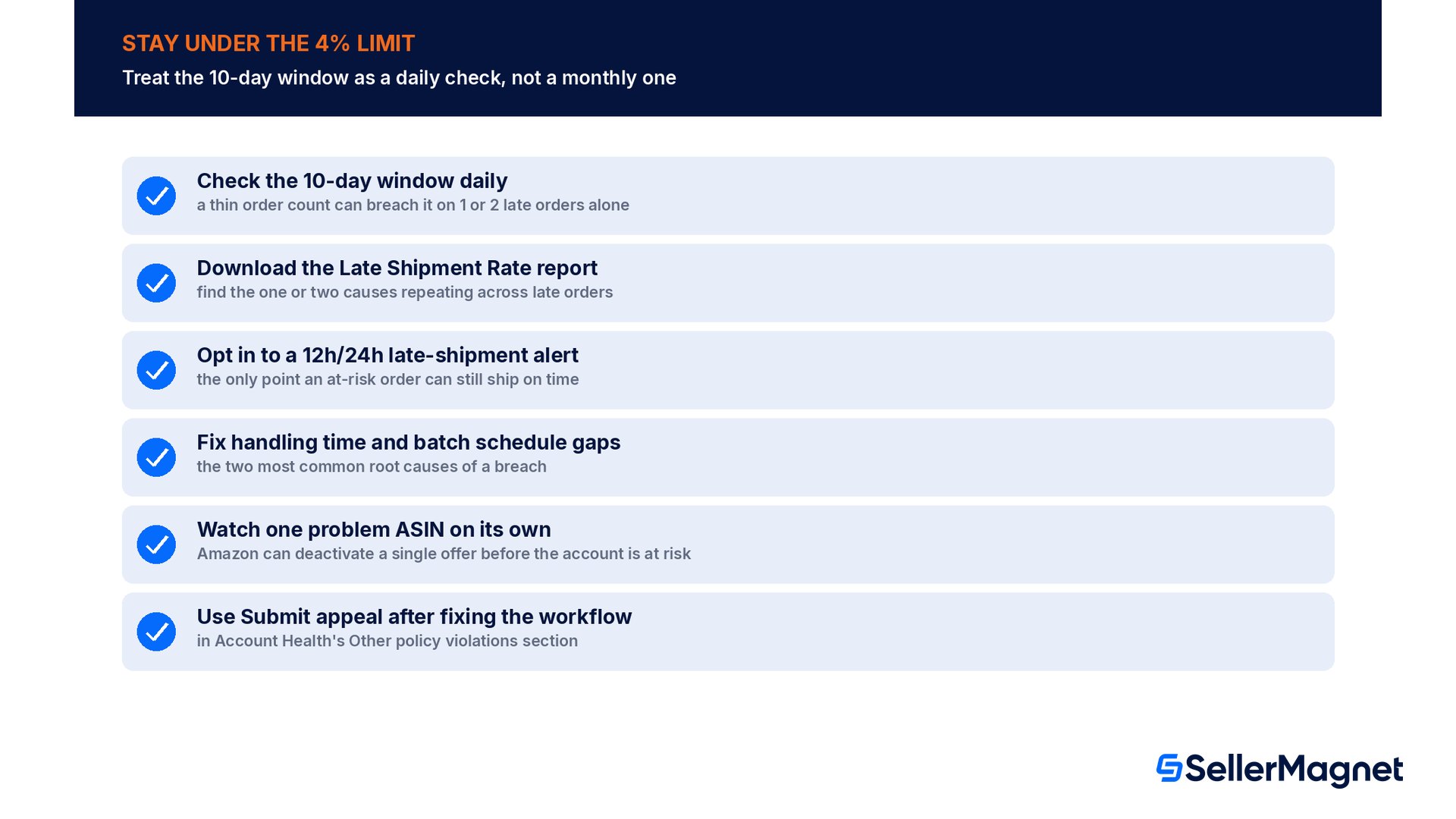
Checklist for staying under the 4% Late Shipment Rate limit
How to monitor and stay under Amazon's Late Shipment Rate limit
Open Account Health and find Shipping performance - Click View details, then select the Late shipment rate tab to see both the 10-day and 30-day figures.
Download the Late Shipment Rate report - It lists the individual orders counted as late, which is where the real pattern (one ASIN, one carrier, one time of week) usually shows up.
Check the 10-day window daily, not just the 30-day window monthly - A thin order count can breach the 10-day threshold on 1 or 2 late orders alone.
Opt in to a 12-hour and 24-hour late-shipment alert - Acting inside that window is the only point where an at-risk order can still ship on time instead of landing in the next LSR report.
Investigate any offer with a repeated late-shipment history on its own - Amazon can deactivate a specific seller-fulfilled offer before the account-level LSR is affected.
If an offer is deactivated, use the Submit appeal path in Account Health's Other policy violations section - Fix the underlying shipping workflow first; the appeal is weaker without it.
What counts as a late shipment for LSR?
An order with no shipment confirmation by the expected ship date, the date Amazon calculated from the seller's stated handling time, adjusted for national holidays.
Does LSR include FBA orders?
No. Late Shipment Rate only applies to seller-fulfilled (FBM) orders. FBA orders are tracked under Amazon's own separate fulfillment metrics.
What is the maximum Late Shipment Rate Amazon allows?
Amazon requires sellers to maintain an LSR under 4%, measured over both a trailing 10-day and a trailing 30-day period.
What happens if my LSR goes above 4%?
Amazon can suspend Fulfilled by Merchant selling privileges, or deactivate the specific seller-fulfilled offers with a history of late shipments.
Why did 2 late shipments put me over the limit when my 30-day rate looks fine?
LSR is measured on both a 10-day and a 30-day window independently. A low order volume in the 10-day window means each late order counts for a much bigger percentage than it would in a larger 30-day sample.
How do I recover from a deactivated seller-fulfilled offer?
From Account Health's Other policy violations section, use Submit appeal and follow the online reinstatement instructions, after fixing the shipping issue that caused the late shipments.
Is Late Shipment Rate the same policy on every Amazon marketplace?
The published policy text is consistent across marketplaces Amazon publishes it for: the 4% ceiling, the 10-day and 30-day windows, and the FBM-only scope match in the US, Germany, Italy, Spain and France help pages.
What other FBM metrics should I watch alongside LSR?
Pre-fulfillment Cancel Rate (under 2.5% over 7 days), Valid Tracking Rate (above 95% over 30 days) and On-Time Delivery Rate (90% or higher over 14 days) are the other three seller-fulfilled performance metrics on the same Account Health dashboard.
Stop Juggling Tools. SellerMagnet Combines Everything You Need.