Amazon Order Defect Rate 2026: ODR vs Contact Metrics
R
RenéFreelance Amazon Editor
|
15 min read
Order Defect Rate sits on every seller's Account Health page as a single percentage, with a flat rule attached: keep it under 1.0%, or Fulfilled by Merchant selling privileges are at risk. What that one number hides is that three completely different inputs feed it, one of them (A-to-z Guarantee claims) counts a refund differently depending on exactly when you issue it, and a separate set of three metrics tracks how fast and how well you reply to buyers in the first place, without directly touching ODR at all. This guide works through the definitions Amazon itself publishes for each metric, where in-house replies genuinely move the number and where only earlier detection does, with a worked example of the same defect either landing on your ODR or missing it entirely.
Order Defect Rate must stay under 1.0% over a rolling 60-day period, counting negative feedback, A-to-z Guarantee claims where you are at fault, and credit card chargebacks on seller-fulfilled orders. A separate set of FBM metrics, Buyer Contact Rate, Average Contact Response Time and Buyer Dissatisfaction Rate, earns Account Health Rating points but does not by itself restrict selling privileges. Replying within Amazon's 24-hour window can stop a buyer from escalating to a claim that would count against ODR; once a claim is filed, a late refund still counts.
Order Defect Rate: the three things that actually count
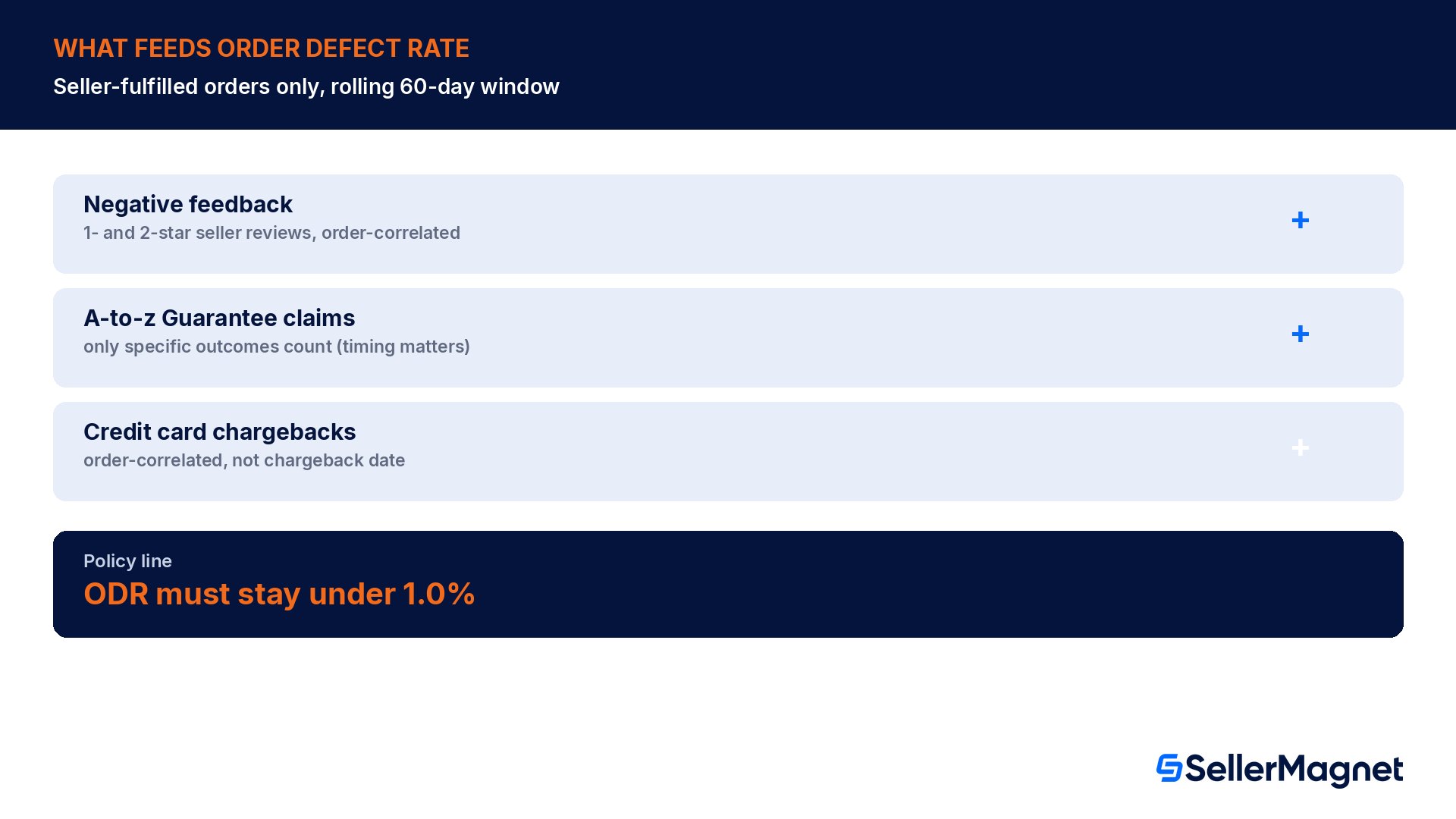
Seller Central is specific about the scope: "Order defect rate (ODR) measures a seller's customer service quality. ODR is the percentage of orders with one or more of the following indicators of poor customer service during a given 60-day period... ODR only applies to seller-fulfilled orders." FBA orders do not count toward this number at all, because Amazon is handling fulfillment and customer-facing logistics on those. The policy itself: "We require sellers to maintain their ODR less than 1.0% to sell in the Amazon store. ODR above 1.0% may result in suspension of your Fulfilled by Merchant selling privileges or deactivation of your seller-fulfilled offers."
ODR component
How Amazon defines it
Negative feedback
1- and 2-star seller reviews. Calculated as orders with negative feedback divided by orders in the period, order-correlated to the order date, not the date the feedback posted.
A-to-z Guarantee claims
Orders with a relevant claim divided by orders in the 60-day period. Only specific claim outcomes count (see the table below).
Credit card chargebacks
Orders with a chargeback divided by orders in the period, also order-correlated to the order date rather than the chargeback date.
A-to-z claims are not all-or-nothing
Seller Central draws a hard line inside this one component. Claims that DO impact ODR: "Claims that are granted to the buyer and for which Amazon determines that you were at fault. Claims for which you refunded the buyer after the claim was filed. Claims for which you or Amazon canceled the order. Claims that are pending a decision on appeal." Claims that do NOT impact ODR: "Claims for which Amazon determines that you were not at fault. Claims that are denied to the buyer. Claims that were withdrawn by the buyer. Claims that fall under the A-to-z claims process for property damage and personal injury." The timing of a refund inside that first bullet is the detail most sellers miss: refunding after a claim is filed still counts, refunding before one is filed does not create a claim at all.
The three FBM metrics that run alongside ODR, not inside it
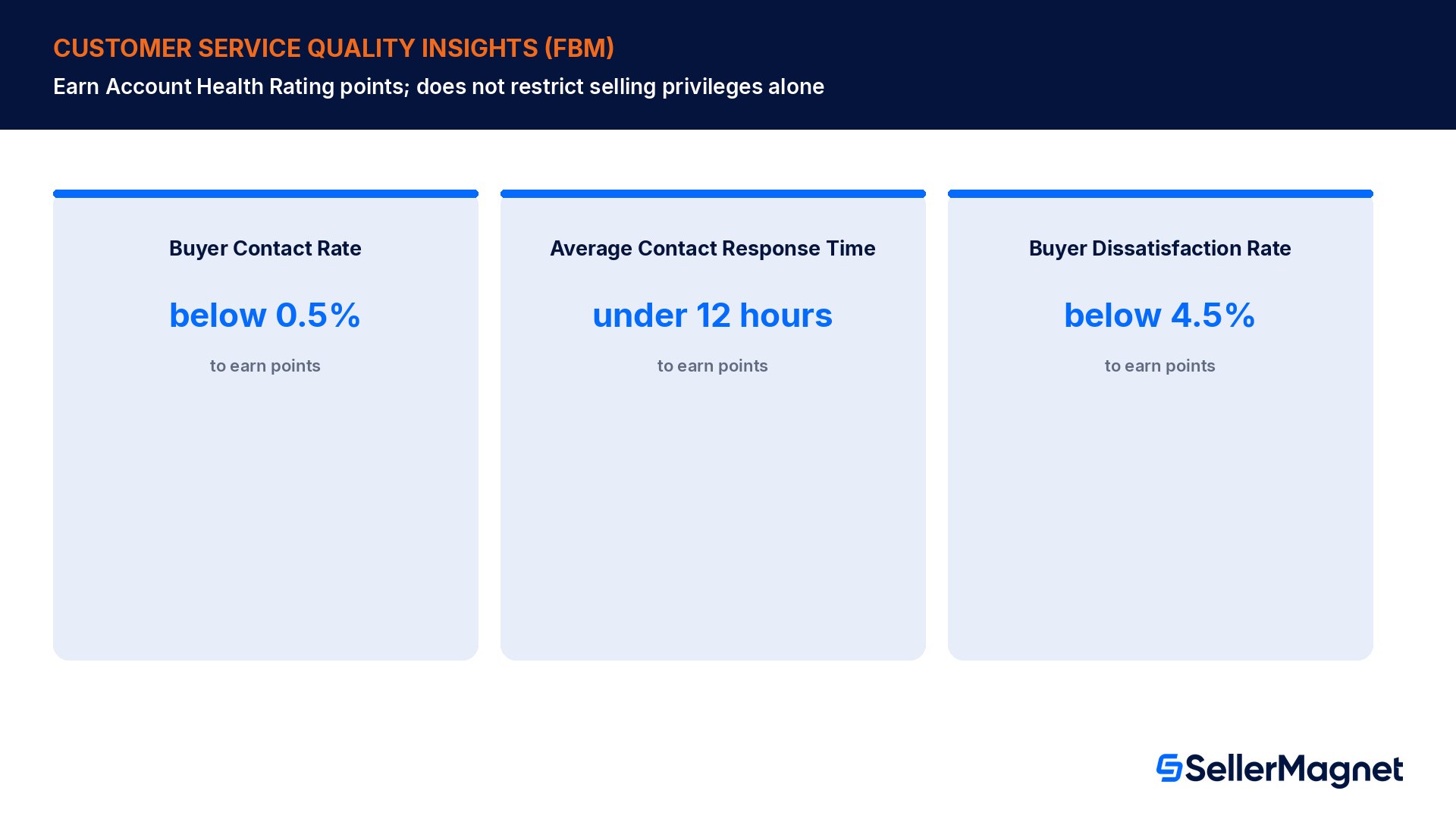
The Account Health Rating policy page adds a second, separate track for sellers with Fulfilled by Merchant orders: "Sellers who have Fulfilled by Merchant orders can also earn points based on their Buyer Contact Rate, Average Contact Response Time, and Buyer Dissatisfaction Rate performance. We will not restrict your selling privileges because of below-average performance on these metrics." Amazon's Customer Service Quality Insights FAQ names the exact standards sellers are measured against, and confirms the same point: these earn you Account Health Rating points, they do not independently trigger enforcement the way ODR does.
FBM metric
Standard to earn AHR points
What it measures
Buyer Contact Rate
below 0.5%
Share of orders that generate a buyer-initiated contact, benchmarked against other self-fulfilling sellers in your store.
Average Contact Response Time
under 12 hours
Average time taken to respond to customer messages, shown in hours; a value of zero means every reply landed in under 1 hour.
Buyer Dissatisfaction Rate
below 4.5%
Share of buyer contacts that signal dissatisfaction, the metric closest to predicting a future negative review or claim.
The FAQ is explicit that this comparison tool works differently from a pass/fail policy: "The insights allow you to compare your performance on these three metrics with other sellers in your store who also fulfill their own orders... You can earn points toward your score by meeting or exceeding the standards." A zero value is a good sign, not a missing one: "A zero (0) value for your Buyer Contact Rate means you have not received any contacts that meet the criteria for this metric... A zero (0) value for your Average Contact Response Time means you have responded to all your customer messages in less than 1 hour."
The 24-hour response rule, and what does not count as a response
Amazon's own performance-improvement guidance sets the floor every seller is measured against: "Respond to buyer messages within 24 hours, including on weekends and holidays. Auto-responders are not considered a valid response." The same page lists the practical fixes sellers are pointed to when response time is slipping: "Review the Contact Response Time table on your customer metrics page to monitor your list of open responses. Make sure that buyer messages are not being blocked by your email program's spam filter. Even if you can't resolve a buyer's concern immediately, you still need to respond to their email within 24 hours to let them know you are investigating their request. Provide a date by which they can expect a resolution." One more operational detail matters for the Buyer Contact Rate math: "If a message does not require a response (for example, a 'thank you' message), then make sure you mark it as 'No Response Required.'" Leaving it open instead inflates both the open-response count and, depending on how it is classified, the contact and response-time figures.
Where this intersects ODR directly
A missed or late reply does not itself create an ODR defect. What it does is remove the one window where a dissatisfied buyer could have been resolved quietly. A buyer who gets no answer, or a form-letter auto-response, within 24 hours is far more likely to escalate: leave 1- or 2-star feedback, or open an A-to-z claim. Both of those, once they land, are the actual ODR defects described above. The response-time metric and the defect-rate policy are two different rules that point at the same failure mode from two different angles.
Account Health Rating: the score both of these feed into
AHR runs on its own scale and its own window, wider than ODR's 60 days: "The AHR is a color-coded score that ranges from 0 to 1,000... All new sellers start with a score of 200, and over time, sellers will see a score that accurately reflects their account health based on policy adherence and selling activities over the last 180 days." The color bands: "If your AHR is green ('Healthy', based on a score of 200-1,000), that means your account is not at risk of deactivation... If your AHR is yellow ('At Risk', based on a score of 100-199), your account is at risk of deactivation. When your AHR is red ('Unhealthy', based on a score of 99 or lower), your account is either eligible for deactivation or already deactivated." ODR violations above the 1.0% policy line deduct AHR points directly; the three FBM metrics only add points when you meet their standards, so a seller who ignores them simply forgoes an easy cushion rather than losing ground. See our full walkthrough of the score in Amazon Account Health Rating 2026 for how points are weighted by violation severity and how to use the Submit appeal path once an account is already At Risk or Unhealthy.
Catch the order before it becomes a defect, not after.Amazon Alerts watches the same signals Amazon scores you on, negative feedback, A-to-z claims and chargeback risk, as soon as they appear in your account data, so you can respond or refund inside the window where it still prevents a defect instead of discovering it on next month's Account Health report. Analytics tracks your refund and contact timing against the order date, the same order-correlation Amazon itself uses for ODR, so you can see which open orders are closest to the line before they cross it.
Worked example: the same defect, two different outcomes
A seller with 400 seller-fulfilled orders in a 60-day window ends up with 2 pieces of negative feedback, 2 A-to-z claims where Amazon found them at fault, and 0 chargebacks. That is 4 defects across 400 orders: 4 / 400 x 100 = 1.0%, sitting exactly on the 1.0% policy line, close enough that one more defect in the next 60 days would put the account over it.
Now replay the same period with one change: this seller set up automated alerts on negative-feedback risk and acted inside the 24-hour response window on every flagged order. The two negative-feedback cases both got a reply and a resolution before the buyer left a review, so neither becomes a defect: 0 instead of 2. Of the two A-to-z-eligible disputes, one buyer was refunded before filing a claim at all, the exact scenario that "does not impact ODR," leaving 1 claim where the seller was still found at fault after the fact. Chargebacks stay at 0. New total: 1 defect / 400 orders x 100 = 0.25%, a seller-fulfilled defect rate that is nowhere near the line, from the same set of underlying customer problems. The in-house reply did not change what happened to the buyer's order; it changed whether the outcome was recorded before or after the line that defines a defect.
What happens when ODR actually crosses the line
Crossing 1.0% is not an automatic account-wide shutdown; Amazon's own description scopes the consequence to the offers that triggered it: "ODR above 1.0% may result in suspension of your Fulfilled by Merchant selling privileges or deactivation of your seller-fulfilled offers with high rates of negative feedback, A-to-z Guarantee claims, or credit card chargebacks." In practice this means Amazon watches for concentration, not just the headline average: "We closely monitor your listings with high rates of negative feedback, A-to-z Guarantee claims, or credit card chargebacks and may remove an offer if there is a history of these in a compressed time period." A handful of problem orders spread thinly across a large catalog reads differently from the same handful piled onto two or three ASINs.
The recovery path Amazon publishes is specific rather than open-ended: "If your seller-fulfilled offers are deactivated due to not meeting the ODR requirement, you can follow the appeal path from Seller Central's Account Health page by clicking Submit appeal and then following the online instructions for reinstatement." For offers pulled over a concentrated run of defects rather than a full ODR breach, the fix sits in a different corner of the same page: "You can reactivate the offers by following the instructions in your Account Health dashboard under the 'Other policy violations' section." Either path starts from the same place, the Account Health page, which is also where the underlying ODR report and its per-defect breakdown live so an appeal can point to specific orders rather than a bare percentage.
Negative feedback specifically: what Amazon tells sellers to do, and not do
Because negative feedback is the ODR component most directly tied to a single unhappy buyer rather than a policy ruling, Amazon's own seller-forum guidance on handling it is narrow and procedural: identify what caused the negative experience, reach out to the buyer to resolve it, and only after resolving their concern ask them to update or remove the review. The same guidance draws a firm boundary around that last step: "Remember that pressuring or incentivizing a buyer to remove or modify negative feedback is a violation of our policies." A buyer can be made whole with a refund, a replacement, or a genuine apology; what a seller cannot do is make removing the feedback itself part of that resolution, since a review that gets pulled under pressure is a separate policy risk on top of the original ODR defect. The practical order of operations stays the same as the A-to-z case above: respond fast enough, and resolve the actual problem well enough, that the review or claim never gets filed in the first place, because reversing one after the fact is far more constrained than preventing it.
Common mistakes mixing up these metrics
Treating Buyer Contact Rate, Average Contact Response Time or Buyer Dissatisfaction Rate as part of ODR; they are a separate FBM-only metric set that earns AHR points but is not a suspension trigger on its own.
Assuming a refund fixes an A-to-z claim's effect on ODR regardless of timing; only a refund issued before the claim is filed avoids the defect, a refund after filing still counts even though the buyer is satisfied.
Counting FBA orders into an ODR estimate; ODR only applies to seller-fulfilled orders, so FBA-fulfilled negative feedback or claims do not move this number.
Replying with an auto-responder and treating the message as handled; Amazon states directly that auto-responders are not considered a valid response.
Leaving a no-reply-needed message open instead of marking it No Response Required, which can inflate contact and response-time figures for no real benefit.
Reading a single bad week as a crisis without checking the window; ODR runs over a rolling 60 days and AHR over 180, so one order rolls out of the calculation as soon as the window passes it, not instantly.
How to respond inside the window that actually protects ODR
Resolve a flagged order before it becomes an ODR defect
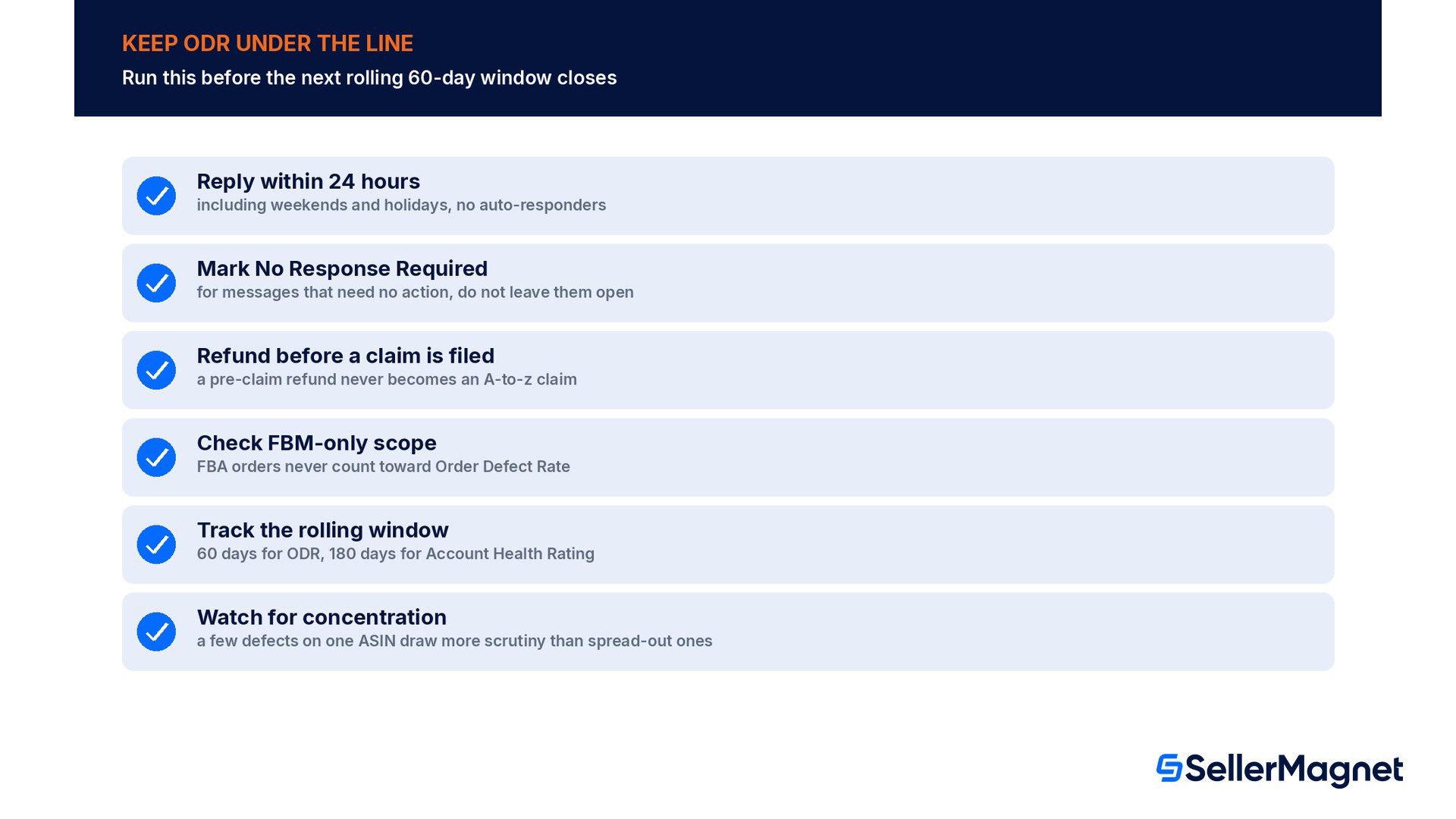
Catch the signal early - Watch for a negative-sentiment message, a late shipment, or a buyer asking where an order is, the point where a problem is still just a message, not yet a review or a claim.
Reply inside 24 hours - Send a real reply, never an auto-responder, within the required window, even if the resolution itself takes longer; state what you are doing and by when.
Mark non-issues closed - If a message needs no action, mark it No Response Required instead of leaving it open on the contact-response table.
Refund before escalation when warranted - If a refund is the right outcome, issue it before the buyer files an A-to-z claim; a pre-claim refund does not create a claim, a post-claim refund still counts as a defect.
Check the FBM-only scope - Confirm the order is seller-fulfilled before worrying about its ODR impact; FBA orders never count toward this metric.
Review the rolling windows monthly - Track ODR against its 60-day window and AHR against its 180-day window separately, since an old defect ages out of each on its own schedule.
What is Amazon's Order Defect Rate policy?
Sellers must keep ODR under 1.0% over a rolling 60-day period on seller-fulfilled orders, counting negative feedback, at-fault A-to-z Guarantee claims and credit card chargebacks. ODR above that line can lead to suspension of FBM selling privileges or deactivation of specific seller-fulfilled offers, especially where defects cluster on a small number of ASINs rather than spreading thinly across the catalog.
Does FBA negative feedback count toward ODR?
No. ODR only applies to seller-fulfilled orders, so feedback, claims or chargebacks tied to an FBA-fulfilled order never factor into this metric at all. That scope matters for mixed-fulfillment sellers: a catalog running both FBA and FBM should track ODR exposure against FBM order volume only, not total order volume, or the percentage will look artificially low.
Does refunding a buyer always remove an A-to-z claim from ODR?
Only if the refund happens before the claim is filed; Amazon counts that as a claim that never existed. A refund issued after filing still counts as a defect even though the buyer ends up satisfied, which is why speed in the first reply matters more than the eventual resolution quality for this specific metric.
Will a high Buyer Contact Rate or slow response time get my account suspended?
Not on its own. Amazon states directly it will not restrict selling privileges for below-average performance on Buyer Contact Rate, Average Contact Response Time or Buyer Dissatisfaction Rate alone. Meeting their published standards earns Account Health Rating points instead, which gives a cushion against violations elsewhere on the account rather than acting as a separate enforcement trigger.
What counts as a valid response to a buyer message?
A real, individualized reply sent within 24 hours, including weekends and holidays. Amazon states plainly that auto-responders are not considered a valid response, even if one fires within the window. Even when the issue cannot be fully resolved immediately, a reply acknowledging the request and naming an expected resolution date still satisfies the requirement.
What does a zero value mean on the Customer Service Quality Insights page?
A zero is a good sign, not missing data. A zero Buyer Contact Rate means no contacts met the criteria for that metric in the period; a zero Average Contact Response Time means every single reply went out in under 1 hour, the fastest band Amazon measures on that metric.
How is Account Health Rating different from Order Defect Rate?
ODR is one specific policy metric with its own 1.0% threshold measured over 60 days on seller-fulfilled orders only. AHR is the broader 0 to 1,000 score, measured over a rolling 180 days, into which ODR violations and many other unrelated policy violations are all combined to produce one color-coded health signal.
Should I mark a message No Response Required if it just says thank you?
Yes. Amazon's own guidance gives this exact example of a message needing no further action. Marking it closes it out on the contact-response table instead of letting it sit open indefinitely, which keeps the Average Contact Response Time and open-contact figures reflecting messages that genuinely still need a reply from you.
Stop Juggling Tools. SellerMagnet Combines Everything You Need.