FBA Donations Program 2026: Rules, Eligibility and Opt-Out by Country
R
RenéFreelance Amazon Editor
|
16 min read
Every seller who uses Fulfillment by Amazon eventually has to decide what happens to inventory that will not sell, returned units Amazon cannot restock as new, overstock sitting past its useful life, or product a seller simply wants off the books. Amazon's default answer for a large share of that inventory is not disposal and not a return to the seller, it is donation: the FBA Donations program, which Amazon's own Seller Central help pages describe as making it possible to 'automatically donate your unwanted inventory to select US nonprofits,' with every eligible seller enrolled in the US program by default, not as an opt-in choice. Outside the US, the rules are not uniform at all, France and Italy have gone further and disabled the opt-out entirely for inventory disposed of in their fulfillment centers, Germany defaults sellers out rather than in, and Spain requires an explicit opt-in through FBA settings for each country separately. None of this changes what a seller pays, Amazon states plainly that its usual donation or disposal fees still apply whether an item is donated or destroyed, so a seller who has never checked their own FBA Donations settings may be unknowingly donating saleable-adjacent inventory for exactly the same fee they would pay to have it destroyed. This guide lays out exactly what Amazon has published about the program, which products qualify, how the per-country rules actually differ, and where it fits next to Amazon's other value-recovery options.
The FBA Donations program automatically donates a US seller's unwanted, unsold or returned FBA inventory to select US nonprofits instead of destroying it, at the same donation or disposal fee Amazon already charges. Every eligible seller is enrolled by default and can opt out in FBA settings, though France and Italy have removed that opt-out for their own fulfillment centers, and Germany requires an opt-in instead. Dangerous, recalled, counterfeit or unsafe products are never eligible and go to disposal. Donated items are never reimbursable, but sellers receive an annual donation certificate for tax purposes.
What is the FBA Donations program, and who is in it by default?
Amazon's official Seller Central help page states the program's purpose directly: the FBA Donations program 'makes it possible for you to automatically donate your unwanted inventory to select US nonprofits.' The mechanism is tied to the removal process a seller already uses: 'When you request donation/disposal of eligible overstock, returned, or other unwanted FBA inventory in US fulfillment centers, Amazon makes it available to select US nonprofits,' and Amazon's 'usual donation/disposal fees apply' regardless of the outcome. The enrollment default is the detail many sellers miss entirely: Amazon's help page states 'you're enrolled in FBA Donations by default,' and once enrolled, 'we'll evaluate all of your eligible product disposals for donation.' A seller who has never opened the FBA Donations settings and who routes aging or returned inventory to disposal is, by default, already donating a share of it, not destroying it, with no separate fee and no separate action required. Amazon names Liquidations and Return to Seller as the alternative removal channels for a seller who specifically does not want their disposed inventory donated.
Which products qualify, and which are automatically excluded?
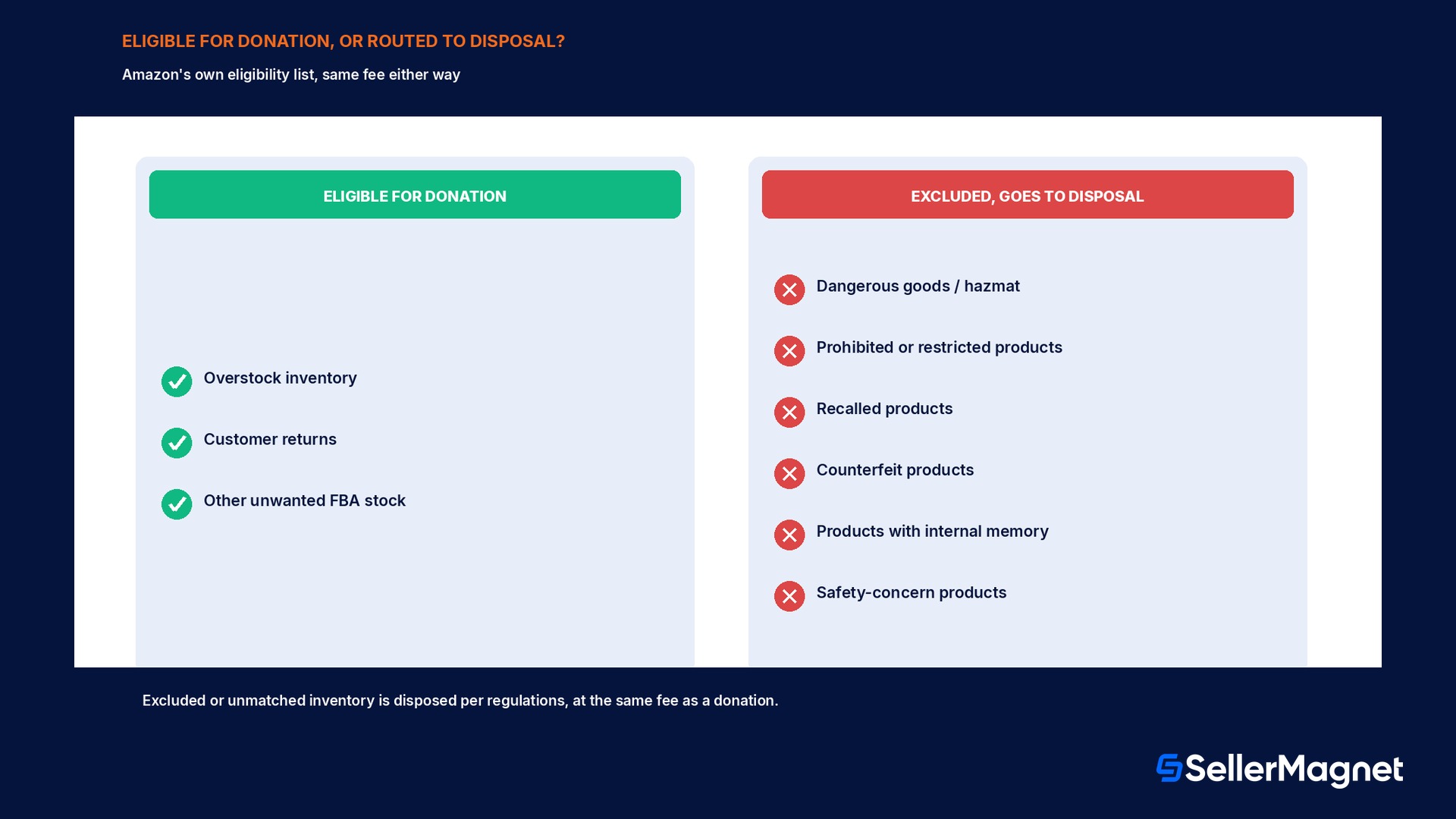
Amazon's FBA Donations help page states eligibility 'is subject to legal, safety, and regulatory guidelines, in addition to nonprofit location, interest, and need,' and lists the categories that are explicitly excluded from the program: dangerous goods (some types of hazmat), prohibited and restricted products, recalled products, products with internal memory, counterfeit products, products with safety concerns, and 'any other products that may be defective or inappropriate for donation.' If a unit falls into one of these categories or simply has no interested nonprofit partner for its condition and location, Amazon disposes of it 'in accordance with relevant regulations and safety guidelines' instead, at the same fee. Amazon also states plainly what its nonprofit partners are permitted to do with a donated unit: to 'prevent waste and encourage product re-use, these nonprofits may keep, sell, or redistribute donated goods with any proceeds going to benefit communities,' so a donated item is not guaranteed to be given away for free to an end recipient, only routed to a nonprofit rather than destroyed.
Category
Outcome under the program
Overstock, returns, other unwanted FBA inventory
Evaluated for donation to a nonprofit partner
Dangerous goods (some hazmat), prohibited or restricted products
Excluded; disposed per regulations
Recalled products, counterfeit products
Excluded; disposed per regulations
Products with internal memory, products with safety concerns
Excluded; disposed per regulations
Any product with no interested or eligible nonprofit partner
Disposed, same fee as donation
Can you opt out, and does the answer change by country?
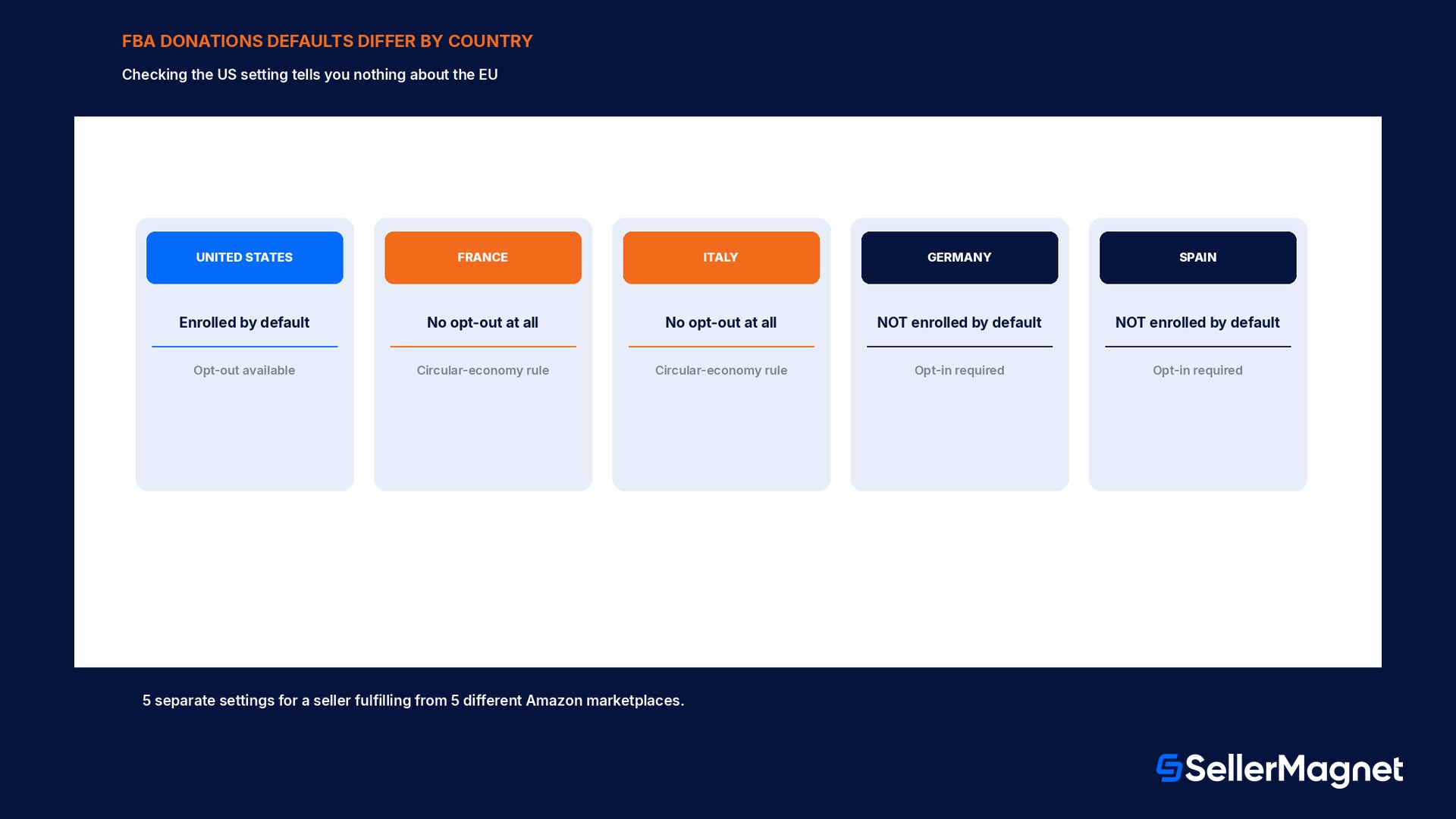
In the US base program, opting out is a seller's own choice: Amazon's value-recovery services page states a seller 'can opt out by disabling FBA Donations program in Fulfillment by Amazon settings at any time,' though 'disposals that are made after you opt out will no longer be eligible for the program,' meaning the choice is not retroactive. Outside the US, Amazon runs country-specific versions of the same program with different defaults. Amazon's own French-market help page states that 'to ensure compliance with France's circular-economy regulations, we're disabling the opt-out functionality of the FBA Donations program for inventory stored in France,' and inventory 'designated for disposal in our French fulfillment centers will be routed for donation' regardless of a seller's preference; the same removal of the opt-out applies to Amazon's Italian fulfillment centers for the same regulatory reason. Spain and Germany work the other direction: Amazon's help page for Spain and Germany describes an opt-in path through Seller Central (Settings, Fulfillment by Amazon, FBA Donations Program, then the country-specific toggle), and for Germany specifically states 'by default, you are not opted in to the FBA Donations program (Germany),' the reverse default of the US program.
Check each country separately
A seller fulfilling from more than one Amazon marketplace does not have one FBA Donations setting; the US program defaults to enrolled with an opt-out, Germany and Spain default to not enrolled with an opt-in, and France and Italy allow no opt-out at all for their own fulfillment centers. Checking the US setting alone does not tell a seller anything about their EU fulfillment centers.
How the UK version of the program is different again
The UK runs its own version of FBA Donations with rules that do not match the US, France, Italy, Germany or Spain versions, which makes it a sixth setting a multi-marketplace seller has to understand separately rather than assume follows one of the other patterns. Amazon's UK Seller Central help page states the programme 'makes it possible for you to automatically donate your unwanted inventory to selected charitable organisations,' and like France and Italy, 'the programme does not offer the option to opt out from the FBA Donations programme for Fulfilment by Amazon inventory stored in UK,' a decision Amazon ties directly to keeping its UK fulfilment operations 'consistent with our circular-economy commitment.' Where the UK version differs structurally from every other country version is in naming its nonprofit partners publicly and by name rather than describing them only as a category: Amazon states it has 'entered into partnership with' 7 named UK charities, Age UK, Barnardo's, British Heart Foundation, Cancer Research UK, Newlife, Scope and Sue Ryder, each of which 'will resell any inventory donated by Fulfilment by Amazon sellers and use the proceeds of the sales for their charitable purposes.' That resale detail matters for a seller's expectations: as with the US programme's own disclosure that nonprofits 'may keep, sell, or redistribute' donated goods, a UK donation is not a guaranteed free giveaway to an end recipient, it funds a named charity's own purpose through resale. The UK version also carries a financial detail none of the other country versions mention: Amazon states that 'donating your inventory may allow you to benefit from special Value Added Tax (VAT) exemptions for donations,' and specifically that the UK 'allows the donation of goods to registered UK charities to be zero-rated for Value Added Tax (VAT) when the goods will be sold, leased or exported by the charity,' meaning a qualifying donation carries no VAT liability on the goods donated, under VAT Notice 701/1, Section 5.5.4. Amazon tells UK sellers to verify their own donations through a different document than the US Donation Certificate: the Amazon VAT Transaction report, where a seller downloads the report and looks for items marked Donation in the Transaction type field, rather than waiting for a once-a-year certificate. Amazon has also announced a change sellers should expect to see formalized: effective 25 June 2026, Amazon introduced new 'FBA Donations - UK - programme terms and conditions' that it states explicitly align the UK programme 'with upcoming EU regulatory requirements, including the Ecodesign for Sustainable Products Regulation,' the same circular-economy direction already visible in France and Italy's removal of the opt-out. A seller who fulfills from the UK and assumes either the Germany/Spain opt-in model or the US opt-out-with-an-off-switch model applies would be wrong on both counts; the UK, like France and Italy, simply does not offer an opt-out at all, with the added VAT and named-charity detail that none of the other 5 country versions include.
The 3 reasons Amazon names for a donation with no reimbursement
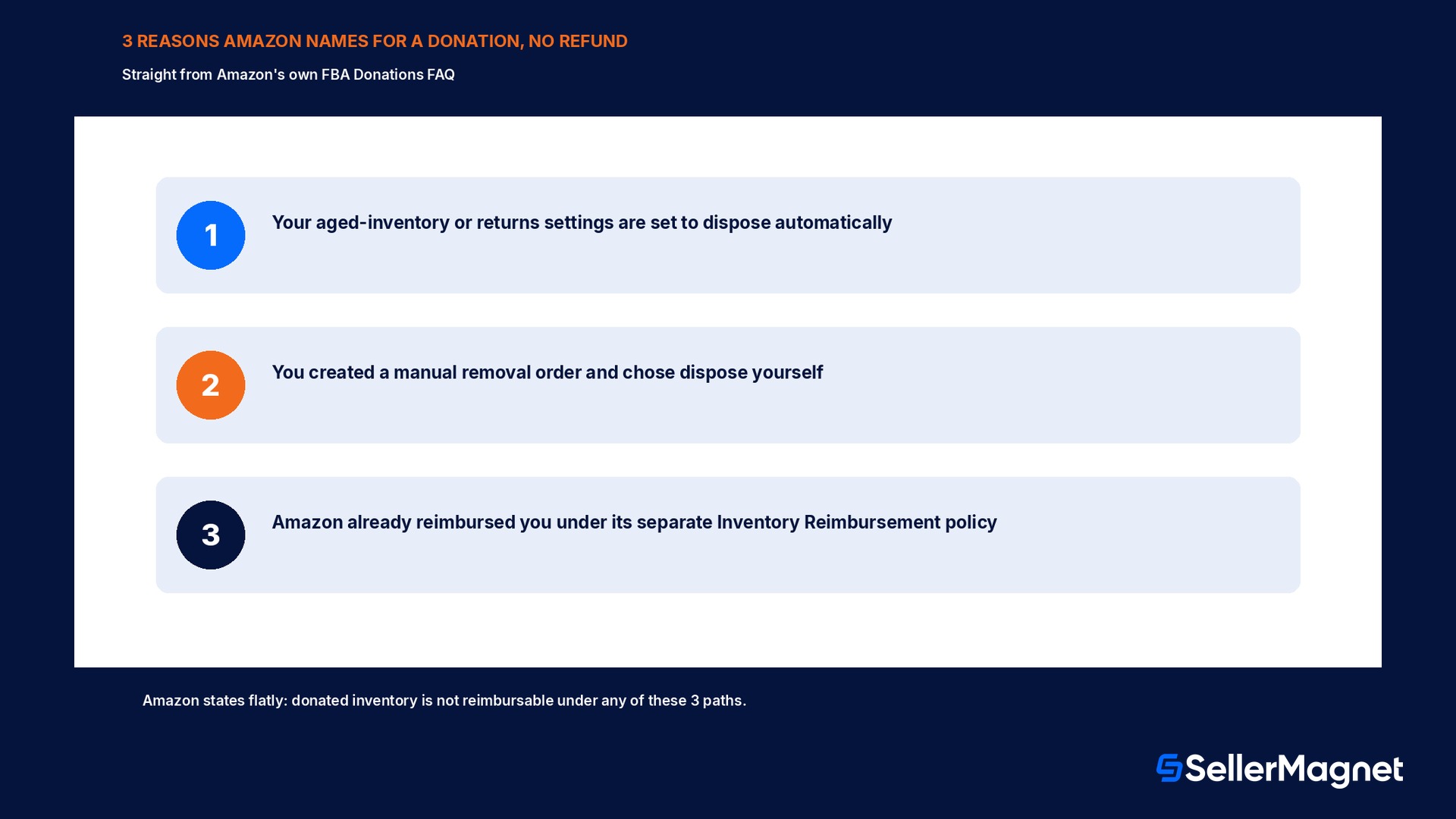
Amazon's own FBA Donations FAQ answers this directly under the heading 'Do I qualify for reimbursement on donated inventory?' with a flat 'No, donated inventory is not reimbursable,' followed by the 3 reasons Amazon states an item may have been donated. First, a seller's own account settings may have automated removals for aging inventory or customer returns set to dispose, meaning donate or recycle, those items automatically, a setting Amazon names specifically as the Automated aged inventory removal settings page. Second, a seller may have created a manual removal order and selected the dispose option themselves, which triggers the same donation or recycling outcome. Third, Amazon states it 'may dispose (donate/recycle) of inventory for which we reimburse you under the FBA Inventory Reimbursement policy,' meaning some units are both reimbursed under a separate Amazon policy and then donated or recycled rather than returned, which is not a contradiction on Amazon's own terms but is worth checking against that separate reimbursement policy if a seller expected different handling.
What the yearly donation certificate actually covers
Amazon states it 'cannot provide tax advice to sellers who take part in FBA Donations' and tells sellers to 'contact your tax adviser to discuss the program and to determine whether a charitable deduction is an option for you,' meaning the certificate is documentation, not a tax determination. The mechanics are specific: 'receipts for donations made in the previous year will be available on your Donation Certificates page,' generated 'on a yearly basis' and listing the inventory donated through the program in the prior year, with the certificate 'available by February 1.' Amazon also states the certificates 'are issued by our nonprofit partners on behalf of the recipient charities,' and that the nonprofit partners and recipient charities, not Amazon, 'are responsible for its content.' The accuracy of that certificate depends entirely on a seller's own account data: Amazon states receipts 'are generated based on your business information in Seller Central,' and explicitly warns it will not reissue a certificate that was generated from inaccurate business information, which makes verifying the Business address page before year-end a real, if small, action item rather than a formality.
What happens inside Refurbishment and FBA Grade and Resell specifically?
Two of the 4 non-donation options Amazon names deserve more than a one-line description, since both change what actually happens to a physical unit rather than just where the money goes. Refurbishment covers 2 separate services: repackaging, which Amazon describes as automatic for eligible items with damaged packaging but a sellable product inside, and a deeper, optional refurbishment service a seller enables separately in their automated unfulfillable settings. Amazon states that when refurbishment is enabled, 'FBA can re-tape, re-glue, and re-staple boxes; remove excessive tape, non-product labels, and stickers; and re-box branded and unbranded corrugated boxes,' and for shoes and apparel specifically, refurbishment 'can include steaming and removing stains and odors.' FBA Grade and Resell works differently again: it is invitation-only, and once invited, a seller enrolls it the same way, through automated unfulfillable settings, after which Amazon itself evaluates the condition of a submitted unfulfillable item, creates the listing, and lists the seller as the seller on record while the seller still sets the price and manages the listing going forward. Amazon states 'a processing fee applies' at the time of relisting, with one exception: 'no processing fee applies for submitted items that are graded as Unsellable,' meaning the one case where Amazon decides the item cannot be resold at all is also the one case where re-listing it costs nothing, since at that point it is effectively heading toward disposal or donation regardless.
How does donation compare to Amazon's other value-recovery options?
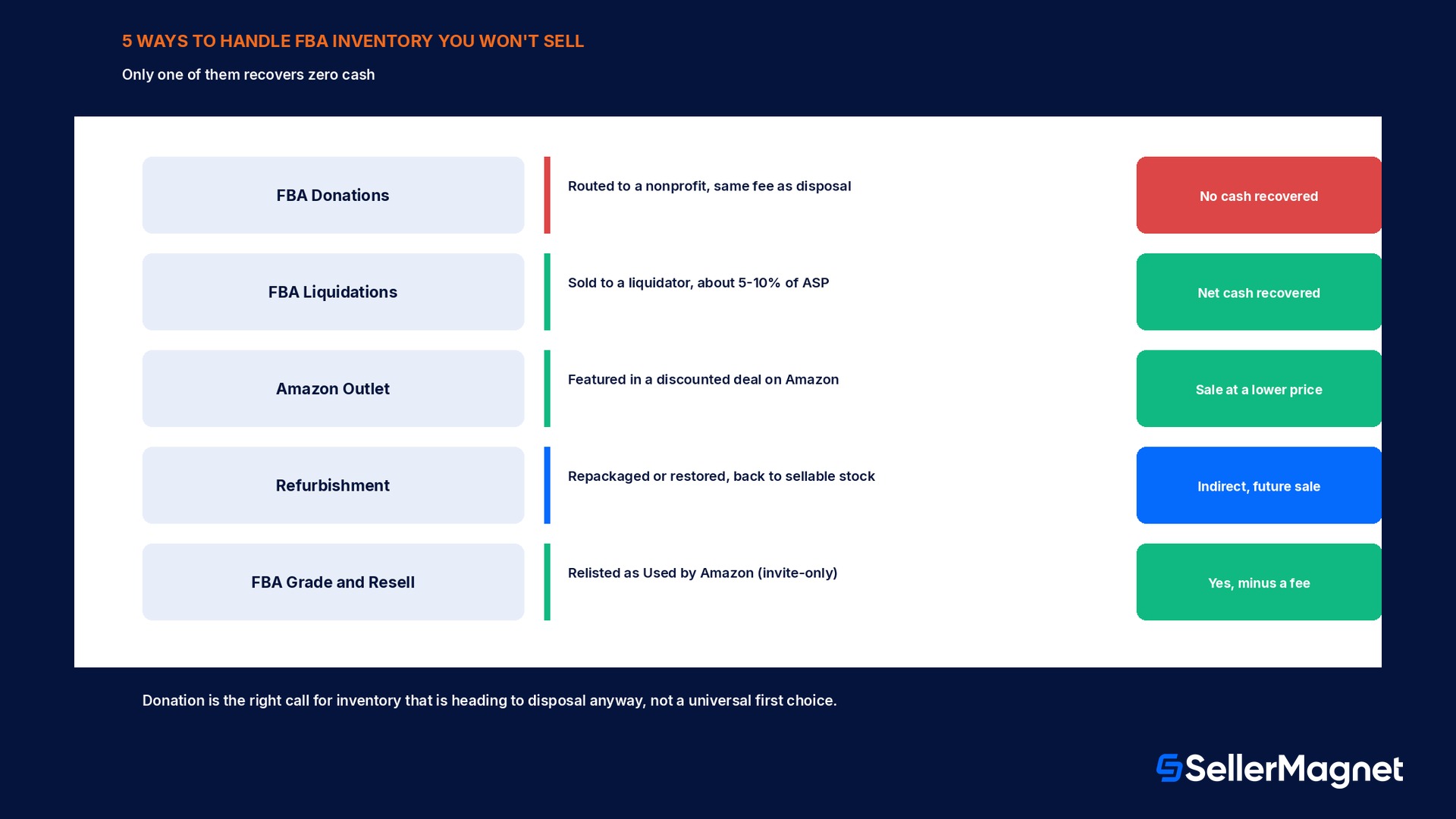
Amazon's own Value-recovery services help page groups FBA Donations alongside 4 other named programs for handling excess or unfulfillable FBA inventory, and each works on a different economic model. FBA Liquidations sells inventory to a contracted liquidator instead of disposing of it, for a gross recovery value Amazon states is 'about 5% to 10% of its average selling price,' with Amazon fees deducted before the net amount is paid to the seller, so unlike donation it returns some cash. Amazon Outlet lets a seller enroll excess inventory in deals featured on Amazon's own outlet storefront once Amazon approves them, aiming to sell the inventory at a discount rather than remove it from sale at all. Refurbishment repackages or restores items with damaged packaging but a sellable product inside, automatic for eligible items with an optional deeper refurbishment a seller can enable in their automated unfulfillable settings, so the unit goes back into sellable stock rather than leaving it. FBA Grade and Resell, invitation-only, lets a seller relist unfulfillable inventory as Used, with Amazon grading the condition and creating the listing on the seller's behalf and a processing fee applying at relisting, except for units graded Unsellable. Donation sits apart from all 4: it recovers no cash and returns no inventory to sale, its value is entirely the avoided-waste and tax-documentation angle, at the same fee a seller would pay for disposal regardless.
Value-recovery option
What happens to the inventory
Cash recovered?
FBA Donations
Routed to a nonprofit partner instead of destroyed
No, same fee as disposal
FBA Liquidations
Sold to a contracted liquidator (about 5-10% of ASP)
Yes, net of Amazon fees
Amazon Outlet
Featured in a discounted deal on Amazon's outlet storefront
Yes, at a lower sale price
Refurbishment
Repackaged or restored, returned to sellable FBA stock
Indirect, via a future sale
FBA Grade and Resell (invite-only)
Relisted as Used by Amazon on the seller's behalf
Yes, minus a processing fee
Mistakes sellers make with the Donations program
Never checking the setting at all. Enrollment is on by default in the US; a seller who assumes disposed inventory is destroyed may already be donating it.
Assuming the EU rule matches the US rule. France and Italy allow no opt-out; Germany and Spain require an opt-in; none of the 4 match the US default.
Expecting reimbursement for donated stock. Amazon states directly that donated inventory is not reimbursable, separate from the FBA Inventory Reimbursement policy that covers other situations.
Treating the donation certificate as tax advice. Amazon explicitly declines to give tax guidance and tells sellers to use their own tax adviser.
Letting business information go stale. A certificate generated from inaccurate business information will not be reissued, according to Amazon's own help page.
Assuming a donated item reaches a recipient for free. Amazon states its nonprofit partners may keep, sell, or redistribute donated goods, with proceeds benefiting communities, not a guarantee of a free direct giveaway.
Opting out as the automatic right move. For inventory that would otherwise be destroyed anyway, donation at no extra fee is often the better outcome than disposal, not a setting to disable by reflex.
Where SellerMagnet fits around FBA inventory decisions like this
FBA Donations is Amazon's own program, and no seller tool changes its enrollment, eligibility or fees, since Amazon runs the routing and the fee schedule entirely on its own side. Where SellerMagnet fits is in catching the inventory decision earlier, before a unit reaches the removal stage at all. Profit Analytics tracks sell-through and aging stock across SKUs on one dashboard, which is how a seller spots slow-moving inventory heading toward an automated aged-inventory removal before it is donated or disposed by default rather than after. On the pricing side, the repricer can keep a slow SKU competitively priced long before it becomes aged inventory candidate for removal at all, and Fee Audit checks whether a unit that was removed, donated or disposed should have triggered an Amazon reimbursement under a separate policy, the exact situation Amazon's own FAQ names as reason 3 for a donation with no refund. For sellers deciding what to restock instead of what to remove, Product Sourcer evaluates new ASIN opportunities so the next purchasing decision is less likely to end up as overstock heading for the same donation or disposal cycle.
Checklist before your next removal order
How to check your FBA Donations exposure before removing inventory
Open Fulfillment by Amazon settings and find the FBA Donations Program toggle - This is where US enrollment status lives, and where a seller opts out if they want disposal instead of donation.
Check each EU marketplace you fulfill from separately - France and Italy have no opt-out for their fulfillment centers; Germany and Spain require an explicit opt-in; none inherit the US setting.
Confirm your Business address information is current - Amazon generates the yearly donation certificate from this data and will not reissue one built on inaccurate information.
Check your automated aged-inventory removal settings - This is reason 1 Amazon names for an unexpected donation; confirm whether aging stock is set to dispose, return, or another channel.
Pull your Donation Certificate by February 1 if you want tax documentation - Share it with your own tax adviser; Amazon states it cannot determine whether a deduction applies to your situation.
Is the FBA Donations program opt-in or opt-out?
In the US, it is opt-out: every eligible seller is enrolled by default. Germany and Spain require an explicit opt-in instead, and France and Italy allow no opt-out at all for their fulfillment centers.
Does donating inventory cost more than disposing of it?
No. Amazon states its usual donation or disposal fees apply either way; there is no separate or additional fee for donation.
Can I get reimbursed for inventory that was donated?
No. Amazon states directly that donated inventory is not reimbursable, separate from the FBA Inventory Reimbursement policy that covers other cases.
What products are excluded from the FBA Donations program?
Dangerous goods, prohibited or restricted products, recalled products, products with internal memory, counterfeit products, and products with safety concerns; these go to disposal instead.
Do I get proof of my donations for tax purposes?
Yes, a yearly Donation Certificate is available by February 1 showing the prior year's donated inventory, though Amazon does not provide tax advice on whether it qualifies for a deduction.
Does the US FBA Donations setting apply to my EU fulfillment centers too?
No. Each country runs its own version of the program with its own default; the US, France, Italy, Germany and Spain settings are all separate.
What happens to inventory that is not eligible for donation?
Amazon disposes of it in accordance with relevant regulations and safety guidelines, at the same fee as a donation would have incurred.
Stop Juggling Tools. SellerMagnet Combines Everything You Need.