Amazon Global Logistics (AGL) 2026: How It Works and When It Pays Off
R
RenéFreelance Amazon Editor
|
12 min read
A factory in Shenzhen finishes a production run, and the seller who placed the order faces the same question every importing FBA seller eventually hits: pay a freight forwarder to quote, book, insure, and customs-clear the shipment as a separate vendor sitting outside Seller Central, or let Amazon itself move the inventory from the factory door to the fulfillment center under one booking. Amazon Global Logistics (AGL) is the second option: a freight service built into Seller Central's own Send to Amazon workflow that books ocean or air freight from the factory region straight into Amazon's network, with the FBA inbound placement fee question already folded into the booking rather than a separate line the seller has to figure out afterward. It is not the only way to get inventory to Amazon, and it is not available on every route. This guide works through exactly which origins and destinations AGL covers, the difference between its shipping modes, how the 4 inbound placement options change which fee a shipment owes (or doesn't), what booking a shipment actually involves, and where a seller is still better off with an independent freight forwarder instead.
Amazon Global Logistics (AGL) is a freight booking service inside Seller Central that moves FBA inventory from a seller's factory region directly into Amazon's fulfillment network by ocean or air freight, selected inside the normal Send to Amazon shipping-plan workflow by checking "I want to ship with Amazon Global Logistics program." It covers ocean freight (FCL or LCL) from China and Vietnam to the US, and from China to the UK, the EU and Japan where available, plus air freight from China to the US only. The quote is instant once weight and volume are entered, bundles freight with customs clearance, and 3 of its 4 inbound placement options waive the separate FBA inbound placement service fee that a self-arranged shipment would otherwise owe.
What Amazon Global Logistics actually is
Amazon Global Logistics is Amazon's own freight forwarding service for sellers, sitting inside the same Send to Amazon workflow a seller already uses to create a shipping plan, rather than a separate portal a seller has to learn from scratch. The seller checks a single box, "I want to ship with Amazon Global Logistics program," during shipping-plan creation, and from that point the shipment is booked, tracked, and customs-cleared by Amazon's freight operation instead of by whatever forwarder the seller would otherwise have called. The practical reason this exists is Amazon's own fulfillment-center network: because AGL is Amazon moving its own inbound inventory, it can offer placement options, covered below, that change which fee a shipment owes once it lands, something an outside forwarder has no way to influence since it has no visibility into Amazon's own warehouse network.
Origin
Destination
Mode available
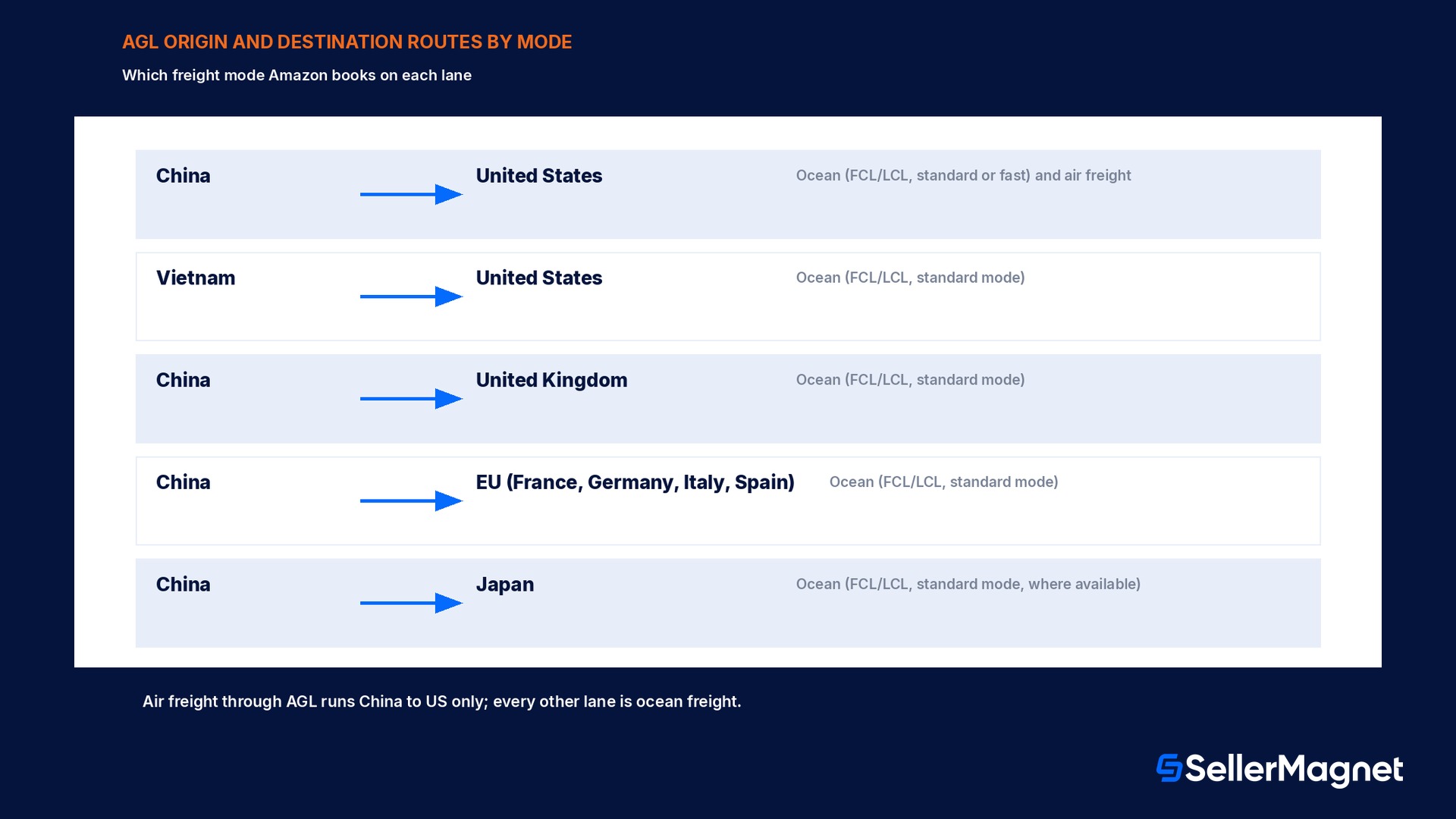
China
United States
Ocean (FCL/LCL, standard or fast) and air freight
Vietnam
United States
Ocean (FCL/LCL, standard mode)
China
United Kingdom
Ocean (FCL/LCL, standard mode)
China
EU (France, Germany, Italy, Spain)
Ocean (FCL/LCL, standard mode)
China
Japan
Ocean (FCL/LCL, standard mode, where available)
Air freight is US-only
Air freight through AGL only runs from China to US destinations. A seller shipping air freight into the UK, the EU or Japan, or shipping from Vietnam by air, is outside AGL's air option and needs an outside forwarder for that leg.
Ocean FCL vs LCL, and what "fast" actually changes
AGL's standard ocean mode offers 2 container choices for every lane it covers: full-container load (FCL), where the seller's cargo fills (or is billed for) an entire container, and less-than-container load (LCL), where the seller's cargo shares a container with other shipments and pays only for the space used. LCL is the natural fit for a seller whose production run does not fill a container on its own; FCL becomes cheaper per unit once volume crosses the point where a shared LCL rate costs more than booking the whole box. On top of standard ocean mode, AGL additionally offers a fast ocean shipping mode, but only for shipments landing in the US; sellers shipping into the UK, the EU or Japan have standard ocean mode only through AGL. Air freight, described by Amazon as its fastest entry into the Amazon network, is the quickest of all 3 options but is also the narrowest in where it runs: China to US destinations only, with no AGL air option for Vietnam-origin or non-US-destination shipments at all.
The 4 placement options, and which one actually waives the inbound fee
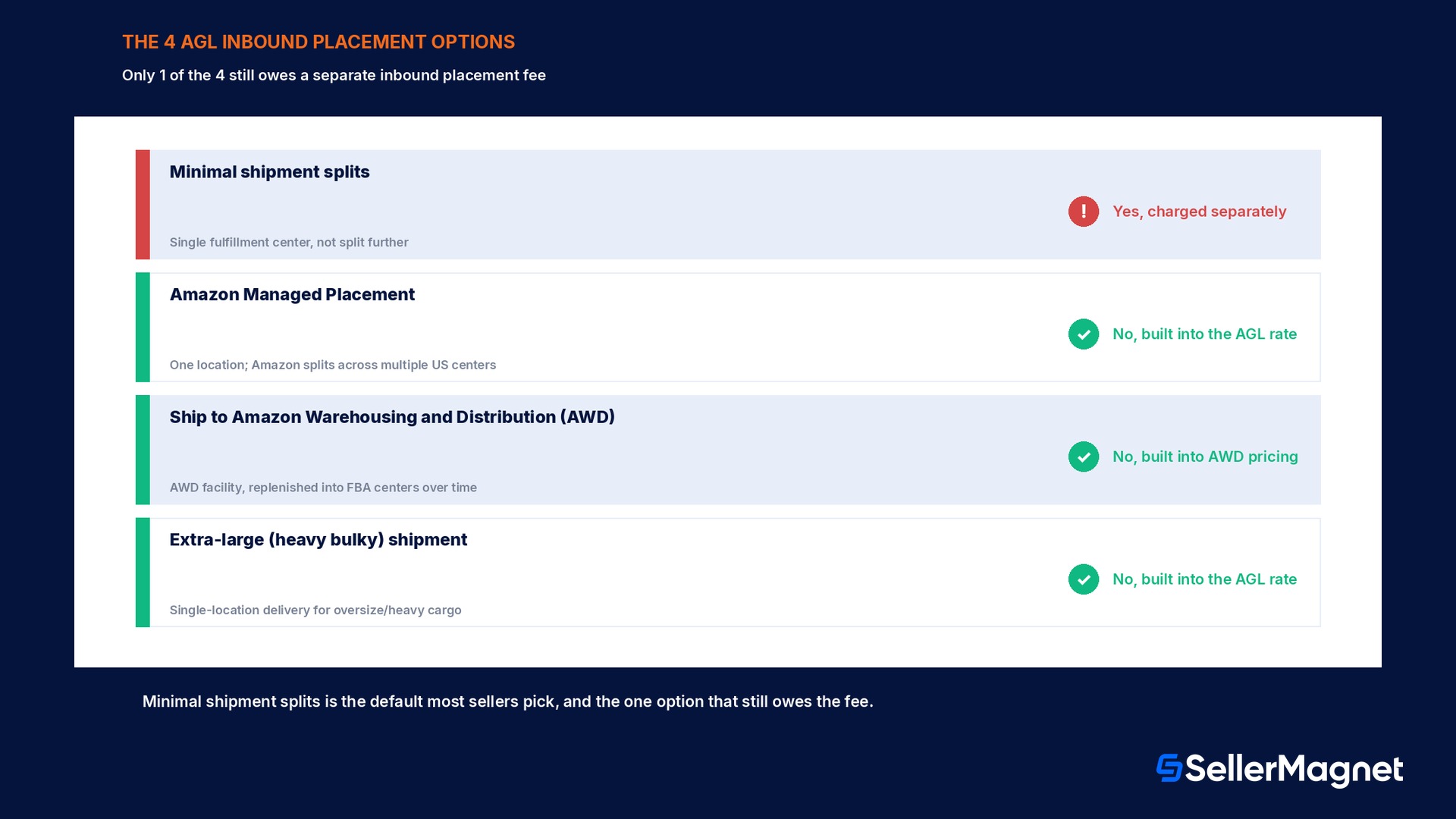
Every AGL shipment into the US chooses 1 of 4 inbound placement options at shipping-plan creation, and the choice is not just about where the inventory physically ends up; it directly decides whether a separate FBA inbound placement service fee applies on top of the AGL freight rate. Minimal shipment splits sends the inventory to a single fulfillment center without Amazon dividing it further, and this is the one option of the 4 that still carries its own, separately priced FBA inbound placement service fee alongside the AGL shipping rate. Amazon Managed Placement also delivers to one location, but lets Amazon decide how to split the inventory across multiple US fulfillment centers afterward, and that option carries no separate placement fee at all, Amazon's own posted rate for it already accounts for the destination charges that placement would otherwise add. Shipping to Amazon Warehousing and Distribution (AWD) routes the inventory into an AWD facility first, to be replenished into FBA fulfillment centers over time as needed, and here too there is no separate placement fee, because AWD's own pricing already covers what the inbound placement service fee would otherwise charge. The fourth option, extra-large (heavy bulky) shipment, exists specifically for oversize, heavy cargo that cannot be split across locations the way standard or large-bulky cargo can, and it also carries no separate placement fee. In practical terms, 3 of the 4 placement options available inside AGL waive the fee a seller would otherwise pay for inbound placement, and only the single-location, no-further-split Minimal shipment splits choice keeps it.
Placement option
What happens to the inventory
Separate inbound placement fee?
Minimal shipment splits
Goes to a single fulfillment center, not split further
Yes, charged separately
Amazon Managed Placement
Goes to one location; Amazon splits it across multiple US centers
No, built into the AGL rate
Ship to Amazon Warehousing and Distribution (AWD)
Goes to an AWD facility, replenished into FBA centers over time
No, built into AWD pricing
Extra-large (heavy bulky) shipment
Single-location delivery for oversize/heavy cargo
No, built into the AGL rate
Cargo type gates which placement options are even offered
Minimal shipment splits and Amazon Managed Placement are offered for standard (sortable) and large bulky (non-sortable) cargo. Ship to AWD is offered for standard (sortable) cargo only. Extra-large (heavy bulky) cargo has its own dedicated option rather than a choice among the other 3. Which options a seller even sees at booking depends on the cargo type the shipping plan declares, not just on preference.
How the quote and booking actually work
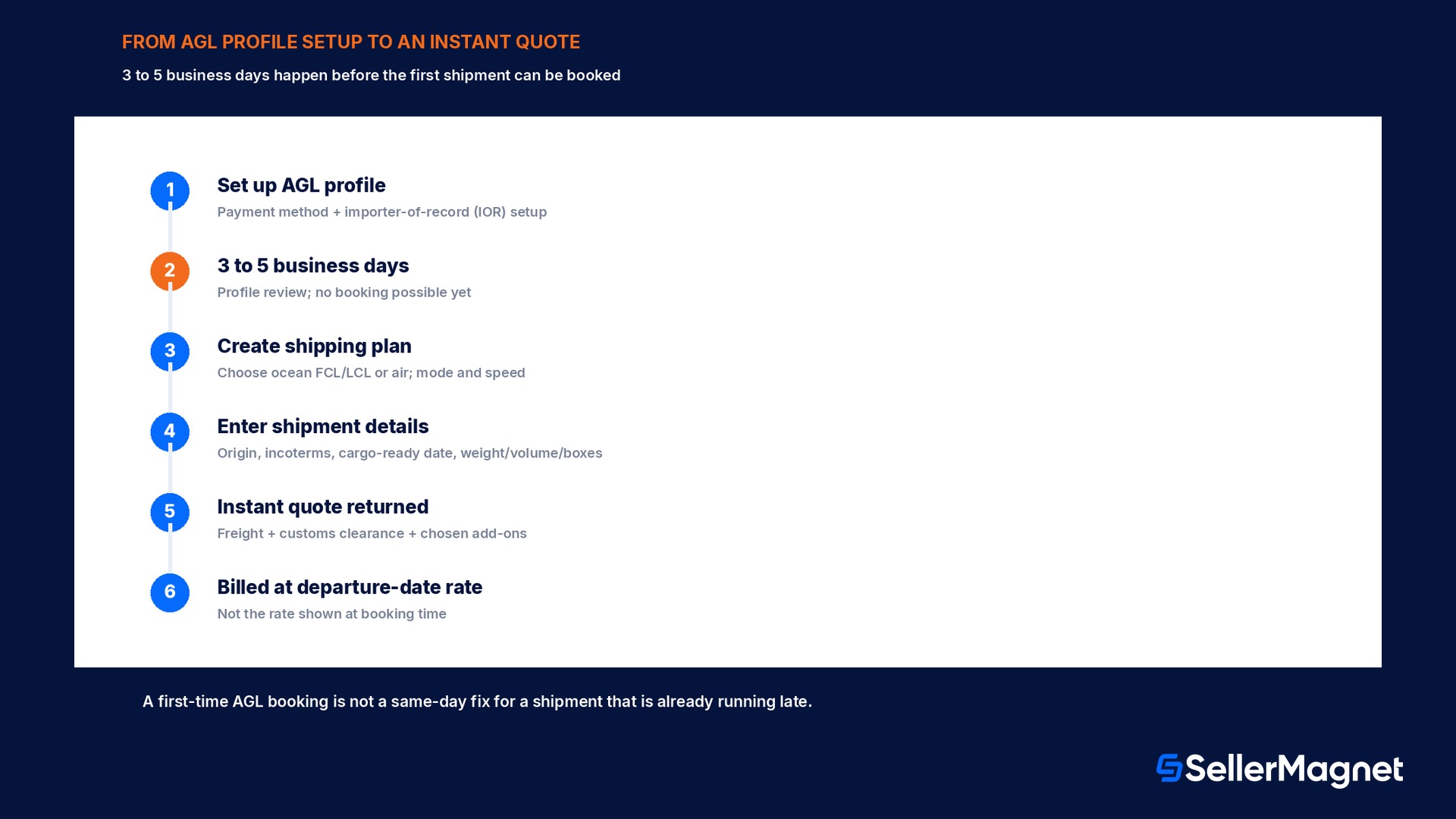
A seller books a shipment the first time by setting up an AGL profile inside Seller Central, choosing a payment method and completing importer-of-record (IOR) setup; Amazon's own guidance states this takes 3 to 5 business days before the first shipment can actually be booked, which is the detail that catches sellers who try to switch to AGL after a shipment is already running late and need something that works today. Once the profile exists, booking a specific shipment runs through the shipping-plan workflow: the seller selects shipping mode (ocean FCL, ocean LCL or air freight) and shipping speed (standard or fast, where offered), enters the origin location, incoterms, a pickup-or-drop-off preference and the cargo-ready date, then provides the shipment's weight, volume and box count. At that point Amazon returns an instant quote, and the quote is not a freight-only number: it bundles the end-to-end transportation cost with import and export customs clearance and, where the seller selects them, palletization and container-loading as priced add-ons. The one number worth remembering past the quote screen itself is that Amazon charges the shipment at the posted AGL rates in force on the actual departure date, not the rate that was quoted or displayed at booking time, so a quote taken weeks before cargo-ready should be treated as an estimate rather than a locked price.
Where sellers get the AGL decision wrong
Assuming AGL covers every lane a forwarder would. Air freight only runs China to US; ocean to the UK, the EU and Japan only runs from China, not Vietnam, and only in standard mode, never fast.
Booking the day a shipment needs to move. The 3-to-5-business-day profile setup has to happen before the first booking exists at all; it is not available same-day on a first-time account.
Picking Minimal shipment splits by default. It is the only one of the 4 placement options that still owes a separate inbound placement fee; Amazon Managed Placement, AWD or the extra-large option waive it, and the choice is made at booking, not fixable afterward on the same shipment.
Treating the booking-time quote as the final charge. AGL bills at the posted rate on the actual departure date, so a shipment that slips its cargo-ready date can land at a different rate than the one shown weeks earlier.
Not checking which cargo type gates which option. Ship to AWD is offered for standard (sortable) cargo only; a large bulky or extra-large shipment does not see it as a choice at all, regardless of preference.
Comparing AGL to a forwarder on freight rate alone. The AGL quote already includes customs clearance and, for 3 of the 4 placement options, the inbound placement fee a self-arranged shipment pays separately; a rate-only comparison undercounts what the outside forwarder route actually costs once those pieces are added back in.
Where SellerMagnet fits a decision AGL does not make for you
AGL itself does not tell a seller whether its bundled quote beats an existing freight forwarder relationship on a specific lane; that comparison depends on the seller's own landed-cost numbers, not a feature inside Seller Central. SellerMagnet's Fee Calculator breaks a shipment's FBA costs down into the same referral-fee and fulfillment-fee components an AGL quote has to be measured against, so a seller can see, size tier by size tier, whether the inbound placement fee that 3 of the 4 AGL placement options waive was ever a meaningful share of their per-unit cost to begin with. For sourcing decisions further upstream, the Sourcer tool keeps per-unit landed cost assumptions, including freight, next to the margin a product is actually expected to clear, so a change in freight mode or placement option shows up as a margin number rather than a separate spreadsheet a seller has to update by hand after every shipment.
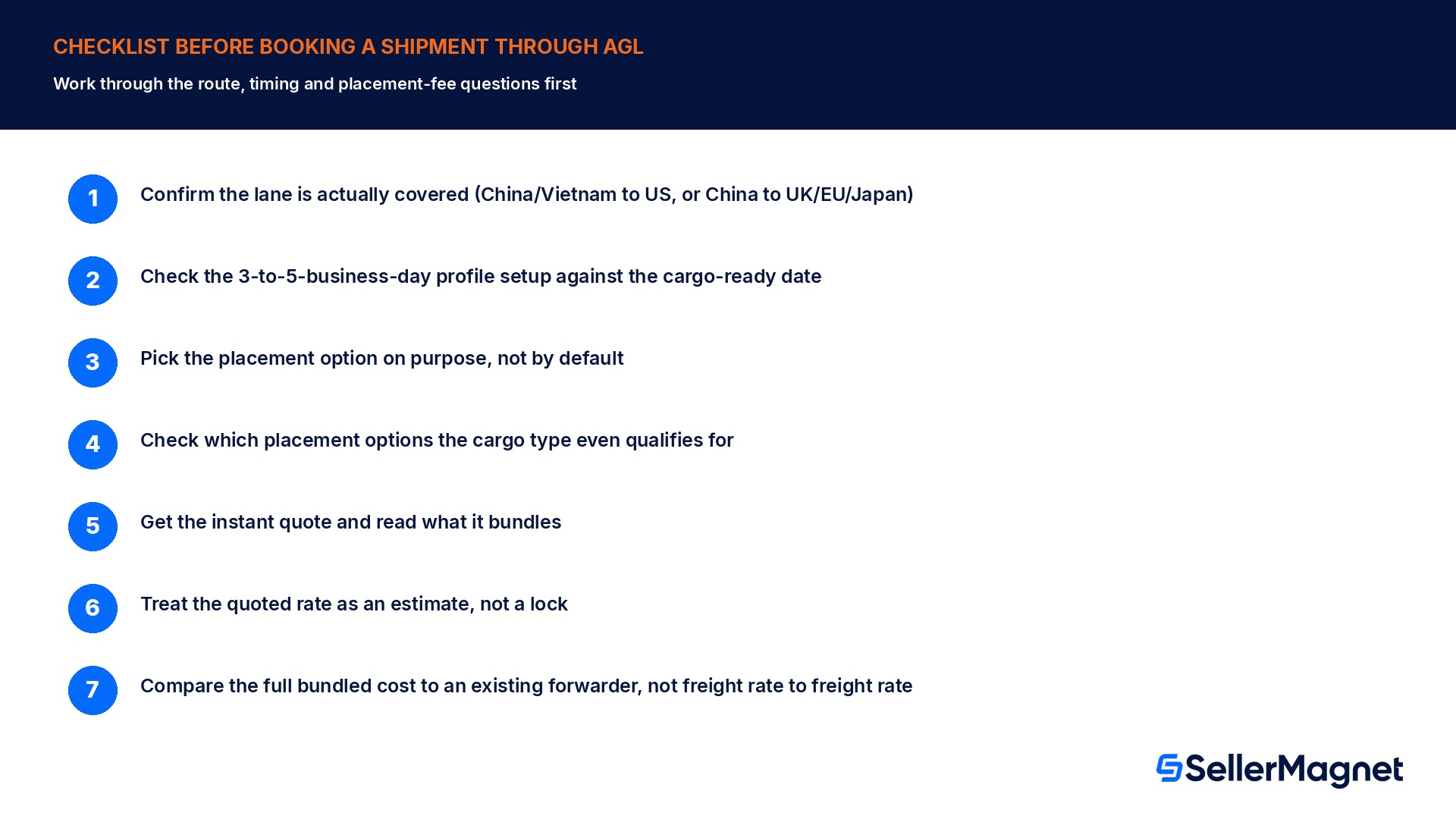
Checklist before booking a shipment through AGL
How to decide whether to book a shipment through Amazon Global Logistics
Confirm the lane is actually covered - China or Vietnam origin to the US, or China to the UK, the EU or Japan; air freight is China-to-US only.
Check the 3-to-5-business-day profile setup window against the cargo-ready date - A first-time AGL booking is not available same-day; set up the profile before a shipment is already running late.
Pick the placement option on purpose, not by default - Amazon Managed Placement, Ship to AWD, or extra-large (heavy bulky) waive the separate inbound placement fee; Minimal shipment splits does not.
Check which placement options the cargo type even qualifies for - Ship to AWD only appears for standard (sortable) cargo; large bulky and extra-large cargo see a narrower set of choices.
Get the instant quote and read what it bundles - Freight, customs clearance, and any palletization or container-loading add-ons selected, not freight alone.
Treat the quoted rate as an estimate, not a lock - The actual charge uses the posted AGL rate on the real departure date, so re-check pricing if the cargo-ready date slips.
Compare the full bundled cost to an existing forwarder, not freight rate to freight rate - Add back customs clearance and the inbound placement fee a self-arranged shipment would separately owe before comparing numbers.
What is Amazon Global Logistics (AGL)?
AGL is Amazon's own freight booking service inside Seller Central's Send to Amazon workflow. It books ocean or air freight to move FBA inventory from a seller's factory region directly into Amazon's fulfillment network, selected by checking a box during shipping-plan creation.
Which countries can I ship from and to with AGL?
Ocean freight covers China and Vietnam to the US, and China to the UK, the EU (France, Germany, Italy, Spain) and Japan where available. Air freight only covers China to the US; there is no AGL air option for any other origin or destination.
Does using AGL always avoid the FBA inbound placement service fee?
No. Only 3 of its 4 placement options waive that fee: Amazon Managed Placement, Ship to Amazon Warehousing and Distribution, and extra-large (heavy bulky) shipments. The Minimal shipment splits option still carries a separately charged inbound placement fee.
How fast can I book my first AGL shipment?
Not immediately. Amazon's own guidance states that setting up an AGL profile, payment method and importer-of-record details takes 3 to 5 business days before the first shipment can be booked.
Is the quote I get from AGL the price I actually pay?
Not necessarily. AGL gives an instant cost estimate once weight and volume are entered, but the shipment is billed at the posted AGL rates in force on the actual departure date, not the rate shown at the time of booking.
Does the AGL quote include customs clearance?
Yes. Amazon's own description of the AGL quote states it includes costs for both end-to-end freight and import/export customs clearance, plus palletization or container loading if the seller selects those as add-ons.
Stop Juggling Tools. SellerMagnet Combines Everything You Need.