Amazon GWD 2026: Global Warehousing and Distribution
R
RenéFreelance Amazon Editor
|
16 min read
At Accelerate 2026, Amazon announced a set of connected tools built to fix a specific, measured gap: only 30% of its sellers list in more than one country, even though sellers active in more than one country earn 70% more revenue on average. The centerpiece is Global Warehousing and Distribution (GWD), a new program that pools inventory across borders instead of forcing a seller to manage a separate batch, compliance process, and warehouse relationship for every country.
This guide covers what GWD actually does, how it differs from the Amazon Warehousing and Distribution (AWD) program already live in several regions, the new one-submission compliance process, a worked storage-savings example, and a worked revenue-uplift example using Amazon's own published figures.
Amazon's Global Warehousing and Distribution (GWD), announced at Accelerate 2026, lets sellers ship one manufacturing run to a single Amazon facility and reach multiple countries from that one shipment instead of splitting inventory per country. It runs in the US today and expands to the UK, Japan, Germany, France, Italy, Spain and Canada by the end of 2026, for eight countries under one pooled inventory, with storage costs up to 45% lower than AWD in the US and FBA replenishment up to 5 days faster.
The problem GWD is built to solve
Amazon's own numbers frame the problem plainly: 30% of its sellers list in only one country, largely because going global has historically meant managing separate inventory, separate compliance paperwork, separate listings, and separate logistics relationships for every destination country. Amazon describes this as effectively starting a new business per country. The announcement's headline number is the incentive on the other side of that friction: sellers who are active in more than one country earn 70% more revenue on average than sellers selling in just one. GWD, the one-submission compliance process, and a new unified opportunity dashboard are Amazon's answer to that gap, built to remove the operational overhead that has kept most sellers from expanding.
What does Global Warehousing and Distribution (GWD) actually do?
GWD's mechanic is a single pooled inventory. Instead of splitting one manufacturing run into separate batches shipped to separate country-specific warehouses, a seller ships that entire run to one Amazon-operated facility located near their factory. From there, Amazon moves units to a specific destination country only when there is real demand for them there, rather than the seller pre-guessing a split across markets before a single unit has sold. Once inventory reaches its destination country, it flows directly into the local Fulfillment by Amazon (FBA) network for delivery to customers in that market.
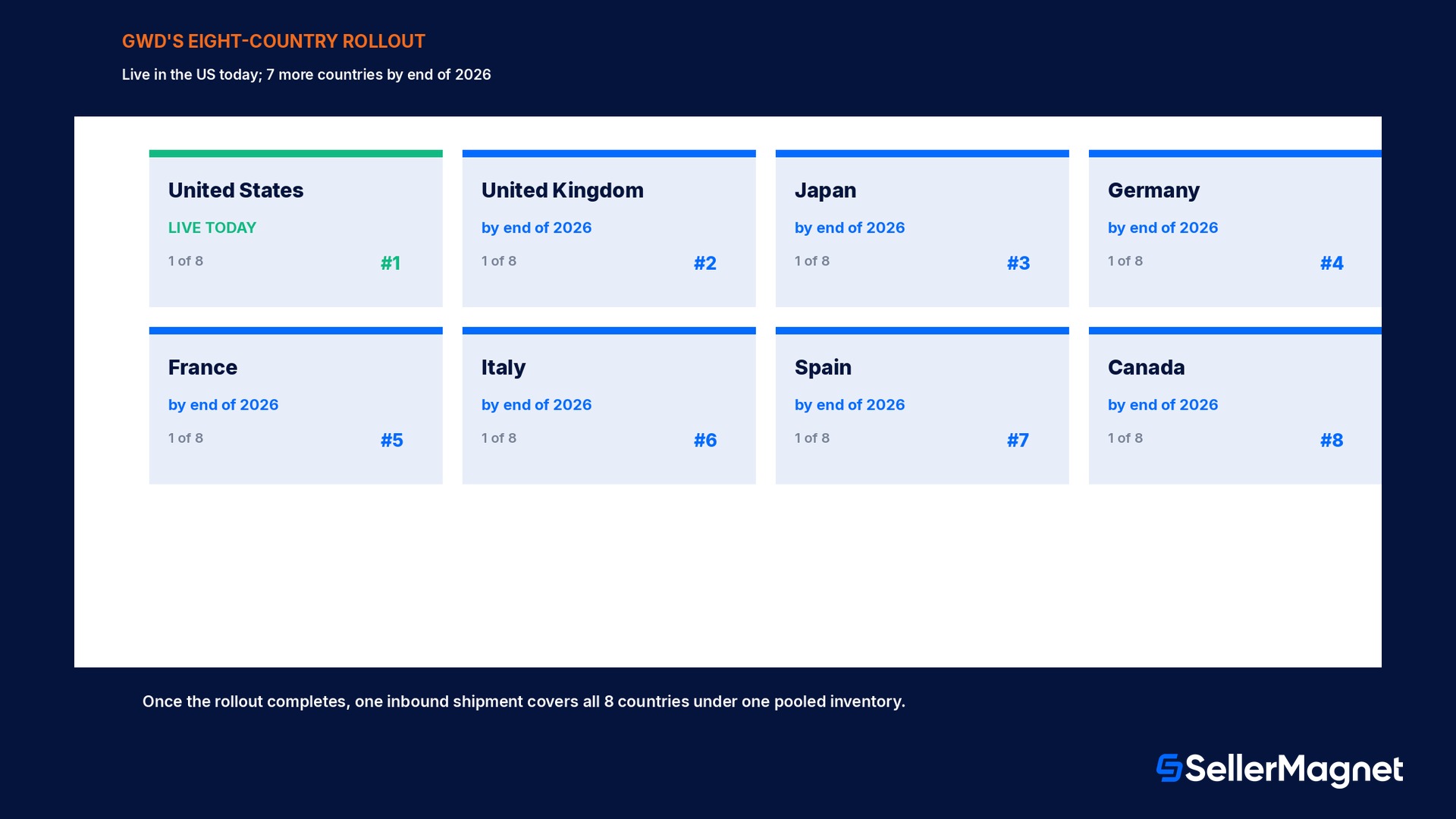
The united states: GWD is live today.
By the end of 2026, GWD expands to: the United Kingdom, Japan, Germany, France, Italy, Spain, Canada.
Once that rollout completes, one inbound shipment covers all 8 countries rather than requiring 8 separate inbound shipments.
Storage costs run up to 45% lower than AWD pricing in the US.
Replenishment from GWD into local FBA fulfillment centers can be up to 5 days faster than the comparable non-pooled path.
GWD is a rollout, not a single switch
Amazon's own wording frames this as capabilities arriving in stages: GWD connects to the US today, the seven additional countries are described as arriving "by the end of the year," and some capabilities described alongside it (a single global listing, country-by-country compliance auto-flagging) are explicitly "rolling out over the coming weeks and months, with more planned for 2027." Check your own Seller Central account for GWD's current availability in your target countries before planning around a specific date.
How is GWD different from AWD?
It is easy to conflate GWD with AWD (Amazon Warehousing and Distribution) because both names start with the same two words and both deal with bulk storage. They solve different problems. AWD is a single-region, low-cost bulk storage service: a seller stores a large batch of inventory in an AWD facility within one region, and Amazon automatically replenishes FBA from that store as units sell, without the seller micromanaging restock timing. AWD has expanded beyond the US into the EU, the UK, Australia, which gives sellers a low-cost storage option positioned closer to customers in each of those regions. See our separate guide to AWD in Europe for the flat-rate storage launch in five European stores; that program is scoped to one region at a time, not cross-border pooling.
GWD sits on top of that idea but adds the piece AWD does not have: cross-border pooling from a single inbound shipment. Where AWD asks "how do I store a lot of inventory cheaply in one region and auto-replenish FBA from it," GWD asks "how do I ship one run of inventory once and let Amazon decide which of up to 8 countries each unit should end up in, based on actual demand." A seller can use both: AWD for low-cost regional bulk storage, and GWD for the cross-border routing layer that gets inventory into the right country-level AWD or FBA stock in the first place.
AWD (Amazon Warehousing and Distribution)
GWD (Global Warehousing and Distribution)
What it solves
Low-cost bulk storage + automatic FBA replenishment, one region at a time
Cross-border inventory pooling from a single inbound shipment
Regions
US, plus the EU, the UK, Australia
The united states today, expanding to 8 countries by end of 2026
Shipment model
One region's batch per facility
One manufacturing run ships once; Amazon routes units to the country with real demand
Storage cost vs AWD US
Baseline
Up to 45% lower
Worked example: storage savings on one SKU family
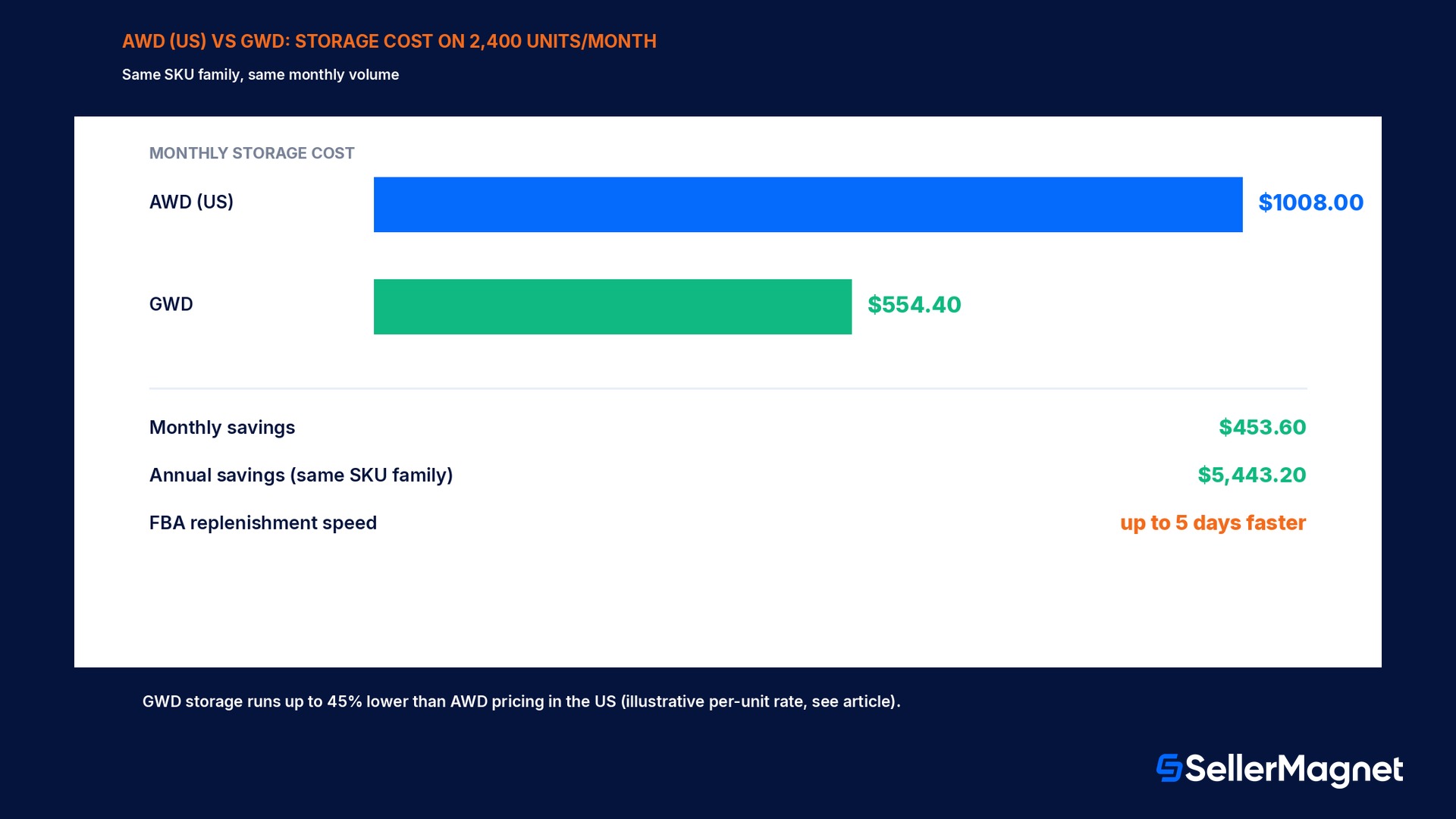
Say a seller moves 2,400 units a month through AWD storage in the US at an illustrative $0.42 per unit per month, for a monthly storage cost of $1,008.00. At the 45% savings GWD advertises relative to AWD US pricing, the equivalent monthly cost comes down to $554.40, a saving of $453.60 a month, or $5,443.20 over a year on this SKU family alone.
AWD (US)
GWD
Units per month
2,400
2,400
Storage cost per unit
$0.42
up to 45% lower
Monthly storage cost
$1,008.00
$554.40
Monthly savings
-
$453.60
Annual savings
-
$5,443.20
The per-unit rate above is an illustration, not an Amazon-published number
Amazon publishes the percentage savings (up to 45%) and the replenishment-speed improvement (up to 5 days), not a flat per-unit storage rate; the $0.42 figure here is a worked illustration so you can see the mechanics. Check your own AWD storage invoice for the real baseline before projecting a savings figure for your own catalog.
On the replenishment side, a seller whose current non-pooled restock cycle takes 11 days from GWD-eligible inventory to live FBA stock could see that cycle fall to roughly 6 days once GWD's faster path is live for their lane, meaning less inventory sitting in transit and fewer stockout days on fast-moving SKUs.
Worked example: the revenue case for going multi-country
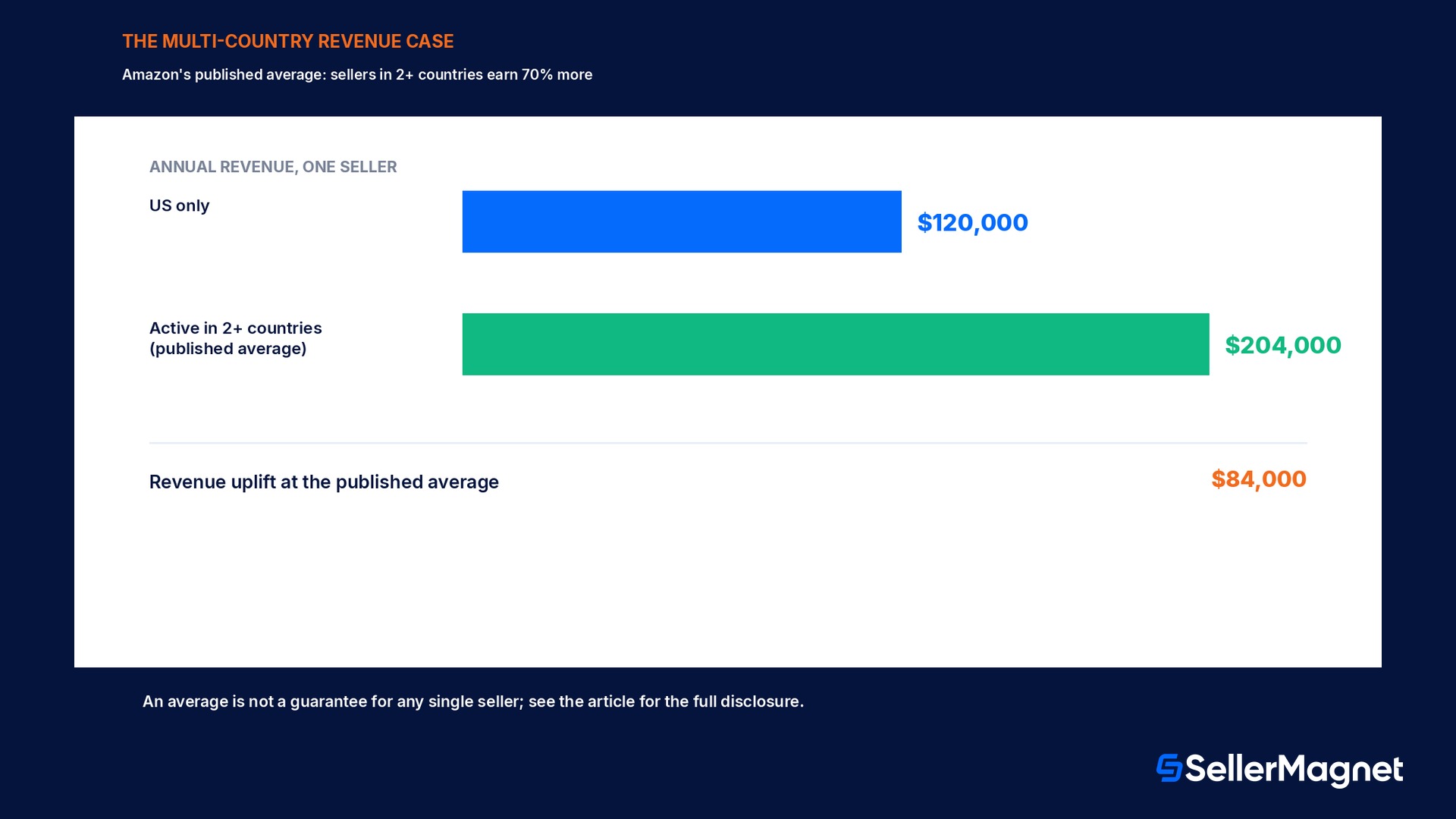
Take a seller doing $120,000 a year selling only in the US. Applying Amazon's published average, sellers active in more than one country earn 70% more revenue on average than single-country sellers, that same seller's revenue profile, if it tracked the published average after expanding, would land around $204,000, an uplift of $84,000.
An average is not a guarantee for any one seller
The 70% figure is Amazon's own published average across its multi-country sellers, not a forecast for a specific product, category or account. Treat the $84,000 figure above as an illustration of what the published average implies for one specific starting revenue, not a number any single seller should expect to hit.
One-submission compliance: test once, certify across countries
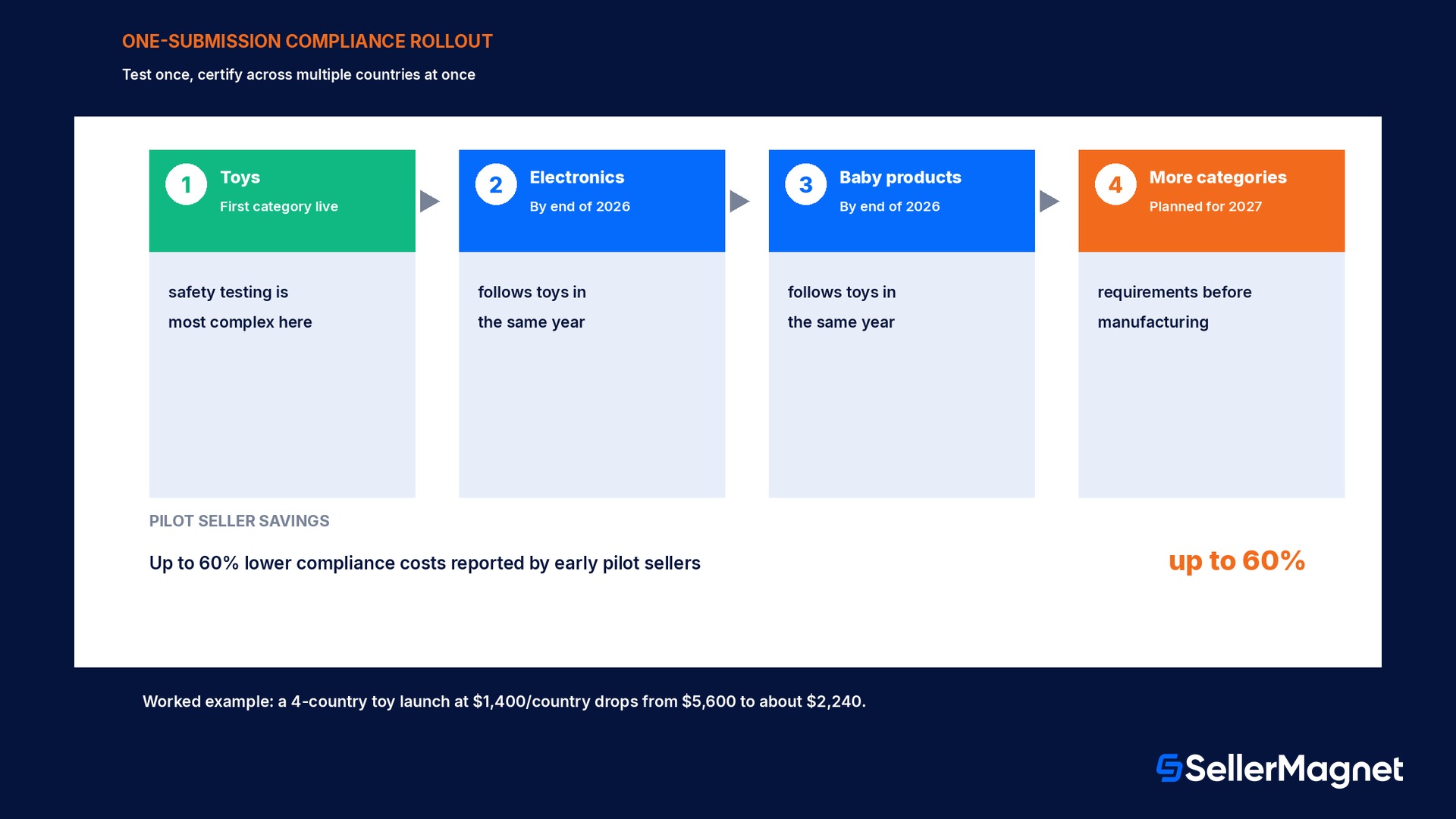
Sellers consistently tell Amazon that compliance, not logistics, is the single biggest reason they do not expand internationally: every country sets its own rules for packaging, labeling, safety testing and ingredient restrictions, and sellers have historically had to work all of that out country by country, often after a product is already manufactured. The new one-submission approach gives sellers a single consolidated view of what compliance requires across the countries they plan to sell in, plus a faster path to get tested and certified. It is rolling out by category, starting with toys, because safety testing there is the most complex, with electronics and baby products following by the end of the year and more categories planned for 2027.
A seller completes one test submission that satisfies multiple countries' certification requirements at once, instead of testing separately per country.
Existing certifications are recognized, so a seller is not re-testing and re-submitting documentation for something already proven.
Early pilot sellers in the one-submission testing program report savings of up to 60% on compliance costs.
The rollout is by category: toys first, electronics and baby products by the end of 2026, more categories in 2027.
Amazon also says it plans to move compliance a step earlier in 2027: giving sellers requirements and costs before they manufacture a single unit, not just before they list.
Worked example: certification cost across a launch in four countries
Say a toy seller launching in 4 countries would otherwise pay an illustrative $1,400 per country for separate safety testing and certification, a total of $5,600. At the up-to-60% savings pilot sellers report from the one-submission process, that same 4-country certification could cost around $2,240 instead, a saving of $3,360 before a single unit ships.
Country-by-country testing
One-submission testing
Countries covered
4
4
Cost per country (illustrative)
$1,400
pooled into one submission
Total cost
$5,600
$2,240
Savings
-
$3,360 (60%)
The unified global-expansion dashboard and Seller Assistant's new role
Alongside GWD and one-submission compliance, Amazon introduced an expanded, unified view for sellers to see expansion opportunities across the US, Europe and Japan today, with more countries coming by the end of the year. Inside it, a seller can see where demand exists for their products, what the economics look like in each candidate country, and exactly what steps remain before they could start selling there, instead of piecing that picture together across disconnected dashboards and spreadsheets. Amazon also describes an end-to-end supply chain visibility layer rolling out over the coming weeks: from the moment a seller creates a shipment, one interface tracks its journey across Amazon-managed fulfillment with a single reconciled unit count, rather than checking separate systems to confirm how much actually arrived.
Seller Assistant is also gaining supply-chain-specific capabilities as part of this rollout, starting with agents focused on aged inventory and inbound planning. Amazon frames this as the beginning of a broader shift toward a more personalized advisor across a seller's global operations: not just showing where inventory sits, but proactively flagging what needs attention, explaining why, and showing the data behind each recommendation.
A real pilot seller's experience
Mo Kuhail, co-founder of MORALVE, a Canada-based home organization company is quoted in Amazon's announcement describing the expansion from the US into Canada, the UK, Germany: understanding country-specific requirements plus Amazon's logistics network removed much of the complexity that traditionally comes with going international, giving a small family business the confidence to keep expanding.
What is still coming in 2027?
Amazon is explicit that several pieces of this announcement are early steps toward a larger vision rather than the finished product. On the listing side, the long-term goal is for a single listing to do the work that used to require a separate listing built and translated by hand for every country: at the moment a seller creates a listing, Amazon's systems would evaluate that product against every destination at once, translating content, adjusting for local currency and units, and flagging country-specific compliance requirements automatically. As those capabilities roll out, products that meet the requirements would be able to go live internationally with listings already localized for the store they are entering, rather than a seller manually adapting copy, pricing and compliance disclosures market by market.
On the compliance side, the 2027 roadmap goes a step earlier than certification itself: Amazon says it plans to give sellers compliance requirements and costs before they manufacture a single unit, not just before they list. That would move the decision point from "can I sell this where I already manufactured it" to "should I manufacture this at all, given what it will cost to certify everywhere I want to sell it," which is a materially different, and potentially much cheaper, place to catch a compliance problem. None of this changes what is actually live today, GWD in the US expanding to seven more countries, and one-submission testing starting with toys, but it is worth tracking as a seller deciding how much to invest in manual country-by-country processes versus waiting for more of this to land.
Why does this matter even if you only sell in the US today?
A seller with no near-term plan to sell outside the US still gets two pieces of this worth watching. First, the unified global-expansion dashboard effectively runs the market-opportunity research for you, for free, inside Seller Central, so checking it costs nothing even if you decide not to act on it yet. Second, and more subtly, Amazon's own framing, that compliance has been sellers' single biggest reason not to expand, is a signal about where Amazon expects friction to keep falling over the next year; a seller who waits until every piece is fully rolled out loses nothing on the logistics side, since GWD's country list will simply be bigger by then, but may lose early-mover advantage on the compliance side if being first through a newly one-submission-covered category carries any benefit, such as faster certification turnaround while the pilot program is still small.
Who should look at GWD now, and who should wait?
GWD is most useful right now for sellers who already have, or are close to having, meaningful FBA volume on a product that would plausibly sell in more than one of the eight countries in the GWD footprint once the full rollout lands. A seller still working out core US fulfillment and listing fundamentals gets less immediate benefit from a cross-border pooling program and should prioritize that groundwork first. Because several of the capabilities described above are explicitly still rolling out, checking GWD's live availability for your specific target countries inside your own Seller Central account, rather than assuming full coverage from this announcement alone, is the right first step before committing inventory to the program.
Check Seller Central directly for GWD's current availability and which of the eight target countries are already live for your account.
If compliance has been your blocker, check whether your product category (starting with toys) is covered by the one-submission process yet.
Use the unified global-expansion dashboard, where available, to see real demand and economics per country before committing a shipment, rather than guessing which markets to prioritize.
Keep AWD and GWD separate in your planning: AWD is regional bulk storage with auto-replenishment, GWD is the cross-border pooling and routing layer.
Track your own storage invoices before and after any GWD move so you can measure your real savings against the up-to-45% figure, rather than assuming the headline number applies exactly to your catalog.
Common mistakes sellers make with GWD and multi-country expansion
Treating GWD and AWD as the same program because both names include "warehousing and distribution"; they solve different problems and can be used together.
Assuming the full eight-country footprint is live immediately, when Amazon's own wording frames the seven additional countries as arriving "by the end of the year."
Projecting the 70% average revenue uplift onto a specific product without checking whether real demand exists in the target country first.
Committing a large shipment to GWD before confirming, in Seller Central, that your product category and target countries are actually covered yet.
Ignoring the compliance side entirely because logistics pooling sounds like the bigger win, when sellers themselves rank compliance as the biggest expansion blocker.
Not tracking a real before-and-after storage invoice, so the up-to-45% savings figure never gets checked against actual numbers.
Multi-country expansion checklist
You have checked Seller Central directly for GWD's current country-level availability for your account.
You know which of your SKUs are strong enough sellers in the US to justify testing demand elsewhere first.
You have checked whether your product category is covered by one-submission compliance yet, starting with toys.
You understand the difference between AWD (regional bulk storage) and GWD (cross-border pooling), and which one, or both, fits your plan.
You have a baseline storage and replenishment number from your current setup to compare against after any move to GWD.
You are tracking per-country sales and margin, not just aggregate revenue, so a multi-country expansion's real return is visible market by market.
How SellerMagnet fits into a multi-country expansion
Going multi-country turns one P&L into several, and the numbers that matter, true margin, true profit and the real cost of fulfillment, change per marketplace even on the same SKU. Fee Calculator lets you check referral and fulfillment fees per marketplace before committing inventory to a new country, so a GWD shipment is sized against real fee math rather than a US-only estimate. Analytics Dashboard tracks sales and margin per marketplace side by side, which matters once GWD starts routing the same SKU into several countries at once and a single blended number stops telling you which market is actually working. See plans and pricing for current rates.
On the listing side, Listing Optimizer helps you adapt copy and keywords per marketplace as Amazon's own localized-listing tools roll out gradually, rather than waiting for full automatic localization to reach every country in your plan. For the fulfillment-model decision underneath any of this, see our guide to FBA versus FBM, and for sellers weighing a seller-fulfilled option in specific markets, Seller-Fulfilled Prime covers that alternative path.
What is Amazon Global Warehousing and Distribution (GWD)?
A program that lets a seller ship one manufacturing run to a single Amazon-operated facility near their factory, after which Amazon routes units to whichever of its covered countries actually has demand, instead of the seller splitting inventory into separate country-by-country shipments.
Which countries does GWD cover?
GWD is live in the US today and is expanding to the UK, Japan, Germany, France, Italy, Spain and Canada by the end of 2026, for eight countries total once the rollout is complete.
How is GWD different from AWD (Amazon Warehousing and Distribution)?
AWD is single-region bulk storage with automatic FBA replenishment, now live beyond the US in the EU, UK and Australia. GWD is a separate, newer layer that pools inventory across borders from one inbound shipment. The two can be used together.
How much cheaper is GWD storage than AWD in the US?
Amazon states storage costs under GWD run up to 45% lower than AWD pricing in the US, with FBA replenishment up to 5 days faster, though the exact saving depends on your product and current baseline.
What is the one-submission compliance process?
A new approach that lets a seller complete a single test submission that satisfies certification requirements in multiple countries at once, instead of testing separately per country. It is rolling out starting with toys, then electronics and baby products by the end of 2026.
How much do sellers save with one-submission compliance?
Amazon reports that early pilot sellers in the one-submission testing program saw savings of up to 60% on compliance costs, though published results from a pilot are not a guarantee for every product or category.
Do sellers really earn more revenue by selling in multiple countries?
Amazon's own data shows sellers active in more than one country earn 70% more revenue on average than single-country sellers. That is a published average across many sellers, not a forecast for any one specific account.
Is GWD available to every seller right now?
Amazon frames several of the capabilities described in its announcement as rolling out over the coming weeks and months, with more planned for 2027, so availability varies by account and country. Check Seller Central directly rather than assuming full coverage.
Stop Juggling Tools. SellerMagnet Combines Everything You Need.