Amazon IP Accelerator 2026: Costs and Trademark Caps
R
RenéFreelance Amazon Editor
|
15 min read
A seller with a brand name worth protecting usually discovers two things at the same time: a trademark registration is the gate that unlocks Amazon Brand Registry, and a trademark registration, done the ordinary way through a law firm found independently, can take months to even get filed while nobody has vetted whether the firm's rates are reasonable. Amazon's IP Accelerator program exists to close exactly that gap. It is not Amazon filing a trademark for a seller, and it is not Brand Registry itself; it is a curated directory of outside law firms that Amazon has vetted for trademark experience and locked into pre-negotiated, capped rates, paired with a specific, narrower benefit that most sellers do not realize exists until they read the fine print: enrolling through an IP Accelerator-affiliated firm can unlock meaningful Brand Registry selling benefits, Reports a Violation, A+ Content, Stores, and Sponsored Brands, while the trademark application itself is still pending at the trademark office, months before a registration certificate would normally arrive. This guide works through what the program actually does and does not do, the real pre-negotiated fee caps published by Amazon, a worked example of what one trademark costs end to end, how the early-access benefit works and where its limits are, and the specific mistakes that cost sellers money or time inside the program.
Amazon IP Accelerator is a free referral program that connects brands with a network of Amazon-vetted intellectual property law firms offering pre-negotiated, capped rates for trademark registration and related services, such as up to $700 plus government fees to file a US trademark application. Amazon does not charge for the referral and does not file trademarks itself; the seller selects a provider from the list and pays that firm directly. Filing through an IP Accelerator-affiliated firm can also unlock early access to several Amazon Brand Registry selling benefits while the trademark application is still pending at the trademark office, rather than only after it is granted.
What is Amazon IP Accelerator, and what is it not?
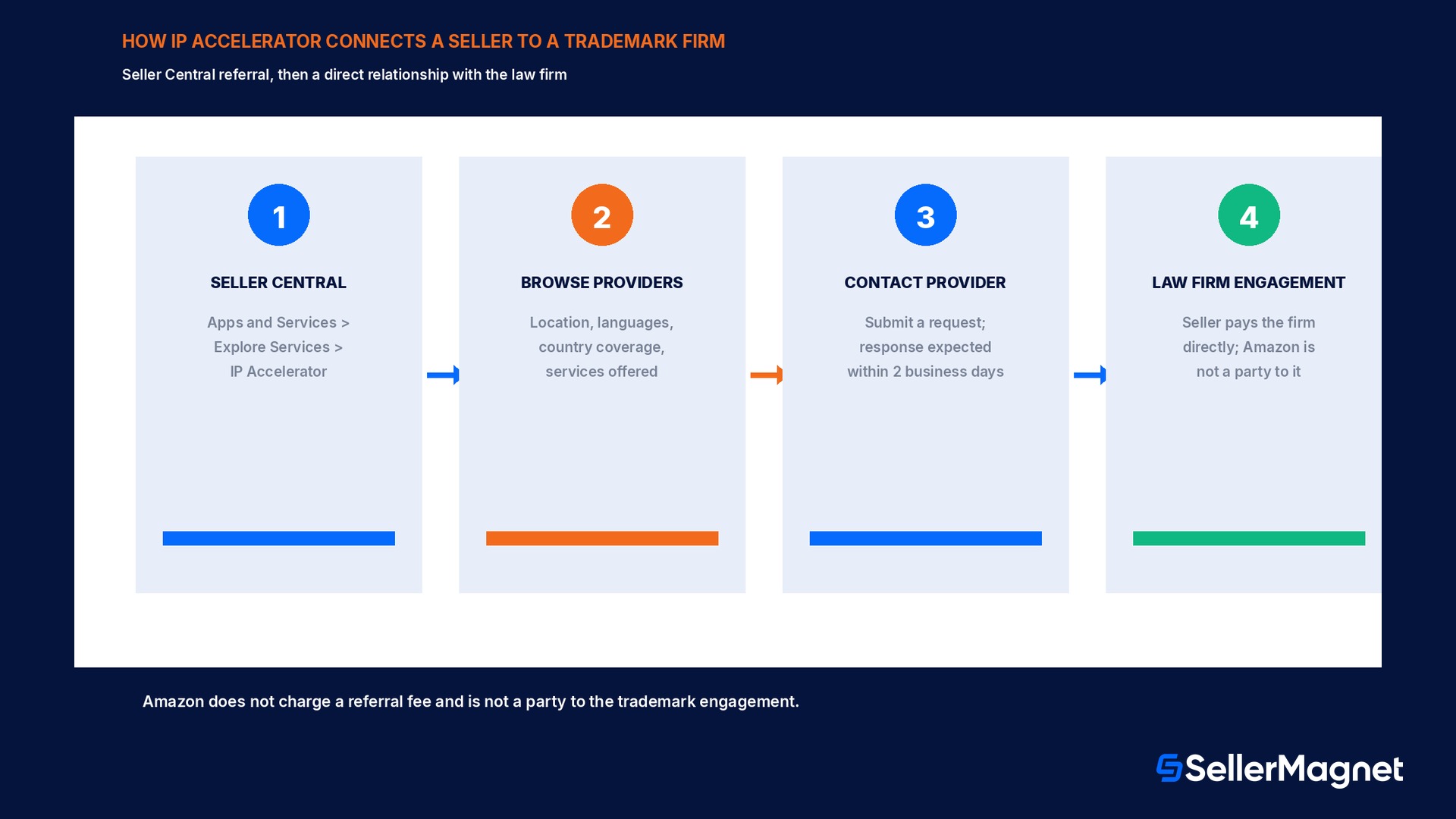
IP Accelerator is a referral and rate-negotiation program, not a legal service in itself and not an extension of Amazon Brand Registry. Amazon's own description is specific about the mechanics: the program connects brands with a curated, vetted network of outside intellectual property law firms that provide trademark registration and related services, and Amazon has pre-negotiated capped rates with those firms for a defined set of standard services. The seller browses the list of participating providers inside Seller Central, reviews each firm's profile, including the location, languages offered, and services provided, and then contacts a chosen provider directly through a request form; Amazon's guidance states providers should respond within two business days of that request. From that point on, the relationship is between the seller and the law firm. Amazon is not a party to the engagement, does not review or approve the actual trademark filing, and is not the one charging for the work; the seller pays the law firm directly for whatever services are agreed, at or below the pre-negotiated cap for the specific services the cap covers. This distinction matters because it defines what a seller can reasonably expect: IP Accelerator removes the search cost and the pricing uncertainty of finding and vetting a trademark attorney independently, and it adds the early-access benefit covered further below, but it does not change who is legally responsible for the quality of the filing, which remains the retained law firm, the same as in any other attorney engagement.
How to reach IP Accelerator inside Seller Central
Amazon's published steps are short because the program is designed as a directory, not a multi-stage application process. First, log in to Seller Central with a Professional selling account; Amazon's own guidance recommends a Professional account specifically because it is the plan that can use the full range of related services once a trademark is in progress. Second, open Apps and Services from the Seller Central main menu, click Explore Services, and select IP Accelerator from the drop-down menu, then click Search to bring up the list of participating providers. Third, review a provider's profile and click Contact Provider; a pop-up collects details about the specific request, and submitting it sends that request directly to the firm, which Amazon states should respond within two business days. There is no Amazon approval step between submitting the request and the firm's response: the firm decides whether and how to take on the engagement, and pricing beyond Amazon's published caps, scheduling, and the actual trademark strategy are all negotiated directly between the seller and that firm from that point forward.
What are the pre-negotiated rate caps, and what does one trademark actually cost?
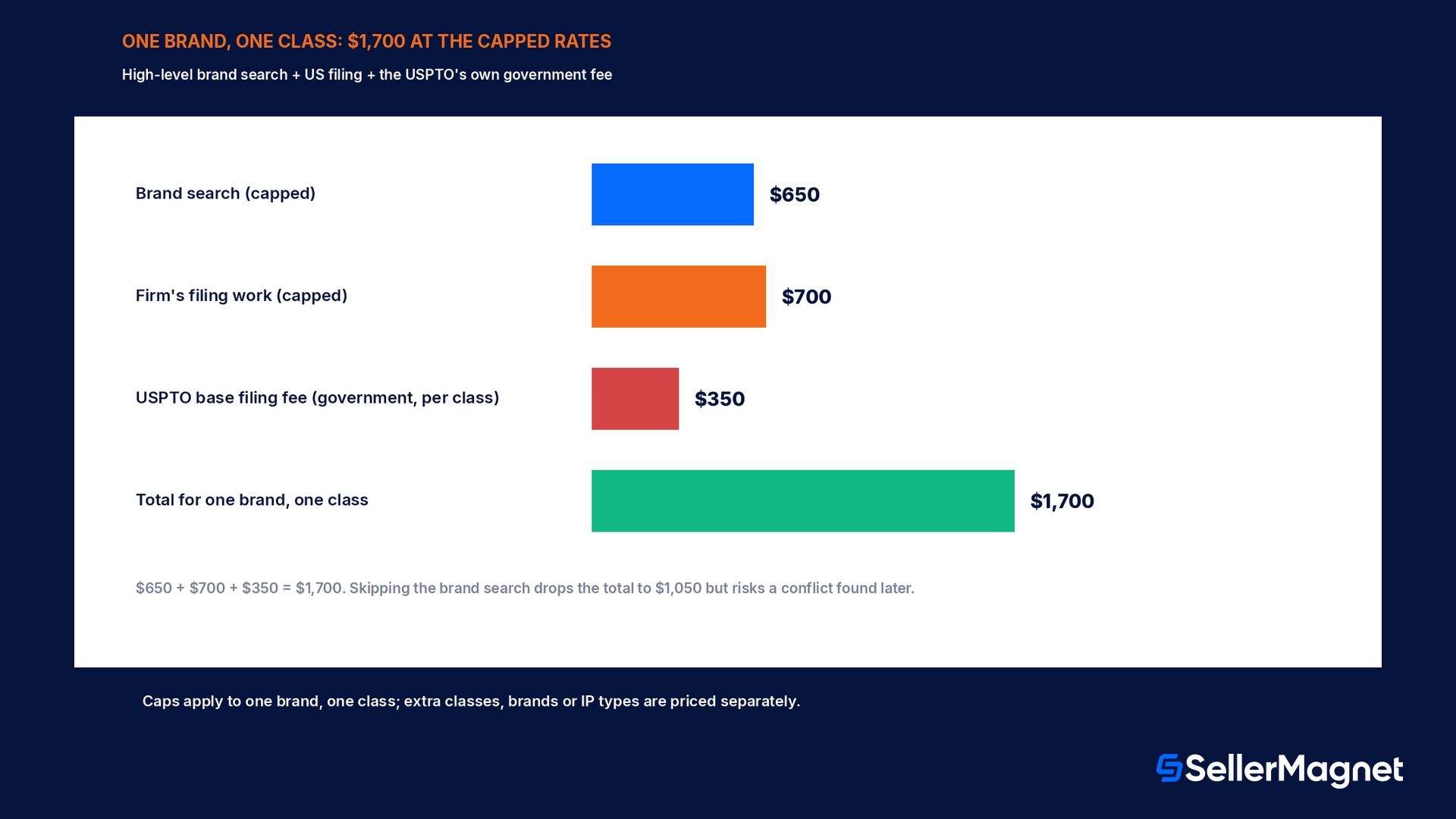
Amazon's own program page states plainly that Amazon does not charge a fee to connect a brand with a service provider; the seller only pays the law firm itself, at or below specific capped rates Amazon has pre-negotiated for a defined list of standard services covering a single brand for a single class of goods or services. Three rates are published: a high-level brand search of trademark office records for relevant pending applications or registrations, capped at up to $650; a comprehensive brand review that includes both trademark office records and unregistered uses of a similar mark, a deeper check than the high-level search, capped at up to $1,800; and filing a US trademark application itself, capped at up to $700 plus whatever government fees the trademark office charges separately. Those government fees are set by the trademark office, not by Amazon or the law firm, and are not covered by the IP Accelerator cap at all; for a standard electronic US trademark application, the US Patent and Trademark Office's own current fee schedule lists a base application fee of $350 per class of goods or services (USPTO fee schedule, revised 1 November 2026), charged on top of whatever the firm bills within the $700 cap for its filing work.
Service
Amazon's pre-negotiated cap
Who sets the fee
High-level brand search
Up to $650
IP Accelerator law firm
Comprehensive brand review
Up to $1,800
IP Accelerator law firm
Filing a US trademark application
Up to $700
IP Accelerator law firm
US base trademark application fee, electronic, per class
$350
USPTO (government fee, separate from the firm's cap)
Worked example: one brand, one class of goods, filed through IP Accelerator
A seller planning to register a single trademark covering one class of goods, running a basic clearance check first, can estimate the full cost before contacting a single provider, since every figure in the estimate is a published cap or a published government fee rather than a quote that has to be negotiated blind. Start with the high-level brand search to check whether a conflicting mark is already pending or registered: up to $650 at the capped rate. If that search comes back clear, move to filing the US trademark application itself: up to $700 for the firm's filing work under the IP Accelerator cap, plus the USPTO's own $350 base application fee per class, which is paid to the government and is not part of the firm's capped rate at all. Adding the three figures: $650 for the search, plus $700 for the firm's filing work, plus $350 in USPTO government fees, comes to $1,700 total for one brand, one class of goods, filed through an IP Accelerator-affiliated firm at the published caps. A seller who skips the high-level search and goes straight to filing spends $700 plus $350, or $1,050, accepting the risk that an undiscovered conflicting mark surfaces later in the examination process instead of before filing. Either path is a ceiling, not a guaranteed price: Amazon's own fine print notes that actual rates can vary by provider for services outside this specific capped list, and the $1,700 or $1,050 figures assume a single brand and a single class; adding a second class of goods, searching for a second brand at the same time, or filing in a country outside the US all fall outside the three capped services above and are priced separately by the firm.
The caps cover one brand, one class, not everything a firm might offer
Amazon's own guidance is explicit that the pre-negotiated rates apply to specific services covering a single brand for a single class of goods or services. Searching for multiple brands at once, filing for additional classes, or filing for other types of intellectual property such as design patents all fall outside the cap, and the firm sets those prices separately.
Can I get Brand Registry benefits before the trademark is granted?
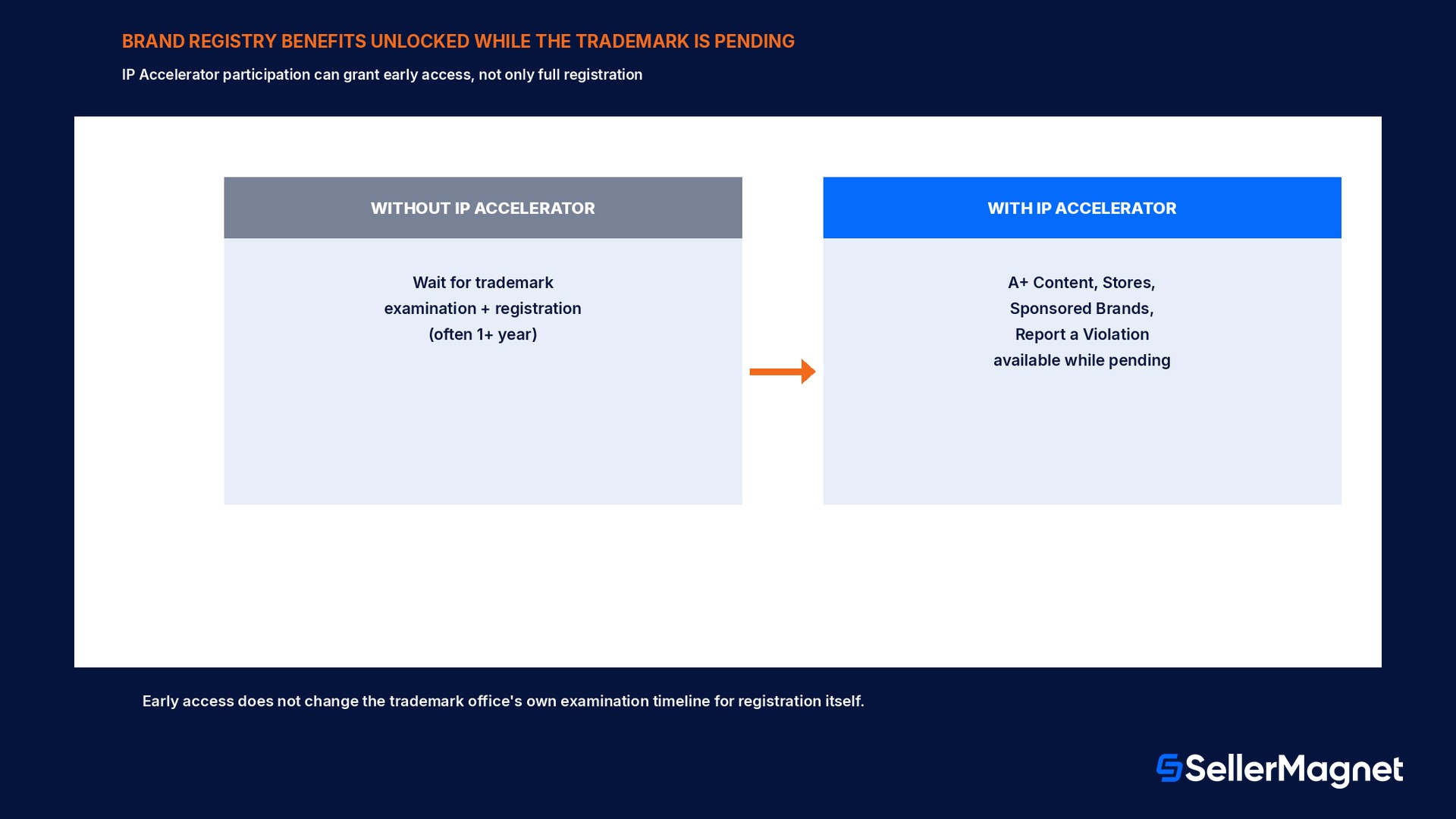
The reason IP Accelerator matters beyond cheaper legal fees is a specific accelerant most sellers only find once they are already enrolled: becoming an IP Accelerator participant, by filing through one of the affiliated law firms, can unlock a broader range of Brand Registry's selling benefits sooner, while the US trademark application is still pending at the trademark office rather than only after a registration certificate is actually issued. Amazon's own guidance names the benefits this covers: Report a Violation, the tool brand owners use to flag infringing listings directly to Amazon, plus brand selling benefits such as A+ Content, Stores, and Sponsored Brands, the advertising format that requires a registered or enrolled brand to run. A seller who files a US trademark application independently, outside IP Accelerator, through any attorney, still has to wait for Brand Registry enrollment the ordinary way, which in practice means waiting for the trademark office's own examination and registration timeline, commonly well over a year for a US application with no obstacles, before most Brand Registry benefits become available at all. The IP Accelerator path compresses that wait specifically for the brand-protection and selling benefits named above; it does not change the trademark office's own examination timeline for the registration itself, and a seller's access remains tied to maintaining an active, pending application in good standing through that same office.
How big the program actually is, and where it reaches
IP Accelerator launched specifically for small and medium businesses that Amazon's own announcement described as facing a cost and complexity barrier to trademark protection that larger brands do not face in the same way, connecting them with a curated network of trusted IP law firms vetted for experience, expertise, and customer service, all of whom agreed to the pre-negotiated, capped rates covered above. By Amazon's own current figures, the program has helped more than 33,000 brands obtain new trademark protection, supporting business owners from 35 countries and in 18 languages, through that same network. Geographic reach runs further than a seller might assume from a program most strongly associated with the US store: participating service providers can assist with trademark registration in numerous countries, including the US, the UK, Canada, Germany, Japan, India, and Brazil, among others, which matters for a seller selling into multiple Amazon stores who needs trademark coverage in more than one jurisdiction rather than only the one where the brand first launched.
How is IP Accelerator different from Brand Registry?
IP Accelerator and Amazon Brand Registry solve two different, sequential problems, and conflating them is the single most common confusion sellers run into when researching either one. Brand Registry is the enrollment program itself: once a seller has an active trademark registration, or in some cases a pending application combined with IP Accelerator participation as covered above, they enroll the brand in Brand Registry and gain access to its full suite of protection and selling tools. IP Accelerator sits one step earlier in that chain: it is the referral service that helps a seller actually obtain the trademark, or the pending-application status, that Brand Registry enrollment is built on top of. A seller who already holds a registered trademark through any attorney, IP Accelerator or otherwise, does not need IP Accelerator at all and can enroll directly in Brand Registry with that existing registration. IP Accelerator exists specifically for the seller who does not yet have a trademark, needs one filed at a predictable, capped cost, and wants the early-access selling benefits while that filing works its way through examination. SellerMagnet's Brand Registry guide covers the enrollment program itself, including what a registered or IP Accelerator-pending brand actually unlocks once enrolled; this guide stays scoped to the trademark-filing step that comes before it.
Mistakes that cost sellers money or time inside the program
Assuming the published caps cover any service a firm offers. The $650, $700, and $1,800 figures apply only to the specific, named services for one brand and one class of goods. A second brand, a second class, or a different IP type such as a design patent is priced outside the cap, and a seller who assumes otherwise can be surprised by a bill that looks uncapped because it legally is.
Treating the USPTO's government fee as part of the firm's cap. The $350 base application fee per class goes to the US Patent and Trademark Office, not the law firm, and is charged on top of whatever the firm bills for its own filing work within the $700 cap. A seller budgeting only $700 for the full filing underestimates the real total by the government fee.
Expecting Amazon to review or guarantee the filing. Amazon vets firms for inclusion in the network and negotiates the rate caps, but it is not a party to the actual trademark engagement and does not review the filing strategy, the goods-and-services description, or the outcome. Legal responsibility for the quality of the work sits with the retained firm, the same as any other attorney engagement.
Not confirming which countries a chosen provider actually covers. Providers vary in which jurisdictions they file in; a seller who needs trademark coverage in more than one Amazon store should confirm a provider's country coverage before engaging them, rather than assuming every IP Accelerator-listed firm files everywhere Amazon itself operates.
Confusing IP Accelerator participation with having a registered trademark. The early Brand Registry access covered above is tied to having a pending application combined with IP Accelerator participation; it is not the same legal status as an issued registration, and a seller should track the actual application status at the trademark office rather than assuming the early access is permanent regardless of what happens to the underlying filing.
Skipping the brand search before filing to save the $650. Filing without a basic clearance check risks discovering a conflicting mark only after the application is already in examination, which can mean a refused application and a lost filing fee rather than the smaller, upfront cost of checking first.
What this means for a seller building a brand on Amazon
The practical sequencing for a seller who does not yet have a trademark is to treat IP Accelerator as the first concrete step toward Brand Registry, not a parallel or optional add-on: run the brand search, file through a vetted firm at the capped rate, and use the resulting pending-application status to request early access to A+ Content, Stores, Sponsored Brands, and Report a Violation while the registration itself works through examination. Once those selling benefits are live, or once the full registration is granted and standard Brand Registry access follows, the catalog and advertising groundwork is where tools outside the trademark process itself start to matter: SellerMagnet's Listing Optimizer helps get a catalog's content quality ready for the moment A+ Content access actually unlocks, so the brand is not filing for the benefit and then scrambling to build the content it enables from scratch, and SellerMagnet's PPC Manager is built for exactly the budget and keyword work Sponsored Brands campaigns require once that advertising format becomes available to the account.
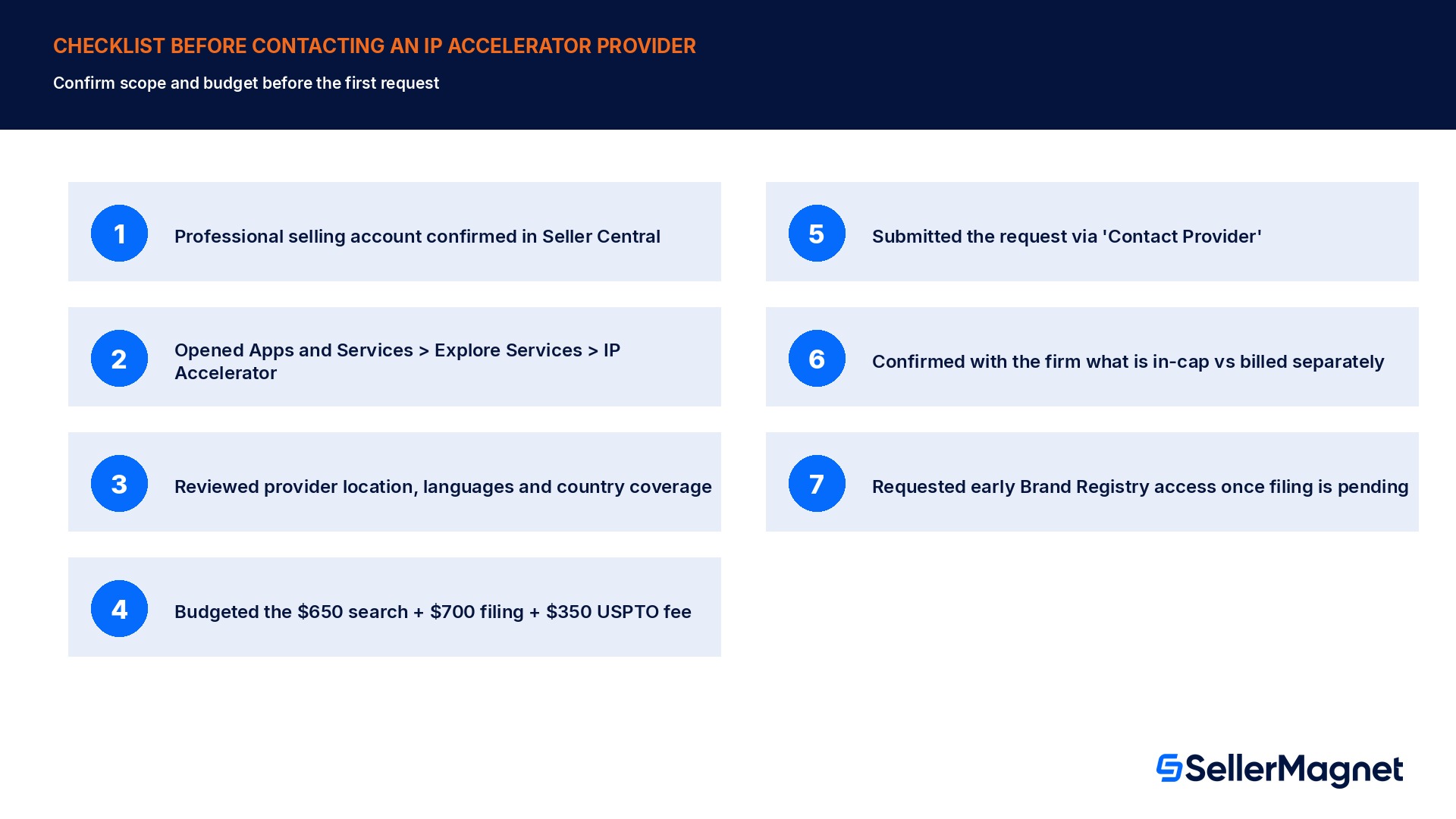
Checklist before contacting an IP Accelerator provider
How to use Amazon IP Accelerator to file a trademark at the capped rate
Confirm the Seller Central account is a Professional selling account - Amazon's own guidance recommends this specifically to use the full range of related services once a trademark is in progress.
Open Apps and Services, then Explore Services, then select IP Accelerator - This is the only path to the list of participating providers; there is no separate application form before this step.
Review provider profiles for location, languages, and country coverage - Providers vary in which jurisdictions they file trademarks in; confirm coverage for every Amazon store the brand sells in, not only the home market.
Budget for the brand search, the filing fee, and the separate government fee - Up to $650 for the search, up to $700 for the firm's filing work, and the USPTO's own $350 base fee per class on top of that, for one brand and one class of goods.
Click Contact Provider and submit the specific request - Amazon's guidance states providers should respond within two business days of a submitted request.
Ask the chosen firm to confirm what counts as in-cap versus billed separately - A second brand, additional classes, or other IP types such as design patents fall outside the three capped services and are priced by the firm directly.
Request Brand Registry's early-access selling benefits once the application is filed and pending - A+ Content, Stores, Sponsored Brands, and Report a Violation can become available while the trademark is still pending through IP Accelerator participation, not only after registration.
Does Amazon charge a fee for IP Accelerator?
No. Amazon does not charge a fee to connect a brand with a service provider. The seller pays the chosen law firm directly, at or below the pre-negotiated capped rates for the specific listed services.
What is the maximum I would pay to file one US trademark through IP Accelerator?
Up to $700 for the firm's filing work under Amazon's cap, plus the USPTO's own government fee, currently a $350 base application fee per class for a standard electronic filing. A brand search beforehand costs up to $650 more.
Does IP Accelerator file the trademark application itself?
No. Amazon connects the brand with a vetted outside law firm; that firm handles the actual filing and the relationship is between the seller and the firm, not Amazon.
Can I get Brand Registry benefits before my trademark is actually granted?
Yes, in part. Filing through an IP Accelerator-affiliated firm can unlock early access to several selling benefits, including A+ Content, Stores, Sponsored Brands, and Report a Violation, while the application is still pending, ahead of full registration.
Do the capped rates cover more than one trademark class or brand?
No. The published caps apply to a single brand for a single class of goods or services. Additional classes, additional brands, or other IP services such as design patents are priced separately by the firm.
Which countries can IP Accelerator providers file trademarks in?
Provider networks cover numerous countries, including the US, the UK, Canada, Germany, Japan, India, and Brazil among others; coverage varies by individual provider, so confirm a firm's specific country coverage before engaging them.
Stop Juggling Tools. SellerMagnet Combines Everything You Need.