Amazon's Choice Badge 2026: Criteria, Myths and Facts
R
RenéFreelance Amazon Editor
|
16 min read
Last updated: Nov 22, 2026
Amazon's Choice is one of the most visible badges in the Amazon store, a dark label with a checkmark that sits right in the search results grid next to a product thumbnail, but it is also one of the most misunderstood: it is not a quality certificate a seller can apply for, not something any seller or brand can pay to receive, and not even a permanent property of a single product. Amazon's own published explanation, repeated on its official seller-visibility help page and in an Amazon-authored Seller Forums guide to its badges, describes Amazon's Choice as a highly-rated, well-priced, immediately-shippable signal built from customer behaviour, assigned and removed on an ongoing basis as that behaviour changes. What Amazon has never published is an exact formula, a minimum star rating, a fixed price threshold, or a guaranteed way to win it, which is exactly why so much seller advice about the badge turns into guesswork, and why forum threads full of confident-sounding tactics rarely agree with each other once a seller checks the actual Amazon wording behind them. This guide separates what Amazon has actually stated about Amazon's Choice from what independent sellers and tools have observed about how it behaves in practice, lays out how it differs from Amazon's other shopper-facing badges and from the separate systems that decide the Featured Offer and search ranking, and walks through a realistic maintenance scenario so a seller knows what actually puts the badge at risk and which levers are worth working on instead of guessing.
Amazon's Choice is a free, algorithmic badge Amazon assigns automatically to products it judges highly rated, well-priced and available to ship immediately for a given search. Amazon states it factors in ratings, price, popularity, availability and fast delivery, but publishes no exact formula or threshold, and sellers cannot apply, pay, or guarantee the badge; it can change as customer behaviour changes.
What does Amazon actually say Amazon's Choice is?
Amazon's official seller-visibility help page, published under Seller Central's Policies and Program Policies section, groups Amazon's Choice under a broader heading called Badges, which it describes as highlighting product information to help customers find items they might like. The same page states plainly: 'Amazon's Choice ... indicates highly rated and well-priced products, which are available to ship immediately,' and that Amazon considers 'many factors' when choosing which products are eligible, with the Best Seller badge singled out as relying mainly on recent and historical sales volume by contrast. A separate, Amazon-authored Seller Forums post titled 'Badges of Honor: A Comprehensive Guide to Amazon Badges,' published by an Amazon community manager account, repeats and extends the same description almost word for word: Amazon's Choice 'makes it easy to discover products that other customers frequently choose for similar shopping needs,' and highlighted products 'are also, on average, delivered faster and returned less frequently than alternative products.' Both of Amazon's own sources describe Amazon's Choice as a shopper-trust shortcut built from how customers already behave toward a product, not a one-time award a listing earns and keeps.
The 5 factors Amazon says it considers
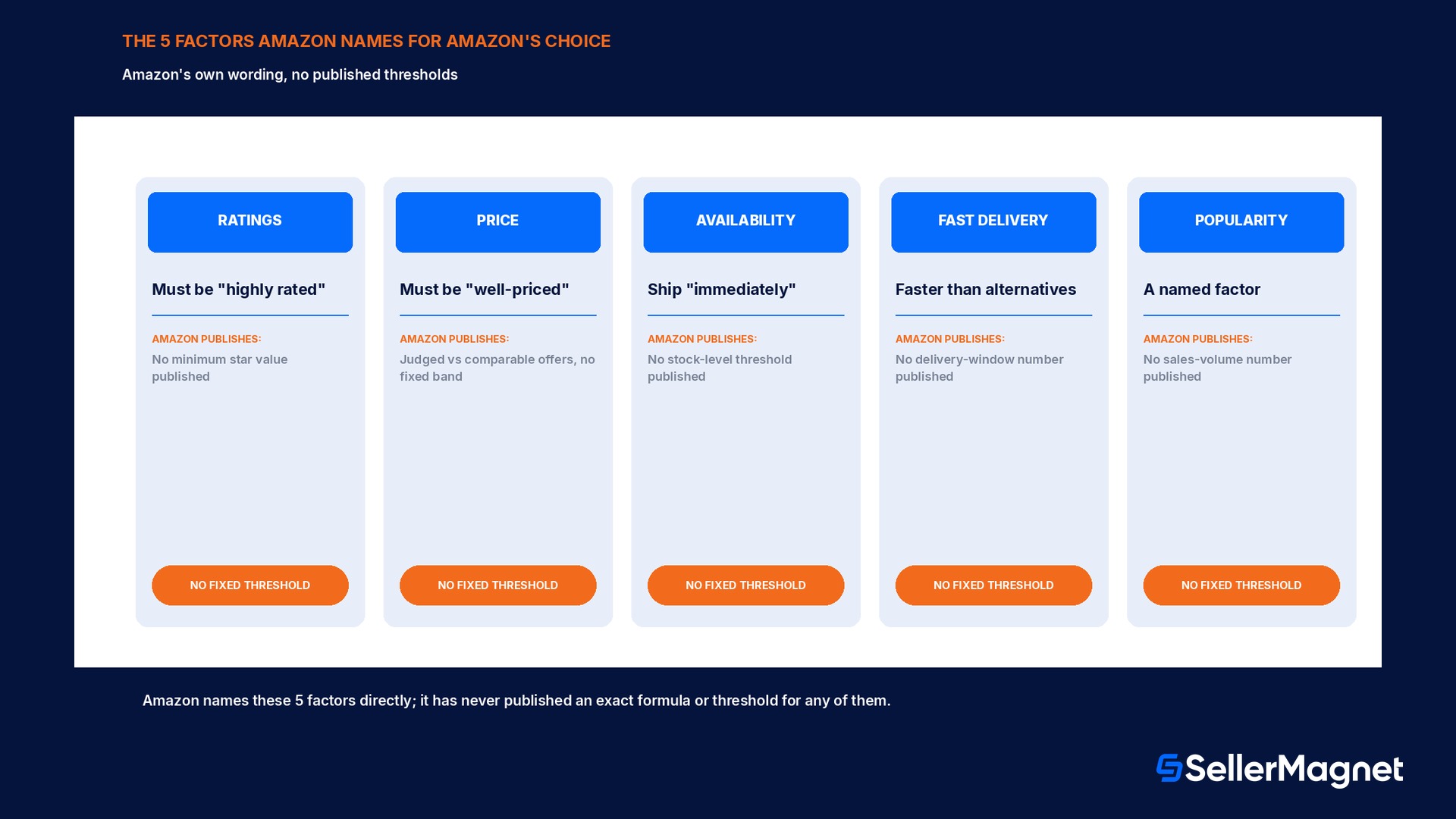
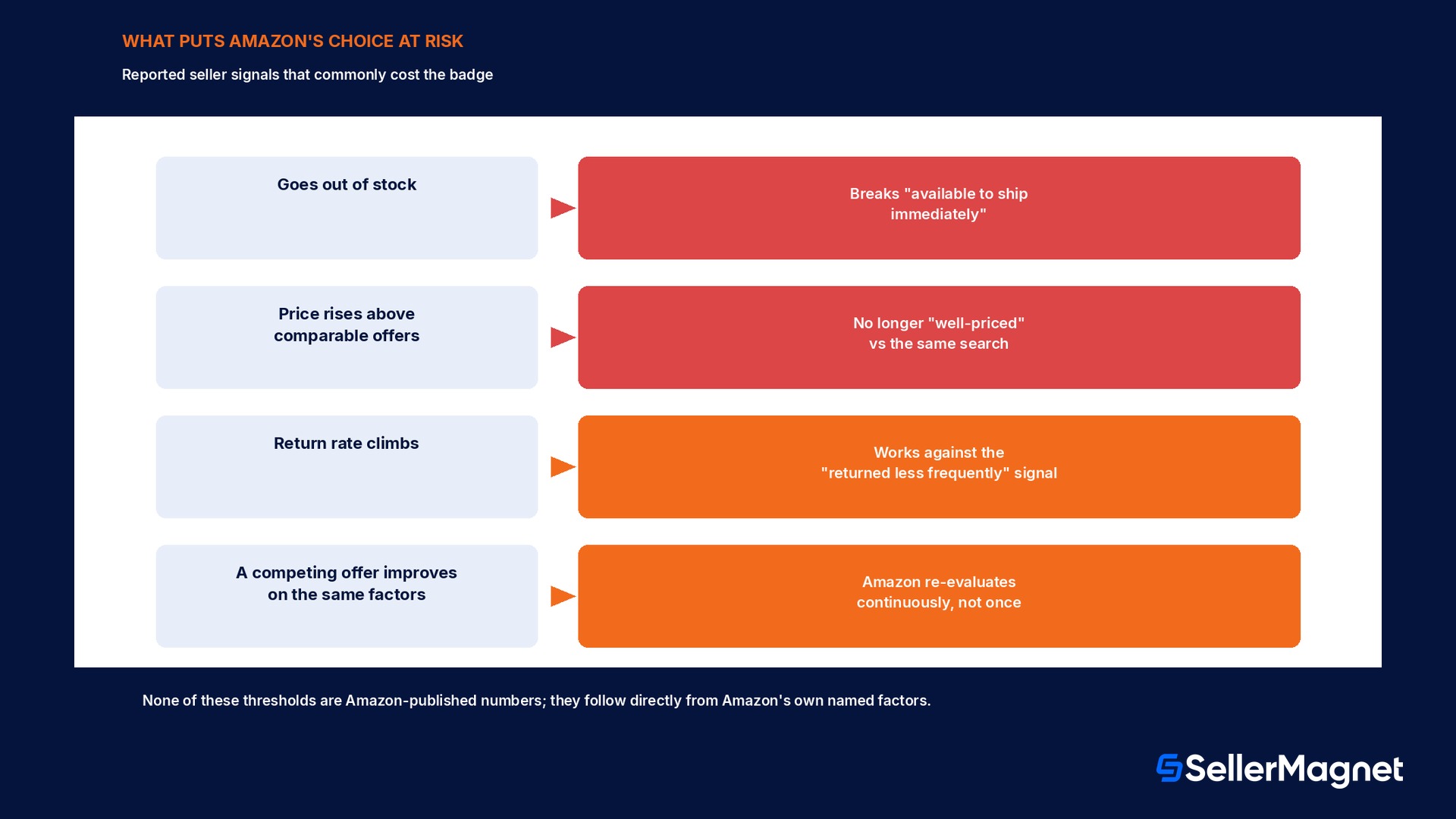
Amazon's own Seller Forums guide states the inputs directly: 'Amazon's Choice considers what customers tell us matters most to them, including ratings, price, popularity, product availability and fast delivery. As customer preferences and feedback change, so do the products we highlight.' That sentence is the only place Amazon names the inputs; no Amazon-published page states a minimum star rating, a specific price band, a sales-velocity number, a stock-level threshold or a maximum delivery window. Each factor is described only in relative terms: a rating is 'high,' a price is 'well-priced' relative to comparable offers, availability means the item can ship 'immediately' rather than being backordered, and delivery is judged against how fast alternative offers for the same search typically arrive. Because Amazon states the badge responds to customer preferences and feedback as they change, the practical reading is that these 5 factors are evaluated on an ongoing basis against the other offers competing for the same shopper search, not against a fixed, publishable bar every seller could check their own numbers against.
Factor (Amazon's own wording)
What Amazon has published about it
Ratings
Must be 'highly rated'; no minimum star value published
Price
Must be 'well-priced'; judged against comparable offers, no fixed band published
Product availability
Must be 'available to ship immediately'; no stock-level threshold published
Fast delivery
'On average, delivered faster ... than alternative products'; no delivery-window number published
Popularity
Named as a factor; no sales-volume or conversion number published
Is the badge tied to the product, or to the search?
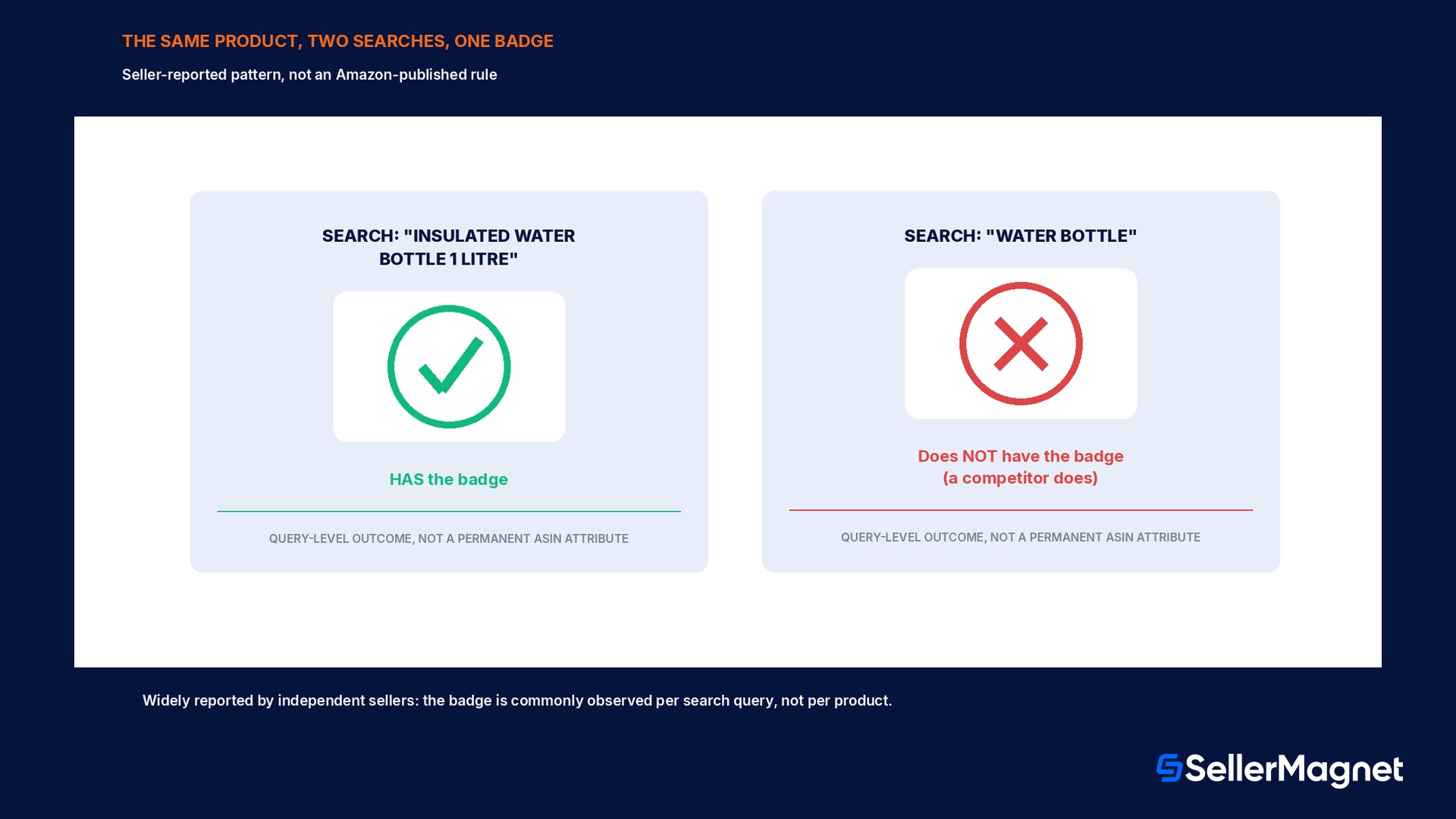
Amazon's own published pages describe Amazon's Choice at the product level, never stating explicitly that the badge is assigned per keyword. What fills that gap is a consistent, widely repeated observation from independent sellers and seller-tool vendors, not an Amazon-stated rule: the same ASIN is commonly seen carrying the badge for one search term while a different, competing ASIN carries it for a closely related term, and the badge can appear or disappear from the same listing for the same search within days with no notification in Seller Central. That observation is consistent with Amazon's own stated logic, since Amazon's Choice is framed around what shoppers are searching for and which available offers best satisfy that specific search, not around a single, fixed property of a product. The practical consequence sellers report is that 'winning Amazon's Choice' is better treated as a per-keyword, ongoing outcome tied to a listing's price, rating, stock and delivery performance against the other offers ranking for that same keyword, rather than a single badge a product earns once and keeps regardless of which search brought the shopper there.
This section is seller observation, not an Amazon-published rule
Amazon has not published a statement confirming the badge is assigned strictly per search query, nor has it published how often it re-evaluates eligibility. The query-level behaviour described above is a pattern independent sellers and tools report seeing consistently, included here because it changes how a seller should read 'I have Amazon's Choice' or 'I lost Amazon's Choice' for their own listing.
Can you apply or pay for Amazon's Choice, and who is eligible?
Amazon's own badges help page states explicitly that third-party seller products are eligible for Amazon's Choice: 'Products sold by third-party sellers can be highlighted as Amazon's Choice.' The same source rules out two common seller assumptions in one sentence: 'Brands and selling partners cannot pay to have their products highlighted as Amazon's Choice, or apply to have their products considered for Amazon's Choice.' There is no application form, no paid placement, and no account-manager request that adds a listing to consideration; the badge is assigned algorithmically from the 5 factors above. Amazon's separate seller-visibility help page adds one more point sellers frequently ask about: when Amazon's own private-label and exclusive brands compete for the same badge as third-party sellers, 'they must meet the same criteria as other products to obtain the badge, and they may receive the badge if they are among the top eligible products,' meaning Amazon states its own brands do not get a guaranteed or separate path to Amazon's Choice.
How is Amazon's Choice different from Best Seller and New Release?
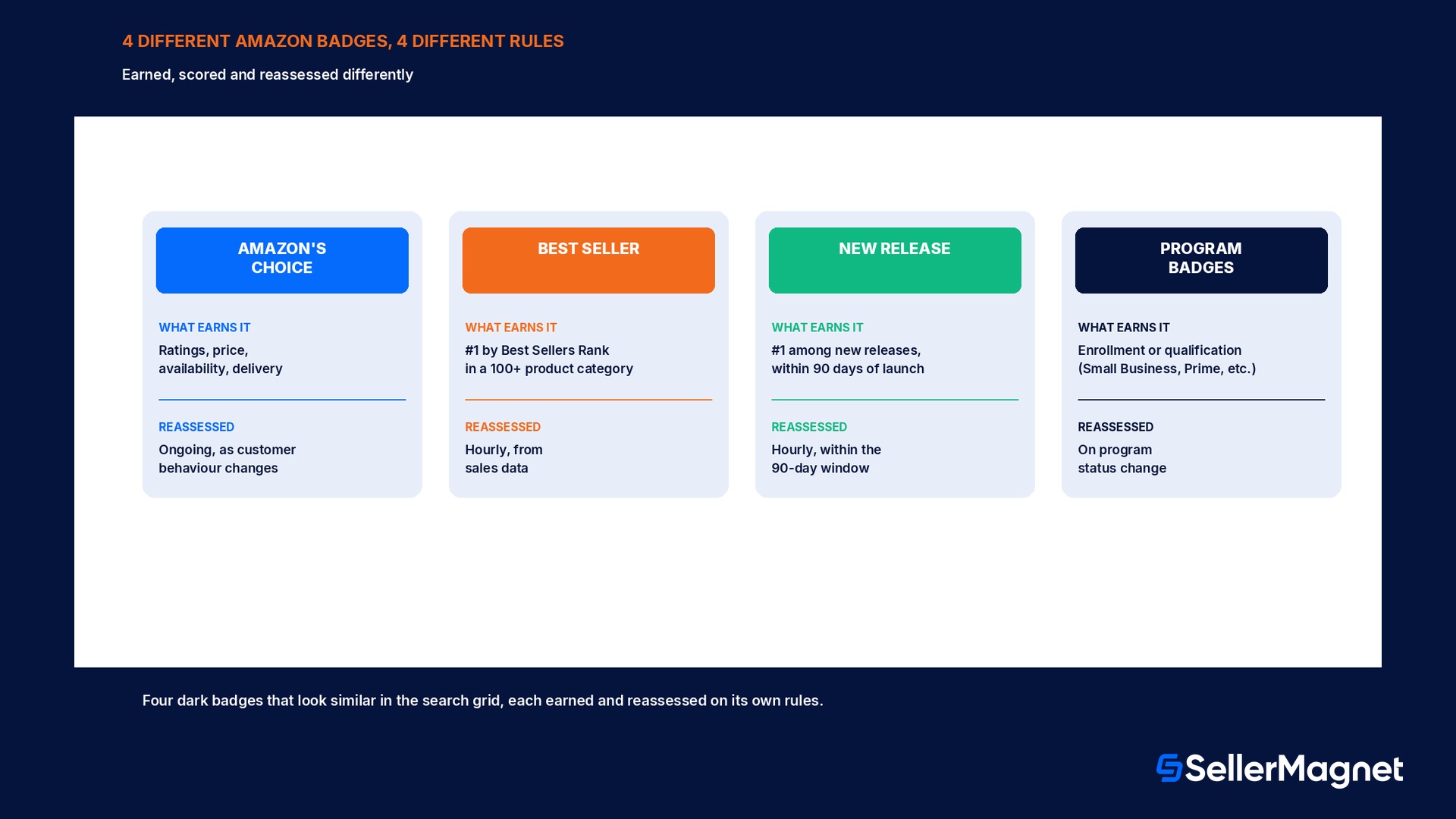
Amazon runs several visually similar dark badges that get confused with each other constantly, and each one is earned from a different mechanism. The Best Seller badge, per Amazon's own Seller Forums guide, is a sales-rank achievement: it is assigned to the ASIN ranked number 1 by Best Sellers Rank (BSR) within a featured category that has at least 100 products, with up to the top 100 ASINs in a category or subcategory eligible for the badge overall, recalculated hourly from recent and historical sales, and it differs by marketplace since the best-selling home products on Amazon.com are not necessarily the best-selling home products on Amazon.co.uk. Amazon's guide also notes a specific exclusion: the Best Seller badge is not shown on parent product pages in stores where child-ASIN orders and sales rank roll up to the parent listing. The New Release badge is a related but distinct sales-rank award: it goes to the number 1 best seller among new releases in a category, available only within the first 90 days after a listing's launch date, also recalculated hourly. Program badges such as Small Business, Climate Pledge Friendly, Black-Owned Business and the Prime badge work on a third, completely different mechanism again: they mark enrollment in or qualification for a specific Amazon program or initiative, not an ongoing performance signal, so a seller qualifies once (by business size, certified sustainability attributes, business ownership documentation or Prime-eligible fulfillment) rather than competing continuously against other offers the way Amazon's Choice and Best Seller do.
Badge
What earns it
How often it is reassessed
Amazon's Choice
Algorithmic match to a search: ratings, price, availability, delivery, popularity
Ongoing, as customer behaviour changes
Best Seller
Number 1 by Best Sellers Rank in a category with 100+ products (top 100 eligible)
Hourly, from sales data
New Release
Number 1 among new releases in a category, within 90 days of launch
Hourly, within the 90-day window
Program badges (Small Business, Climate Pledge Friendly, Prime, etc.)
Enrollment in or qualification for a specific Amazon program
On program status change, not continuous performance
Where does Amazon's Choice sit among Amazon's other visibility tools?
Amazon's own seller-visibility help page frames badges as just one of several ways Amazon surfaces products to shoppers, and understanding the other mechanisms helps explain what Amazon's Choice is not. The same page names the Featured Offer, the offer Amazon predicts a shopper would pick after comparing every available offer on a listing, considering price, delivery speed and seller performance; a product detail page can have more than one Featured Offer, or none, and most shoppers who compare offers end up choosing whichever one Amazon features. It also names Featured results, the default sort order for Amazon store search results, driven mainly by customer actions such as purchase frequency and listing information such as title, price and description. Sponsored Brands and Sponsored Products are a third, clearly labeled mechanism: paid placements chosen primarily by the keywords a seller bids on, the bid amount, and Amazon's own estimate of a shopper's interest in that offer. Amazon's Choice sits apart from all three: unlike the Featured Offer, it is not about which seller's offer wins the buy button on an existing listing; unlike Featured results, it is not the default search ordering itself but a label applied on top of it; and unlike Sponsored Brands or Sponsored Products, it cannot be bought or bid on at all. The practical reading for a seller is that these are four separate, independently evaluated systems running at once on the same search results page, and performing well in one, winning the Featured Offer through competitive pricing, for example, does not automatically carry over into Amazon's Choice eligibility, since the two systems weigh different inputs.
Mechanism
What mainly drives it
Can a seller buy or bid for it?
Featured Offer
Price, delivery speed, seller performance, compared across all offers on one listing
Ratings, price, availability, delivery, popularity for a specific search
No
What a seller is not allowed to do with the badge itself
Amazon's product image requirements, published on its official Seller Central help page for product images, state the restriction directly: sellers may not use 'badges used on Amazon, or variations, modifications, or anything confusingly similar to such badges,' and the policy names Amazon's Choice first in its own list of examples, alongside Premium Choice, Amazon Alexa, Works with Amazon Alexa, Best Seller and Top Seller. That means a seller cannot add the words Amazon's Choice, a recreation of the badge graphic, or a close visual imitation of it into a product's own images, title, bullet points or external marketing, even on a listing that currently and legitimately carries the real badge on the product detail page; the badge Amazon displays automatically on a qualifying listing is not the same thing as content a seller is permitted to create or reuse. This is a separate restriction from the 'Available at Amazon' badge, which Amazon does license to sellers for their own marketing under a published set of Trademark Usage Guidelines, with downloadable logo files for multiple countries; Amazon's Choice has no equivalent self-serve logo license because it is never something a seller places, only something Amazon displays.
Mistakes that come from treating the badge the wrong way
Applying, asking an account manager, or paying for it. Amazon states directly there is no application and no paid placement; the badge is assigned algorithmically.
Assuming the badge is permanent once earned. Amazon states highlighted products change as customer preferences and feedback change; independent sellers consistently report losing and regaining it within days.
Reading 'I have Amazon's Choice' as true for every search term. The badge is commonly observed per search query, not per product; a listing can carry it for one keyword and not a closely related one.
Reusing the badge graphic or wording in the seller's own images or marketing. Amazon's product image policy explicitly bans this, even for a listing that currently has the real badge.
Treating it as a universal quality seal. Amazon's own wording frames it as a match for a specific shopping need, not a claim that the product is the best option in its category.
Assuming Amazon's own branded products get a free pass. Amazon states its own brands compete under the same criteria as third-party sellers for the badge.
Chasing the badge with a single lever (price alone, or ads alone). Amazon names 5 separate factors; a seller with a weak return rate or thin stock is unlikely to earn it on price alone.
Confusing a lost badge with a policy strike or an account health issue. Amazon's wording ties the badge to customer behaviour and the competing offers on a search, not to account standing; a seller who loses Amazon's Choice has not necessarily done anything wrong.
Where SellerMagnet fits around chasing Amazon's Choice
Amazon runs the algorithm behind Amazon's Choice itself; no third-party tool, including SellerMagnet, can apply for it, buy it or guarantee it, since Amazon states plainly that neither is possible. What a seller can influence are the inputs Amazon names. Competitor Tracker follows a chosen ASIN, including one a seller does not sell, for Buy Box owner, price, sales rank, stock level, listing edits, rating drops and negative reviews, which covers most of the 5 factors Amazon names in one place rather than a seller checking each competing offer by hand every time a badge appears or disappears. That is the practical way to see when a competing offer starts outperforming on ratings, price, stock or delivery, rather than guessing why a badge changed. On the price side, the repricer runs continuously and re-evaluates roughly every 5 minutes, logging the reason behind every price change, so an offer stays priced against the same comparison set Amazon is judging 'well-priced' against without a seller manually re-checking competitor prices every day; a Minimum and Maximum price keep that automation from ever pricing below a seller's own floor, which matters because chasing Amazon's Choice on price alone is one of the mistakes above.
On the rating and return-rate side, a lower return rate is one of the two outcomes Amazon's own wording directly associates with Amazon's Choice products, so Listing Optimizer is where a listing's images, bullet points and size or fit information actually get corrected to reduce the expectation-mismatch returns that work against a listing on this factor, and Review Requester automates Amazon's own native Request a Review action, sent inside the 5 to 30 day window Amazon allows per order, to help a genuinely good product accumulate the rating signal Amazon names first. Profit Analytics tracks sales velocity and stock position over time, the same popularity and availability inputs Amazon names, on one dashboard instead of across separate Seller Central reports, which is useful precisely because Amazon states these inputs are evaluated on an ongoing basis rather than checked once; a seller who only looks at a listing's status after losing the badge is reading the result, not the inputs that produced it.
Checklist before assuming a listing is or isn't in the running
How to read a listing's Amazon's Choice status correctly
Search the exact keyword a shopper would use, not just the product's own title - The badge is commonly observed per search query; checking only the product detail page or one broad term misses badge status on the specific terms that drive traffic.
Check price, rating and stock against the other offers ranking for that same search - Amazon names ratings, price, availability and delivery speed as factors judged relative to the competing offers on that search, not against a fixed number.
Confirm the listing can ship immediately, not on backorder - Amazon's own wording requires 'available to ship immediately'; a stocked-out or delayed listing is working against this factor regardless of its rating or price.
Re-check periodically instead of assuming a one-time result - Amazon states highlighted products change as customer feedback and preferences change; a badge seen once is not guaranteed to still be there weeks later.
Never add the words or badge graphic to the seller's own content - Amazon's product image policy bans recreating Amazon's Choice, Best Seller or similar badges in a seller's own images or marketing.
Can I apply for the Amazon's Choice badge?
No. Amazon states directly that brands and selling partners cannot apply to have their products considered for Amazon's Choice; it is assigned algorithmically, not through a request or application.
Can I pay to get the Amazon's Choice badge?
No. Amazon's own badges help page states brands and selling partners cannot pay to have their products highlighted as Amazon's Choice; there is no paid placement for it.
What factors does Amazon say it considers for Amazon's Choice?
Amazon names 5 factors directly: ratings, price, popularity, product availability and fast delivery. It has not published exact thresholds or weightings for any of them.
Is Amazon's Choice the same as the Best Seller badge?
No. Best Seller is a category sales-rank award for the number 1 ASIN by Best Sellers Rank, recalculated hourly; Amazon's Choice is a search-relevance signal based on ratings, price, availability and delivery, not sales rank.
Can a product have Amazon's Choice for one search but not another?
This is a widely reported seller observation, not an Amazon-published rule: the badge is commonly seen assigned per search query, so the same product can carry it for one keyword and not a closely related one.
Can I use the words 'Amazon's Choice' in my own product images or marketing?
No. Amazon's product image requirements explicitly ban recreating badges used on Amazon, including Amazon's Choice, Best Seller and Top Seller, in a seller's own content.
Do Amazon's own branded products get Amazon's Choice automatically?
No. Amazon states that when its own brands compete for the badge against other sellers, they must meet the same criteria as everyone else to obtain it.
Does losing the Amazon's Choice badge mean my account has a problem?
No. Amazon ties the badge to customer behaviour and the other offers competing for the same search, not to account health; a badge can disappear with no policy violation, no notification and no change on the seller's side.
Stop Juggling Tools. SellerMagnet Combines Everything You Need.