Amazon Manage Your Customer Engagement (MYCE) 2026 Guide
R
RenéFreelance Amazon Editor
|
15 min read
A brand that wants to email its own past buyers on Amazon cannot just export an address list the way it would from its own storefront; Amazon keeps every buyer's contact details inside its own walls. Manage Your Customer Engagement, usually shortened to MYCE, is Amazon's own answer to that gap: a free tool inside Seller Central that lets a Brand Registered seller send Amazon-templated marketing emails to its own brand followers and past buyers, without ever seeing an email address, exporting a list, or paying a per-send fee. It sits in the Brands menu next to Amazon Posts and A plus Content, but it is a fundamentally different kind of feature: those are passive content a shopper might stumble onto, MYCE is an outbound message a seller actively sends to a chosen audience. This guide works through exactly who is eligible, the 5 audience segments Amazon defines and how each one is calculated, the 3 campaign types a brand can actually send, the beta Tailored Audiences unlock gate and its specific numeric thresholds, a worked example of what one campaign does to a real segment of repeat buyers, and where MYCE stops being useful because of what Amazon deliberately does not let a brand do with it.
Manage Your Customer Engagement, or MYCE, is a free email marketing tool inside Amazon Seller Central (Brands, Customer Engagement) for Brand Registered sellers. It sends Amazon-templated marketing emails, product launch announcements, 7-day deal alerts, or percentage-off promo codes, to a brand's own audience segments: brand followers, recent customers, repeat customers, high-spend customers, and cart abandoners. The seller never receives the actual email addresses; Amazon sends the message and reports back aggregate performance metrics only.
What is Manage Your Customer Engagement, exactly?
Manage Your Customer Engagement lives under the Brands tab in Seller Central, in a menu item called Customer Engagement, and it does one specific job: it lets a registered brand send a marketing email, built from an Amazon template, to a defined group of its own Amazon customers, without the brand ever touching a raw email address. A seller picks a campaign type, a product, a supporting lifestyle image, and an audience segment; Amazon's own moderation team reviews the campaign content before it goes out, then Amazon sends it during a scheduled delivery window and reports back aggregate performance afterward. The tool is free: there is no per-email fee and no subscription cost, the only real cost a brand takes on is whatever discount it chooses to put inside a promotional campaign. It first rolled out as a beta to 1P vendor-side Merchandising accounts before 3P Seller Central brands, and the richer 5-segment Tailored Audiences version itself launched as a beta feature, so a brand checking whether a specific option is visible yet should expect staged availability rather than everything appearing on day one of Brand Registry approval.
Who is actually eligible to use it?
3 things have to already be true before Customer Engagement even shows up as an option. First, the brand has to be enrolled in Amazon Brand Registry; a reseller or a seller account not tied to an approved, registered brand does not see the menu item at all, regardless of sales volume or account age. Second, the brand needs an active Amazon Store, the free brand storefront Amazon gives registered brands, because that Store page is what collects Brand Followers, the base audience Customer Engagement sends to; a brand with Brand Registry but no built-out Store, or no followers yet, has nothing to send to even if the menu is unlocked. Third, for the richer Tailored Audiences segments beyond Brand Followers (recent, repeat, high-spend, cart abandoners), Amazon's own rollout was staged by account type and region, so a newly registered brand checking the menu for the first time may see only the Brand Followers option until the fuller segmentation becomes available on its account. None of this requires a minimum ad budget or a running Sponsored Products campaign; Customer Engagement is independent of a brand's advertising spend.
Requirement
Why it matters
Amazon Brand Registry
Resellers and unregistered sellers never see the Customer Engagement menu item
An active Amazon Store with Brand Followers
Brand Followers is the base audience; a Store with no followers has nothing to send a campaign to
Staged rollout for Tailored Audiences segments
Recent, repeat, high-spend and cart-abandoner segments were rolled out as a beta, by account and region
Cost
Free; no license fee, no per-email charge; the only cost is any discount offered inside a promo campaign
The 5 audience segments, and exactly how Amazon defines each one
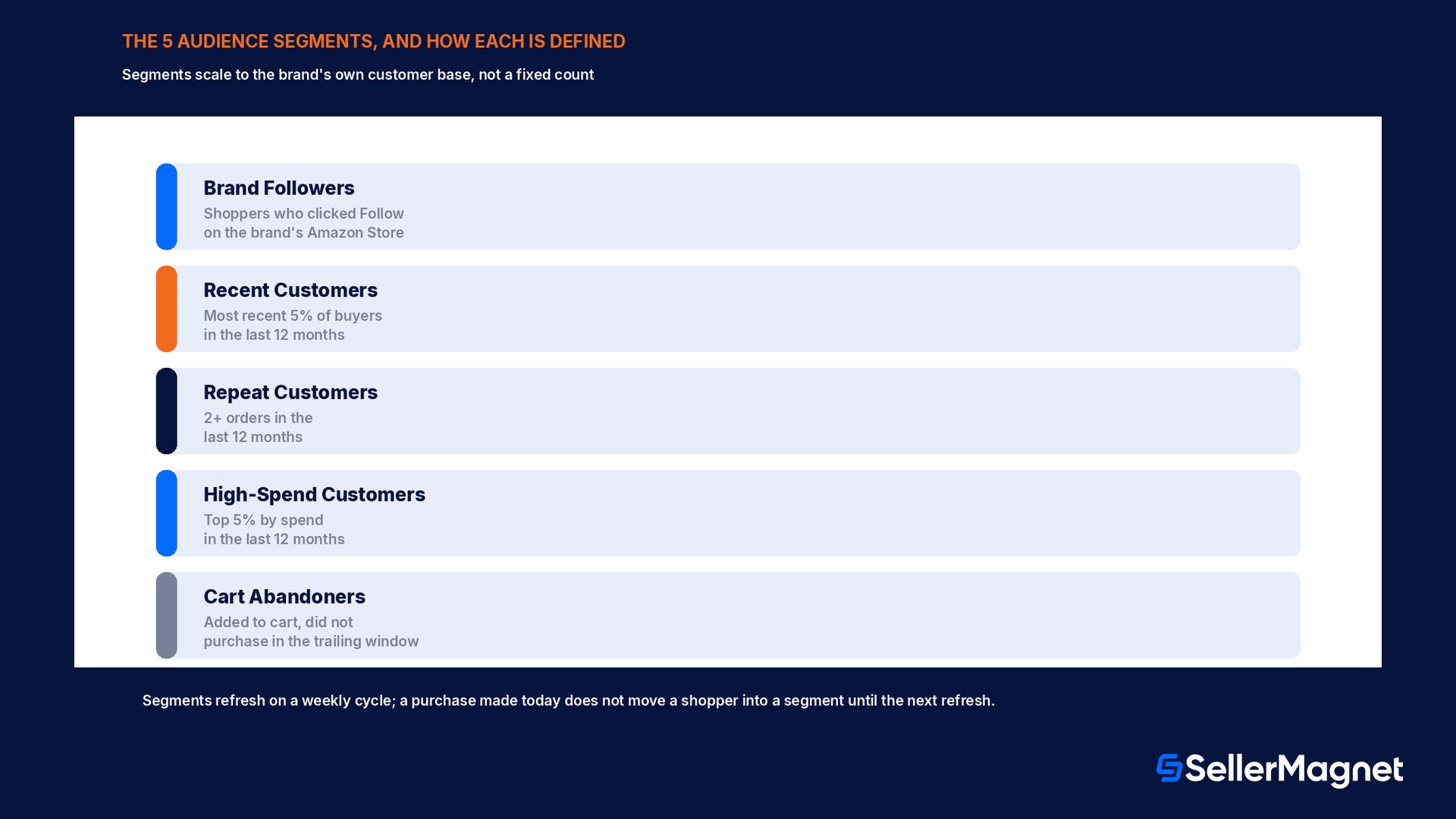
A campaign is sent to one named segment, not to a hand-built list, and each segment has a specific, stated definition rather than a vague label. Brand Followers are every shopper who clicked Follow on the brand's Amazon Store page, the largest and broadest segment for most brands. Recent Customers are the most recent 5% of customers who purchased from the brand within the last 12 months, refreshed weekly as new orders come in. Repeat Customers are buyers who have ordered the brand's products 2 or more times within the last 12 months, Amazon's own definition of a 'repeat' buyer for this tool specifically. High-Spend Customers are the highest-spending 5% of the brand's customers over the last 12 months, a value-based segment rather than an order-count one. Cart Abandoners are shoppers who added one or more of the brand's products to a cart but did not complete a purchase within the trailing window. Because the recent- and high-spend-customer segments are defined as a percentage of the brand's own customer base, a brand with 40,000 buyers in 12 months and a brand with 400 buyers both get a 'top 5%' segment, just at very different absolute sizes; the tool scales the audience to the brand automatically rather than using a fixed customer count.
Segment
Amazon's definition
Brand Followers
Shoppers who clicked Follow on the brand's Amazon Store
Recent Customers
The most recent 5% of customers who bought from the brand in the last 12 months
Repeat Customers
Customers who ordered the brand's products 2 or more times in the last 12 months
High-Spend Customers
The highest-spending 5% of the brand's customers over the last 12 months
Cart Abandoners
Shoppers who added the brand's product to a cart but did not purchase in the trailing window
Segments refresh weekly, not in real time
Amazon recalculates every segment on a weekly cycle, so a purchase made today does not move a shopper into the Repeat Customers segment until the next refresh; a campaign sent the same week as a sales spike is still targeting the previous week's segment membership.
The 3 campaign types a brand can actually send
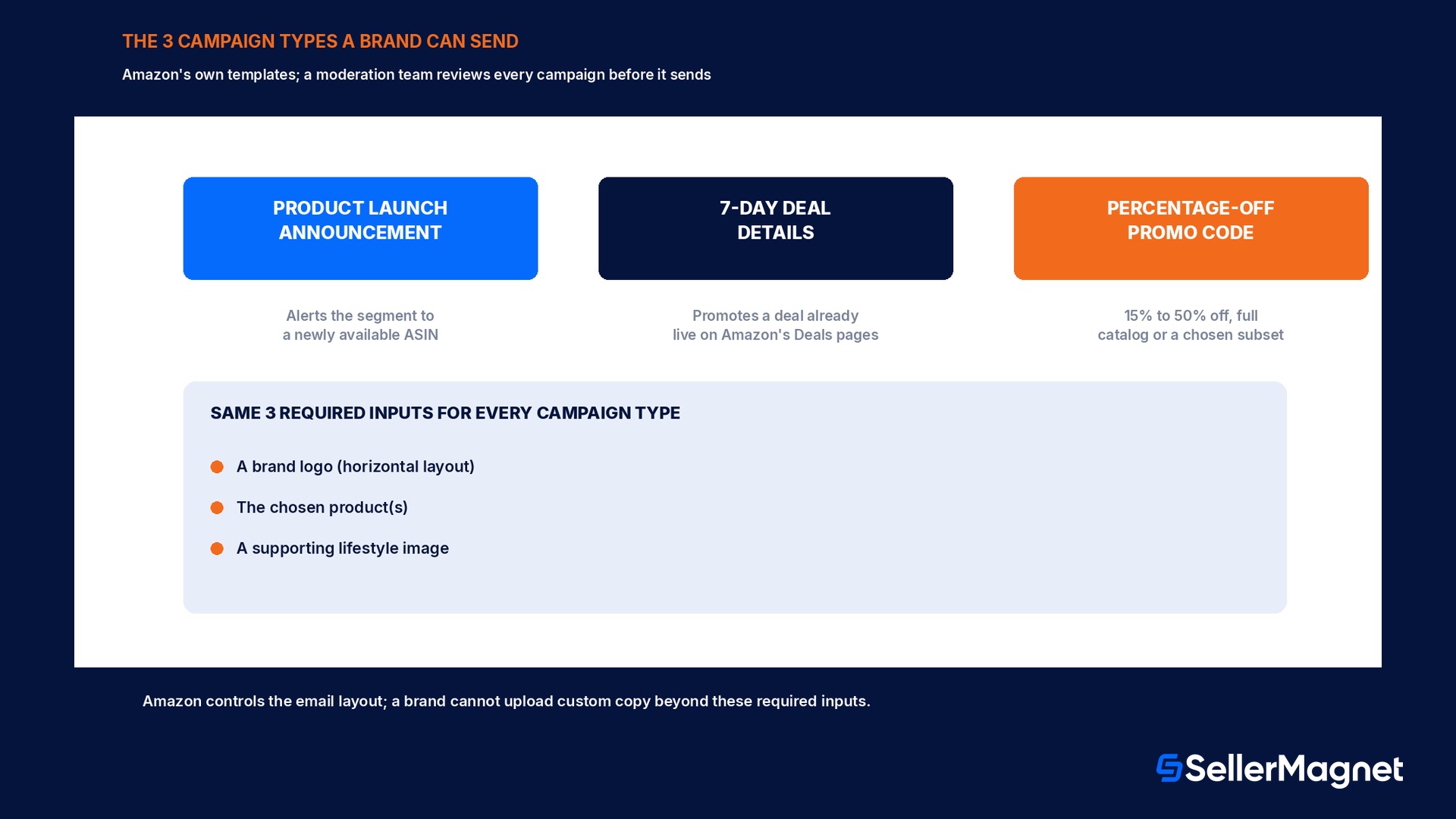
Every MYCE campaign is one of 3 templated types, not a free-form email the brand writes itself; Amazon controls the layout, and a moderation team reviews the content before it sends. Product Launch Announcements alert a chosen audience segment to a new ASIN, meant for a product recently made available for purchase rather than something that has already been live for months. 7-Day Deal details promote a time-based deal that is already listed on Amazon's own Deals pages for up to 7 days, giving it an extra push to the brand's own audience on top of whatever organic deal-page traffic it gets. Percentage-Off promotional codes are the discount-led campaign type: a brand sets a discount from 15% to 50% off, applied either to its entire catalog or to a chosen subset of products, and Amazon emails a redeemable code to the selected segment; each eligible customer can redeem it on a single purchase, limited to one unit of redemption per customer. None of the 3 types let a brand upload custom copy beyond the required inputs (a logo, the chosen product, a supporting lifestyle image, and the campaign-specific parameters); the email layout itself is Amazon's own template.
Campaign type
What it sends
Required inputs
Product Launch Announcement
Alerts the segment to a newly available ASIN
Logo, the new product, a supporting lifestyle image
7-Day Deal details
Promotes a deal already listed on Amazon's Deals pages for up to 7 days
Logo, the deal's product(s), a supporting image
Percentage-Off promo code
A redeemable discount code, 15% to 50% off, full catalog or a chosen subset
Logo, discount percentage, product scope, a supporting image
What does Amazon report back, and what does it never hand over?
After a campaign sends, Amazon's own reporting shows a fixed set of aggregate metrics: emails delivered, open rate, click-through rate, opt-out rate, sales, and conversion. These numbers tell a brand how the campaign performed as a whole, but they are deliberately aggregate: MYCE never discloses which specific shopper opened, clicked, or bought, and it never exports the underlying list of email addresses in the segment at all. A brand is choosing an audience definition and a message, Amazon is doing the sending and the measuring, and the brand only ever sees the summary on the other end. That is also why MYCE cannot be plugged into an outside email service provider or CRM: there is no list to import, because the brand is never given one.
Metric
What it shows
Emails delivered
How many messages in the segment were successfully delivered
Open rate
Share of delivered emails that were opened
Click-through rate
Share of delivered emails that produced a click
Opt-out rate
Share of delivered emails whose recipient opted out of future campaigns
Sales / conversion
Amazon sales and conversion attributed to the campaign after it sent
The Tailored Audiences beta gate: the exact numbers to clear it
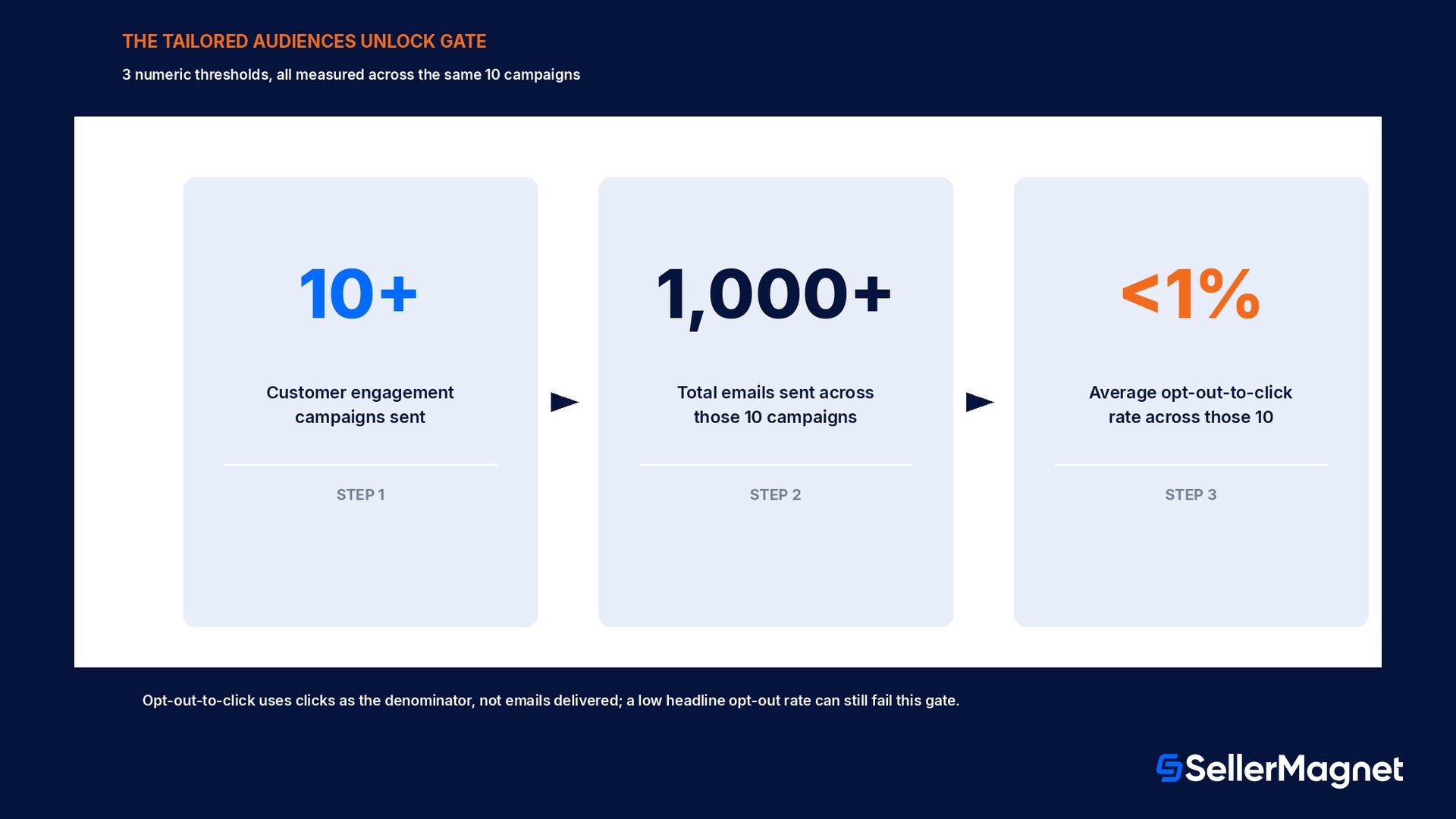
The segmentation beyond Brand Followers, recent, repeat, high-spend, and cart-abandoner audiences, originally rolled out as its own beta feature called Tailored Audiences, and Amazon gates access to it with a stated, numeric eligibility bar rather than a vague 'send more campaigns' suggestion. To unlock it, a brand needs to have sent 10 or more customer engagement campaigns, totaling at least 1,000 emails sent across those 10 campaigns, with an average opt-out-to-click rate under 1% across that same set of 10. The opt-out-to-click calculation is specific: for each of the 10 campaigns, multiply its emails delivered by its click-through rate to get that campaign's click count, sum the clicks across all 10 campaigns, then divide the total opt-outs across those 10 campaigns by that summed click total. A brand running its first few campaigns purely on the Brand Followers segment, with clean, relevant messaging that keeps opt-outs low relative to clicks, is building toward this exact threshold rather than toward a subjective reputation score.
Tailored Audiences unlock requirement
Threshold
Customer engagement campaigns sent
10 or more
Total emails sent across those 10 campaigns
1,000 or more
Average opt-out-to-click rate across those 10 campaigns
Under 1%
Opt-out-to-click is not the same as opt-out rate
A low opt-out RATE (opt-outs divided by emails delivered) is not automatically a low opt-out-to-CLICK rate; a campaign with very few clicks can still fail the Tailored Audiences gate even with a low headline opt-out rate, because the denominator in this specific calculation is clicks, not emails delivered.
Worked example: what one Percentage-Off campaign does to a Repeat Customers segment
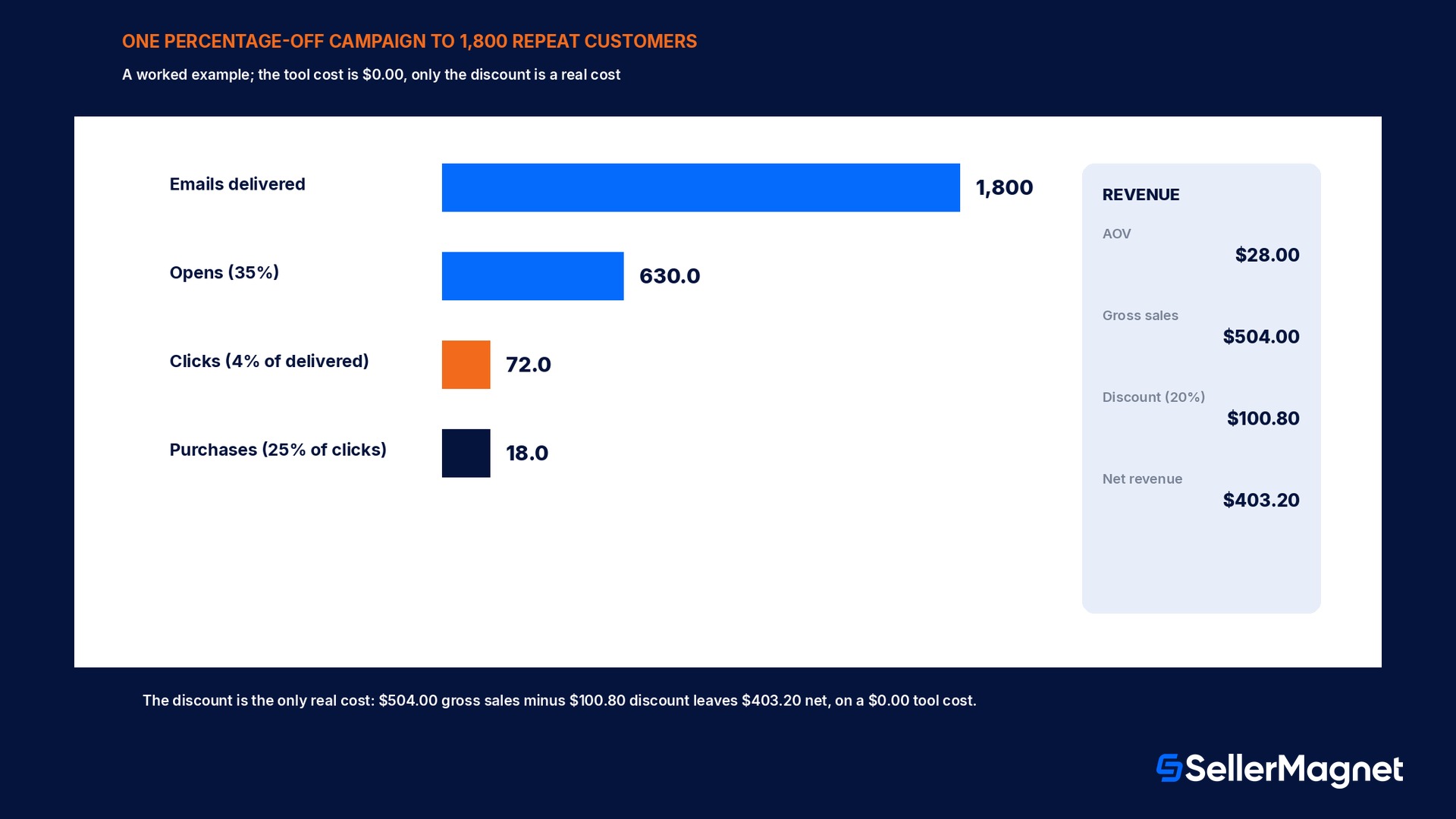
Take a Brand Registered seller whose Repeat Customers segment, buyers with 2 or more orders in the last 12 months, currently sits at 1,800 shoppers (a brand's own segment size for this example, not an Amazon-published average). The brand sends a Percentage-Off campaign at a 20% discount to that segment. Assume 1,800 emails delivered, a 35% open rate for 630.0 opens, and a click-through rate of 4% of emails delivered for 72.0 clicks; of those clicks, a 25% conversion rate to purchase produces 18.0 orders. At a $28.00 average order value, that is $504.00 in gross sales generated by the campaign. Because the campaign carries a 20% discount, the brand's net revenue on those 18.0 orders is $504.00 minus the $100.80 discount cost (20% of $504.00), or $403.20, against a tool cost of $0.00 since MYCE itself is free. The discount is the only real cost in this example; there is no per-email fee, no ad spend, and no agency fee for the send itself, the brand is only giving up margin on the orders the campaign itself produced.
Step
Value
Repeat Customers segment size (emails delivered)
1,800
Open rate -> opens
35% -> 630.0
Click-through rate (of delivered) -> clicks
4% -> 72.0
Conversion rate of clicks -> purchases
25% -> 18.0
Average order value
$28.00
Gross sales
$504.00
Discount cost (20% off)
$100.80
Net revenue after discount
$403.20
MYCE tool cost
$0.00
The segment size, rates and discount above are planning assumptions
The 1,800-shopper segment, the 35% open rate, the 4% click-through rate, the 25% click-to-purchase rate and the $28.00 average order value are sample figures for illustration; a real brand substitutes its own segment size and its own reported rates from the campaign's own results page once it has actually sent one. What does not change is the mechanism: the discount is the only cost, so the math above (gross sales minus the discount percentage) applies at any segment size or rate a real brand sees.
What MYCE is not: Request a Review, Amazon Posts, and A+ Content are different tools
MYCE sits in the same general neighborhood as 3 other brand-facing Amazon features, and mixing them up leads to the wrong tool for the job. Request a Review is a per-order, transactional action a seller fires on a single completed order, asking that one buyer for a product review or seller feedback; it is not a marketing email and cannot be sent to a segment or carry a promo code. Amazon Posts and A+ Content are passive, on-page content, a shopper has to browse to the brand's Store or a product's detail page to see a Post or an A+ module; MYCE is the opposite, an outbound message that lands in a chosen segment's inbox without the shopper visiting anything first. A brand trying to re-engage a Repeat Customers segment around a relaunch needs MYCE, not an A+ Content refresh or another round of Request a Review on orders that already happened; the 3 tools answer different questions and none of them substitutes for another.
What SellerMagnet does and does not do with Customer Engagement
Sending a MYCE campaign, choosing the segment, the campaign type, and the discount, happens entirely inside Seller Central; no third-party tool, SellerMagnet included, creates or sends a Customer Engagement campaign on a brand's behalf, because Amazon does not expose that as an API a third party can call. Where SellerMagnet's Analytics fits is on the measurement side after a campaign sends: tracking what the resulting orders do to per-SKU margin and repeat-purchase rate over the following weeks, the same kind of before-and-after read used in the worked example above, rather than stopping at the headline sales number Amazon's own report shows.
It is also worth keeping Review Requester and MYCE conceptually separate even though both touch past buyers: Review Requester automates the per-order Request a Review action Amazon already allows, asking a single buyer about a single completed order; it does not send marketing emails, discount codes, or segment-wide campaigns, because Amazon's own rules do not allow a review request to carry a promotional offer. A brand running both tools is using one for transactional review requests and the other, entirely separately, for the audience-wide marketing email MYCE sends.
Checklist before sending a first Customer Engagement campaign
How to confirm a brand is actually ready to send its first MYCE campaign
Confirm Brand Registry is active and the Store is live - The Customer Engagement menu under Brands does not appear at all without an approved, registered brand and an active Amazon Store.
Check which segments are actually visible on the account - A newly registered brand may see only Brand Followers until the fuller Tailored Audiences segments roll out to that account.
Confirm the segment has a usable audience size before sending - A campaign to a segment of a few dozen shoppers produces too little data to read the resulting open, click and conversion rates with any confidence.
Pick the campaign type that matches the actual goal - Product Launch for a new ASIN, 7-Day Deal for a deal already live on Amazon's Deals pages, Percentage-Off for a straight discount push.
Track opt-outs relative to clicks across the first 10 campaigns - The Tailored Audiences unlock needs 10+ campaigns, 1,000+ emails sent, and an average opt-out-to-click rate under 1% across those 10.
Read the post-send report before planning the next campaign - Emails delivered, open rate, click-through rate, opt-out rate, sales and conversion are the only numbers Amazon reports; there is no recipient-level detail to request.
Is Manage Your Customer Engagement free?
Yes. MYCE has no license fee and no per-email charge. The only real cost is any discount a brand chooses to offer inside a Percentage-Off promotional campaign.
Who is eligible to use MYCE?
Brand Registered sellers with an active Amazon Store that has Brand Followers or past buyers. Resellers and sellers without an approved, registered brand do not see the Customer Engagement menu item.
Does MYCE give a brand the actual email addresses of its customers?
No. Amazon sends the campaign on the brand's behalf and reports back aggregate metrics only. The brand never receives a list of recipient email addresses.
What audience segments can a MYCE campaign target?
Brand Followers, Recent Customers, Repeat Customers (2 or more orders in 12 months), High-Spend Customers (top 5% by spend), and Cart Abandoners, refreshed on a weekly cycle.
What discount range does the Percentage-Off campaign type allow?
15% to 50% off, applied to a brand's full catalog or a chosen subset of products, redeemable once per customer.
What does it take to unlock the Tailored Audiences segments?
Sending 10 or more customer engagement campaigns totaling at least 1,000 emails, with an average opt-out-to-click rate under 1% across those 10 campaigns.
Is MYCE the same as Request a Review?
No. Request a Review is a per-order, transactional action asking one buyer about one completed order. MYCE is a segment-wide marketing email and cannot carry a promo code on a review request.
Stop Juggling Tools. SellerMagnet Combines Everything You Need.