Amazon DSP Advertising for Sellers 2026: Access, Cost, Placements
R
RenéFreelance Amazon Editor
|
16 min read
A seller who has run Sponsored Products for a year and reads about Amazon DSP for the first time usually assumes it is just a bigger, more expensive version of the same keyword-targeted ad they already know, something to graduate into once the budget grows. It is not the same product at all. Sponsored Products, Sponsored Brands, and Sponsored Display are self-service, cost-per-click ads sold directly through the advertising console and shown only on Amazon's own properties; Amazon DSP is a demand-side platform, a programmatic buying tool that bids in real time on display, video, audio, and streaming TV ad inventory both on Amazon properties and across thousands of third-party sites and apps, billed on a cost-per-thousand-impressions basis rather than per click. The two live in genuinely different parts of Amazon's advertising stack, with different eligibility paths, different minimum-spend realities, and different skills required to run them well. This guide works through what Amazon DSP actually is, the real difference between its self-service and managed-service paths, what Amazon's own FAQ states the managed-service minimum spend actually is, and where it fits for a seller who is already running the familiar sponsored-ad console.
Amazon DSP is a demand-side platform, a programmatic advertising tool that buys display, video, audio, and streaming TV ad inventory through real-time bidding, both on Amazon's own properties and across thousands of third-party sites and apps. It is billed on a cost-per-thousand-impressions basis, unlike the cost-per-click Sponsored Products, Sponsored Brands, and Sponsored Display ads sold directly in the advertising console. It has a self-service path with no stated Amazon minimum, and a managed-service path with an Amazon Ads account executive that Amazon's own FAQ states typically requires a $50,000 minimum spend. It is open to sellers and non-sellers alike.
What is Amazon DSP, actually?
Amazon's own product page describes Amazon DSP as a demand-side platform, Amazon Ads' programmatic advertising solution, letting advertisers buy display, video, audio, and streaming TV ads across Amazon properties and third-party publishers. The word programmatic is doing real work here: instead of a human picking keywords and setting manual bids per click the way Sponsored Products works, a demand-side platform automates the purchase of ad inventory using real-time bidding, evaluating available ad space and bidding on it within milliseconds as a page loads, so the right ad reaches the right audience at the moment they are browsing somewhere else entirely, not on an Amazon search results page. Amazon's own guide to demand-side platforms lays out the mechanics plainly: a DSP is the buy-side counterpart to a supply-side platform, or SSP, which represents publishers selling their ad space; think of the DSP as the shopper at an auction and the SSP as the seller, with an ad exchange connecting the two in real time. For a seller, the practical difference from the sponsored-ad console is not just scale, it is an entirely different buying mechanism, a different pricing model, and a different reach: off-Amazon inventory that Sponsored Products, Sponsored Brands, and Sponsored Display simply do not touch.
Amazon DSP vs the sponsored-ad console: not the same product
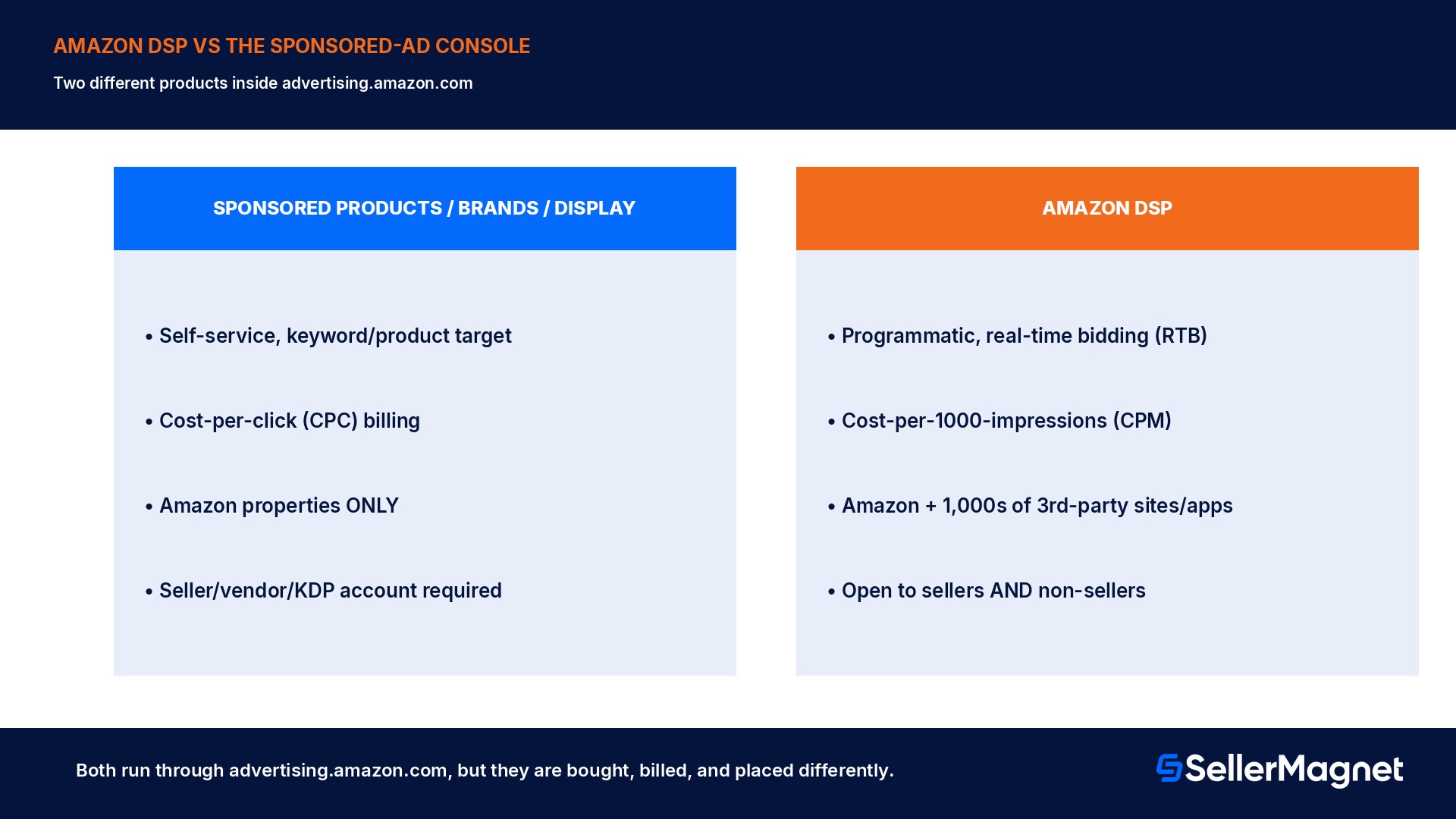
The confusion between Amazon DSP and the familiar sponsored-ad console is understandable, since both ultimately run through advertising.amazon.com and both can promote the same ASINs, but Amazon's own FAQ and product documentation draw a clear line between them on four separate axes: how the ad is bought, where it can appear, how it is billed, and who sets it up. Sponsored Products, Sponsored Brands, and Sponsored Display are self-service, cost-per-click products: an advertiser sets keywords or product targets and a bid, pays only when a customer clicks, and the ad can only appear on Amazon's own properties, desktop, mobile, and app. Amazon DSP instead buys display, video, audio, and streaming TV placements programmatically through real-time bidding, is billed on a cost-per-thousand-impressions basis for display and video, or a CPM basis specifically stated for audio ads, and its inventory spans Amazon's own properties plus thousands of third-party publisher sites and apps reached through the open programmatic exchange. The eligibility gap matters just as much as the mechanical one: Sponsored Products specifically requires an active Amazon professional seller account (or retail vendor status, or a Kindle Direct Publishing account) with Featured-Offer-eligible listings, while Amazon's own DSP product page states plainly that it is available to both advertisers who sell on Amazon and those who do not, since it is reaching audiences across the wider web, not placing an ad next to a specific Amazon listing's Buy Box.
Sponsored Products / Brands / Display
Amazon DSP
How it's bought
Self-service, keyword or product targeting, manual or automatic bids
Programmatic, real-time bidding (RTB) across an ad exchange
Billing model
Cost-per-click (CPC); pay only when clicked
Cost-per-thousand-impressions (CPM) for display/video; CPM for audio
Where it can appear
Amazon's own properties only (search, product pages, app)
Amazon properties PLUS thousands of third-party sites and apps
Who can use it
Active Amazon seller, retail vendor, or KDP account required
Open to sellers AND advertisers who do not sell on Amazon
Setup path
Self-service only, sign up directly in the console
Self-service, or managed-service with an Amazon Ads account executive
Self-service or managed-service: which access path actually applies?
Amazon's own FAQ is specific about how the two DSP access paths actually differ, and it is the single most important distinction for a seller deciding whether to even look further. Display ads, video ads, and ads run through Amazon DSP can be managed independently, meaning self-service, or with an Amazon Ads account executive, meaning managed-service; the FAQ directs advertisers interested in the managed path to contact Amazon Ads sales directly to get started, rather than self-enrolling the way a Sponsored Products campaign is created. The managed-service route is where Amazon's own published minimum spend figure applies: the same FAQ states that advertising through a managed-service option with an Amazon Ads account executive, covering display ads, video ads, and ads run through Amazon DSP together, typically requires a minimum spend of $50,000 (US). That figure is not stated as a monthly or annual number in Amazon's own FAQ text, only as a typical minimum for the managed-service engagement itself, so a seller should confirm the actual commitment period directly with an Amazon Ads account executive rather than assume a cadence. The self-service path, by contrast, carries no equivalent published minimum spend figure in Amazon's own FAQ or product pages; an advertiser comfortable managing bid strategies, audience segments, and creative directly in the console can start self-service DSP campaigns without clearing that $50,000 bar at all.
No stated self-service minimum
Amazon's own FAQ ties the $50,000 figure specifically to the managed-service option with an account executive. It does not state an equivalent minimum for self-service DSP campaigns; a seller should still confirm current terms directly on advertising.amazon.com before assuming either number applies to their situation.
A worked comparison: what the $50,000 managed-service minimum actually represents
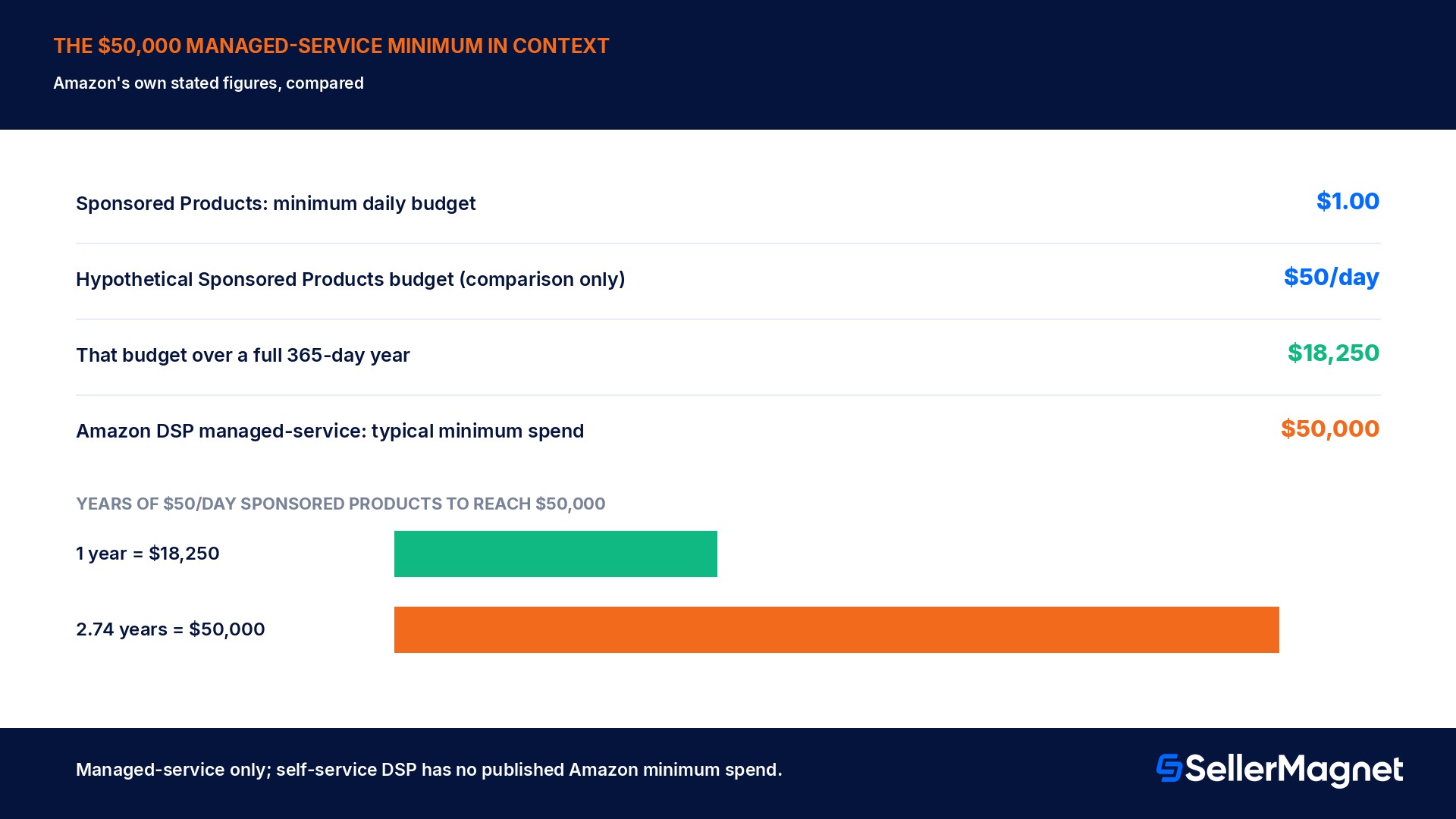
Amazon's own FAQ states the Sponsored Products minimum daily budget as $1.00, and the managed-service DSP minimum as a typical $50,000 (US); putting those two official figures side by side shows exactly how far apart the two products are, in spend terms, without inventing a number Amazon has not published. Dividing the managed-service minimum by the Sponsored Products daily floor ($50,000 / $1.00) comes to 50,000: the managed-service DSP minimum sits 50,000 budget-units above the smallest daily budget Amazon allows on Sponsored Products. For a more realistic comparison, take a seller running a middle-of-the-road $50-a-day Sponsored Products budget, a hypothetical figure chosen only for this comparison, not an Amazon-published number: over a full 365-day year that comes to $50 x 365 = $18,250. That seller's cumulative Sponsored Products spend would need to run for almost three full years at that same pace, roughly 2 years plus most of another, before the running total caught up to the same $50,000 figure Amazon's FAQ states as the typical managed-service DSP minimum. The point of the comparison is not that DSP is simply unaffordable; it is that the managed-service path is built around a materially different scale of advertising budget than the self-service sponsored-ad console a typical seller starts with, which is exactly why Amazon offers the separate, no-published-minimum self-service DSP path for advertisers who are not yet operating at that scale.
Where can the ad actually appear?
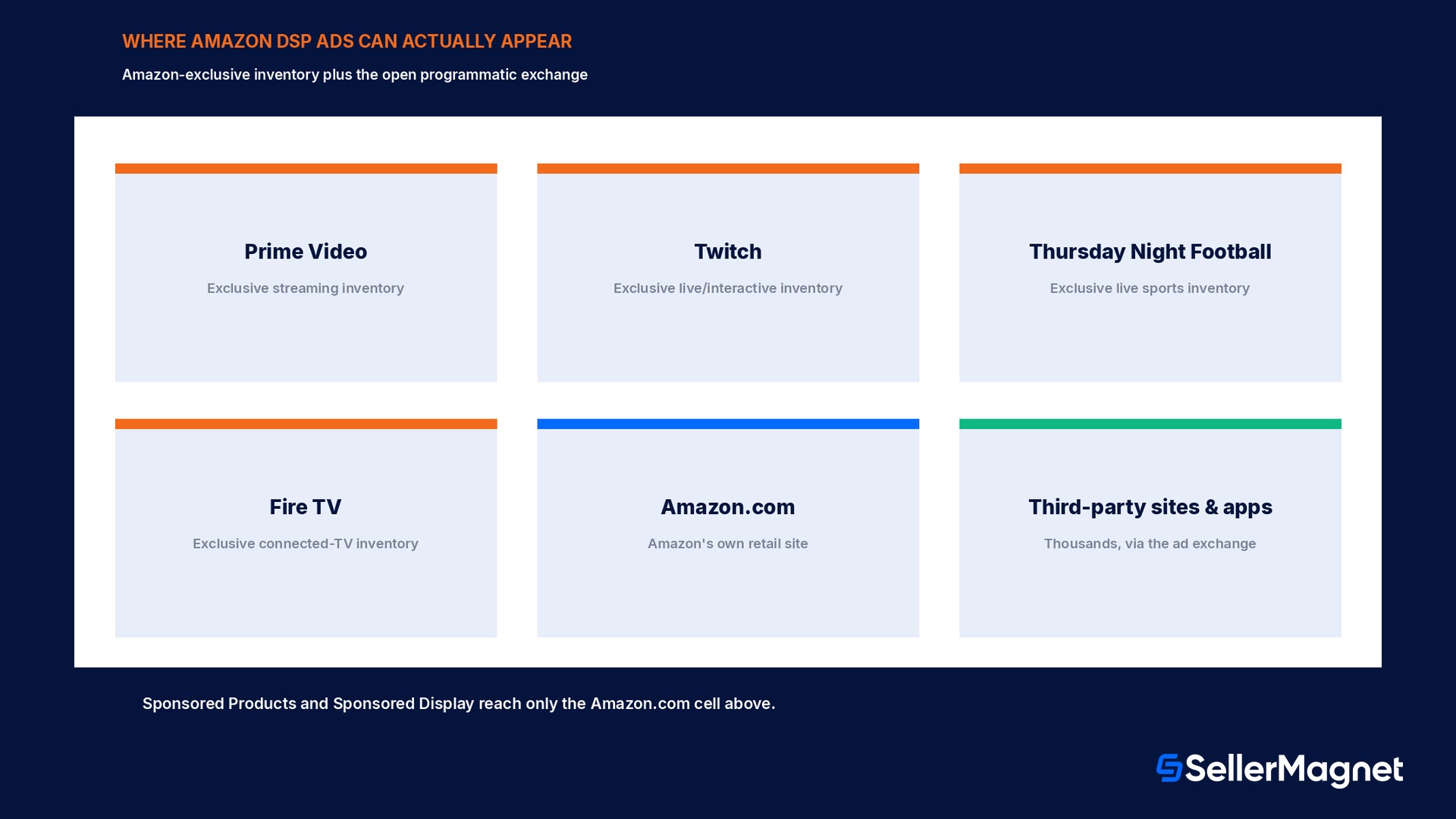
The inventory gap is where Amazon DSP earns its reach, and Amazon's own product page names the exclusive placements plainly: access to inventory on Prime Video, Twitch, Thursday Night Football, Amazon.com, and Fire TV, each a placement a Sponsored Products or Sponsored Display ad simply cannot reach, alongside thousands of premium third-party sites and apps bought through the open programmatic exchange. This is not a single ad format stretched across more pages; Amazon's own guide to demand-side platforms describes centralized management of display, video, audio, and streaming TV campaigns from one platform, so the same advertiser can run a display banner on a third-party retail site, a video pre-roll on Fire TV, and an audio spot during a Twitch stream, from the same DSP account, targeting the same audience segment across all three. Amazon's own case studies published on its library of guides illustrate the off-Amazon reach concretely: one cited case has a brand using Amazon DSP's ASIN-level shopping signals to reach Amazon shoppers interested in its products or similar categories across the open web, then driving that traffic to the brand's own site rather than to Amazon.com, something a Sponsored Products or Sponsored Brands campaign, confined to Amazon's own properties, structurally cannot do.
Inventory type
Example placements
Amazon-exclusive video/streaming
Prime Video, Thursday Night Football, Fire TV
Amazon-exclusive live/interactive
Twitch
Amazon's own retail site
Amazon.com display and video placements
Third-party open web
Thousands of premium third-party sites and apps via the ad exchange
Audience targeting and attribution: what makes it different from a keyword
Sponsored Products and Sponsored Brands match an ad to a shopper's typed search query or to a specific product being viewed; Amazon DSP instead targets audiences built from signals, and Amazon's own guide to demand-side platforms lists first-party signals specifically, browsing, shopping, and streaming behavior, as the basis for precise reach, rather than a keyword typed into a search box at a single moment. Amazon's own case studies describe this in practice as ASIN-level shopping signals: an advertiser can build an audience of shoppers who viewed or purchased products similar to their own, or in the same category, and then reach that audience with a display or video ad anywhere in the DSP's inventory, on Amazon or off it, not only at the exact moment that shopper is searching on Amazon.com. Attribution works on a similar logic shift: Amazon's own guide explains that DSP attribution connects an ad view or click with a later action, such as a purchase or sign-up, tracked within a defined lookback window, so a campaign's effect on sales can be measured even when the eventual purchase happens on a different device or days after the ad was seen, rather than crediting only an immediate click-through the way Sponsored Products reporting does by default. For deeper analysis across channels, Amazon's own published case studies describe advertisers pairing DSP with Amazon Marketing Cloud and Amazon Marketing Stream to analyze cross-channel shopper behavior and adjust bids, in one cited example making up to 800 daily bid adjustments from full-funnel insights, a level of granularity built for the programmatic, audience-based model DSP runs on, not for a manual keyword bid list.
What Amazon's own published case studies show
Amazon's library of DSP case studies cites outcomes like an 11.4x return on ad spend driving traffic to a brand's own site, and a 106% year-over-year sales increase in a new market from a 50% spend increase, both from named advertisers using Amazon DSP's audience and attribution tools together. These are Amazon's own published results for specific named brands, not a guarantee for every advertiser or campaign; actual outcomes vary by category, creative, and audience strategy.
Ad formats and the free certification path
Amazon's own guide to demand-side platforms breaks a DSP down into named components that matter for anyone evaluating whether to run it themselves: a bidder that handles the real-time bidding process, an ad server that manages delivery and measurement, campaign reporting through a centralized dashboard, a budget manager controlling spend allocation, ad exchange and SSP integration to find inventory, creative management for building display, video, audio, and component-format ad creatives, and fraud detection and brand-safety measures built into the platform.
None of that requires hiring an agency to access: Amazon Ads Academy offers a free, beginner-level Amazon DSP Certification validating an understanding of Amazon DSP's features, use cases, audience solutions, campaign setup, and performance optimization, open to anyone regardless of ad spend or whether they go through the self-service or managed-service path. A separate Amazon DSP Advanced Certification validates proficiency in more advanced programmatic offerings specifically, including bid strategies, conversion tracking, audience solutions, third-party integrations, deals, attribution, and creative formats, plus dedicated courses on setting up a first DSP campaign and on building ads that pass Amazon's own Guidelines and Acceptance Policies for legibility, branding, and claim substantiation. A seller curious about DSP but nowhere near a $50,000 managed-service budget can complete both certifications for free before spending a single dollar, which is a genuinely different on-ramp than the sponsored-ad console offers.
Where sellers get the comparison wrong
The most common mistake is treating Amazon DSP as simply a bigger-budget tier of the same Sponsored Products auction, and then being surprised that a CPM-billed, audience-targeted, programmatic product does not behave like a CPC, keyword-targeted one; the two require different skills (audience strategy and creative formats for display, video, and audio, rather than keyword research and bid management) and different success metrics (reach and attributed sales across a lookback window, rather than ACOS on an individual click). A second mistake is assuming a Seller Central account and Featured-Offer-eligible listings are a prerequisite, the way they explicitly are for Sponsored Products; Amazon's own DSP product page states the opposite, that it is available to both advertisers who sell on Amazon and those who do not, since the audience it targets is reached on the open web and Amazon's own media properties, not tied to a specific Buy Box. A third mistake is conflating the $50,000 managed-service minimum with a hard requirement to even start with DSP at all, when Amazon's own FAQ ties that figure specifically to the managed-service option with an account executive and states no equivalent minimum for the self-service path. A fourth, subtler mistake is skipping the free DSP Certification courses and going straight into a self-service console with only sponsored-ad experience; the certification material exists precisely because the programmatic bidding, audience, and attribution model genuinely differs from keyword advertising, and a seller who has only run Sponsored Products is starting from a different baseline than the certification assumes.
What SellerMagnet does and does not cover here
SellerMagnet connects to a seller's Amazon Seller Central account and does not run, bid on, or manage Amazon DSP campaigns directly; signing up for self-service DSP, or being assigned an Amazon Ads account executive for the managed-service path, both happen directly between the advertiser and Amazon Ads. Where SellerMagnet's PPC Manager is useful is on the sponsored-ad side of the same advertising budget: bid and budget management for Sponsored Products, Sponsored Brands, and Sponsored Display campaigns, the self-service, cost-per-click products covered in the comparison table above, not the programmatic DSP inventory this guide describes. A seller weighing whether their sponsored-ad spend has reached the point where Amazon DSP's audience reach is worth evaluating should look at the trend over time, not a single week, and the Analytics Dashboard shows net profit per order, product, and marketplace after Amazon's own fees, the actual budget base a seller would be stretching toward either DSP access path from.
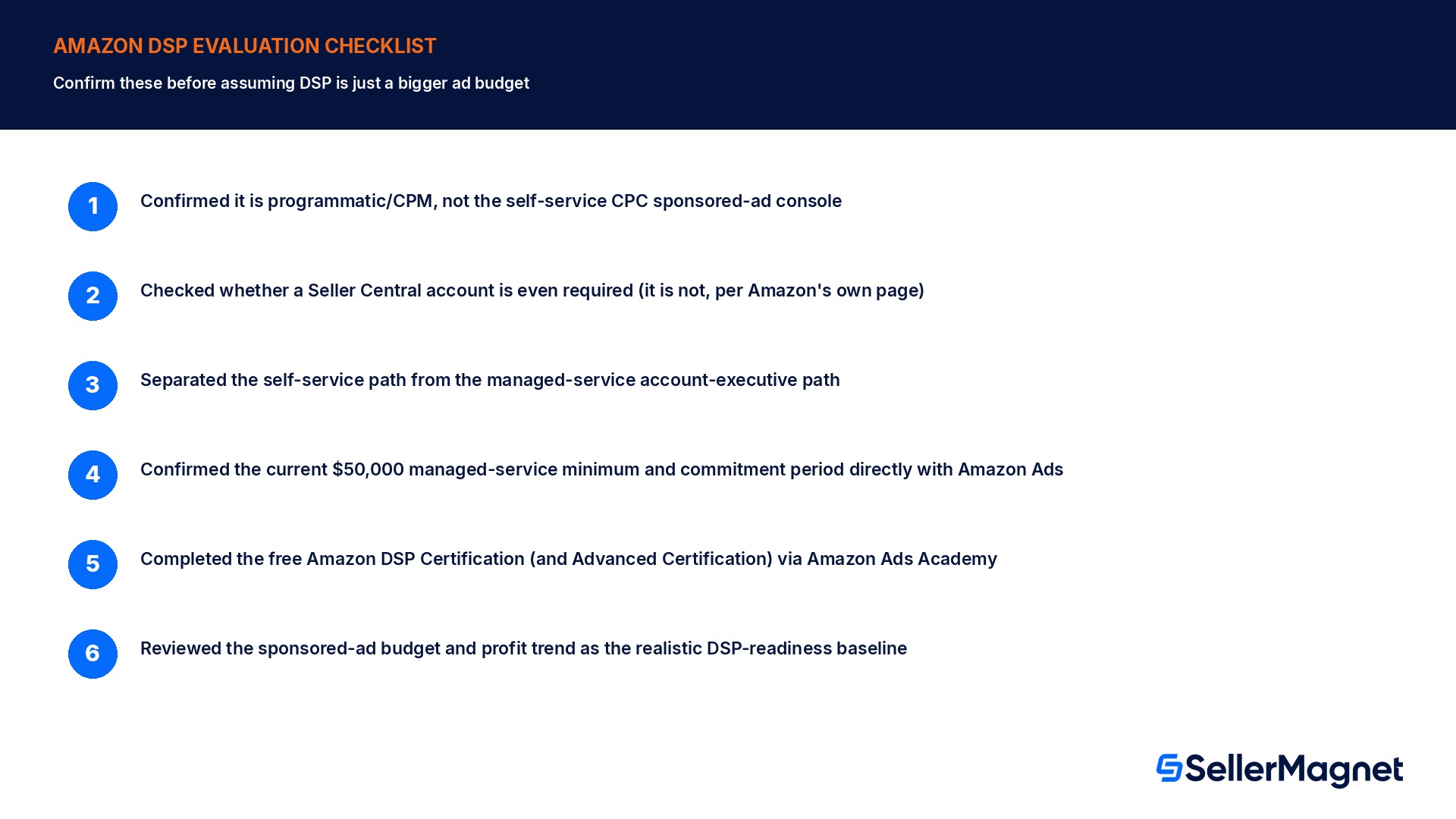
Checklist before evaluating Amazon DSP
How to figure out whether Amazon DSP is worth evaluating right now
Confirm it is not the sponsored-ad console - Amazon DSP is programmatic and CPM-billed; Sponsored Products/Brands/Display are self-service and CPC-billed. They are different products with different skills required.
Check whether a Seller Central account is even required - Amazon's own DSP page states it is open to sellers AND non-sellers; it is not gated behind Featured-Offer-eligible listings the way Sponsored Products is.
Separate the self-service and managed-service paths - Only the managed-service option with an Amazon Ads account executive carries Amazon's stated typical $50,000 minimum; self-service carries no published Amazon minimum.
Confirm the current minimum and commitment period directly - Amazon's FAQ states a typical figure without a stated time period; confirm the live number and cadence with an Amazon Ads account executive before planning around it.
Complete the free DSP Certification before running a self-service campaign - Amazon Ads Academy's beginner and Advanced DSP certifications are free and open regardless of spend, and cover the audience/attribution model this guide describes.
Track the sponsored-ad budget base first - A seller's existing Sponsored Products/Brands/Display spend and profit trend is the realistic starting point for judging DSP readiness, not a single month's number.
Is Amazon DSP the same as Sponsored Products or Sponsored Display?
No. Sponsored Products, Sponsored Brands, and Sponsored Display are self-service, cost-per-click ads targeted by keyword or product and shown only on Amazon's own properties. Amazon DSP is a demand-side platform that buys display, video, audio, and streaming TV inventory programmatically through real-time bidding, billed on a cost-per-thousand-impressions basis, across Amazon properties AND thousands of third-party sites and apps.
Do I need to sell on Amazon to use Amazon DSP?
No. Amazon's own DSP product page states it is available to both advertisers who sell on Amazon and those who do not. This is different from Sponsored Products, which requires an active Amazon professional seller account, retail vendor status, or a Kindle Direct Publishing account.
What is the minimum spend for Amazon DSP?
Amazon's own FAQ states that the managed-service option with an Amazon Ads account executive, covering display ads, video ads, and ads run through Amazon DSP, typically requires a minimum spend of $50,000 (US). No equivalent minimum is published for the self-service DSP path.
What is the difference between self-service and managed-service DSP?
Self-service means the advertiser manages their own DSP campaigns directly in the console, with no stated Amazon minimum spend. Managed-service means working with an Amazon Ads account executive, which Amazon's FAQ states typically requires a $50,000 minimum spend; advertisers interested in managed-service contact Amazon Ads sales directly.
Where can Amazon DSP ads actually appear?
Amazon's own product page names Prime Video, Twitch, Thursday Night Football, Amazon.com, and Fire TV as exclusive inventory, plus thousands of premium third-party sites and apps bought through the open programmatic exchange. This is a wider reach than Sponsored Products or Sponsored Display, which only appear on Amazon's own properties.
Is there a free way to learn Amazon DSP before spending money?
Yes. Amazon Ads Academy offers a free, beginner-level Amazon DSP Certification and a separate Advanced Certification covering bid strategies, attribution, audience solutions, and creative formats, open to anyone regardless of ad spend or which access path they plan to use.
Stop Juggling Tools. SellerMagnet Combines Everything You Need.