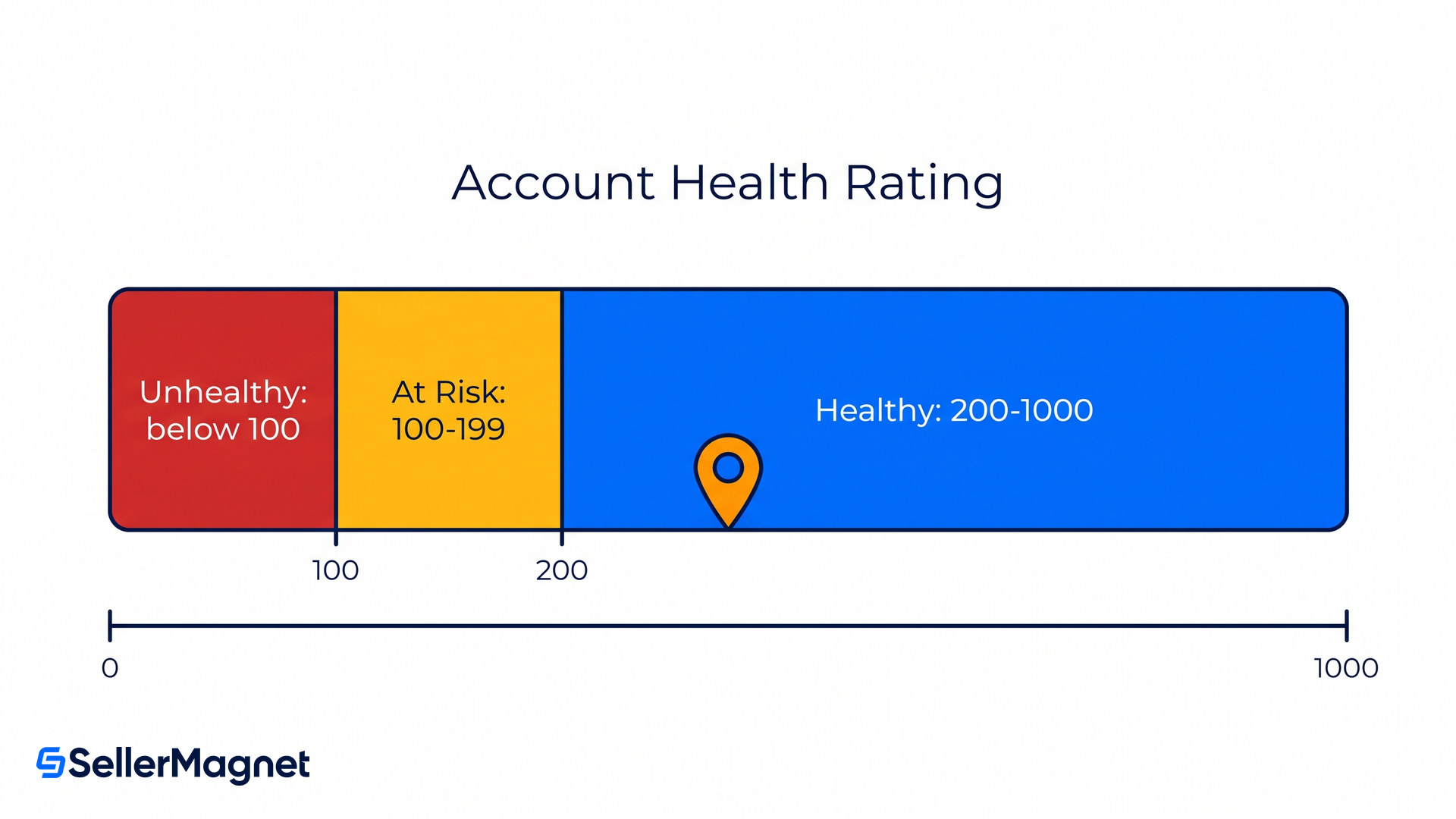
The Amazon Account Health Rating is a score from 0 to 1,000 that measures how closely your selling account follows Amazon's policies. At 200 and above it is green and healthy, between 100 and 199 your account is at risk of deactivation, and below 100 it is eligible for deactivation. The number that panics most sellers, though, is often just sales volume moving through a rolling window.
The Amazon Account Health Rating is a score from zero to one thousand that reflects how well a selling account follows Amazon's policies. Two hundred or higher is healthy. Between one hundred and one hundred and ninety nine the account is at risk. Below one hundred it is eligible for deactivation.
What is the Amazon Account Health Rating?
The Account Health Rating is a compliance score, not a quality score. Amazon calls the AHR "a holistic measure of your selling account's adherence or compliance with Amazon's policies" in its staff introduction to the rating, and adds: "When account health issues do take place, often it is due to an accumulation of listing violations." The number sits in the centre of your Account Health page, directly above the listing violation box.
An Amazon staff guide posted in Seller Forums describes it as "a numeric score (0-1,000) that reflects your adherence to Amazon's policies". That range matters when you read advice elsewhere: a score of 340 is not a percentage and not a grade out of 100, and comparing your number to another seller's tells you nothing, because the two accounts carry different order volumes and different violation histories.
What do the AHR score bands mean?
Three bands, each with a colour and a consequence. Amazon defines them by hard thresholds rather than by judgement, so you always know which side of a line you are on.
Band
Score
What Amazon does
What you should do
Healthy (green)
200 to 1,000
Nothing. Amazon notes the score "will not fall below this number unless listing violations are incurred"
Check the page weekly and keep the four delivery and defect targets clear
At Risk (yellow)
100 to 199
Shows a banner reading "Your Account is At Risk of Deactivation"
Work the open violations immediately, highest impact first
Unhealthy (red)
Below 100
The account is "eligible for deactivation"
Resolve violations now; once the score rises above 100 the account is "eligible for reinstatement"
Not every violation costs the same. Amazon sorts them into five impact categories, "Critical, High, Medium, Low, No impact", and warns that "with critical violations, the score will likely be dropped all the way to zero". A single critical violation therefore skips both lower bands in one step, which is why a seller can go from green to deactivated without ever seeing yellow.
Why does the score move when I have no violations?
Because the page measures your order volume, not only your mistakes. Amazon states that the Account Health page "measures listing activity on a rolling 180 period" and adds: "For orders fulfilled within this period, you may see a raising or lowering of the AHR score as orders move into and out of the window."
That single sentence explains most of the panic posts in seller forums. A score that slides in January after a heavy Q4 is usually last year's orders ageing out of the 180-day window, not a hidden enforcement. The same effect works in your favour: volume growth lifts the number without you doing anything to your listings.
Read the violations box, not the number
The score alone cannot tell you whether anything is wrong. A drop with an empty violation list is volume. A drop with a new entry in the listing violation box is an enforcement, and only the second kind needs an appeal.
Which performance targets sit on the same page?
Four numeric targets, each with a published threshold of its own. The Amazon staff guide lists them as a step of their own, and they carry consequences for seller-fulfilled offers wherever your rating happens to sit.
Metric
Amazon's target
What feeds it
Order Defect Rate (ODR)
Below 1%
Negative feedback, A-to-z Guarantee claims and credit card chargebacks
Late Shipment Rate (LSR)
Below 4%
Seller-fulfilled orders confirmed as shipped after the expected ship date
Pre-Fulfilment Cancellation Rate
Below 2.5%
Orders you cancel before shipping, usually a stock or pricing error
Valid Tracking Rate (VTR)
Above 95%
Seller-fulfilled orders shipped with a valid, carrier-confirmed tracking number
Amazon has never published the AHR formula, so be sceptical of any guide that tells you exactly how these four feed into it. What Amazon does describe is a rating driven by unresolved policy violations and their severity, alongside four targets that carry enforcement of their own. The practical reading is the one worth keeping: a green AHR is not proof that everything is fine, because the rating can sit comfortably above 200 while a late shipment rate climbs toward the line that costs you your seller-fulfilled offers.
The fact that changes how you triage
Amazon is explicit that the hit is temporary: "When the violations first appear, any impact they have on your score is immediately deducted from the AHR. It should be noted that this is a one-time deduction. Once the affected listing violation has been successfully removed from the Account Health page, the points will be reinstated to the AHR score." A violation you win back is not a permanent scar, and a violation you leave open is not costing you more every week. It cost you once, and it is still costing you that.
What does Account Health Assurance actually protect?
Account Health Assurance buys you a conversation, not immunity. Amazon's programme post states the commitment plainly: "With Account Health Assurance, we will no longer deactivate your selling account as long as you work with us to resolve any issues." It costs nothing, and Amazon says the benefit is "now available worldwide".
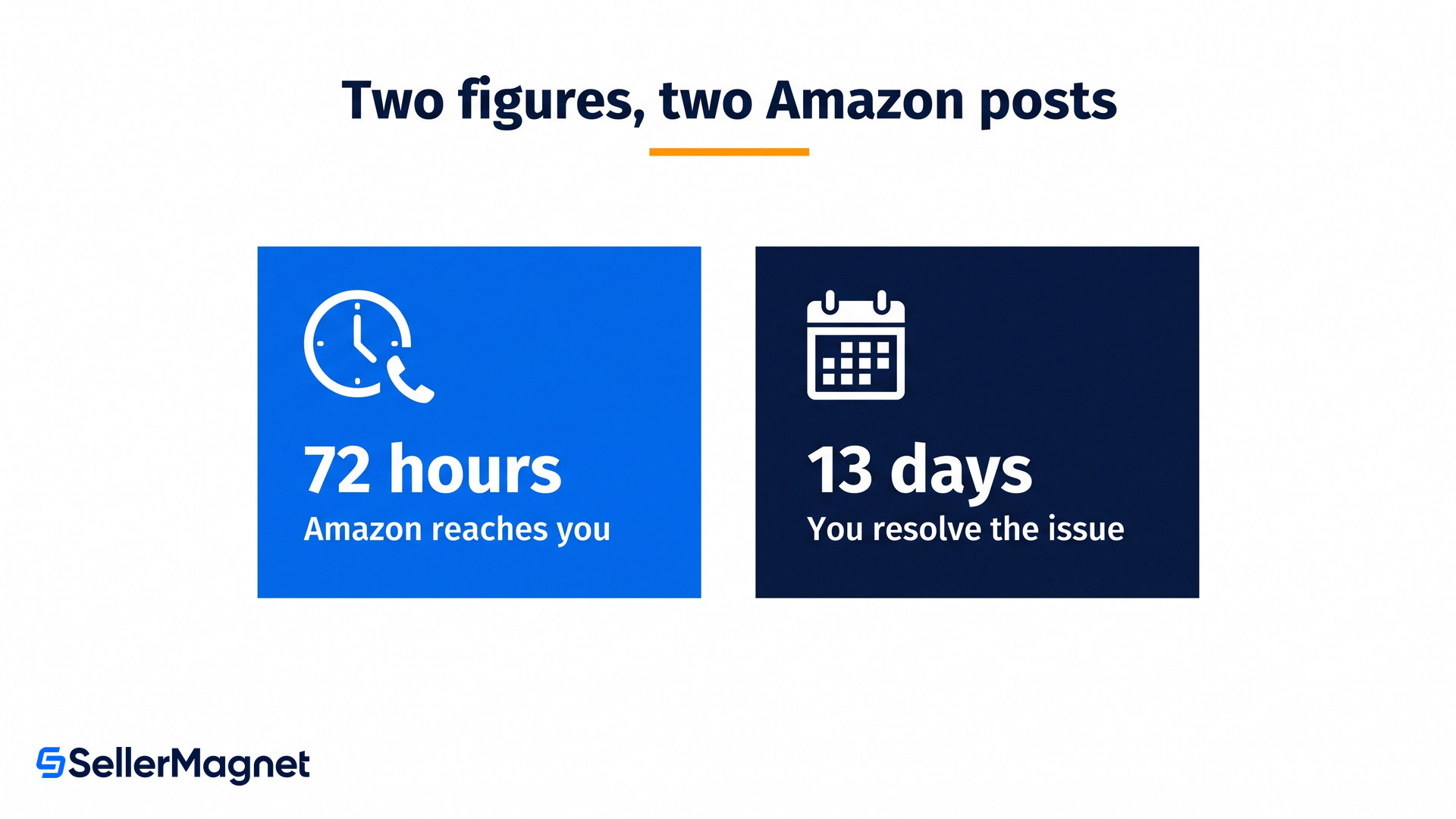
Two numbers circulate for how much time the benefit buys you, and Amazon states them in two different places. The programme post gives one: "When you encounter an issue that would otherwise result in account deactivation in a store in which you are enrolled, an account health specialist will proactively reach out and explain step-by-step what the issue is and how to address it. As long as our team can reach you within 72 hours and you work with us to address the account issues, your selling account will not be deactivated." A separate Amazon staff guide in Seller Forums gives the other: "AHA gives you up to 13 days (instead of 3) to resolve issues before suspension."
Amazon never sets those two figures side by side, so treat the relationship between them as unsettled rather than as a documented sequence, however confidently a blog post states otherwise. The 72 hours is the unambiguous half, and it is also the half you control. Amazon's commitment is conditional on "our team can reach you", which turns the phone number and email address on your account into part of the protection rather than an administrative detail. Being unreachable is the one scenario Amazon's own sentence rules out.
Enrolment is automatic rather than an application. Amazon writes that "when you become eligible for Account Health Assurance, you'll be enrolled automatically and will receive an email notification", and lists the criteria as "sellers with a professional account subscription who maintain an AHR score of 250 or higher for at least six months with no more than 10 days below 250, and have a valid emergency contact number on Seller Central". Sellers also "know they are enrolled in Account Health Assurance when they see the badge at the top of their account page in Seller Central".
A Professional selling plan. Individual plans are outside the programme.
An AHR of 250 or higher for at least six months, with no more than 10 days spent below 250 in that stretch.
A valid emergency contact number stored in Seller Central, because the benefit begins with a phone call.
The badge at the top of your account page, which is how you confirm you are actually in the programme rather than assuming it.
What the assurance does not cover
Amazon reserves the right to remove a seller from the programme and deactivate the account immediately where there are suspicions of involvement in fraudulent, deceptive, illegal or harmful activities, or where the seller fails to comply with the relevant regulations. The benefit is a safety net for operational mistakes, not for the categories Amazon treats as abuse.
Availability is wider than most guides say, and the two programmes arrived on separate timetables. Amazon's November 2022 launch announcement introduced the assurance "first with selling partners in Amazon's U.S. and Canadian stores", which the programme post has since superseded with "now available worldwide". The underlying rating reached Europe separately: Amazon's European newsroom announced in January 2023 that the Account Health Rating was coming to sellers in the "France, Germany, Italy, Spain, Netherlands, Poland, Sweden, Belgium, UK, and Türkiye stores", where specialists "proactively call, email, and send notifications to the seller". Check your own account page for the badge rather than trusting any list in a blog post, this one included.
How do you fix a falling account health rating?
Work the violations in impact order and use the phone. Amazon's guidance is specific on both points, and both are faster than the appeal-writing marathon most sellers start with.
How to recover an Account Health Rating
Separate a volume dip from an enforcement - Open the Account Health page and look at the listing violation box, not the number. If no new violation appeared, the movement is your order volume passing through the rolling 180-day window and there is nothing to appeal.
Sort the violations by AHR impact - Amazon's guidance is to sort by AHR impact from highest to lowest and work down that list. Clearing one critical or high violation moves the score further than clearing five low ones.
Use the Call Me Now button - The Account Health page has a Call Me Now button that connects you to Account Health Support. A specialist can tell you what the enforcement actually is and what evidence will close it, which is quicker than guessing at a plan of action.
Submit the appeal through the dashboard - File the appeal or the supporting documentation directly from the violation entry on the Account Health page rather than through general seller support, so it lands against the right enforcement.
Watch performance notifications until the points return - The deduction is reversed only when the violation is removed from the page, so keep checking notifications until the entry clears and the score moves back up.
Quick win for today
Open Seller Central and confirm two things that take a minute each: that an emergency contact number is stored on your account, and whether the Account Health Assurance badge is on your account health page. Then keep the defect side of the equation quiet at the source, by asking for feedback on the orders that went well with the SellerMagnet review request tool instead of letting the ODR line be written only by the unhappy minority.
Anything from 200 upward is in Amazon's Healthy band. If you want Account Health Assurance you need 250 or higher, held for six months with no more than 10 days below that line.
Why did my AHR drop with no new violation?
Because the Account Health page measures listing activity on a rolling 180-day window, and the score rises and falls as orders move into and out of it. A drop with an empty violation box is volume, not enforcement.
Do I get the points back after I resolve a violation?
Yes. Amazon describes the hit as a one-time deduction and says the points are reinstated once the violation has been successfully removed from the Account Health page.
Can one violation deactivate my account?
It can. Violations are graded from Critical to No impact, and Amazon says a critical violation will likely drop the score all the way to zero, which puts the account below the deactivation line in one step.
Is the Order Defect Rate part of the AHR?
Amazon has not published the AHR formula, so watch them as two numbers rather than one. Amazon describes the rating in terms of unresolved policy violations and their severity, while the order defect rate is a published target of its own that must stay below 1 percent.
How do I know if I have Account Health Assurance?
Amazon shows a badge at the top of your account health page in Seller Central. Enrolment is automatic for sellers who meet the criteria, so there is nothing to apply for.
Stop Juggling Tools. SellerMagnet Combines Everything You Need.