EU Customs Handling Fee 2026: The New 2 Euro Charge
R
RenéFreelance Amazon Editor
|
16 min read
On 1 November 2026 the European Union added a second charge to every parcel that crosses its border from outside the EU to a consumer inside it: a flat 2 euro customs handling fee, applied per item in the customs declaration, regardless of what that parcel is worth. It is easy to read that sentence and assume it simply replaces the 3 euro duty the EU introduced on low-value imports back on 1 July 2026, four months earlier. It does not. Amazon's own help page is explicit that the handling fee stacks on top of the duty for shipments at or under 150 euro, and that it also applies, on its own, to shipments above that threshold where the 3 euro duty never applied in the first place. The charge is not an Amazon fee; it is mandated under EU customs rules and simply flows through Amazon's fulfilment and carrier mechanics differently depending on whether a seller ships FBM or uses Remote Fulfilment with FBA. This guide works from Amazon's own EU customs requirements reference page and seller forums announcement to walk through exactly what the fee is, who actually pays it and how, a worked comparison of what it adds to a real multi-item parcel, and the mistakes the stacking rule makes easy to fall into.
Since 1 November 2026, the EU charges a 2 euro customs handling fee per item in the customs declaration on every shipment sent directly from outside the EU to an EU consumer, regardless of shipment value. It stacks on top of the existing 3 euro duty on shipments of 150 euro or under, and applies on its own above that threshold. For FBM, the carrier invoices the seller; for FBA with Remote Fulfilment, Amazon includes it in the displayed price.
What exactly is the new EU customs handling fee?
Amazon's EU customs requirements reference page states the rule in one sentence: effective as of 1 November 2026, a 2 euro customs handling fee applies per item, or tariff line, in the customs declaration, for all customer shipments shipped directly from outside the EU to consumers in the EU, regardless of value. Two words in that sentence do the real work. "Item" means a tariff line, the same unit of counting the EU already uses for the 3 euro duty on low-value imports: a line groups one or more goods sharing the same tariff classification, description and origin, so several identical units of one product are a single item and a single 2 euro charge, while several different products in the same parcel are separate items and separate charges. "Regardless of value" is the second detail that separates this fee from the duty it sits next to; the 3 euro duty only ever applied to consignments at or under 150 euro, but the handling fee applies to every qualifying shipment no matter how expensive it is, because it is priced as a flat administrative charge, not a percentage of value.
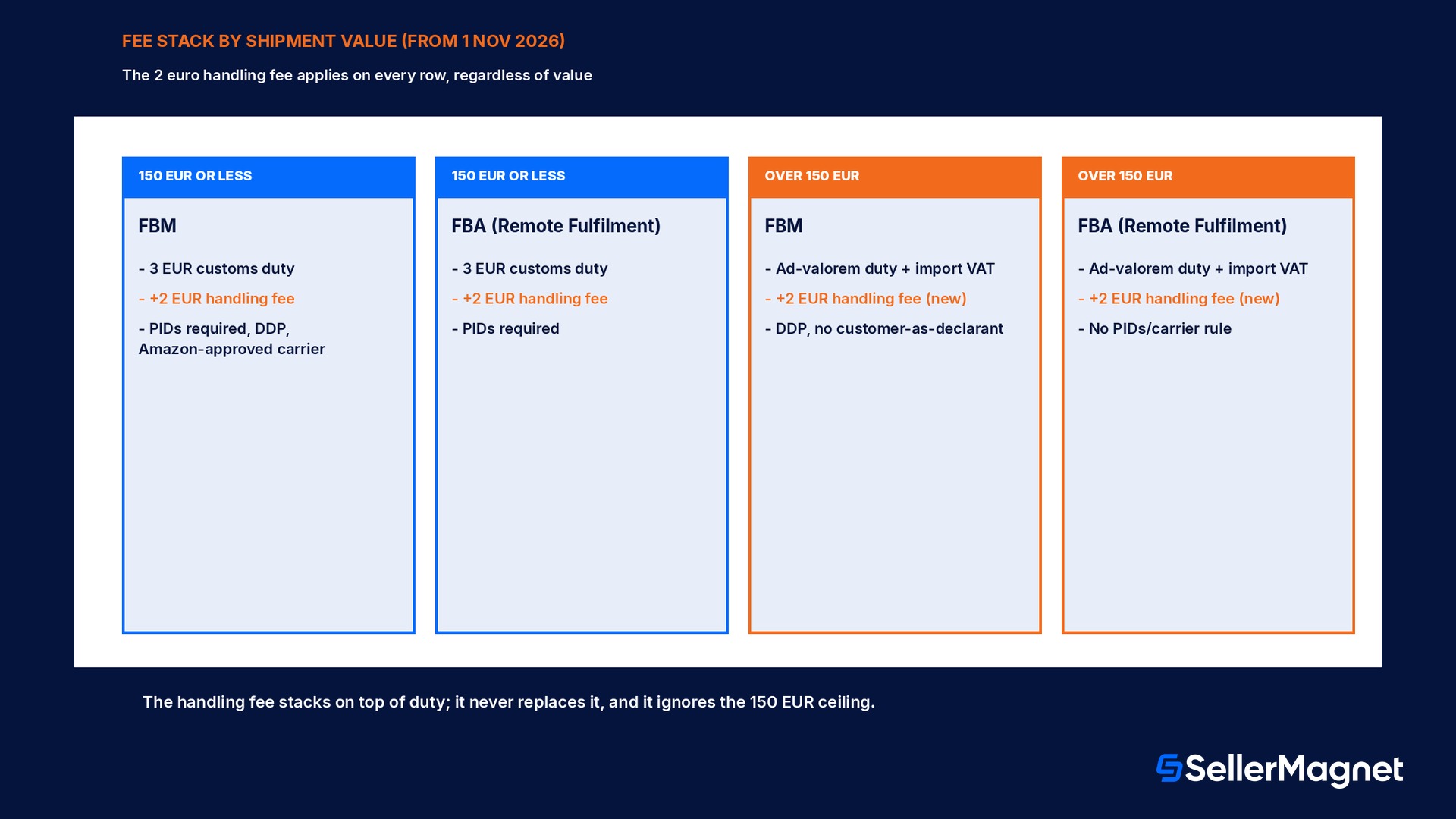
Shipment value
FBM shipment
FBA shipment
Over 150 euro
2 euro handling fee, ad-valorem duty, import VAT, Delivery Duty Paid, customer not listed as declarant
2 euro handling fee, ad-valorem duty, import VAT
150 euro or less
3 euro customs duty, 2 euro handling fee, product identifiers (PIDs) required, Delivery Duty Paid, Amazon-approved carrier, customer not listed as declarant
3 euro customs duty, 2 euro handling fee, product identifiers (PIDs) required
It stacks on the 3 euro duty, it does not replace it
Amazon's own FAQ on this page asks the exact question a seller would ask first: does the 2 euro customs handling fee replace the 3 euro customs duty on low-value imports that has applied since 1 July 2026? The answer, word for word, is no. The handling fee applies in addition to the customs duty for all customer shipments shipped directly from outside the EU to consumers in the EU, and it is applied to every item in the shipment regardless of shipment value; for low-value imports specifically, Amazon states the handling fee is applied on top of the existing 3 euro customs duty. The two charges came from two different regulatory moves four months apart. The 3 euro duty traces to Council Regulation (EU) 2026/382, which deleted the old 150 euro customs-relief chapter and replaced it with a flat 3 euro per-item duty from 1 July 2026 until 1 July 2028, covered in detail in SellerMagnet's earlier guide to that duty. The 2 euro handling fee is a separate EU customs administrative charge layered on top from 1 November 2026, and it does not inherit the duty's 150 euro ceiling; it reaches shipments the duty never touched.
Since 1 July 2026
Since 1 November 2026 (added)
Shipments 150 euro or under
3 euro duty per item
+2 euro handling fee per item (5 euro total per item)
Shipments over 150 euro
Ad-valorem duty + import VAT only, no flat duty
+2 euro handling fee per item, on top of duty and VAT
Who actually pays it, and how, depends on your fulfilment method
The EU customs rule sets the charge; Amazon's own seller forums announcement sets out how it actually reaches a seller's account, and the mechanics split cleanly along the FBM and FBA line. For Fulfilled by Merchant shipments, the seller's own carrier invoices the seller directly for the applicable handling fee and is the party that remits that fee to the EU customs authorities; the seller is responsible for paying it to the carrier, the same relationship that already existed for the 3 euro duty on qualifying FBM shipments. For products enrolled in Remote Fulfilment with FBA, Amazon does not invoice the seller separately at all. Instead, Amazon includes the handling-fee-inclusive price directly in what the customer sees: on the product detail page, in the basket, and at checkout. The practical result Amazon spells out explicitly is that the price a customer sees in an EU store can end up higher than the price the seller actually set, because the fee is folded into the displayed figure rather than added as a separate line a seller would notice on an invoice.
Check your pricing rules and automations now
Amazon's own announcement calls this out directly: if you use pricing rules or repricing automation on Remote Fulfilment with FBA listings, review them and adjust as needed, taking the added customs handling fee into account on top of your set price. A rule that was tuned against the old displayed price, before the fee was folded in, can now push a price lower than intended or trigger on a figure that no longer matches what the seller actually set.
Why this is not an Amazon fee, and why that distinction matters
Amazon's reference page states plainly that the 2 euro customs handling fee is mandated under EU customs rules, it is not an Amazon fee, the same language used for the 3 euro duty it stacks on. That distinction is not just a liability disclaimer; it explains why the charge behaves the way it does across fulfilment methods instead of appearing as a single uniform line item everywhere. A genuine Amazon fee is something Amazon sets, bills and can adjust on its own schedule inside Seller Central. A government-mandated customs charge, by contrast, has to be collected at the point goods actually cross the EU border, through whichever party is legally positioned to remit it to customs authorities there: a seller's own carrier for FBM, or Amazon itself acting as the importer-facing party for Remote Fulfilment shipments. That is exactly the split described above, and it is also why a seller cannot simply ask Amazon to waive or credit the fee the way they might dispute an Amazon-set referral or fulfilment fee; the charge exists at the EU customs level, and Amazon's own mechanics are only the plumbing that gets it collected.
A worked comparison: what the new fee actually adds to a real parcel
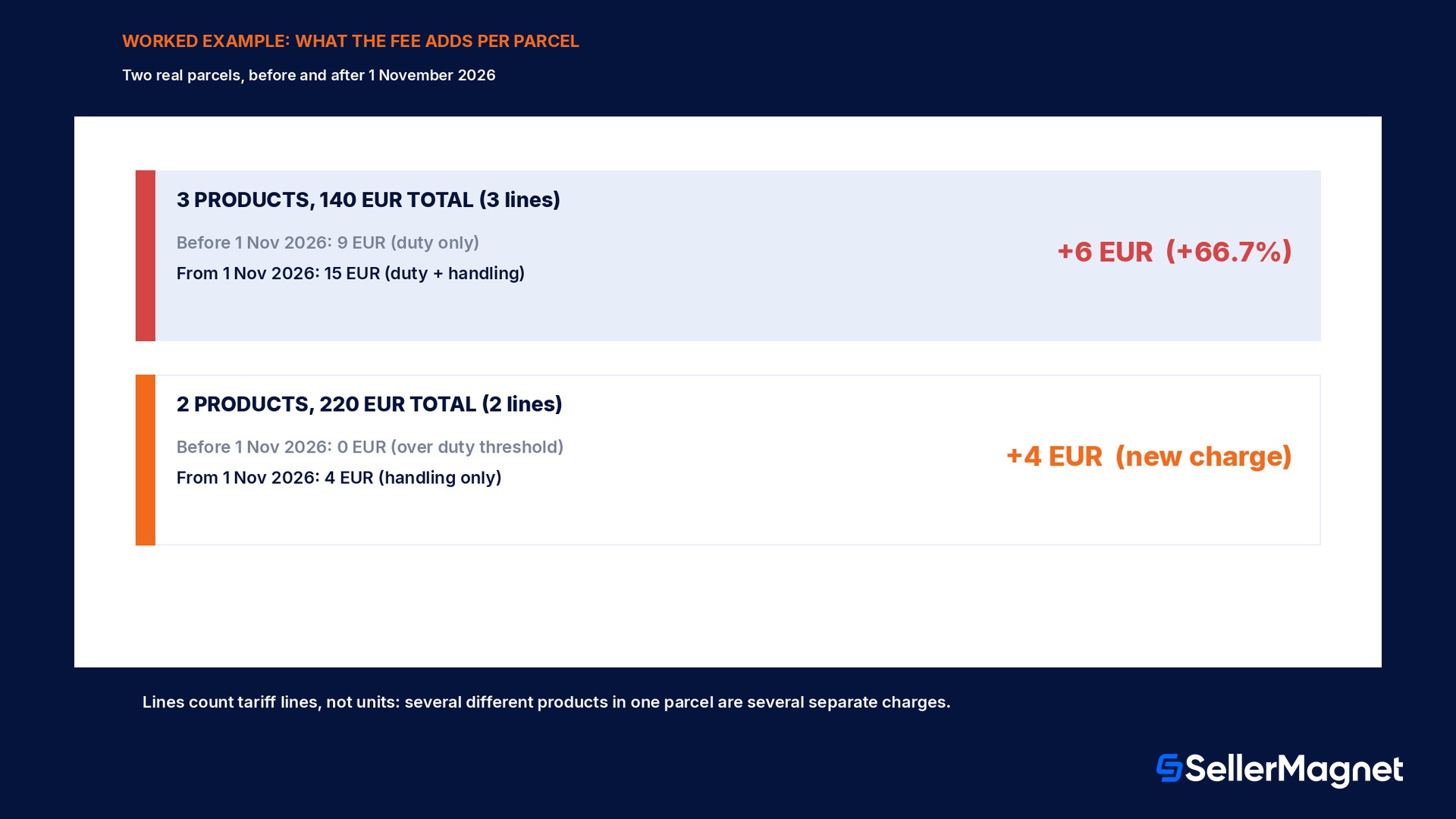
Take a parcel shipped directly from outside the EU to an EU consumer, holding 3 different products worth 140 euro in total, under the 150 euro threshold where the duty applies. On a customs declaration that carries full tariff detail, those 3 different products sit on 3 separate tariff lines, which is the unit this fee and the duty both count against, not the number of physical units inside the box. Before 1 November 2026, the only flat charge on that parcel was the 3 euro duty per line, for a total of 9 euro across the 3 lines. From 1 November 2026, each of those same 3 lines now carries both the 3 euro duty and the new 2 euro handling fee, 5 euro per line, for a total of 15 euro across the parcel. The handling fee alone adds 6 euro to this specific parcel, a 66.7% increase over the 9 euro duty-only baseline, computed directly from Amazon's own stated per-item rates, not an estimate. Run the same logic on a shipment worth more than 150 euro, say 220 euro across 2 tariff lines: that parcel never paid the flat duty at all, since the duty only reaches shipments at or under 150 euro, but it now picks up 4 euro in handling fees, 2 euro per line, purely because the handling fee ignores the value threshold the duty respects.
Parcel
Tariff lines
Before 1 Nov 2026
From 1 Nov 2026
Added by the handling fee
3 products, 140 euro total
3
9 euro (duty only)
15 euro (duty + handling)
+6 euro (+66.7%)
2 products, 220 euro total
2
0 euro (over the duty threshold)
4 euro (handling only)
+4 euro (new charge)
Two EU customs changes, four months apart, that are easy to conflate
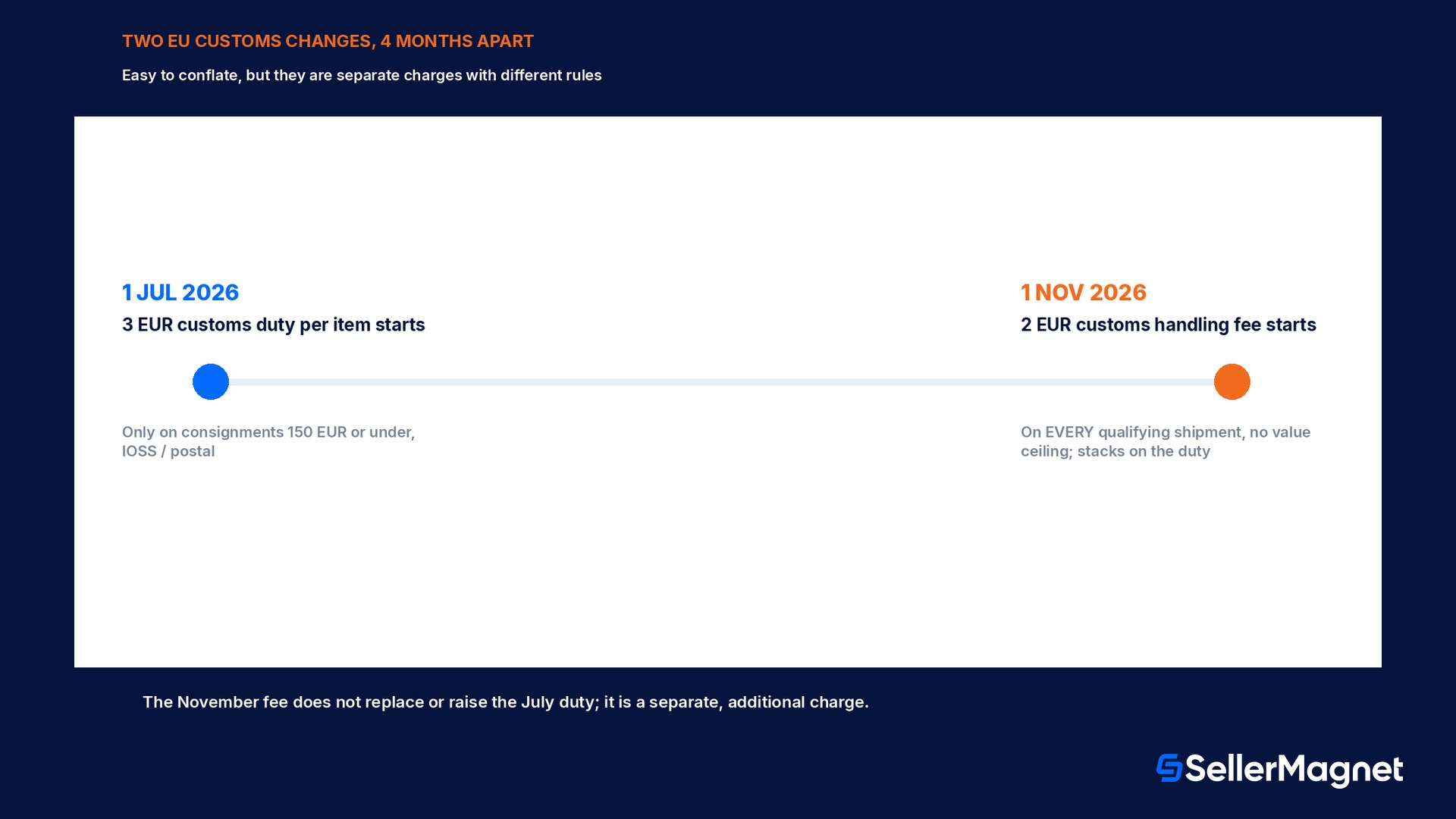
Sellers who already adjusted their pricing or process for the 1 July 2026 duty change have a real reason to assume the 1 November 2026 announcement is just a rate tweak to the same rule; it is a separate charge from a separate decision, arriving 4 months later. The 1 July 2026 change removed the EU's old 150 euro customs-relief exemption entirely and put a flat 3 euro per-item duty in its place, for consignments at or under that 150 euro threshold, imported under the Import One-Stop Shop or as postal consignments. The 1 November 2026 change does not touch that duty rule at all; it adds a separate 2 euro per-item handling fee that ignores the 150 euro ceiling the duty respects, reaching shipments the July change never covered. Treating the two as one event risks underestimating the cost on exactly the shipments the November change newly reaches, anything over 150 euro that the July rule left untouched.
The requirements that travel with the fee on low-value shipments
On shipments at or under 150 euro, the handling fee does not arrive alone; Amazon's table of requirements lists it alongside the same conditions that already applied to the 3 euro duty on that tier. FBM sellers on these low-value shipments must still provide product identifiers (PIDs) on the customs declaration, ship on a Delivery Duty Paid basis so the customer is never listed as the declarant, and use an Amazon-approved carrier; the handling fee is simply one more line those existing obligations now carry. FBA sellers using Remote Fulfilment face the same PIDs requirement on low-value shipments, without the carrier-selection or DDP conditions that apply specifically to FBM. On shipments over 150 euro, the PIDs and Amazon-approved-carrier requirements drop away for both fulfilment methods, since the flat-fee duty regime for low-value goods never applied there in the first place, but the ad-valorem duty, import VAT and the new 2 euro handling fee all still apply.
Who this change actually hits hardest
Not every seller feels this fee the same way, because it is scoped to one specific movement of goods: directly from outside the EU to a consumer inside it. A seller who already stocks inventory inside the EU, in an EU fulfilment centre or an EU-based 3PL, and ships from there to EU customers, never triggers this charge at all, regardless of where the product was originally manufactured or sourced. The sellers who feel it are the ones whose fulfilment path still crosses the EU border on every single order.
FBM sellers shipping cross-border into the EU from the UK, US, or anywhere outside it. Every qualifying order now carries a carrier-invoiced handling fee on top of whatever duty already applied, regardless of the order's value.
Sellers using Remote Fulfilment with FBA from a non-EU fulfilment centre into EU stores. The fee is baked into the price Amazon displays, which is the scenario the pricing-rule warning above is aimed at directly.
Sellers who ship small, high-line-count parcels. Because the charge counts tariff lines, a parcel with several different low-value products accumulates handling fees fast, even if the parcel's total value is modest.
Sellers who assumed a 150 euro+ order was exempt from EU customs charges. That assumption held for the 3 euro duty; it does not hold for the 2 euro handling fee, which reaches every qualifying shipment regardless of value.
Sellers running tight, thin-margin price automation into EU stores. A 2 euro per-line fee that was invisible on 1 October 2026 is a real, recurring cost from 1 November 2026 that a margin model built on the old figures will not show.
What SellerMagnet can and cannot do about this
Collecting, invoicing and remitting the EU customs handling fee happens entirely between a seller's carrier, Amazon's own Remote Fulfilment pricing and the EU customs authorities; no third-party dashboard, including SellerMagnet, intercepts or adjusts that flow. Where a tool like SellerMagnet's Analytics genuinely helps is on the side the customs mechanics do not touch: surfacing whether a given EU-bound order's margin still holds once every real cost, referral and fulfillment fees, VAT, and now this added per-line customs charge, is counted against the sale price, rather than discovering the gap only when a monthly reconciliation runs short.
A fee check through the Fee Calculator is worth running specifically on cross-border EU listings this month, not as a general habit. The calculator will not add the EU's customs handling fee for you automatically, since that charge is set by EU customs rules rather than by Amazon's own fee schedule, but it is still the fastest way to confirm the referral and fulfillment side of the same order still clears a real margin once a seller manually adds this fee's per-line cost on top, instead of assuming October's numbers still describe November's shipments.
Mistakes the stacking rule makes easy to fall into
Assuming the 2 euro handling fee replaces the 3 euro duty. Amazon's own FAQ answers this directly: no, it stacks on top for shipments 150 euro or under, and applies on its own above that threshold.
Assuming the fee only applies to low-value shipments. It applies regardless of value; a 220 euro, 2-line shipment above the duty threshold still picks up 4 euro in handling fees that did not exist before 1 November 2026.
Counting the fee per physical unit instead of per tariff line. Ten identical units of one product on one tariff line is a single 2 euro charge, the same counting logic as the 3 euro duty.
Leaving Remote Fulfilment with FBA pricing rules untouched. Amazon states the fee-inclusive price is what customers see on the product page, basket and checkout; a stale pricing rule can now undercut the seller's intended price without anyone noticing on an invoice.
Treating it as an Amazon fee that support can waive or adjust. It is mandated under EU customs rules, collected through a seller's own carrier (FBM) or folded into the displayed price (FBA Remote Fulfilment), not something Amazon bills or controls on its own schedule.
Forgetting that domestic EU-to-EU shipments are untouched. Both the duty and the handling fee apply only to shipments sent directly from outside the EU to an EU consumer; stock already inside the EU moving between EU customers does not pick up either charge.
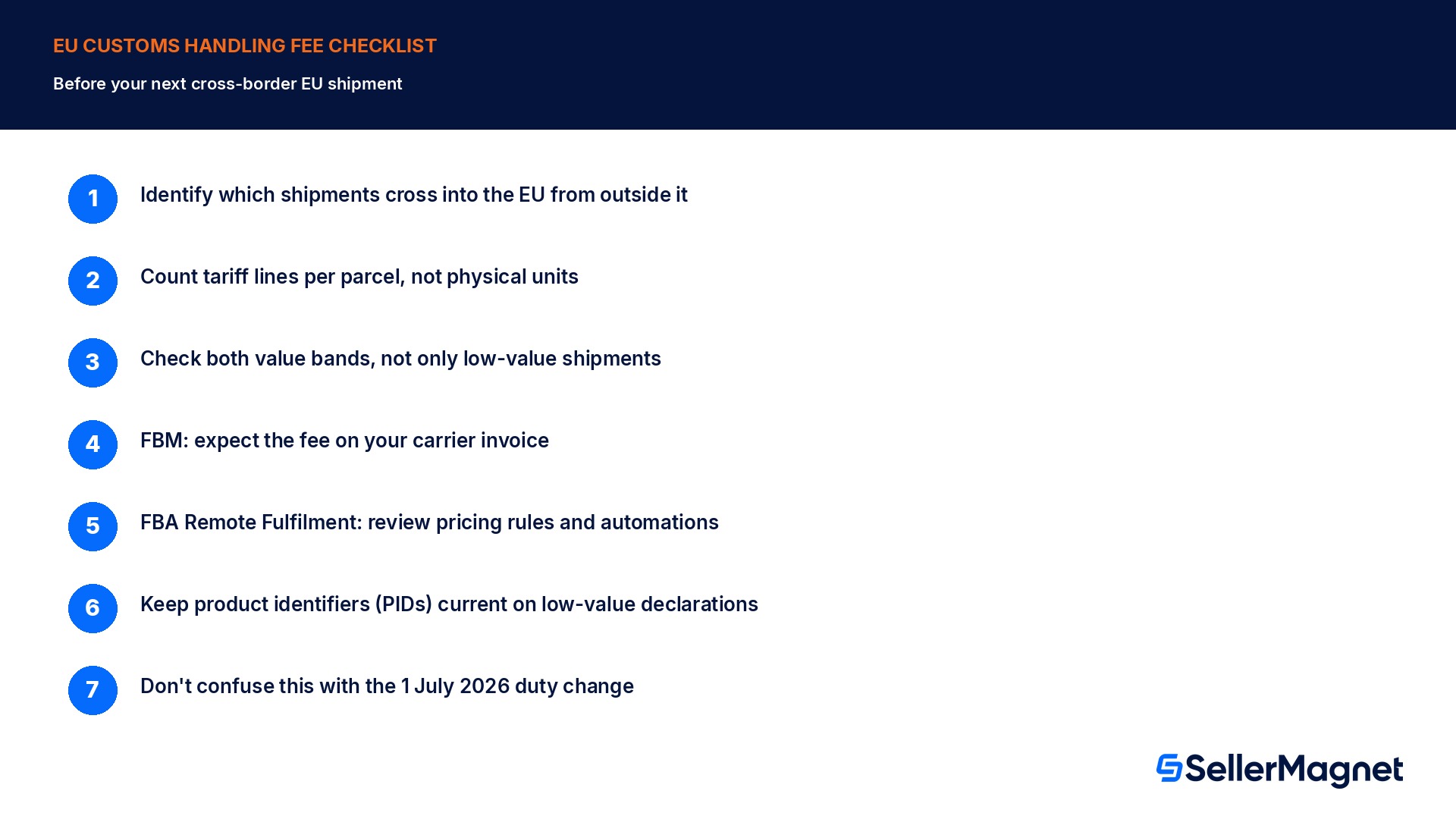
Checklist for the new EU customs handling fee
How to prepare for the EU's 2 euro customs handling fee
Identify which of your shipments actually qualify - The fee only applies to shipments sent directly from outside the EU to a consumer inside the EU; stock already in the EU moving between EU customers is not affected.
Count tariff lines, not units, per parcel - The fee is charged per item/tariff line in the customs declaration; several different products in one parcel are several separate charges, several units of one product are one charge.
Check both value bands, not only low-value shipments - The fee applies regardless of shipment value; do not assume a shipment over 150 euro, which escapes the 3 euro duty, also escapes the 2 euro handling fee.
For FBM: expect a carrier invoice - Your carrier invoices you for the applicable handling fee and remits it to EU customs authorities; budget for it the same way you already budget for duty on qualifying shipments.
For FBA Remote Fulfilment: review pricing rules and automations - Amazon folds the fee into the price customers see on the product page, basket and checkout; a repricing rule tuned to the old displayed price can now misfire.
Keep product identifiers (PIDs) current on low-value declarations - Shipments at or under 150 euro still require PIDs information alongside the stacked duty and handling fee.
Do not confuse this with the 1 July 2026 duty change - The 2 euro handling fee is a separate charge, announced 4 months after the 3 euro duty, with a different value threshold; review both rules together, not as one event.
Does the 2 euro customs handling fee replace the 3 euro customs duty on low-value imports?
No. Amazon's own FAQ states the handling fee applies in addition to the customs duty; for low-value imports it is applied on top of the existing 3 euro duty, not instead of it.
Does the handling fee only apply to shipments worth 150 euro or less?
No. It applies to all customer shipments sent directly from outside the EU to EU consumers, regardless of shipment value. The 3 euro duty is the one limited to 150 euro or under; the handling fee is not.
Is the 2 euro customs handling fee an Amazon fee?
No. Amazon's reference page states it is mandated under EU customs rules, not an Amazon fee; Amazon's role is limited to how the charge is collected on FBM and FBA Remote Fulfilment shipments.
How do I pay the handling fee on an FBM shipment?
Your carrier invoices you for the applicable fee and remits it to EU customs authorities. You are responsible for paying the carrier directly.
How does the fee reach me on a Remote Fulfilment with FBA shipment?
Amazon includes the handling-fee-inclusive price in what the customer sees on the product detail page, basket and checkout, rather than invoicing the seller separately.
What counts as one "item" for this fee?
A tariff line in the customs declaration, the same unit used for the 3 euro duty: goods sharing the same tariff classification, description and origin count as one item regardless of how many physical units are included.
Does this fee apply to shipments that start and stay inside the EU?
No. It applies only to customer shipments shipped directly from outside the EU to consumers in the EU, the same scope as the existing 3 euro duty.
What should I actually change in my account because of this fee?
FBM sellers should expect the fee on their carrier invoice; FBA Remote Fulfilment sellers should review pricing rules and automations, since Amazon now folds the fee into the customer-facing price.
Stop Juggling Tools. SellerMagnet Combines Everything You Need.