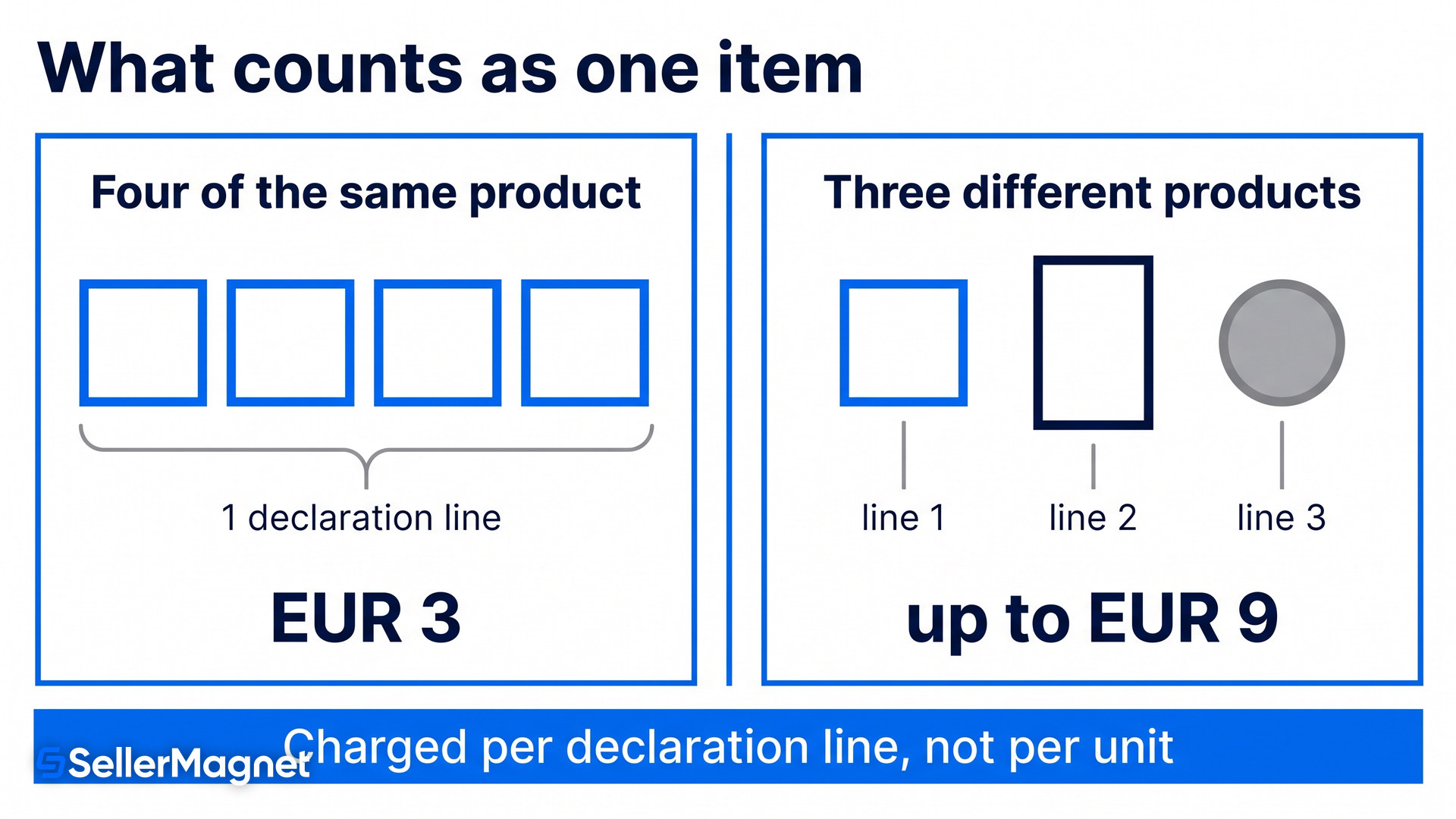
The European Union removed its 150 euro customs duty exemption on 1 July 2026 and replaced it with a flat 3 euro duty on low-value imports. The detail that changes the maths is what "item" means. It is not a unit. The duty falls once per line of the customs declaration, so ten identical units cost 3 euro between them, while three different products can cost 9 euro in the same parcel.
Since 1 July 2026 the European Union charges a customs duty of three euro per customs declaration line on consignments worth up to 150 euro imported from outside the EU under the Import One-Stop Shop or as postal consignments. Amazon sellers who confirm their own shipments must use an Amazon-approved carrier, unless they buy labels through Amazon Buy Shipping.
What exactly changed on 1 July 2026?
The exemption that made low-value imports duty-free is gone. Council Regulation (EU) 2026/382 of 11 February 2026 amends the old reliefs regulation, and its first article is one line: "Chapter V of Title II of Regulation (EC) No 1186/2009 is deleted." That chapter was the 150 euro relief. Article 4 sets the date: "It shall apply from 1 July 2026."
What replaced it is narrower than a normal tariff and is written as a stopgap. Article 2 reads: "From 1 July 2026 until 1 July 2028, a customs duty of EUR 3 per item in a consignment the intrinsic value of which does not exceed a total of EUR 150 shall apply instead of the relief eliminated pursuant to Article 1 of this Regulation, where:" and then sets two conditions. It applies where the import is VAT-exempt under the Import One-Stop Shop route, or where the goods travel as a postal consignment.
One line, not one unit
The regulation says "EUR 3 per item in a consignment", and Amazon's own announcement is the clearer of the two: "per item/tariff line in the customs declaration". An item is not a unit. EU customs law defines it as "one or more goods in a consignment sharing the same tariff classification, description and, if provided ..., origin", so four units of one product are a single item and a single 3 euro charge. It is variety, not quantity, that multiplies the bill.
The European Commission's guidance on the measure is blunt about the mechanism: "the EUR 3 customs duty will automatically apply per declaration line irrespective of the quantity (number of the articles) in that declaration line, provided that the intrinsic value of all goods included in the declaration does not exceed EUR 150". Grouping lines to dodge it is not available either, because the guidance notes that the usual simplification for goods under different subheadings "is not allowed where the temporary EUR 3 customs duty applies".
The same guidance carries a worked example that should change how you think about the charge. A consignment worth 140 euro from China, VAT collected under IOSS, holding three different women's suits. On an H7 declaration, which carries a 6-digit code and no origin data, the three collapse into one line and the duty is "1x EUR 3". On an H1 declaration, which carries the 10-digit TARIC code and origin, they separate into three lines and the duty is "3x EUR3". Same parcel, same goods, three times the duty, decided by which dataset your carrier files.
Two boundaries are worth fixing in your head. The 150 euro is the intrinsic value of the whole consignment, and above it the Article 2 measure does not apply. Those consignments fall outside the transitional regime and are dutiable under the ordinary tariff, as they were before 1 July 2026. And goods already inside the EU are untouched: Amazon's announcement states that "Shipments sent from within the EU to customers in the EU are not subject to this import duty (other import charges may still apply)."
Date
What happens
Who it comes from
1 July 2026
150 euro duty relief deleted, 3 euro per item applies, Amazon enforces its approved carrier list
EU regulation, enforced by Amazon
1 October 2026
The Commission must complete its first assessment of whether trade flows are being diverted, then monthly
EU regulation
1 November 2026
Product Identifiers become mandatory in the electronic customs declaration
EU customs data rules, via your carrier
1 July 2028
The 3 euro measure expires unless the Council adopts an extension on a Commission proposal
EU regulation
Why is Amazon rejecting your shipment confirmation?
Because the carrier is not on Amazon's approved list, and this is enforced in software rather than in policy. Amazon's seller announcement puts the requirement plainly: "To confirm your FBM shipment with a value of EUR 150 or less, you must select a carrier authorised to use Amazon's Import One-Stop Shop (IOSS) number to clear customs."
Amazon's own developer repository documents what the rejection looks like. A confirmation on an unapproved carrier comes back with the message "The selected carrier is not supported for shipping your order. Please use only supported carriers." and the error code InvalidInput. Two paths are validated: the confirmShipment operation of the Orders API, and the POST_ORDER_FULFILLMENT_DATA feed, where the failure surfaces as a feed processing error on that one message.
The validation is narrower than it sounds
The carrier check only fires when the ship-from location is outside the EU, the ship-to destination is inside it, and the item total is 150 euro or less excluding VAT, shipping and discounts. A seller shipping intra-EU, or one whose basket clears 150 euro net, never sees it. That narrowness is why the failure looks random until you map it against those three conditions.
There is one exemption that removes the whole problem, and it is stated in Amazon's SP-API changelog rather than in the seller-facing announcement: "This only applies to sellers who confirm their own shipments (self-ship). If a seller uses Amazon's Buy Shipping service to purchase labels, Amazon handles carrier compliance internally - no action needed." If you buy labels through Buy Shipping, the carrier question is already answered for you.
What do you have to give the carrier?
Two pieces of data and a delivery term, and the data part is new. Amazon requires you to "Supply your carrier with ASIN details for each product in the shipment with a value of EUR 150 or less imported under IOSS, as well as Amazon's IOSS number", and notes that "The authorised carrier will invoice you for applicable import duties and provide the duty to EU customs authorities". The duty reaches customs through the carrier, and reaches you as an invoice afterwards.
The delivery term is the third requirement and the one that protects the customer experience. Amazon says to "Continue to ship FBM shipments Delivered Duty Paid (DDP) so that customers do not receive additional import duties, customs or tax charges after completing their purchase", and to give the carrier "all data and documents required for customs clearance". A buyer asked for money at the door is a buyer who opens a claim.
An approved carrier. Amazon said it would "add approved carriers in the coming weeks and continue to update the list after 1 July", so the list is a living document worth re-checking rather than a one-off lookup.
ASIN details per product in any consignment at or below 150 euro imported under IOSS.
Amazon's IOSS number, which the carrier uses to clear customs on the VAT side.
Delivered Duty Paid, so nothing lands on the buyer after checkout.
The full customs documentation set, which Amazon makes the seller's job to hand over.
How does this work on FBA?
On Remote Fulfilment with FBA, Amazon handles it and changes your price to do so. The announcement says: "we'll add the EUR 3 import duty to the customer-facing price for items in customer shipments with a value of EUR 150 or less and then calculate VAT as per the existing rules. As a result, the price that customers see for your Remote Fulfilment with FBA products in our EU stores may be higher than the price that you've set."
That creates a reporting gap worth knowing about before you go looking for a bug. Amazon adds: "All Seller Central pages, including Manage All Inventory, will show your price without the import duty and any applicable VAT." The price in your inventory screens is not the price on the detail page, and the way to see the real one is the Revenue Calculator.
Check your repricer before it fights the duty
Amazon warns that if you use pricing rules or automations you should review them "taking into account the EUR 3 import duty added on top of your set price". An automation that matches a competitor's shelf price while Seller Central shows it a pre-duty number is working from the wrong figure, and on low-value items 3 euro is a large share of the gap it is trying to close.
Amazon also names the structural way out, which is simply to stop importing per order: "Shipments sent from within the EU to customers in the EU are not subject to this import duty. Consider sending inventory to our EU fulfilment networks for local fulfilment and faster delivery." Bulk placement inside the EU turns a per-line duty on every parcel into one customs event on a container. That event is not free, because a bulk import pays the ordinary tariff and import VAT, but it is a single declaration rather than a charge on every parcel you send. It is the same argument behind Amazon Warehousing and Distribution in Europe.
What is the 1 November 2026 deadline?
Product Identifiers become a mandatory part of the EU customs declaration, and this one is not in any Amazon announcement. The requirement reaches sellers through carriers instead. Royal Mail's guidance, reproduced in full by a seller inside Amazon's own EU forum thread, states that the new Product Identifier requirements "will be optional from July 2026 but will become mandatory from November 2026", and that these changes "apply to all carriers exporting to the EU, not just Royal Mail and Parcelforce Worldwide".
The Commission's own guidance is more precise than the carrier summaries, and names three identifiers rather than two. A merchant product identifier, "assigned by the online seller, marketplace or platform", required in all cases. A non-standardised manufacturer identifier, also required in all cases. And a standardised manufacturer identifier, a GTIN, EAN or ISBN, required only where one exists. The obligation is per product, not merely per line, so a line covering several products needs an identifier for each.
Watching Seller Central is not enough this time
The 1 July change arrived as an Amazon announcement because Amazon had to enforce it. The 1 November change is a customs data requirement between you and whoever carries the parcel, so nothing will appear in your notifications. If your product data has never needed a manufacturer reference before, the work is in your catalogue rather than in your Amazon settings, and six weeks is not a lot of time to add a GTIN to a long tail of SKUs.
How to get a non-EU operation compliant
Confirm whether the rule reaches you at all - The carrier validation fires only on orders shipped from outside the EU to an EU address where the item total is 150 euro or less excluding VAT, shipping and discounts. If everything you send to EU customers already sits inside the EU, none of this applies and the rest of the list is optional reading.
Move to an approved carrier, or to Buy Shipping - Check your current carrier against Amazon's approved list, which is still being added to. If your carrier is not on it, either switch or buy labels through Amazon Buy Shipping, where Amazon states it handles carrier compliance internally and no action is needed from you.
Wire the ASIN and the IOSS number into your shipping data - Your carrier needs ASIN details for each product in a qualifying consignment plus Amazon's IOSS number. If you generate customs data from an order export, this is a field-mapping job, and it is worth doing once properly rather than pasting values per shipment.
Reprice the items where 3 euro per item is the whole margin - Count the distinct product types in a typical basket, not the units, because the charge multiplies by declaration line rather than by quantity. Amazon recommended reviewing prices before 1 July, and the same arithmetic decides which low-priced SKUs are still worth listing cross-border at all.
Point your automations at the real price - On Remote Fulfilment with FBA, Seller Central shows your price without the duty and VAT while shoppers see a higher one. Use the Revenue Calculator for the final sales price and check that any pricing rules are not chasing a number that is 3 euro below what the customer sees.
Fill in the product identifiers before November - Every product needs your own merchant reference and the manufacturer's, plus a standardised code such as a GTIN or EAN where one exists. Audit the catalogue for SKUs with no manufacturer reference now, because these become mandatory in the customs declaration on 1 November 2026.
Is the 3 euro duty permanent?
No, and the regulation says so on its face. Article 2 runs "From 1 July 2026 until 1 July 2028", and the recitals explain why it is shaped as a flat amount rather than a real tariff: it is a "transitional measure of temporary nature" introduced "pending the adoption of the new Union Customs Code, which is expected to establish a new centralised Union IT infrastructure". The 3 euro is a placeholder for a system that does not exist yet.
The regulation also builds in a review that starts in under two weeks. Article 3 requires that "By 1 October 2026 and every month thereafter, the Commission shall assess whether a diversion of trade flows occurs", and if it finds one, it may propose changes. A second clock runs alongside it: the Commission must assess by 1 December 2027 whether the EU Customs Data Hub will be operational in time to replace this regime. Nothing about the current figure should be treated as settled, and a business model that only works at exactly 3 euro per item is carrying more risk than it looks.
The one number to run
Take your median EU order shipped from outside the EU, count the distinct products in it rather than the units or the parcels, and multiply by three. Compare that with the contribution margin on the same order. If the duty eats more than a third of it, the answer is not better customs paperwork, it is holding stock inside the EU, and the sooner that decision is made the less of Q4 it costs.
Cross-border sellers tend to discover this kind of change through a spike in failures rather than through an announcement, which is the expensive way to find out. Knowing which SKUs actually carry your EU volume, and what each one nets after fees and duty, is what turns this from a compliance scramble into a pricing decision. A seller analytics dashboard that splits margin by marketplace makes that visible faster than a customs invoice will, and our guide to selling across the EU and the US covers the wider trade-offs.
How much is the new EU customs duty on low-value imports?
Three euro per item in a consignment worth up to 150 euro in total, imported under IOSS or as a postal consignment. An item is a customs declaration line rather than a unit, so several units of one product are charged once, while several different products are charged separately.
Does the 3 euro duty apply to FBA orders?
It applies to shipments sent to EU customers from outside the EU, which includes Remote Fulfilment with FBA. There Amazon adds the duty to the customer-facing price itself. Stock already held inside the EU is not affected.
Why does Amazon reject my shipment confirmation?
Because the carrier is not authorised to use Amazon's IOSS number. The confirmation fails with the message that the selected carrier is not supported, under the error code InvalidInput, on orders shipped from outside the EU to an EU address at 150 euro or less.
Do I need an approved carrier if I use Amazon Buy Shipping?
No. Amazon states that the requirement applies to sellers who confirm their own shipments, and that when labels are bought through Buy Shipping it handles carrier compliance internally with no action needed from the seller.
What changes on 1 November 2026?
Product Identifiers become mandatory in the electronic customs declaration, having been optional since July. Each line needs your own product reference and the manufacturer's, including a GTIN, EAN or UPC where one exists.
Can I get the 3 euro back if the order is returned?
Royal Mail's guidance to sellers says the duty is non-refundable on returns, and the legal position is close to that: the Commission confirms the simplified route for invalidating a declaration on a returned low-value consignment is closed, "although the general rules for refund of customs duties in Article 116 UCC continue to apply". Treat the 3 euro as sunk unless you are willing to run a refund claim.
Stop Juggling Tools. SellerMagnet Combines Everything You Need.