Selling on Amazon Haul Means Giving Up Your Brand Name
R
RenéFreelance Amazon Editor
|
12 min read
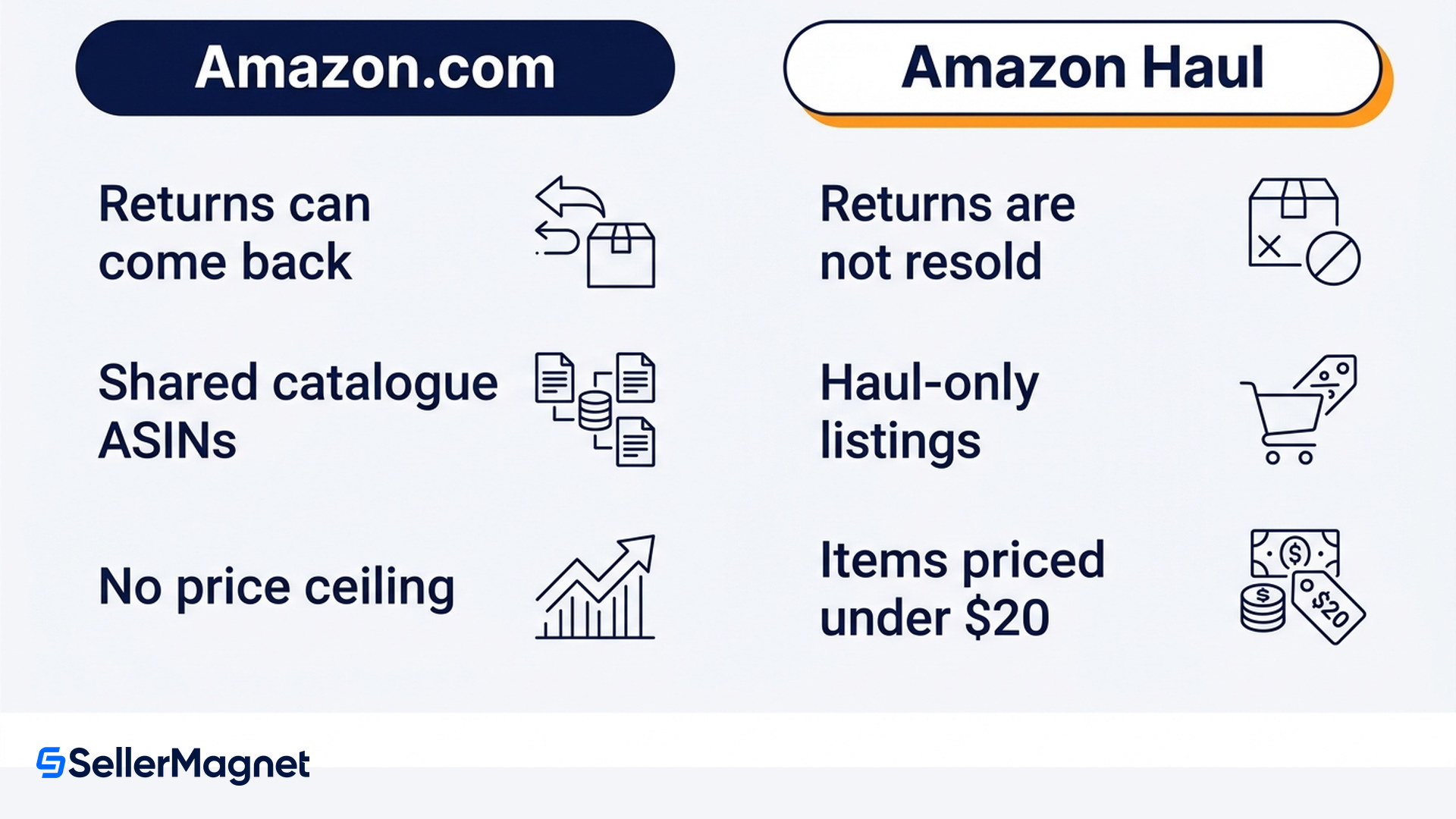
Amazon Haul is usually written up as a new place to list. Amazon's own seller pages describe something closer to a separate business with your inventory in it. It is invitation-only, the customer price is capped at $20, an ASIN cannot exist on both Amazon.com and Haul, returns are never sent back to you, and every single product must be listed under the brand name Generic.
Amazon Haul is Amazon's low-price shopping experience, also called Bazaar in some countries. Sellers cannot sign up directly because it is invitation only. Products must be fulfilled by Amazon, priced at twenty dollars or less, listed under the brand name Generic, and given ASINs that are not used on the main Amazon store. Buyer returns are liquidated or disposed of rather than returned to the seller.
Can you sign up for Amazon Haul?
Not by applying in Seller Central. The Amazon Haul help page opens with the answer before it describes the programme at all: "Note: For now, Amazon Haul is operating on an invitation-only basis. If you want to be added to the interest list, contact interested-sellers@amazon.com". The customer-facing storefront sits at amazon.com/haul, but that mailbox is the whole published route in, and the expansion FAQ repeats it: "Amazon Haul/Bazaar is currently an invite-only program."
Haul also carries a second name depending on where you are. Amazon describes it as "also known as 'Haul' or 'Bazaar' in different countries/regions", and distinguishes the storefront from a standalone app: "The difference between Haul and the Bazaar app is that Bazaar app customers interact with our product through a dedicated app which is finetuned to enhance the overall customer experience." If you have seen Bazaar discussed as a separate programme, it is largely the same one.
There is no seller-fulfilled option, and inventory may sit in China
Amazon states plainly that "Amazon Haul orders are fulfilled by Amazon" and, in a note of its own, that "Seller fulfillment is not yet available." Where that inventory sits is the part worth reading twice: "Inventory is often stored in a fulfillment center that is operated by one of our third-party logistics service providers located in China." Haul Direct Fulfillment uses those dedicated centres and delivers "directly to customers, bypassing storage in local Amazon fulfillment networks", while Haul Distributed Fulfillment extends visibility to ASINs already "enrolled in FBA and stored within the local Amazon fulfillment network".
What is the Generic rule, and why does it matter?
Every Haul product is listed under the brand name Generic. It is one sentence in the selection policy: "All products must be listed with a brand name of Generic." Not your brand with a sub-label, not a Haul-specific variant of your brand. Generic.
For a private-label seller, that removes most of the reason to be there. The listing cannot build brand recognition, cannot feed the brand's review base in any useful way, and cannot be defended with the brand tools that the rest of your catalogue relies on. Brand Registry protections, A+ content and Transparency all sit on a brand that this listing does not carry. Haul is better understood as an outlet channel for unbranded stock than as a storefront for a brand.
And the ASIN cannot be shared with your main catalogue
The selection policy adds: "Additional listing restrictions: ASINs and SKUs must be unique to Amazon Haul, meaning that you may not have an Amazon.com and an Amazon Haul offer on the same ASIN, and you may not reuse SKUs between Amazon.com and Amazon Haul." So this is not a second offer on a product you already sell. It is a duplicate catalogue with its own identifiers, its own inventory pool and its own listings, which is a real operational cost before a single unit sells. Plan it as a separate product line, because Amazon has already decided that it is one.
What can you sell, and at what price?
Small, cheap, new and non-perishable. The ceiling is explicit: "The maximum customer-facing price for selection on Amazon Haul is $20. Individual Haul stores may have lower maximum customer price points, which may be adjusted from time to time." But the $20 is a ceiling rather than a target. Amazon publishes recommended seller input prices per product type, and they sit well below it: 3D Glasses $11.50, Abis Book $8.00, Abis Drugstore $7.00, Adhesive Tapes $7.00, Adult Costume $10.00, Advent Calendar $12.00, Air Fryer $12.50, Air Pump $9.00.
New condition only, and for items stored in an Amazon fulfilment centre "the weight must not exceed 1.5 lb and the dimensions measurement must not exceed 16 x 12 x 5 inches".
Nothing ingestible or topical. Items "must not be ingestible, such as food, or intended to go on the skin topically", and "must not be expiration-dated".
No dangerous goods or hazmat, and no battery chemistry outside alkaline, NiMH and lithium-ion or lithium metal.
Batteries in equipment only. Lithium-ion in equipment and lithium metal in or with equipment are eligible; "Lithium-ion batteries with equipment" and "Stand-alone batteries" are not.
A material safety data sheet every year for anything containing lithium batteries, "one material safety data sheet per ASIN each year".
Domestic Haul, which uses inventory already in the local network, has its own gate. Items must "Be below the product-type cap, or Be on discount (have a strike-through price) and below $20", and must be "stored in domestic Amazon Fulfillment Network". That discount clause is the interesting one: a product above its product-type cap can still qualify if it is genuinely marked down under $20, which turns Haul into a clearance surface for slow stock as much as a home for permanently cheap goods.
What does fulfilment cost?
Less than standard FBA at the light end, and the rate card starts lower than most sellers expect. A unit of 4 oz or less costing $3 or under is $0.50 to fulfil, apparel or not. Above that, apparel and non-apparel diverge slightly and climb to $12.23 and $12.51 at 4+ lb.
Shipping weight
Apparel
Non-apparel
4 oz or less, price $3 or under
$0.50
$0.50
4 oz or less, price over $3
$0.99
$0.88
4+ oz to 8 oz
$2.05
$1.77
8+ oz to 12 oz
$2.84
$2.60
12+ oz to 16 oz
$3.48
$3.22
1+ lb to 1.25 lb
$4.14
$3.72
4+ lb
$12.23
$12.51
The rows below are selected from a longer table, which also prices every band between 1.25 lb and 4 lb. Two structural details go with that table. Shipping weight is "the larger of unit weight or dimensional weight, where dimensional weight is equal to the unit volume (length x width x height) divided by 139", and "Size tiers don't apply to the Amazon Haul fulfillment rate table", so the usual standard-versus-oversize logic is gone. Storage is a flat "$0.40 per cubic foot per month" year-round with no utilization surcharge. Haul inventory also "won't incur Inbound Placement Service fees or an aged inventory surcharge", and Haul ASINs "are not eligible for the FBA New Selection program".
A fee note on that page expired more than a year ago
The storage and removal rows both carry the footnote "These fees are $0 until the second quarter of 2025". Read on 28 September 2026, that waiver has been over for more than a year, and the page still presents it as current. Treat the published rates as live and the footnote as leftover text, which is the safe direction to be wrong in. It is also a reminder to price Haul from the rate table rather than from a summary of it that someone wrote while the waiver was still running.
What happens to returns?
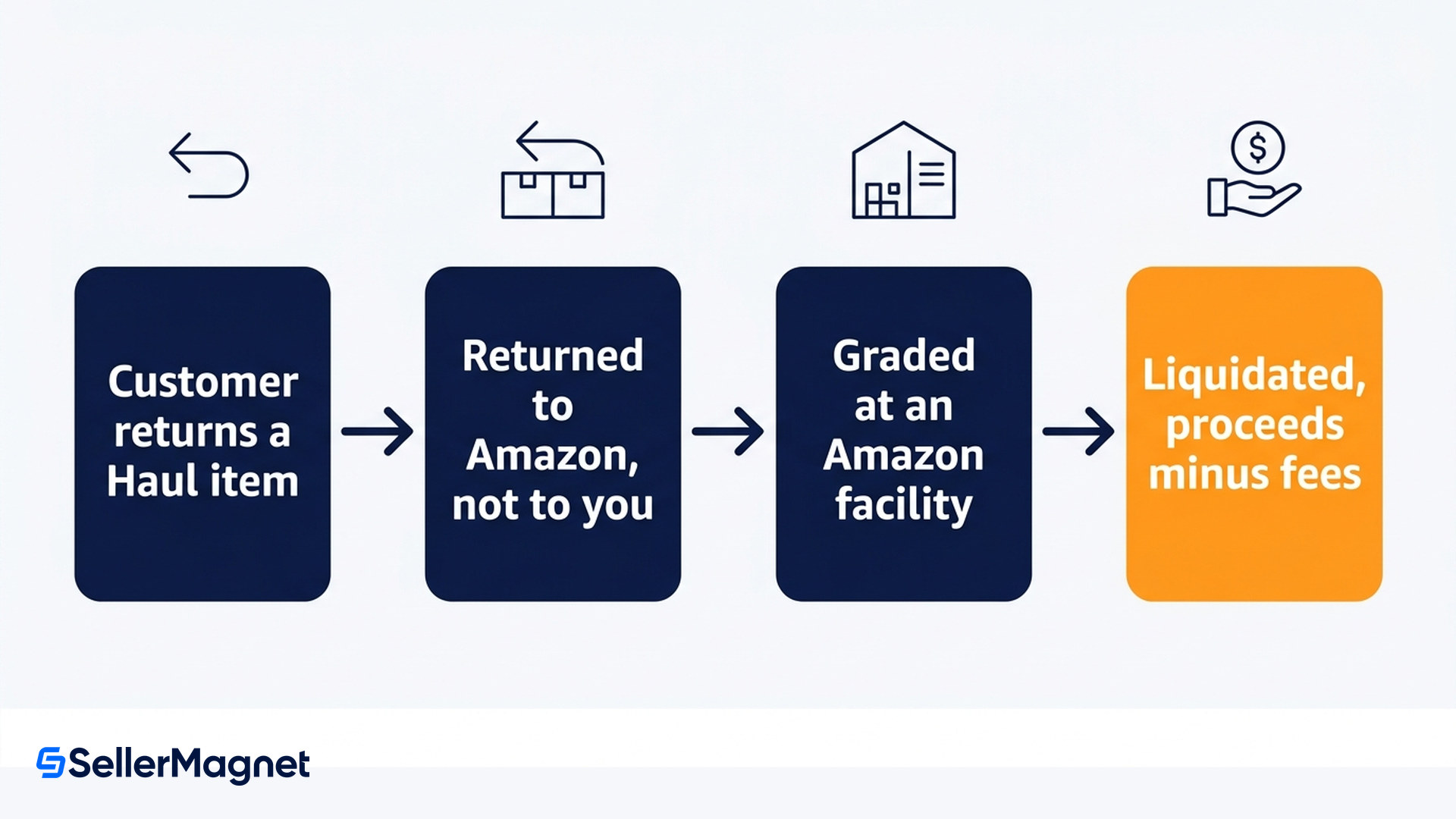
Returns do not come back. Amazon is explicit: "Any buyer returns of Amazon Haul products will be liquidated, donated, or disposed of by Amazon and will not be shipped back to you." The window is shorter than the standard store at "15 days from the date of item delivery", and at the bottom of the price range returns disappear entirely: "Applicable for US Orders: Amazon Haul products priced at $3 or less won't be eligible for buyer returns."
The default resolution is a refund without a return, and it is not optional. Products "will by default be eligible for returnless resolutions", Amazon retains "sole discretion" to require the item back for liquidation or disposal instead, and the closing line removes the choice: "You won't have the option to unenroll from returnless resolution for Amazon Haul orders." Where an item is liquidated you receive "the proceeds from liquidation, minus applicable fees". On the fee side Haul is gentler than the main store, since the "Return processing fee and high-return-rate fee" are "$0 for Amazon Haul orders".
How to assess Haul before you ask for an invitation
Decide whether an unbranded listing is acceptable - Every Haul product carries the brand name Generic. If your business case depends on brand recognition, review velocity on your brand, or Brand Registry protections, that case does not survive the first rule, and nothing further on this list will rescue it.
Check your selection against the hard gates - New condition, not ingestible, not topical, not expiration-dated, no hazmat, and under 1.5 lb with dimensions under 16 by 12 by 5 inches for anything stored in an Amazon fulfilment centre. Batteries must be in equipment, and anything with lithium needs a fresh material safety data sheet every year.
Price it against the product-type recommendation, not the $20 ceiling - Amazon publishes a recommended seller input price for each product type, and most sit between $7 and $12.50. If your unit economics only work near $20, you are pricing against the ceiling rather than against what the store is built to sell.
Model the fulfilment fee from the Haul table - Use the Haul rate card rather than your FBA figures, remember that dimensional weight divides by 139 and that size tiers do not apply, and add the $0.11 per-unit lithium battery fee if it applies. At the light end the fee can be $0.50, which is what makes very cheap selection viable at all.
Budget for a duplicate catalogue - New ASINs, new SKUs, separate inventory and separate listings, because none of them can be shared with Amazon.com. Count that setup and the ongoing management as a real cost before you email the interest list.
The cross-border part changes what you are actually agreeing to
When Haul expands into another country, Amazon does not list you as a seller there in the usual sense. The expansion FAQ describes a purchase: "When a customer in another country/region purchases your product, Amazon will buy the product from you at the price you have offered the product in the US - just as if a customer had purchased the product directly from you in the Amazon Haul store in the US - and Amazon will handle all aspects of international shipping and delivery." You are paid your US price, Amazon takes the cross-border economics and the risk, and your eligible products "may be automatically listed in all countries/regions where the program is offered". That is simpler than international selling and it also means the upside from a strong market abroad is not yours.
Haul is a volume business with thin absolute margins, which makes per-unit cost visibility the whole game: at a $9 price and a $1.77 fulfilment fee, a few cents of landed cost decides whether a line is worth running. A seller analytics dashboard that holds cost and fee data per ASIN is the difference between knowing that and guessing. Since Haul inventory often sits in fulfilment centres outside the destination market, our guide to the US import rules after de minimis covers the customs side of moving that stock.
How do I sign up to sell on Amazon Haul?
You cannot sign up directly. Haul is invitation-only, and Amazon's published route is to ask to be added to the interest list by contacting interested-sellers@amazon.com.
Can I use my own brand name on Haul?
No. Amazon's selection policy states that all products must be listed with a brand name of Generic, so the listing does not carry your brand.
Can I list a product I already sell on Amazon.com?
Not on the same identifiers. ASINs and SKUs must be unique to Haul, so you cannot have an Amazon.com and a Haul offer on the same ASIN or reuse a SKU between them.
What is the maximum price on Amazon Haul?
The maximum customer-facing price is $20, and individual Haul stores may set lower caps. Amazon's recommended seller input prices by product type mostly fall between $7 and $12.50.
Do I get Haul returns back?
No. Buyer returns are liquidated, donated or disposed of by Amazon and are not shipped back. If an item is liquidated you receive the proceeds minus applicable fees.
Can I fulfil Haul orders myself?
No. Haul orders are fulfilled by Amazon, and the help page states that seller fulfilment is not yet available.
Stop Juggling Tools. SellerMagnet Combines Everything You Need.