Amazon Aged Inventory Surcharge (2026): The Fee Separate From Storage
R
RenéFreelance Amazon Editor
|
15 min read
The aged inventory surcharge is the fee that quietly turns a small amount of slow-moving stock into a real loss, and it is charged on top of the monthly storage fee you already pay, not instead of it. Amazon renamed it from the long-term storage fee, but the mechanism is the same: the longer a unit sits in a fulfillment center past 181 days, the steeper the per-cubic-foot rate climbs, until units held over a year cost more than ten times the normal storage rate. This guide walks through the exact fee table Amazon publishes, a fully worked example for a 500-unit order, the two ways Amazon calculates the charge and bills whichever is higher, how monthly storage fees and this surcharge stack rather than overlap, and the math on when a removal order actually pays for itself instead of waiting out another billing cycle.
The aged inventory surcharge is an Amazon FBA fee charged on inventory stored for 181 days or longer, on top of the monthly storage fee. It is assessed on an inventory snapshot taken the 15th of each month and billed between the 18th and 22nd. The rate rises in steps as inventory ages, and Amazon charges whichever is higher between a per-cubic-foot calculation and a flat per-unit fee that applies from 366 days onward. You avoid it by selling through, discounting via Amazon Outlet, or submitting a removal or disposal order before the 14th of the month.
What is the aged inventory surcharge?
The aged inventory surcharge is charged on inventory units that have been stored in Amazon's fulfillment network for 181 days or longer. It was previously called the long-term storage fee, and sellers who have read older material will recognize the mechanics even though the name changed. The key detail that trips sellers up is that this is a surcharge, a charge added on top of something else: the regular monthly inventory storage fee still applies every month regardless of age, and the aged inventory surcharge is billed separately once a unit crosses the 181-day line. The two fees appear as separate line items in your payments, and both are driven by the same cubic footage, so a product that is expensive to store every month becomes dramatically more expensive to store once it ages past the threshold.
Fee
Charged on
Starts at
Billed
Monthly inventory storage fee
Every unit, every month, by cubic foot
Day the unit is received
Monthly
Aged inventory surcharge
Units stored 181 days or longer, in addition to the storage fee
181 days
Monthly, on the 15th snapshot
The fee schedule: how the rate escalates by age
Amazon assesses the surcharge using an inventory snapshot taken on the 15th day of each month, then bills it typically between the 18th and 22nd. The rate is published per cubic foot and rises in eight steps as inventory ages. From 366 days onward, Amazon also applies a flat per-unit fee and charges whichever amount is higher. The table below is the published US rate card, current from 16 January 2026, when Amazon split the oldest bracket into two and raised the top rate.
Inventory age
Cubic-foot rate
Per-unit rate (if applicable)
181 to 210 days
$0.06
N/A
211 to 240 days
$0.11
N/A
241 to 270 days
$0.17
N/A
271 to 300 days
$0.62
N/A
301 to 330 days
$0.65
N/A
331 to 365 days
$0.68
N/A
366 to 455 days
$0.79
$0.30
456 days or more
$0.91
$0.35
A narrow exemption for the first three brackets
Items in the clothing, shoes, bags, jewelry and watches categories are excluded from the cubic-foot rate in the 181-to-270-day range. Every other category, and every bracket from 271 days onward, pays the published rate with no exemption.
The jump between the 241-to-270 bracket ($1.50 per cubic foot) and the 271-to-300 bracket ($5.45 per cubic foot) is the one that catches most sellers off guard: the rate more than triples the moment a unit crosses nine months in storage. From there every further bracket keeps climbing, topping out at $7.90 per cubic foot, or $0.35 per unit if that is higher, for anything held 456 days or more.
The aged inventory surcharge rate is the same regardless of the time of year, which is a separate thing from the regular monthly storage fee's own peak-season jump. Standard-size storage below the 22-week utilization threshold runs $0.78 per cubic foot from January through September and $2.40 per cubic foot from October through December. A batch that drifts past 456 days during the October-to-December peak therefore pays the full aged inventory surcharge on top of a storage fee that is already more than three times its off-peak rate, which is exactly the combination that turns a slow-selling product into a loss during the busiest shipping months of the year.
Why does Amazon bill two methods instead of one?
A single per-cubic-foot rate would undercharge very small, dense products relative to how much shelf space they actually occupy over a long hold, and it would let sellers of tiny accessories treat the surcharge as a rounding error no matter how long the stock sat. Adding a flat per-unit floor from 366 days onward closes that gap: once inventory is old enough, Amazon charges at least a fixed amount per unit regardless of how small it is. The practical effect is that the surcharge behaves like a storage fee for bulky products and like a flat holding fee for small ones, and a seller only finds out which one applies by calculating both and comparing, exactly as Amazon's own formula does.
How is the surcharge actually calculated?
Amazon calculates the charge two ways for the same inventory and bills whichever produces the larger amount. The first method multiplies the item's cubic feet by the cubic-foot rate for its age bracket, then by the number of units. The second method, which only exists in the 366-day-and-older brackets, multiplies the number of units by a flat per-unit rate. For small, dense items the per-cubic-foot method almost always wins because the item takes up little space; for large, lightweight items the flat per-unit fee can take over.
Calculate the aged inventory surcharge for one ASIN
Find the cubic feet - Multiply the packed unit's length, width and height in inches, then divide by 1,728.
Identify the age bracket - Use the number of days since the unit was received, counted on a first-in, first-out basis across your whole network.
Apply the cubic-foot method - Multiply the cubic feet by the bracket's per-cubic-foot rate, then by the number of units in that bracket.
Apply the per-unit method, if the bracket has one - From 366 days onward, also multiply the number of units by the bracket's flat per-unit rate.
Bill the greater amount - Amazon charges whichever of the two results is higher for that bracket.
Amazon's own published example uses a toy measuring 11 x 8 x 2 inches, 20 units at 457 days: cubic feet of 0.102 times $7.90 times 20 units gives $16.12 by the cubic-foot method, against $7.00 by the flat per-unit method, so the cubic-foot method is billed because it is higher. That example and the worked example below both involve items dense enough that the cubic-foot method wins. It is worth seeing the reverse case too, because it is common for small accessories: a 4 x 3 x 1 inch item (0.0069 cubic feet) at 456 days or more costs only $0.05 by the cubic-foot method, but the flat per-unit fee of $0.35 is higher and gets billed instead. The lesson either way: never assume one method applies without checking the other, especially once a product crosses into the 366-day-and-older brackets where the per-unit fee exists at all.
Does this fee schedule apply outside the US?
The rates and even the starting threshold are store-specific, so the US table above is not a universal number to reuse on another marketplace. The UK store, for example, starts charging its aged inventory surcharge at 241 days rather than 181 days, and its rates are published in pounds rather than a simple currency conversion of the US figures. Sellers running inventory in more than one marketplace should pull the aged inventory surcharge help page for each store they sell in rather than assuming the US schedule carries over.
Worked example: 500 units of a small kitchen item
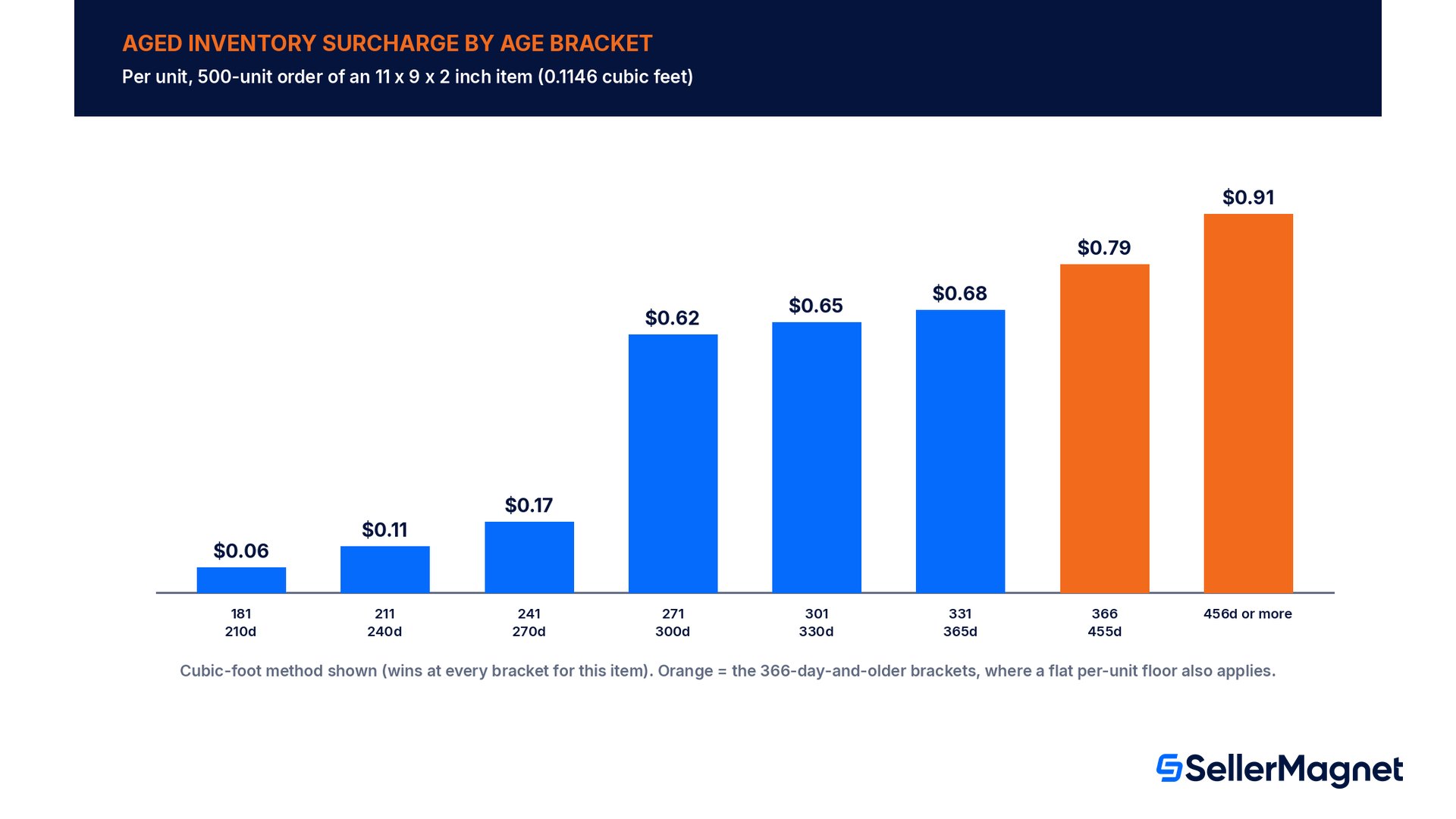
Here is the full calculation for a realistic case. The product is a stackable silicone kitchen storage set, packed at 11 x 9 x 2 inches and weighing 0.8 lb, sold at $18.99. The seller has 500 units sitting in Amazon's network. The cubic feet per unit is (11 x 9 x 2) / 1,728 = 0.1146. The table below shows what the surcharge would be for all 500 units at each age bracket if that stock were still unsold at that age, assuming the inventory stays below the 22-week storage utilization threshold so the regular storage fee does not also carry a utilization surcharge.
Inventory age
Cubic-foot method (500 units)
Per-unit method (500 units)
Billed surcharge
181 to 210 days
$28.65
N/A
$28.65
211 to 240 days
$57.30
N/A
$57.30
241 to 270 days
$85.95
N/A
$85.95
271 to 300 days
$312.29
N/A
$312.29
301 to 330 days
$326.61
N/A
$326.61
331 to 365 days
$338.07
N/A
$338.07
366 to 455 days
$395.37
$150.00
$395.37
456 days or more
$452.67
$175.00
$452.67
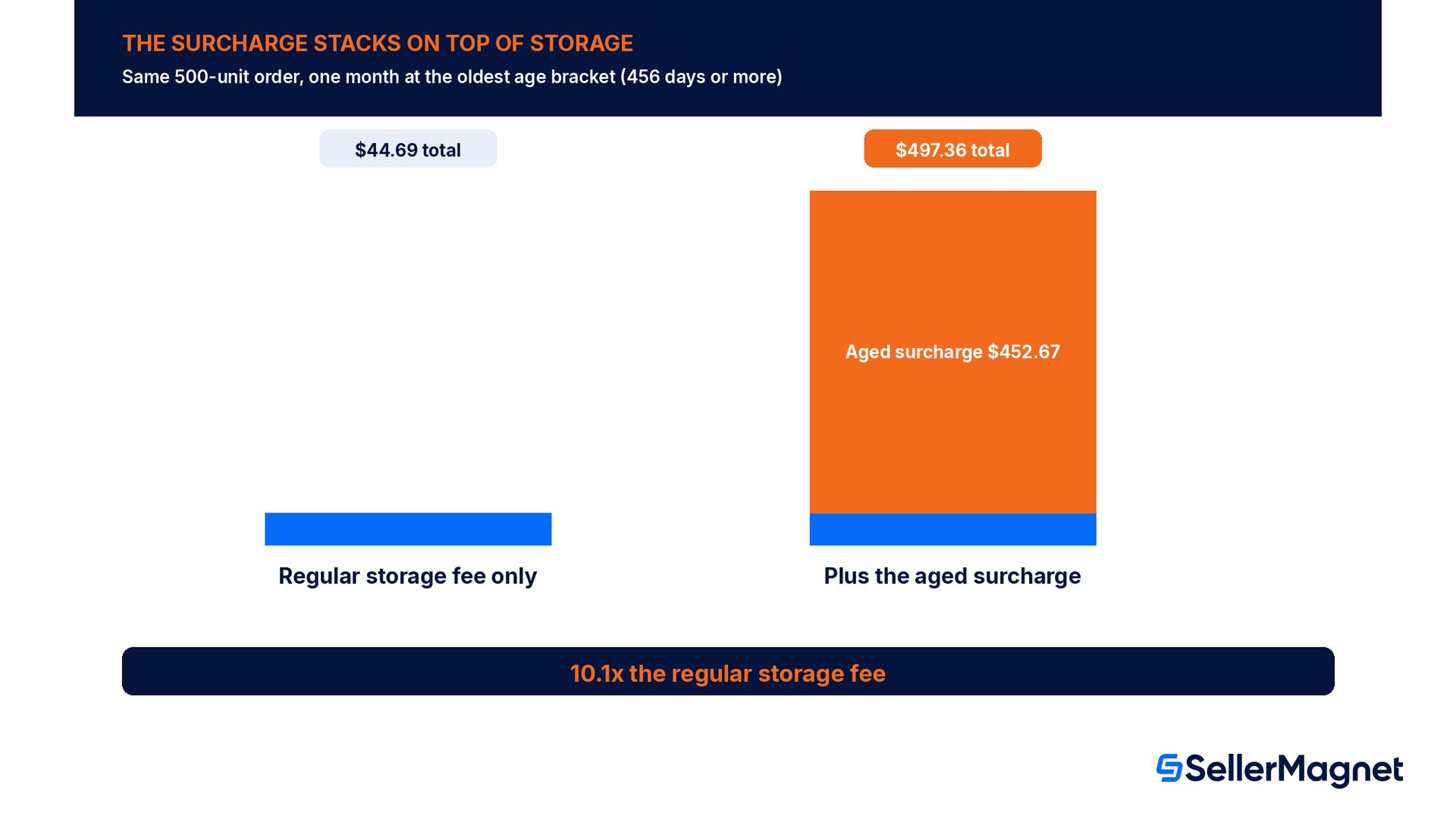
For this product, the cubic-foot method wins at every bracket because the item is too small and light for the flat per-unit fee to catch up. At 456 days or more, Amazon would bill $452.67 for the month, on top of the regular monthly storage fee of $44.69 that this same stock already pays every month regardless of age. Per unit, that is $0.91 in surcharge against $0.09 in regular storage, a difference of 10.1 times.
This is on top of storage, not instead of it
The $452.67 aged inventory surcharge in this example is charged in addition to the $44.69 regular storage fee for the same month. A seller who only budgets for the surcharge and forgets the base storage fee underestimates the true monthly cost of slow-moving stock by a meaningful margin.
Why age is tracked first-in, first-out, and why that matters
Amazon calculates inventory age on a first-in, first-out basis across the entire fulfillment network: when a unit sells or is removed, it is deducted from the oldest matching inventory in stock, regardless of which physical unit a warehouse associate actually picked. This matters for sellers who restock before the old batch sells out. If you send a second shipment while 200 units of the first batch are still unsold, Amazon's count treats every sale as coming from the oldest units first on paper, so the new batch does not reset or hide the age of the old one. Reordering early does not protect inventory from the surcharge; only selling through, discounting, or physically removing the old stock does.
How do you avoid the aged inventory surcharge?
Amazon's own guidance points to three practical paths, and the FBA Inventory tool can flag which ASINs are currently subject to the surcharge or will become subject to it within 60 days, so there is no need to guess.
Sell through the stock at a markdown. Amazon Outlet runs promotional deals with a minimum discount of 20%, which moves stock before it reaches the next age bracket.
Submit a removal or disposal order before the inventory cleanup date. Once the order is submitted before the 14th of the month at 11:59 p.m. Pacific Time, that inventory will not incur the next month's surcharge, even if the physical removal has not finished yet.
Set up automated removals so inventory that crosses a chosen age is removed automatically, without needing to review the FBA Inventory tool every month.
The deadline detail is the one with the most leverage: because the surcharge is assessed from a snapshot on the 15th, and the removal deadline to skip that snapshot is the 14th at 11:59 p.m. Pacific Time, submitting the order one day before the assessment is enough. Waiting until after the snapshot locks in another full month of the surcharge even if the removal order goes in the next morning.
When does removing inventory actually pay for itself?
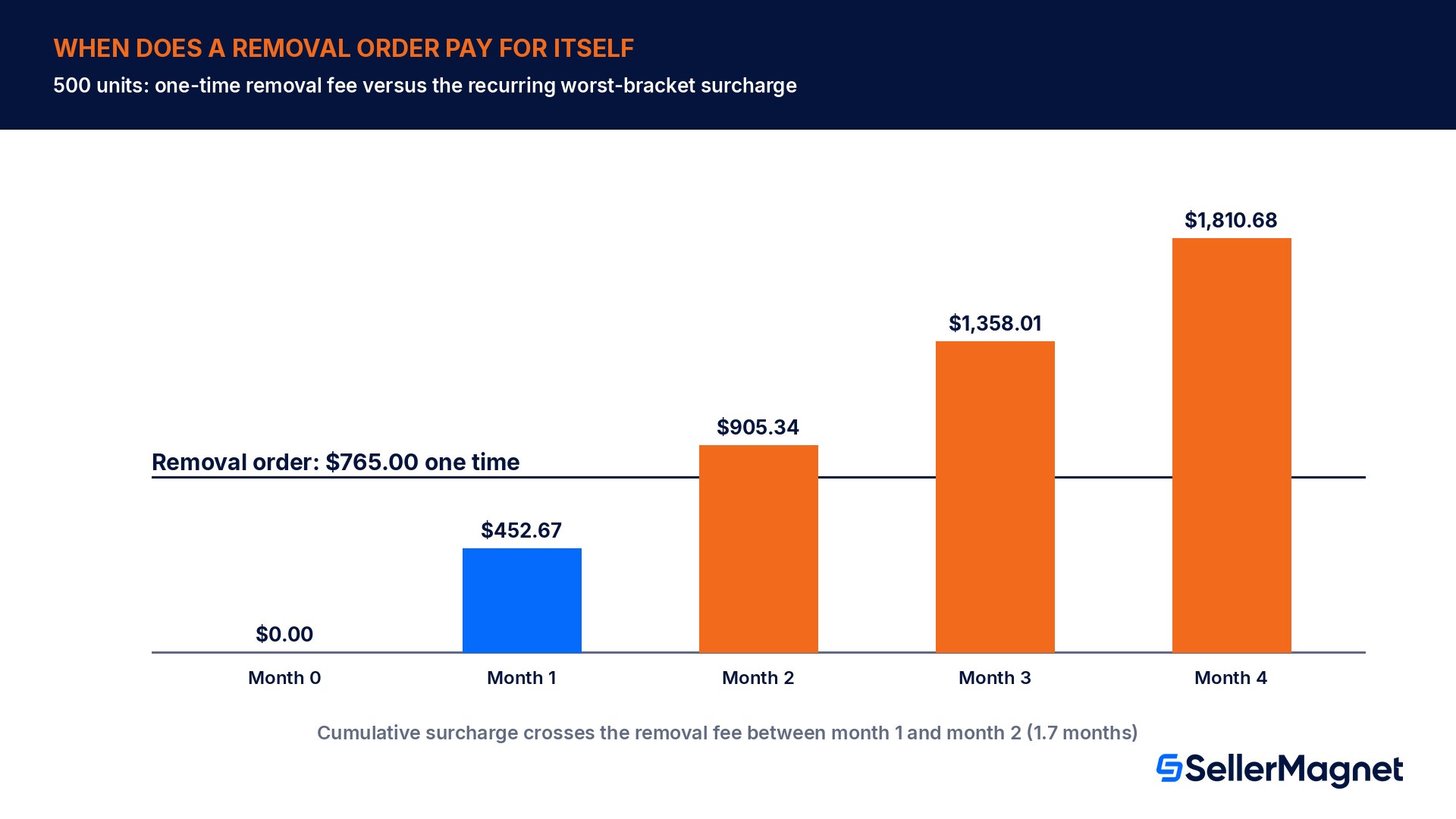
Removal and disposal orders are not free: the standard-size removal fee for this product's weight tier (0.5+ to 1.0 lb) is $1.53 per unit, effective from 15 January 2026. For the full 500-unit batch, that is $765.00. The question worth running the numbers on is simple: does paying that fee once beat paying the surcharge again next month?
Option
Cost for 500 units
What happens next
Do nothing, keep paying the surcharge
$452.67 per month at the oldest bracket
Recurs every month the stock stays unsold, stacked on top of regular storage
Submit a removal order before the 14th
$765.00 one time
No more surcharge or storage fee on these units from the next cycle
Discount via Amazon Outlet (20% minimum)
$3.80 per unit sold, no fee if it sells
Stock sells through if buyers respond to the price; some may still remain unsold
At the worst bracket, the one-time removal fee of $765.00 costs less than 1.7 months of the ongoing surcharge of $452.67 per month. In other words, removing this batch now is cheaper than leaving it in place for two more billing cycles. The comparison only gets more favorable to removal the longer the stock has already aged, because the surcharge keeps climbing while the removal fee for a given weight tier stays fixed.
Outlet discounting is an either-or with the surcharge, not a sure thing
Amazon Outlet can sell through stock without paying a removal fee, but a 20% discount is a minimum, not a guarantee of a sale. If the batch does not sell at the discounted price before the next snapshot, it still owes the next month's surcharge. Removal is the only option on this list that is certain to stop the fee.
Common mistakes that let the surcharge run unnecessarily
Checking inventory age only after the monthly bill arrives, instead of using the FBA Inventory tool to see which ASINs will cross 181 days within 60 days.
Submitting a removal order on the 15th or later, after that month's snapshot has already locked in the surcharge for another cycle.
Forgetting that the surcharge stacks on top of the regular storage fee, and budgeting only for one or the other.
Restocking the same ASIN while the old batch is still aging, without realizing Amazon's first-in, first-out counting still ages the old units on paper.
Comparing only this month's surcharge to the removal fee, instead of comparing the removal fee to several months of a surcharge that keeps climbing.
Assuming a product in the clothing exemption is exempt at every age: the exemption only covers the 181-to-270-day brackets, not the steeper ones from 271 days on.
Checklist: review aging inventory before the next snapshot
Pull the FBA Inventory tool's age breakdown and flag every ASIN at or approaching 181 days.
Calculate each flagged ASIN's cubic feet, and compare the cubic-foot and per-unit methods for its current and next age bracket.
Decide per ASIN: discount and sell through, submit a removal or disposal order, or accept another month of surcharge because a sale is imminent.
If removing, submit the order before the 14th of the month at 11:59 p.m. Pacific Time to skip the next snapshot.
Log the decision and the number against the regular storage fee for the same stock, so next month's comparison starts from real figures, not a guess.
How SellerMagnet fits into the decision
Spotting aging stock before it reaches the next bracket is a forecasting problem as much as a fee problem. SellerMagnet's inventory forecast, part of the Analytics Dashboard, shows days of stock left and an expected stockout date based on your real sales velocity, so a batch that is moving too slowly to sell through before it ages shows up early, while there is still time to act instead of after the snapshot has already billed. The Analytics Dashboard itself tracks net profit per product after Amazon fees, so a removal fee or an Outlet discount can be weighed against the real margin on that product rather than a guess. For a quick check of current Amazon fee rates on a single ASIN, the free Fee Calculator uses Amazon's own published fee schedule. Slow-moving stock and a tight inventory budget tend to show up together: a seller juggling aging stock on one ASIN is often also trying to avoid the opposite problem on another, running too thin and risking a low-inventory-level fee instead. The same forecast view flags both directions, so the goal is neither too much aging stock nor too little live stock, but a level that matches real sales velocity.
Is the aged inventory surcharge the same as the long-term storage fee?
Yes. Amazon renamed the long-term storage fee to the aged inventory surcharge; the mechanics, the 181-day threshold and the monthly 15th-of-the-month assessment are the same program under a new name.
Does the aged inventory surcharge replace the regular monthly storage fee?
No. It is charged in addition to the regular monthly storage fee for the same units, not instead of it. Both fees are driven by cubic footage, so an aging unit's total monthly storage cost is the sum of the two.
When exactly is the surcharge calculated and billed?
Amazon takes an inventory snapshot on the 15th day of each month to determine which units are subject to the surcharge, then bills the fee, typically between the 18th and 22nd day of the same month.
Which method does Amazon use to calculate the fee?
Amazon calculates the charge both ways, a per-cubic-foot rate for the item's age bracket and, from 366 days onward, a flat per-unit rate, and bills whichever amount is higher for that bracket.
How do I stop the surcharge before it is charged again?
Submit a removal or disposal order before 11:59 p.m. Pacific Time on the 14th of the month. That inventory will not incur the next surcharge even if the physical removal has not been completed yet.
Does reordering the same product reset its age?
No. Amazon tracks inventory age on a first-in, first-out basis across your entire fulfillment network, so a new shipment does not reset or hide the age of an older batch that is still in stock; sales are counted against the oldest units first.
Are any products exempt from the aged inventory surcharge?
Items in the clothing, shoes, bags, jewelry and watches categories are excluded from the per-cubic-foot rate only in the 181-to-270-day brackets. From 271 days onward, every category is charged the published rate.
Is selling through Amazon Outlet always cheaper than a removal order?
Not necessarily. Outlet requires a minimum 20% discount and the stock still has to sell before the next snapshot, or it owes another month of surcharge. A removal order has a one-time fee but is certain to stop the surcharge, which is why comparing the numbers for your own stock matters more than a general rule.
Stop Juggling Tools. SellerMagnet Combines Everything You Need.