Amazon Low-Inventory-Level Fee 2027: The New 28-Day Test
R
RenéFreelance Amazon Editor
|
14 min read
Amazon's low-inventory-level fee is a per-unit FBA surcharge charged when a product's stock runs thin relative to how fast it sells, and on February 1, 2027 the test that decides whether a seller owes it changes completely. Today, Amazon assesses the fee using trailing 30- and 90-day sales, a purely backward-looking measure. From February 1, 2027, Amazon switches to comparing a product's inventory against its actual shipped units in the four weeks before AND the four weeks after the week being assessed, charges the fee only when both periods come up short, and moves the charge onto its own line on the Payment view report instead of folding it into the FBA fulfillment fee. The published per-unit rates do not change, but which products trigger the fee, and which ones now dodge it, does. This guide works through Amazon's own 2027 rate card and worked examples, recomputed here, so the mechanics are clear before the change lands.
From February 1, 2027, Amazon's low-inventory-level fee stops using trailing 30- and 90-day sales and starts comparing a product's inventory against its actual units shipped in the four weeks before and the four weeks after the assessed week, charging the fee only when both periods show under 28 days of supply. The per-unit rates are unchanged, but oversize items are now in scope and the charge moves to its own line on the Payment view report.
What the low-inventory-level fee is, and what actually changes on February 1, 2027
Amazon charges the low-inventory-level fee on shipped units of a product whose stock is running thin compared with how fast it is actually selling, a per-unit surcharge added on top of the regular FBA fulfillment fee. Through January 31, 2027, Amazon's own help page states the fee is based on historical days of supply, calculated at the product FNSKU level from the GREATER of the long-term (trailing 90 days) and short-term (trailing 30 days) historical sales, and only charged when BOTH of those trailing windows come in under 28 days. Amazon's own 2027 announcement describes that mechanic plainly: 'Today, the fee is assessed using trailing 30- and 90-day sales.' Starting February 1, 2027, Amazon's help page "Low-inventory-level fee 2027" replaces that entirely: days of supply is now calculated by comparing a product's inventory at the weekly check against its actual units shipped in the four weeks BEFORE that check (trailing) and, separately, its actual units shipped in the four weeks AFTER that check (following). The fee only applies when the inventory level is insufficient in BOTH periods; if either the trailing or the following days-of-supply figure is at or above 28 days, no fee applies at all. Amazon states the goal directly: this change "confirms whether low inventory reflects ongoing demand," targets SKUs that genuinely need replenishment, and "reduce[s] instances triggered by unexpected demand spikes or end-of-season and end-of-life products."
Old test against new test, side by side
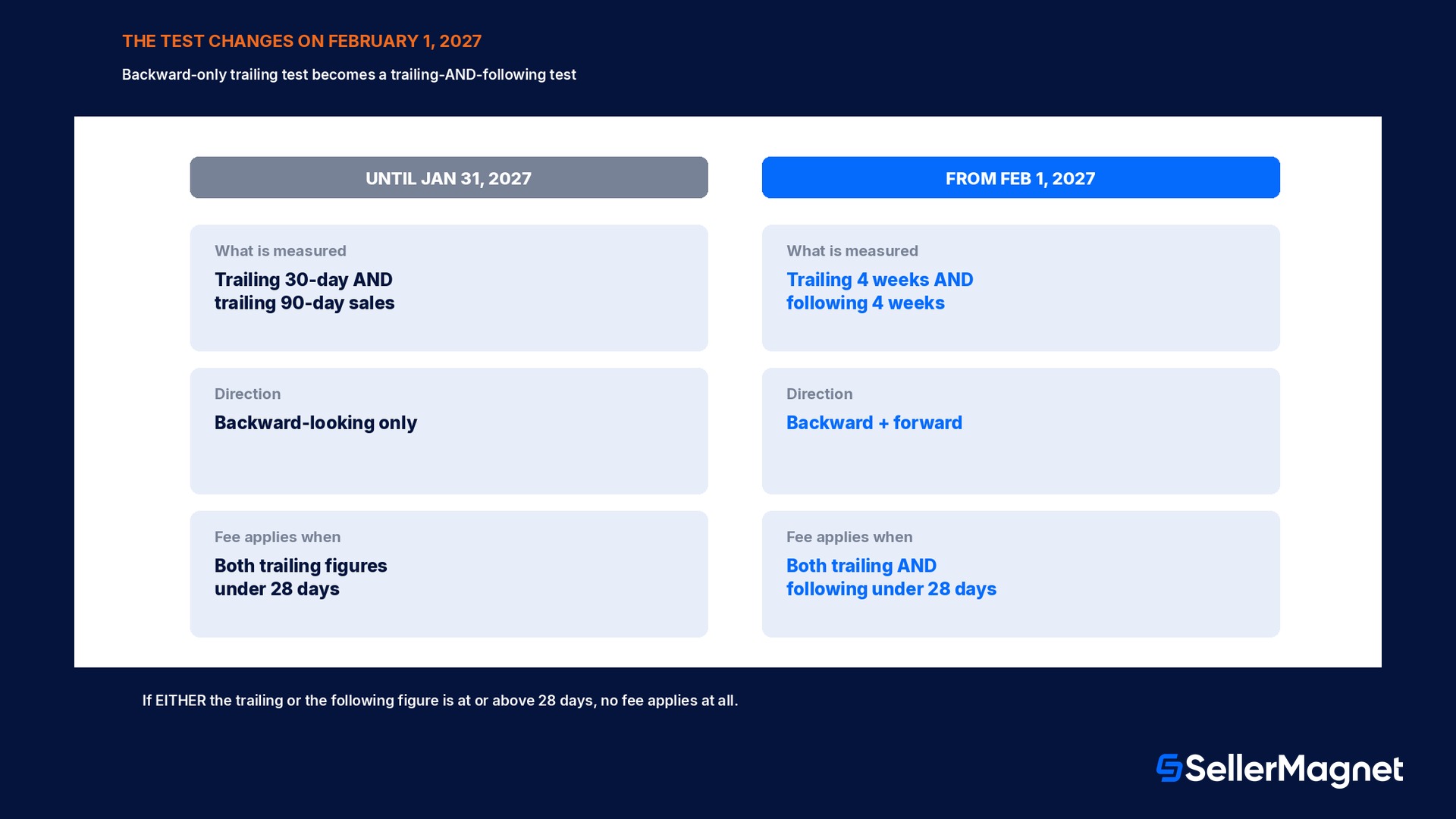
The two tests measure fundamentally different things. The test used through January 31, 2027 is entirely backward-looking: it takes the greater of a product's trailing-30-day and trailing-90-day historical days of supply, and charges the fee if that number is under 28 days, with no visibility into whether sales are about to pick back up or a product is simply winding down for good. The test effective February 1, 2027 adds a forward-looking check: it still looks backward over 4 weeks, but it also waits 4 weeks forward from the assessment date to see whether units actually kept shipping at a similar pace, and only charges the fee if inventory was thin relative to sales on BOTH sides of that date. A product whose sales legitimately dried up because it is seasonal or discontinued will show thin stock on the trailing side but near-zero shipments (and so a very high, exempt days-of-supply figure) on the following side, and will not be charged under the new test even though it likely would have been charged under the old one.
Until January 31, 2027
From February 1, 2027
What is measured
Historical days of supply: the GREATER of trailing 30-day and trailing 90-day sales
Days of supply calculated separately for the trailing 4 weeks AND the following 4 weeks
When the fee applies
Both the trailing-30 and trailing-90 figures are under 28 days
BOTH the trailing and the following 28-day figures are under 28 days
Direction of the data
Entirely backward-looking
Backward (trailing) and forward (following) from the assessment date
Scope by size tier
Standard and bulky size tiers
Every size tier, including all oversize tiers for the first time
Where the charge appears
Folded into the FBA fulfillment fee
A standalone line on the Payment view report
When a seller sees the charge
After the trailing window closes
4 weeks after the assessed week, once the following window also closes
The 2027 rate card: unchanged dollar amounts, wider size-tier scope
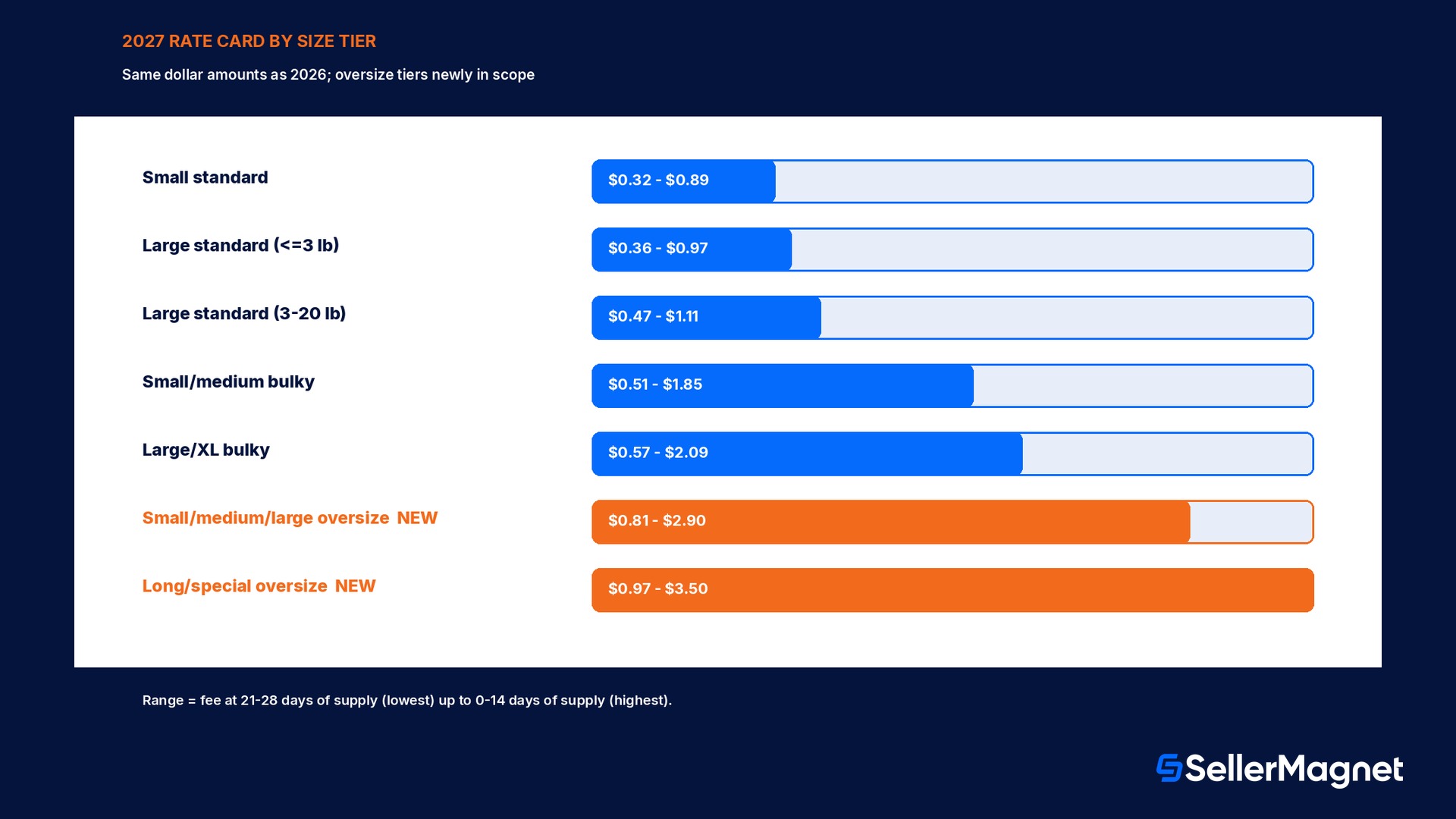
Amazon's 2027 low-inventory-level fee rate card publishes the exact same per-unit dollar amounts, by size tier and days-of-supply band, that applied in 2026 for every tier that already existed: $0.32 to $1.11 for standard-size items depending on weight and how thin the stock is, and $0.51 to $2.09 for the bulky tiers. What changes is scope, not price: Amazon's own 2027 help page states plainly that "the fee will now apply to items in all oversize product size tiers," where the fee previously stopped at the bulky tiers and left small, medium, large and extra-large oversize products, and the long/special oversize tier, outside the fee's reach altogether. The new oversize rows run from $0.81 up to $3.50 per unit depending on weight and how far under 28 days of supply the product falls.
2027 size tier
Shipping weight
0 to 14 days of supply
14 to 21 days of supply
21 to 28 days of supply
Small standard
Up to 16 oz
$0.89
$0.63
$0.32
Large standard
Up to 3 lb
$0.97
$0.70
$0.36
Large standard
3 to 20 lb
$1.11
$0.87
$0.47
Small/medium bulky
Up to 50 lb
$1.85
$1.02
$0.51
Large/extra-large bulky
Up to 50 lb
$2.09
$1.15
$0.57
Small/medium/large oversize (new scope)
Up to 150 lb
$2.90
$1.30
$0.81
Long/special oversize (new scope)
n/a
$3.50
$1.57
$0.97
The days-of-supply band uses the HIGHER of the two figures, not the lower
Amazon's help page is explicit that "the fee rate is applied using the higher of the two days of supply metrics" (trailing and following), so a product only pays the steepest band when BOTH figures land in that band's range; whichever figure is less thin sets the rate actually charged.
Two of Amazon's own worked examples, recomputed
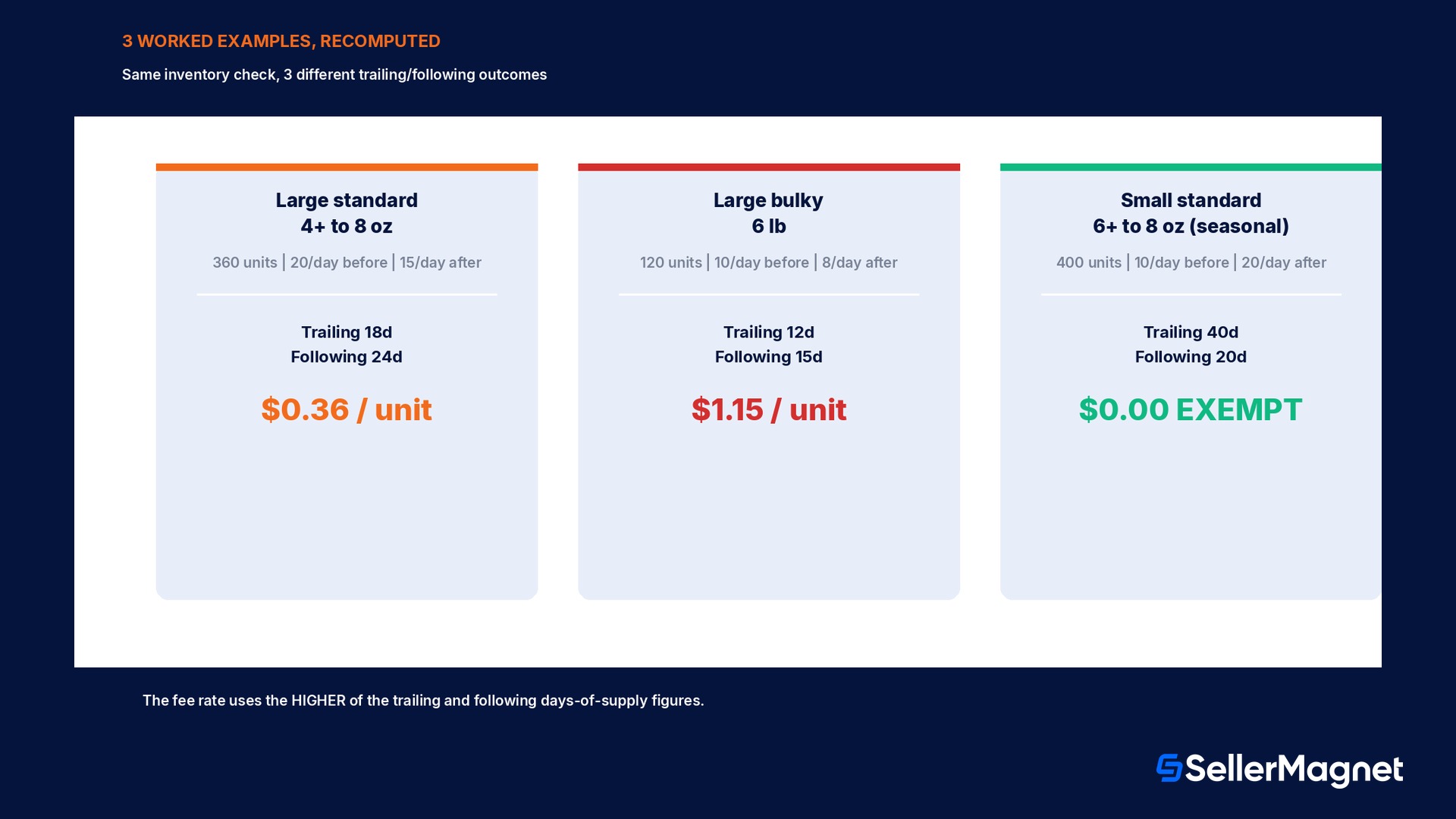
Amazon's 2027 help page publishes several worked examples; two of them are recomputed here from the raw inputs to show exactly how the trailing-and-following test lands on a real fee. In the first, a large standard-size product (4+ to 8 oz) has 360 units in stock at a weekly inventory check, having shipped an average of 20 units a day in the 4 weeks before the check and an average of 15 units a day in the 4 weeks after. Trailing days of supply is 360 divided by 20, or 18 days; following days of supply is 360 divided by 15, or 24 days. Since the fee uses the higher of the two figures, the relevant number is 24 days, which falls in the 21-to-28-day band, so the product owes $0.36 per unit. In the second, a large-bulky product (6 lb) has 120 units in stock, shipping an average of 10 units a day before the check and 8 units a day after. Trailing days of supply is 120 divided by 10, or 12 days; following days of supply is 120 divided by 8, or 15 days. The higher figure, 15 days, falls in the 14-to-21-day band, so the product owes $1.15 per unit, Amazon's own stated result for that example.
A third case: the exact kind of product the new test is built to let through
A third scenario shows why Amazon built the test around both directions rather than just the trailing window. A small standard-size product (6+ to 8 oz) has 400 units in stock, having shipped an average of 10 units a day in the 4 weeks before the check (a slow stretch) but an average of 20 units a day in the 4 weeks after (sales picked back up, for example as a seasonal item moved into its selling window). Trailing days of supply is 400 divided by 10, or 40 days, which on its own would have looked thin under the old trailing-only test. But following days of supply is 400 divided by 20, or 20 days, comfortably above 28, and since the fee only applies when BOTH periods are under 28 days, this product owes nothing under the 2027 test. A seller who only watches the trailing figure would wrongly expect a charge here; the following-window check is specifically what clears it.
Example
Trailing days of supply
Following days of supply
Fee per unit
Large standard, 4+ to 8 oz
18 days
24 days
$0.36
Large bulky, 6 lb
12 days
15 days
$1.15
Small standard, 6+ to 8 oz (seasonal rebound)
40 days
20 days
$0.00 (exempt)
Why the charge now shows up four weeks late, and where to find it
The forward-looking half of the new test has a direct, unavoidable consequence for timing: a seller cannot know whether a given week's shipments owe the low-inventory-level fee until the 4 weeks of FOLLOWING sales data for that week have actually happened. Amazon's own help page states this without softening it: 'you'll wait four weeks before seeing low-inventory-level charges on your shipped units for any given week.' Two further changes make the fee easier to track once it does appear. First, from February 1, 2027 the charge appears as a standalone fee on the Payment view report rather than being folded into the FBA fulfillment fee line, so a seller can see it as its own number instead of reverse-engineering it out of a blended fulfillment charge. Second, a new Low-Inventory-Level Fee Report, available from February 1, 2027, gives order-level detail with the trailing and following days-of-supply values and any exemption reason for every shipped unit, replacing guesswork with a report that states, per unit, exactly why a fee did or did not apply.
Mistakes this change makes easy to fall into
Watching only the trailing figure. The fee needs BOTH the trailing and the following 28-day figures to be thin; a product that looks at risk on the backward-looking number alone may still owe nothing once the forward-looking figure comes in.
Expecting the dollar rates to change. They do not for any tier that already had the fee in 2026; what changes is the test that decides WHICH products get charged, and the fact that oversize tiers are newly in scope.
Assuming a clean Payment view means no fee was charged that week. Since the fee needs 4 weeks of following data, a shipment from this week will not show its fee, if any, on a report run today; check back after the following window closes.
Ignoring oversize inventory because the fee never used to reach it. From February 1, 2027 small, medium, large, extra-large and long/special oversize tiers are all in scope for the first time, at rates from $0.81 to $3.50 per unit depending on weight and days of supply.
Reacting to a single thin week instead of the trend. Amazon's stated intent is to stop charging the fee for a short demand spike or a seasonal wind-down that shows up on only one side of the test; a genuinely thin SKU across both the trailing and following windows is the case the fee is still designed to catch.
Not using the new report. The Low-Inventory-Level Fee Report publishes the exact trailing/following days-of-supply numbers and exemption reason per unit; reading last year's blended fulfillment-fee total will not show the same detail.
Where SellerMagnet fits around this change
Amazon runs the low-inventory-level fee calculation and publishes its own rates, reports and exemption logic entirely inside Seller Central; SellerMagnet has no role in that calculation. What SellerMagnet's tools do is the planning work on either side of it. Sourcer and SellerMagnet's inventory-facing research flag a SKU whose sell-through is genuinely slowing before four weeks of following-window data forces the question, giving more lead time to reorder, discount or wind a SKU down deliberately rather than reactively. Fee Calculator lets a seller plug in a product's size tier and weight to see the exact per-unit low-inventory-level rate it would face in each days-of-supply band before deciding how much safety stock to carry against it.
After the change lands, Profit Analytics shows the low-inventory-level fee as its own line once Amazon starts reporting it that way on the Payment view report, so a seller can see which SKUs are actually absorbing the charge across a full month rather than noticing it buried inside a blended fulfillment-fee number.
Checklist before February 1, 2027
How to get ready for the 2027 low-inventory-level fee test
List every SKU currently near the 28-day days-of-supply line - Pull current inventory against trailing sales velocity for every active FNSKU, standard or oversize.
Separate genuinely thin SKUs from seasonal or end-of-life ones - A SKU with sales about to resume (seasonal rebound, a planned promotion) is the case the new following-window check is built to exempt; a SKU with no sales plan ahead is the case it still catches.
Check oversize SKUs specifically - Every oversize size tier is newly in scope from February 1, 2027, at rates from $0.81 to $3.50 per unit; oversize sellers who never budgeted for this fee need to start.
Budget for the 4-week reporting lag - A shipment made today will not show its low-inventory-level fee status, if any, until the following 4-week window closes; do not expect same-week visibility.
Use the new Low-Inventory-Level Fee Report once it is live - From February 1, 2027 it publishes trailing/following days of supply and exemption reason per unit, replacing manual reconstruction from the fulfillment-fee line.
Re-run the fee against planned reorders - Check the exact per-unit rate for a SKU's size tier and weight before deciding how much extra safety stock is worth carrying to stay above 28 days of supply on both sides of the test.
When does the new low-inventory-level fee test take effect?
February 1, 2027. Through January 31, 2027, Amazon continues using the trailing 30- and 90-day historical days-of-supply test described in its current Low-inventory-level fee help page.
Do the per-unit dollar rates change in 2027?
No, the published rates by size tier and days-of-supply band are the same dollar amounts as 2026 for every tier that already carried the fee. What changes is which products the test catches, and that every oversize tier is newly included.
Does the fee apply if only my trailing sales look thin?
No. From February 1, 2027 the fee only applies when BOTH the trailing 28-day and the following 28-day days-of-supply figures are under 28 days. If either one is at or above 28 days, no fee applies.
Why would I not see this fee on a report the same week a shipment goes out?
Because the test needs the following 4 weeks of actual shipped units to calculate the following days-of-supply figure, Amazon's own help page states a seller waits 4 weeks before seeing the charge for any given week's shipments.
Are oversize products newly subject to this fee?
Yes. From February 1, 2027 the fee applies to all oversize product size tiers for the first time, at rates from $0.81 to $3.50 per unit depending on weight and days of supply; previously the fee stopped at the bulky tiers.
Where will the charge appear on my reports after February 1, 2027?
As a standalone line on the Payment view report, separate from the FBA fulfillment fee, plus a new order-level Low-Inventory-Level Fee Report with the trailing/following days-of-supply values and exemption reason per unit.
Stop Juggling Tools. SellerMagnet Combines Everything You Need.