Amazon Lending Program 2026: How Seller Financing Actually Works
R
RenéFreelance Amazon Editor
|
15 min read
Amazon Lending is the financing program Amazon surfaces inside Seller Central under the name Amazon Lending, offering business financing to eligible small and medium-sized sellers through a set of third-party financing providers rather than through Amazon itself. Amazon stopped underwriting its own seller loans in the US and UK in March 2024, and since then every offer a seller actually sees inside the Amazon Lending page comes from one of several outside lenders Amazon has partnered with, each offering a different product: term loans, a merchant cash advance, a revolving line of credit, or an SBA-backed loan of up to $5 million. At Amazon's Accelerate 2026 seller conference in September, Amazon announced it is opening the program to every eligible seller by the end of 2026, dropping the invitation requirement that previously limited who could even see an offer. This guide works through exactly how Amazon Lending works today, which providers sit behind it, what each product actually costs and requires, and a worked comparison of a term loan against a revolving line of credit for a seller financing the same inventory purchase.
Amazon Lending is Amazon's Seller Central financing program that connects eligible sellers to third-party lenders, not to Amazon itself, offering term loans, merchant cash advances, revolving lines of credit, and SBA 7(a) loans up to $5 million. Amazon stopped underwriting its own loans in the US and UK in March 2024, and by the end of 2026 Amazon says every eligible seller will be able to apply without needing an invitation first.
What is Amazon Lending, and who actually lends the money?
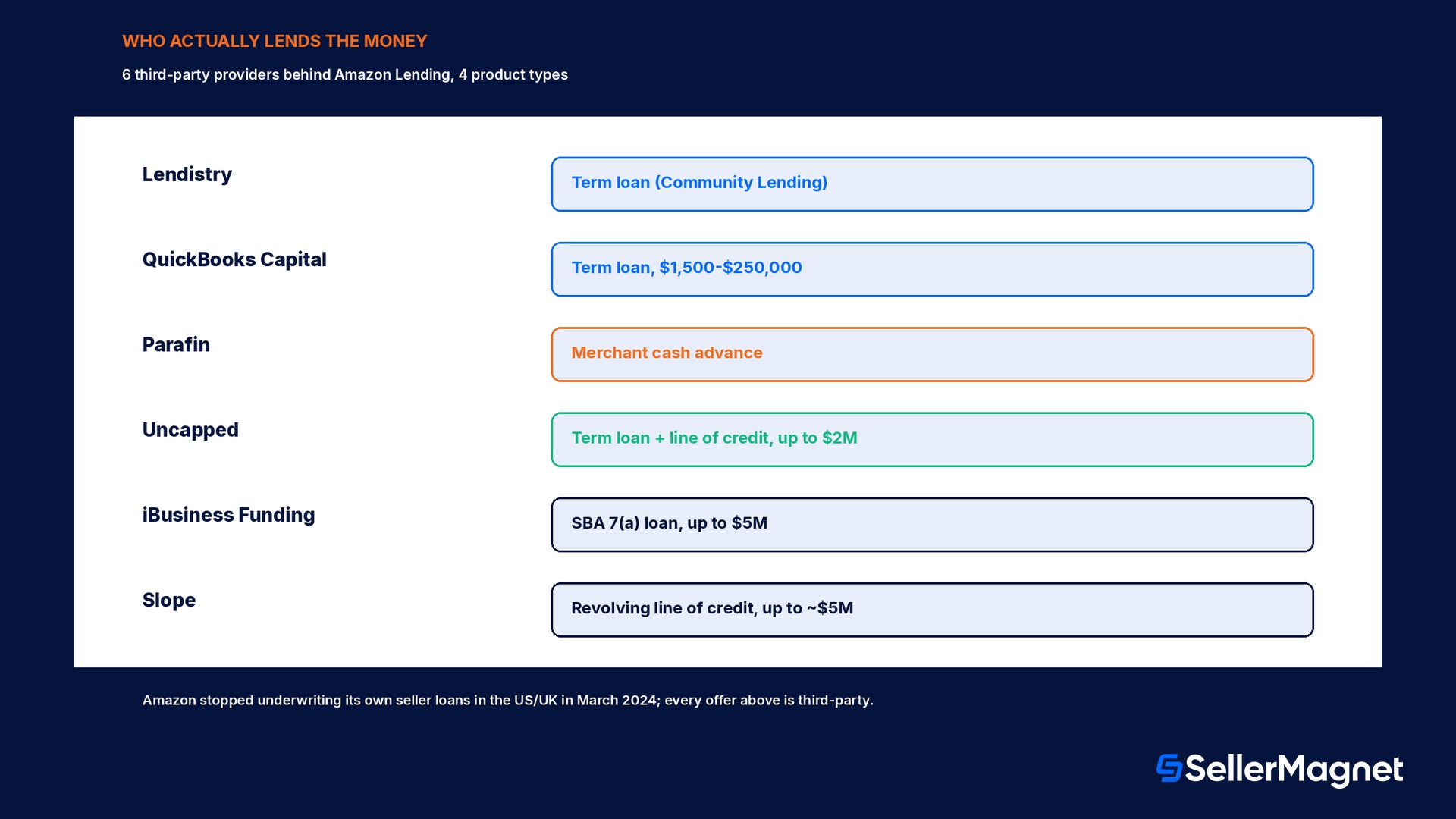
Amazon's own Seller Lending program help page states plainly that the Seller Lending program is offered by Amazon Lending, and that under this program a seller may be eligible to apply for loans provided by local third-party lenders or lending service providers, not by Amazon itself. That distinction matters because of a change that is easy to miss if a seller only remembers the older version of the program: Amazon stopped underwriting its own seller loans in the US and UK in March 2024, and the Amazon Lending page now shows invitation-based or directly-applied-for offers from outside financing partners rather than an Amazon-funded loan. Amazon's own program page names six such partners as of 2026: Lendistry (through the Amazon Community Lending partnership, aimed at underserved communities), Parafin (a merchant cash advance provider), QuickBooks Capital (small term loans), Uncapped (term loans and a line of credit for e-commerce sellers), iBusiness Funding (which connects sellers to SBA-approved lenders for SBA 7(a) loans), and Slope (a revolving line of credit aimed at larger working-capital needs). A seller does not choose a lender from a catalog the way they would shop a bank; Amazon's help page states that eligibility and any specific offers are determined by the seller's own account, and a seller signs in to Seller Central and goes to the Amazon Lending page to see whether their business is eligible to apply at all.
The three products behind Amazon Lending, and what each actually costs
Every offer visible through Amazon Lending falls into one of three product types, and the type matters more than the provider's name when comparing offers, since the repayment structure is what actually determines cash flow impact. A term loan is a non-revolving, lump-sum loan with a specified payback period, repaid in equal monthly payments covering both principal and interest, the structure used by QuickBooks Capital (loans from $1,500 up to published maximums in the low hundreds of thousands) and Uncapped's term loan product (funding from $10,000 up to $2,000,000 for US sellers, with a fixed fee starting from 0.7% per month over terms of up to 24 months, and no personal guarantees required). A merchant cash advance, the product Parafin offers, is structured differently: it is a non-revolving sum of funding with no interest charged and no additional fees, repaid instead as a fixed percentage of the seller's future Amazon sales until a pre-agreed capital fee is paid off, which means the repayment amount rises and falls with sales rather than staying fixed like a loan payment. A revolving line of credit, Uncapped's and Slope's product (Slope's reaching up to roughly $5 million, aimed at sellers with large, ongoing working-capital or wholesale cash flow needs), lets a seller draw, repay, and redraw funds as needed, paying interest only on the amount actually drawn rather than on a lump sum sitting unused. The SBA 7(a) loan, accessed through iBusiness Funding connecting a seller to SBA-approved lenders, is a government-backed, longer-term loan product capped at $5 million under SBA's own rules, generally carrying lower interest rates and longer repayment terms than the other products, suited to large-scale expansion rather than a short working-capital gap.
Product
Provider(s)
Repayment style
Typical use
Term loan
QuickBooks Capital; Uncapped
Fixed equal monthly payments, principal plus interest
A known, one-time funding need with a planned payback date
Merchant cash advance
Parafin
A fixed percentage of future Amazon sales, no interest charged
Short-term cash flow gaps that track with sales volume
Revolving line of credit
Uncapped; Slope (up to ~$5M)
Interest only on the amount drawn, redraw as repaid
Ongoing working capital, inventory or wholesale cash flow
SBA 7(a) loan
iBusiness Funding (via SBA-approved lenders)
Monthly amortization, government-backed, capped at $5M by SBA rules
Large-scale expansion, equipment or warehouse purchases
Funding ranges and pricing are set per provider and per offer, not fixed by Amazon
Amazon's own program page states a business may be eligible to apply for one or more financing options from Amazon's select financial partners, up to the full amount the business is eligible for, and that every provider sets its own pricing and funding range for the specific offer a seller sees. Treat any dollar figure or rate in this guide as the published range for that provider, not a number Amazon guarantees for every account.
Who can apply, and how the invitation requirement is changing
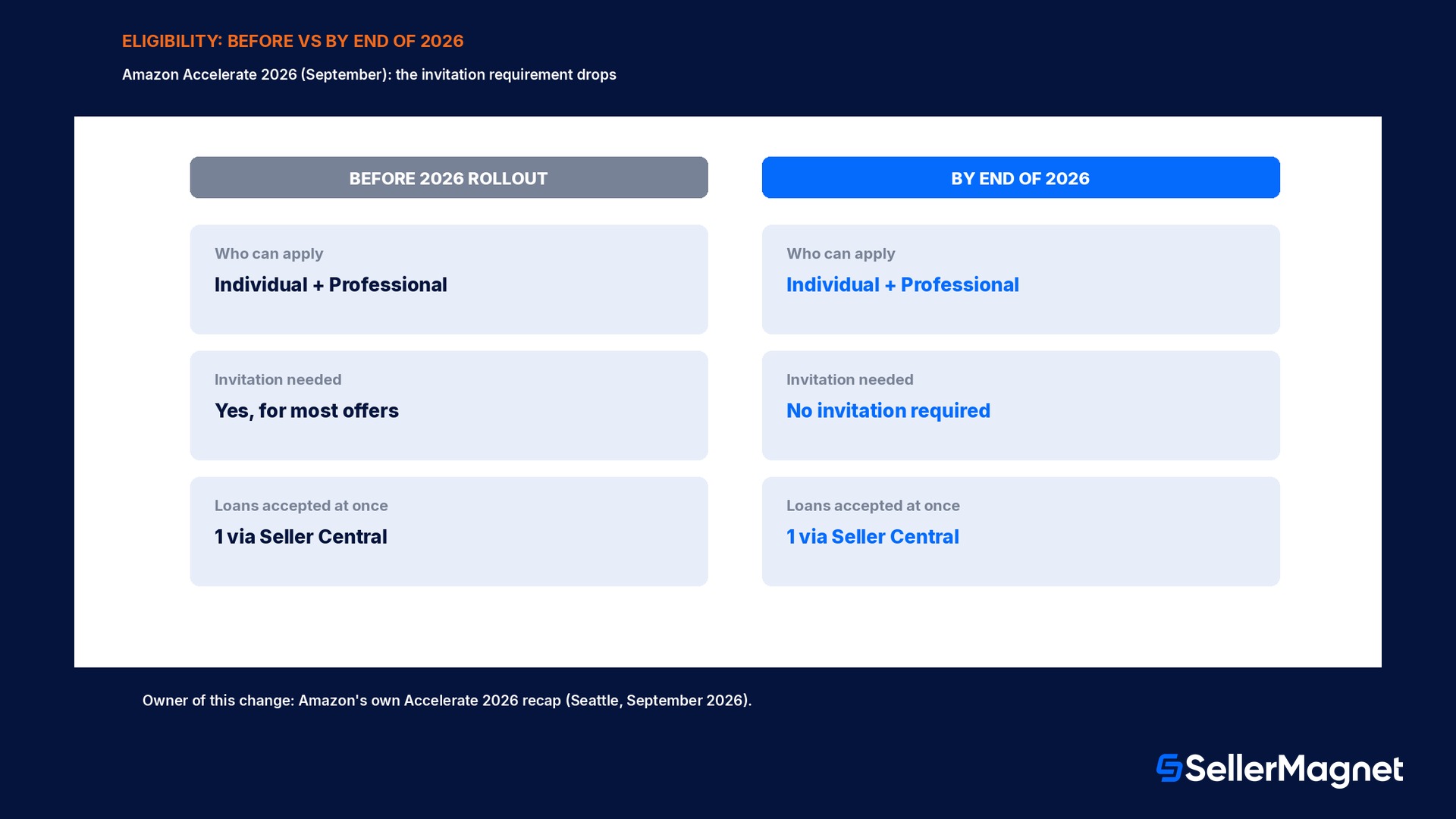
Amazon's Seller Lending program FAQ confirms that both Individual and Professional sellers can apply for loans through the program, so account type alone does not gate access the way it does for some other Seller Central tools. Historically, most sellers only saw an offer when Amazon or a partner extended an invitation inside Seller Central, which is why many eligible sellers never saw a single financing option despite running a business that would have qualified. A seller can apply for as many loans as they would like across the available providers, but Amazon's help page is explicit that a seller can choose to accept only one loan at a time through Seller Central's own offerings, so comparing offers before accepting any one of them is the only chance to pick the best fit. At Amazon's Accelerate 2026 seller conference in September, Amazon announced it is removing the invitation requirement entirely: Amazon Lending opens to every eligible seller by the end of 2026, alongside a wider set of financing partners including SBA-backed loans up to $5 million, described at the conference as a substantive change for businesses that have historically struggled to secure conventional capital. A seller who sees no current invitation is not necessarily locked out of financing altogether; Amazon's own help page frames the Seller Central page as the place to check for Amazon-connected offers, and several of the financing providers named above, along with SBA lenders and banks directly, also accept applications outside the Seller Central flow.
Before the 2026 rollout
By end of 2026
Who can apply
Individual and Professional sellers, invitation needed to see most offers
Individual and Professional sellers, no invitation needed
How many loans can be applied for
Multiple providers, one loan accepted at a time
Unchanged: multiple providers, one loan accepted at a time
Financing partner count
Six named providers (Lendistry, Parafin, QuickBooks Capital, Uncapped, iBusiness Funding, Slope)
Same providers, wider rollout, SBA-backed loans up to $5M emphasized
Worked comparison: a term loan against a line of credit for the same $40,000 inventory purchase
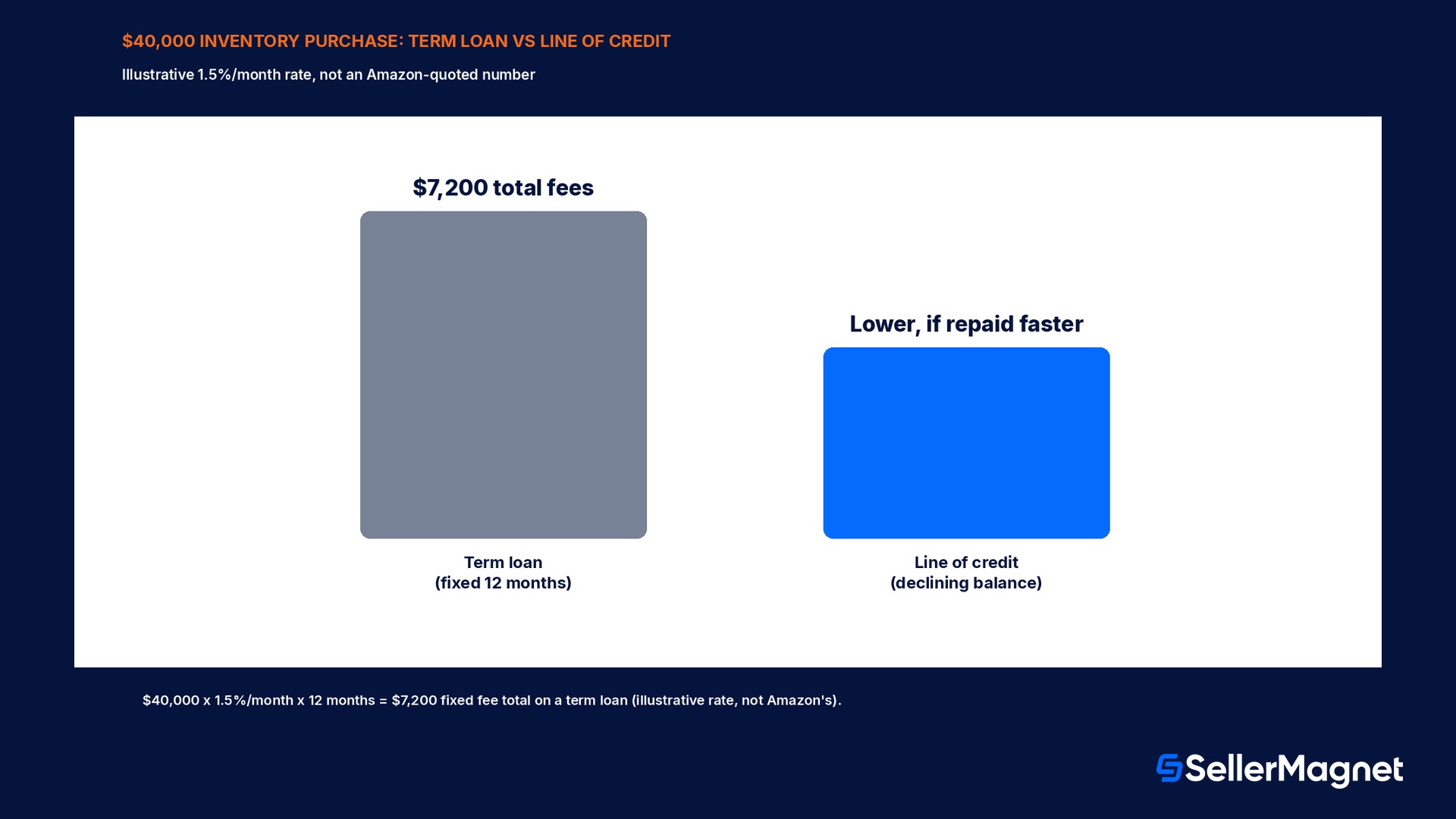
Take a seller who needs $40,000 to pay a supplier for a bulk inventory order ahead of a seasonal peak, and is weighing a term loan against a revolving line of credit, the two products most sellers compare first. Funded as a term loan at a representative fixed fee of 1.5% per month over a 12-month term (within the published ranges above, used here only as a worked example, not an Amazon-quoted rate), the seller owes the $40,000 principal plus 12 months of fees: $40,000 multiplied by 1.5% is $600 per month in fees, multiplied by 12 months is $7,200 total in fees, for a total repayment of $47,200, repaid in fixed equal monthly installments of $47,200 divided by 12, or about $3,933 a month, regardless of how sales perform that month. Funded instead as a revolving line of credit at the same 1.5% monthly rate on the amount actually drawn, and assuming the seller draws the full $40,000 on day one and repays it steadily over the same 12 months, interest is charged only on the declining balance rather than on the original $40,000 for the full term, so the total interest cost comes in lower than the term loan's fixed-fee total, at the cost of a variable monthly payment that depends on how much of the balance is still drawn. The practical difference is not which product is cheaper in isolation, it is cash flow predictability against cost: a term loan's fixed monthly payment is easier to budget around a known seasonal sales forecast, while a line of credit's interest-on-drawn-balance structure rewards a seller who can repay faster than the minimum, and a merchant cash advance's percentage-of-sales repayment is the only one of the three that automatically shrinks in a slow sales month, at the cost of no fixed end date for repayment.
Term loan (illustrative)
Line of credit (illustrative)
Amount financed
$40,000
$40,000 drawn
Rate used in this example
1.5% per month, fixed fee
1.5% per month, on drawn balance only
Monthly payment
~$3,933 fixed for 12 months
Variable, falls as the balance is repaid
Total fee/interest cost
$7,200 over 12 months
Lower than $7,200 if repaid faster than the term loan schedule
The 1.5% monthly rate above is an illustrative planning number, not a published Amazon or provider rate
Every provider in this guide (QuickBooks Capital, Uncapped, Parafin, Slope, iBusiness Funding) publishes its own pricing per offer, and Amazon's own program page states a seller's actual rate and amount depend on the specific offer their account receives. Rerun this comparison with the real APR, fee, or percentage-of-sales rate shown on an actual Amazon Lending offer before deciding between products.
How to check eligibility and apply
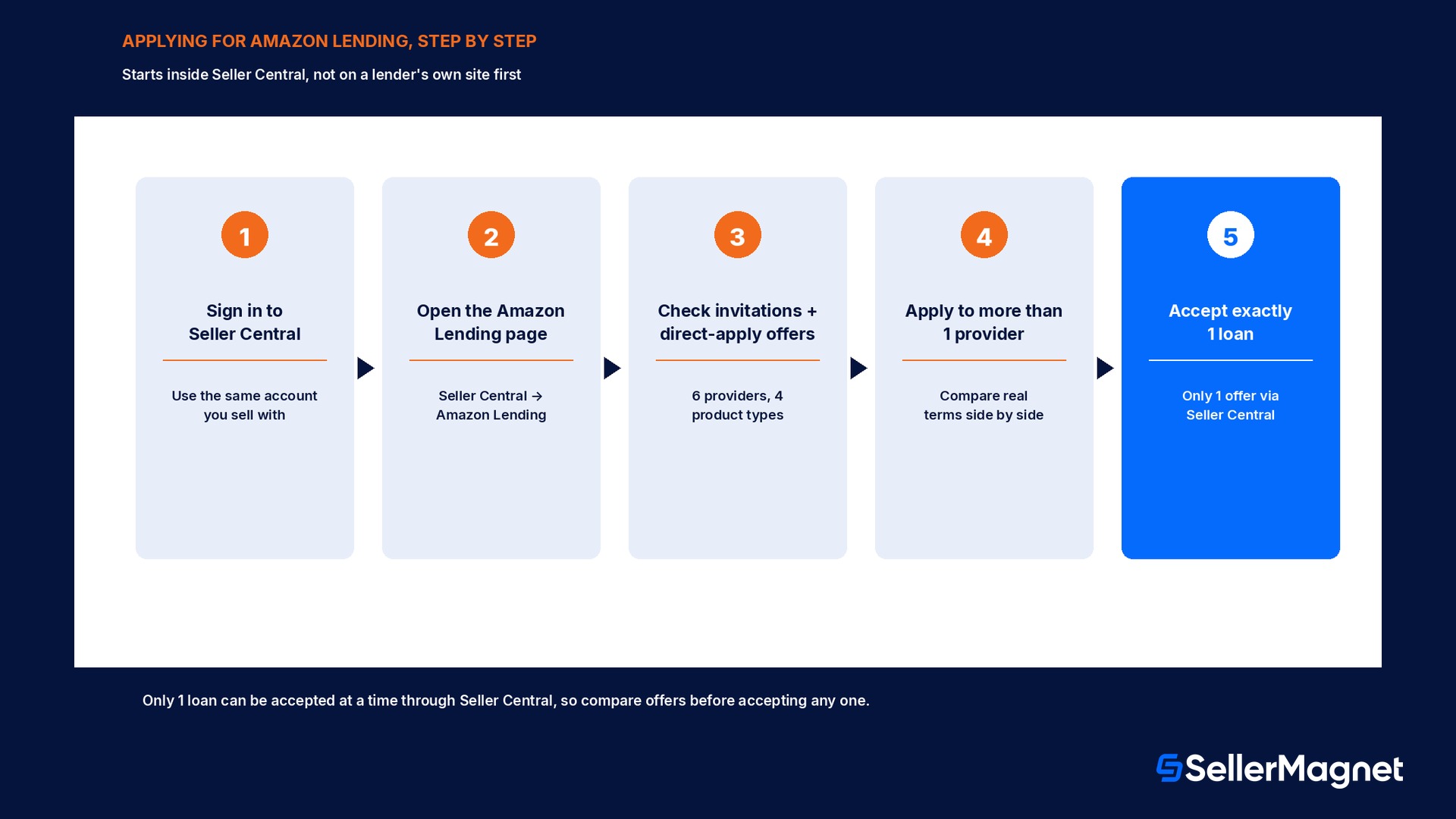
Applying starts inside Seller Central, not on a lender's own website first. Amazon's own Seller Lending program page instructs a seller to sign in to their Seller Central account and go to the Amazon Lending page to see if their business is eligible to apply for a loan; that page shows any current invitations from the six partners above, plus eligibility to apply directly for products that do not require a prior invitation. A seller should apply broadly rather than narrowly, since Amazon's help page confirms a seller can apply for as many loans as they want, comparing the fixed monthly payment of a term loan, the percentage-of-sales repayment of a merchant cash advance, and the draw-and-repay flexibility of a line of credit against their own specific cash flow need before accepting any one offer, since only one can be accepted through Seller Central at a time. A seller who needs a specific amount above $2 million, the ceiling most of the standard term loan and line-of-credit products publish, should look specifically for the SBA 7(a) loan path through iBusiness Funding, since that is the product capped at $5 million by SBA rules rather than by Amazon's own partner limits. A seller who sees no eligible offer at all should not assume their business cannot get financing; it means no Amazon-connected provider has extended one yet, and direct applications to SBA lenders, banks, or e-commerce-focused lenders outside the Seller Central flow remain a separate, parallel option.
Mistakes that cost real money on an Amazon Lending decision
Assuming Amazon is the lender. Since March 2024 Amazon does not underwrite seller loans in the US or UK; every offer comes from a named third-party provider, and the loan agreement is with that provider, not Amazon.
Comparing providers by name instead of by product type. A term loan, a merchant cash advance, and a line of credit have fundamentally different repayment structures; compare the structure that fits the actual cash flow need, not just which provider's name is more familiar.
Accepting the first offer without comparing a second. A seller can apply to multiple providers and compare real terms before accepting; Amazon's own help page confirms only one loan can be accepted at a time, so the comparison has to happen before that single acceptance, not after.
Treating the $5 million figure as available to every seller. That ceiling applies specifically to the SBA 7(a) loan (set by SBA rules) and Slope's line of credit; QuickBooks Capital and the standard term loan products publish far lower maximums.
Giving up after seeing no invitation. By end of 2026 Amazon says the program opens to every eligible seller without an invitation; a seller who checked months ago and saw nothing should check the Amazon Lending page again rather than assuming the answer is permanent.
Ignoring a merchant cash advance's lack of a fixed end date. Repayment tied to a percentage of sales has no fixed monthly amount and no fixed payoff date, which fits a seasonal, sales-linked cash flow need but makes it a poor fit for a seller who needs predictable budgeting.
Applying for financing before checking the real margin on the inventory it funds. A loan or advance adds a real cost on top of the purchase; run the fee calculation against the product's actual profit margin before committing to the purchase it is meant to fund.
Where SellerMagnet fits around an Amazon Lending decision
Amazon Lending, its six financing partners, and every rate or offer shown inside Seller Central are run entirely by Amazon and its outside providers; SellerMagnet has no connection to the program and cannot influence an eligibility decision or a quoted rate. What SellerMagnet's tools do is answer the question that should come before any financing decision: whether the inventory purchase a loan or advance would fund actually produces enough margin to justify its cost. Fee Calculator computes the real landed cost and Amazon fee stack for a planned purchase before a seller commits capital to it, so the margin used in a financing decision reflects Amazon's actual fees rather than a rough estimate.
After financing is in place, Profit Analytics tracks whether the resulting inventory purchase is converting into the sales and margin the financing decision assumed, which is the practical way to confirm a term loan's fixed monthly payment or a cash advance's sales-linked repayment is actually being covered by the extra inventory it funded. For sellers financing inventory specifically to defend or win the Buy Box during a seasonal push, Repricer is the tool that turns that extra stock into the sales velocity the financing plan is counting on.
Checklist before accepting an Amazon Lending offer
How to evaluate an Amazon Lending offer before accepting it
Check the Amazon Lending page in Seller Central - Sign in and go to the Amazon Lending page to see current invitations and direct-apply eligibility; by end of 2026 no invitation should be required.
Identify which product type is actually on offer - A term loan, merchant cash advance, SBA 7(a) loan, and revolving line of credit have different repayment structures; read the offer terms, not just the provider's name.
Apply to more than one provider before accepting any offer - Only one loan can be accepted through Seller Central at a time, so compare real terms side by side first.
Match the product to the actual cash flow need - A fixed, known expense fits a term loan; an ongoing or seasonal need fits a line of credit or a merchant cash advance.
Run the real cost against the purchase it funds - Use a fee calculator on the specific inventory purchase to confirm the margin covers the loan's monthly payment or the advance's sales percentage.
Accept the single best-fit offer, then track repayment against actual sales - Confirm after acceptance that sales and margin are tracking the plan the financing decision assumed.
Does Amazon itself lend the money through Amazon Lending?
No. Amazon stopped underwriting its own seller loans in the US and UK in March 2024. Every offer inside Amazon Lending today comes from a named third-party provider such as Lendistry, Parafin, QuickBooks Capital, Uncapped, iBusiness Funding, or Slope.
Can I apply for Amazon Lending without an invitation?
Amazon announced at its Accelerate 2026 conference that the invitation requirement is being removed, with Amazon Lending opening to every eligible seller by the end of 2026. Before that, most offers required an invitation visible inside Seller Central.
Can both Individual and Professional sellers apply?
Yes. Amazon's Seller Lending program FAQ confirms both account types are eligible to apply for loans through the program.
How many loans can I accept at once?
A seller can apply to as many providers as they like, but can choose to accept only one loan at a time through Seller Central's own offerings.
What is the maximum amount available through Amazon Lending?
It depends on the product. The SBA 7(a) loan is capped at $5 million by SBA rules, and Slope's revolving line of credit reaches a similar range; standard term loan products from providers like QuickBooks Capital publish far lower maximums.
How is a merchant cash advance different from a term loan?
A term loan is repaid in fixed equal monthly payments regardless of sales. A merchant cash advance, Parafin's product, is repaid as a fixed percentage of future Amazon sales with no separate interest charged, so the payment rises and falls with sales.
Stop Juggling Tools. SellerMagnet Combines Everything You Need.