Amazon FBA vs 3PL 2026: Costs, Control and When to Switch
R
RenéFreelance Amazon Editor
|
12 min read
A seller who outgrows self-fulfillment has exactly 2 real options for getting a product into a customer's hands: pay Amazon to store and ship it through Fulfillment by Amazon (FBA), or pay an outside warehouse, a third-party logistics (3PL) provider, to do the same job across every channel the seller sells on, not just Amazon. Both numbers look simple in isolation and turn out not to be: FBA's fulfillment fee already bundles pick, pack, ship, customer service and returns handling into one per-unit charge, while a 3PL quote is usually 2 or 3 separate line items (a per-order pick-and-pack fee, a storage fee, and a monthly account minimum) that only add up to a real number once a seller's own volume and unit size are plugged in. This guide works from Amazon's own published FBA fee structure and widely reported 3PL rate-card ranges to build one real monthly comparison for the same product, the same volume, and the same month, plus the control and channel trade-offs that do not show up in either invoice.
Amazon FBA bundles storage, pick, pack, shipping, customer service and returns into one per-unit fee and includes the Prime badge, but only fulfills Amazon orders and ties inventory to Amazon's Inventory Performance Index. A third-party logistics (3PL) provider charges separately for pick-and-pack, storage and a monthly minimum, has no automatic Prime badge and ships slower, but fulfills every sales channel from one inventory pool with no IPI restriction. Which one costs less depends on order volume, unit size, return rate and how many channels the inventory needs to serve.
What is a 3PL, and how does it differ from FBA?
Fulfillment by Amazon stores a seller's inventory in Amazon's own fulfillment centers and ships it exclusively to orders placed on Amazon, using Amazon's fee schedule (a referral fee on the sale plus a fulfillment fee set by size tier and price band) and Amazon's own delivery network, which is what carries the Prime badge. A third-party logistics provider is an independent warehousing and fulfillment company a seller contracts with directly; it stores inventory in its own or a partner facility and ships orders placed on any channel the seller connects to it, a seller's own website, a wholesale account, or another marketplace, from the same pool of stock. The practical split is channel reach against built-in reach: FBA's Prime badge and Amazon-native checkout do real work on conversion inside Amazon, but that same inventory sits idle for every order placed somewhere else unless it is separately routed out through Amazon's own Multi-Channel Fulfillment service; a 3PL's inventory serves every channel from day one but starts with no badge and no guaranteed 1-2 day delivery window of its own.
Where the real cost difference comes from: fee structure, badge, and inventory rules
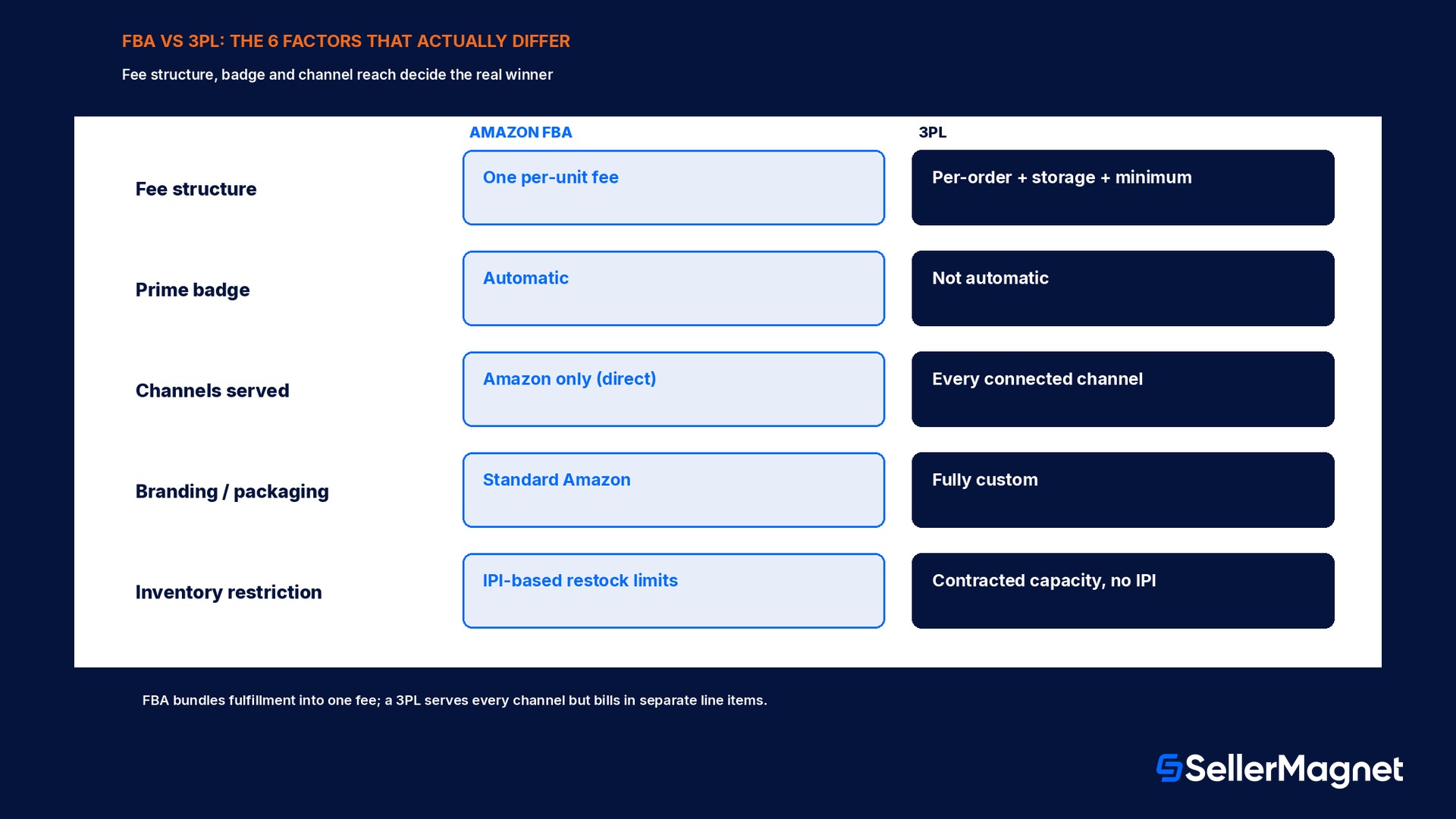
FBA's fulfillment fee is one number per unit, set by Amazon's published size-tier and price-band table, and in the US it now carries a 3.5% fuel and logistics surcharge on top of the base rate since 17 April 2026. Storage is billed separately per cubic foot per month, at a lower off-peak rate from January through September and a materially higher peak rate from October through December, and a seller whose Inventory Performance Index score falls too low faces restock limits regardless of how much cash is sitting ready to buy more stock. A 3PL's invoice is built differently: a per-order pick-and-pack fee (commonly reported in the $2.50 to $5.00 range for a simple single-item order), a separate storage charge (commonly billed per pallet per month rather than per cubic foot, translating to a lower per-unit cost at real volume for most standard-size goods), and a flat monthly account minimum, commonly in the low hundreds of dollars, that a very small seller pays regardless of order count. Neither bill mentions the 2 factors that often decide the real-world winner: the Prime badge's measurable lift on an Amazon listing's conversion rate, which is Amazon's and FBA's structural advantage, against full control over packaging, branding and customer data, which is the 3PL side's structural advantage and the reason some brands keep paying a 3PL premium even when the raw per-unit math is close.
Factor
Amazon FBA
3PL
Fee structure
One per-unit fulfillment fee (size tier + price band) plus separate storage per cubic foot
Per-order pick-and-pack fee plus separate per-pallet storage plus a monthly account minimum
Prime badge / delivery speed
Automatic Prime badge, Amazon's own 1-2 day network
No automatic badge; 2-5 days typical unless separately Seller Fulfilled Prime-qualified
Channels served from one stock pool
Amazon orders only, unless routed out via Multi-Channel Fulfillment
Every connected channel (own site, wholesale, other marketplaces) from day one
Branding and packaging
Standard Amazon packaging and inserts
Custom branded packaging and unboxing, seller's choice
Inventory restrictions
Restock limits tied to the seller's Inventory Performance Index score
Storage scaled to the seller's own contracted capacity, no IPI-style score
Returns handling
Amazon's standardized returns process
Negotiated reverse-logistics terms, often slower but more customizable
Worked example: the same 600 units a month through FBA against a 3PL
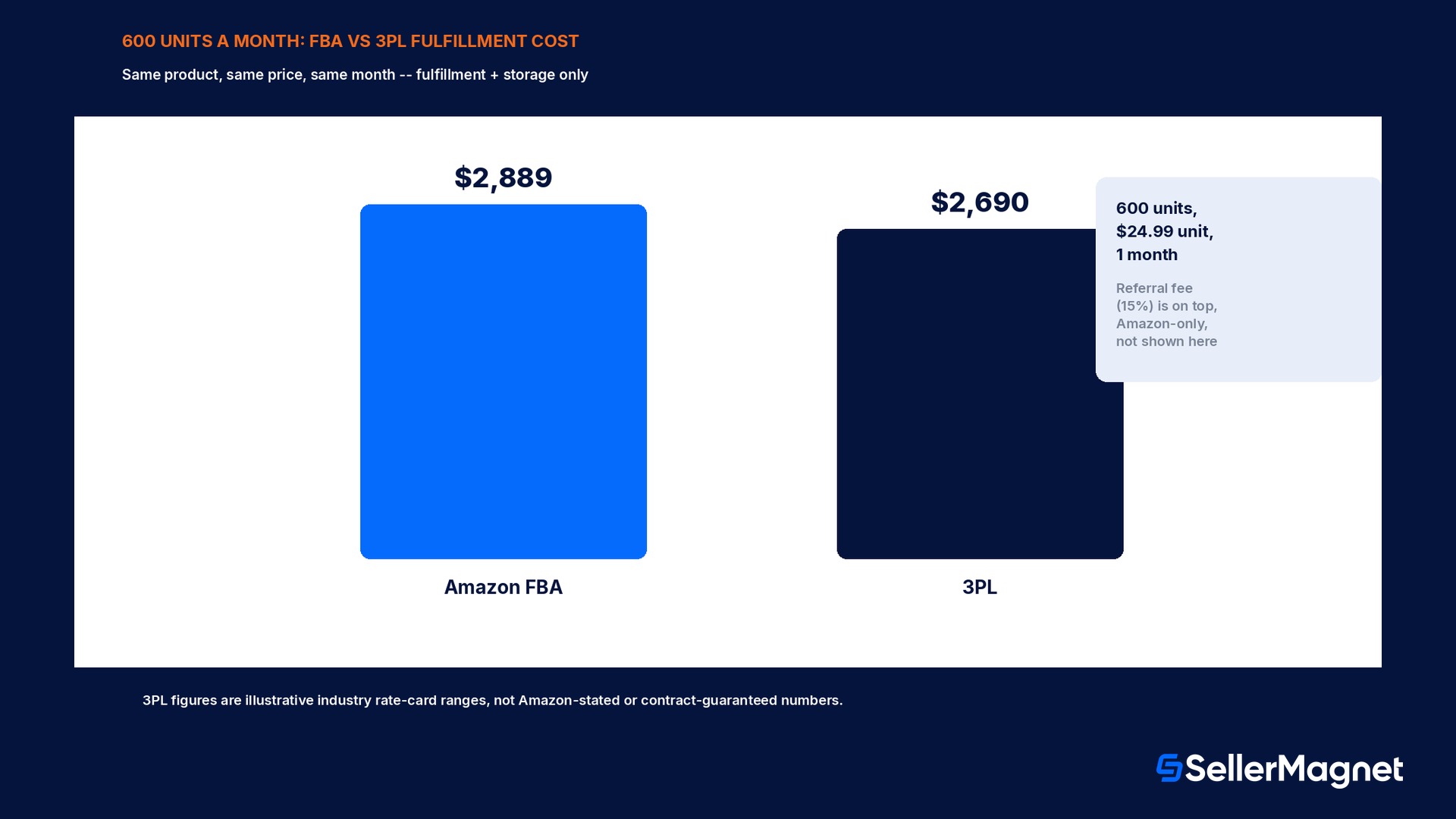
Take a seller moving 600 units a month of a single Home and Kitchen product, $24.99 retail price, a large standard-size unit of 10 x 8 x 1.5 inches (0.0694 cubic feet). Through FBA, each unit pays the US large standard-size fulfillment fee of $4.60 in the non-peak period, which becomes $4.76 once the 3.5% US fuel and logistics surcharge (in effect since 17 April 2026) is added; off-peak storage at $0.78 per cubic foot per month adds roughly $0.05 per unit for a full month in the fulfillment center. Across 600 units that is $2,889.08 in fulfillment plus storage cost for the month, before the separate referral fee Amazon takes on each sale ($3.75 per unit at the 15% Home and Kitchen rate, $2,249.10 across 600 units, charged on every model). Through a representative 3PL at illustrative, publicly reported rate-card figures, a $3.20 per-order pick-and-pack fee plus roughly $0.45 per unit per month in storage (the per-unit equivalent of a typical per-pallet rate for this size), plus a flat $500.00 monthly account minimum, totals $2,690.00 for the same 600 units and the same month, with no separate referral-style cut on the sale itself since a 3PL does not run the marketplace the product sells on.
Amazon FBA (600 units)
3PL (600 units)
Pick, pack and ship
$4.76 per unit (incl. surcharge)
$3.20 per order
Storage (1 month, off-peak)
$0.05 per unit
$0.45 per unit (per-pallet equivalent)
Monthly account minimum
None
$500.00
Fulfillment + storage total
$2,889.08
$2,690.00
Separate marketplace referral fee
$2,249.10 (15% Home & Kitchen, charged by Amazon on every sale wherever it sells)
Not applicable (3PL does not run the sales channel)
These 3PL figures are illustrative industry rate-card ranges, not Amazon-stated or contract-guaranteed numbers
Amazon's FBA fee table above is Amazon's own published 2026 rate; the 3PL pick-and-pack, per-unit storage and monthly-minimum figures used in this example are drawn from commonly reported rate-card ranges across the 3PL industry and will vary by provider, region, contract volume and negotiated terms. Request a real quote at the seller's own unit size and volume before treating any 3PL number here as a cost to plan around.
Where does the FBA vs 3PL crossover actually sit?
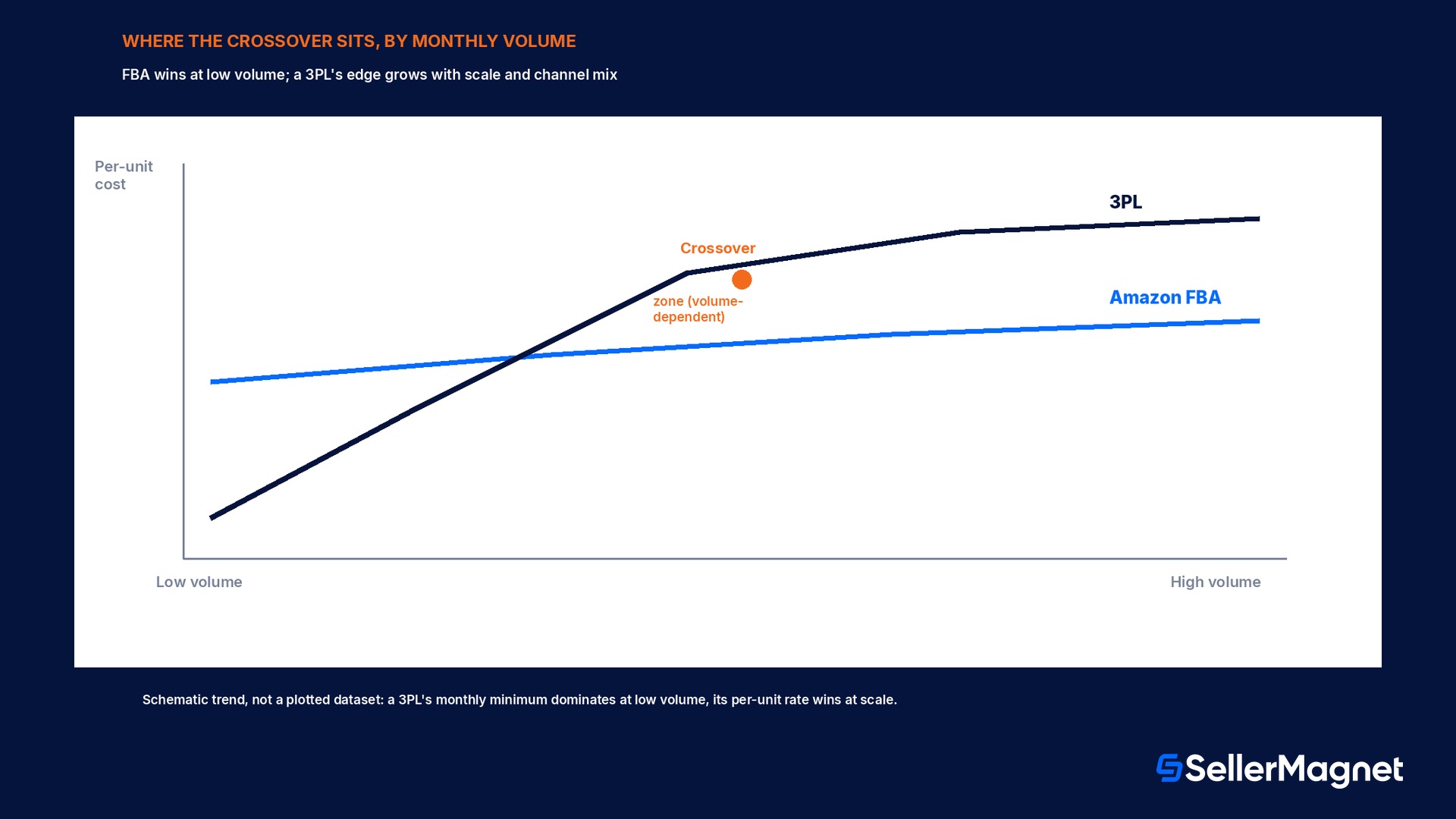
The 600-unit example above lands close to a crossover rather than a clear win for either model, and that is the point: at very low volume, a handful of orders a month, FBA's bundled per-unit fee usually beats a 3PL's flat monthly minimum outright, since the minimum alone can exceed the entire fulfillment cost of a small order count. As monthly volume climbs into the hundreds and especially the thousands of units, the 3PL's monthly minimum stops mattering relative to its lower marginal per-unit rate at scale, and the math increasingly favors the 3PL, particularly for a seller whose orders come from multiple channels rather than Amazon alone, since FBA inventory earning its Prime badge on Amazon still has to be shipped out separately (and billed separately through Multi-Channel Fulfillment) to reach any other channel. Products with a high return rate shift the math further toward whichever side offers the cheaper, faster reverse-logistics process for that specific product category, which is a negotiated term with a 3PL and a fixed, standardized process with FBA. None of this accounts for the Prime badge's own effect on an Amazon listing's conversion rate, which is real and can outweigh a small per-unit cost difference entirely for a seller whose sales are concentrated on Amazon.
How do I decide between FBA and a 3PL before switching?
How to decide between Amazon FBA and a 3PL for one product
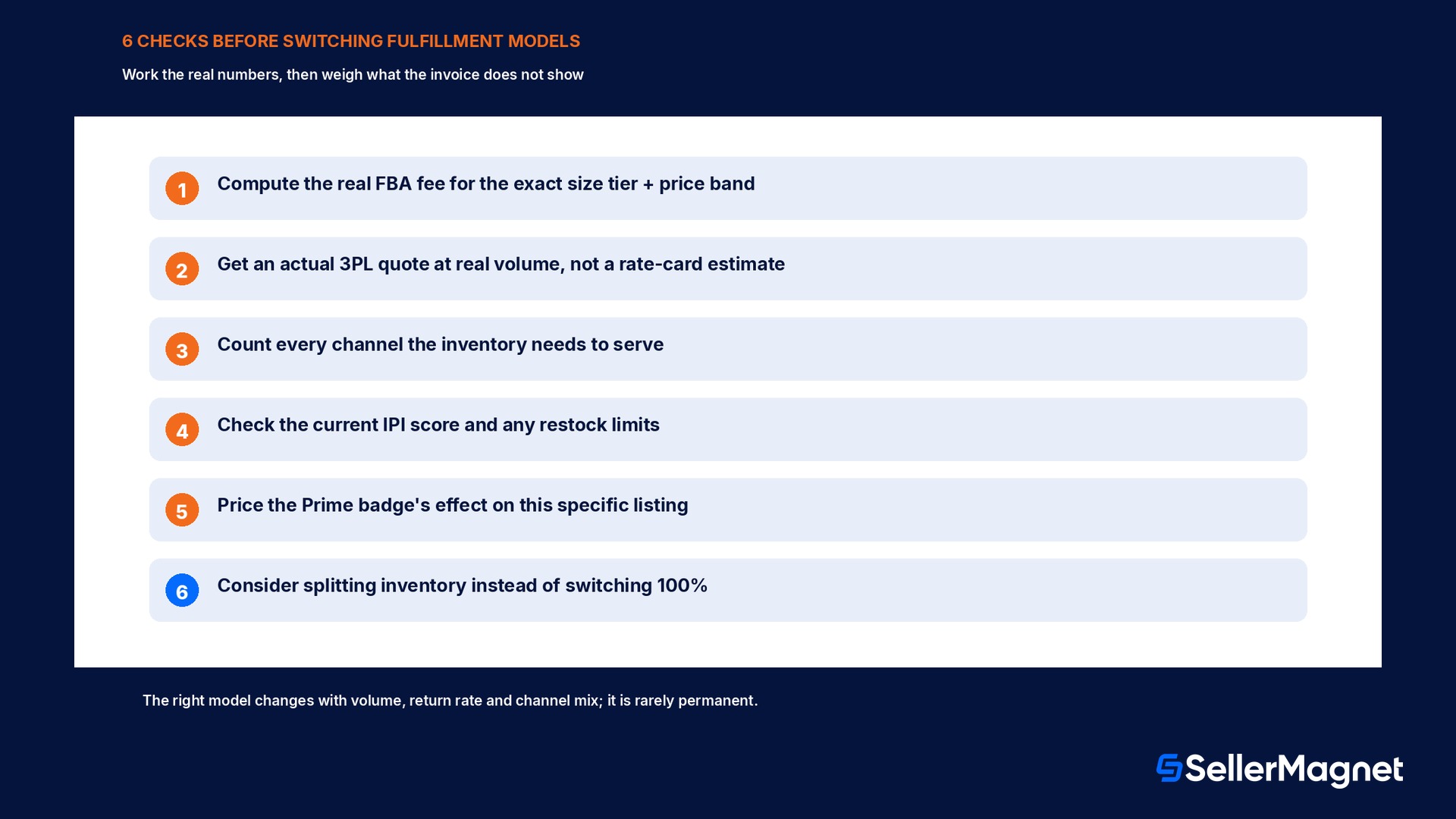
Compute the real FBA fulfillment and storage cost for the exact size tier and price band - Use Amazon's published fee table for the unit's size tier, add the current US fuel and logistics surcharge, and add off-peak or peak storage depending on the month.
Get an actual 3PL quote at the real volume, not a rate-card estimate - Ask for the pick-and-pack fee, the storage rate, and whether a monthly minimum applies below a stated order count, since published ranges vary by provider and region.
Count every channel the inventory needs to serve - FBA inventory only fills Amazon orders directly; every other channel needs Multi-Channel Fulfillment (extra fee) or a separate stock pool.
Check the current Inventory Performance Index score and any restock limits - A seller already constrained by IPI-based restock limits gains real flexibility from a 3PL's lack of an equivalent score.
Price the Prime badge's effect on the specific listing's conversion rate - A high-converting Amazon listing can lose real sales without the Prime badge; this is the hardest FBA advantage to replace with a 3PL alone.
Consider splitting inventory rather than switching entirely - Many sellers keep FBA for Amazon orders and route every other channel through a 3PL from a separate, smaller stock pool, instead of moving 100% of inventory either way.
Mistakes that make the comparison look wrong
Comparing a 3PL's per-order rate to FBA's per-unit rate without adding storage. A 3PL's pick-and-pack fee alone often looks cheaper than FBA's all-in fulfillment fee; the comparison only works once separate storage and the monthly minimum are added on both sides.
Ignoring the monthly minimum at low volume. A 3PL's flat monthly minimum can make a small seller's true per-unit cost far higher than the quoted rate-card numbers suggest; it only disappears into the rounding at real volume.
Forgetting the US fuel and logistics surcharge on the FBA side. Since 17 April 2026 the 3.5% surcharge applies on top of every published US FBA fulfillment fee rate; a comparison built from the base rate alone understates the real FBA cost.
Assuming FBA inventory automatically serves every channel. It does not; orders from a seller's own site or another marketplace need Amazon's separate Multi-Channel Fulfillment service, with its own fee, or a parallel stock pool elsewhere.
Treating the Prime badge as a fixed, ignorable variable. It is a real, measurable conversion lift specific to the Amazon listing in question, not a constant that cancels out between models.
Picking one model as permanent. Order volume, return rate and channel mix change; the right model for a product at 50 units a month is not necessarily the right one at 5,000.
Where SellerMagnet fits around a fulfillment-model decision
SellerMagnet has no connection to Amazon FBA, Multi-Channel Fulfillment, or any 3PL provider, and does not set or influence either side's fees or rates. What SellerMagnet's tools do is compute the real Amazon-side number this comparison depends on: Fee Calculator pulls the current referral fee and FBA fulfillment fee, including the US fuel and logistics surcharge, for the exact size tier and price band of a specific ASIN, so the FBA side of the comparison above is never a rough estimate.
After a decision is made, whether that is staying on FBA, moving to a 3PL, or splitting inventory between the two, Profit Analytics tracks whether the real margin matches the model the fulfillment decision assumed, across every marketplace a seller runs. For inventory that stays on FBA specifically to compete for the Buy Box, Repricer is the tool that converts that Prime-eligible stock into the sales velocity the FBA side of the decision is counting on.
Is Amazon FBA always cheaper than a 3PL?
No. At low order volume FBA's bundled per-unit fee usually beats a 3PL's flat monthly minimum, but as volume grows into the hundreds or thousands of units a month, a 3PL's lower marginal per-unit rate at scale often wins, especially for multi-channel sellers.
Does a 3PL give me the Prime badge?
Not automatically. The Prime badge is tied to Amazon's own fulfillment network (FBA, or Seller Fulfilled Prime for a seller's own warehouse that meets Amazon's delivery speed and reliability bar); a standard 3PL arrangement does not carry it.
Can I use FBA and a 3PL at the same time?
Yes, and many sellers do: FBA fulfills Amazon orders and keeps the Prime badge, while a 3PL fulfills every other channel (a seller's own site, wholesale, other marketplaces) from a separate, smaller stock pool.
What does the US fuel and logistics surcharge add to FBA fees?
A flat 3.5% on top of the published US FBA fulfillment fee rate, in effect since 17 April 2026, and (from 2 May 2026) on Buy with Prime and Multi-Channel Fulfillment orders too.
Does the Inventory Performance Index apply to 3PL storage?
No. IPI-based restock limits are specific to FBA inventory inside Amazon's own fulfillment network; a 3PL scales storage to the seller's contracted capacity instead.
Stop Juggling Tools. SellerMagnet Combines Everything You Need.