Amazon Partner Carrier Program (PCP) 2026: SPD vs LTL and Requirements
R
RenéFreelance Amazon Editor
|
15 min read
Every FBA, MCF or Amazon Warehousing and Distribution shipment has to get to an Amazon facility somehow, and most sellers either book their own carrier or let a freight broker quote the lane. The Amazon Partner Carrier program (PCP) is Amazon's own answer: a Seller Central booking flow that hands a shipment to one of more than 25 partner carriers, or to Amazon's own 60,000-plus Amazon Freight trailers and 20,000-plus intermodal containers, at pre-negotiated rates Amazon states run up to 25% lower than the alternative. The program covers two very different kinds of freight under one roof: small-parcel deliveries (SPD) for individually boxed shipments, and less-than-truckload, full-truckload and intermodal (LTL/FTL/IM) for palletized freight, each with its own size limits, its own booking step inside the Send to Amazon workflow, and its own physical requirements at the pickup address. This guide works from Amazon's own PCP program page and help center to lay out exactly which mode a shipment qualifies for, what a seller's dock and equipment actually need to look like for LTL, how the resulting charge shows up in the Payments report, and where the PCP math changes again once Amazon Warehousing and Distribution enters the picture.
The Amazon Partner Carrier program (PCP) is a Seller Central feature that books inbound shipments to FBA, Multichannel Fulfillment or Amazon Warehousing and Distribution with one of Amazon's partner carriers, or with Amazon's own Amazon Freight network, at pre-negotiated rates. It covers small-parcel deliveries (SPD, capped at 150 lb and 165 inches of length plus girth per package) and palletized less-than-truckload, full-truckload or intermodal shipments, within the 48 contiguous US states.
What is the Partner Carrier program, and who can use it?
PCP is not a carrier in its own right; it is the booking layer inside Seller Central that hands a shipment to one of Amazon's negotiated carrier partners or to Amazon's own transportation network. Amazon's program page states PCP is available to all sellers using FBA, Multichannel Fulfillment or Amazon Warehousing and Distribution (AWD) to store and distribute inventory and fulfill orders within the 48 contiguous US states; a Professional selling plan is recommended so a seller can reach the full range of services PCP sits inside (Amazon's broader set of logistics tools it calls Amazon Supply Chain Services). The carrier side of PCP is large on purpose: more than 25 partner carriers, plus 60,000-plus Amazon-owned Amazon Freight trailers and 20,000-plus intermodal containers, covering what Amazon describes as nearly every domestic lane. A seller never negotiates with any of those carriers directly; Seller Central shows a dynamic list of capacity-aware freight-ready dates with a real-time cost estimate for each option, and the seller just picks one. There is no separate signup fee or subscription to join PCP itself, since booking it is simply a step inside the Send to Amazon workflow every FBA, MCF and AWD seller already uses; what a seller pays is the per-shipment inbound transportation charge once a specific booking is confirmed, not a membership cost to access the program at all.
Who can use PCP
Detail
Fulfillment programs covered
FBA, Multichannel Fulfillment (MCF), Amazon Warehousing and Distribution (AWD)
Send to Amazon workflow (FBA/MCF) or Send to Amazon Warehousing and Distribution workflow (AWD)
Which transport mode does your shipment actually need?
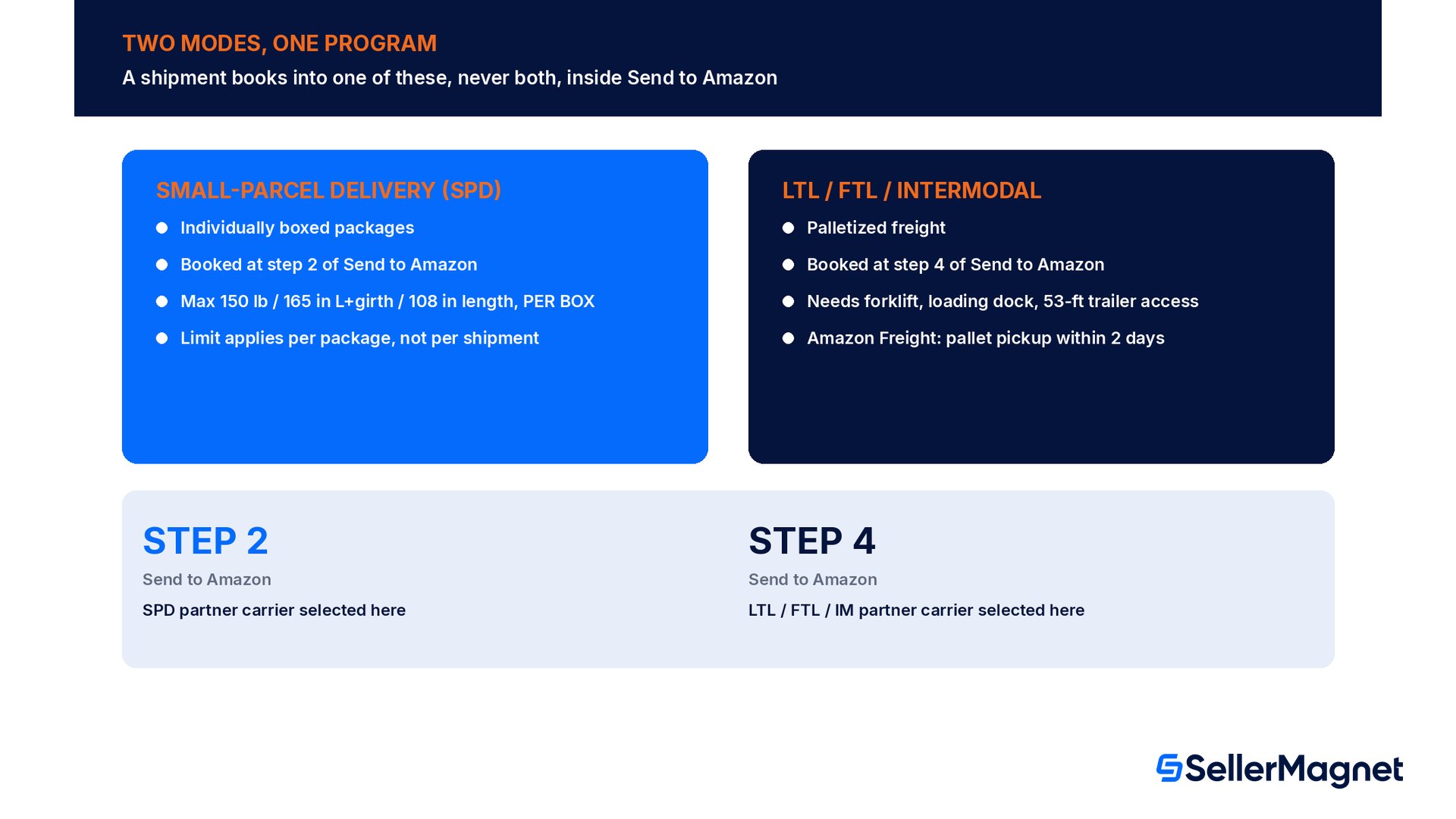
PCP covers two structurally different kinds of freight, and a shipment only ever uses one of them. Small-parcel delivery (SPD) is for individually boxed packages, booked at step 2 of the Send to Amazon workflow. Less-than-truckload, full-truckload and intermodal (LTL, FTL, IM) are for palletized freight, booked at step 4 of the same workflow (or the matching step in the Send to Amazon Warehousing and Distribution flow for AWD). Both steps show the same kind of dynamic list, a preferred partner carrier, a freight-ready date, and a real-time cost estimate, but the physical requirements and the size limits behind each mode are completely different, which is exactly where sellers misjudge which one their shipment actually qualifies for. A seller cannot mix the two inside one booking either: a shipment that includes both loose boxes and palletized cartons has to be split into a separate SPD booking for the boxed portion and a separate LTL or FTL booking for the palletized portion, each going through its own step of the workflow with its own cost estimate and its own freight-ready date.
What are the SPD per-box weight and size limits?
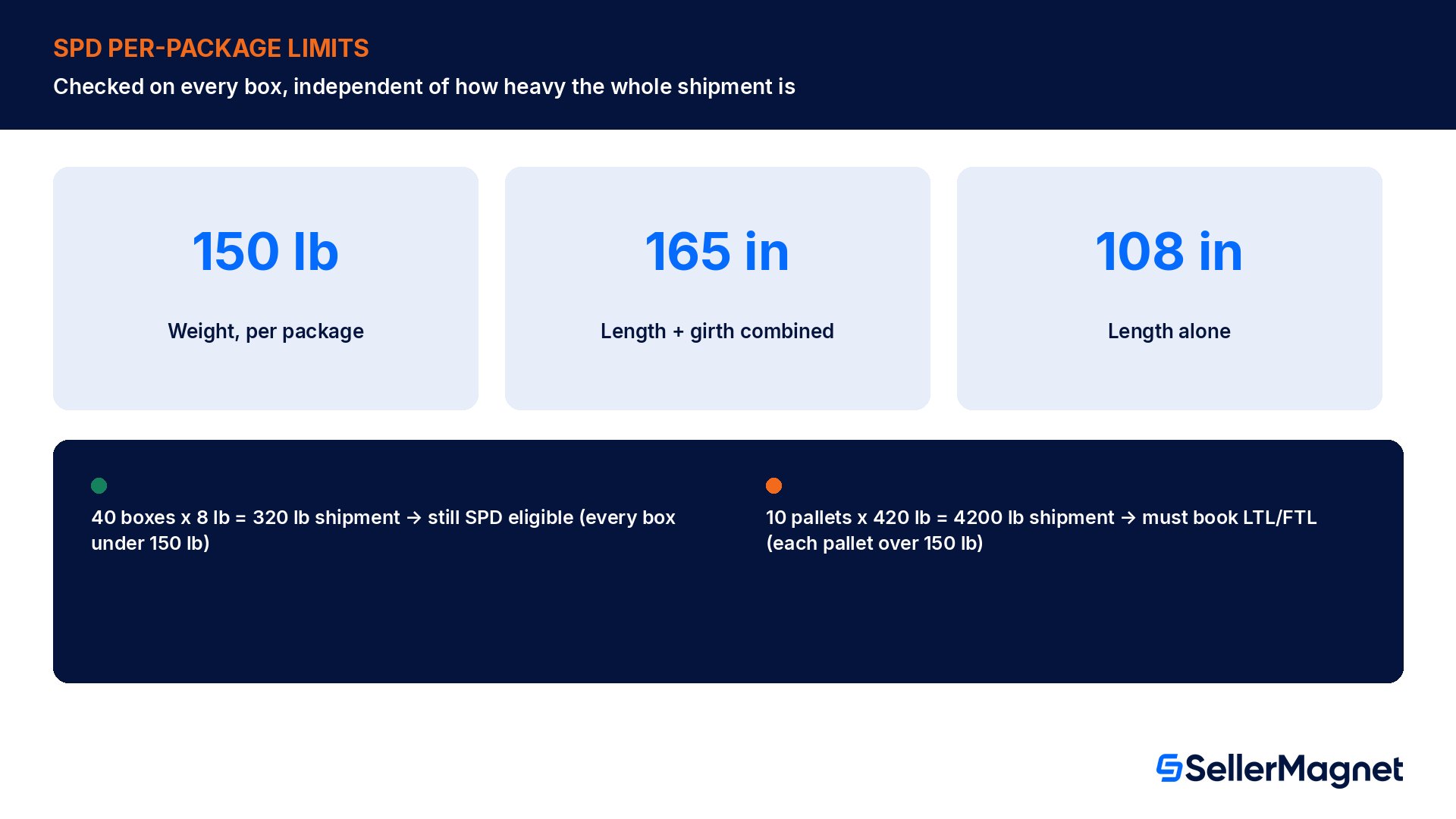
Every individual SPD package is capped at 150 lb, 165 inches of length plus girth combined, and 108 inches of length on its own, and Amazon estimates the shipping cost from the box weight and dimensions entered at booking, rounding the billable weight up. Critically, those limits apply per PACKAGE, not per shipment: a shipment made up of many boxes that each individually clear the 150 lb and size limits still qualifies for SPD no matter how heavy the shipment is in total, because Amazon bills and routes each box separately. Take a shipment of 40 boxes at 8 lb each; the shipment totals 320 lb, well past the single-package 150 lb cap, but every one of those 40 boxes is still individually eligible for SPD since none of them, on its own, exceeds 150 lb, 165 inches of length plus girth, or 108 inches of length. The charge itself is billed to the seller's disbursement account as an inbound transportation charge and appears as a service fee in the Payments report about 24 hours after the seller accepts it; shipments weighing less than 1 lb are billed Amazon's minimum fee instead of a weight-based rate.
Limit
Per-package maximum
Weight
150 lb
Length + girth combined
165 in
Length alone
108 in
Billing
Inbound transportation charge, Payments report, about 24h after acceptance
Under 1 lb
Minimum fee applies instead of a weight-based rate
What does your dock need for LTL, FTL or intermodal?
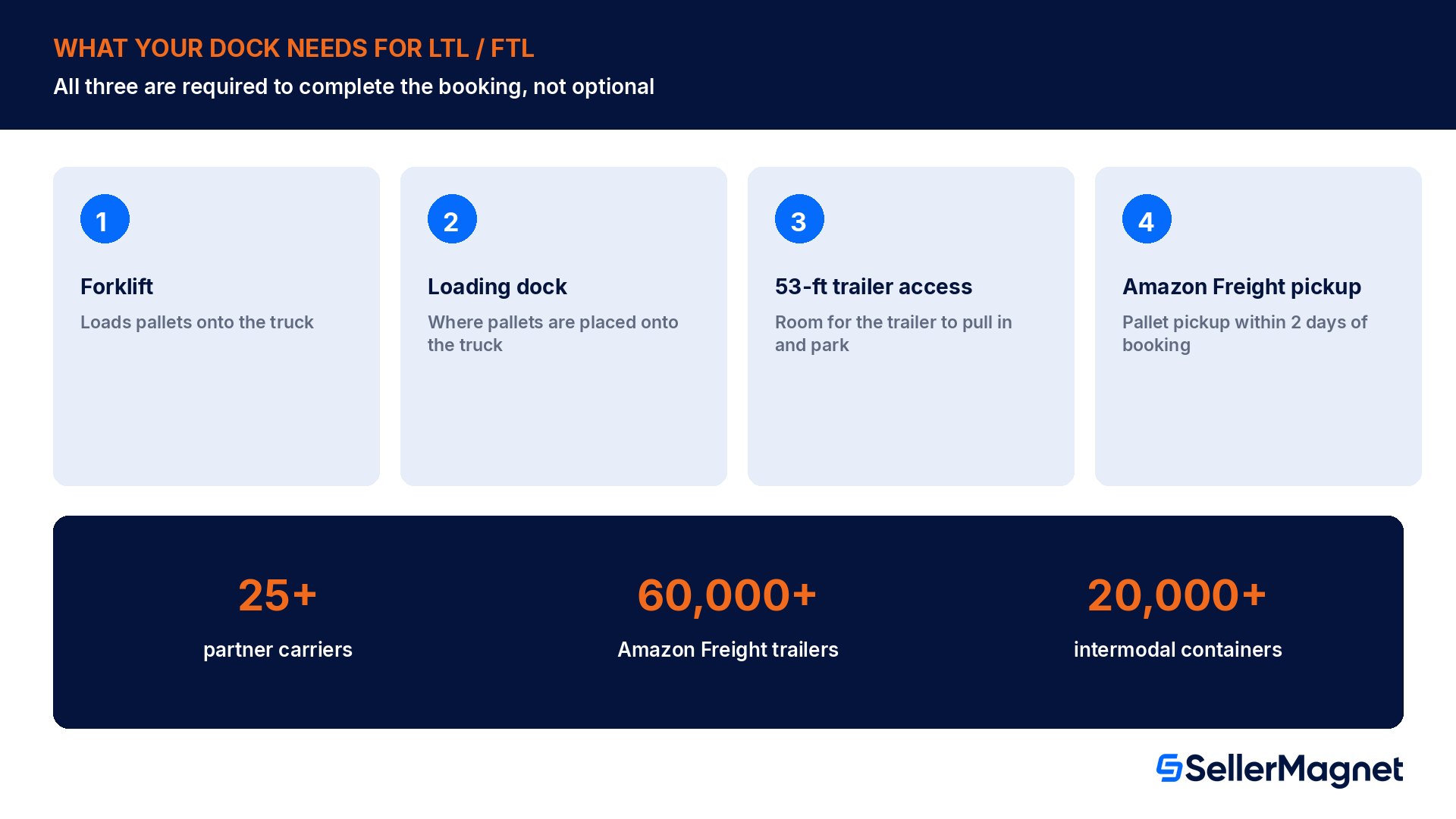
Once a shipment is palletized, or any single package would blow past the SPD limits above, it moves into the LTL/FTL/IM side of PCP. Amazon's own guidance frames the 150 lb line as the practical cutoff: once a shipment's total weight passes that mark, a partnered LTL or FTL carrier becomes the economical choice over multiple SPD packages. Qualifying for LTL or FTL booking is not just a size question, it is a physical-site question: the pickup address needs a forklift to load pallets onto the truck, a loading dock to place those pallets, and enough room for a 53-foot trailer to pull in. A seller without a dock or a forklift at the pickup address cannot complete an LTL or FTL PCP booking regardless of how the freight is packed, which is the single most common reason a palletized shipment that looks eligible on paper gets rejected at booking. Amazon Freight, the Amazon-owned fleet inside the PCP carrier network, adds one more concrete commitment on top of the standard LTL/FTL booking: pallet pickup within two days of booking. Take the 10-pallet shipment at 420 lb per pallet from the comparison above (4200 lb total): every pallet in that shipment exceeds the SPD per-package caps on its own, so the entire shipment has to book as LTL or FTL, and the seller's dock, forklift and trailer space all have to be confirmed before the booking goes through, not after. Intermodal (IM) sits alongside LTL and FTL in the same booking step and uses the same dock and trailer-access requirements; the difference is in how Amazon routes the freight behind the scenes (rail plus truck legs instead of truck the whole way), which a seller does not configure directly, it simply shows up as one more option inside the same dynamic carrier list when the lane supports it.
Requirement
Why it matters
Forklift
Loads pallets onto the truck; required for LTL/FTL booking
Loading dock
Where pallets are placed onto the truck
Room for a 53-foot trailer
The trailer has to be able to pull in and park at the pickup address
Amazon Freight pickup window
Pallet pickup within 2 days of booking, when Amazon Freight is the carrier selected
PCP and Amazon Warehousing and Distribution: where the savings stack
AWD shipments book through the separate Send to Amazon Warehousing and Distribution workflow, but PCP is the transportation layer underneath it too. Amazon's Amazon Managed Service goes a step further: it is an end-to-end service that routes AWD shipments through PCP automatically, and Amazon states that using it saves 20% on AWD storage and 10% on transportation, on top of PCP's own pre-negotiated rates. On an assumed $2400 monthly AWD storage bill and an assumed $1850 transportation bill for one shipment, that works out to $480 saved on storage (20% of $2400) and $185 saved on transportation (10% of $1850), for $665 combined on those two line items alone; a seller's real AWD bill will differ, since both percentages are Amazon's stated rates applied to the seller's own invoiced amounts, not a fixed dollar figure. The practical read for a seller already on AWD is that opting into Amazon Managed Service is a one-time setup choice that compounds a stated storage and transportation discount on top of whatever PCP mode (SPD or LTL/FTL/IM) ends up routing the physical freight. The PCP inbound transportation charge covered in this guide is also a separate line item from the Amazon FBA inbound placement service fee: the placement fee is about which fulfillment center the inventory ends up split across once it arrives, while PCP's inbound transportation charge is about how it physically gets there, and a seller can see both line items on the same shipment.
What actually happens when you book a PCP shipment?
Both modes sit inside the same Send to Amazon workflow, just at different steps: SPD is selected at step 2, and LTL, FTL or intermodal at step 4, while an AWD shipment runs through the separate Send to Amazon Warehousing and Distribution workflow instead. In every case, Seller Central shows a dynamic list rather than a static menu, meaning the partner carriers, freight-ready dates and cost estimates offered change based on the shipment's own weight, dimensions, pickup location and the carrier capacity Amazon currently has on that lane. A seller picks a preferred partner carrier (or lets Amazon select one), a freight-ready date (the date the shipment will actually be available for pickup, not the date it was packed), and the mode itself if more than one is offered. Once confirmed, the same booking produces the shipping labels, lets the seller manage payment for the charge, and generates tracking that is visible afterward in the Shipping Queue for FBA and MCF shipments, or on the Amazon Warehousing and Distribution page for AWD shipments. Nothing about this flow requires contacting a carrier directly or comparing quotes outside Seller Central; the entire negotiation already happened between Amazon and its partner carrier network before the seller ever sees a rate. How much inbound capacity a fulfillment center has left for a given lane also interacts with Amazon's FBA Capacity Manager, since a tight capacity window at the destination can affect which freight-ready dates PCP actually offers on a given booking.
Why there is no public PCP rate card to quote from
Unlike a flat referral-fee percentage or a published FBA fee table, PCP does not publish a fixed price per pound, per pallet or per lane anywhere outside a live booking. The cost estimate a seller sees at step 2 or step 4 of Send to Amazon is generated at that moment from the shipment's own weight, dimensions, pickup zip code, destination fulfillment center and the carrier capacity Amazon has available on that specific lane right then, which is also why the same shipment quoted on two different days, or sent to two different fulfillment centers, rarely comes back at an identical price. Amazon's stated up to 25% lower than the alternative claim is a comparison PCP makes against outside carrier pricing in aggregate, not a number that applies evenly to every lane or every shipment size; a seller cannot back into a specific dollar figure from that percentage alone without first knowing what the non-PCP alternative would have cost for that exact shipment. The only reliable way to see an actual number before committing to a shipment is to walk a real shipment's weight, dimensions and destination into the Send to Amazon workflow and read the real-time estimate it returns.
Scope: this program page covers the US; EU marketplaces run their own version
Everything above describes the US Partner Carrier program, scoped by Amazon's own program page to the 48 contiguous US states. Amazon separately runs a Partnered Carrier Program for sellers shipping FBA inventory into fulfillment centers across Europe, covering the same two shapes of freight, small-parcel delivery and palletized LTL/FTL, through the equivalent help pages on each EU marketplace's own Seller Central (for example amazon.de and amazon.fr). The mechanics are the same in spirit, book through Seller Central, let Amazon select or offer a partner carrier, and get billed as an inbound transportation charge, but the specific size and weight limits, dock requirements and fee calculation inputs are published separately per marketplace and should be checked on that marketplace's own help page before assuming the US numbers above apply unchanged across the Atlantic.
Mistakes that make a PCP booking fail or cost more than it should
Assuming SPD eligibility is about the shipment total, not the package. A shipment can total well over 150 lb and still qualify for SPD, as long as every individual package stays under 150 lb, 165 inches of length plus girth, and 108 inches of length.
Booking LTL or FTL without confirming a forklift, dock and 53-foot trailer access at the pickup address first. All three are required to complete the booking, not optional conveniences.
Expecting a published, fixed price list for PCP. Seller Central shows a real-time cost estimate per shipment at booking time; there is no public per-lane rate card to quote from in advance.
Treating Amazon Managed Service and standard PCP as the same thing. Amazon Managed Service is the end-to-end AWD service that routes through PCP automatically and adds its own 20% storage / 10% transportation savings; booking PCP directly for an AWD shipment does not include those two discounts by itself.
Forgetting the inbound transportation charge lands in the Payments report, not a separate invoice. It shows up as a service fee about 24 hours after the seller accepts the shipment's estimated cost.
Assuming PCP covers shipments outside the 48 contiguous US states. The US program is scoped to the 48 contiguous states; sellers shipping into other Amazon marketplaces should check that region's own Partnered Carrier program page, since eligibility and requirements are set per marketplace.
Where SellerMagnet fits: seeing the inbound cost before you book it
PCP's real-time cost estimate lives inside the Send to Amazon workflow itself, one shipment at a time, which makes it easy to book a lane without seeing how that inbound transportation charge lands against the rest of a product's margin. SellerMagnet's Fee Calculator models the referral and FBA fee side of that same per-unit margin, so an inbound transportation charge from a PCP booking can be checked against the unit economics it is actually landing on, rather than judged in isolation. SellerMagnet's Analytics Dashboard covers the other half: tracking a product's actual FBA cost trend over time (demo-mode screenshots only, never a seller's own account data) so a spike in inbound transportation charges after a carrier or mode change shows up as a trend line, not a surprise on next month's Payments report.
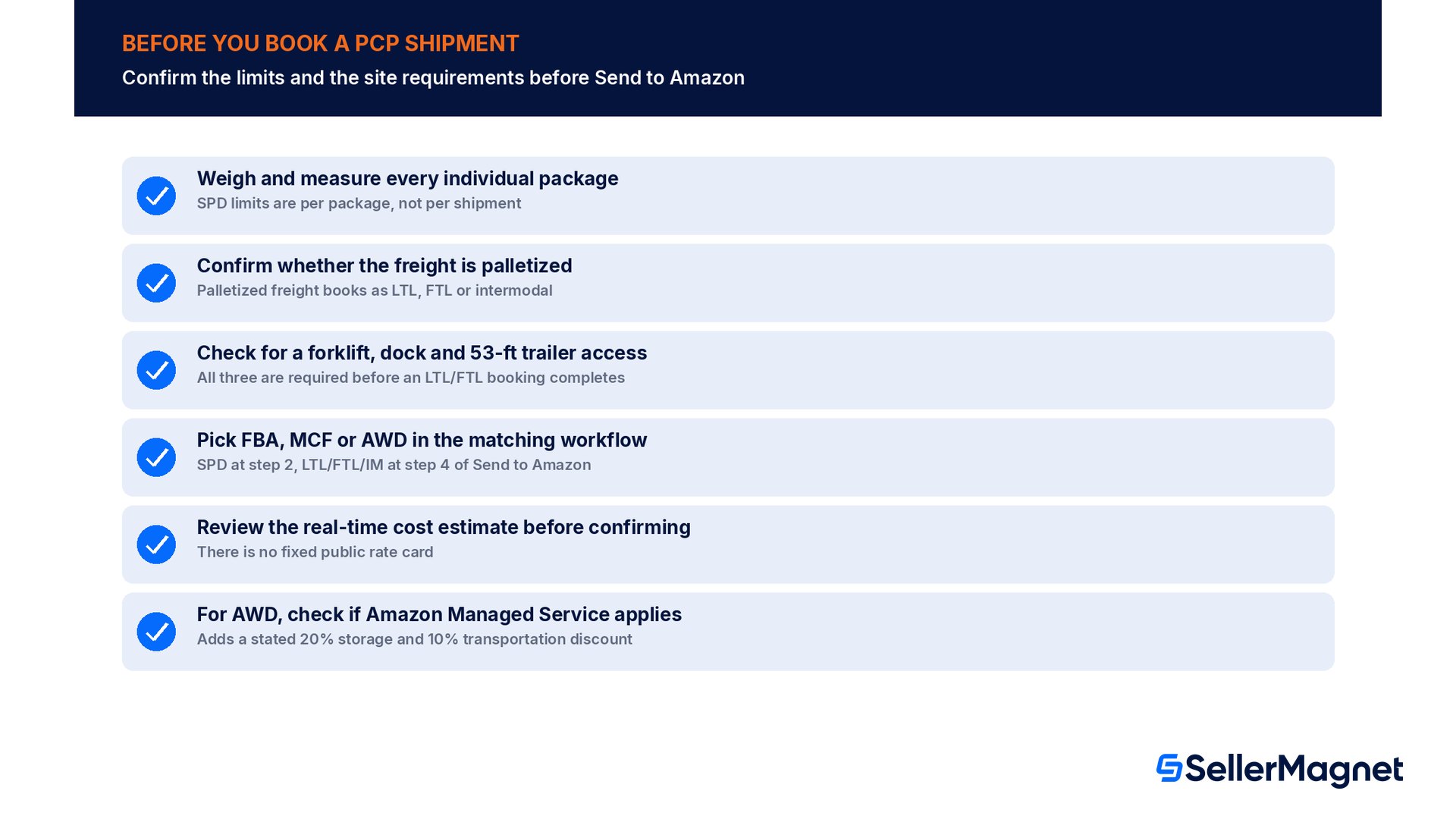
Checklist before booking a PCP shipment
How to pick the right Amazon Partner Carrier program mode
Weigh and measure every individual package - SPD eligibility is 150 lb, 165 inches of length plus girth, and 108 inches of length PER PACKAGE, not per shipment.
Confirm whether the freight is palletized - Palletized freight, or any package that exceeds the SPD limits above, books as LTL, FTL or intermodal instead.
Check for a forklift, a loading dock and 53-foot trailer access at the pickup address - All three are required before an LTL or FTL booking can complete.
Pick FBA, MCF or AWD in the matching Send to Amazon workflow - SPD books at step 2, LTL/FTL/IM at step 4 of Send to Amazon; AWD uses the separate Send to Amazon Warehousing and Distribution workflow.
Review the real-time cost estimate and freight-ready date before confirming - There is no fixed public rate card; every estimate is shipment-specific.
For AWD shipments, check whether Amazon Managed Service applies - It routes through PCP automatically and adds a stated 20% storage and 10% transportation discount on top of PCP's own rates.
Is the Amazon Partner Carrier program a carrier itself?
No. PCP is the Seller Central booking layer that connects a shipment to one of more than 25 partner carriers, or to Amazon's own Amazon Freight trailers and intermodal containers, at pre-negotiated rates.
Does the SPD weight limit apply to the whole shipment or to each box?
Per package. A shipment made of many boxes can total well over 150 lb and still qualify for SPD, as long as every individual box stays under 150 lb, 165 inches of length plus girth combined, and 108 inches of length.
What do I need at my pickup address to book LTL or FTL?
A forklift to load pallets onto the truck, a loading dock to place those pallets, and enough room for a 53-foot trailer to pull in. All three are required to complete the booking.
How fast does Amazon Freight pick up a pallet shipment?
Within two days of booking, when Amazon Freight is the partner carrier selected for an LTL shipment.
How is the PCP charge billed?
As an inbound transportation charge billed to the seller's disbursement account, appearing as a service fee in the Payments report about 24 hours after the seller accepts the estimated cost. Shipments under 1 lb are billed a minimum fee.
Is Amazon Managed Service the same as PCP?
No. Amazon Managed Service is a separate, end-to-end AWD service that routes shipments through PCP automatically and adds a stated 20% AWD storage discount and 10% transportation discount on top of PCP's own negotiated rates.
Can I use PCP outside the 48 contiguous US states?
The US Partner Carrier program is scoped to the 48 contiguous states. Sellers shipping into other Amazon marketplaces should check that marketplace's own Partnered Carrier program help page, since eligibility and requirements are set per marketplace.
Which fulfillment programs can use PCP?
Fulfillment by Amazon (FBA), Multichannel Fulfillment (MCF), and Amazon Warehousing and Distribution (AWD), each booked through its own Send to Amazon workflow.
Stop Juggling Tools. SellerMagnet Combines Everything You Need.