Amazon Inbound Placement Service Fee 2026: How to Avoid It
R
RenéFreelance Amazon Editor
|
12 min read
Amazon's inbound placement service fee is a per-unit charge on FBA shipments that you choose to send to fewer fulfillment centers than Amazon's optimized split. In 2026 it runs from $0.14 to $1.90 per standard-size unit and from $1.10 to $6.50 per bulky unit on minimal shipment splits, and it is $0 on Amazon-optimized splits. The fee is set when you create the shipping plan, posts 45 days after receipt, and is skipped entirely for inventory that enters through Amazon Warehousing and Distribution.
The Amazon inbound placement service fee is what you pay when you send an FBA shipment to one fulfillment center instead of the several Amazon proposes. For standard-size products it is between fourteen cents and one dollar ninety per unit in 2026. Choose Amazon-optimized shipment splits, or route inventory through Amazon Warehousing and Distribution, and the fee is zero.
What is the Amazon inbound placement service fee?
The inbound placement service fee is a per-unit charge for sending an FBA shipment to one location and letting Amazon redistribute it. It went live on March 1, 2024, as part of the 2024 fee changes that also cut fulfillment fees, and Amazon describes it on the inbound placement fee help page as a fee that varies by inbound location, with higher rates for shipments sent to the West than to other parts of the country.
The logic is simple. Amazon wants inventory close to the customers who will buy it, spread across regions. If you do that splitting yourself, by sending separate shipments to the fulfillment centers Amazon names, the transfer cost is yours and the fee disappears. If you send everything to one building, Amazon moves it and bills the move per unit. For a seller shipping 2,000 large standard units of 1.5 to 3 lb a month, the difference between the two choices is $680 to $1,200 every month, which is why the option deserves a real calculation rather than a default click.
Which shipment split options exist in Send to Amazon?
Three inbound placement options exist, and since February 20, 2025 standard-size products only see two of them. When you create a shipping plan, Send to Amazon shows each available option with its estimated fee, so the choice is visible before you confirm.
Option
Destinations
Fee in 2026
Available for
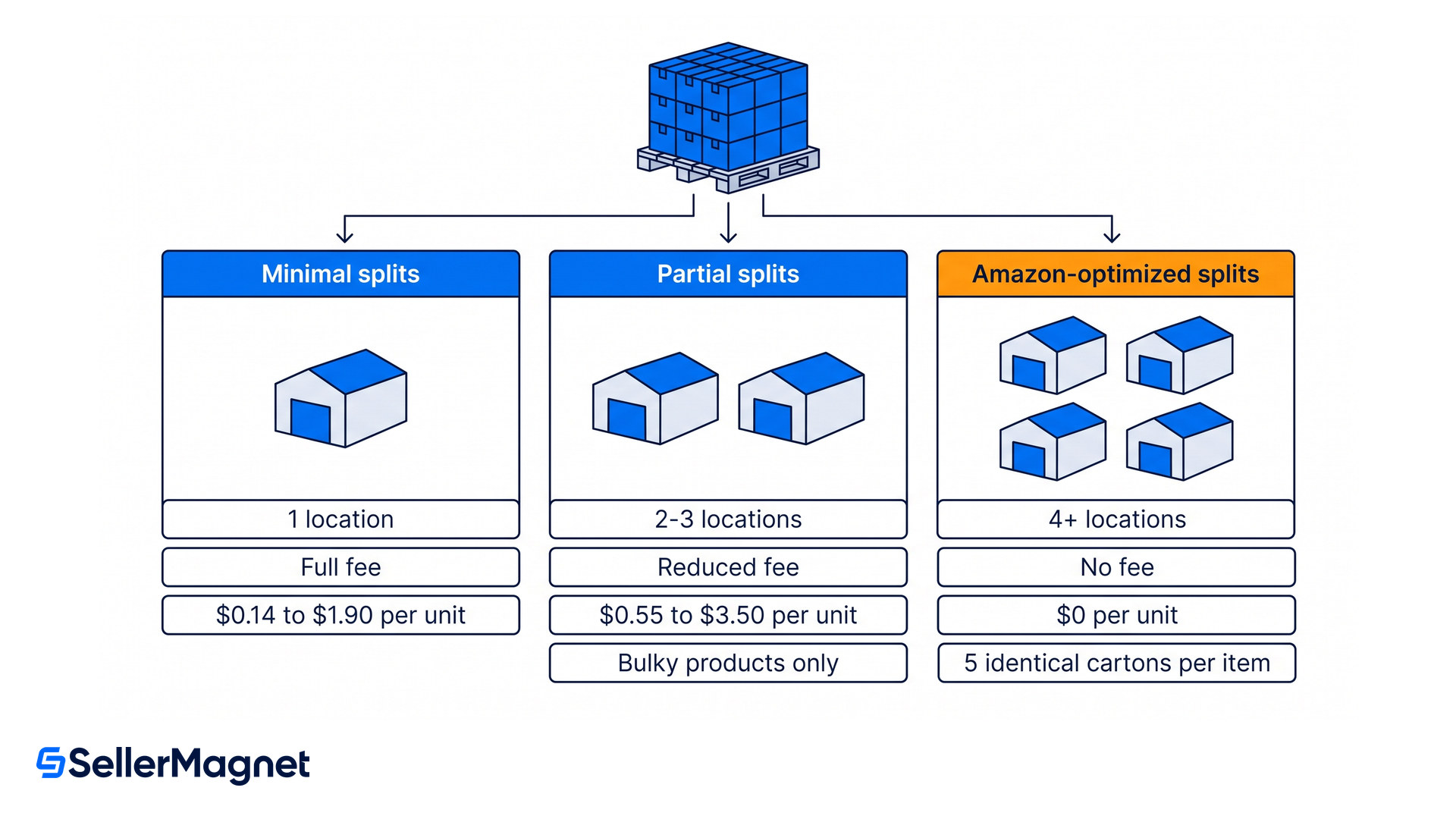
Minimal shipment splits
One inbound location, generally a single fulfillment center
Full per-unit fee: $0.14 to $1.90 standard, $1.10 to $6.50 bulky
Standard and bulky products
Partial shipment splits
Two or three inbound locations
Reduced per-unit fee: $0.55 to $3.50 bulky
Bulky products only since February 20, 2025
Amazon-optimized shipment splits
Every location Amazon proposes, generally three to five
No fee
Shipments with at least five identical cartons or pallets per item
The qualifying rule for the free option matters more than the fee table. Amazon offers Amazon-optimized splits at no fee only when the shipment includes at least five identical cartons or pallets per item, each carton holding the same quantity and the same item mix. Mixed cartons, single-carton SKUs and small replenishments therefore land on minimal splits by default, which is why AMZ Prep notes that most mixed-catalog sellers cannot reach the free option without changing how they pack.
How much is the inbound placement fee per unit in 2026?
The 2026 fee depends on three things: the size tier, the shipping weight band, and the destination region, with West-coast destinations at the top of each range. The table shows the rate card effective January 15, 2026 for minimal shipment splits (bulky tiers abridged to their lightest and heaviest bands), as published on Amazon's inbound placement fee page and compiled by Goat Consulting; Amazon-optimized splits are $0 in every row.
Size tier and shipping weight
Minimal splits
Partial splits
Amazon-optimized
Small standard, 8 oz or less
$0.14 to $0.32
not offered
$0
Small standard, 8 to 16 oz
$0.16 to $0.32
not offered
$0
Large standard, 12 oz or less
$0.20 to $0.40
not offered
$0
Large standard, 12 oz to 1.5 lb
$0.24 to $0.50
not offered
$0
Large standard, 1.5 to 3 lb
$0.34 to $0.60
not offered
$0
Large standard, 3 to 5 lb
$0.38 to $0.76
not offered
$0
Large standard, 5 to 7 lb
$0.40 to $0.98
not offered
$0
Large standard, 7 to 10 lb
$0.42 to $1.20
not offered
$0
Large standard, 10 to 15 lb
$0.44 to $1.50
not offered
$0
Large standard, 15 to 20 lb
$0.55 to $1.90
not offered
$0
Small bulky, 5 lb or less
$1.10 to $1.60
$0.55 to $1.10
$0
Small bulky, 42 to 50 lb
$4.80 to $5.95
$1.23 to $3.32
$0
Large bulky, 5 lb or less
$1.30 to $1.80
$0.55 to $1.25
$0
Large bulky, 42 to 50 lb
$5.50 to $6.50
$1.23 to $3.50
$0
Extra-large
not charged
not charged
not charged
Why the rates are ranges
Each band is published as a range because the exact per-unit fee depends on the destination region Amazon assigns to your plan: West, Central or East. The West sits at the top of every range. Send to Amazon shows the exact figure for your plan before you confirm it.
What changed on January 15, 2026?
Amazon announced its 2026 US fee changes on October 15, 2025, and most took effect on January 15, 2026. The headline in the official announcement was an average FBA fee increase of $0.08 per unit sold with no new fee types; the inbound placement fee was one of the lines that moved.
Finer weight bands. Small standard is split into two bands (up to 8 oz and 8 to 16 oz), and large standard between 3 and 20 lb is split into five bands, so heavy large-standard items pay visibly more than light ones.
A single inbound defect fee of $0.60 per unit replaced the previous set of charges for shipments that are deleted, abandoned or delivered to the wrong location, so a shipment that goes wrong now carries one per-unit penalty next to any placement fee.
No change to the free option. Amazon-optimized splits remain $0 and the five-identical-cartons rule is unchanged, which makes the 2026 increase a push toward splitting shipments yourself.
When is the fee charged and where do you see it?
The fee posts 45 days after the shipment is received, based on the quantities Amazon actually received. Amazon staff confirmed in the Seller Central forum that the charge uses the inbound location and the received quantities, not the planned ones, so units that go missing in receiving are not charged, and a shipment received on March 1 appears in your account around mid-April.
Payments dashboard: open the Transaction view tab and filter the Transaction type to Service fees; each placement charge appears with the shipment reference.
Fulfillment reports: under Reports, choose Fulfillment, then FBA inbound placement service fees in the Payments section for a per-shipment, per-unit breakdown you can reconcile with your plan.
Shipping plan: Send to Amazon shows the estimated fee per option at plan creation, which is the only moment the fee can still be changed.
Who is exempt from the inbound placement fee?
Three situations carry no fee, and two of them are strategic choices rather than exceptions. Amazon-optimized splits are the everyday route; Amazon Warehousing and Distribution is the structural one.
Amazon Warehousing and Distribution (AWD). Amazon staff stated in the AWD forum thread that inventory reaching FBA through AWD is not subject to the inbound placement fee, because Amazon manages placement into its network as an included service; shipments you send directly to FBA still pay it. You pay AWD storage and processing instead.
Amazon-optimized shipment splits. $0 on every size tier when the shipment meets the five-identical-cartons rule.
Extra-large products. Items in the extra-large size tier are not subject to the fee at all, per the 2026 rate card.
Minimal splits or Amazon-optimized: how do you decide per SKU?
Compare the total placement fee against the extra freight of splitting, per SKU and per shipment. Minimal splits mean one cheaper freight leg plus the fee; Amazon-optimized splits mean several shipments, more boxes and more carrier pickups, and no fee. SKU Compass's decision math puts the pattern plainly: for small, light SKUs the fee is small and consolidating usually wins; for heavy and bulky SKUs the fee is large and spreading usually wins.
Worked example
A seller ships 1,200 units of a large standard kitchen item weighing 1.5 to 3 lb. On minimal splits the 2026 band is $0.34 to $0.60 per unit depending on the destination region, so the fee is roughly $408 to $720 for the shipment. Amazon-optimized splits cost $0 in fees but turn one pallet into four or five smaller consignments. If the extra freight for those consignments comes to less than about $400, splitting wins; above $700, paying the fee wins; in between, the exact figure Send to Amazon shows for your plan decides. SKU Compass's own cases, computed on the earlier flat rate card, land on both sides: 1,000 small standard units saved $100 to $300 net by consolidating, while 500 large oversize (now large bulky) units lost $390 to $590 net by doing the same.
Two costs hide in that comparison. Splitting raises the number of boxes and labels, and with it the chance of the new $0.60-per-unit inbound defect fee on a shipment that goes wrong. Consolidating to one West-coast destination lands at the top of every range. Scale changes the answer too: AMZ Prep describes a single 5,000-unit shipment of heavier large standard items carrying more than $3,000 in placement fees before freight, a figure that justifies a consolidation hub or AWD rather than a per-shipment decision.
How to cut the inbound placement fee on your next shipment
Pack in identical cartons from the start - Ask your supplier or prep center for a fixed case pack per SKU, the same quantity in every carton, no mixed boxes. Five or more identical cartons per item is what unlocks the Amazon-optimized option at $0.
Read every option's fee at plan creation - In Send to Amazon, compare the estimated placement fee per option before confirming. The estimate becomes final on the inbound location and the quantities actually received.
Price the extra freight of splitting - Get carrier quotes for the split consignments and compare the difference with the total placement fee. Choose the lower number per shipment, not per habit.
Move heavy, steady sellers to AWD or a consolidation hub - For SKUs that pay placement fees every month, stage inventory in Amazon Warehousing and Distribution, which carries no placement fee on the transfer into FBA, or use a middle-mile consolidator, a freight partner that receives your single shipment and delivers it to each fulfillment center.
Reconcile the charge after 45 days - Pull the FBA inbound placement service fees report under Fulfillment reports, match the charged units to the received units, and open a case for any difference.
Quick win for today
Open the SellerMagnet profit dashboard, filter the last 90 days of Amazon fees to service fees and list the inbound placement charges by SKU. Every SKU that pays the fee on every shipment is a candidate for a fixed case pack and Amazon-optimized splits; the heaviest three are candidates for AWD. Fixing the top five usually removes most of the monthly total.
The placement fee is one of several 2026 FBA charges that depend on how you ship and stock. The holiday peak fulfillment fee raises per-unit costs from October 15 to January 14, the low-inventory-level fee punishes thin stock that tempts sellers into small, frequent shipments, and the returns processing fee charges products that come back too often. Keeping the SellerMagnet repricer floor above the sum of those fees is what protects the margin once the inventory is in the network.
Inbound placement fee FAQ
How much is the Amazon inbound placement service fee in 2026?
Look up the size tier and weight band in the table above: $0.14 to $1.90 per standard-size unit and $1.10 to $6.50 per bulky unit on minimal splits, with the exact figure for your destination region shown in Send to Amazon. Amazon-optimized splits are free.
How do I avoid the inbound placement fee?
Choose Amazon-optimized shipment splits in Send to Amazon, which requires at least five identical cartons or pallets per item, or route inventory through Amazon Warehousing and Distribution, which carries no placement fee on the transfer into FBA.
When does Amazon charge the inbound placement fee?
45 days after the shipment is received, on the quantities actually received rather than planned. Reconcile it in the FBA inbound placement service fees report under Fulfillment reports and open a case for any unit charged but not received.
Are partial shipment splits still available?
Only for bulky products. Amazon removed partial splits for standard-size products on February 20, 2025, leaving minimal splits with a fee or Amazon-optimized splits at no fee.
Does AWD inventory pay the inbound placement fee?
No. Amazon has stated that inventory placed through Amazon Warehousing and Distribution carries no inbound placement fee, because Amazon manages the placement itself. You pay AWD storage and processing fees instead, so compare those with the placement fee you would otherwise pay.
Why is my placement fee higher than another seller's for the same item?
The fee varies by destination region, with West-coast locations at the top of each weight band's range. Two sellers with the same product pay different fees if Amazon routes their minimal-split shipments to different regions.
Stop Juggling Tools. SellerMagnet Combines Everything You Need.