Amazon Low-Inventory-Level Fee: Rates and How to Avoid It
R
RenéFreelance Amazon Editor
|
10 min read
The Amazon low-inventory-level fee is a per-unit surcharge on FBA orders that applies when a product's historical days of supply is under 28 days in both the last 30 days and the last 90 days. It costs $0.32 to $1.11 per unit for standard-size items and up to about $2.09 for bulky items. Since January 15, 2026 Amazon measures it per FNSKU, so every variation is judged on its own stock.
Amazon charges the low-inventory-level fee when an FBA product has fewer than 28 days of supply over both the last 30 and the last 90 days. It adds between 32 cents and one dollar eleven per unit shipped for standard-size items, and since January 2026 it is measured per FNSKU, so each variation counts separately.
What is the Amazon low-inventory-level fee?
The low-inventory-level fee is an FBA surcharge on every unit shipped from a product that has run low on stock relative to its sales. Amazon introduced it on April 1, 2024 for the US marketplace, as the Threecolts fee guide records, and it has applied in every week since.
Amazon's reasoning is operational. Products with thin stock cannot be spread across the fulfillment network, so orders ship from further away, deliveries slow down and the cost per shipment rises. The fee passes part of that cost back to sellers who keep inventory below roughly four weeks of sales. Unlike storage fees, it is charged per unit shipped, so a fast-selling product with thin stock pays it on every order.
How does Amazon calculate historical days of supply?
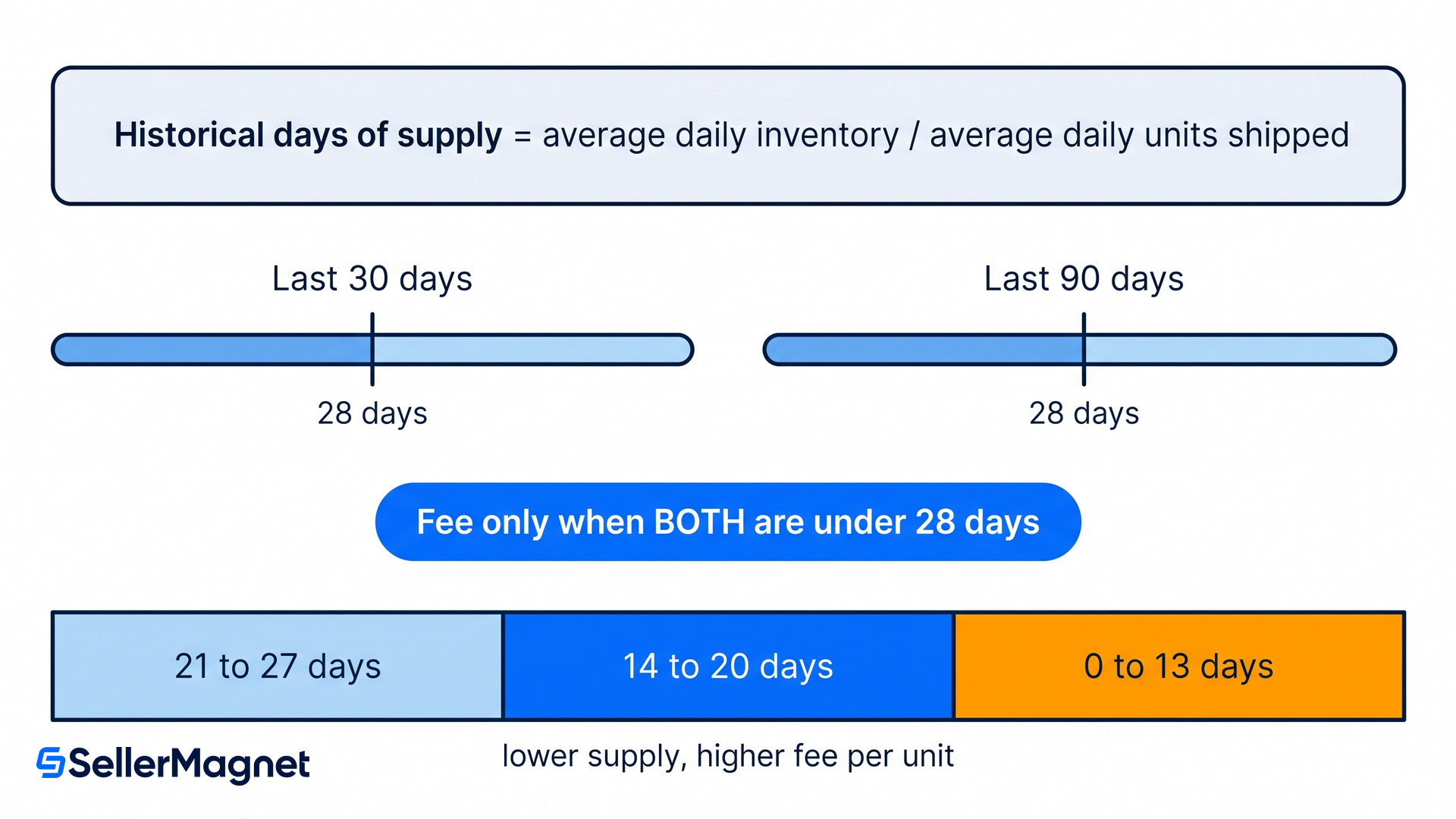
Historical days of supply equals your average daily inventory divided by your average daily units shipped. Amazon runs that formula over two windows at once, the trailing 30 days and the trailing 90 days, and the Seller Central explanation of the fee states that the fee is only assessed when both results are below 28 days.
The two-window rule is the lever most sellers miss. A product with 25 days of supply over the last 30 days but 45 days over the last 90 days pays nothing, because the long-term window is still above the threshold. The fee starts when a stock problem has lasted long enough to pull the 90-day average under 28 as well, which is why a single late shipment rarely triggers it but a quarter of chronic under-ordering always does.
How much is the low-inventory-level fee in 2026?
The rate depends on the product's size tier and on how far below 28 days the supply sits. The lower the days of supply, the higher the per-unit charge, and the fee is applied to every unit shipped in a week in which both windows are under the threshold.
Size tier
21 to 27 days ($ per unit)
14 to 20 days ($ per unit)
0 to 13 days ($ per unit)
Small standard, up to 16 oz
$0.32
$0.63
$0.89
Large standard, up to 3 lb
$0.36
$0.70
$0.97
Large standard, 3 to 20 lb
$0.47
$0.87
$1.11
Small bulky, up to 50 lb
$0.51
$1.02
$1.85
Large bulky, up to 50 lb
$0.57
$1.15
$2.09
The standard-size rates above are the 2026 figures published by PrepVia and AMZ Prep, and they match the tiers sellers quote in Amazon's own forum thread. Bulky products joined the fee in January 2026 with a top rate of about $2.09 per unit at the lowest supply band; the two bulky rows follow Goat Consulting's 2026 rate card. Amazon's own table labels the bands 0 to 14, 14 to 21 and 21 to 28 days with an exclusive upper bound, so 14 days sits in the middle band and 28 days pays nothing; the amounts are identical.
Worked example
A large standard product under 3 lb sells 40 units a day and sits at 18 days of supply in both windows. The 14 to 20 day band for that tier is $0.70, so every unit pays $0.70: $196 per week (280 units) and roughly $840 per month. Once either window is back above 28 the fee is zero, there is no partial charge. Both windows are trailing averages, though, so a restock lifts the number over days rather than overnight; expect one to two weeks after receipt for the 30-day window.
What changed on January 15, 2026?
Three things changed on January 15, 2026: the metric is now measured per FNSKU, small and large bulky products are in scope, and Grocery is exempt. The 28-day rule and the rate bands did not move, and the 2026 fee announcement confirmed that slower-moving items remain exempt.
FNSKU-level calculation. Days of supply is now measured per seller FNSKU instead of per parent ASIN. A shirt in five colors used to be judged on the combined stock; now each color stands alone, so one thin variation is charged even when the parent looks healthy.
Bulky products included. Small bulky and large bulky items, such as furniture, fitness equipment and small appliances, lost their exemption and carry rates up to about $2.09 per unit; extra-large items stay outside the fee, per AMZ Prep.
Grocery exempt. Products in the Grocery category are excluded because of shelf life and demand swings.
Also in the same update, not a change to this fee: base fulfillment fees rose. FBA fulfillment fees rose by an average of $0.08 per unit, so the low-inventory-level fee now stacks on a slightly higher base.
Variation trap
Under the FNSKU rule a parent with healthy total stock can still pay the fee on its best-selling size or color. Review days of supply per child, not per listing, and reorder the variations that sell fastest first.
Which products and sellers are exempt?
Amazon lists several exemptions, and most of them are automatic. They matter because a product that qualifies for one can sit at 10 days of supply without paying a cent, while an identical product without an exemption pays the top band.
New professional sellers for the first 365 days after their first FBA inventory is received.
New-to-FBA parent products for 180 days after first receipt, provided the seller is enrolled in FBA New Selection.
Low-volume products that sold fewer than 20 units in the trailing 7 days; Amazon's 2026 update confirms slower-moving items stay exempt, though they may see slower delivery promises.
Grocery products, exempt since January 2026.
AWD auto-replenished inventory. Products replenished through Amazon Warehousing and Distribution auto-replenishment are waived; Threecolts puts the bar at roughly 70% of replenishment through AWD, and PrepVia adds that it is measured over the trailing 90 days.
Where do you see the fee and your days of supply in Seller Central?
Two places cover it. The FBA Inventory page (Inventory, then FBA Inventory) can show a Historical days of supply column and a Low-inventory-level fee column for every SKU; add them through the column preferences. The SKU Economics report under Business Reports breaks the fee out per SKU once you enable fee data and the fulfillment base rate and surcharges view, which is the number to reconcile against your settlement.
AMZ Prep's practical tip is to check the FBA Inventory columns every Monday. Amazon assesses the fee on a weekly cycle, so a Monday review of every SKU under 35 days of supply leaves the rest of the week to create a shipment or slow down sales before the next assessment.
How do you avoid the low-inventory-level fee without overstocking?
The fee punishes thin stock. Overstocking, though, brings monthly and aged-inventory storage fees, and monthly storage roughly triples from October to December, from $0.78 to $2.40 per cubic foot for standard sizes, on top of the holiday peak fulfillment fee. The goal is a days-of-supply target just above 28 in both windows for every FNSKU that sells 20 or more units a week, and the steps below get you there.
The six-step days-of-supply routine
Pull days of supply per FNSKU every Monday - Add the historical days of supply and low-inventory-level fee columns on the FBA Inventory page, export the list and sort by days of supply ascending. Only FNSKUs that sold 20 or more units in the last 7 days matter.
Set a 35-day target, not 28 - Aim for 35 days in the 30-day window so a strong sales week cannot drop you under 28. The 90-day window follows once the 30-day window has been healthy for a few weeks.
Reorder the variations that sell fastest first - Under the FNSKU rule the best-selling size or color is the one at risk. Split purchase orders by variation velocity instead of ordering the same quantity of each.
Use the 180-day and AWD exemptions on purpose - Enroll new parent products in FBA New Selection before the first shipment, and route staple products through AWD auto-replenishment so the fee is waived while AWD handles the buffer.
Slow sales rather than run dry - If a shipment is late, pause ads and coupons on the affected FNSKU or raise the price a little. Fewer daily units shipped lifts days of supply within days and keeps the 90-day window from collapsing.
Reconcile the fee monthly - Compare the low-inventory-level fee column in the SKU Economics report with your settlement. Any FNSKU that paid the fee in two consecutive months needs a higher reorder point, not another emergency shipment.
Quick win for today
Open the SellerMagnet profit dashboard, sort your SKUs by units sold in the last 7 days and take everything at 20 units or more. Those are the only FNSKUs the fee can hit, so they get the Monday days-of-supply check first, and any of them sitting under 35 days gets a shipment created this week.
Between $0.32 and $1.11 per unit shipped for standard-size products, depending on size tier and how far below 28 days of supply the product sits. Bulky products, included since January 2026, reach about $2.09 per unit.
What are historical days of supply on Amazon?
Average daily inventory divided by average daily units shipped, calculated over the trailing 30 days and the trailing 90 days. Amazon charges the fee only when both figures are under 28 days.
Is the low-inventory-level fee charged per ASIN or per FNSKU?
Per seller FNSKU since January 15, 2026. Before that Amazon measured days of supply at the parent ASIN level, so variations shared one number.
Who is exempt from the low-inventory-level fee?
New professional sellers for 365 days, FBA New Selection products for 180 days, products with fewer than 20 units sold in the trailing 7 days, grocery products, and inventory auto-replenished through Amazon Warehousing and Distribution.
Does the low-inventory-level fee apply to bulky and oversize products?
Small bulky and large bulky products have been included since January 15, 2026, with rates up to about $2.09 per unit. Extra-large products are not part of the fee.
How do I stop paying the low-inventory-level fee?
Get either the 30-day or the 90-day days of supply above 28 for the affected FNSKU. Ship more units, slow sales by pausing ads or raising the price, or move the product to AWD auto-replenishment. The fee stops at the first weekly assessment in which one window is back above 28, usually one to two weeks after the restock lands.
Stop Juggling Tools. SellerMagnet Combines Everything You Need.