Amazon FBA Fees 2026: Every Fee in One Table (US and EU)
R
RenéFreelance Amazon Editor
|
16 min read
Amazon charges sellers through roughly a dozen separate fee lines, not one. A Professional selling plan costs $39.99 a month in the US and €39.99 a month in the EU (excl. VAT), a referral fee of 8% to 45% of the sale price applies to every unit sold, and FBA sellers add a per-unit fulfillment fee, a monthly storage fee, and up to five conditional surcharges that only trigger if a product is returned too often, shipped to one warehouse instead of several, stored too long, kept too thin on stock, or sent to Amazon without packaging that survives shipping alone. This page puts every one of those fees in one table, names the marketplace on every figure, links the primary Amazon Seller Central page it came from, and walks one real product through the full stack so the numbers add up to a checkable total.
Amazon FBA fees for 2026 fall into three groups. A monthly account fee ($39.99 US, €39.99 EU) or a $0.99/€0.99 per-item fee if you sell under the Individual plan. A referral fee on every sale, 8% to 45% of the sale price by category, $0.30/€0.30 minimum. And FBA-only fees: a per-unit fulfillment fee, monthly storage, and conditional charges for excess returns, thin stock, single-warehouse shipments and non-SIPP bulky packaging. Every figure differs between the US and EU rate cards, so check the marketplace before applying any number.
What fees does every Amazon seller pay, US and EU?
Two fees apply to every seller, FBA or not. The account fee is either a flat monthly subscription or a per-item charge, and the referral fee is a percentage of every sale. Both are set separately per marketplace, in the local currency, and the US figures do not transfer to the EU even where the wording matches.
Two things catch sellers out here. First, the account fee is per marketplace unless your accounts are merged, so an unmerged seller listing in the US and three EU countries pays the subscription fee up to four times; merging caps it at the equivalent of $39.99. Second, the digital services fee only exists in the UK, France, Italy and Spain, layered on top of the referral and FBA fees to cover local digital services taxes; it does not exist in the US or in Germany or Spain's non-DST neighbours.
Check your own category before you budget
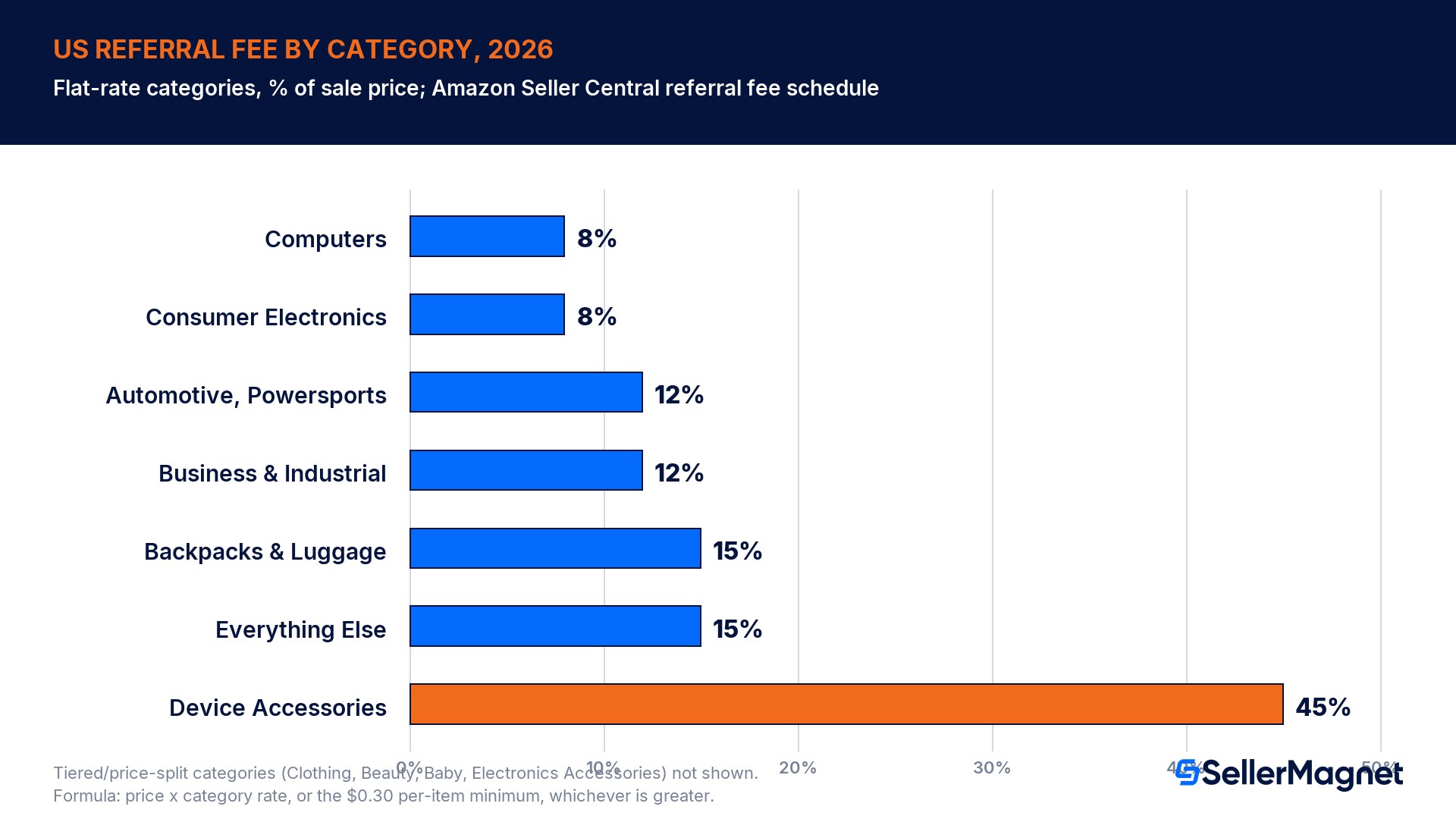
The 15% "Everything Else" rate covers most generalist catalogues, but Amazon Device Accessories sits at 45%, Computers and Consumer Electronics at 8%, and several categories use tiered or price-split rates (Clothing, for example, is 5% up to $15, 10% up to $20, then 17% above that in the US). Run your own ASIN through the free SellerMagnet Fee Calculator rather than assuming 15% across a mixed catalogue.
How much does the referral fee vary by category?
The spread between categories is the single biggest swing in this whole fee stack, wider than any FBA surcharge. A seller in Computers pays 8% while a seller in Amazon Device Accessories on the same sale price pays 45%, a 5.6x difference before any fulfillment cost is even added. All figures below are the flat-rate US categories from Amazon's own referral fee schedule, current as of this page's fetch date.
Categories with tiered or price-split rates (Clothing and Accessories, Beauty and Personal Care, Baby Products, Electronics Accessories, 3D Printers) are not on the chart because they do not reduce to one number; the formula for all of them is the same: referral fee equals the sale price (plus shipping and gift wrap) multiplied by the category rate for that price band, or the per-item minimum, whichever is greater. The minimum is $0.30 (€0.30 in the EU) for almost every category, so it only binds on very cheap items.
What does the FBA fulfillment fee cost in 2026?
The fulfillment fee replaced what Amazon used to call the "pick and pack" fee, and in 2026 it rose by about $0.08 per unit sold on average across the US catalogue, or under 0.5% of an average item's selling price, with no new fee types added. The increase is not flat: small standard items in the $10 to $50 band went up $0.25 per unit on average, large standard items in that band only $0.05, and items priced below $10 actually came out ahead because Amazon widened its low-price discount at the same time.
Size tier and weight (items priced $10 or less, US)
Non-peak fee (15 Jan to 14 Oct 2026)
Peak fee (15 Oct 2026 to 14 Jan 2027)
Small standard, 2 oz or less
$2.43
$2.62
Small standard, 14 to 16 oz
$2.95
$3.17
Large standard, 4 to 8 oz
$3.13
$3.39
Large standard, 12 to 16 oz
$3.78
$4.07
Large standard, 1 to 1.25 lb
$4.22
$4.52
Large standard, 2.25 to 2.5 lb
$5.28
$5.67
Large standard, 3 to 20 lb
$6.15 + $0.08 per 4 oz above the first 3 lb
$6.69 + $0.08 per 4 oz above the first 3 lb
These rows are the US rate card for standard-size, non-apparel items priced $10 or under, from Amazon's 2026 Low Price FBA fulfillment fee page. Items priced above $10 use a different, higher rate card on the same page; Amazon's own 2026 summary states those bands rose by $0.05 to $0.51 per unit depending on size and price, which is directional guidance, not a line-item quote, so check the Fee Preview on your own ASIN rather than reusing a number from a different price band. On top of every fulfillment fee, a 3.5% fuel and logistics-related surcharge applies in the US and Canada starting 17 April 2026; the same surcharge is 1.5% in the UK, Germany, France, Italy, Spain, Poland, Sweden, the Netherlands, Ireland and Belgium from the same date, per Amazon's FBA fulfillment fee page.
EU fulfillment fees are a separate rate card, not a currency conversion
Amazon cut average FBA parcel fulfillment fees by about €0.26 per unit in the UK, Germany, France, Italy and Spain stores effective 15 December 2025, on top of 2026 referral fee cuts for Clothing, Home Products, Pet Clothing and Food, and Grocery categories. The exact EU per-tier dollar figures are not published in the same table format as the US card, so do not estimate an EU fulfillment fee by converting the US number at a currency rate. Pull the EU figure from the Fee Preview inside your EU Seller Central account or the SellerMagnet Fee Calculator.
What do storage and aged inventory cost in 2026?
Storage is billed monthly on the cubic feet your inventory occupies, and it has two layers: a base rate everyone pays, and an aged inventory surcharge that only hits units that sit unsold too long. Both layers change by time of year, and both are US-dollar, cubic-foot figures; the EU rate card is billed in cubic meters on a different schedule, so the two are not directly comparable row by row.
US monthly storage fee (per cubic foot)
Standard-size
Oversize
January to September
$0.78
$0.56
October to December (peak)
$2.40
$1.40
Source: Monthly inventory storage fees. A storage utilization surcharge can add $0.44 to $1.88 per cubic foot on top of the standard-size base rate (or $0.23 to $1.26 for oversize) if your average daily inventory is at or above 25 cubic feet and your inventory-to-shipping ratio stays above 22 weeks for more than a year of selling history; new sellers and anyone under that threshold pay the base rate only.
Days in an Amazon fulfillment center (US)
Aged inventory surcharge, from 16 Jan 2026
181 to 210 days
$0.50 per cubic foot
211 to 240 days
$1.00 per cubic foot
241 to 270 days
$1.50 per cubic foot
271 to 300 days
$5.45 per cubic foot
301 to 330 days
$5.70 per cubic foot
331 to 365 days
$5.90 per cubic foot
366 to 455 days
$6.90 per cubic foot, or $0.30 per unit, whichever is greater
456 days or more
$7.90 per cubic foot, or $0.35 per unit, whichever is greater
Source: Aged inventory surcharge, US marketplace, assessed from a snapshot on the 15th of each month and billed between the 18th and 22nd. Clothing, shoes, bags, jewelry and watches are excluded from the cubic-foot rate below day 271. Marketplaces outside the US run their own day thresholds and rates on this surcharge; do not reuse the US 181-day start date for a UK or EU listing without checking that marketplace's own aged inventory page first.
Which FBA fees only apply in specific situations?
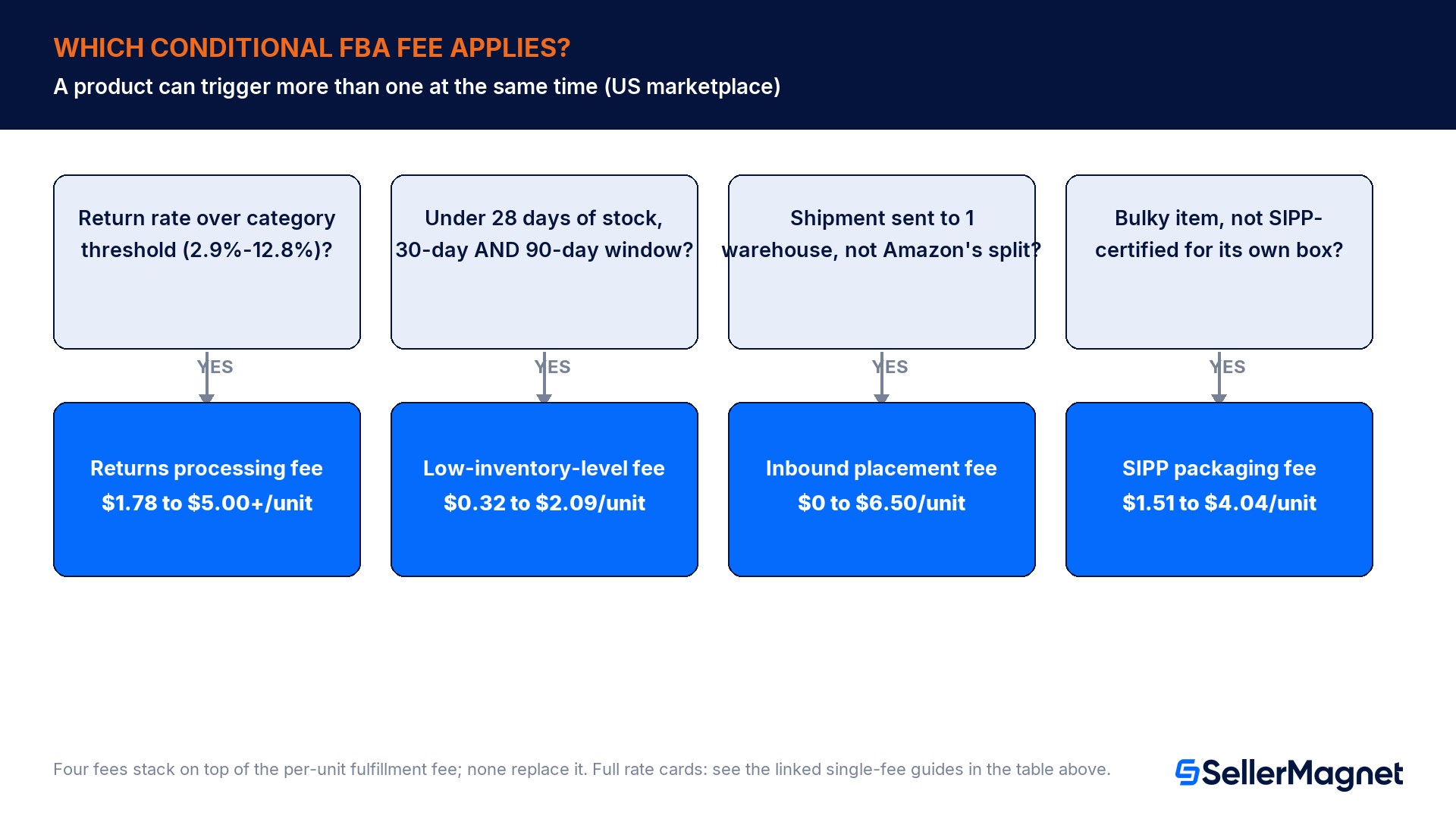
Four more fees exist, and none of them hit every seller, every unit, every time. Each one is conditional on a measurable trigger: a return rate, a stock level, a shipping choice, or a packaging certification. We cover the full rate card, thresholds and how to avoid each one in a dedicated SellerMagnet guide; this table is the summary so you can see all four side by side.
Fee
Trigger (US marketplace)
2026 rate
Full guide
Returns processing fee
Product's 3-month return rate exceeds its category threshold (2.9% to 12.8%); apparel and shoes pay on every return
$1.78 to $5.00 per excess standard-size unit; more for bulky/extra-large
Read the diagram as a checklist, not a sequence: a single product can trigger more than one of these at once. A bulky item that is not SIPP-certified, ships to one warehouse because its shipment is too small for an optimized split, and has thin stock because it is also a fast seller, picks up three of the four conditional fees on the same unit. None of the four replace the per-unit fulfillment fee; they stack on top of it.
What is a full FBA fee stack for one real product?
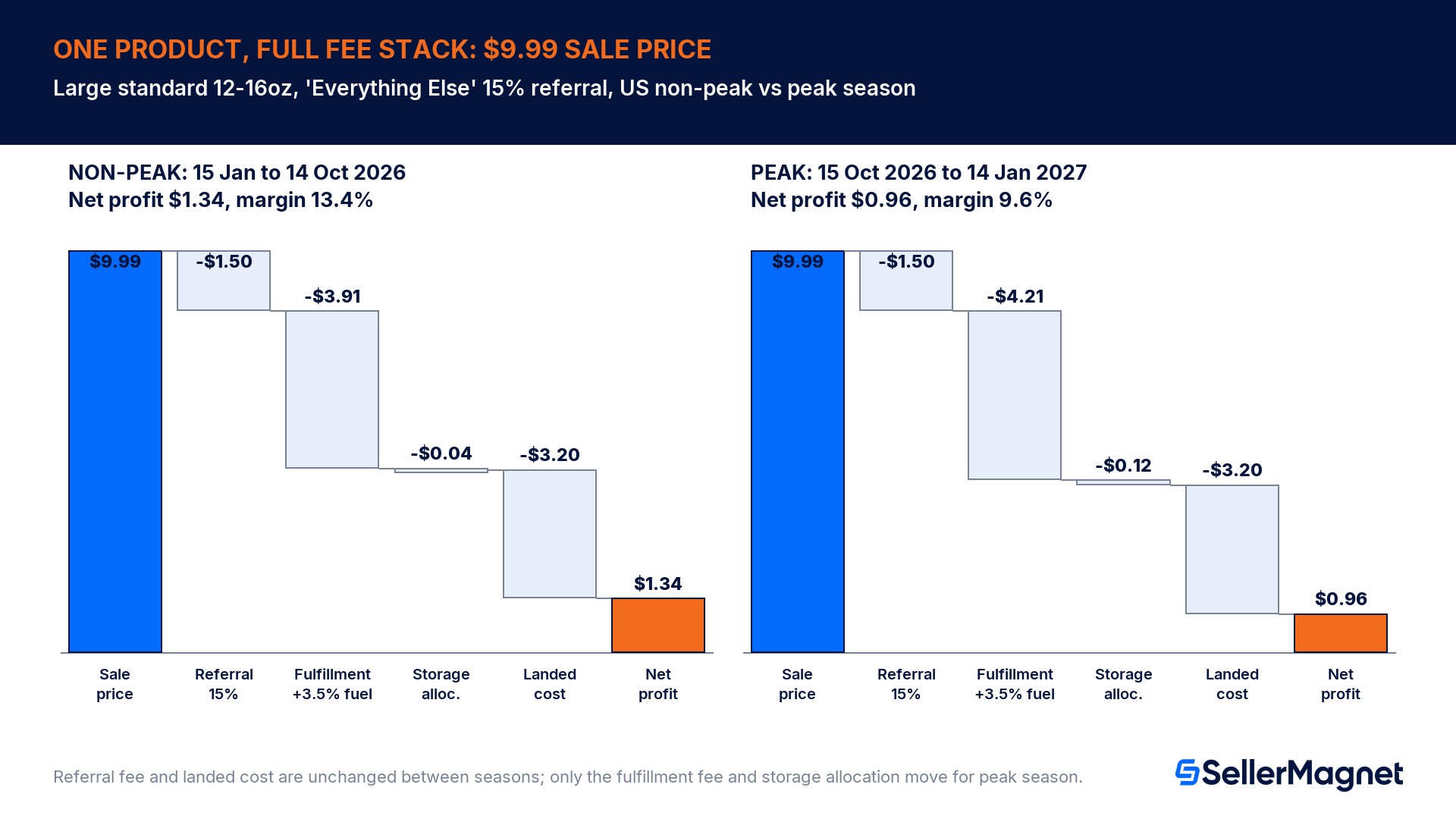
Take a $9.99 item: a large standard product, 12 to 16 oz, in the "Everything Else" referral category, non-apparel, not SIPP-enrolled, sold with no excess returns, no aged stock and no inbound-placement penalty. Every figure below is the exact rounded rate from the tables above, recalculated step by step so the total matches the sum of the parts.
Line item
Non-peak (15 Jan to 14 Oct 2026)
Peak (15 Oct 2026 to 14 Jan 2027)
Sale price
$9.99
$9.99
Referral fee (15% of $9.99)
−$1.50
−$1.50
FBA fulfillment fee, base rate
$3.78
$4.07
+ 3.5% fuel and logistics surcharge
+$0.13
+$0.14
Fulfillment fee, total
−$3.91
−$4.21
Monthly storage allocation (0.05 cu ft, ~1 month at $0.78/$2.40 per cu ft)
Work it forward to check it: $1.50 + $3.91 + $0.04 + $3.20 is $8.65, and $9.99 minus $8.65 is $1.34, matching the printed non-peak total. For peak season the storage line rises because the monthly rate jumps to $2.40 per cubic foot in October through December, and the fulfillment fee moves to its peak rate before the same 3.5% surcharge is applied on top. The landed cost and referral fee do not change between non-peak and peak; only the two FBA-specific lines do. On this product the swing from non-peak to peak is $0.38 off the margin, a 3.8-point drop on a $9.99 item, before any conditional fee (returns, low stock, placement, packaging) is even checked.
Run your own ASIN instead of this illustration. The free SellerMagnet Fee Calculator pulls Amazon's public fee schedule to show FBA vs FBM fees, referral fee, profit and ROI for any ASIN, with 5 free lookups a day and no signup. For an account-wide view, Profit Analytics shows net profit per order after Amazon fees, COGS, shipping, VAT, refunds and your own expenses, and lists every fee and adjustment from your settlements in one Transactions view, from €19/month excl. VAT (as of Oct 2026, 14-day free trial).
Common mistakes sellers make with the 2026 fee changes
Quoting the 2024 fee structure. Returns processing moved to category-specific thresholds in June 2024, low-inventory-level started in April 2024, inbound placement in March 2024, and the SIPP discount for bulky items was replaced by a fee in January 2026. A margin model built on 2024 fee logic is missing four fee lines that now apply.
Converting a US dollar figure into EUR at the exchange rate. The EU rate card is a separate schedule with its own categories, tiers and minimums, not a currency conversion of the US one. The $39.99 US subscription and the €39.99 EU subscription happen to look similar in value; the referral fee categories and fulfillment fee bands do not.
Forgetting the fuel and logistics surcharge starts partway through the year. It applies from 17 April 2026, at 3.5% in the US/Canada and 1.5% across the UK/EU marketplaces listed above. A fee model built in January 2026 and never updated understates every fulfillment fee from that date on.
Treating peak fulfillment and storage rates as the same as non-peak. Both the per-unit fulfillment fee and the monthly storage fee change for 15 October 2026 to 14 January 2027. A floor price calculated on non-peak rates sells at a lower real margin, or a loss, for the whole Q4 selling season.
Averaging return rate, low-inventory or placement status across a whole catalogue. All three conditional fees are assessed per product (low-inventory now per FNSKU variation), not per account. A healthy catalogue average can hide one or two ASINs that are quietly paying every conditional fee on the list.
Assuming the referral fee minimum always applies. The $0.30/€0.30 per-item minimum only binds on very cheap items; above roughly $2 to $4 depending on category, the percentage rate is already higher than the minimum, so it has no effect on the number.
A 2026 Amazon FBA fee checklist
Confirm your account fee: Professional plan monthly subscription, or Individual plan per-item fee, and whether merged accounts change the amount you actually pay.
Look up the exact referral fee category and rate for each ASIN rather than assuming 15%; check for a tiered or price-split structure.
Pull the current FBA fulfillment fee for the product's real size tier and weight band, separately for non-peak and peak season, with the fuel and logistics surcharge added for dates on or after 17 April 2026.
Check the product's storage utilization ratio and age in the fulfillment center; model October to December storage at the peak rate, not the base rate.
Check the product's trailing 3-month return rate against its category threshold, and its historical days of supply against the 28-day line, at least monthly.
Confirm the inbound shipment split chosen in Send to Amazon (minimal, partial or Amazon-optimized) and whether the product qualifies for the free optimized split.
Check SIPP certification status for any bulky product and the packaging fee that applies if it is not certified.
Recalculate every minimum price and profit target before 15 October and again after 14 January, when peak rates start and end.
How much are Amazon FBA fees in 2026?
There is no single number. A US seller pays a $39.99 monthly subscription (or $0.99 per item, Individual plan), a referral fee of 8% to 45% of the sale price by category, a per-unit fulfillment fee from about $2.43 upward, monthly storage from $0.56 to $2.40 per cubic foot, and conditional fees for excess returns, thin stock and single-warehouse shipments.
Are Amazon FBA fees different in the EU than in the US?
Yes, on every line. The EU subscription is €39.99/month, the referral fee schedule uses its own categories and tiers, fulfillment fees are billed in EUR/GBP on a separate rate card, storage is billed per cubic meter rather than per cubic foot, and the EU adds a digital services fee (2% UK, 3% France/Italy/Spain) that the US does not charge.
What is the Amazon referral fee for 2026?
The referral fee is a percentage of the total sale price (item plus shipping and gift wrap), ranging from 8% in Computers and Consumer Electronics to 45% in Amazon Device Accessories, with most generalist categories at 15%. A per-item minimum of $0.30 ($0.30 EU) applies if the percentage would fall below that. US referral fees were unchanged for 2026.
Did Amazon FBA fulfillment fees go up in 2026?
Yes, by about $0.08 per unit sold on average across the US catalogue, effective 15 January 2026, with no new fee types added. The increase varies: small standard items between $10 and $50 rose about $0.25 per unit, large standard items in that band about $0.05, and some items under $10 saw an effective discount instead of an increase.
What is the 3.5% Amazon fuel and logistics surcharge?
Starting 17 April 2026, Amazon applies a 3.5% surcharge on top of FBA and Multi-Channel Fulfillment fees in the US and Canada, including Remote Fulfillment with FBA into Canada, Mexico and Brazil. The equivalent surcharge in the UK, Germany, France, Italy, Spain, Poland, Sweden, the Netherlands, Ireland and Belgium is 1.5%, not 3.5%.
When do Amazon's 2026 peak season fees start and end?
Holiday peak fulfillment fees and the peak monthly storage rate both apply from 15 October 2026 through 14 January 2027, across FBA, Multi-Channel Fulfillment, Remote Fulfillment with FBA and Buy with Prime. Rates revert to non-peak levels on 15 January 2026 for the prior cycle and again on 15 January 2027 for this one.
Which Amazon FBA fees only apply to some products?
Four fees are conditional: returns processing (return rate above a category threshold), low-inventory-level (under 28 days of stock in a 30-day and 90-day window), inbound placement service (shipments sent to fewer warehouses than Amazon proposes), and the SIPP packaging fee (bulky items not certified to ship in their own packaging). A product can trigger more than one at once.
How do I calculate my real Amazon FBA profit per unit?
Start from the sale price, subtract the referral fee, the FBA fulfillment fee (with any fuel surcharge for dates after 17 April 2026), a storage allocation, and your landed cost, then check any conditional fees separately. Use the free SellerMagnet Fee Calculator for a single ASIN, or Profit Analytics for net profit per order across your whole catalogue.
Stop Juggling Tools. SellerMagnet Combines Everything You Need.