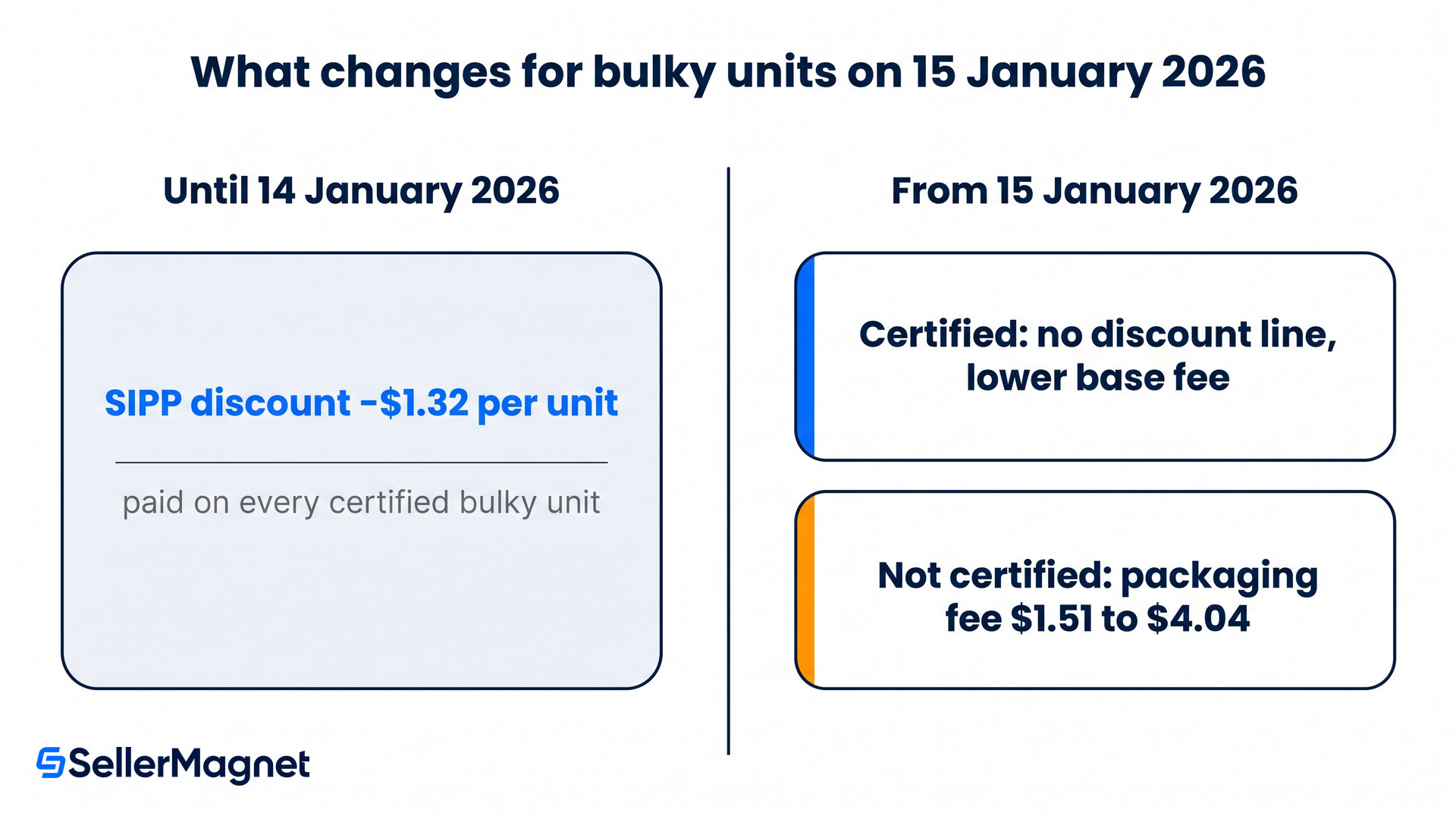
On 15 January 2026 Amazon stops paying the $1.32 per unit that nearly every Ships in Product Packaging guide still quotes as the headline saving, and starts charging a packaging fee of $1.51 to $4.04 on bulky units that are not enrolled. The programme did not get better or worse so much as it flipped: certification is no longer a discount you earn, it is a fee you avoid. Every figure below is the US rate card; SIPP also runs in Canada, the UK, Germany, France, Italy and Spain, on their own rates.
Ships in Product Packaging, or SIPP, is Amazon's certification for products that can ship in their own packaging without an Amazon box around them. From 15 January 2026, certified standard-size units get a small fulfilment fee discount, certified bulky units get a lower fulfilment fee instead of the old discount, and non-certified bulky units that need packaging pay a packaging fee of $1.51 to $4.04.
What changes on 15 January 2026?
Three things, and only one of them is good news. Amazon's SIPP fulfilment fee page sets them out together: "Effective January 15, 2026, Standard-size items will continue to receive fulfillment fee discounts for SIPP-certified products. For Small Bulky and Large Bulky items, since most products now ship in their own packaging, we'll replace the SIPP discount with a lower fulfillment fees for SIPP items. Bulky products that can't ship in their own packaging will incur a packaging fee."
The deprecation is stated in a single line that is easy to scroll past: "Note: The SIPP discount for Large Bulky ($1.32/u irrespective of size) items will be deprecated for both apparel and non-apparel, starting January 15, 2026." That is the number almost every third-party guide still leads with, including ones published for 2026.
A lower fee is not the same as a discount
Amazon's phrasing is that it will "replace the SIPP discount with a lower fulfillment fees for SIPP items". For bulky sizes the discount line disappears from your fee breakdown entirely and the base rate drops instead. That matters when you model, because the base rate drop applies to enrolled and non-enrolled units alike, while the packaging fee only lands on the non-enrolled ones.
How much is the packaging fee?
Between $1.51 and $4.04 per unit, set by dimensional weight rather than by what the item actually weighs. Amazon states the rule as: "Starting January 15, 2026, non-enrolled SIPP products requiring packaging services will incur a packaging fee. The fee will average $2.07 per unit for Small Bulky and Large Bulky products." It applies to those two size tiers only, and "This fee won't apply to SIPP-enrolled products."
Dimensional weight
Packaging fee per unit
0 to 5 lb
$1.51
5 to 10 lb
$1.68
10 to 15 lb
$1.97
15 to 20 lb
$2.60
20 to 25 lb
$2.92
25 to 30 lb
$3.47
30 to 35 lb
$3.60
35 to 40 lb
$3.78
40 to 45 lb
$3.80
45 or more lb
$4.04
The choice of dimensional weight is deliberate, and Amazon explains it: "Dimensional weight is used for calculating fees since dimension determines the packaging required for the product." A light product in a big carton is exactly the case the fee is aimed at, so a seller whose unit weight is comfortably low can still land three or four bands up.
What does Amazon's own arithmetic show?
That certification now protects you rather than pays you, and that one of the four cases Amazon chose to publish gets worse even though the seller did everything right. All four examples sit at an average selling price of $10 to $50 and compare 2025 non-peak fees with 2026 non-peak fees.
Amazon's example
2025 total
2026 total
Change
Small bulky, SIPP enrolled (vent cover filter)
$10.31
$9.57
-$0.74
Small bulky, not enrolled (baby cot)
$12.27
$12.18
-$0.09
Large bulky, SIPP enrolled (shoe storage bench)
$17.71
$18.77
+$1.06
Large bulky, not enrolled (book shelf)
$20.74
$23.08
+$2.34
Read the third row twice. The shoe storage bench is SIPP-certified in both years, and it still costs $1.06 more in 2026, because losing the $1.32 discount outweighs the $0.26 cut in the base rate. Read the second row as well: the non-enrolled baby cot ends up nine cents cheaper despite paying a $1.97 packaging fee, because its base fee fell by $2.06. Neither outcome fits the simple story that SIPP saves money and non-SIPP costs money.
One of Amazon's examples does not match Amazon's table
The baby cot is listed with a dimensional weight of 7.77 lb, which falls in the 5 to 10 lb band worth $1.68. The example charges it $1.97, which is the 10 to 15 lb rate. We could not reconcile the two from the published page, checked on 23 September 2026. The other non-enrolled example reconciles perfectly, which is what isolates the cot: the book shelf's 19.04 lb lands in the 15 to 20 lb band and is charged exactly $2.60. The same page also opens by scoping the benefit to products that "weigh 20 lb or less", then works an example on a 25 lb shoe bench. Until Amazon corrects these, budget with the higher figure and check the fee preview on your own ASINs rather than the worked examples.
What do the standard-size discounts actually pay?
Pennies, and that is not a criticism so much as a planning fact. For standard sizes the 2026 discount runs from $0.04 per unit at the bottom to $0.23 per unit at the top for non-apparel, and from $0.06 to $0.22 for apparel. A small standard item of two ounces or less earns four cents. A large standard item between three and twenty pounds earns twenty-three, which is the ceiling; small standard tops out at seven cents.
At those rates, certification pays for a standard-size catalogue through volume alone. Ten thousand units a year of a large standard product at $0.23 is $2,300, which is worth an afternoon of drop tests. The same afternoon spent on a Large Bulky product is worth far more, because there you are not chasing a discount, you are avoiding a fee of up to $4.04 a unit.
Which products cannot be enrolled at all?
Four groups. Dangerous goods, very small products, extra-large products and oversized bags. Two of them surprise people: the size floor, which rules out small flat products entirely, and the extra-large exclusion, which is why some sellers cannot find their best candidates in the portal.
Dangerous goods. Hazmat products "aren't eligible for SIPP certification" at all.
Anything under 6 x 4 x 0.375 inches. The packaging "must be no smaller than the minimum dimensions of 6 x 4 x 0.375 inches (15.2 x 10.2 x 0.95 cm), with no exceptions", because a smaller face cannot carry a shipping label.
Extra-large in the US and Canada, special oversize in Europe. These are "excluded from the Eligible products tab, as they're required to ship in product packaging, excluding them from SIPP discounts". They ship in their own box whether you certify or not, and earn nothing for it.
Poly bags above the flexible-packaging maximums. Bagged products must stay within 18 x 14 x 6 inches and 7 lb in the US and Canada, or 45.5 x 34 x 23.5 cm and 5 kg in the UK, Germany, France, Italy and Spain. Above that the product can still be certified, just not in a bag.
Do you need a paid lab test?
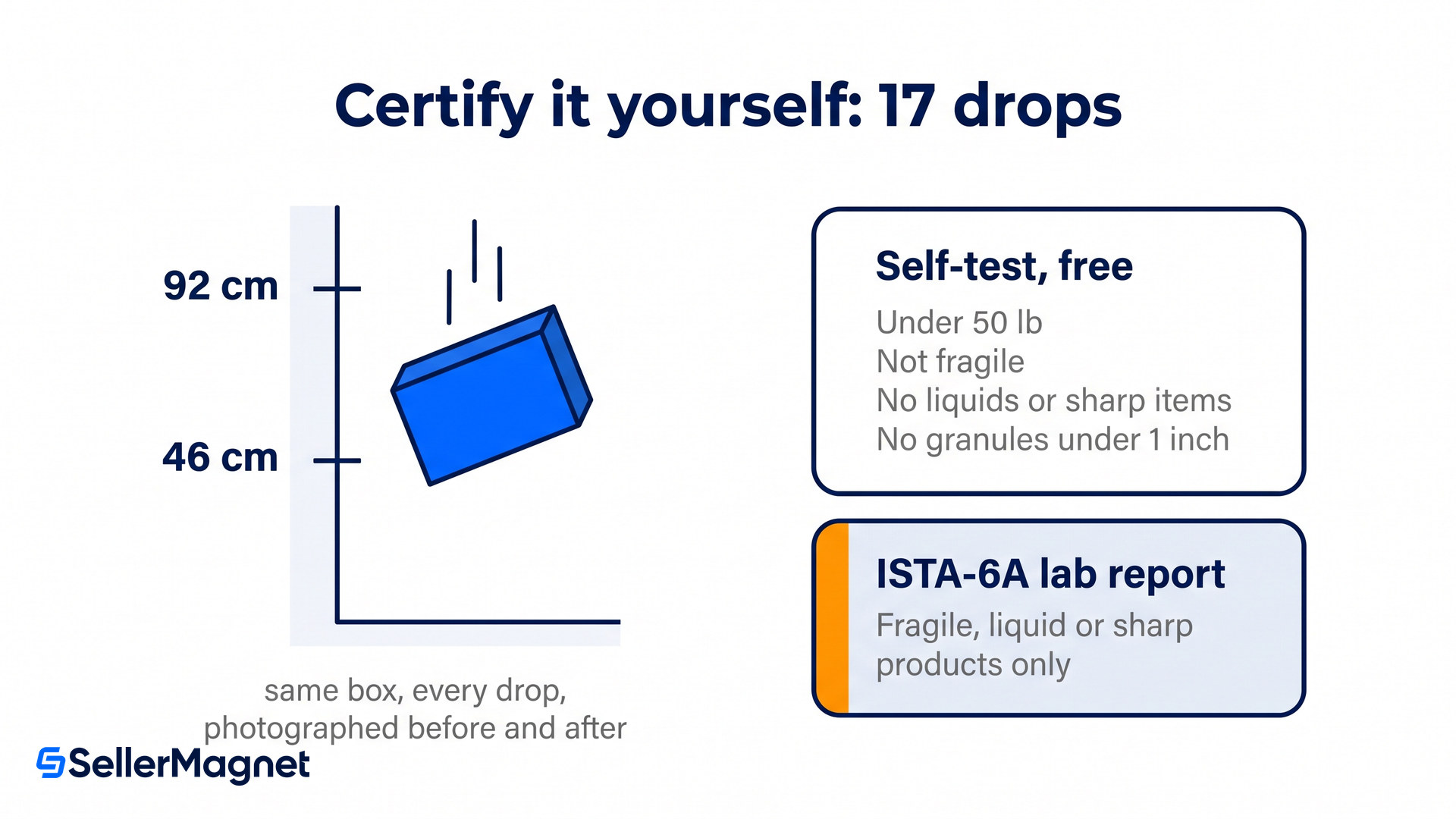
Usually not, and this is where the loudest misconception costs sellers real money. Amazon's SIPP FAQ answers it directly: "Do I have to pay for a third-party lab to certify a product as SIPP? No. You can self-test products for SIPP certification if your product meets the following criteria: Weighs less than 50 lb (22.67 kg). Not fragile. Doesn't contain liquids or sharp items. Doesn't consist of granules with a diameter less than 1 inch (2.5 cm)." Enrolment itself is free: "There are no fees to enroll in SIPP."
The self-test is a defined procedure, not a judgement call. Amazon requires packaging to "pass physical performance tests through a self-drop test or International Safe Transit Association (ISTA) 6 lab test", and the self-test is seventeen drops of a single package: you "Mark 46 cm (18 inches) and 92 cm (36 inches) on a table, leg or wall" and drop the same box onto specified faces, edges and corners in a fixed order, fifteen times from 46 cm and twice from 92 cm, with photographs before and after. Bags get one extra test, in which a 23 by 16 by 8 cm box holding a 2 kg bag of sand is dropped on them from 92 cm without puncturing the material.
A lab report becomes mandatory only when the product is fragile, sharp or liquid, and Amazon defines fragile precisely: "any item that could easily leak or break during the fulfillment process. These products include materials such as glass, ceramic, porcelain, clay, liquid, semi-liquid, and substances that liquefy at temperatures above 70 degree Fahrenheit (21 degree Celsius)." If that describes your product, you need an ISTA-6A report from a lab in Amazon's network. If it does not, you need a tape measure and a floor.
The first arrival date decides what you get paid
Enrolment asks for a date, and that date is not the day you filled the form. Amazon applies certification "to inventory received after the first arrival date you provided when enrolling the product, no earlier than the date of certification", and states flatly that "Current inventory won't receive the SIPP discount." Enter the day your SIPP-compliant units will actually land: if you enrol on 1 March and the new packaging ships on 1 April, the answer is 1 April. Backdating does not accelerate anything, and while approval is pending "Your shipments aren't SIPP-certified".
What gets a certified product thrown out?
Damage, mostly, measured statistically rather than case by case. Amazon lists four decertification triggers: 90% confidence that a product's damage rate is "0.5% worse in SIPP than with Amazon added packaging", 90% confidence that the SIPP damage rate is "more than 5%", 90% confidence that "the packaging non-compliance rate is above 5%", and a confirmed escalation that inbounded packaging is not compliant.
That first trigger is the one to plan around, because it is relative. A product that breaks at a modest rate in an Amazon box has very little headroom before shipping bare pushes it over the line. Unenrolling yourself is quick, and Amazon says it will "review your decertification request and approve within three business days", but the discount stops the moment approval lands.
How to decide SIPP before 15 January 2026
Pull your bulky ASINs first, not your bestsellers - The packaging fee only touches Small Bulky and Large Bulky, so those units are where the 2026 change is worth $1.51 to $4.04 each. Standard-size items can wait: their best case is $0.23. Sort by units shipped in the last 90 days within those two size tiers and work down the list.
Recalculate by dimensional weight - The fee band comes from dimensional weight, not unit weight, so measure the carton rather than reading the scale. A product that weighs seven pounds in a box that dimensions out at sixteen pays the 15 to 20 lb rate. This is also the cheapest thing to fix, because trimming a carton can drop you a band.
Check whether Amazon already enrolled you - Amazon certifies some products itself: a machine learning programme identifies and certifies SIPP-compliant products "with no action required from you", and those units already receive the fee benefits. Open the Ships in Product Packaging portal and read the Enrolled tab before you plan any work, because part of the job may be done.
Sort candidates into self-test and lab - Split the list in two and price only the second half. Self-testing costs a morning and some cardboard; a lab report is a quote, a lead time and a shipment of samples. Doing this before you plan anything else stops a handful of fragile SKUs from making the whole project look expensive.
Test the heaviest item in each group, once - Variations do not each need a report. If the primary product, "which is the heaviest and largest product of the product group", passes, "the secondary ASINs in that group can be certified without a test report". Group by size, weight, material, packaging and pack quantity, then test the worst case in each group.
Set the first arrival date to your next inbound - Enter the date your compliant units will reach a fulfilment centre, not today's date, and line the enrolment up with a shipment you are already sending. Existing stock earns nothing, so the sooner a compliant batch lands, the sooner the fee stops applying to the units you sell.
The one number worth calculating this week
Take your Small Bulky and Large Bulky units shipped in the last 90 days, multiply by four to annualise, and multiply that by the packaging fee band each one falls into. That figure is what not enrolling will cost you in 2026, and it is the only number in this programme large enough to change a plan. Compare it against the same list with $0 in the fee column, which is what enrolment buys. A catalogue shipping five thousand bulky units a year at the $2.07 average is looking at roughly ten thousand dollars, and the work is a stack of cartons and an afternoon.
Three things that do not change your fees
Frustration-Free Packaging is stricter than SIPP, requiring curbside recyclable material and opening "within 120 seconds", but "FFP-compliant packaging doesn't grant different fee benefits beyond those offered for SIPP". A customer choosing "Ships in Amazon Packaging" at checkout costs you nothing and you keep the discount "regardless of whether the customers choose to add Amazon packaging". And Low-Price FBA rates stack: you are "also eligible to receive lowered FBA fulfillment fees on each SIPP-certified unit shipped".
The 2026 change rewards knowing which of your SKUs are bulky, what each one dimensions out at, and how many units of each you actually ship, which is three separate facts about the same SKU, usually held in three separate places. A seller analytics dashboard that holds fees and units per ASIN turns the list above into a sorted spreadsheet, and our guide to the Amazon returns processing fee covers the other 2026 fee that lands on the same units.
Is the $1.32 SIPP discount really gone?
For bulky sizes, yes. Amazon states that the Large Bulky discount of $1.32 per unit "will be deprecated for both apparel and non-apparel, starting January 15, 2026", and replaces it with a lower base fulfilment fee. Standard-size discounts continue at $0.04 to $0.23.
Who pays the new packaging fee?
Small Bulky and Large Bulky units that are not enrolled in SIPP and need packaging services. The fee runs from $1.51 to $4.04 by dimensional weight and averages $2.07. Enrolled units do not pay it, and neither do standard-size units.
Do I need an ISTA-6 lab test for SIPP?
Only if the product is 50 lb or heavier, fragile, contains liquids or sharp items, or consists of granules under one inch. Otherwise Amazon accepts a free self-test of seventeen drops with before and after photographs.
Does SIPP apply outside the United States?
Yes. Amazon says the programme "is available to sellers in our Canada, US, Italy, Spain, Germany, UK, and France stores". The fee figures in this article are the US ones; European rate cards differ, and special oversize items in Europe are excluded.
What is the difference between SIPP and SIOC?
None, in certification terms. Amazon answers its own question with "No. The packaging certification standards for SIPP are the same as SIOC", and enrolled SIOC products are automatically enrolled in SIPP.
Will my existing FBA stock get the discount?
No. Certification applies only to inventory received after the first arrival date you entered. Bulky stock that is already SIPP-enrolled is the exception: Amazon moves it to the lower 2026 fee and charges no packaging fee. Bulky stock that is not enrolled gets no such protection.
Stop Juggling Tools. SellerMagnet Combines Everything You Need.