Amazon's returns processing fee is a per-unit charge on FBA returns that applies once a product's return rate over a three-month window exceeds its category threshold. Thresholds run from 2.9% for Grocery to 12.8% for luggage, and only the returns above the line are charged, at $1.78 to $5.00 per unit for standard sizes on the rate card in force since January 15, 2026. Apparel and shoes pay on every return, with no threshold.
Amazon charges a returns processing fee on FBA products whose return rate, measured over three months, is above the threshold for their category. Only the returns above that threshold are charged, between roughly one dollar seventy-eight and five dollars per unit for standard-size items. Apparel and shoes are charged on every return regardless of rate.
What is the Amazon returns processing fee?
The returns processing fee is an FBA charge for handling customer returns on products that are returned more often than Amazon expects for their category. Amazon introduced the current model on June 1, 2024, extending a fee that previously covered only apparel, shoes, watches, jewelry, handbags, sunglasses and luggage to every category and tying it to category-specific return-rate thresholds, as the Seller Central announcement thread records.
Since January 15, 2026 the fee has its own rate card, separate from the fulfillment fee, so the amount no longer moves with the FBA fee of the product. Amazon's stated aim is to cover the operational cost of high-return products and reduce waste; in practice the design rewards fixing the causes of avoidable returns, such as sizing confusion, misleading images and weak packaging, because only the returns above the category norm are charged.
How does Amazon calculate the return rate and the fee?
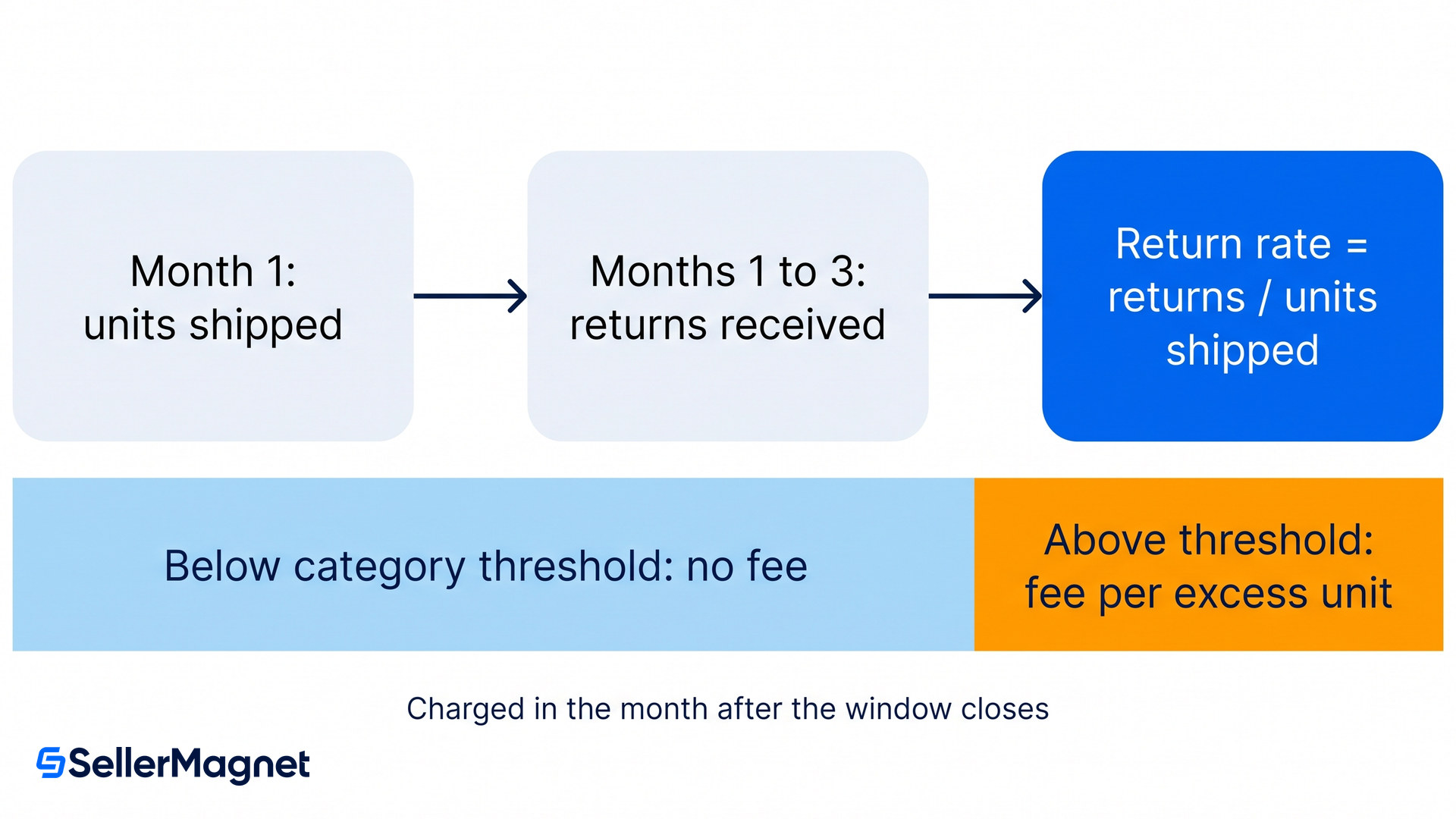
Amazon uses a fixed three-month cohort per shipment month. It counts every unit of a product shipped in month one, then counts every return of that product received in months one, two and three, and divides returns by shipments. If the result is above the category threshold, the units above the threshold are charged at the rate-card fee, and the charge posts between the 7th and the 15th of the month after the window closes, so January shipments are charged in April, per Amazon's own returns processing fee schedule.
Two details decide whether you pay. Only excess returns count: a Home and Kitchen product with 500 units shipped and 45 returns runs at 9% against an 8.1% threshold, so about 5 units are charged, not 45. And the window is per product, so one problem ASIN cannot be averaged away by the rest of the catalogue.
What are the return rate thresholds by category?
Amazon publishes one threshold per category, and the spread is wide. Categories with cheap, consumable products sit low; categories where customers expect to try and return sit high. The table shows the thresholds most sellers meet; the full list of 32 categories is on Amazon's returns processing fee page.
Category
Return rate threshold
Grocery and Gourmet
2.9%
Office Products
4.4%
Toys and Games
4.7%
Everything else
4.8%
Business, Industrial and Scientific
6.0%
Home and Kitchen
8.1%
Sports and Outdoors, Tools and Home Improvement, Tires
8.7%
Electronics Accessories
8.8%
Automotive and Powersports
9.1%
Baby Products, Mattresses
9.3%
Furniture
9.6%
Pet Products
10.2%
Consumer Electronics
11.2%
Computers
11.4%
Watches
12.0%
Backpacks, Handbags and Luggage
12.8%
Apparel and Shoes
no threshold, every return is charged
Apparel and shoes
In these two categories every returned unit pays the fee. The upside is a lower dedicated rate card that starts at $1.65 for the smallest items.
How much is the returns processing fee per unit in 2026?
The fee depends on the size tier and shipping weight of the returned unit, not on its price. The rates below are selected weight bands for non-apparel products from January 15, 2026; the full card on Amazon's fee page lists every band.
Size tier and shipping weight (selected bands)
Fee per excess returned unit
Small standard, 2 oz or less
$1.78
Small standard, 6 to 8 oz
$1.96
Small standard, 14 to 16 oz
$2.21
Large standard, 4 oz or less
$2.36
Large standard, 12 to 16 oz
$3.39
Large standard, 1.5 to 1.75 lb
$4.32
Large standard, 1.75 to 2 lb
$4.63
Large standard, over 2 lb (first 3 lb)
$5.00, plus $0.05 per additional 4 oz
Large bulky
from $6.74, rising by weight to over $26 at the top band
Extra-large
up to $157.35, by weight
Worked example
A Home and Kitchen seller ships 500 units of a 7 oz item in January and receives 45 returns by the end of March, a 9% rate against the 8.1% threshold. The excess is 0.9% of 500, about 5 units, charged at $1.96 each: roughly $9.80, posted in April once the window has closed. A worst-case projection: 5,000 units a month running 10 points over threshold is about 500 excess units, roughly $980 a month or $11,760 a year.
What does a return really cost beyond the fee?
The returns processing fee is the visible part. An independent breakdown of return costs lists what else leaves your account on a refunded FBA order, and it adds up to far more than the fee for most products.
The outbound fulfillment fee is never refunded. Amazon keeps the fee it charged to ship the order, so a $4 fulfillment fee is sunk the moment the customer sends the item back.
Refund administration fee. Amazon keeps the lesser of $5.00 or 20% of the referral fee it originally charged; on a $30 item with a 15% referral fee that is $0.90.
The unit itself. A share of returns comes back unsellable; those units go to removal, liquidation or disposal, each with its own fee, and that cost breakdown prices the disposal of a 1.25 to 1.5 lb example at $2.27.
Return shipping and regrading. On FBA orders Amazon covers the customer's return label, but the seller carries the storage and regrading time before the unit is available again.
That example makes the point: a $29.99 large standard item weighing 1.25 to 1.5 lb with a 15% referral fee and $6.90 cost of goods loses about $10.52 on a return that comes back sellable, and that figure already contains the $4.01 returns processing fee for that weight band next to the $5.61 fulfillment fee and the $0.90 refund administration fee. If the unit is unsellable the loss rises to about $19.69. The fee is one slice, not the whole cost.
Who is exempt from the returns processing fee?
Two exemptions cover most small catalogues, and both are automatic. Apparel and shoes have no threshold, so every return there is charged from the first unit.
Low-volume products. A product that ships fewer than 25 units in a given month is exempt for that month, so slow sellers never pay even with a high return rate.
New-to-FBA parent ASINs. The first 20 returned units above the threshold are fee-waived, provided the returns are received within 180 days of the first inventory receipt.
Where do you see your return rate and the fee in Seller Central?
Two reports cover it. The Return Insights dashboard under FBA Returns shows each product's return rate against its threshold and is updated three times a week, which makes it the place to catch a product drifting over the line before the charge lands after the window closes. The SKU Economics report under Business Reports shows the returns processing fee actually charged per ASIN, which is the figure to reconcile with your settlement.
How do you bring a product back under its threshold?
The fee rewards fixing the product page and the packaging, not gaming the metric. The routine below takes the return reasons Amazon already gives you and turns them into listing changes, then checks the effect in the next three-month cohort.
The five-step return-rate routine
Rank products by distance to threshold - Open the Return Insights dashboard, export the return rate per ASIN and subtract the category threshold. Anything within one point of the line, or already above it, goes on this month's list.
Read the return reasons, not just the rate - Pull the FBA customer returns report for those ASINs. Sizing, not as described, and damaged in transit each point to a different fix; a spike in a single reason is a listing problem, not a customer problem.
Fix the page before touching the price - Add a size chart or dimension image, rewrite the bullets that overpromise, and lead the gallery with a photo that shows scale. Most excess returns come from an expectation the page set.
Harden the packaging - For damaged-in-transit returns, move to a stronger carton or add inner protection. One prep change removes the reason instead of paying the fee every month.
Recheck in the next cohort and prune - Return rates are measured per three-month cohort, so give a fix one full cycle. If a product stays above threshold after two cycles, price in the fee or remove the product before it also drags the parent's reviews.
Quick win for today
Open the SellerMagnet profit dashboard, sort your products by refunds over the last 90 days and take the top ten. Compare each one's return rate with its category threshold from the table above; every product over the line is paying the fee on every unit above it, so those pages get the size chart and bullet rewrite this week.
Between $1.78 and $5.00 per excess returned unit for standard-size products on the rate card in force since January 15, 2026, plus $0.05 per 4 oz above 3 lb; bulky items run from $6.74 upward. Apparel and shoes use a lower card that starts at $1.65.
When does the returns processing fee apply?
When a product's return rate, measured as returns received over three months divided by units shipped in the first month, is above its category threshold. Only the returns above the threshold are charged.
What is the return rate threshold for my category?
Between 2.9% (Grocery) and 12.8% (Backpacks, Handbags and Luggage); products outside a named category use 4.8%. Apparel and Shoes have no threshold, so every return is charged.
Are small sellers exempt from the returns processing fee?
Products that ship fewer than 25 units in a month are exempt for that month, and new-to-FBA parent ASINs get their first 20 returned units above the threshold waived within 180 days of first receipt.
Does Amazon refund the fulfillment fee when a customer returns an item?
No. The outbound fulfillment fee stays with Amazon, and Amazon also keeps a refund administration fee of 20% of the referral fee, capped at $5.00. That is why a return costs more than the returns processing fee alone.
Where can I see the returns processing fee I was charged?
In the SKU Economics report under Business Reports, per ASIN. The Return Insights dashboard under FBA Returns shows the current return rate against the threshold and updates three times a week.
Stop Juggling Tools. SellerMagnet Combines Everything You Need.