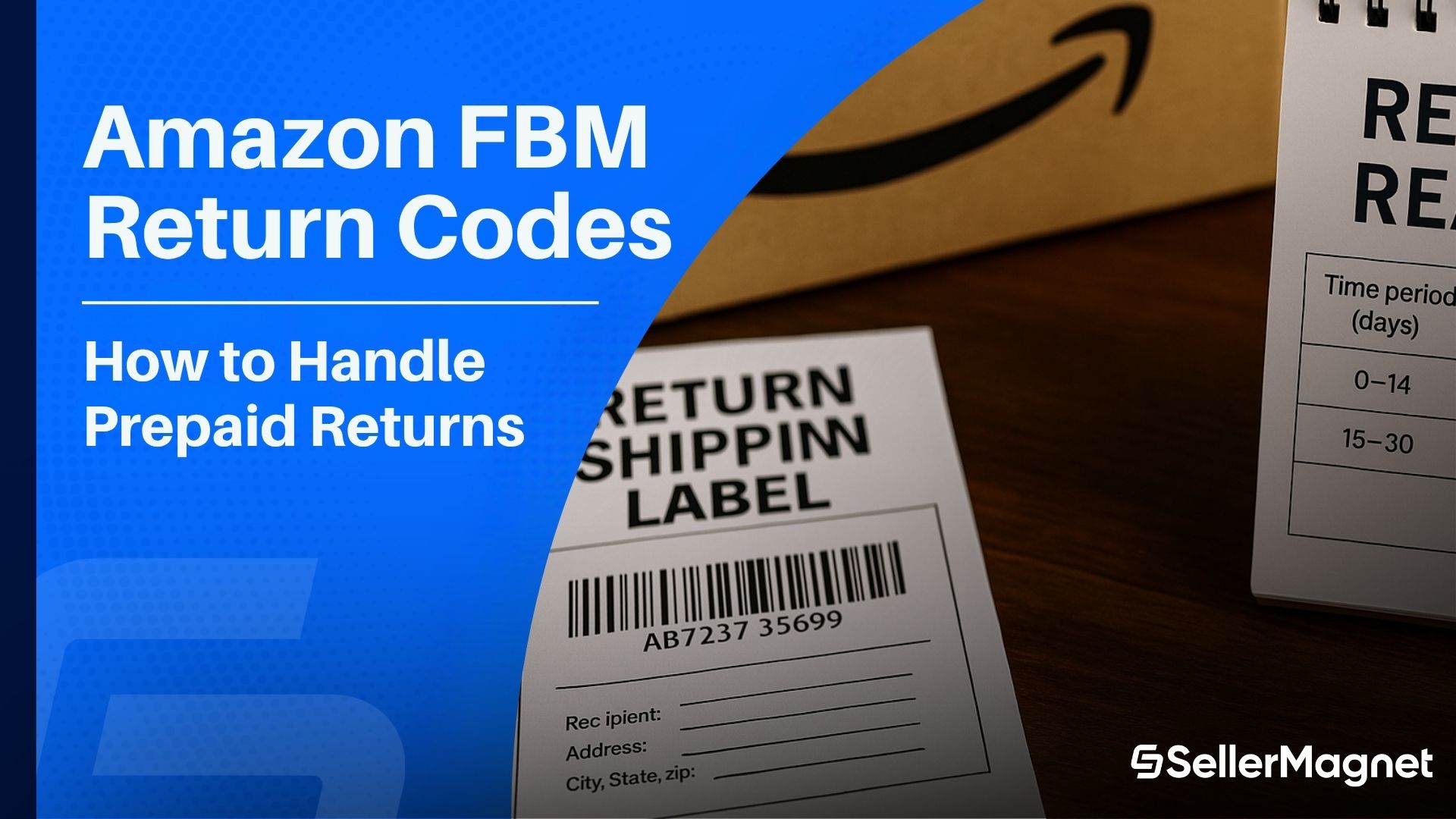
Amazon FBM Return Codes: How to Handle Prepaid Returns
Table of Contents
- What are prepaid return codes for Amazon FBM sellers
- Amazon return codes: list and meanings
- Responsibility for return shipping costs
- Effectively managing returns: benefits and strategies
- SellerMagnet Analytics Dashboard: track returns and costs
- Step-by-step guide to handling FBM returns
What are prepaid return codes for Amazon FBM sellers
Amazon return codes: list and meanings
| No. | Return reason | Liability |
|---|---|---|
| 1 | Accidental order | Buyer |
| 2 | Better price available | Buyer |
| 3 | Packaging intact but item damaged | Seller |
| 4 | Estimated delivery date missed | Seller |
| 5 | Missing parts or accessories | Seller |
| 6 | Packaging and item damaged | Seller |
| 7 | Wrong item sent | Seller |
| 8 | Defective or not working | Seller |
| 9 | Extra item beyond order | Seller |
| 10 | No longer needed or wanted | Buyer |
| 11 | Unauthorized purchase | Seller |
| 12 | Inaccurate description | Seller |
| 13 | Damaged during delivery | Seller |
| 14 | Performance or quality not adequate | Buyer |
| 15 | Not useful or incompatible with intended use | Buyer |
| 16 | Damaged due to inadequate packaging | Seller |
| 17 | Part not compatible with existing system | Buyer |
| 18 | Installation too complex or incomplete | Buyer |
Responsibility for return shipping costs
| Time from receipt to return request | Return reason | Original shipping cost | Return shipping cost |
|---|---|---|---|
| 0-14 days | Seller | Seller | Seller |
| 0-14 days | Buyer | Seller | Buyer* |
| 15-30 days | Seller | Seller | Seller |
| 15-30 days | Buyer | Buyer | Buyer* |
Effectively managing returns: benefits and strategies
- Increased customer satisfaction.
- Fewer negative reviews.
- Reduced financial loss through root cause control.
- Regularly monitor return codes to spot recurring issues.
- Clearly communicate return policies to customers.
- Implement a fast dispute resolution system.
SellerMagnet Analytics Dashboard: track returns and costs
- Track multi-marketplace inventory, orders, and returns.
- Automatically calculate costs associated with returns and refunds.
- Detailed reports to analyze performance and recurring issues.
Step-by-step guide to handling FBM returns
- Receive the return request and immediately evaluate the assigned return code.
- Verify and analyze the reason: check frequency of specific codes to identify quality or service issues.
- Respond promptly to the customer: confirm the return or propose an alternative solution.
- Process the refund or replacement quickly.
Stop Juggling Tools. SellerMagnet Combines Everything You Need.
Join a smarter way to manage your Amazon store.

Recommended Articles

Amazon FBA Prep and Labeling Requirements 2026
Amazon stopped prepping and labeling FBA inventory in the US on 1 January 2026. Prep types, FNSKU and barcode rules, category rules and what a non-compliant shipment costs.
Amazon Listing Not Showing in Search: 5 Causes and Fixes
Amazon's US help page names 5 reasons an ASIN can be unsearchable: parent ASIN, no browse node, no offer, future launch date and listing quality, plus the 250-byte keyword limit and the 72-hour reindex window.

Amazon Product Image Requirements 2026: Main Image Rules, Sizes and What Gets an Image Rejected
Amazon's 2026 product image rules: main image specs, the 85% frame fill rule, pure white background, pixel size limits, variant codes, and when a listing can be removed from search.

Remote Fulfilment with FBA vs Pan-EU 2026
Remote Fulfilment with FBA versus Pan-European FBA in 2026: price caps, the new fuel surcharge and EU customs duty, and which cross-border model fits your catalogue.
Amazon A+ Content 2026: Modules and Approval Guide
What Amazon A+ Content actually is, Basic versus Premium versus Brand Story, the technical rules that get submissions rejected, and a realistic approval timeline for 2026.
Amazon Lightning Deals 2026: Fees and Margin Guide
Amazon's 2026 Lightning Deal fee structure: the 12-hour one-day duration limit vs Best Deals, non-peak $70/day + 1%, peak events $100 flat + 1.5%, plus a margin example.