FREEASIN Converter, Fee Calculator and more free tools, no signup required
Amazon Dietary Supplement TIC Requirements 2026
Amazon Updates Amazon Basics Inventory Management

Amazon Dietary Supplement TIC Requirements 2026

|
16 min read
If you sell dietary supplements on Amazon.com, a notice can now land in Account Health naming one or more of your ASINs and starting a clock: Amazon names a case-specific due date in that notice, and you need to submit a Test Request Form (TRF) to an approved provider before it passes, or the offer gets deactivated. Amazon's own help pages do not publish one universal day count; sellers and industry reporting on the 2026 rollout commonly describe this window as running around 90 days, so this guide treats that as a planning estimate, not an Amazon-stated rule, and tells you exactly where to find your ASIN's real due date. This is not a minor label tweak: Amazon's rollout, phased through 2026, replaces direct document submission with a mandatory third-party testing, inspection and certification (TIC) step for every notified ASIN, and five supplement sub-categories face an extra lab-testing standard on top of the baseline rules. This guide works through exactly which products are affected, what the baseline and enhanced requirements ask for, which eight providers Amazon's own authorized-provider table currently lists for dietary supplements, how the clock really works, and the mistakes that get a compliant product deactivated anyway.
Amazon's dietary supplement TIC requirement means every notified supplement ASIN must be verified by an Amazon-approved third-party testing, inspection and certification provider, one of the eight Amazon currently lists (Certified Laboratories, Cotecna, Eurofins, Intertek, Merieux NutriSciences, NSF, SGS or UL), before the case-specific due date named in your Account Health notice, a window sellers commonly report as running around 90 days, covering baseline 21 CFR manufacturing and labeling rules for every supplement and NSF/ANSI 173-2024 lab testing for bodybuilding, joint health, sexual enhancement, sports nutrition and weight management products specifically. Missing the deadline or failing the test deactivates the listing until you submit compliant documents.

What counts as a "dietary supplement" to Amazon?

Amazon's policy starts from the FDA's own definition: a vitamin, mineral, herb or other botanical, amino acid, or other dietary substance meant to supplement the diet by increasing total nutrient intake, sold as a concentrate, metabolite, constituent, extract or combination of those, for human consumption. In practice it shows up as powders, tablets, capsules, drops and oral sprays, spanning vitamins and minerals through herbal and botanical blends.
Amazon does not wait for you to tick a category box. It classifies a listing as a dietary supplement if the product description, label or marketing materials show one or more of six signals:
  • A Supplement Facts panel.
  • A label statement such as "dietary supplement" or "herbal supplement."
  • Ingredient claims naming vitamins, minerals, herbs, amino acids or botanical substances.
  • Dosage or intake instructions, such as "take 2 capsules daily."
  • Health-benefit claims, such as "supports healthy blood sugar levels."
  • Structure or function claims, such as "supports immune system health" or "promotes joint mobility."
A Nutrition Facts panel does not save you
Amazon's own note is explicit: a product carrying a plain Nutrition Facts panel (the standard food label) can still fall under this policy if the description shows one or more of the six signals above. A gummy marketed with "supports immune health" on the listing, even with a food-style nutrition label, is a dietary supplement to Amazon.

The two-tier rulebook: baseline vs. enhanced categories

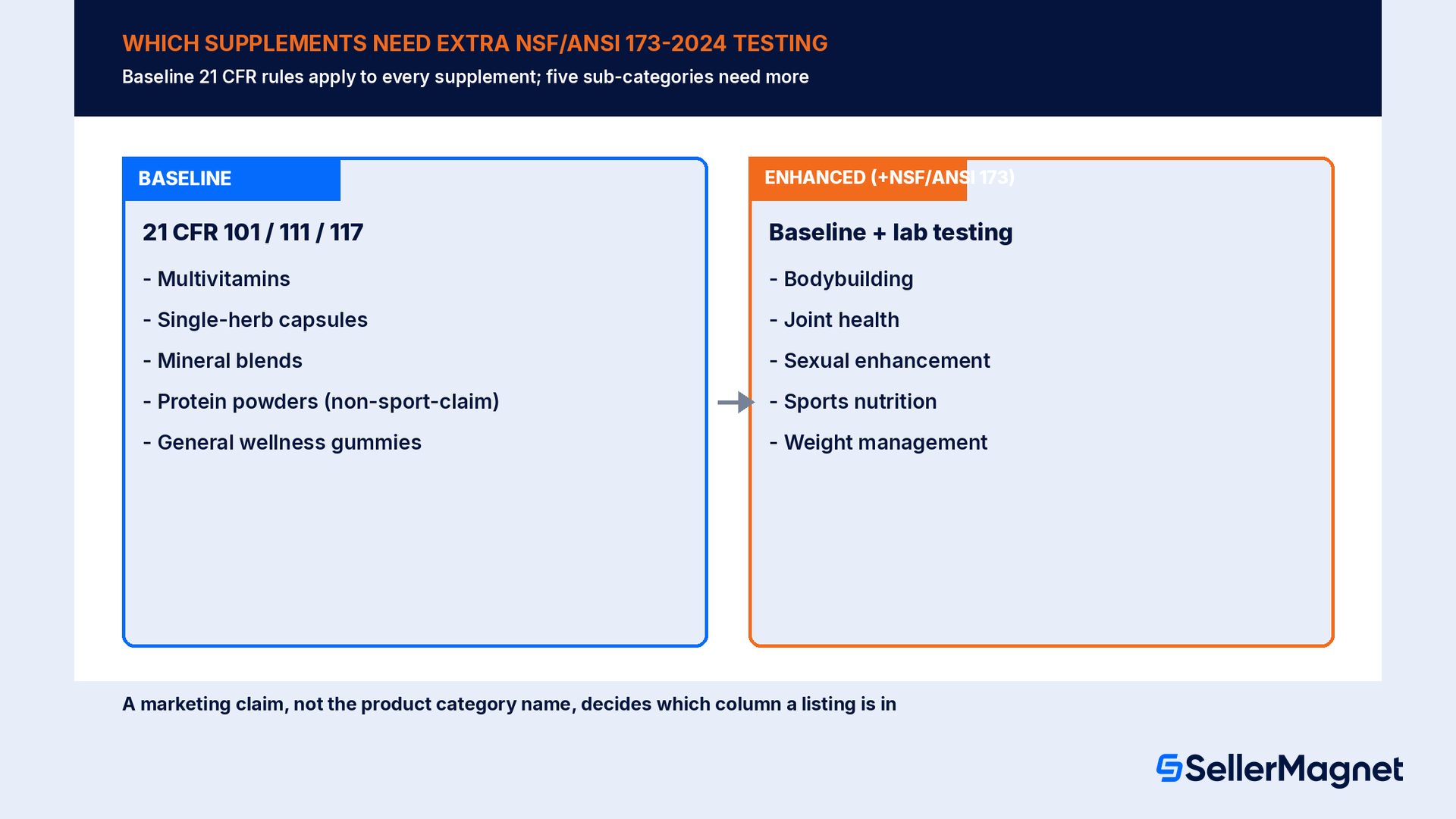
Amazon requires every dietary supplement to meet the same baseline law and standard, then layers an extra standard on top for five specific sub-categories.
Product scope Laws, regulations and standards required
All dietary supplements Title 21 of the FD&C Act, including 21 CFR 101 (food labeling) and 21 CFR 111 (current good manufacturing practice for manufacturing, packaging, labeling and storage of dietary supplements) or 21 CFR 117 (current good manufacturing practice, hazard analysis and risk-based preventive controls for human food), or equivalent.
Bodybuilding, joint health, sexual enhancement, sports nutrition, and weight management All of the above, plus NSF/ANSI 173-2024 (the ANSI standard for dietary supplements), or equivalent.
What classifies a listing as an Amazon dietary supplement (six label and marketing triggers) and which five sub-categories need the extra NSF/ANSI 173-2024 standard on top of the baseline 21 CFR rules
The practical read: a plain multivitamin or a single-herb capsule only has to clear the baseline cGMP and labeling rules. A pre-workout, a joint-support formula, a sexual-enhancement product, a sports-nutrition blend, or a weight-management product has to clear the baseline rules AND pass NSF/ANSI 173-2024 testing, which is real laboratory analysis against a published standard, not a paperwork review. If your catalog spans both groups, budget for the enhanced-category products to take longer and cost more.

What the detail page and enhanced compliance actually require

Amazon splits the requirement into product-detail-page compliance, which is largely under your control today, and enhanced compliance, which is the new third-party verification layer.

Product detail page: offer attributes

  • Item name that includes the supplement's name.
  • Manufacturer name.
  • Brand name.
  • Ingredient list.
  • Unit count of the supplement (for example, 100 tablets, 5 mg, or 6 oz).

Product detail page: images

  • The entire product label, written in English and physically attached to the product, showing the supplement name, the total amount or unit count (for example, 100 tablets, 5 mg, or 6 oz), a matching Supplement Facts or Nutrition Facts panel, the full ingredient list, certification logos, the identity statement, usage directions, and every product warning.
  • The identification codes the manufacturer or distributor placed on the packaging, including matrix codes, lot numbers or serial numbers, plus the name and address of the brand owner, manufacturer, packager or distributor.
  • No FDA logo anywhere on the image.

Product detail page: warranty claims (what the listing may NOT say)

  • No FDA logo in the offer attributes or images, and no "FDA approved" claim unless the product genuinely holds official FDA approval.
  • No claim of the same effect as a controlled substance or a prescription drug, including names that could be confused with one, Amazon's own examples are "GLP-1," "Viagrex" and "TestosterX."
  • No claim of an effect similar to anabolic steroids, for example describing a product as "legal steroids."
  • No label wording such as "sample," "not for retail sale" or "not intended for resale."
  • No disease names stuffed into search terms.
  • No ingredient or extract claim that does not match the amounts printed on the Supplement Facts panel, which specifically rules out converting a real extract amount into an inflated raw-material weight (quoting a 10,000 mg raw-herb equivalent when the actual extract is 500 mg), stating an ingredient's weight without naming the ingredient, or stating a weight without the serving size it applies to.
Equivalent units are fine, invented equivalents are not
Amazon allows the same ingredient amount expressed in different, mathematically equivalent units, for example Vitamin C 10,000 IU = 250 mcg, as long as it matches the Supplement Facts panel. What it does not allow is translating an extract dose into a much larger "raw material equivalent" number that was never tested or printed on the panel.

Non-GMO claims need one of three documents

  • A valid product-level certificate, "Non-GMO Project Verified" or "Nutrasource Igen," naming the product by name and current at submission.
  • A PCR (polymerase chain reaction) lab test report from an ISO 17025 accredited lab covering every high-risk ingredient in the product (alfalfa, apple, canola, corn, cotton, eggplant, papaya, pineapple, potato, salmon, soybean, squash, sugar beet and sugarcane), each showing under 0.9% GMO content; separate per-ingredient reports or one combined report both work.
  • A valid USDA Organic certificate naming the product; USDA organic standards already exclude genetically modified organisms.

Offers

Every offer must be new, in the manufacturer's original sealed packaging. Used, opened or repackaged dietary supplements are not eligible.

Enhanced compliance: the part that actually changed in 2026

  • A Certificate of Insurance (COI) verifying your commercial liability insurance, submitted in Seller Central.
  • Verification of every notified ASIN by an Amazon-approved third-party testing, inspection and certification (TIC) provider. You no longer submit documents directly to Amazon; the TIC provider submits on your behalf.
  • If you already use an accredited lab that is not on Amazon's approved list, its results still need to be validated by an authorized TIC provider before Amazon accepts them.

The eight TIC providers Amazon currently lists
As of this writing, Amazon names eight approved third-party testing, inspection and certification providers for dietary supplements: Certified Laboratories, Cotecna, Eurofins, Intertek, Merieux NutriSciences, NSF, SGS and UL. If you have existing cGMP certificates or lab reports, send them to one of these providers first; the provider reviews what you have and tells you whether it already meets Amazon's policy or whether new testing is required. If you have no existing documentation, or your product needs testing against NSF/ANSI 173-2024, the provider runs the tests directly and submits the results to Amazon on your behalf.
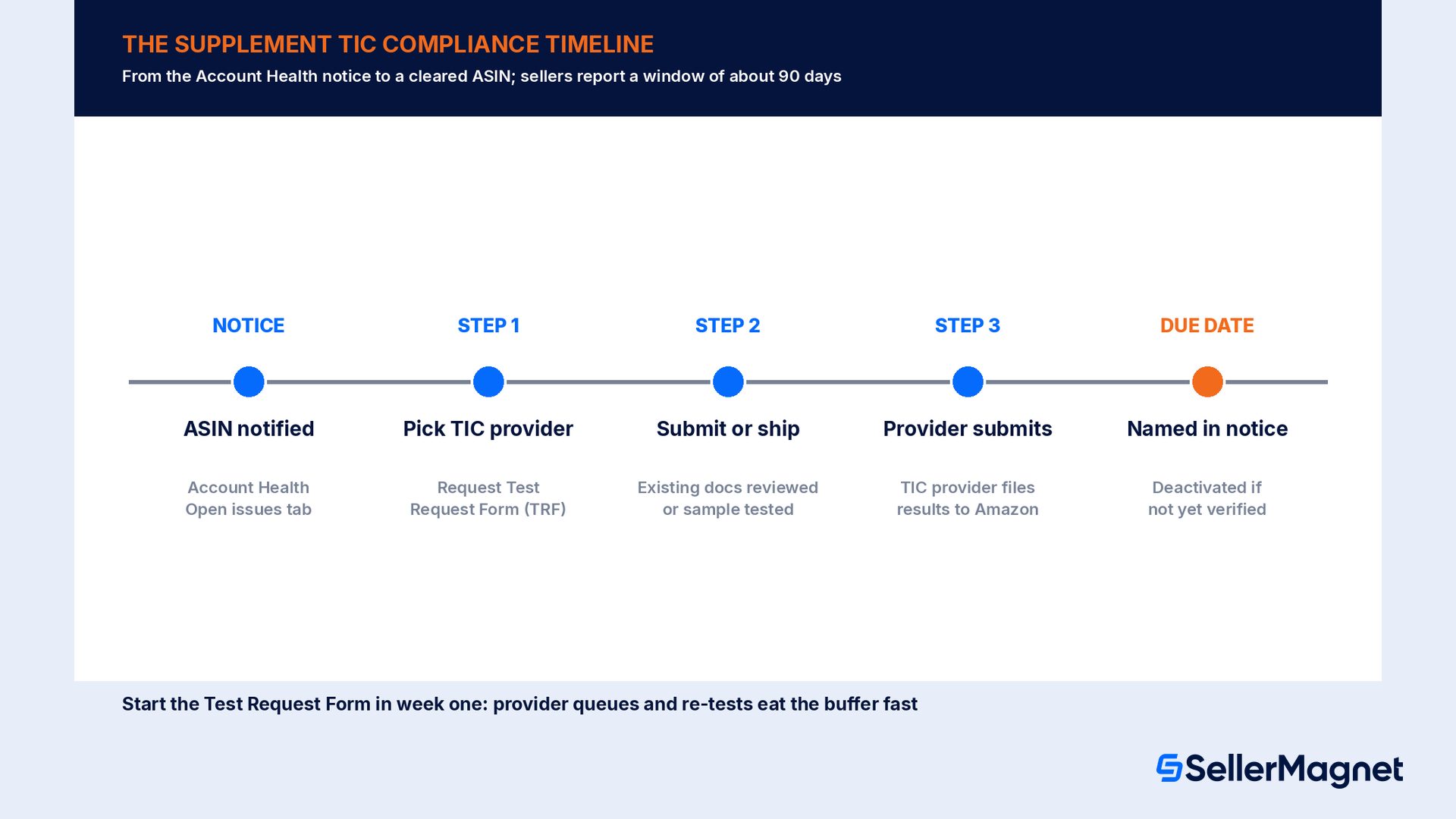
The reported ~90-day Amazon supplement TIC compliance timeline: ASIN notification in Account Health, choosing a TIC provider, submitting the Test Request Form, lab review or testing, and the deadline before the offer is deactivated

The compliance clock: what actually starts it and what resets it

Amazon notifies you ASIN by ASIN, inside Seller Central under Account Health, as its phased 2026 rollout reaches your catalog. Amazon's own help pages name a case-specific due date in that notice rather than publishing one universal day count; sellers and trade reporting on the 2026 rollout commonly describe the window as running around 90 days, so treat that figure as a planning estimate and always check the exact date your own notice shows before starting the documentation process, either validating existing testing documents or starting new product testing, with your chosen TIC provider.

Respond to an Amazon supplement TIC notification

  1. Check Account Health the day you are notified - Open the Open issues tab in Account Health and note the exact ASIN, the deadline date, and whether the notice flags it as a baseline or NSF/ANSI 173-2024 category product.
  2. Pick a TIC provider from Amazon's approved list - Choose from the eight approved providers (or confirm your existing accredited lab's results can be validated by one of them) and request a Test Request Form (TRF) through Third-party testing, inspection and certification services under Account Health.
  3. Send existing documents, or ship a sample - If you already hold cGMP certificates and (for enhanced categories) NSF/ANSI 173-2024 test results, submit them for review. If not, ship the product sample the TRF specifies so the provider can test it directly.
  4. Track the provider's submission - The TIC provider submits results to Amazon on your behalf; you no longer send documents directly. Confirm with the provider that submission happened well before your notice's due date, not on it.
  5. Watch for a monitoring or random Safety Program test - Amazon can select any supplement ASIN for periodic testing or inspection, and separately for random monitoring tests under its Safety Program, at any point after initial compliance.
  6. Appeal if you believe a requirement is wrong - Use the Appeal Request section in Account Health if a notification, a failed test, or a document rejection looks incorrect for your specific product.
A failed test deactivates the offer immediately
If a product fails testing, or your documentation fails review, Amazon deactivates that offer right away. It stays deactivated until you submit compliant documents AND resolve every other open issue tied to that ASIN, so a single unrelated flag on the same ASIN can keep a now-compliant product offline. Check the Open issues tab and Manage All Inventory together, not just the TIC status.

Variations, reformulations and private-label lines: the detail sellers miss

The TIC requirement is per ASIN, not per brand or per parent listing, so a product sold in three flavors or three bottle sizes is three separate ASINs that each need their own notification response, even when the formula and label are otherwise identical. A private-label seller running the same base formula under several storefront brands has the same multiplier problem: each branded ASIN carries its own label artwork, its own identity statement, and its own compliance clock, so a single approved test on one SKU does not automatically clear its siblings.
  • A flavor or size variant counts as its own ASIN and its own due-date notice, even when the core formula is unchanged.
  • A reformulation, a new flavor, or a new supplier for a key ingredient resets the compliance picture for that ASIN: the existing TIC approval was for the old formula, not the new one, so treat a formula change as a reason to re-engage your TIC provider before relisting.
  • A private-label seller distributing one base formula across several storefronts needs separate label artwork and separate TIC verification for each branded ASIN; budgeting "one test covers the whole line" undercounts the real cost and the real deadline load.
  • If your enhanced-category product changes anything that could affect the NSF/ANSI 173-2024 result, a different manufacturing site, a new raw-material supplier, or a revised dosage, re-testing is the safer assumption, not an optional extra.

Worked example: budgeting a 46-ASIN supplement catalog

A seller runs 46 active supplement ASINs: 31 baseline products (multivitamins, single herbs, mineral blends) and 15 enhanced-category products across sports nutrition, weight management and joint health. Provider quotes for the baseline group range $350 to $900 per ASIN for a cGMP and label review where existing documentation is accepted; the enhanced group runs $900 to $2200 per ASIN once NSF/ANSI 173-2024 lab testing is added.
Group ASINs Per-ASIN cost range Catalog cost range
Baseline (21 CFR only) 31 $350 to $900 $10,850 to $27,900
Enhanced (+ NSF/ANSI 173-2024) 15 $900 to $2200 $13,500 to $33,000
Total catalog 46 - $24,350 to $60,900
That puts the whole catalog's compliance cost between $24,350 and $60,900, before counting staff time chasing providers or re-shooting label photos. The bigger risk is the ASINs that slip past their due date undocumented. If roughly 30% of a 46-ASIN catalog, 14 ASINs, is still unresolved when the deadline passes and gets deactivated, at an average 2.4 units a day and $21.90 average price, that is roughly $735.84 in lost sales every single day those listings stay dark, on top of whatever the testing itself costs.
Deactivation cost compounds, testing cost does not
The testing budget above is a one-time cost per ASIN. A deactivated listing's lost-sales cost repeats daily until the documents clear and every open issue on that ASIN is resolved, so starting the TIC process the week you're notified, not the week before your due date, is the single biggest lever a supplement seller has here.

Common mistakes that cost sellers time or listings

  • Waiting until close to the due date to request a Test Request Form, leaving no buffer if the chosen TIC provider's queue runs long or the first test fails.
  • Assuming a product is baseline-only without checking whether its marketing (a "pre-workout," "sexual enhancement," "joint support" or "weight management" claim) actually puts it in one of the five NSF/ANSI 173-2024 categories.
  • Submitting lab results from an accredited lab that is not on Amazon's approved list without first confirming it can be validated by one of the eight approved providers.
  • Quoting an extract's raw-material equivalent weight on the listing instead of the actual tested amount on the Supplement Facts panel, a warranty-claim violation that is easy to introduce when copywriting from a supplier's marketing sheet.
  • Treating a Non-GMO claim as self-evident from the ingredient list, instead of holding one of the three accepted documentation types before the claim goes live.
  • Assuming a failed monitoring test only affects the one flagged batch; Amazon's review covers the ASIN and listing, not a single production run, and deactivation applies until the whole ASIN clears.
  • Not checking the Open issues tab after resubmitting TIC documents, and missing an unrelated issue on the same ASIN that is the actual reason the listing is still deactivated.
Catch an Account Health compliance notice the day it lands, not the week you happen to check. SellerMagnet's Alerts watches your Account Health score and listing status for every ASIN in your connected catalog and flags a drop or a new deactivation as soon as it is visible, so a TIC notice does not sit unread while its compliance clock runs. The same Alerts surface also catches a resulting listing deactivation immediately if a test or document review fails, which matters here since the offer goes dark the moment that happens. For a related catalog-wide compliance change, see our guide to new hazmat listing questions, and for a different kind of listing risk entirely, our design patent infringement claim guide covers IP-based takedowns.

Pre-check: is your supplement catalog ready?

  • Every supplement ASIN checked against the six classification triggers, not assumed safe because it is also a food-style product.
  • Every ASIN marked baseline vs. enhanced category (bodybuilding, joint health, sexual enhancement, sports nutrition, weight management) correctly, from the actual listing claims, not the product's informal category.
  • cGMP documentation (21 CFR 111 or 117 or equivalent) current and ready to hand to a TIC provider for every ASIN.
  • NSF/ANSI 173-2024 test results in hand, or a TIC provider engaged to run them, for every enhanced-category ASIN.
  • Label images show the full English label, matching Supplement Facts panel, ingredient list, certification logos, identity statement, directions and warnings, with no FDA logo anywhere.
  • Any Non-GMO claim backed by one of the three accepted document types before it goes live.
  • A Certificate of Insurance on file in Seller Central, current and not about to expire mid-review.
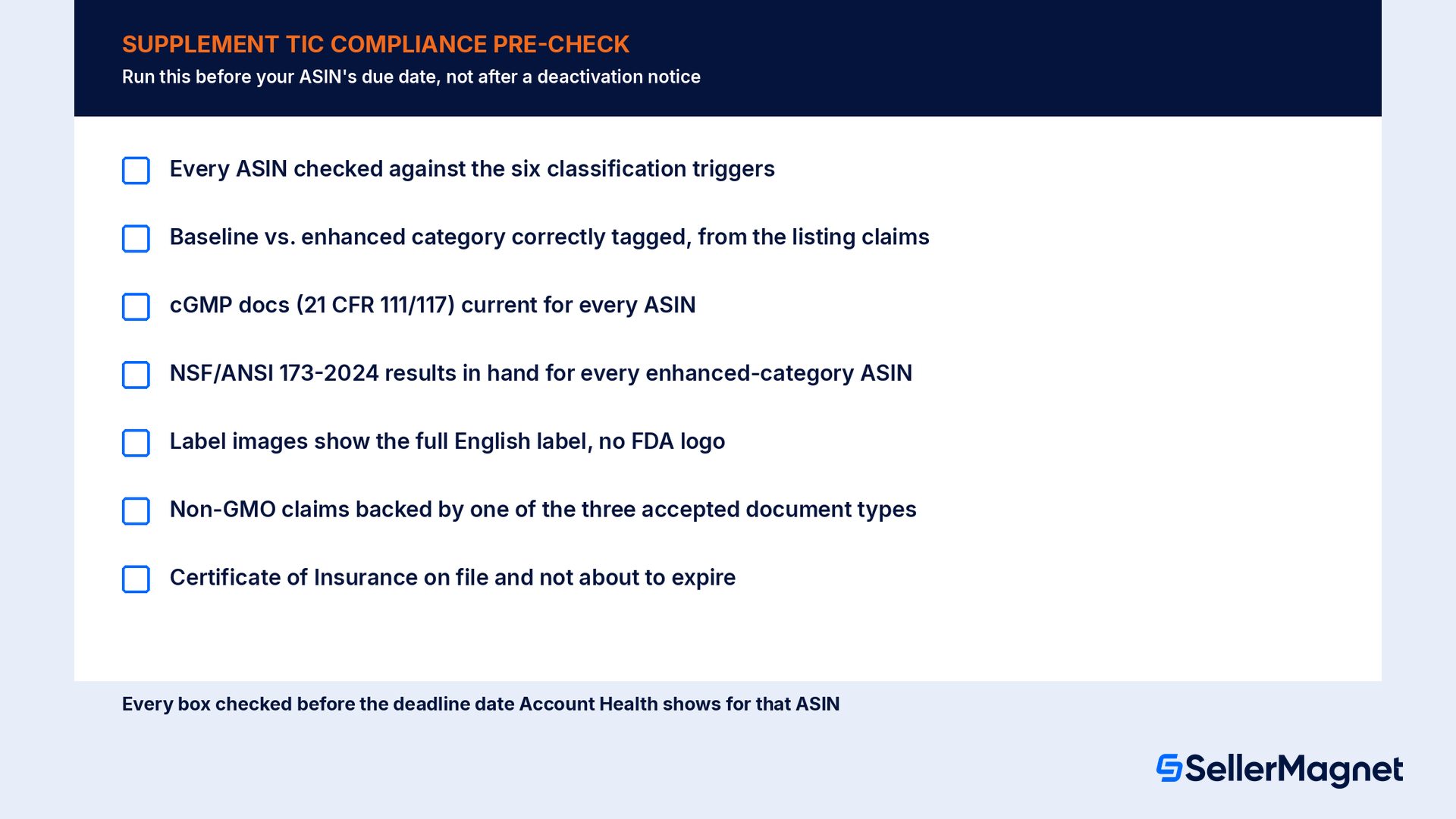
Pre-check list for Amazon dietary supplement TIC compliance before your ASIN's due date passes

What is Amazon's TIC requirement for dietary supplements?

Amazon now requires every notified dietary supplement ASIN to be verified by an Amazon-approved third-party testing, inspection and certification (TIC) provider before the case-specific due date named in your Account Health notice, replacing the previous process of submitting documents directly to Amazon yourself.

Which products need NSF/ANSI 173-2024 testing specifically?

Products in bodybuilding, joint health, sexual enhancement, sports nutrition, and weight management, on top of the baseline 21 CFR 101/111/117 rules every dietary supplement must meet.

Which TIC providers does Amazon approve for supplements?

Amazon's own authorized-provider table for dietary supplements (US) currently names eight: Certified Laboratories, Cotecna, Eurofins, Intertek, Merieux NutriSciences, NSF, SGS and UL. A result from a different accredited lab still needs validation by one of these eight before Amazon accepts it.

What happens if I miss my ASIN's TIC due date?

The affected offer is deactivated. It stays deactivated until you submit compliant documents through your TIC provider and resolve every other open issue tied to that ASIN.

Does a Nutrition Facts panel instead of a Supplement Facts panel exempt my product?

No. Amazon's policy explicitly notes that a product with a Nutrition Facts panel can still be classified as a dietary supplement if its description carries a dosage instruction, a health-benefit claim, a structure or function claim, or an ingredient claim naming vitamins, minerals, herbs, amino acids or botanicals.

Can I submit my own lab's test results instead of using a TIC provider?

You can use any accredited lab, but if it is not one of Amazon's eight approved TIC providers, its results must still be validated by an authorized provider before Amazon accepts them, and you no longer submit anything directly to Amazon yourself.

What documents prove a Non-GMO claim?

A valid product-named "Non-GMO Project Verified" or "Nutrasource Igen" certificate, a PCR lab report from an ISO 17025 accredited lab covering every high-risk ingredient at under 0.9% GMO content, or a valid USDA Organic certificate naming the product.

Is a routine test the only way Amazon checks compliance after approval?

No. Amazon can select any supplement ASIN for periodic testing or inspection, and separately for random monitoring tests under its Safety Program, at any point after the initial compliance process.

Stop Juggling Tools. SellerMagnet Combines Everything You Need.

Join a smarter way to manage your Amazon store.

Recommended Articles

Amazon Dietary Supplement TIC Requirements 2026
Amazon Updates Amazon Basics Inventory Management

Amazon Dietary Supplement TIC Requirements 2026

Amazon's 2026 TIC requirement for dietary supplements: the compliance deadline, baseline vs. NSF/ANSI 173-2024 categories, the approved providers, and how to avoid deactivation.
Read more
Amazon Keyword Indexing 2026: Why Listings Go Unsearchable
Amazon SEO Amazon Basics SellerMagnet Tools

Amazon Keyword Indexing 2026: Why Listings Go Unsearchable

Why an active Amazon listing can still be unsearchable, Amazon's own 5 documented causes, and a manual way to check indexing without a third-party tool.
Read more
Amazon Bundle Policy 2027: What Changes on January 11 and How to Stay Compliant
SellerMagnet Tools Amazon Basics

Amazon Bundle Policy 2027: What Changes on January 11 and How to Stay Compliant

From 11 Jan 2027 most hard kit bundles outside Consumables must be manufacturer-packaged unless they have a letter of authorization, sit in an exempt category, or become virtual bundles.
Read more
Amazon Listing Variations 2026: Parent-Child Errors
Amazon SEO Amazon Basics SellerMagnet Tools

Amazon Listing Variations 2026: Parent-Child Errors

What an Amazon parent and child ASIN variation actually is, the 5 causes that break a family, and a worked example of when to split or merge listings.
Read more
Amazon Return Fraud: Patterns, SAFE-T and the Real Tradeoff
Amazon Basics FBA

Amazon Return Fraud: Patterns, SAFE-T and the Real Tradeoff

Amazon return abuse patterns, the SAFE-T claim vs restocking fee tradeoff, and the evidence and Report Abuse workflow that gets a repeat offender reviewed.
Read more
Amazon Order Defect Rate 2026: ODR vs Contact Metrics
Amazon Updates Amazon Basics

Amazon Order Defect Rate 2026: ODR vs Contact Metrics

What counts against Order Defect Rate, how Contact Rate, Response Time and Dissatisfaction Rate work, and why refund timing decides an A-to-z claim's ODR impact.

Read more

Ready to grow your Amazon business?

Used on nearly 800 Amazon projects to automate pricing, track profits and scale faster.

14-day free trial • Cancel anytime