If you ship FBA inventory into the US from overseas, Amazon quietly extended two clocks that decide whether a split international shipment gets hit with a defect fee. For international shipment plans created between 1 August 2026 and 30 November 2026, the window for the remaining shipments in a multi-destination plan to arrive after the first one is received has grown from 30 to 45 days, and the automatic shipment-closure window has been extended to 90 days. Both changes are temporary, both apply automatically with no action required, and both are easy to miss because they sit quietly inside the Inbound Performance Dashboard rather than arriving as a dramatic policy announcement. This guide walks through exactly what changed, which shipments qualify, how it is different from the baseline 45-day domestic and 75-day international arrival rule that Amazon did NOT change, a worked example with real dates, and what to check before you assume a fee was waived automatically.
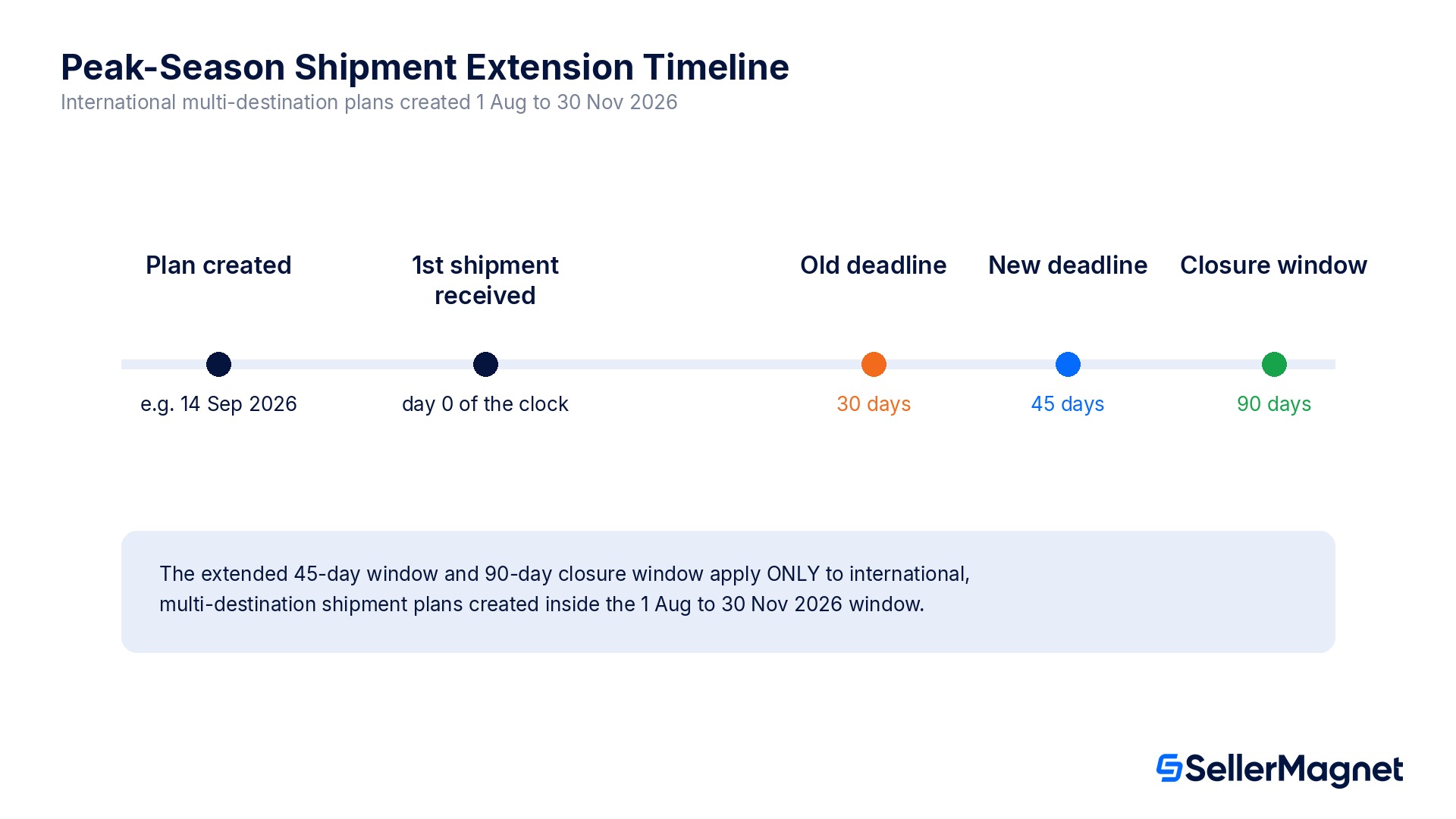
Amazon's 2026 peak-season shipment extensions give international multi-destination shipment plans created between 1 August and 30 November 2026 two temporary breaks: the window for the remaining shipments to arrive after the first one is received grows from 30 to 45 days before the deleted or abandoned defect fee applies, and the automatic shipment-closure window extends to 90 days. Both apply automatically, no seller action is required, and any defect fee already charged on an eligible shipment is reimbursed through the Reimbursement report. The baseline 45-day domestic and 75-day international shipment-arrival rule is unchanged.
What actually changed, in plain terms
A multi-destination international shipment plan splits one purchase order into several shipments, usually because Amazon's placement service routes inventory to more than one fulfillment center. Those shipments rarely arrive on the same day: ocean transit times, customs clearance and inland trucking all drift, so the shipments behind the first one can land days or weeks later. Amazon tracks how long that gap is allowed to be, and when a shipment inside the plan arrives too late relative to the first one, it gets flagged as a deleted or abandoned shipment on the Inbound Performance Dashboard and a defect fee applies. The idea behind the rule in normal conditions makes sense: without a limit, a seller could in theory let the tail end of a shipment plan drag on indefinitely while still counting the whole order as in-progress rather than closed.
For shipment plans created in the 1 Aug to 30 Nov 2026 window, Amazon stretched that allowance from 30 to 45 days, specifically to absorb the longer and less predictable transit times that come with peak-season ocean freight demand. A second, separate change extends the automatic shipment-closure window, the point at which Amazon stops waiting for an in-transit shipment and closes it, to 90 days, giving slow shipments more runway before they are closed out instead of received.
Multi-destination plans are the most exposed
A single-destination shipment plan has nothing to compare against, so this extension mainly matters to sellers whose shipments are split by Amazon's placement service, or who deliberately choose a multi-destination split to reduce their own freight to Amazon. The more destinations a plan has, the more opportunities exist for one leg to run long relative to the others, which is exactly the scenario this extension was built to absorb.
Clock
Normal value
Extended value (plans created 1 Aug - 30 Nov 2026)
What it protects against
Related-shipment arrival window
30 days
45 days
The deleted/abandoned defect fee on later shipments in the same multi-destination plan
Automatic shipment-closure window
Not published as a fixed figure on Amazon's general pages
90 days
An in-transit shipment being closed before it has a realistic chance to arrive
A shipment that never arrives at all, from its creation date
These are two different clocks from the 75-day arrival rule
It is easy to conflate this extension with the general rule that an international shipment must arrive within 75 days of its creation date or it is treated as never having arrived. That rule has NOT changed. What changed is the window measured between the FIRST shipment received in a multi-destination plan and the LATER shipments in the same plan, which is a narrower, plan-specific comparison, not the overall creation-to-arrival clock.
Who actually qualifies
The shipment plan must be INTERNATIONAL (inventory shipped into a US fulfillment center from outside the US).
The shipment plan must be a MULTI-DESTINATION plan, meaning Amazon split it into more than one shipment going to more than one fulfillment center.
The plan must have been CREATED between 1 August 2026 and 30 November 2026 (the creation date of the plan, not the ship date or the arrival date, is what Amazon checks).
The later shipment(s) in the plan must arrive within 45 days of the FIRST shipment in the same plan being received, not within 45 days of being created or shipped.
A single-destination shipment, a domestic shipment, or a multi-destination plan created outside the 1 Aug to 30 Nov window does not qualify for either extension, and falls back to the normal 30-day related-shipment window with no special treatment. It is also worth noting that the extension applies to the PLAN as a whole, not to individual shipments inside it picked and chosen: once a multi-destination plan's creation date falls inside the window, every shipment belonging to that plan is covered by the extended related-shipment clock, not just the ones that happen to be running late.
What happens automatically, and what you should still check
Confirm a peak-season shipment extension applied correctly
Check your plan's creation date - Open the shipment plan in Send to Amazon and confirm the creation date falls inside 1 August 2026 to 30 November 2026, since that date, not the ship date, is what decides eligibility.
Watch the Inbound Performance Dashboard, not just your inbox - A qualifying shipment can still show a defect flag on the dashboard even though the fee itself is waived; the flag and the fee are tracked separately, so do not assume a visible flag means you were charged.
Check the Reimbursement report for an automatic refund - If a defect fee was already charged on a shipment that turns out to be eligible, Amazon reimburses it automatically; confirm the reimbursement actually landed in your report rather than assuming it did.
Re-check any dispute you already filed - If you manually disputed a related-shipment defect fee before this extension was visible to you, verify the dispute and the automatic reimbursement did not both apply, which would be a duplicate credit worth flagging if you notice it.
Plan your next shipment's timing around the real deadline - Use the extended 45-day window as your working buffer for THIS window's shipments, but do not assume it will still apply after 30 November 2026; plan shipments created after that date around the normal 30-day rule.
No action required, but "no action" is not "no checking"
Amazon's own wording is that no seller action is required and the changes and reimbursements apply automatically. That is true for the mechanics, but it is still worth confirming the dates and the reimbursement landed correctly on your own account, the same way you would double-check any automatic adjustment on a fee this specific.
Worked example: a 1,000-unit, 3-destination plan
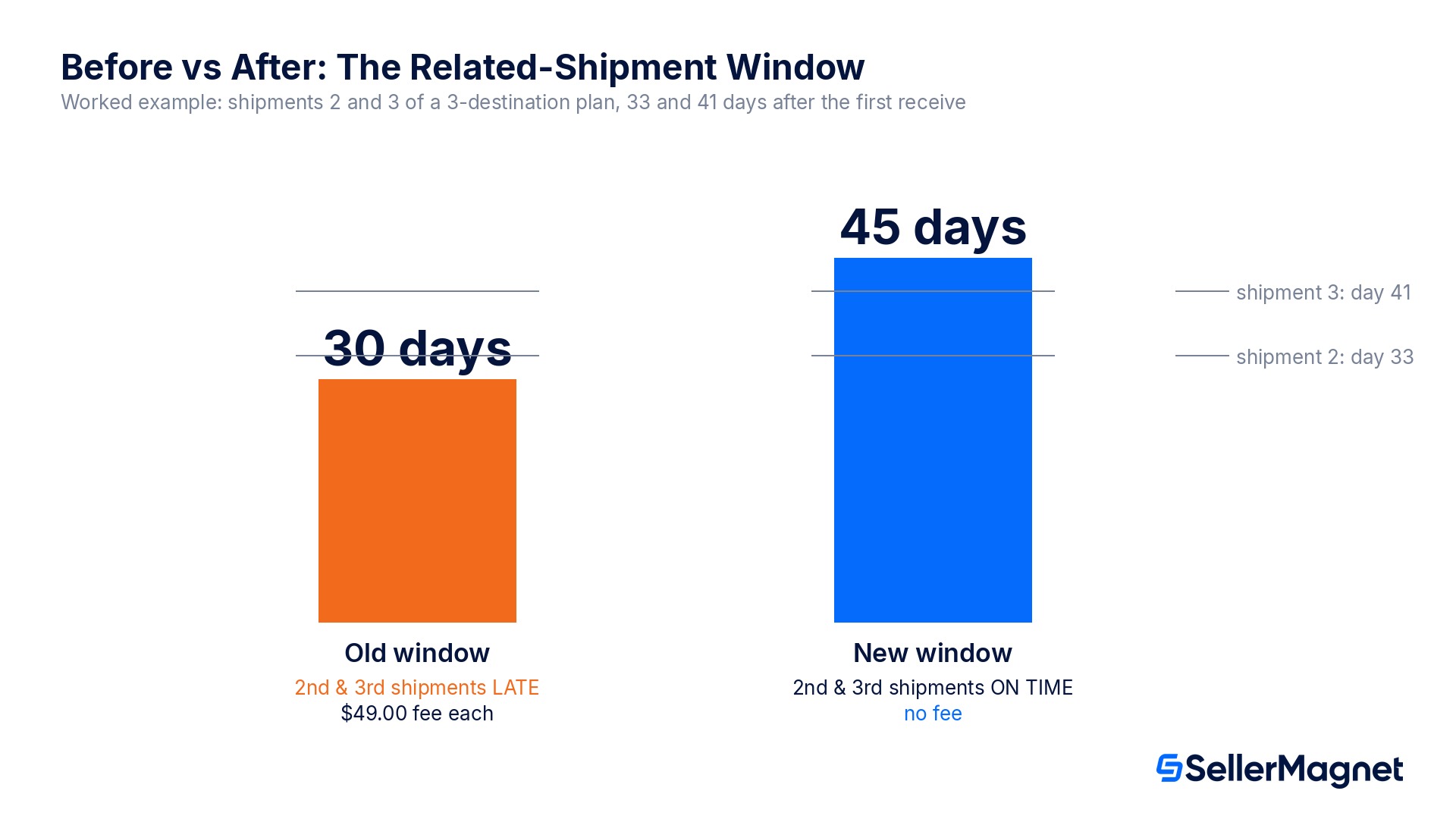
A seller creates an international shipment plan for 1000 units on 14 September 2026, which falls inside the extension window. Amazon's placement service splits it into 3 shipments of 400, 350, 250 units each, heading to 3 different fulfillment centers. The first shipment is received on 21 September 2026. Ocean transit and customs delays push the second shipment's receive date to 33 days after the first, and the third to 41 days after the first.
Shipment
Units
Days after first receive
Under the old 30-day rule
Under the extended 45-day rule
1st (reference)
400
0 (first received)
N/A
N/A
2nd
350
33
Defect fee applies ($49.00)
No defect fee (inside 45 days)
3rd
250
41
Defect fee applies ($49.00)
No defect fee (inside 45 days)
Under the old 30-day rule, both the 2nd and 3rd shipments would have missed the window and been flagged with a defect fee of roughly $49.00 each, a total of $98.00 (the exact fee depends on the product's size tier, see our full FBA fee table). Under the extended 45-day window that applies to this plan, both shipments arrive inside the allowed gap, so no related-shipment defect fee applies to either one. The defect may still show briefly on the Inbound Performance Dashboard before clearing, but the fee itself does not land, and if it had already been charged before the extension was reflected on the account, it would be reimbursed automatically through the reimbursements report.
At an average sale price of $18.50 and roughly 9 units sold a day across the listing, the full 1000-unit order takes about 111 days to sell through once every shipment has arrived. That sell-through horizon is exactly why the 90-day closure extension matters on top of the 45-day related-shipment window: a shipment that is still legitimately in transit needs enough runway to be received as inventory, not closed out as a non-arrival, before it can even start contributing to that sell-through number.
Why Amazon extended these two clocks for peak season
Ocean freight gets less predictable every year between late summer and the end of November, which is exactly the window this extension covers. Port congestion builds ahead of the holiday rush, vessel schedules slip, and a container that would clear customs in a week in April can sit for two or three weeks in October. When Amazon's placement service splits one purchase order into shipments bound for several fulfillment centers, those delays do not hit every shipment equally: the first one to clear might be routed through a quieter port, while the second or third sits behind a backlog somewhere else. Before this extension, a seller who did everything right on their end, booking freight early, using a reliable forwarder, could still end up with a defect fee purely because the SECOND leg of their own shipment plan was slower than the first, through no fault of their shipping decisions.
The 90-day closure extension solves a related but slightly different problem. Amazon's system periodically reviews in-transit shipments and automatically closes the ones it judges unlikely to still be coming, which protects the Inbound Performance Dashboard from carrying stale, never-arriving shipments forever. During peak season, a shipment that is genuinely still in transit, just slower than usual, risks being closed out as if it had been abandoned, which both triggers a defect and strips it out of the inventory pipeline a seller is actively counting on for the holiday selling period. Extending that window to 90 days gives a slow but real shipment enough time to still be recognized as inbound inventory rather than written off.
The practical effect: less paperwork, not less freight risk
It is worth being precise about what this extension does and does not fix. It does not make freight arrive faster, and it does not protect a seller from the real cost of a late shipment: lost selling days, a stockout risk, or missing a peak-season demand window. What it removes is the SECONDARY cost of a defect fee and a dispute process stacked on top of an already-late shipment. A seller whose second shipment lands 40 days after the first one is still dealing with 40 days of thinner inventory at that fulfillment center; the extension only means that lateness, by itself, inside the new 45-day band, no longer also costs a fee and a trip through the dispute process.
How this interacts with other peak-season rules
This extension is one of several temporary 2026 peak-season adjustments running at the same time, and it is worth keeping them separate rather than assuming one change covers another. The AWD storage-fee waiver for Europe distribution centres, for example, runs on its own calendar and only touches storage fees, not shipment-arrival defect fees; see our guide to the AWD storage fee waiver for that one specifically. Peak fulfillment fee surcharges and holiday storage rate changes are also separate from this extension and are covered in our FBA storage fees guide. None of these other peak-season changes extend the related-shipment or closure windows this guide covers; treat each one as its own rule with its own dates.
What this means if you are planning your remaining 2026 shipments right now
If you still have inbound shipments to create before the end of November, the practical takeaway is to keep using your normal planning discipline, book freight early, choose a forwarder with a track record on the lanes you use, and build buffer into your own internal deadlines, rather than treating the extended window as permission to cut it closer. The extension is a safety net for delays that happen despite good planning, not a replacement for it. A shipment that would have arrived on time anyway gains nothing from a wider window; the extension only helps the shipments that were already running late for reasons outside your control, like a port backlog or a vessel delay, and it only helps them up to 45 days, not indefinitely.
It is also worth telling your freight forwarder or 3PL that this extension exists, since not every provider tracks Amazon policy changes as closely as they track their own transit times. If a forwarder is quoting you an expedited, higher-cost option specifically to beat the old 30-day related-shipment window on a plan that actually falls inside the 1 Aug to 30 Nov 2026 window, that premium may no longer be necessary, and the money is better spent elsewhere, for example on the inspection or prep side of the shipment. A quick email to your forwarder with the exact dates of this extension, and a link to the forum announcement itself, is usually enough to settle the question without a long back-and-forth.
Common mistakes sellers make with this extension
Assuming the extension applies to a plan based on its SHIP date or ARRIVAL date, when Amazon checks the plan's CREATION date instead.
Confusing the related-shipment window (30 -> 45 days, this extension) with the baseline shipment-did-not-arrive rule (45 days domestic / 75 days international), which did not change at all.
Assuming a visible defect flag on the Inbound Performance Dashboard always means a fee was charged, instead of checking the Reimbursement report for what was actually billed.
Filing a manual dispute for a defect fee that the automatic extension and reimbursement would have cleared on its own, risking a duplicate credit.
Planning a shipment created just after 30 November 2026 around the extended 45-day window, when that shipment falls back to the normal 30-day rule.
Treating a domestic shipment plan as eligible; the extension only covers international multi-destination plans.
Keep every shipment in a multi-destination plan visible in one place, instead of checking each fulfillment center separately. SellerMagnet's Inventory Planner tracks shipment status and arrival dates across every destination in a plan, so a slow second or third shipment shows up against the real deadline instead of getting lost between separate shipment-tracking pages. For the exact dollar figures this extension is protecting you from, see our complete FBA fee table, and for what to do if a fee lands anyway, our FBA reimbursements guide covers the dispute process end to end.
Pre-check: is your current shipment plan covered?
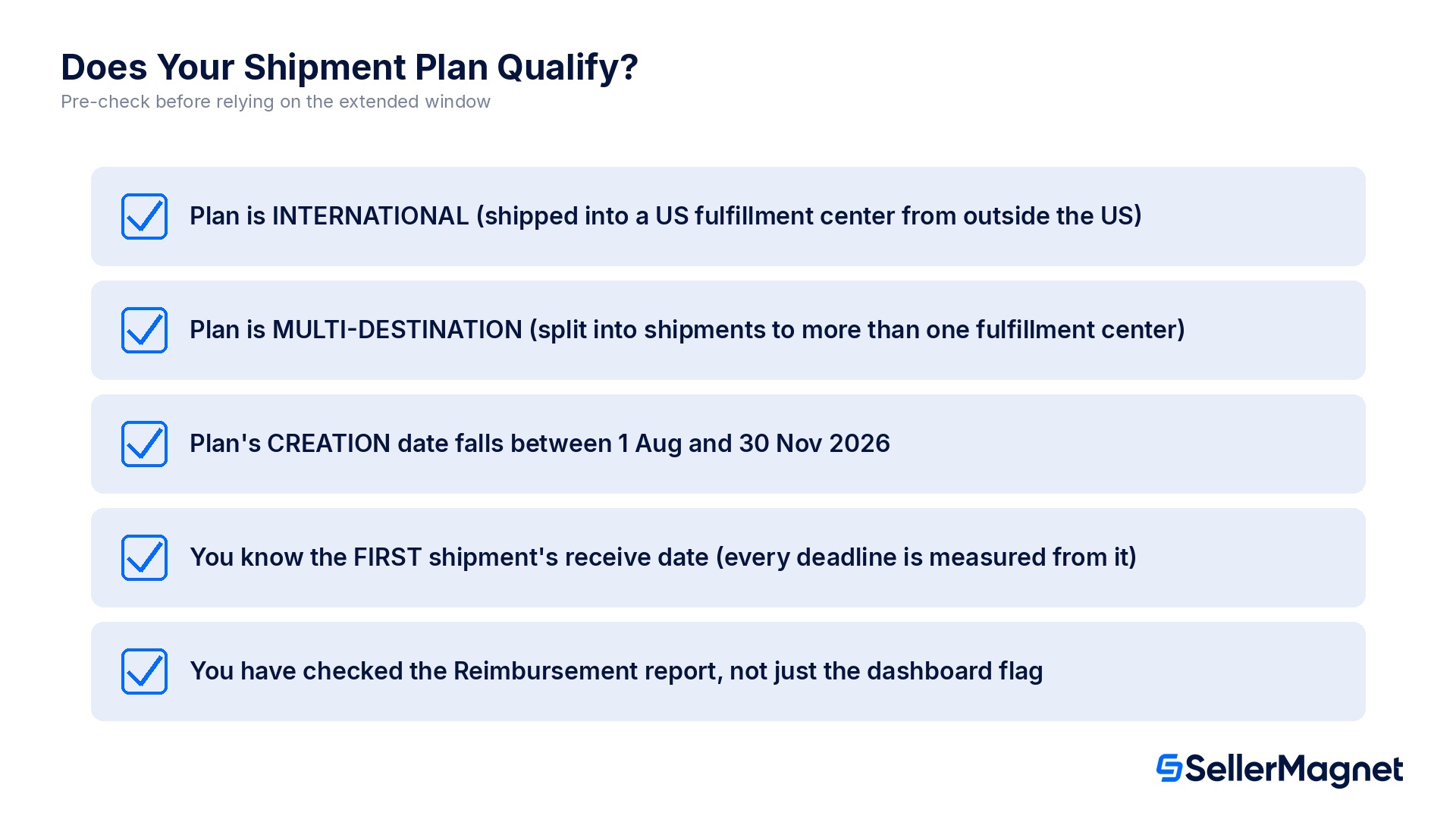
Plan is international (shipped into a US fulfillment center from outside the US), not domestic.
Plan is multi-destination (split by Amazon into shipments going to more than one fulfillment center).
Plan's CREATION date falls between 1 August 2026 and 30 November 2026.
You know the receive date of the FIRST shipment in the plan, since every other shipment's deadline is measured from that date, not from the plan's creation date.
You have checked the Reimbursement report, not just the Inbound Performance Dashboard, for whether a defect fee was actually charged.
What exactly did Amazon change for peak season 2026?
For international multi-destination shipment plans created between 1 August 2026 and 30 November 2026, Amazon extended the related-shipment arrival window from 30 to 45 days and the automatic shipment-closure window to 90 days, giving a genuinely slow in-transit shipment more runway before a defect fee applies or the shipment is closed out.
Does this change the 75-day international shipment arrival rule?
No. The baseline rule that an international shipment must arrive within 75 days of its creation date, or 45 days for a domestic shipment, is completely unchanged. This extension covers a different, narrower clock: the gap between the first shipment received in a multi-destination plan and the later ones in that same plan.
Do I need to request this extension or apply for it?
No. Amazon identifies eligible shipments automatically based on the plan's creation date and the destination structure, and applies the extended related-shipment window, the extended closure window, and any resulting reimbursement without any seller action, request, case, or form.
What if I already paid a defect fee that should have been waived?
Amazon states explicitly that any inbound defect fee already charged on a shipment that turns out to be eligible under this extension is reimbursed automatically, and the credit appears in the Reimbursement report. Check that report directly rather than assuming the reimbursement happened.
Does the extension apply to domestic shipments too?
No. Both extensions are explicitly scoped to international shipment plans only. A domestic multi-destination plan, even one created inside the same 1 August to 30 November window, still runs on the normal, unextended 30-day related-shipment window and the standard closure timing, since the announcement names international plans specifically.
What happens to a shipment plan created in October but with shipments still arriving in December?
Eligibility is based on the plan's creation date, not the date individual shipments actually arrive, so a plan created inside the 1 August to 30 November window still qualifies for both extended clocks even if one or more of its shipments physically arrive after 30 November, as long as the plan itself was created within the stated window.
Will this extension still apply after 30 November 2026?
No. Amazon describes it explicitly as a temporary peak-season measure scoped to shipment plans created between 1 August and 30 November 2026. Any international multi-destination plan created after that date falls back to the standard 30-day related-shipment window and the normal closure timing, with no extension carried forward into the new year.
Stop Juggling Tools. SellerMagnet Combines Everything You Need.