Amazon Seller Identity Verification 2026: Call and Documents
R
RenéFreelance Amazon Editor
|
14 min read
A seller finishes registration, uploads an ID, and never thinks about identity verification again, until one day a Performance Notification asks for it a second time: a video call, a stack of documents, and a deadline measured in days. Amazon runs identity verification twice, in two very different modes, and sellers who only know the first one are unprepared for the second. This guide works from Amazon's own registration guide, its seller-verification help pages, the Business Solutions Agreement itself, and the documented reactivation process to lay out exactly what each mode asks for, who has to be on the call, and what the Account Health Assurance protection does and does not cover.
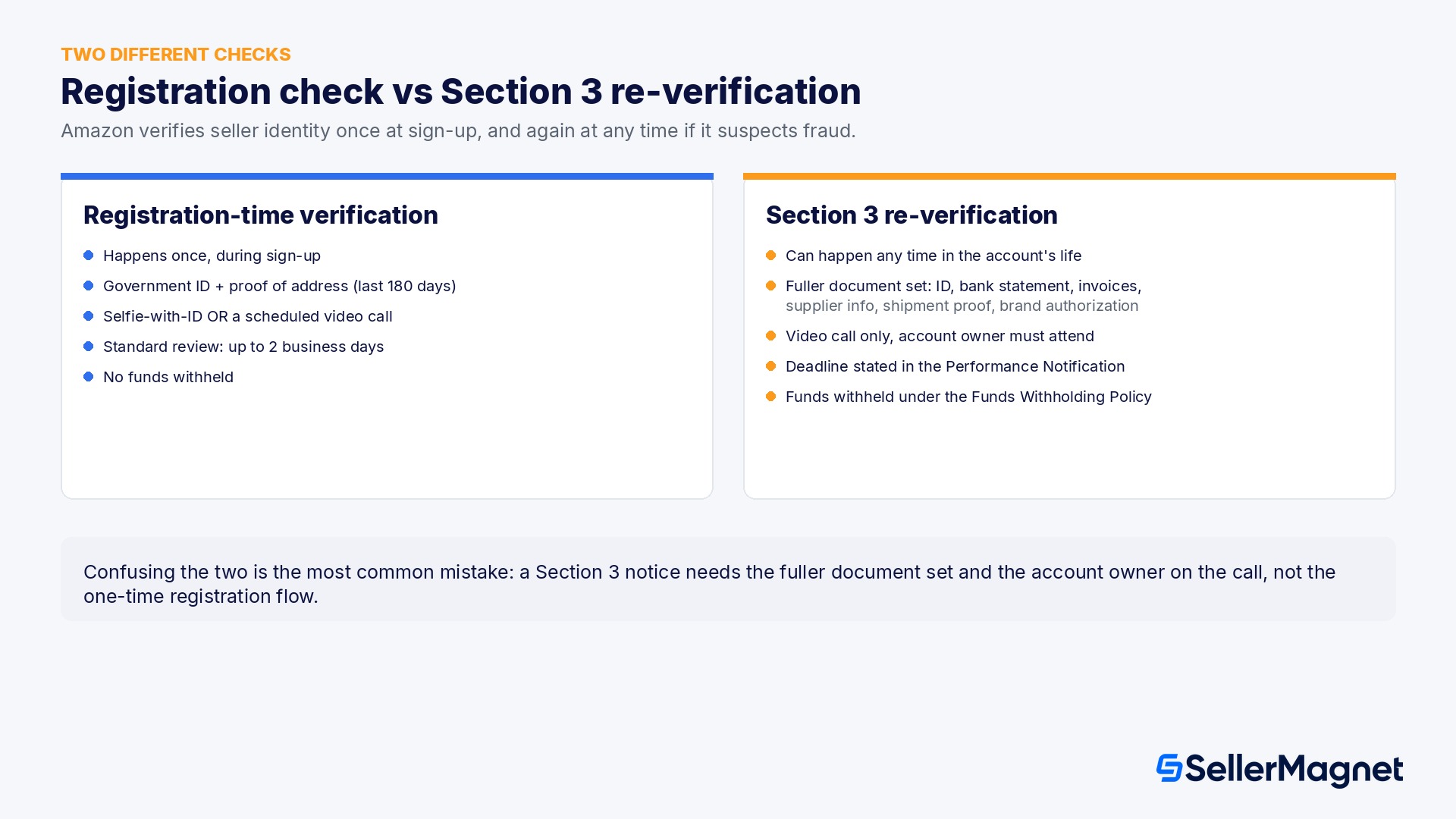
Amazon seller identity verification happens in two modes. The first is a one-time registration step: upload a government-issued ID and a proof-of-address document, then either take a selfie with your ID or join a scheduled video call with an Amazon associate, after which Amazon's help page says a standard review can take up to 2 business days. The second is a Section 3 re-verification, which can happen at any point in the account's life if Amazon suspects fraud or a policy violation; it requires the account owner personally on a video call with a specific document list, and Account Health Assurance does not protect against it because that program explicitly excludes suspected fraud.
Why do sellers get asked to verify identity twice?
Amazon's own registration guide describes identity verification as step 5 of signing up to sell: after providing business, personal, billing and store information, every new seller uploads a government-issued ID and a proof of residential or business address dated within the last 180 days, then either takes a photo of their face next to the ID or joins or schedules a video call with an Amazon associate. This step happens once, as part of onboarding, and most sellers never see it again.
The second mode is different in purpose, trigger and stakes. Amazon's Business Solutions Agreement states plainly that Amazon "may at any time require you to provide any financial, business or personal information we request to verify your identity," and that providing it "is a condition precedent to further disbursements following account suspension or termination." This is the mechanism behind the Performance Notifications sellers describe on the forums: an account flagged under Section 3 of the Agreement for suspected deceptive, fraudulent or illegal activity is asked to complete a fresh virtual identity verification, on a deadline, with payouts held in the meantime. Confusing the two modes is the most common mistake a seller makes reading about this topic online, since the document list, the deadline pressure and the consequences of a failed attempt are not the same.
Mode 1: registration-time verification
At registration, Amazon's help pages describe the verification page as adapting to the seller's business type and country, but the documents it asks for follow the same pattern everywhere: an identity document matching the proof-of-identity information already entered, a business verification document where the account is registered to a company, and a proof-of-address document. The person completing this step is called the primary contact person, and the name on the submitted ID must match the name entered as the primary contact in the seller account; a mismatch is one of the most common reasons a registration verification stalls.
Document
What Amazon checks
Common rejection reason
Government-issued photo ID
Issued by the country of the applicant's citizenship or residence; must be legible and current
Expired document, or a name that does not match the primary contact name on file
Proof of address
A bank or credit card statement dated within the last 180 days, showing the residential or business address
A statement older than 180 days, or an address that does not match the one entered at registration
Business verification document
Company registration documents showing the legal business name and address (business accounts only)
A document that does not match the business name entered on the account
Once every document is uploaded, Amazon's help page states Seller Central shows a confirmation message and that Amazon will review the submission and may contact the seller for clarification within 2 business days. A seller who chooses the video-call option instead of the selfie photo brings the same government-issued ID and proof-of-address document to the call; Seller University publishes a short video on preparing for it, which Amazon's own help page links to directly rather than leaving sellers to guess the format.
Mode 2: Section 3 re-verification, the one that catches sellers off guard
A Section 3 case starts with a Performance Notification, not a routine prompt, and the wording sellers report receiving is specific: Amazon states it believes, or its checks determine, that the account may be being used for deceptive, fraudulent or illegal activity, citing Section 3 of the Business Solutions Agreement, and asks for a virtual identity verification on a video call to resolve it. Funds already earned are not released during this period; Amazon's own notice text ties this to the Funds Withholding Policy, and a seller's payouts stay held in the account regardless of whether the review eventually clears them.
Document category
What to actually include
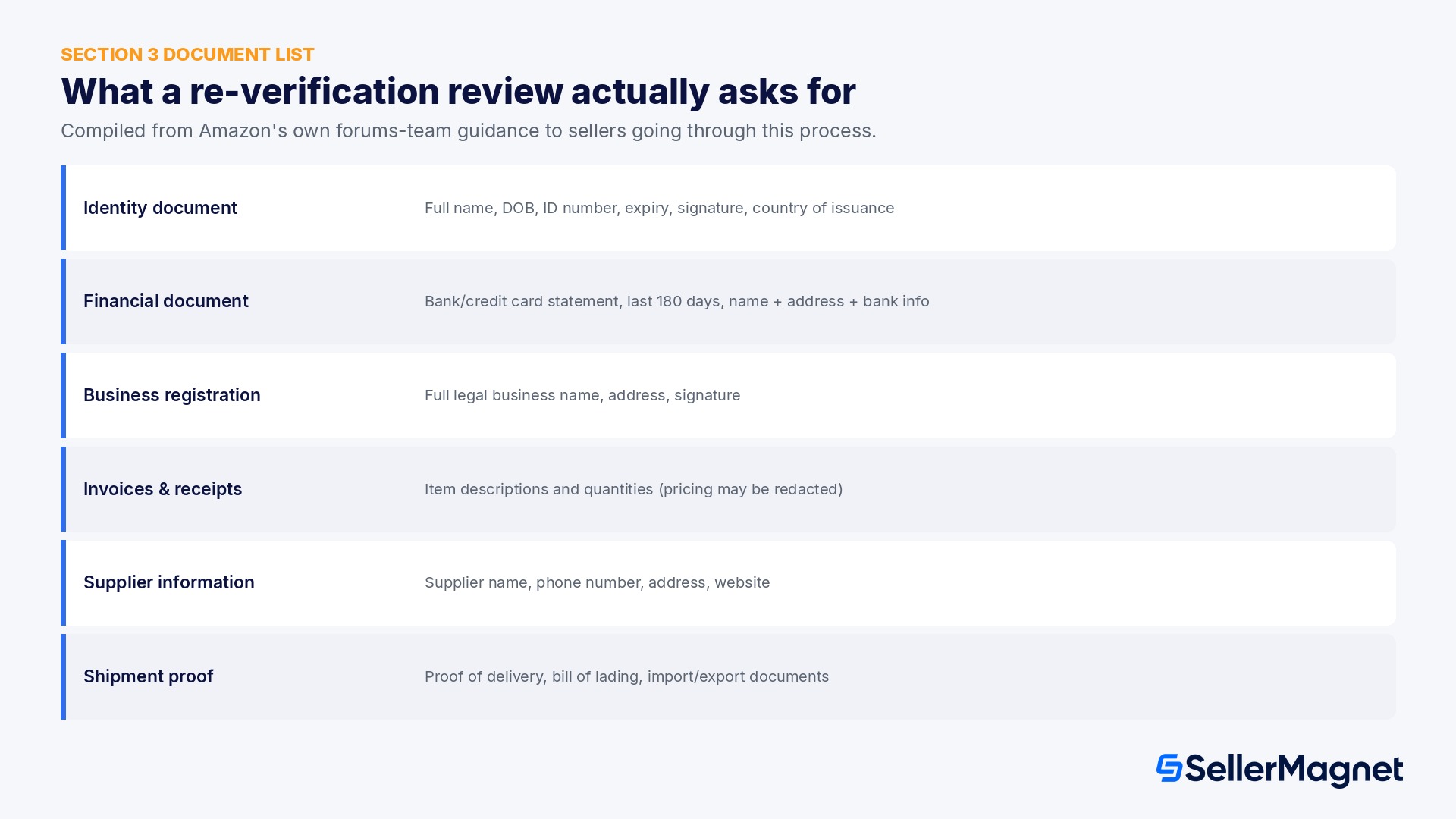
Identity document
Full name, date of birth, ID number, expiry date, signature of the bearer where applicable, country of issuance or citizenship
Financial document
A bank or credit card statement issued in the last 180 days, showing the individual's or business's full name, address and bank information
Business registration documents
Full legal business name, address and signature, matching the business profile on the account
Invoices and receipts
Item descriptions and quantities; pricing information may be removed, but the rest of the document must stay visible
Supplier information
Supplier name, phone number, address and website
Shipment proof
Proof of delivery from the carrier, bill of lading, import and export documents (commercial invoices, origin and destination locations, brand information, quantity, date, buyer information)
Brand authorization
Authorization letters from brands or their licensed distributors, where the account sells a branded product
Not every category applies to every seller; a private-label account with no third-party brand relationship skips the brand-authorization row, for instance. The list above is compiled directly from Amazon's own forums-team responses to sellers going through this process, which is the most specific public source available since the Business Solutions Agreement itself only states the general right to request information, not an itemized list.
Who is allowed on the video call?
Amazon's US Seller Forums team has answered this question directly, and the rule is narrower than many sellers assume: the call must be conducted by the account owner, meaning the individual or business owner who registered the account, not an employee, a virtual assistant, or an outside consultant standing in. The same guidance allows a translator to join if needed, and allows another person associated with the store, such as a named business partner, to be introduced during the call, but the account owner has to be the one driving it. Sellers who send an authorized representative in their place, even a trusted one, are running a real risk of the call being treated as invalid.
Amazon's forums team has also stated, in a separate guidance post, that the call can happen at different points in a seller's selling journey, not only at registration; this is the forum-level confirmation that a Section 3 video call is a distinct, later event from the one-time registration check, run by the same identity-verification system but triggered for a different reason.
Section 3 re-verification: notice to decision, step by step
Respond to an Amazon Section 3 identity re-verification notice
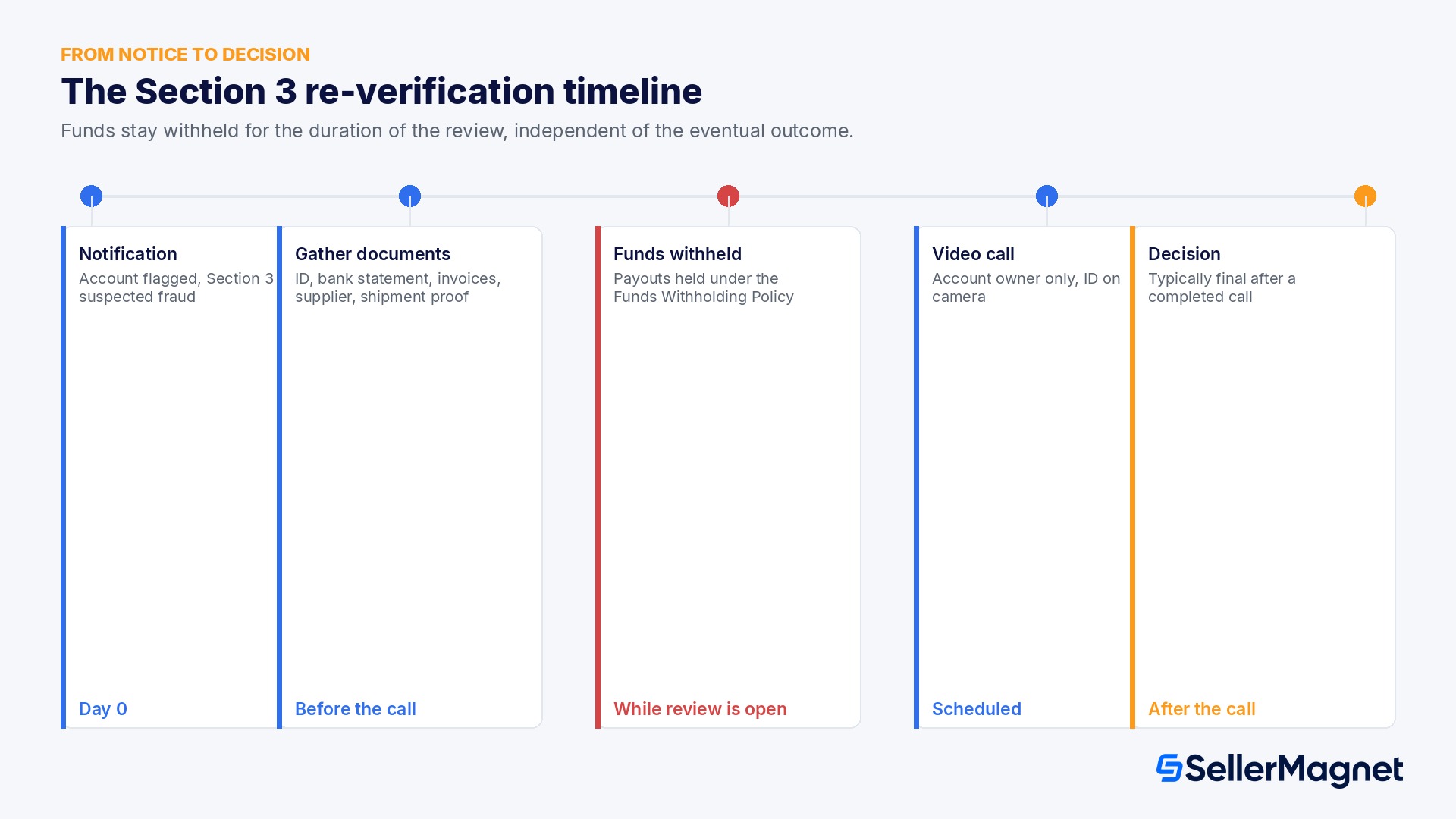
Read the exact Performance Notification - Note the specific deadline it states (seller reports commonly cite 14 days) and whether it names a document list or only the video-call requirement.
Gather every document before scheduling - Collect the identity, financial, business, invoice, supplier and shipment documents that apply to the account; arriving at the call without them is a common reason reviews stall.
Confirm who has to attend - The account owner personally conducts the call; add a translator or a named business partner only if genuinely needed, never a substitute for the owner.
Join the scheduled video call - Present the government-issued ID and supporting documents on camera as instructed; funds remain withheld under the Funds Withholding Policy while the review is open.
Receive Amazon's decision - Sellers report that a decision after a completed call is typically treated as final by Amazon's process, which is why document completeness before the call matters more than requesting a second attempt afterward.
Why does Account Health Assurance not cover this?
Account Health Assurance is Amazon's stated protection against account deactivation for sellers with a strong track record: it applies to professional sellers whose Account Health Rating has stayed at or above 250 for at least 6 consecutive months, with no more than 10 days below that line, and a valid emergency contact number on file. Once those conditions are met, Amazon's own FAQ commits to resolving an issue within 72 hours of reaching out instead of deactivating the account outright.
Account Health Assurance has a fraud exception
Amazon's Account Health Assurance FAQ states the protection does not apply where Amazon believes the account is involved in fraud or illegal activity. A Section 3 identity re-verification exists specifically because Amazon suspects deceptive, fraudulent or illegal activity, so it sits inside the exact exception Account Health Assurance carves out. A seller with a perfect Account Health Rating is not shielded from a Section 3 video-call requirement by that score alone.
A Section 3 review holds funds, but it does not pause the business. SellerMagnet's Analytics Dashboard keeps showing net profit per order, product and marketplace from your own stored order history even while a payout is withheld, so you still know your real numbers once funds release. The Alert System tracks Buy Box and listing-level signals outside Seller Central, which matters most on the days a seller is focused entirely on a verification deadline. For the score behind the protection discussed above, see our Amazon Account Health Rating guide.
What turns a routine check into a long one?
Sending someone other than the account owner to the video call, which Amazon's own forums guidance says is not how the process is meant to run.
Submitting a proof-of-address document older than 180 days, the single most common document-level rejection at registration.
A name mismatch between the submitted ID and the primary contact name on file, which stalls review regardless of how complete the rest of the submission is.
Treating a Section 3 notice like the one-time registration check and showing up to the call without the fuller document list (financial statements, invoices, supplier information, shipment proof) that a fraud-suspicion review actually asks for.
Assuming a strong Account Health Rating or an active Account Health Assurance enrollment will excuse the requirement, when the program's own FAQ states it does not cover suspected fraud or illegal activity.
Waiting until close to the stated deadline to gather documents that take days to obtain, such as a fresh bank statement or a brand authorization letter.
Treat a Section 3 notice as a documentation project, not a quick call
The video call itself is usually short; assembling a complete, accurate document set beforehand is the part that takes real time. Sellers who gather every applicable category from the table above before scheduling consistently describe a smoother single call, which matches Amazon's own framing that a completed, well-documented submission is what the review is actually judging.
Worked example: a seller account caught in a Section 3 notice
A private-label seller account on Amazon.com receives a Performance Notification stating Amazon's checks determined the account may be used for deceptive or fraudulent activity under Section 3, and that a virtual identity verification is required within a stated deadline. Payouts already earned stop releasing the moment the notice lands, under the Funds Withholding Policy, regardless of whether the seller has done anything wrong; the hold is tied to the open review, not to a finding of fault.
The account owner, not the hired PPC manager who usually answers Seller Central messages, is the one who has to read the notice and respond. Working backward from the document table above, the owner pulls a bank statement issued in the last 180 days, the business registration certificate, a set of recent supplier invoices with item descriptions and quantities (pricing redacted), the supplier's name and contact details, and a bill of lading from the most recent inbound shipment. None of these documents takes more than a day to request from a supplier or a bank, but gathering all of them on the morning of a scheduled call is the single most common reason a seller asks for the call to be rescheduled, which only extends the time funds stay withheld.
On the call, the owner presents the government-issued ID on camera first, since that single document anchors every other document to the same legal name, then works through the financial and shipment evidence in the order Amazon's representative requests it. A seller who has never checked whether their Account Health Rating qualifies for Account Health Assurance might assume that protection applies here; it does not, because the program's own exception for suspected fraud covers exactly this notice type, independent of how healthy the account's other metrics are.
Does this work the same way on every marketplace?
The underlying document categories, an identity document, a proof of address, and business registration where applicable, are consistent across Amazon's seller-verification help pages for different country stores, and the registration guide's step-5 language (a selfie-with-ID or a scheduled video call) is the same mechanic everywhere. What does vary by marketplace is the specific document Amazon accepts as proof of address or business registration, since a utility bill accepted in one country may not be the standard proof-of-address document type in another; a seller running a unified account across several Amazon stores should confirm the accepted document list on each store's own help pages rather than assuming the US list transfers directly.
A Section 3 case is also account-wide rather than store-specific in its consequence: a flagged account's funds-withholding and verification requirement apply to the Seller Central account as a whole, not only to the marketplace where the triggering activity was identified, since a single login and a single set of payout settings sit behind every connected store.
What should be ready before any identity verification call?
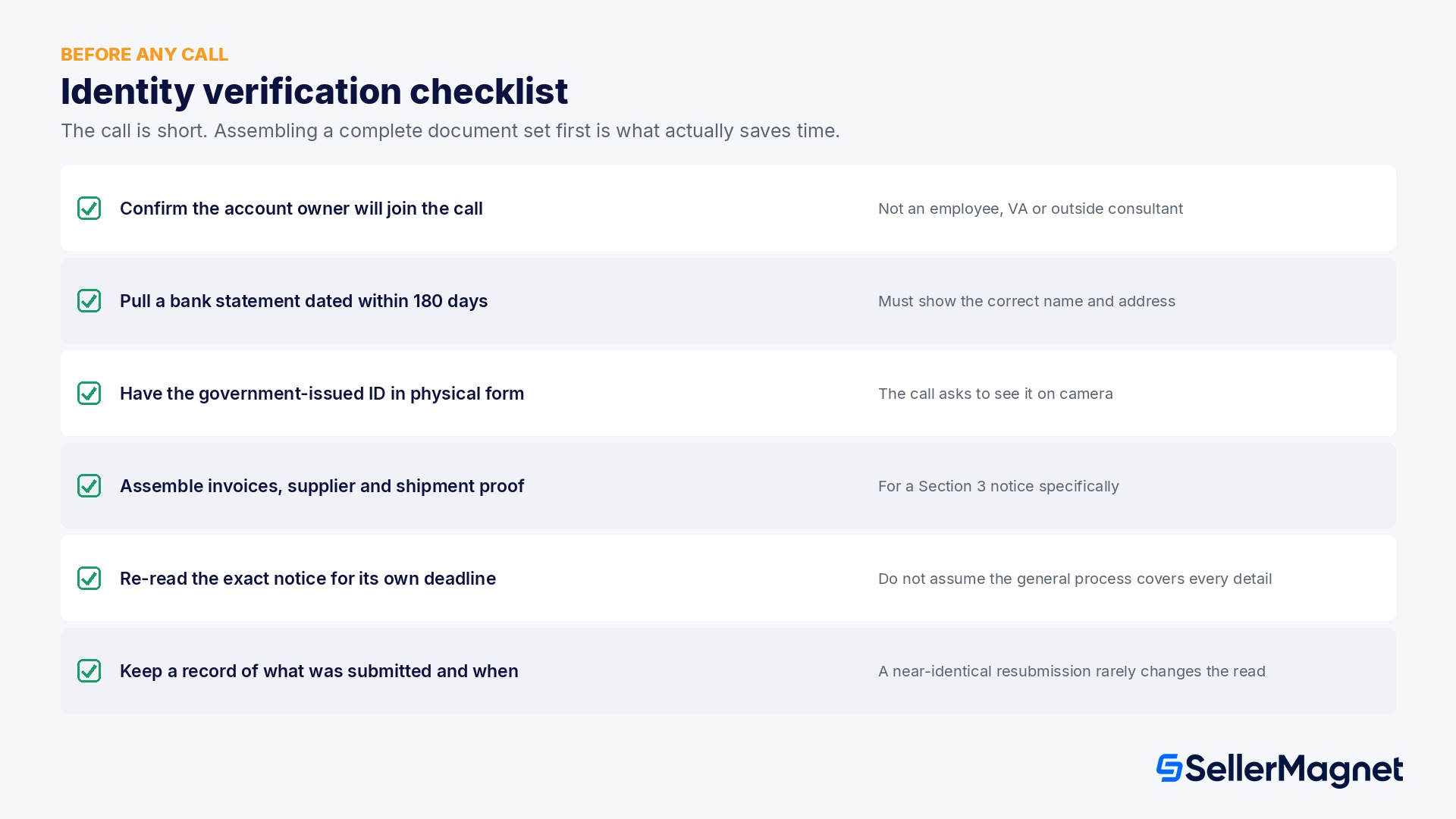
Confirm the account owner, not an employee or agency contact, is the one who will join the call.
Pull a bank or credit card statement dated within the last 180 days showing the correct name and address.
Have the government-issued ID ready in physical form, not only a scanned copy, since the call itself asks to see it on camera.
For a Section 3 notice specifically, assemble invoices, supplier contact details, shipment proof and any brand authorization letters that apply to the flagged products.
Re-read the exact wording of the Performance Notification for the stated deadline and document list before assuming the general process above covers every detail of that specific case.
Keep a record of what was submitted and when, since a seller cannot resubmit a near-identical set a second time and expect a different read without something genuinely new in it.
Is Amazon seller identity verification a one-time step?
The registration-time check is one-time, done during sign-up. Amazon's Business Solutions Agreement also allows a re-verification at any point in the account's life, most often triggered by a suspected Section 3 fraud or policy issue, so the same system can ask again later for a different reason.
Who has to attend the identity verification video call?
Amazon's own forums team states the call must be conducted by the account owner, the individual or business owner who registered the account. A translator or a named business partner may join, but an employee or outside consultant cannot stand in for the owner.
Does Account Health Assurance protect against a Section 3 identity check?
No. Account Health Assurance's own FAQ excludes cases where Amazon believes the account is involved in fraudulent or illegal activity, which is the exact trigger for a Section 3 re-verification, so the protection does not apply to it.
Are funds released while a Section 3 review is in progress?
Sellers report that funds are withheld under Amazon's Funds Withholding Policy for the duration of the review, independent of the eventual outcome, so a payout can stay held until the identity check is resolved.
What documents does a Section 3 re-verification usually ask for?
Based on Amazon's own forums-team guidance, common categories include a government-issued ID, a recent bank or credit card statement, business registration documents, invoices and receipts, supplier information, shipment and import or export proof, and brand authorization letters where applicable.
Can I complete identity verification with a selfie instead of a video call?
At registration, Amazon's own guide offers a choice: take a photo of your face with your government-issued ID, or join or schedule a video call with an Amazon associate. A Section 3 re-verification, by contrast, is described in seller reports as a video call requirement, not a selfie option.
Stop Juggling Tools. SellerMagnet Combines Everything You Need.