Amazon Vendor Central vs Seller Central 2026: 1P vs 3P
R
RenéFreelance Amazon Editor
|
15 min read
An invitation email from Amazon's vendor recruitment team lands in your inbox, offering to buy your products wholesale through Vendor Central. It looks like a promotion. It is really a different business model with a different retail price, a different seller of record, and a different set of deductions coming off every invoice. This guide lays out exactly what changes between Seller Central (third-party, 3P) and Vendor Central (first-party, 1P), what the common deduction types actually are, whether you can run both at once, and a worked example of the same product's profit under each model.
Seller Central is Amazon's open, third-party selling program: you register yourself, set your own retail price, and sell directly to customers, paying a referral fee plus fulfillment fees if you use FBA. Vendor Central is Amazon's invitation-only, first-party wholesale program: Amazon's retail team invites a brand, the brand sells inventory to Amazon at a wholesale price it proposes, and Amazon becomes the seller of record, sets the retail price, and handles the customer relationship. Vendors are paid on invoiced terms, minus co-op, freight, damage and compliance-chargeback deductions. A brand can run both programs at once, even on the same product.
How you get in: open registration vs an invitation only Amazon sends
Amazon's own Seller Central page answers this directly in its FAQ: "Seller Central is open to business owners and entrepreneurs who want to offer products to customers as third-party sellers in the Amazon store. To register as an Amazon seller, go to sell.amazon.com and select Sign up. Vendor Central is by invitation only from Amazon. It's a first-party vendor relationship. Instead of selling directly to customers, vendors sell in bulk (wholesale) to Amazon. Amazon then provides distribution of a brand or manufacturer's product." There is no public Vendor Central sign-up form; Amazon's category and vendor-recruitment teams extend the invitation to brands and manufacturers they want to buy from.
Who sells to the customer, and who sets the price
The split is cleanest on this point. In Seller Central you keep the seller-of-record role: you list the product, you set the retail price, you manage inventory and fulfillment (yourself or through FBA), and you keep the margin between your cost and whatever a customer pays after fees. In Vendor Central, Amazon issues purchase orders at a wholesale price you proposed, Amazon takes ownership of that inventory, and Amazon becomes the seller of record. Amazon sets its own retail price on the product page, independent of your wholesale price, and Amazon's own customer service answers the buyer. Amazon's Seller Forums post on this topic puts the vendor side plainly: "As a Vendor, you set the wholesale price and ship products to Amazon, who then handles the retail pricing, inventory management, fulfillment, and customer experience... Vendor Central provides access to Amazon's massive customer base and fulfillment capabilities, but with less control over the end-to-end selling process."
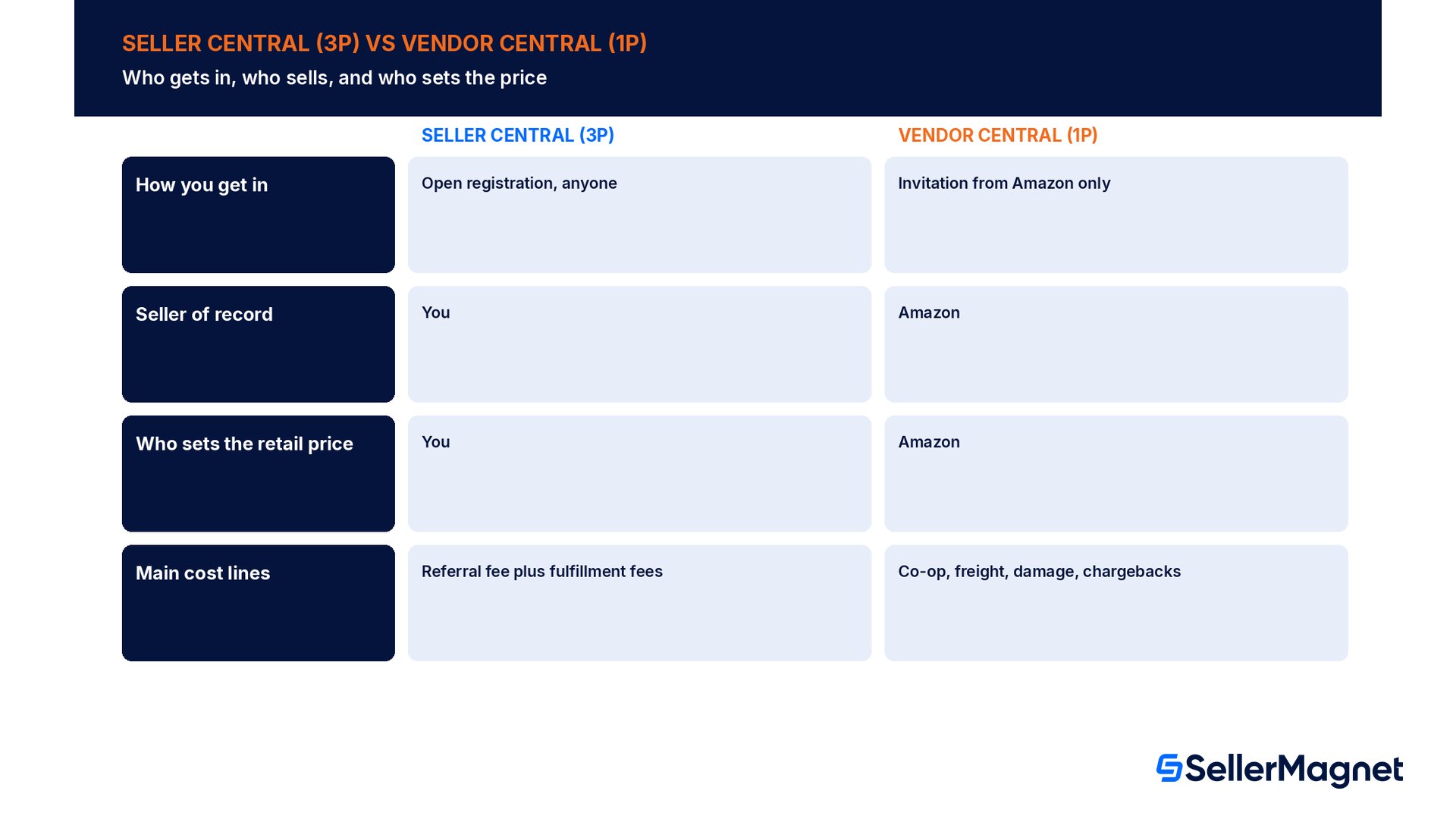
Seller Central (3P)
Vendor Central (1P)
How you get in
Open registration, any time
Invitation from Amazon only, no public application
Seller of record
You
Amazon
Who sets the retail price
You
Amazon
How you sell
Directly to the customer
Wholesale, by purchase order, to Amazon
Order flow
Customer orders through your listing
Amazon issues POs; you ship or deliver against them (often via EDI)
Customer service
You, unless FBA or opted into a service
Amazon
Support channel
Seller Support, forums, help pages
Amazon's dedicated Vendor Management team
Main cost lines
Selling plan fee, referral fee, FBA and storage fees if used
Co-op, freight and damage allowances, compliance chargebacks
Where the money actually goes on each side
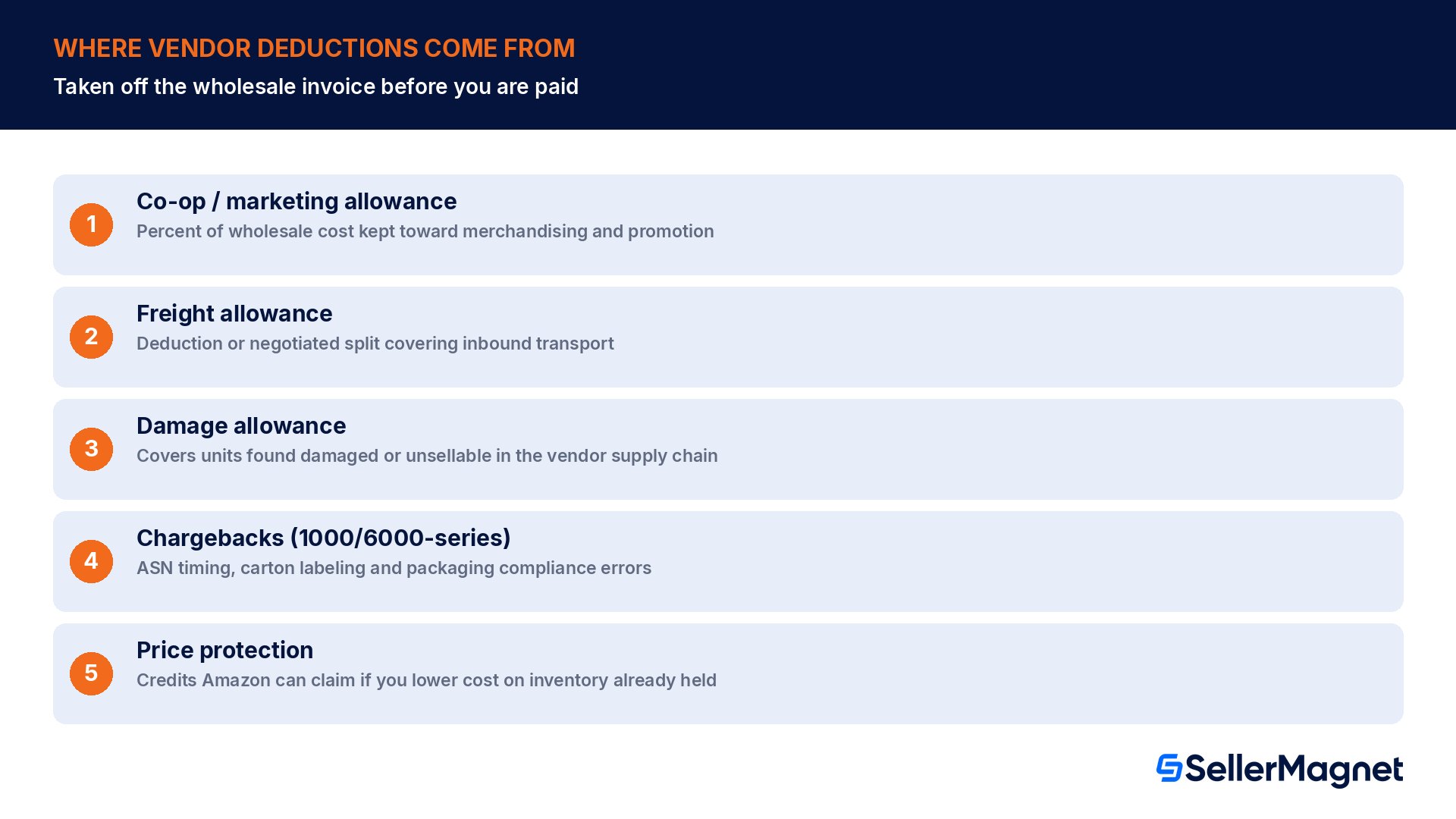
On the Seller Central side the math is visible on every order: retail price, minus a category referral fee, minus an FBA or FBM fulfillment cost, leaves your proceeds. On the Vendor Central side the visible number is your invoice to Amazon at the agreed wholesale (cost) price, and the deductions come off that invoice before you get paid, on payment terms that commonly run 30 to 90 days. The deduction types that recur across vendor-management guidance are:
Deduction (1P)
What it covers
Co-op / marketing allowance
A negotiated percentage of the wholesale cost that Amazon keeps toward merchandising, promotion and related costs, whether or not you see dedicated marketing for your SKU.
Freight allowance
A deduction, or a negotiated split, covering who pays to move the inventory from you into Amazon's network.
Damage allowance
A deduction to cover units that arrive or are found damaged or unsellable in the vendor supply chain.
Chargebacks
Deductions for compliance errors against Amazon's vendor requirements: a late or missing advance shipment notice (ASN), a wrong or missing carton label, or incorrect prep/packaging. These are invoice deductions for process mistakes, not card-network chargebacks, and vendors can dispute them with supporting documentation within a limited window.
Price protection
Credits Amazon can claim if you lower your wholesale cost on inventory Amazon is already holding.
There is no official Amazon figure for how much chargebacks cost
Amazon's own public pages do not publish a chargeback-code table or an average loss percentage. Third-party vendor-management sources (not Amazon) commonly report new vendors losing a low single-digit percentage of gross wholesale revenue to chargebacks in their first year, driven mainly by ASN-timing and carton-labeling errors. Treat that as an industry estimate to plan around, never as an Amazon-stated number, and track your own actual deductions from day one.
How a vendor purchase order actually moves, and where chargebacks start
A Seller Central listing takes an order the moment a customer clicks buy. A Vendor Central relationship works in the opposite direction: Amazon's buying team decides how much of a product it wants, issues a purchase order against a forecast, and the vendor fills that PO on a schedule Amazon sets. Larger vendor programs typically run this exchange over EDI (electronic data interchange) directly between the vendor's system and Amazon's, rather than by hand in a web portal, because the PO, the advance shipment notice and the invoice all need to reconcile automatically at volume.
That reconciliation step is exactly where most new-vendor chargebacks originate. Industry vendor-management guidance (not an Amazon-published source) groups the recurring chargeback categories into two families: a 1000-series tied to advance shipment notice (ASN) accuracy (the ASN submitted late, a quantity mismatch against the PO, or a missing or unreadable FNSKU label), and a 6000-series tied to prep and packaging (missing poly-bagging, incorrect bubble-wrap, or product-level labeling errors against the current routing guide). A separate, commonly cited category covers missed delivery windows at the carrier-appointment stage. Every one of these is a process-discipline issue rather than a pricing issue, which is why two vendors selling an identical product at identical wholesale terms can land on very different realized margins depending purely on how tight their shipping operation is.
Chargebacks are disputable, within a window
Vendor-management sources describe a documented-dispute process (commonly reachable from an Orders or Chargebacks area inside Vendor Central) where a vendor uploads supporting evidence, such as a bill of lading, carrier tracking, or packaging photos, within a limited window, commonly cited as around 60 days. Well-documented disputes are reported to succeed a meaningful share of the time, which is a strong argument for logging every shipment's paperwork from day one rather than treating chargebacks as a fixed cost to absorb.
What happens to your brand and catalog control
Giving up the seller-of-record role changes more than who answers support tickets. On Seller Central, you (or your Brand Registry account) typically control the listing content itself: title, images, bullet points, A+ Content and the product detail page. On Vendor Central, Amazon's retail team can edit the live product page independently, including the retail price, promotions and sometimes the content, since Amazon now owns the inventory and the customer transaction. A brand that cares about tightly controlling its page's exact wording, imagery or price positioning gives up some of that control the moment a unit sells through the vendor channel rather than the seller channel, even on an otherwise identical listing.
This is also why many brands deliberately keep a Seller Central presence even after accepting a vendor invitation: running select SKUs, new launches, or marketplaces Amazon has not yet offered to buy wholesale through the seller account preserves direct pricing and content control precisely where that control matters most, while still accepting Amazon's wholesale terms on the SKUs where the volume and logistics economics favor it.
Direct Fulfillment: the vendor variant that skips Amazon's warehouse
Not every vendor relationship routes inventory through an Amazon fulfillment center first. Under Vendor Central's Direct Fulfillment option, the vendor keeps the inventory in its own warehouse and ships the customer's order directly once Amazon generates it, rather than sending stock into Amazon's network in advance. The commercial relationship is still vendor economics, governed by the negotiated wholesale price and terms, not the 3P referral-fee model, but the fulfillment step itself bypasses an Amazon FC entirely. Seller-forum discussion of this option notes it can suit higher-priced, higher-shipping-cost products particularly well, since the vendor is not paying to move expensive, bulky inventory into Amazon's network before a single unit sells, and the per-order shipping cost is absorbed under vendor terms rather than charged as a 3P referral fee on the full sale price including shipping.
This matters when comparing models for a specific catalog: a product that is awkward or costly to ship through standard FBA (oversized, fragile, or simply expensive enough that holding inventory at Amazon ties up real capital) can look very different once Direct Fulfillment vendor terms are on the table, compared to the straightforward wholesale-into-FBA-style flow most of this guide assumes. The core trade-off is the same as everywhere else in this comparison though: you give up the seller-of-record role and direct pricing control in exchange for Amazon handling the retail side, and the real answer is still SKU by SKU math, not a blanket preference for one fulfillment style.
Returns, inventory ownership and who absorbs a damaged unit
Inventory ownership flips at different points in each model, and that changes who absorbs a damaged or returned unit. On Seller Central, you own your inventory until it sells (and, for FBA stock, Amazon's reimbursement policy covers units it loses or damages in its own warehouse, a process entirely separate from the vendor side). On Vendor Central, ownership transfers to Amazon once it accepts a purchase order's shipment, which is also roughly the point a vendor's revenue is recognized. From there, a damaged allowance (see the deduction table above) is typically how a vendor is compensated for units that turn up damaged or unsellable in the vendor supply chain, rather than a unit-by-unit reimbursement claim process like FBA sellers use. A customer return on a vendor-sold unit is Amazon's to process end to end, since Amazon is the seller of record; the vendor generally does not see that individual return transaction at all, only its aggregate effect on future purchase order volume.
Worked example: the same product, two models
Take one product a brand could sell either way. Assume a 3P retail price of $20.00, a representative 15 percent referral fee, a representative $4.20 FBA fulfillment fee, and $6.50 cost of goods per unit. On Seller Central: referral fee $3.00 plus the FBA fee gives total fees of $7.20, leaving proceeds of $12.80 and, after cost of goods, a profit of $6.30 per unit (a 31.5 percent margin on the retail price).
Now assume Amazon invites the same brand and agrees an assumed $9.00 wholesale cost price for the same product. A 3 percent co-op allowance is $0.27, plus an assumed $0.20 freight allowance, an assumed $0.10 damage allowance and an assumed $0.15 of chargebacks, for total deductions of $0.72. That leaves a net invoice of $8.28, and after the same $6.50 cost of goods, a profit of $1.78 per unit (a 19.8 percent margin on the wholesale price), $4.52 less than the Seller Central result on these assumed numbers. Every number here is a labelled assumption for illustration, not an Amazon-published rate; a real invitation's wholesale price and allowance terms are negotiated per brand and per SKU, and a brand with Amazon-level logistics efficiency, large volume, or a product that is expensive and slow to ship itself could easily see the comparison flip the other way.
Model it SKU by SKU before you decide
Run this same comparison with your real wholesale offer, your real cost of goods, and your real referral and fulfillment fees for the same product, side by side, before accepting or declining a Vendor Central invitation. Some SKUs net out better under each model; a blanket decision across a whole catalog usually leaves money on one side or the other.
Can you run both at the same time?
Yes. Both programs can coexist, even for the identical product. A brand can operate a Seller Central account and a Vendor Central account simultaneously, because Amazon treats them as separate services for separate business models, and a seller and a vendor relationship can sell the same ASIN at the same time. In practice this is common once a brand has grown large enough to draw a vendor invitation: the brand keeps selling some SKUs or marketplaces directly as a 3P seller while also fulfilling Amazon's wholesale purchase orders on other SKUs as a 1P vendor, and the mix between the two often shifts order by order as Amazon's own buying decides which channel takes a given ASIN that month.
Whichever model wins on a given SKU, you still need the real numbers to decide.Fee Calculator works out your exact Seller Central referral and FBA fees per category so the 3P side of the comparison is not a rough estimate, and Analytics reconciles your actual Seller Central payouts against Settlement reports so you are comparing a vendor offer with your real net proceeds, not your retail price. If you are weighing a first wholesale relationship at all, our guide on starting Amazon wholesale and on Brand Registry requirements cover the groundwork most vendor invitations assume you already have in place.
Common mistakes brands make deciding between the two
Most of the bad vendor decisions this guide has seen trace back to comparing the wrong numbers, not to the model itself being a bad fit. The mistakes below recur across the vendor-management guidance this post draws on, and every one of them is avoidable with the SKU-by-SKU comparison above.
Comparing the wholesale price Amazon offers directly against the retail price you charge as a 3P seller, instead of against your own net proceeds after referral and fulfillment fees.
Accepting a Vendor Central invitation without modelling co-op, freight, damage and chargeback deductions first, so the margin on paper never matches the margin that actually lands.
Assuming accepting a vendor invitation shuts down the existing Seller Central account; the two can run in parallel, including on the same ASIN.
Treating chargebacks as a fixed, Amazon-published cost instead of a largely preventable one driven mainly by ASN timing and carton-labeling accuracy.
Ignoring payment terms (commonly 30 to 90 days as a vendor) when comparing cash flow against the faster Seller Central payout cycle.
Giving up pricing control as a vendor without checking whether price protection terms apply if Amazon changes the retail price on inventory you already shipped.
How to evaluate a Vendor Central invitation
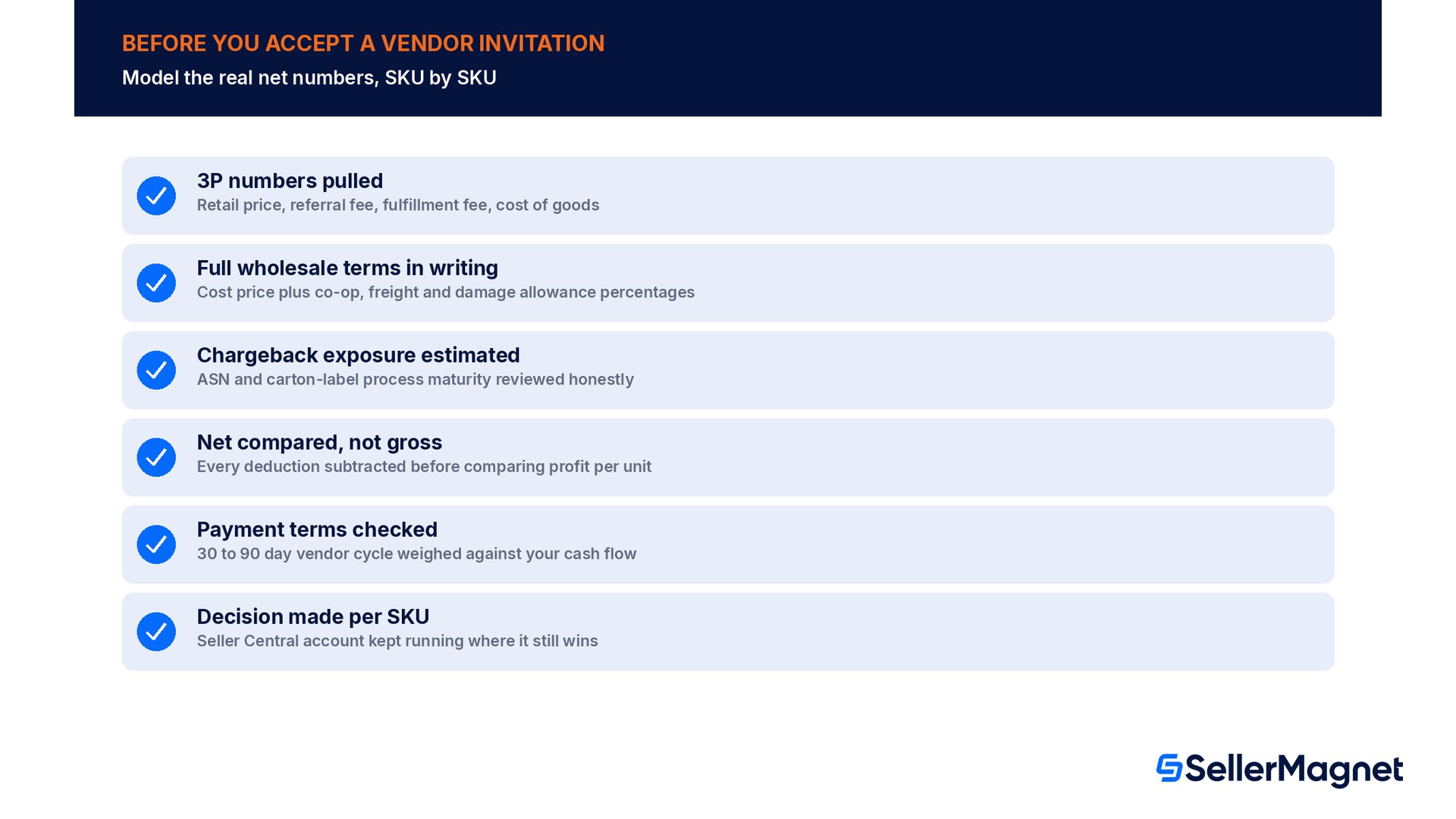
Decide whether to accept an Amazon Vendor Central invitation
Pull your current 3P numbers - For the same ASIN, write down your retail price, referral fee percentage, fulfillment fee and cost of goods, and calculate your actual net profit per unit today.
Get the full wholesale terms in writing - Ask for the proposed wholesale cost price plus the co-op, freight and damage allowance percentages before assuming the headline wholesale number is final.
Estimate chargeback exposure - Review your own shipment and labeling process maturity; a vendor with solid EDI/ASN and carton-label discipline sees far fewer compliance chargebacks than one bolting the process on for the first time.
Compare net, not gross - Subtract every deduction from the wholesale price, and every fee from the retail price, then compare the two resulting profit-per-unit numbers side by side.
Check payment terms against your cash flow - A 30 to 90 day vendor payment cycle is slower than the Seller Central payout cycle; make sure your cash flow can absorb the gap if you accept.
Decide per SKU, not per brand - Keep the Seller Central account running and move only the SKUs where the vendor terms genuinely net out better, since both can operate at once.
Can I just sign up for Amazon Vendor Central?
No. Amazon's own FAQ states Vendor Central is by invitation only; there is no public sign-up. Seller Central, by contrast, is open to anyone who registers at sell.amazon.com.
Who sets the retail price in Vendor Central?
Amazon does. A vendor proposes and negotiates the wholesale price Amazon pays, but Amazon sets its own retail price on the product page independently of that wholesale number.
What is a vendor chargeback?
A deduction Amazon takes from a vendor's invoice for a compliance error, most commonly a late or missing advance shipment notice, an incorrect or missing carton label, or a packaging or prep mistake. It is unrelated to a credit-card chargeback, and most programs allow a documented dispute within a limited window.
Can I sell on both Seller Central and Vendor Central at the same time?
Yes. Amazon treats them as separate services for different business models, and a seller and a vendor relationship can even sell the identical ASIN at the same time.
Is Vendor Central always more profitable than Seller Central?
No. It depends on the negotiated wholesale price and deduction terms versus your real 3P net proceeds after referral and fulfillment fees. Model each SKU rather than assuming either model wins by default.
How fast does Amazon pay a vendor?
Payment terms are negotiated per vendor and commonly fall in a 30 to 90 day range from invoice, which is slower than the typical Seller Central payout cycle.
Does accepting a Vendor Central invitation end my Seller Central account?
No. The two are separate accounts and services; accepting a vendor invitation does not require closing an existing seller account.
Who handles customer service for a vendor sale?
Amazon does, since Amazon is the seller of record on a 1P vendor sale. On Seller Central, you handle it yourself unless the order ships via FBA or you opt into a Customer Service by Amazon style program.
Stop Juggling Tools. SellerMagnet Combines Everything You Need.