Amazon's 2027 FBA Fee Changes: What Rises, What Gets Simpler
R
RenéFreelance Amazon Editor
|
15 min read
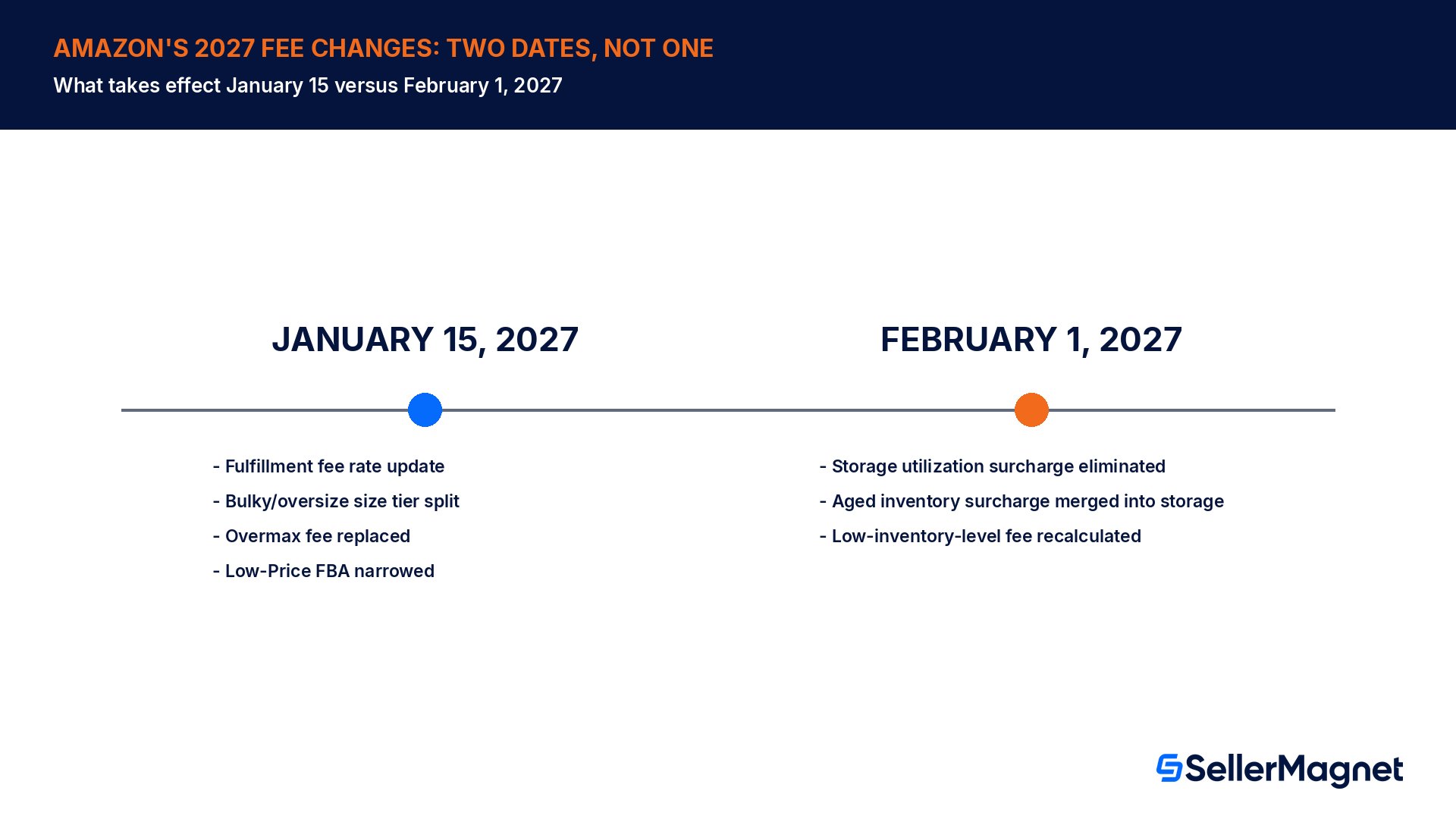
On November 5, 2026, Amazon sent every US selling partner its annual fee letter, and for 2027 the message is split into two pieces that take effect on two different dates. Fulfillment fees go up on January 15, 2027, by $0.19 per unit sold on average, roughly 0.8% of the average item's selling price. Separately, on February 1, 2027, Amazon is simplifying how storage is billed: the storage utilization surcharge disappears, the aged inventory surcharge gets folded into a single age-based monthly storage rate, and the low-inventory-level fee changes how it decides a seller is actually running low. This guide walks through the published rate tables, a worked example on exactly how much one popular size tier is rising, and what to check in your own account before the fulfillment fee change lands.
Amazon frames this year's letter differently from the 2026 one, which told sellers there would be "no new fee types in 2026" and promised at least 90 days of notice before any increase. For 2027, Amazon is keeping that same notice window, sharing the update on November 5 for changes that mostly land January 15, more than two months out, explicitly because, in Amazon's words, this news "arrives during your busiest season" and fee changes affect seller planning regardless of direction. The letter also leans on the scale of the program it is adjusting: Amazon says it delivered 8 billion items same-day or next-day across US stores last year, and that faster delivery speeds measurably lift conversion, which is the backdrop Amazon uses to justify continued investment in the fulfillment network that this fee update is meant to help pay for.
Amazon's 2027 FBA fee changes raise fulfillment fees by about $0.19 per unit on average starting January 15, 2027, while the 3.5% fuel and logistics surcharge stays the same. Separately, starting February 1, 2027, Amazon simplifies storage by removing the storage utilization surcharge and merging the aged inventory surcharge into a single age-based monthly storage rate, and changes the low-inventory-level fee to trigger only when inventory falls below 28 days of supply.
What Amazon announced, and when it takes effect
Amazon frames the 2027 update as two separate kinds of change. The first is a rate adjustment to fulfillment fees themselves, intended, in Amazon's own words, to make "each fee more closely match our cost of fulfilling that product": some products get more expensive to fulfil, others get cheaper, averaging out to a $0.19 per-unit increase. The second is a set of changes to how storage-related fees are calculated, which Amazon describes as a simplification driven directly by seller feedback that storage costs were too hard to predict. The two changes do not share a start date.
Change
Effective
What it affects
Fulfillment fee rate update
January 15, 2027
Per-unit FBA fulfillment fees across standard, bulky and oversize tiers
Size tier restructuring (bulky/oversize split)
January 15, 2027
Bulky and Extra-Large products: new, narrower size tiers
Overmax handling fee replaced
January 15, 2027
Irregular oversize products: new Flat product and Overhang handling fees
Low-price FBA eligibility narrowed
January 15, 2027
5 named fee categories lose Low-Price FBA rates in the $10-$50 band
Storage utilization surcharge eliminated
February 1, 2027
Monthly storage billing
Aged inventory surcharge merged into a unified age-based storage rate
February 1, 2027
Monthly storage billing for aged stock
Low-inventory-level fee recalculated
February 1, 2027
When the fee applies at all
How much are fulfillment fees actually rising?
The headline $0.19 average increase is exactly that, an average across every size tier and price band, so it is not the number that applies to any one product. Amazon publishes the full non-peak rate table for both the current (Jan 15, 2026 to Oct 14, 2026) and the new (Jan 15, 2027 to Oct 14, 2027) periods side by side, and the differences vary by size tier, shipping weight and the item's price band.
Product group
Price band
Average change per unit
Small standard-size
$10 to $50
+$0.40
Large standard-size
$10 to $50
+$0.12
Small standard-size
above $50
+$0.70
Large standard-size
above $50
+$0.47
Small standard-size
below $10
+$0.20
Large standard-size (non-apparel)
below $10
no change
Large standard-size apparel
below $10
+$0.08
These are Amazon's own published per-tier averages; an individual weight band inside a tier can move by a different amount again, which is why the Fee Change Comparison dashboard inside Profit Analytics matters more than any published average: it applies the new rate table directly to your own catalog.
Worked example: a small-standard item in the $10 to $50 band
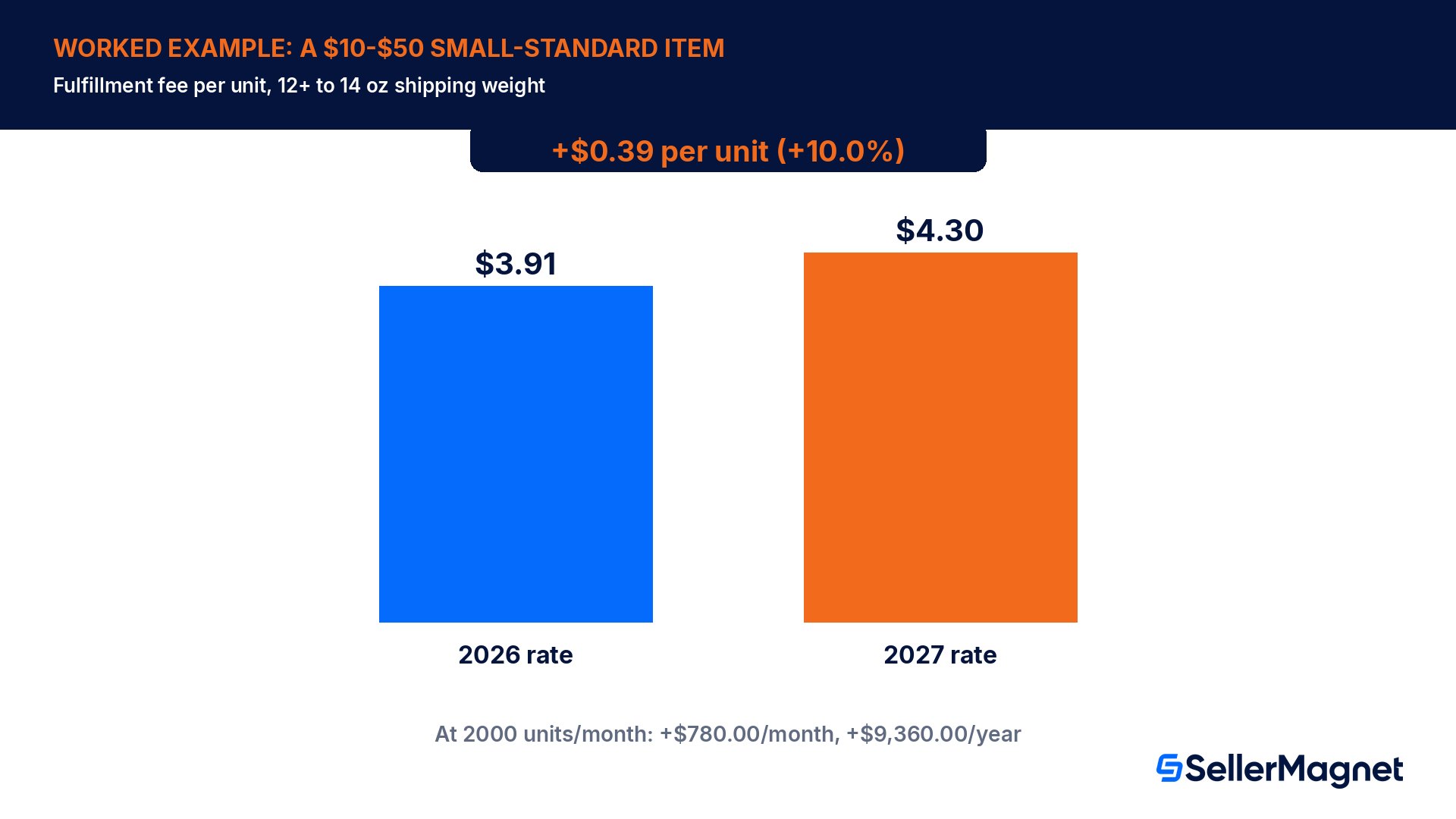
Take a small-standard product weighing between 12 and 14 ounces, priced between $10 and $50, sold at an average price of $24.99 with 2000 units moving a month. Under the current (2026) non-peak rate table, the fulfillment fee for this tier is $3.91 per unit. Under the new 2027 rate table, the same tier costs $4.30 per unit, an increase of $0.39 per unit, or 10.0%.
2026 rate (per unit)
2027 rate (per unit)
Difference
Fulfillment fee
$3.91
$4.30
$0.39 (10.0%)
Scaled to 2000 units a month, that $0.39-per-unit increase adds $780.00 a month, or $9,360.00 over a full year, in fulfillment fees alone for this single size tier, with no change in sales volume or price. Against monthly revenue of $49,980.00 for this product, that extra cost is 1.56% of revenue, small on any one order but real once it compounds across a full catalog of SKUs sitting in different tiers, some of which may be rising faster than this example and some of which may actually be falling.
The average hides which way your own products move
Amazon states plainly that "fees for some products will increase, and others will decrease." A seller who only reads the $0.19 headline number and assumes every SKU rises by roughly that amount can badly misjudge next year's margin on an individual product; the only way to know is to check each SKU's own size tier and price band against the published table, or use the Fee Change Comparison dashboard that applies the new rates to the actual catalog.
The fuel and logistics surcharge is not changing
Since April 17, 2026, a 3.5% fuel and logistics-related surcharge has applied to FBA fulfillment fees in the US and Canada, plus Remote Fulfillment with FBA from the US into Canada, Mexico and Brazil, and since May 2, 2026 to Buy with Prime and Multichannel Fulfillment as well. Amazon's own letter confirms this surcharge is staying in place for 2027 unchanged, citing continued elevated fuel and line-haul trucking costs, while noting it will keep reviewing the surcharge as conditions change. Anyone modeling next year's fees needs to stack this 3.5% on top of the new 2027 base rate, not the old 2026 rate, to get the real number.
Storage fees get simpler on February 1, 2027
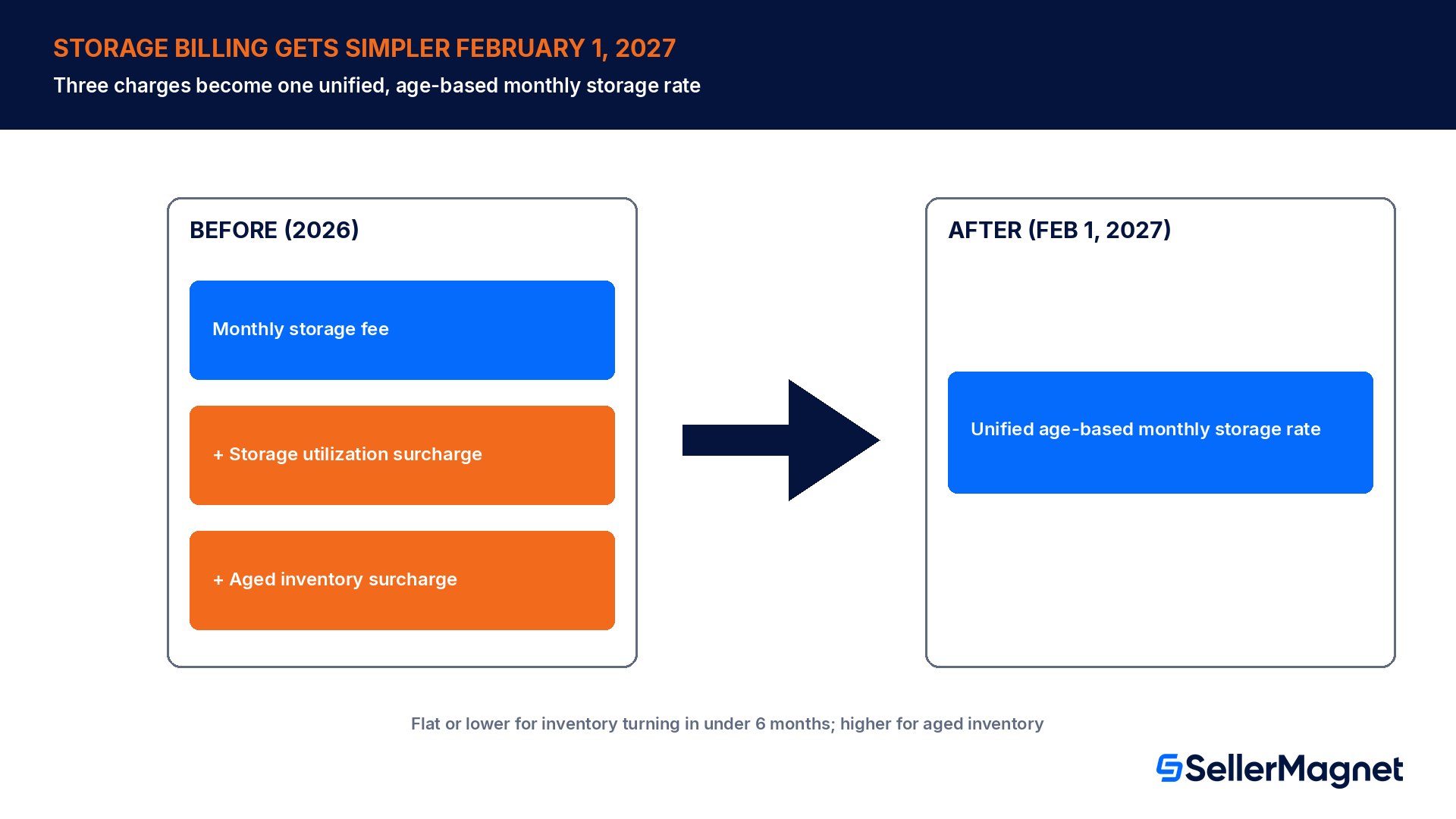
The second half of the letter addresses a complaint Amazon says it has heard directly from sellers: storage fees are hard to predict because a single unit's monthly bill could include the base monthly storage fee, a storage utilization surcharge if the seller's utilization ratio was too high, and an aged inventory surcharge if the unit was old enough, three separate calculations stacking on the same cubic footage. Effective February 1, 2027, two of those three collapse into one.
The storage utilization surcharge is eliminated entirely, which Amazon says makes it easier to stock up ahead of high-demand events without a utilization penalty working against that decision.
The aged inventory surcharge (previously the long-term storage fee, see our aged inventory surcharge guide) is removed as a separate line item and combined with the monthly storage fee into one unified, age-based rate.
Amazon states the combined change results in flat or lower fees for inventory that turns in under six months, and higher fees for aged inventory, which is the same underlying incentive as the old two-fee system, just billed as one number.
Simpler billing is not automatically cheaper
Fewer line items on the invoice does not mean a lower total. Amazon's own description says the new unified rate will be higher for inventory that has actually aged past the point where it used to incur the separate surcharge; the simplification changes how the number is calculated and displayed, not the underlying incentive to keep stock turning over.
The low-inventory-level fee changes how it decides you are low
Today, the low-inventory-level fee is assessed using trailing 30- and 90-day sales, a backward-looking window that can flag a SKU as low-inventory even when the real cause was a short, temporary demand spike or a product that is winding down at end of season and does not need restocking. Effective February 1, 2027, Amazon changes the trigger: the fee applies only when inventory falls below 28 days of supply, based on actual shipments in both the four weeks before AND the four weeks after the assessment date. Checking sales after the assessment date, not just before it, is the detail that confirms whether the low-inventory reading reflected genuine ongoing demand rather than a one-off spike.
Amazon's stated goal for this change is narrower targeting: catching SKUs that genuinely need replenishment, while reducing false triggers from unexpected demand spikes or from products near their end of life that were never going to be restocked anyway. Compare this against the mechanics in our existing low-inventory-level fee guide, since the trigger itself, not just the fee amount, is what is changing.
Bulky and Extra-Large size tiers get split into more, narrower tiers
Starting January 15, 2027, Amazon is also restructuring the size tiers for Bulky and Extra-Large (oversize) products. The current small bulky and large bulky tiers split into four: small bulky, medium bulky, large bulky and extra-large bulky. The current single extra-large tier splits into six oversize tiers: small oversize, medium oversize, large oversize, long oversize, special oversize light and special oversize heavy. Amazon states smaller, lighter products in these groups will see lower fulfillment fees under the new, narrower tiers, while larger, heavier products will see higher fees, with the exact amount depending on a product's specific dimensions, not just which broad category it used to sit in.
Alongside the size tier split, Amazon is removing the Overmax handling fee (the surcharge that applied to Extra-Large products, up to 150 lb, exceeding 96 inches on the longest side or 130 inches for length plus girth) and introducing two new charges in its place: a Flat product handling fee and an Overhang handling fee, both also effective January 15, 2027. Anyone shipping bulky or oversize products should re-check which of the new tiers and new handling fees their specific dimensions now fall into, since the old tier boundaries are being redrawn, not just re-priced.
Dangerous goods (hazmat) fees rise too, and by more in this tier
Products classified as dangerous goods, also called hazardous materials or hazmat, pay a separate, higher fulfillment fee table because of the special handling and storage they require, and that table rises for 2027 as well. For the same small-standard, 12 to 14 ounce, $10 to $50 band used in the worked example above, the dangerous goods fee rises from $4.72 to $5.01, an increase of $0.29 per unit, or 6.1%, a noticeably steeper jump than the 10.0% rise on the equivalent non-hazmat product. Sellers of batteries, aerosols, or other hazmat-classified items should check the dangerous goods rate table specifically rather than assuming the general fulfillment fee change applies to their catalog at the same rate.
What the new bulky size tiers actually cost
Because the old two-tier bulky structure (small bulky, large bulky) is being replaced outright by four new tiers rather than simply re-priced, there is no single before/after number to quote; a product's old tier does not map one-to-one onto a new one. The table below shows the published base rate for each new 2027 bulky tier in the $10 to $50 price band for the first pound of shipping weight, plus the per-pound rate that applies above that.
New 2027 tier
Base rate (first lb, $10-$50 band)
Rate above first lb
Small bulky
$7.51
+$0.39/lb
Medium bulky
$7.66
+$0.39/lb
Large bulky
$9.88
+$0.39/lb
Extra-large bulky
$10.09
+$0.39/lb
The practical takeaway is that a product sitting near the old small bulky/large bulky boundary should be re-measured against the new four-way split before assuming its fee simply rose or fell by whatever the nearest published average suggests; it may now fall into a tier that did not exist under the old structure at all.
Low-price FBA eligibility narrows for some categories
Low-Price FBA rates give lower fulfillment fees to inexpensive items, but starting January 15, 2027, five fee categories lose eligibility for Low-Price FBA rates in the $10 to $50 price band and move to standard rates instead: Automotive and Powersports, Compact Appliances, Musical Instruments and AV Production, Media (books, DVD, music, software, video), and Computers. A seller with inventory in any of these five categories priced between $10 and $50 should assume the Low-Price rate no longer applies after the change and budget for the standard-size rate table instead.
What to do before January 15, 2027
Open the new Fee Change Comparison dashboard inside Profit Analytics and review the account- and product-level impact on your own catalog, not just the published averages.
Run current and projected fees through the Revenue Calculator for any SKU close to a size or price band boundary, since the boundaries themselves may have shifted for bulky and oversize items.
For any product in the five categories losing Low-Price FBA eligibility, recheck pricing and margin assumptions for the $10 to $50 band specifically.
If you carry aged or slow-moving inventory, model the February 1 unified storage rate change in addition to the January 15 fulfillment fee change; the two land three weeks apart, not on the same date.
Re-check any SKU that was recently flagged by the low-inventory-level fee under the old 30/90-day trailing window; the February 1 change may remove the trigger if the spike that caused it was temporary.
Common mistakes sellers make with this kind of update
Assuming the published average applies evenly to every product, instead of checking the actual rate for each SKU's own size tier and price band.
Forgetting the fuel and logistics surcharge stacks on top of the new 2027 base rate, and modeling fees without it.
Treating the January 15 fulfillment fee change and the February 1 storage change as the same date, and missing that storage math changes three weeks later.
Not re-checking bulky or oversize products against the new, narrower size tiers, since a product that used to sit comfortably inside one old tier can land in a different new one.
Assuming "simpler storage billing" means cheaper storage billing, when Amazon explicitly states aged inventory will cost more under the new unified rate.
Ignoring the low-inventory-level fee change because it sounds like a minor mechanical detail, when it can remove or add the fee entirely for SKUs near the 28-day threshold.
Checklist before January 15, 2027
Pulled the Fee Change Comparison dashboard and reviewed impact at the product level, not just the account-level average.
Re-run the Revenue Calculator for every SKU within one size or price band of a boundary.
Flagged every SKU in the five categories losing Low-Price FBA eligibility in the $10 to $50 band.
Modeled the February 1 storage and low-inventory-level fee changes separately from the January 15 fulfillment fee change.
Logged the before/after fee for the highest-volume SKUs so the actual billed amount can be checked against the projection once the new rates go live.
How SellerMagnet fits into the decision
A rate table is only useful once it is applied to your own catalog, order by order. The free Fee Calculator checks a single ASIN's current Amazon fee using Amazon's own published schedule, which is a quick way to sanity-check a product before and after a rate change lands. For the ongoing picture across an entire catalog, the Analytics Dashboard tracks true net profit per order after every Amazon fee, so a fulfillment fee increase, a reshuffled size tier or a changed storage rate shows up directly in the real margin number instead of staying buried in a spreadsheet nobody updates until the next invoice arrives. The same dashboard view that catches a rising fulfillment fee on one SKU is the one that also flags aging stock before the new unified storage rate makes it expensive, so reviewing both together, fulfillment fees and storage, in one place beats checking each in isolation.
When do the 2027 Amazon FBA fee changes take effect?
Most fulfillment fee changes, the size tier restructuring and the Low-Price FBA eligibility narrowing take effect January 15, 2027. The storage fee simplification and the low-inventory-level fee change take effect separately, on February 1, 2027.
Is the FBA fuel and logistics surcharge changing for 2027?
No. The 3.5% surcharge, in place since April 2026, stays the same for 2027. Amazon says it will keep reviewing the surcharge as fuel and trucking costs change, but it is not part of this update.
Does the aged inventory surcharge still exist as a separate fee?
Starting February 1, 2027, no. It is combined with the monthly storage fee into one unified, age-based storage rate rather than appearing as a separate line item.
Will my own fees go up or down under the 2027 changes?
It depends on the specific product. Amazon states fees for some products will increase and others will decrease so that each fee more closely matches the actual cost of fulfilling that product; the average increase across all products is about $0.19 per unit, but that average does not describe any single SKU.
Where can I see the exact impact on my own account?
Amazon's new Fee Change Comparison dashboard inside Profit Analytics shows the account- and product-level impact of the 2027 changes. The Revenue Calculator can also model fee scenarios for individual products.
Do these changes apply outside the US?
The rate tables and dates in this guide are for the United States store specifically. Other marketplaces publish and update their own fee schedules separately and on their own timelines.
What happens to Low-Price FBA rates?
Low-Price FBA eligibility narrows starting January 15, 2027: five fee categories (Automotive and Powersports, Compact Appliances, Musical Instruments and AV Production, Media, and Computers) no longer qualify for Low-Price FBA rates in the $10 to $50 price band and move to standard rates.
Is there anything I need to do right now, in November 2026?
There is no action required immediately, since the changes do not take effect until January 15 and February 1, 2027. Amazon is sharing the update with more than two months of lead time specifically so sellers can review the Fee Change Comparison dashboard and the Revenue Calculator before the new rates go live.
Stop Juggling Tools. SellerMagnet Combines Everything You Need.