A seller planning a new listing for 2026 now has a real choice that did not exist a few years ago: book a photo studio for the product, or open an AI image generator and have a finished-looking set of images in minutes. Both routes can produce images that pass Amazon's technical checks, and both can also get a listing suppressed or flagged if the seller picks the wrong tool for the wrong image slot. The two routes are not interchangeable, because Amazon's own main image rule requires the main image to accurately represent the real product, at its real scale, quantity and color, and a fully AI-generated image has no real physical unit behind it to accurately represent, while the other eight image slots have far more room to use AI well. This guide works through what a photography package and an AI-image workflow actually cost in 2026, where each one is compliant and where it is not, a worked example on a small catalog, and the hybrid workflow most sellers who use both well have landed on.
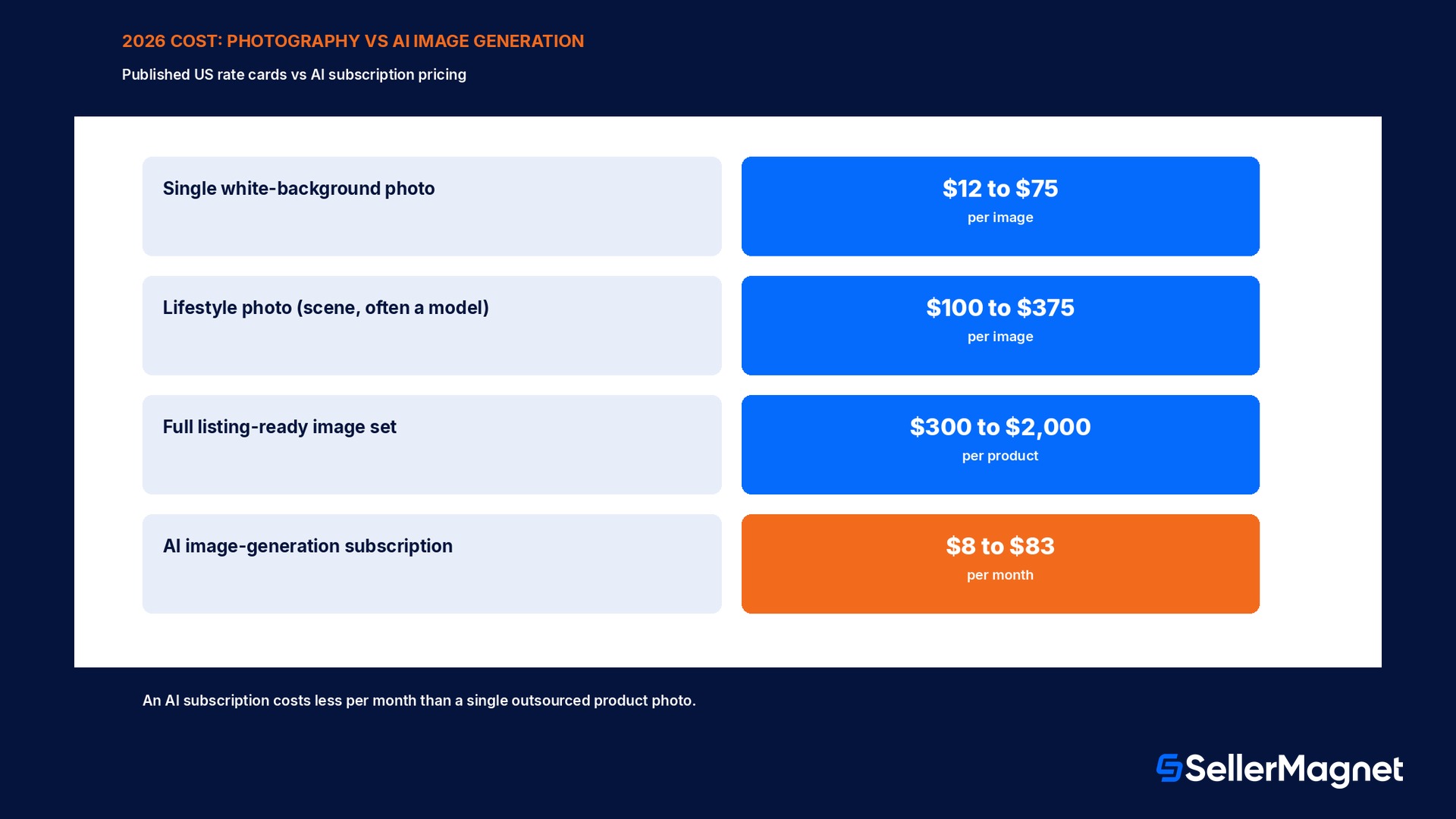
Amazon requires the main listing image to be an actual photograph of the real product, so a fully AI-generated main image is against policy even when it looks realistic. A single studio product photo runs roughly $12 to $75 in 2026, a full listing-ready image set roughly $300 to $2,000 per product, while AI image subscriptions cost $8 to $83 a month. The practical approach most sellers use is hybrid: a real photo shoot for the main image and true product angles, then AI tools for lifestyle backgrounds, infographics and A+ Content modules built around those real photos, not replacing them.
What Amazon's own image rule actually requires, and where that leaves AI
Amazon's product image guide states the main image requirement in two direct sentences: it must "accurately represent the product as a realistic, professional-quality image," and "the image should accurately represent the real scale, quantity, and color of the product." That wording decides the whole question for the main image slot before cost or speed even enter the conversation; an image generator can produce a photorealistic rendering of a product that does not exist in that exact physical form, and Amazon's rule does not care how convincing it looks, only whether the image accurately represents the real, specific unit a seller actually ships, at its real scale, quantity and color. A fully AI-generated image fails this by definition, because there is no real physical unit for it to represent accurately. The other eight image slots a listing is allowed (one main plus up to eight additional views, or a video in categories where it is enabled) carry no such restriction on their own; an additional image showing the product in a lifestyle scene, a size comparison graphic, or an infographic callout over a product photo has much more room for AI-assisted production, because none of those slots carry the main image's accurate-representation requirement. For the full technical specification (minimum and maximum pixel dimensions, file formats, the 85% frame-fill rule and the rest), see Amazon's product image requirements, which this guide does not repeat; the question here is specifically where a real photograph is mandatory and where it is not.
What a photography package actually costs in 2026
Published 2026 US rate cards for Amazon product photography cluster into a fairly predictable range once volume discounts are stripped out. A single white-background photo, the kind a main image needs, runs about $12 to $75 depending on the studio and how many images are ordered at once, with per-image pricing dropping toward the bottom of that range at volume (50 or more SKUs) and sitting toward the top for a one-off single-product order. A finished, listing-ready image set, a main image plus several supporting angles, one or two lifestyle shots and an infographic card or two, runs roughly $300 to $2,000 per product depending on how much lifestyle and model photography it includes; a basic set with only white-background images and simple infographics sits at the low end, while a set with a hired model, styled props and multiple scene changes sits at the high end. Lifestyle photography specifically, showing the product in a realistic use scenario rather than on a plain background, tends to cost more per image than a white-background shot, commonly in the $100 to $375 range per image when priced separately, because it needs a set, props and often a model rather than just a product on a turntable.
Image type
Typical 2026 cost
Where it is used
Single white-background photo
$12 to $75 per image
Main image, simple supporting angles
Lifestyle photo (real scene, often a model)
$100 to $375 per image
Supporting images, A+ Content
Infographic card (designer working from a real photo)
$50 to $200 per image
Supporting images, feature callouts
Full listing-ready image set, one product
$300 to $2,000 per product
Hero plus 6 to 8 supporting images
AI image-generation subscription
$8 to $83 per month
Backgrounds, infographics, A+ layouts
What an AI image subscription actually gives a seller
Standalone AI image-generation subscriptions, the kind built for product marketing rather than general art generation, published 2026 pricing in the $8 to $83 a month range across entry and mid tiers, a fraction of a single photography booking and nowhere close per month to what even one full listing-ready image set costs once. For that price, the realistic output is background replacement and scene generation around a real product photo (dropping a real, photographed product into a styled kitchen counter, a gym floor or a seasonal backdrop without a second physical shoot), infographic layout generation (turning a feature list into a laid-out callout card against a real product photo), and A+ Content module backgrounds and banners. What it is not realistically used for, inside Amazon's own rule, is generating the main image from nothing: the tool can produce a photorealistic image of a product, but unless that image is a real photograph of the real, physical SKU a seller actually ships, it fails the accurate-representation requirement the moment Amazon's review catches it, which risks the listing's main image being pulled rather than simply a wasted image credit.
The AI-generated-people tag applies no matter which tool made the image
If any product image or video, from a camera or from an AI tool, contains a photorealistic person who was entirely generated by AI rather than based on a real person, Amazon requires the contains-synthetic-performer metadata keyword in the file before upload. A real model in a real or AI-styled scene does not need the tag; only a fully synthetic, photorealistic person does. Full detail: Amazon's AI-generated people disclosure rule.
A worked example: a 10-SKU catalog, three routes
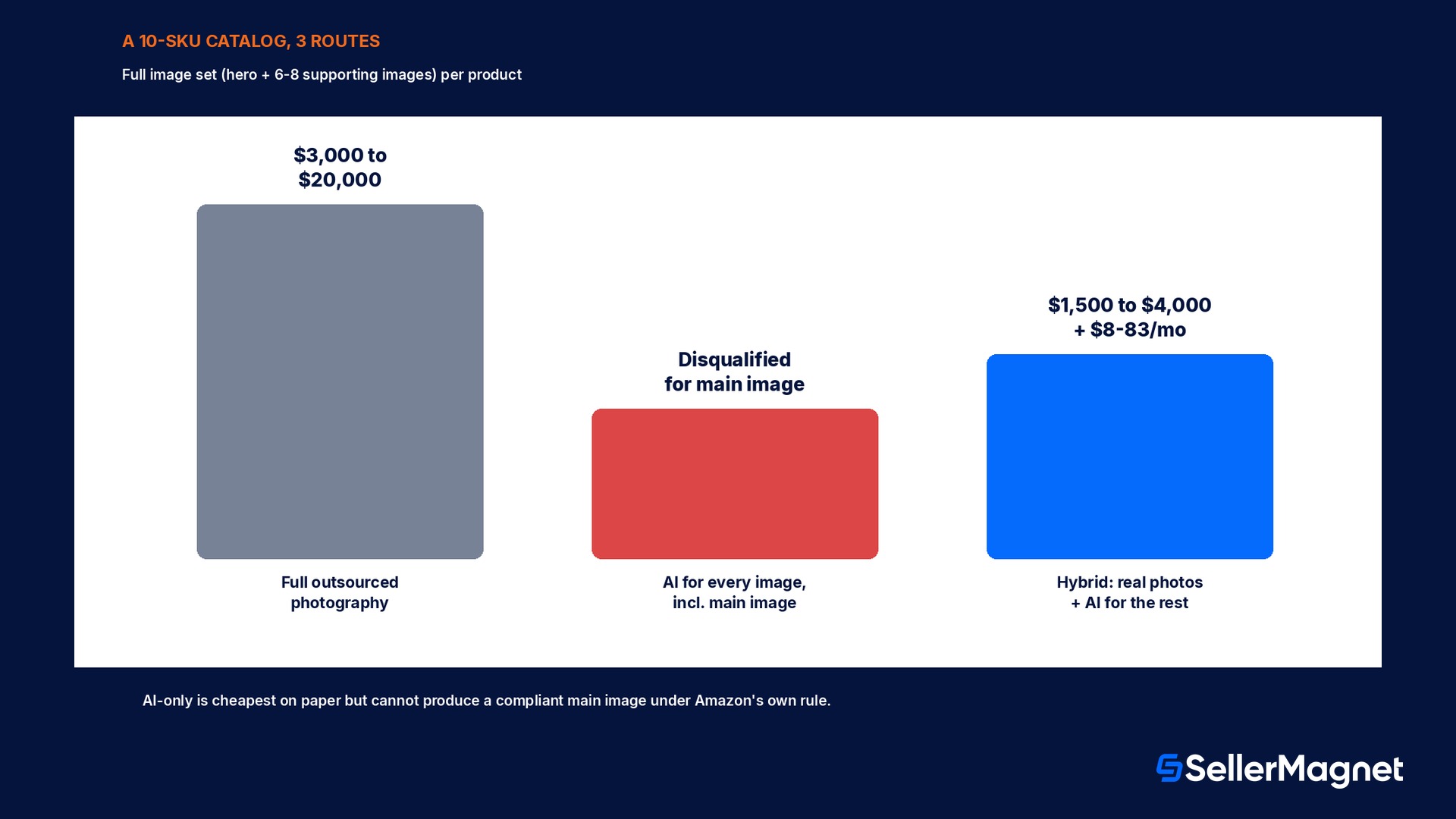
Take a seller launching 10 SKUs who needs a compliant main image plus roughly 6 supporting images per product, the typical full image set. Route one, full outsourced photography for every image: at the published $300 to $2,000 per product range, 10 products land between $3,000 and $20,000 depending on how much lifestyle and model work is included, commonly cited around $3,000 to $8,000 for a straightforward catalog shoot with some efficiency gained from a shared lifestyle set and bulk studio pricing. Route two, AI for everything including the main image: this route is cheapest on paper, $8 to $83 a month covers unlimited generation across all 10 SKUs, but it is not a real option for the main image slot at all under Amazon's own rule, so this route is disqualified before cost is even the deciding factor. Route three, the hybrid most sellers land on: a real photography session covering only the main image and 2 to 3 true product angles per SKU (the images that must show the actual product), commonly priced at the lower end of the per-image range because the shot list is short and simple, roughly $150 to $400 per product for that reduced set across 10 SKUs ($1,500 to $4,000 total), then an AI subscription at $8 to $83 a month generating the remaining lifestyle backgrounds, infographic cards and A+ Content layouts around those real photos. The hybrid route keeps every compliance-sensitive image real while moving the volume of secondary, AI-friendly images off the photography invoice entirely, landing well under route one's total cost without touching the main image rule at all.
Route
What it covers
Approx. cost, 10 SKUs
Full outsourced photography
Every image, all 10 SKUs, 6 to 8 images each
$3,000 to $20,000
AI for every image, including the main image
Disqualified for the main image slot under Amazon's own rule
$8 to $83/month, not usable as-is
Hybrid: real photos for main + key angles, AI for the rest
Main image and 2 to 3 true angles real, lifestyle/infographics AI-built
$1,500 to $4,000 plus $8 to $83/month
Where each route actually risks a suppressed listing
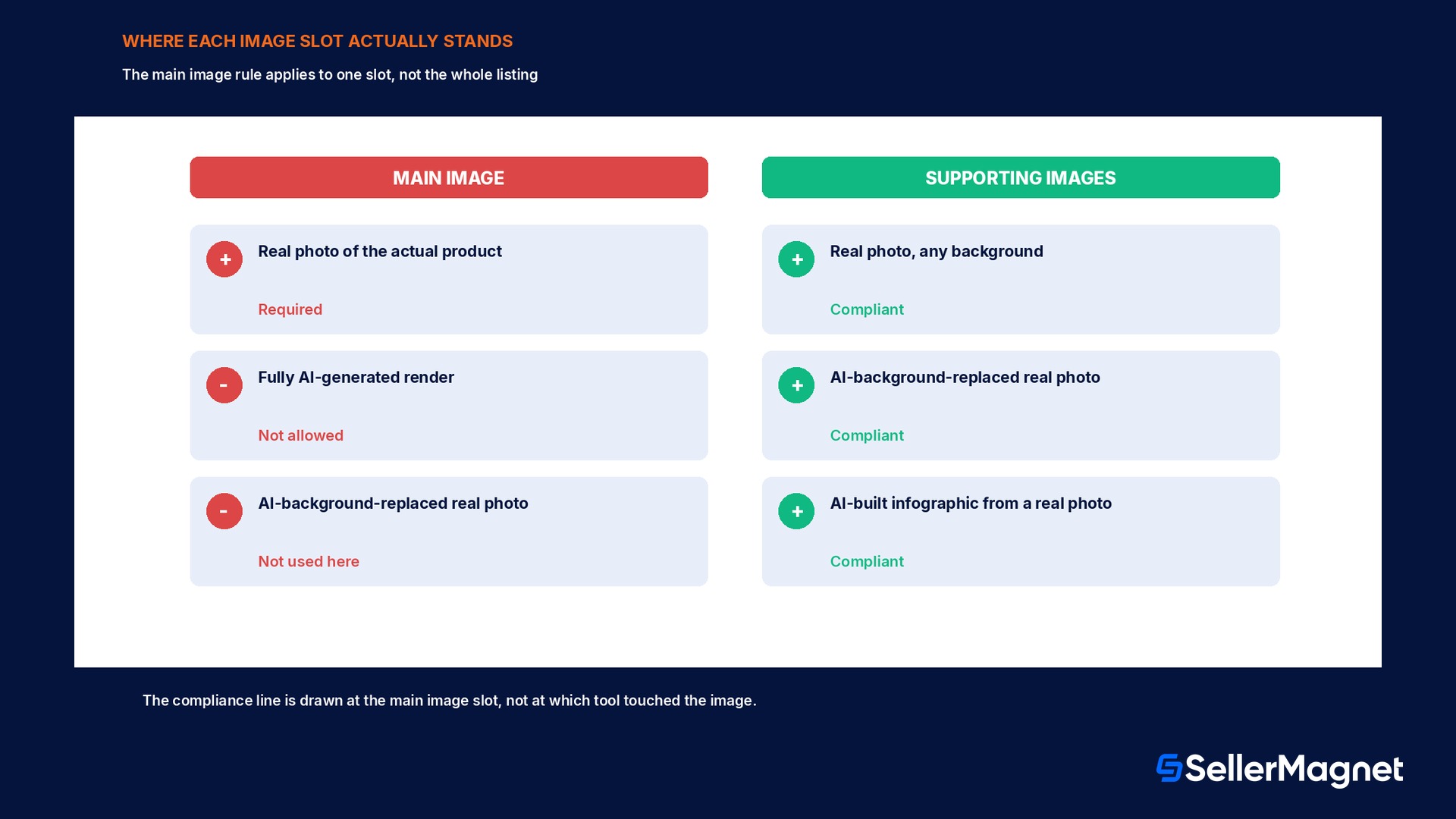
The compliance risk is not evenly spread across the image slots, and understanding where it concentrates changes which route makes sense per image. A fully AI-generated main image risks a direct main-image rejection or removal from search, because it fails the single clearest requirement in Amazon's own image guide, that the main image accurately represent the real product at its real scale, quantity and color, something a fully AI-generated image has no real physical unit behind it to do. A real photograph used as a supporting image, even one that was later AI-background-replaced or lifestyle-staged, generally stays compliant for that slot, because the product in frame remains the real, photographed item; the scene around it changing does not change what the main-image rule is actually checking for, since that rule applies specifically to the main image slot, not to every slot. An infographic card built by an AI layout tool from a real product photo carries essentially the same risk profile as one built by a human designer from the same photo, because neither one is standing in for the main image. The one rule that follows the content regardless of which tool produced it is the AI-generated-people tag: a photorealistic, fully synthetic person in any image or video, main or supporting, needs the metadata keyword before upload, independent of whether a camera, a designer or an AI tool made the rest of the image.
Where a listing-image workflow tool fits in either route
SellerMagnet's Listing Studio, included from €14.90 a month with 10,000 AI credits, generates listing text, images and A+ Content modules from inside the same workspace a seller already uses to manage the rest of the catalog, rather than running image generation and listing copy through two unrelated tools. The practical use inside the hybrid route above is the same shape as any other AI image subscription: it is built to generate the AI-friendly slots, backgrounds, infographic layouts, A+ Content banners, around a real product photo a seller uploads, not to replace the photography a compliant main image needs. Running listing text and image generation through one subscription instead of a photography invoice plus a separate AI tool plus a separate AI writing tool mainly saves the coordination overhead of keeping three vendors' outputs consistent in style and message, which matters more the larger the catalog gets.
Mistakes that come up on both sides of this decision
The most common and most costly mistake is generating a fully synthetic main image because it looks convincing enough to pass a casual glance; Amazon's review does not need to prove the product does not exist, only that the main image is not a photograph of the actual, physical SKU, and a removed main image stops search traffic entirely until it is fixed. The second mistake runs the other direction: paying full photography rates for every secondary image a catalog needs, lifestyle scenes, infographics, size comparisons, none of which carry the main image's restriction, when an AI subscription at a fraction of the cost produces an equally usable version of most of them. A third mistake is assuming an AI-background-replaced real photo is somehow riskier than an untouched one; the compliance question is whether the product itself in the image is the real, photographed item, not whether the background behind it came from a studio backdrop or a generated scene. A fourth mistake is skipping the synthetic-performer tag on an AI-generated model in a supporting image on the theory that the rule only applies to "fake products," when it specifically targets photorealistic AI-generated people, independent of whether the product itself is real.
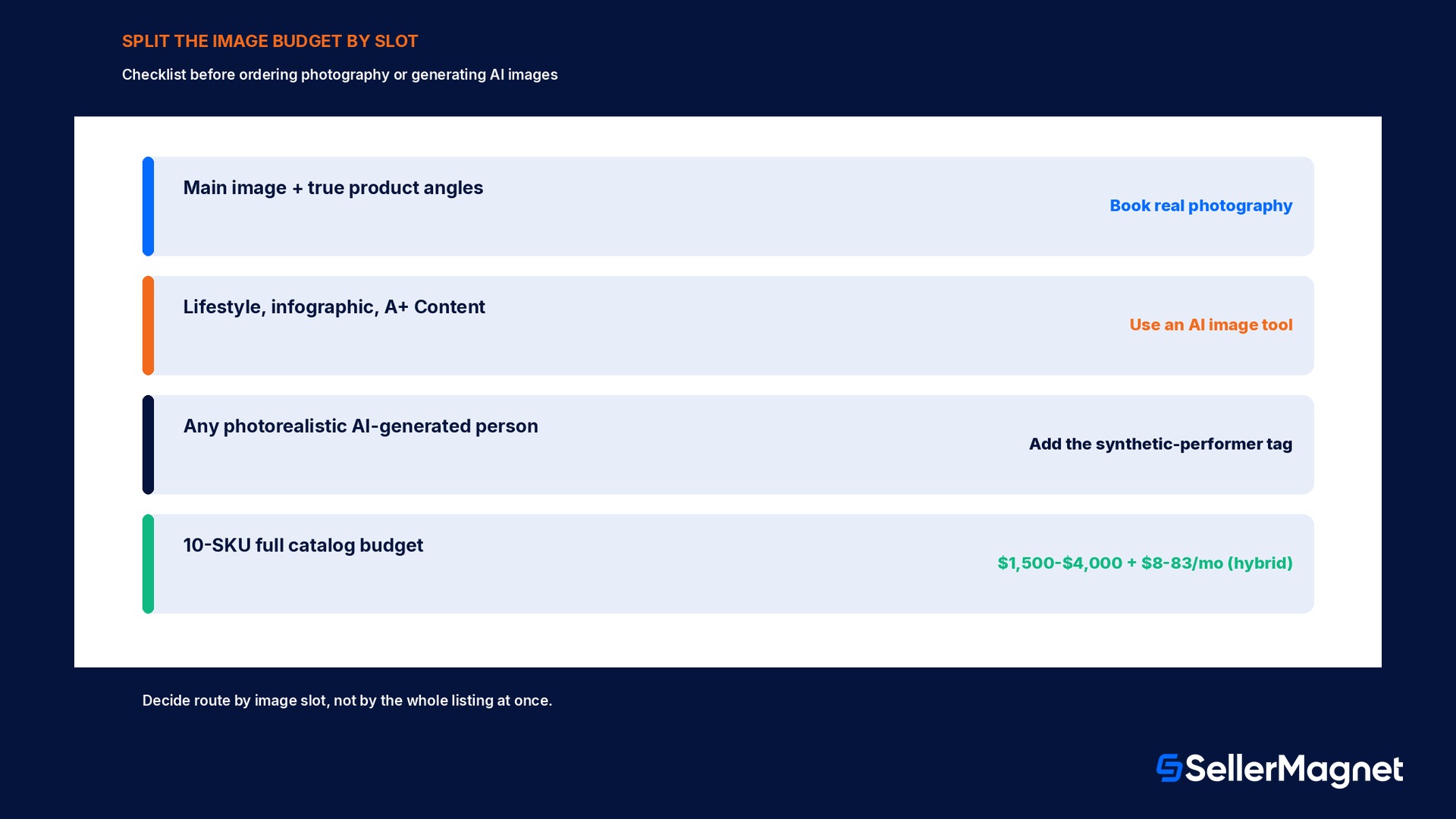
Checklist before choosing a route per image slot
How to split a listing's image budget between photography and AI without risking the main image
Book real photography for the main image and any true product-angle images - These are the slots Amazon's own rule requires to be an actual photograph of the real product.
Confirm the main image passes the 85%-frame-fill and pure-white-background checks before anything else - A compliant real photo that fails the other technical rules still gets flagged; check both at once.
Route lifestyle, infographic and A+ Content images to an AI tool built around a real product photo - These slots carry no accurate-representation-of-a-real-unit restriction, so AI-assisted production is compliant here.
Tag any fully synthetic, photorealistic AI-generated person before upload - Applies to any image or video regardless of which tool produced the rest of it; a real model never needs the tag.
Price a 10-SKU catalog by route, not by a single quote - A full outsourced set commonly runs $3,000 to $20,000 for 10 SKUs; the hybrid route commonly lands under $4,000 plus a monthly AI subscription.
Re-check this split any time a new image type is added to a listing - A newly added main-image variant (for example, a seasonal swap) carries the same accurate-representation requirement as the original.
Can I use a fully AI-generated image as my Amazon main image?
No. Amazon's product image guide requires the main image to accurately represent the real product, including its real scale, quantity and color. A fully AI-generated main image has no specific physical unit behind it to accurately represent, so it fails this requirement regardless of how realistic it looks.
Can I use AI tools for my supporting (non-main) listing images?
Yes, generally. The main image rule's requirement to accurately represent the real product's scale, quantity and color applies to the main image slot specifically. Supporting images such as lifestyle scenes, infographics and A+ Content modules built with AI tools around a real product photo do not carry that same restriction.
How much does a basic Amazon product photography package cost in 2026?
Published 2026 US rate cards put a single white-background photo at about $12 to $75, and a full listing-ready image set (hero plus supporting angles, lifestyle and infographics) at roughly $300 to $2,000 per product, depending on how much lifestyle and model photography it includes.
Is an AI-background-replaced photo of my real product compliant?
Generally yes, for a supporting image slot, because the product in the frame remains the real, photographed item; only the scene around it changed. The compliance question is whether the product itself is real and photographed, not whether the background came from a studio or an AI-generated scene.
Does the AI-generated-people metadata tag apply to AI-generated products too?
No. The tag specifically targets photorealistic, fully AI-generated people in an image or video. It does not apply to AI-generated products, scenes or backgrounds that do not feature a synthetic person.
What is the cheapest compliant way to get a full image set for a new SKU?
The hybrid route most sellers use: a single photography session covering only the main image and a few true product angles (roughly $150 to $400 per product for that reduced set), then an AI subscription ($8 to $83 a month) generating the remaining lifestyle, infographic and A+ Content images around those real photos.
Do I need a professional photographer, or can I photograph the product myself?
Amazon's rule requires the main image to accurately represent the real product at its real scale, quantity and color; it does not require a hired studio specifically. A seller who can meet that bar plus the technical specification (pure white background, correct frame fill, resolution) with their own camera satisfies the same requirement a paid studio does; the cost ranges in this guide describe the outsourced option for sellers who choose it.
Stop Juggling Tools. SellerMagnet Combines Everything You Need.