Amazon FBA Landed Cost per Unit (2026): The Full Formula
R
RenéFreelance Amazon Editor
|
20 min read
Most sellers who lose money on a product never see it coming, because the number they trusted was wrong from the start. They take the factory price, add a rough freight figure, and call it their cost. Then customs duty, a few small government fees, the customs broker, prep, labels, the truck to Amazon and the inbound placement fee arrive one invoice at a time, and a product that looked like a 50% margin quietly turns into 40% or less. This guide builds landed cost per unit the way it actually happens: every cost line from the factory to a sellable unit on an Amazon shelf, a fully worked example for a $24.99 kitchen product with every number shown, how the result feeds into real profit next to the FBA fees and the referral fee, how sensitive the figure is to duty, freight and order size, what changes when you import into the EU, and a checklist to run before you pay a supplier deposit.
Landed cost per unit is the total cost of getting one sellable unit to an Amazon fulfillment center, divided by the units you can actually sell. Add the factory price, payment and currency fees, inspection, international freight, customs duty, customs fees such as the US merchandise processing fee and harbor maintenance fee, the customs broker, prep and labels, freight to Amazon and the inbound placement fee. Then divide by your sellable units after defects. Amazon's referral and fulfillment fees are subtracted from the sale price separately, and storage is a holding cost on top.
What does landed cost actually include?
Landed cost is a buy-side number. It answers one question: what did this unit cost me by the time it was ready to sell? It is not the same as the factory price, which is only the first line, and it is not the same as your total cost per sale, which also includes the fees Amazon takes when the unit sells. Keeping those layers apart is what makes the number useful, because each layer is controlled by different decisions: the buy side by your supplier, your Incoterm and your shipping method; the sell side by your price, your category and your product's size tier.
Monthly storage fees and any storage utilization surcharge while units wait to sell
Every month the unit sits in a fulfillment center
Sell-side fees
Referral fee, FBA fulfillment fee (plus the US fuel and logistics surcharge)
When each unit sells
Overheads
Software, advertising, samples for new products, your own time
Spread across the whole business, not one order
This guide covers the first two layers in full and uses the third to turn landed cost into profit. Advertising and overheads matter just as much for the business, but they belong in your profit margin calculation, not in the cost of the goods themselves. If you mix them into landed cost, you can no longer compare two suppliers or two shipping methods on equal terms.
How do you calculate landed cost per unit?
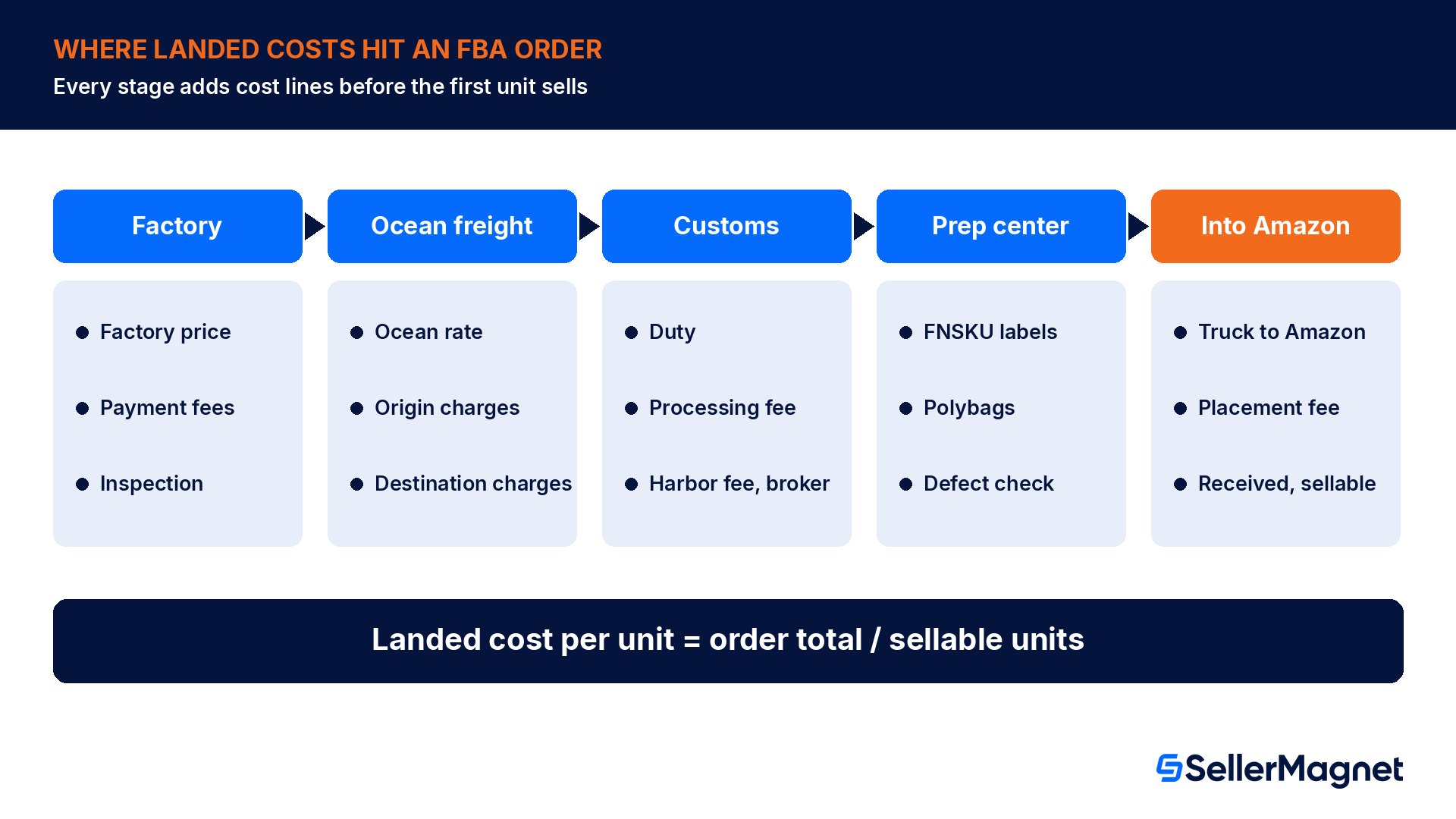
Written out, the formula is short: landed cost per unit = (goods + money costs + quality control + international freight + duty and customs fees + clearance + prep + the way into Amazon) / sellable units. The work is in not forgetting a line, so go through them in this order for every purchase order:
Calculate landed cost per unit for one purchase order
Price the goods - Multiply the factory price per unit by the units ordered, under the Incoterm you agreed (FOB, EXW or DDP).
Add the money costs - Add bank transfer fees and the currency conversion margin on the deposit and on the balance.
Add quality control - Add samples, a pre-shipment inspection and any rework the inspection triggers.
Add international freight - Add the international leg plus origin and destination charges, up to your prep center or warehouse.
Add customs duty and fees - Add duty at the rate for your product's tariff code, plus government fees such as the US merchandise processing fee and harbor maintenance fee.
Add clearance - Add the customs broker and, for US imports, the customs bond.
Add prep - Add FNSKU labels, polybags, bundling or kitting, at a prep center or in your own warehouse.
Add the way into Amazon - Add freight from the prep center to the inbound location and Amazon's inbound placement fee.
Divide by sellable units - Divide the order total by the units ordered minus the share you expect to be defective, damaged or lost.
Sellable units, not ordered units
Defective units still cost freight, duty and prep, but they never earn anything. If 2 out of 100 units are unsellable, every cost of the order has to be recovered from the other 98. Dividing by ordered units makes the landed cost look about 2% lower than it is, and on a thin-margin product that is the difference between a small profit and a small loss.
Which costs go into landed cost, line by line?
1. Factory price and the Incoterm behind it
A quoted price only means something together with its Incoterm. EXW (ex works) means you pay for everything from the factory door, including the truck to the port and export clearance. FOB (free on board) means the supplier delivers the goods onto the vessel at the named port, and your costs start there. DDP (delivered duty paid) means the supplier quotes a price that already includes freight and duty to your destination, which is convenient but hides the split, so you cannot check what you are paying for duty or freight. When you compare two quotes, convert them to the same Incoterm first. A trading company's FOB quote and a factory's EXW quote are not comparable as written, which is one of the reasons it pays to know whether your supplier is a factory or a trading company.
2. Payment and currency costs
Paying a supplier abroad usually costs twice: a transfer fee from your bank or payment provider, and a currency conversion margin that is built into the exchange rate rather than shown as a fee. Together they are often in the range of 1% to 3% of the payment, depending on the provider. Because most supplier orders are paid as a deposit plus a balance, you pay these costs on both transfers. Check your last two statements and use your real percentage instead of a guess.
3. Samples and inspection
Samples for a new product and a pre-shipment inspection are real costs of the order, even if they feel like a one-off. A pre-shipment inspection is usually a flat fee per visit, so it costs the same whether you order 500 units or 5,000, which is exactly why it weighs heavily on small orders. Skipping it saves money on paper and can cost the whole batch if the defect rate turns out to be high.
4. International freight
Freight is the line sellers most often underestimate, because the quoted ocean rate is only part of it. A full freight bill also contains origin charges at the port of loading, destination charges at the port of arrival (terminal handling, documentation, delivery order), and the delivery to your prep center or warehouse. Ask your forwarder for an all-in quote to your door, compare it on a per-unit basis, and keep it separate from the freight to Amazon, which is a different leg with a different price.
5. Customs duty, and what it is charged on
Duty is a percentage of the customs value, at the rate that applies to your product's tariff code, plus any additional duties in force on the date of entry. What the customs value includes depends on where you import. In the United States, the preferred basis is the transaction value: the price actually paid or payable for the goods when sold for export to the United States, and international freight and insurance are not added to it. In the EU, transport and related costs up to the point of entry into the EU are part of the customs value, so duty is also charged on most of the freight. Duty rates and additional tariffs change, sometimes several times a year, so look up the current rate for your exact code before every order instead of reusing last year's figure.
6. US customs fees: merchandise processing fee and harbor maintenance fee
On top of duty, a US formal entry carries two government fees that are small in percentage terms but easy to forget. U.S. Customs and Border Protection publishes both, and the minimum of the merchandise processing fee is adjusted every fiscal year:
Fee
Rate
Charged on
Source
Merchandise processing fee (formal entry)
0.3464%, minimum $34.58, maximum $670.86 per entry (fiscal year 2027, from 1 October 2026)
Value of the imported goods, excluding duty, freight and insurance
CBP user fee table
Harbor maintenance fee
0.125%
Value of commercial cargo unloaded from a vessel at a covered US port
CBP user fee table
The minimum is the part that matters for smaller sellers. At 0.3464%, a $3,200 shipment would owe only $11.08, but the minimum of $34.58 applies instead. On a 1,000-unit order that is about 3.5 cents per unit, which is small, but it is a fixed cost per entry, so splitting one order into several small shipments multiplies it.
7. Customs broker and bond
Most sellers use a customs broker to file the entry, and many forwarders include it as a line on their invoice. Brokers usually charge per entry, often with extra lines for additional tariff codes or for filing the security data that ocean imports into the US require. US imports also need a customs bond, either one bond per shipment or a continuous bond for the year. Ask for the broker's full fee schedule, not just the headline per-entry price.
8. Prep and labels
Units that arrive at Amazon need to meet Amazon's packaging and labeling requirements. If the factory cannot apply FNSKU labels and polybags reliably, a prep center does it for a per-unit fee, usually with extra charges for bundling, bubble wrap or kitting. If you prep in your own warehouse, count the labour and materials honestly: a label and a bag cost money even when nobody sends you an invoice for them.
9. Freight to Amazon
The leg from the prep center to Amazon is a domestic shipment with its own price per box or pallet. Spread over the units in the shipment it becomes a per-unit figure, and it changes with the number of inbound locations you send to: one location is simpler to ship, several locations mean more boxes on more trucks.
10. Amazon's inbound placement fee
In the US, Amazon charges an inbound placement fee when you choose to send a shipment to fewer inbound locations and let Amazon distribute the inventory across its network. For a large standard-size unit over 12 oz up to 1.5 lb, the US fee from 15 January 2026 for the minimal shipment split (one inbound location) is $0.24 to $0.50 per unit, depending on the inbound location. Choosing Amazon's optimized split, where you send to several inbound locations yourself, has no placement fee but raises your own freight to Amazon. The details and the other size tiers are in our guide to the inbound placement service fee.
11. Defects, damage and shrink
Finally, plan for the units you will not be able to sell: factory defects the inspection missed, transit damage and units that Amazon receives as damaged. Take the rate from your own history with that supplier, or use a conservative figure such as 2% for a first order, and divide the order total by the sellable units that remain.
Worked example: a $24.99 kitchen utensil set
Here is the full calculation for one realistic order. The product is a silicone kitchen utensil set sold in the US Home and Kitchen category at $24.99. The packed unit measures 10 x 4 x 3 inches and weighs 14 oz, which makes it large standard size: its dimensional weight is about 13.8 oz (10 x 4 x 3 = 120 cubic inches, divided by 139), so the unit weight of 14 oz is the shipping weight. The seller orders 1,000 units at $3.20 FOB. The freight, duty rate, broker, inspection, prep and truck figures below are assumptions for this example; the government fees and Amazon fees are the published rules.
Cost line
Order total (1,000 units)
Basis
Factory price (FOB), 1,000 x $3.20
$3,200.00
Assumption
Payment and currency fees (2%)
$64.00
Assumption
Pre-shipment inspection
$300.00
Assumption
Ocean freight to the prep center
$850.00
Assumption
Customs duty (12% of $3,200.00)
$384.00
Assumed rate
Merchandise processing fee (minimum applies)
$34.58
CBP minimum $34.58
Harbor maintenance fee (0.125%)
$4.00
CBP rule
Customs broker
$125.00
Assumption
Prep and FNSKU labels ($0.45 x 1,000)
$450.00
Assumption
Truck to Amazon ($0.30 x 1,000)
$300.00
Assumption
Inbound placement fee ($0.50 x 1,000)
$500.00
Amazon range, top end
Total landed cost of the order
$6,211.58
Sum
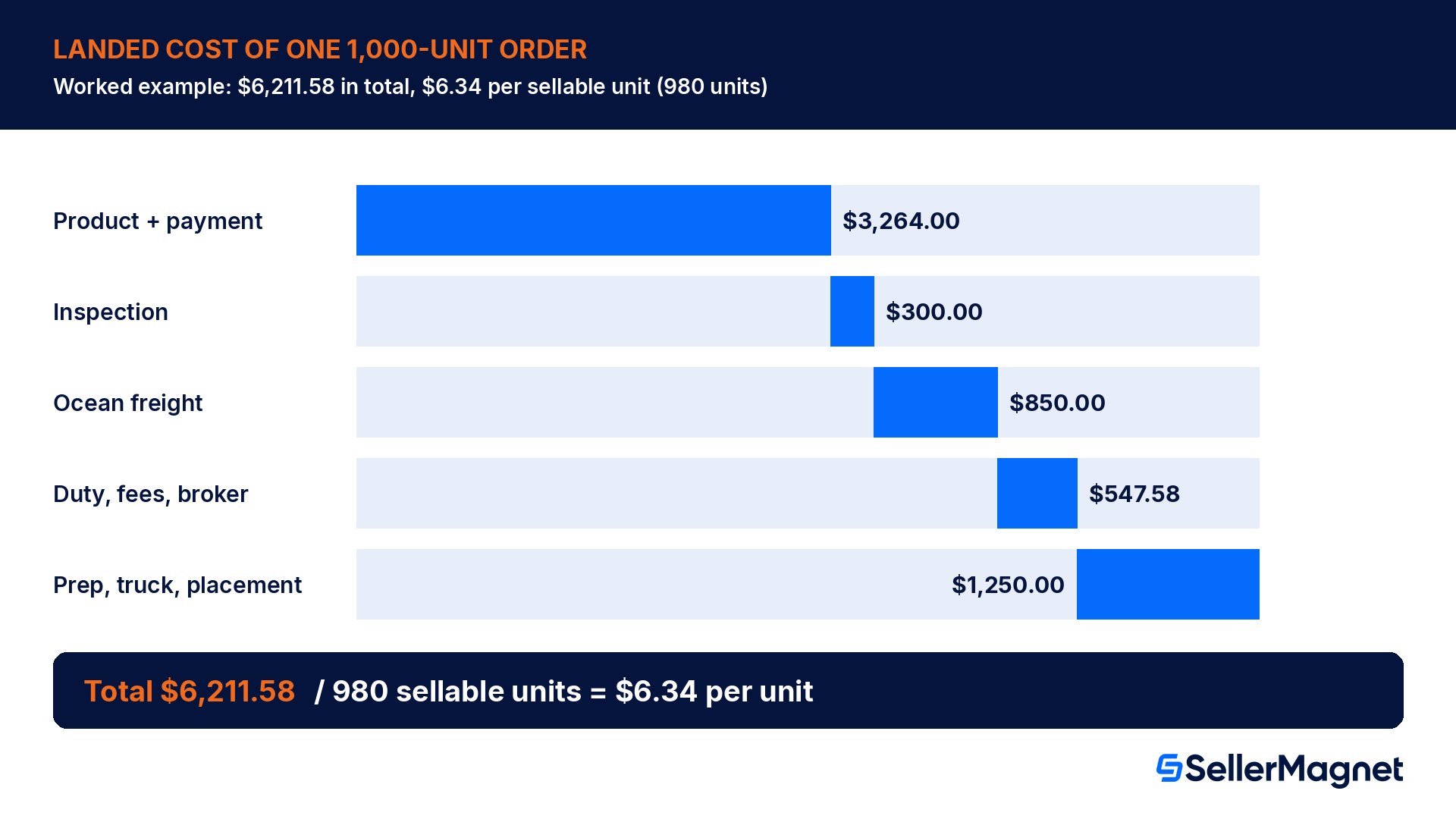
The order costs $6,211.58 to land. Divided by 1,000 ordered units that is $6.21 per unit, but with a 2% defect allowance only 980 units are sellable, so the real landed cost is $6.34 per sellable unit. The quick estimate most sellers use, factory price plus ocean freight, gives ($3,200.00 + $850.00) / 1,000 = $4.05. The gap is $2.29 per unit, and more than half of it comes from lines that never appear on the supplier's or the forwarder's quote.
The duty rate here is an assumption
The example uses a combined duty rate of 12% to keep the math readable. Your real rate depends on your product's tariff code, its country of origin and any additional duties in force on the date of entry, and for some products and origins it is far higher. Look up the current rate for your exact code, and ask your broker to confirm it, before you rely on any landed cost figure.
Add the holding cost
Storage is not part of the landed cost, but a unit that waits three months to sell has cost you three months of storage by the time it sells. The unit is 0.0694 cubic feet (120 / 1,728). At the US off-peak rate of $0.78 per cubic foot per month for standard-size items (January to September), three months cost about $0.16 per unit, which brings the fully loaded cost to $6.50. From October to December the base rate is $2.40 per cubic foot, so the same three months over the holiday season cost roughly three times as much. If your storage utilization ratio reaches 22 weeks or more, Amazon also adds a storage utilization surcharge on top. The rates in full are in our guide to FBA storage fees.
From landed cost to real profit
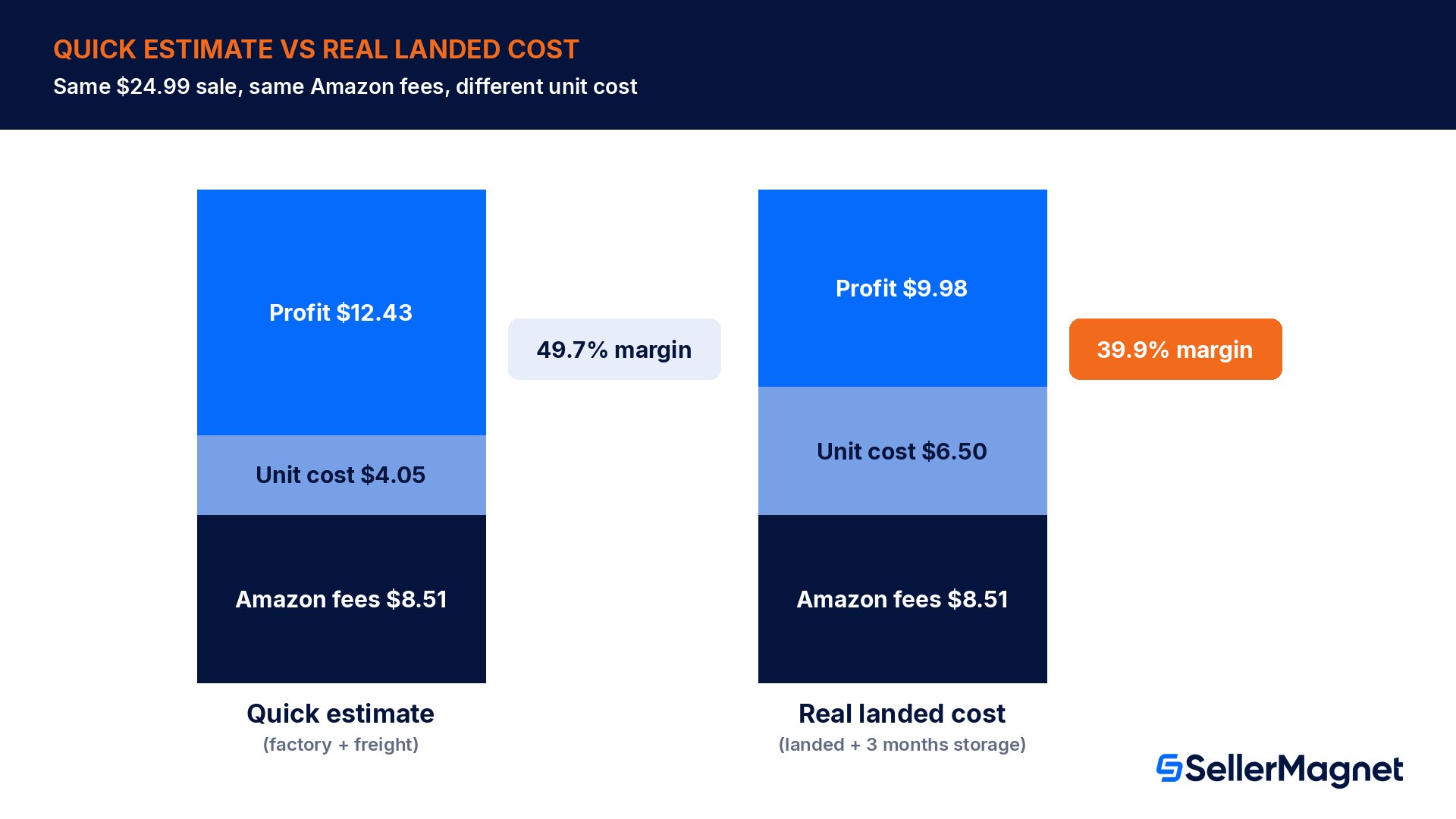
Now put the landed cost next to the sell side. In Home and Kitchen the US referral fee is 15% with a $0.30 minimum, so $24.99 x 15% = $3.75. The US FBA fulfillment fee for a large standard-size unit of 12 to 16 oz at a price between $10 and $50 is $4.60 in the 2026 non-peak period, before the 3.5% fuel and logistics surcharge that applies to US FBA fulfillment fees since 17 April 2026: $4.60 x 1.035 = $4.76. Together Amazon takes $8.51, which leaves $16.48 of the sale price.
Per unit
Quick estimate
Real landed cost
Sale price
$24.99
$24.99
Referral fee (15%)
$3.75
$3.75
FBA fulfillment fee incl. 3.5% surcharge
$4.76
$4.76
Cost of the unit
$4.05 (factory + freight)
$6.50 (landed + 3 months storage)
Profit per unit
$12.43
$9.98
Margin on the sale price
49.7%
39.9%
Return on the unit cost
307%
154%
The product is still profitable, which is the point: the quick estimate did not turn a loser into a winner, it made a decent product look excellent. A margin of 49.7% invites a higher advertising budget, a lower price to win sales, or a bigger second order. At the real 39.9%, each of those decisions looks different. Across the 980 sellable units, the difference between the two profit figures is about $2,401, money the quick estimate counted on and the business never had. In the holiday peak period the same fulfillment fee is $4.89 before the surcharge, so margins narrow further from 15 October to 14 January; our peak fulfillment fee guide has the full peak table.
How much do duty, freight and order size change the result?
A landed cost figure is only as good as its inputs, and three of them move a lot. It pays to know how much each one shifts the result before you negotiate, so you know where the money really is.
Change
Effect on landed cost per sellable unit
Why
Duty rate +10 percentage points
+$0.33
10% of $3,200.00 = $320.00, spread over 980 units
Freight bill +$500.00
+$0.51
$500.00 spread over 980 units
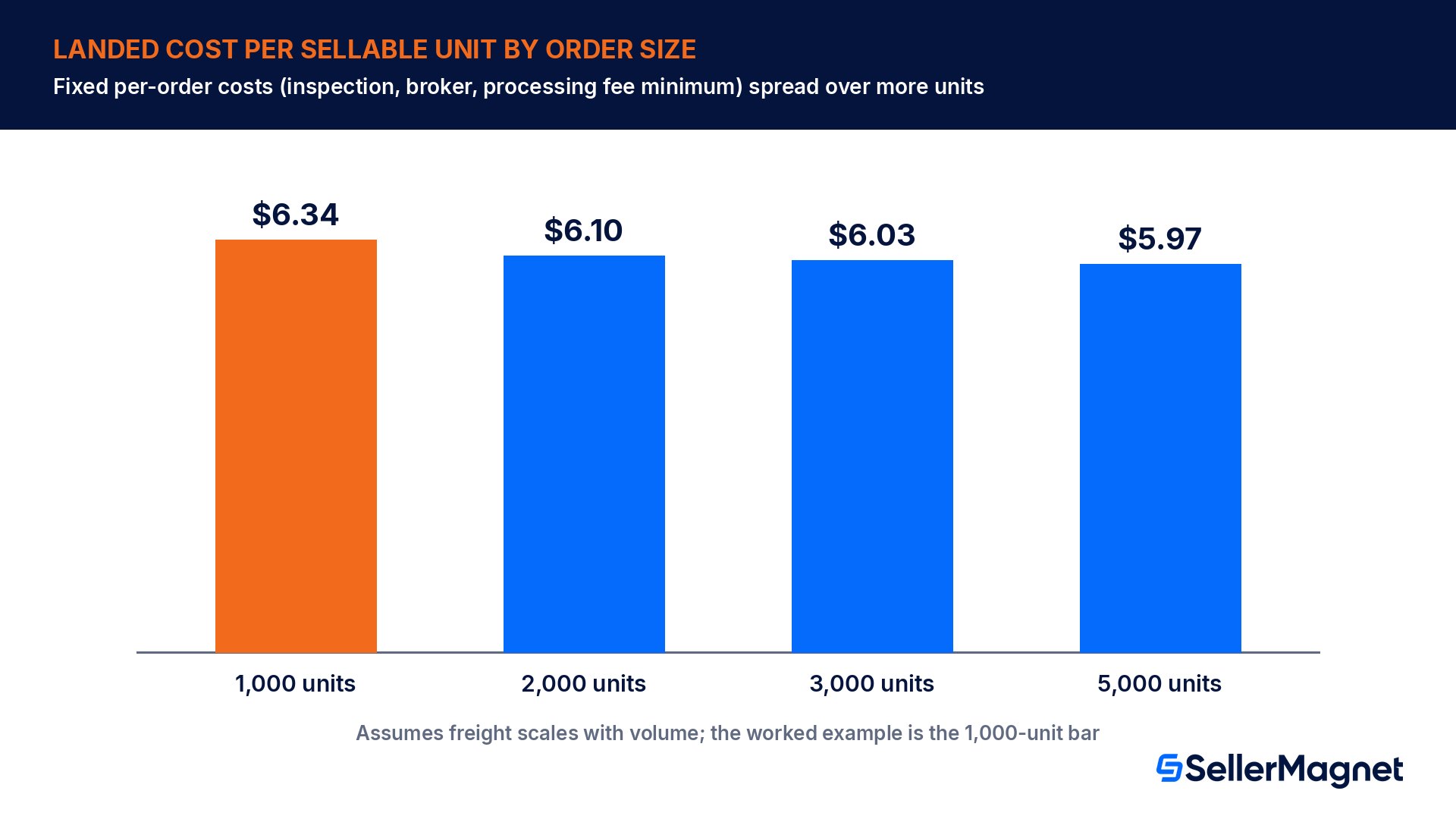
Order of 2,000 instead of 1,000 units
$6.10 instead of $6.34
Inspection, broker and the processing fee minimum are spread over twice the units
Importing into the EU instead of the US
+$72.00 duty on the order
Transport to the EU border is part of the customs value
The order size row needs a word of caution. It assumes freight scales with the volume and that inspection, the broker and the merchandise processing fee stay fixed per order, which is roughly how it works for a single shipment. In practice a bigger order can also earn a lower factory price and a better freight rate per unit, or cost more in storage while the extra units wait to sell. The direction is reliable; the exact saving depends on your quotes.
Two practical conclusions follow. First, on small orders the fixed costs are a large share of the landed cost, so ordering below a few hundred units can make an otherwise good product marginal. Second, bigger orders lower the landed cost but tie up more cash and raise the storage bill, and if your inventory is too thin Amazon can charge a low-inventory-level fee instead. The right order size is the one that balances the landed cost against the months of stock you can sell without long storage.
What changes when you import into the EU?
The cost lines are the same for an EU import, but two of them work differently. First, the customs value includes the cost of transport and related costs up to the point of entry into the EU, while transport after that point is not included. In the example, if $600.00 of the $850.00 freight bill is the sea leg to the EU border, the customs value is $3,800.00 instead of $3,200.00, and the same 12% rate costs $456.00 instead of $384.00, which is $72.00 more on the order. Second, import VAT is charged at the border. A VAT-registered seller can usually reclaim it as input VAT, so it is a cash-flow item rather than a cost, but it still has to be paid before the goods are released, and it can tie up a meaningful amount of cash between payment and the next VAT return. For the rules on lower-value consignments and the import one-stop shop, see our guide to EU customs and IOSS.
The US merchandise processing fee and harbor maintenance fee do not apply to EU imports; instead your broker or forwarder charges for the customs declaration, and the destination charges at the EU port take their place in the freight bill. The principle stays the same: put every line in, then divide by sellable units.
Common mistakes that make landed cost look lower than it is
Comparing quotes on different Incoterms: an EXW price looks cheaper than an FOB price because the cost of getting the goods to the port is not in it yet.
Using the ocean rate instead of the full freight bill: origin charges, destination charges and the delivery to your prep center are often a large share of the total.
Calculating duty on the wrong value: in the EU the freight to the border is part of the customs value, and in every market additional duties can apply on top of the base rate.
Forgetting the fixed fees per entry: the merchandise processing fee minimum, the broker and the bond cost the same on a small shipment as on a large one.
Leaving out prep and labels because they are done in-house: the materials and the hours are still a cost of each unit.
Ignoring the inbound placement fee: choosing one inbound location is convenient, but the fee is charged on every unit of the shipment.
Dividing by ordered units instead of sellable units: every defective or damaged unit still carries its share of freight, duty and prep.
Reusing an old landed cost for a reorder: duty rates, freight rates, exchange rates and Amazon's fees all change, so recalculate every order.
Landed cost checklist before you pay a deposit
The supplier's price is confirmed on a named Incoterm, and every other quote has been converted to the same basis.
Your payment and currency costs are taken from your own statements, for both the deposit and the balance.
The freight quote is all-in to your prep center or warehouse, with origin and destination charges listed.
The tariff code and the current duty rate, including any additional duties, are confirmed with your broker.
For US imports, the merchandise processing fee (with its per-entry minimum), the harbor maintenance fee, the broker and the bond are in the calculation.
Prep, labels and the freight to Amazon are priced per unit, and you know whether you will pay the inbound placement fee.
A defect allowance is set, and the total is divided by sellable units.
Storage for the months you expect the stock to last is added, using the peak rate if the units will sit there from October to December.
The result has been run against today's referral fee and FBA fee for your exact size tier and price band, and the margin still works with your planned advertising spend.
How SellerMagnet fits into the calculation
Landed cost is the number you have to bring; the sell side is the part a tool can do for you. In SellerMagnet's Product Sourcer, you look up any ASIN, UPC, EAN or ISBN and see fees, profit, ROI, BSR history, price history, competing offers and who has held the Buy Box. Enter your landed cost per sellable unit as your cost and the profit and ROI reflect what the product will really earn, not the factory price. The Chrome extension shows a BUY, MARGINAL or PASS verdict based on your own criteria right on Amazon product and search pages, so a product that only works on the quick estimate shows up as marginal before you order.
For a whole supplier list, the Bulk Sourcer analyzes CSV files or pasted codes and gives each row a BUY, MARGINAL or PASS verdict with ROI, margin and profit at your cost; with your Amazon account connected, the detailed analysis uses your real Amazon fees and flags rows where it had to estimate. If you only need a quick fee check for a single product, the free Fee Calculator compares FBA and FBM fees, the referral fee, profit and ROI for any ASIN using Amazon's public fee schedule.
What is landed cost per unit on Amazon FBA?
It is the total cost of getting one sellable unit to an Amazon fulfillment center: factory price, payment fees, inspection, freight, duty, customs fees, broker, prep, freight to Amazon and the inbound placement fee, divided by the units you can actually sell. Amazon's referral and fulfillment fees are taken from the sale price separately, and storage is a holding cost.
Is the FBA fulfillment fee part of landed cost?
No. The FBA fulfillment fee and the referral fee are charged when a unit sells, so they belong on the sell side of the calculation. Landed cost stops when the unit is received at Amazon and ready to sell. Keeping the two apart lets you compare suppliers and shipping methods without mixing in your price or size tier.
Does US customs duty include the cost of freight?
For most imports, no. The US normally uses the transaction value, the price paid for the goods when sold for export to the United States, without international freight or insurance. The EU is different: transport costs up to the point of entry into the EU are part of the customs value, so duty is charged on them too.
What is the merchandise processing fee and how much is it?
It is a US customs user fee on imports. For a formal entry it is 0.3464% of the value of the goods, excluding duty, freight and insurance, with a minimum of $34.58 and a maximum of $670.86 per entry for fiscal year 2027, which started on 1 October 2026. CBP adjusts the minimum and maximum every fiscal year.
Why divide by sellable units instead of ordered units?
Because defective, damaged or lost units still cost freight, duty and prep, but they never produce a sale. Every dollar of the order has to be recovered from the units you can sell. With a 2% defect rate on 1,000 units, the order cost is spread over 980 units, which raises the landed cost per unit by about 2%.
Should storage fees be included in landed cost?
Keep storage separate as a holding cost, then add it for your profit check. Storage depends on how long a unit waits to sell and on the season, not on what it cost to bring in. In the worked example, three months of US off-peak storage add about $0.16 per unit to a landed cost of $6.34.
How often should I recalculate landed cost?
For every purchase order. Duty rates and additional duties, freight rates, exchange rates and Amazon's fees all change during the year, and Amazon also moves between non-peak and peak fulfillment fees. A landed cost from your last order is a starting point for the new quote, not a number to reuse without checking every line again.
Is DDP from the supplier cheaper than arranging freight myself?
Not necessarily. A DDP price includes freight and duty but hides how much of it is freight, duty or margin, so you cannot check it line by line. Ask for an FOB quote alongside the DDP price and build your own landed cost; if the DDP price is still lower and the supplier is reliable, it can be worth it.
Stop Juggling Tools. SellerMagnet Combines Everything You Need.