Amazon FBA sellers lose money two ways on inventory: running out of a bestseller, and holding too much of everything else. Amazon ties both to one number, the Inventory Performance Index (IPI), and uses it to set your storage capacity limits. Forecasting restocks from your own sell-through rate, not gut feeling, is how you keep enough stock to never go out, without tripping the excess-inventory penalties that drag the score down.
Amazon inventory forecasting means estimating how many days of stock you have left from your real sales velocity, and timing restock shipments so you neither run out (hurting your in-stock rate and IPI) nor sit on more than about 90 days of forecasted demand (counted as excess, also hurting your IPI). Amazon's Inventory Performance dashboard shows the score and a restock-today list; a seller tool that forecasts from your own trailing sales velocity gives the same answer without you reading four reports by hand.
What is the Inventory Performance Index (IPI) and why does it control your limits?
The IPI is Amazon's single score for how efficiently you manage FBA inventory, from 1 to 1,000. Amazon's own IPI help page lists four things it watches: excess and aged inventory, 90-day sell-through, stranded inventory (listings that cannot sell for a fixing-fixable reason), and your in-stock rate on replenishable ASINs. The score updates weekly, based on your trailing three months, and Professional-plan sellers can see it on the Inventory Performance dashboard.
Your FBA storage capacity limits come from that score, plus your sales volume (including seasonality), your historical IPI and available fulfilment-centre capacity. Amazon's FBA capacity limits page (US) says new Professional accounts active in FBA for less than 39 weeks don't receive capacity limits yet, so they can build a sales record first; after that, a consistently higher IPI earns higher limits. Limits run on a rolling monthly cycle — Amazon confirms next month's limit, reaffirms or adjusts the month after that, and estimates the month beyond — typically announced during the fourth week of the month, and when your IPI changes, your capacity limit does not change immediately, it is applied at the next monthly adjustment.
The minimum IPI threshold is tightening, not loosening
Public reporting on Seller Central changes (not an official SellerMagnet-verified number — re-check your own Inventory Performance dashboard before relying on a figure) puts the current minimum IPI threshold at 400, and describes 2025 tightening: capacity based on roughly 5 months of forecasted sales instead of 6, plus ASIN-level restock limits layered on top of the account-wide cap. Treat any specific threshold number as a snapshot to verify in your own dashboard, since Amazon updates it region by region.
How do you forecast a restock date instead of guessing?
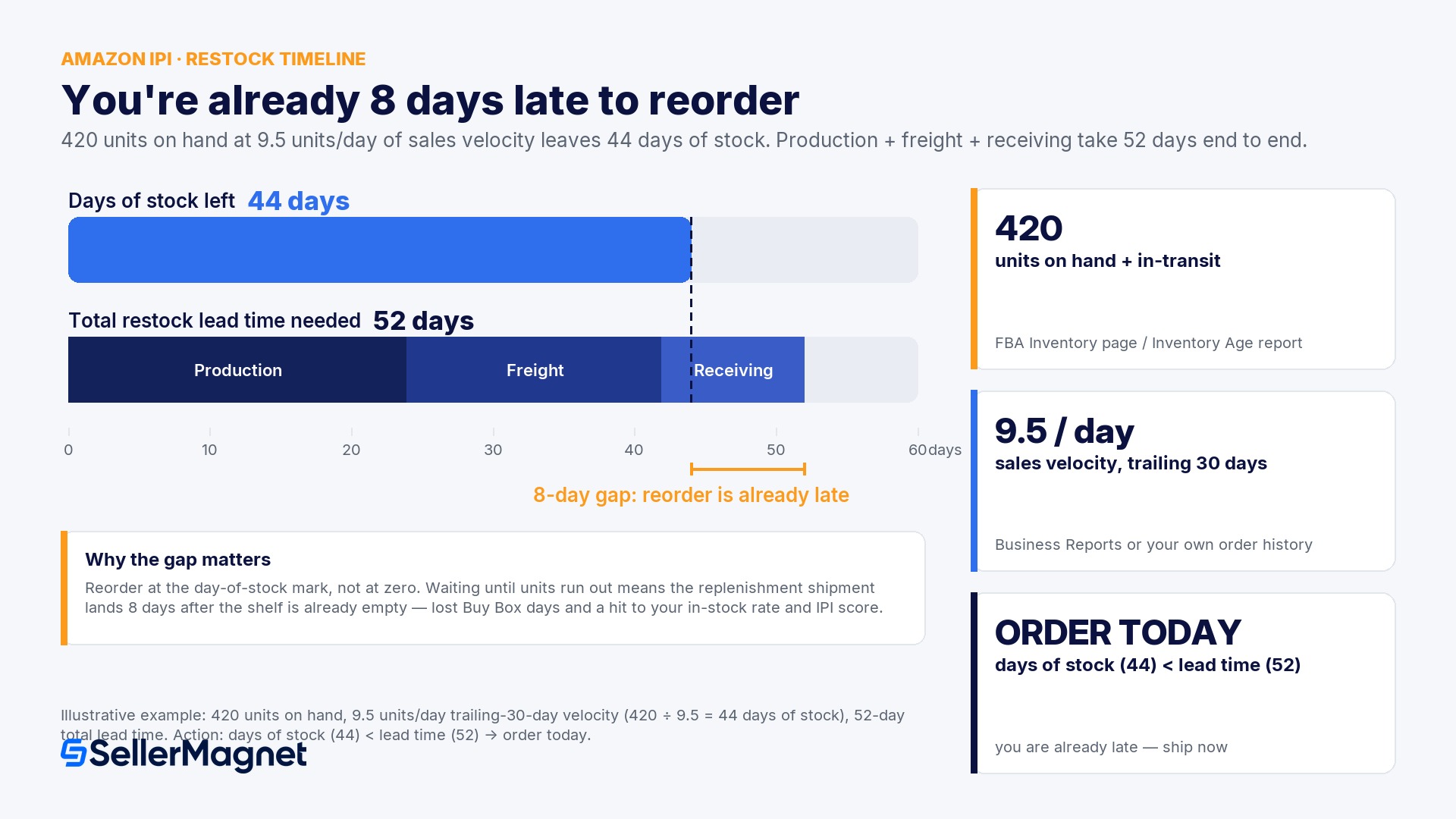
A restock forecast answers one question per SKU: at today's sales rate, on what date do you sell your last unit, and does a new shipment land before that date? Three inputs feed it: days of stock on hand (units available now, including in-transit stock due soon), your sales velocity (units/day, averaged over a window long enough to smooth noise but short enough to catch a real trend change), and your total lead time (supplier production + freight + Amazon's receiving time at the fulfilment centre).
Input
Illustrative value
Where it comes from
Units on hand + in-transit
420 units
FBA Inventory page, Inventory Age report
Sales velocity (trailing 30 days)
9.5 units/day
Business Reports or your own order history
Days of stock left
44 days
420 ÷ 9.5
Total lead time (production + freight + receiving)
52 days
Supplier terms + your last 3 shipment timelines
Action
Order today
Days of stock left (44) < lead time (52): you are already late
That math mirrors the same restock-urgency logic behind Amazon's own Inventory Performance dashboard, which flags SKUs needing immediate reorder once their days of supply drops below their restock lead time. The difference between doing it yourself in a spreadsheet and using a forecast tool is mostly speed and consistency across a full catalogue: SellerMagnet's inventory forecast (included from the Growth tier) calculates days of stock left, an expected stockout date and units to send from your real sales velocity, with a lookback window from 7 to 365 days, so you can smooth out a one-off spike or dip instead of reacting to it. The FBA storage fee guide covers what happens once a SKU slips past the forecast and sits too long.
How do you avoid the excess-inventory side of the same score?
Amazon treats a unit as excess once your FBA inventory for that ASIN covers more than 90 days of forecasted demand. That is a forward-looking number, not a backward one: it compares what you are holding to what Amazon predicts you will sell, not to what you sold last quarter. A seasonal spike in Q3 can make your August inventory look fine and your October inventory look excessive on the same shelf, once demand drops back.
Check sell-through, not just units sold. Amazon's 90-day sell-through metric divides units sold and delivered by the average sellable units on hand over the same period — a SKU can sell a lot and still look like it has too much stock if inbound shipments were oversized.
Fix stranded listings fast. A listing that cannot be bought (missing content, suppressed, or a restricted keyword) stops counting as a sale opportunity but keeps counting as stock on hand, which only hurts your score.
Split big purchase orders. Ordering 120 days of stock in one shipment guarantees an excess period right after it lands, even if the SKU is healthy on average. Smaller, more frequent shipments track the demand curve more closely.
Remove or liquidate dead stock before it ages. Once a removal order or liquidation is placed, Amazon's IPI FAQ confirms that inventory stops counting toward your score — holding on to it and hoping it sells does not help the score, only clearing it does.
Aged inventory has its own, earlier deadline now
Amazon's own aged inventory surcharge page confirms the deadline moved earlier: in the US it now starts at 181 days on hand instead of the older 365-day mark (the UK's equivalent surcharge starts later, at 241 days), plus a Storage Utilization Surcharge above 22 weeks of inventory on hand in the US, in place since April 2024 — down from 26 weeks before that change. Whatever the exact current numbers in your region, the direction is the same: Amazon is charging for aged and excess stock earlier than it used to, so a forecast that assumes last year's grace period will run its restock-vs-liquidate decisions too late.
How do capacity limits and ASIN-level restock limits actually block a shipment?
Capacity limits apply per storage type — standard-size, oversize, apparel, footwear and extra-large — and each is tracked independently. Amazon's FBA capacity limits page (US) gives the example: if you have 200 cubic feet of standard-size capacity and 100 cubic feet of oversize capacity, shipping 150 cubic feet of standard-size inventory doesn't touch your oversize capacity at all — usage in one storage type never counts against another, and capacity can't be transferred between them. If your on-hand inventory plus inbound shipments exceeds your limit in a given storage type, you're blocked from creating new shipments in that type, even with headroom to spare elsewhere. Reactivated ASIN-level restock limits work the same way one layer down: even with account capacity free, a single popular SKU can be capped on how many units you may send in, independent of your overall limit.
The colour bands on the dashboard are the early warning: green under 75% of your limit, yellow between 75% and 90%, red above 90%. A forecast that only looks at "will I run out" misses half the picture if your account is sitting in red on a storage type — you can be short on a bestseller and simultaneously blocked from shipping it in, because older, slower SKUs are eating the capacity.
One dashboard for both failure modes. SellerMagnet's Inventory Management forecast shows days of stock left, an expected stockout date and units to send per SKU, based on your real sales velocity over a lookback window you choose (7-365 days), alongside your returns and settlement data so restock decisions use the same numbers as your profit numbers. Included from the Growth tier; see pricing for the current tiers (14-day free trial, card required, cancel before it ends and pay nothing).
How to forecast an Amazon FBA restock without over-ordering
Pull your real sales velocity - Use a trailing window (30-60 days works for most SKUs; widen it for seasonal items) rather than last week alone, so one spike or dip does not skew the forecast.
Calculate days of stock left - Divide total units on hand plus confirmed in-transit units by your daily sales velocity.
Compare against your full lead time - Add supplier production time, freight time and Amazon's typical receiving time. If days of stock left is lower, you are already behind on reordering, not just due soon.
Check the 90-day excess line before you order more than you need - Make sure the shipment you are about to send does not push the ASIN's total coverage past roughly 90 days of forecasted demand, especially right after a seasonal peak.
Review the IPI dashboard weekly, not just before a deadline - Catch a slipping sell-through or a newly stranded listing while there is still time to fix it before the next score-check week, instead of after a capacity cut arrives.
What is a good Amazon IPI score?
There is no single published "good" number. Scores run 1-1,000 and update weekly. What matters is the current minimum threshold (recently around 400, down from 450): stay above it to avoid storage limits, and well above it for higher capacity over time. Check the live threshold on your Inventory Performance dashboard, since Amazon adjusts it by period.
How often does Amazon update the IPI score?
Weekly, based on a rolling three-month window of your inventory performance. Amazon also announces the specific "score-check weeks" it will use to decide the next period's capacity limits 4-8 weeks in advance, so a sudden drop the week before a score-check week has outsized impact on your limits for the following period.
When does Amazon count inventory as excess?
When an item's FBA inventory covers more than roughly 90 days of supply against Amazon's forecasted demand for it. This compares your stock to a forward demand forecast, not to last quarter's sales, so inventory that looked fine during a seasonal peak can become excess once demand normalizes.
Can a restock limit block me even if my overall FBA capacity has room?
Yes. Reactivated ASIN-level restock limits apply per SKU, on top of the account-wide, per-storage-type capacity limit. A single fast-moving ASIN can be capped on how many units you may ship in during a period, independent of whatever headroom your account has for other products.
Stop Juggling Tools. SellerMagnet Combines Everything You Need.