Amazon FBA Storage Fees 2026: Monthly Rates and Surcharges
R
RenéFreelance Amazon Editor
|
11 min read
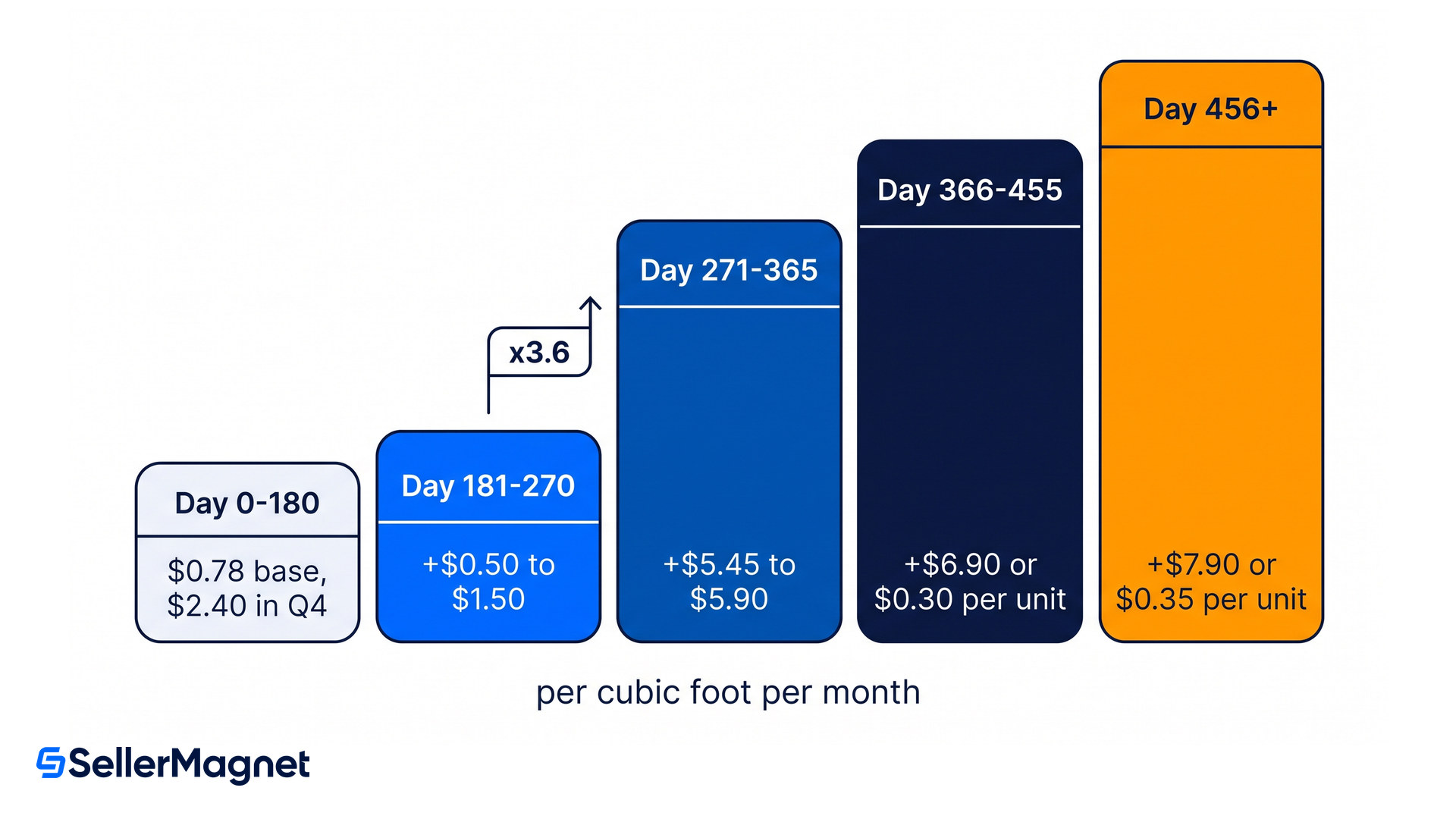
Amazon FBA storage fees are three charges that stack on the same cubic foot of inventory. The monthly storage fee is $0.78 per cubic foot for standard-size items from January to September and $2.40 from October to December; the aged inventory surcharge starts on day 181 at $0.50 per cubic foot and reaches $7.90 after 456 days; and the storage utilization surcharge adds $0.44 to $1.88 per cubic foot once you hold more than 22 weeks of supply. All three are per cubic foot, per month, on the rate card in force in 2026.
Amazon FBA storage fees in 2026 are seventy-eight cents per cubic foot per month for standard-size items from January to September and two dollars forty in the fourth quarter. On top of that, inventory older than one hundred eighty days pays an aged inventory surcharge, and sellers holding more than twenty-two weeks of supply pay a storage utilization surcharge.
What are Amazon FBA storage fees?
FBA storage fees are what Amazon charges for the space your inventory occupies in its fulfillment centers, measured in cubic feet per month. Three separate charges use that measure: the base monthly storage fee that every unit pays, the aged inventory surcharge that punishes units sitting longer than six months, and the storage utilization surcharge that charges accounts holding far more stock than they sell. A unit can pay all three in the same month.
Amazon measures volume on packaged dimensions, longest side by median side by shortest side, and averages the daily volume over the month, as Seller Assistant's storage fee explainer describes. The monthly fee for a given month then posts between the 7th and the 15th of the following month, so the October to December peak rates land on your statements from November to January. The two surcharges have their own assessment days, covered below.
How much is the FBA monthly storage fee in 2026?
The 2026 monthly storage fee is $0.78 per cubic foot for standard-size and $0.56 for oversize inventory from January to September. From October to December it rises to $2.40 and $1.40. The rates are unchanged from 2025; the only mid-year fee change in 2026 was a 3.5% fuel surcharge on fulfillment fees from April 17, not on storage, per AMZ Prep's 2026 fee breakdown. Dangerous goods carry their own, higher rate card and are exempt from the utilization surcharge.
Inventory type
January to September
October to December
Standard-size
$0.78 per cubic foot
$2.40 per cubic foot
Oversize (large bulky and extra-large)
$0.56 per cubic foot
$1.40 per cubic foot
Dangerous goods, standard-size
$0.99 per cubic foot
$3.63 per cubic foot
Dangerous goods, oversize
$0.78 per cubic foot
$2.43 per cubic foot
Two details shape the bill. First, volume is per unit as packaged, so a 12 by 8 by 4 inch box is 0.22 cubic feet and 1,000 of them cost about $173 a month off-peak and about $533 a month in Q4. Second, the fee is averaged daily, so inventory received on October 25 pays roughly a fifth of a full October month, which is why late-October inbounds are cheaper to hold than September ones that sit through the whole quarter.
How does the aged inventory surcharge work?
The aged inventory surcharge is a monthly charge on units that have been in Amazon's network for 181 days or more, on top of the monthly storage fee. Amazon takes a snapshot on the 15th of each month and charges between the 18th and the 22nd, as Amazon's own staff laid out in the Seller Central aging inventory thread. Age is counted first-in, first-out per ASIN, so new shipments never reset the clock on old units.
Inventory age on the 15th
Surcharge per cubic foot per month
Per-unit minimum
181 to 210 days
$0.50
none
211 to 240 days
$1.00
none
241 to 270 days
$1.50
none
271 to 300 days
$5.45
none
301 to 330 days
$5.70
none
331 to 365 days
$5.90
none
366 to 455 days
$6.90
$0.30 per unit, whichever is greater
456 days and more
$7.90
$0.35 per unit, whichever is greater
The cliff sits at day 271, where the rate jumps from $1.50 to $5.45 per cubic foot, and the 456-day tier at $7.90 is new for 2026, effective January 16, per Goat Consulting's 2026 rate card. For very small items the per-unit minimum decides: a unit of 0.02 cubic feet at 400 days owes $0.14 by volume but $0.30 by the minimum, so the minimum wins. Above roughly 0.043 cubic feet per unit the volume rate takes over, which is why Feedvisor's example of 100 units at 0.05 cubic feet, 80 of them aged 13 to 16 months, comes to $29.10 a month by volume, about $349 a year for stock that is not selling.
The 14th-of-the-month rule
A removal or disposal order submitted by 11:59 p.m. Pacific on the 14th excludes those units from that month's surcharge, even if they are still on the shelf on the 15th. Removal orders take one to three months to process, so the order date, not the pickup date, is what matters.
Clothing, shoes, bags, jewelry and watches are exempt from the aged inventory surcharge. Everything else pays from day 181, which is why the six-month mark, not the old twelve-month long-term storage fee, is the date to plan around.
What is the storage utilization surcharge?
The storage utilization surcharge is an account-level charge for holding far more inventory than you ship. Amazon divides your average daily inventory volume by your average daily shipped volume over the past 13 weeks to get a ratio in weeks; above 22 weeks the surcharge applies to every cubic foot older than 30 days, per Seller Assistant's breakdown of the rule, which replaced the old 26-week threshold on April 1, 2024.
Storage utilization ratio
Standard-size surcharge
Oversize surcharge
Under 22 weeks
none
none
22 to 28 weeks
$0.44 per cubic foot
$0.23 per cubic foot
28 to 36 weeks
$0.76 per cubic foot
$0.46 per cubic foot
36 to 44 weeks
$1.16 per cubic foot
$0.63 per cubic foot
44 to 52 weeks
$1.58 per cubic foot
$0.76 per cubic foot
More than 52 weeks
$1.88 per cubic foot
$1.26 per cubic foot
The tiers are the same in peak season; only the base fee underneath them changes, so a standard-size cubic foot in the 22 to 28 week band costs $1.22 a month off-peak and $2.84 in Q4. Your ratio is shown on the FBA dashboard in Seller Central, and three groups never pay the surcharge at all.
Individual selling plans. The surcharge applies to Professional accounts only.
New FBA sellers. Accounts whose first FBA shipment was received less than 365 days ago are exempt.
Small or fresh inventory. Accounts with an average daily inventory of 25 cubic feet or less in the size tier, and any inventory younger than 30 days.
How much does storage really cost for one product?
Fifty cubic feet cost $39 in March and $167 in November once the three fees stack, far above the base rate people remember. The stacking is what makes Q4 expensive: a unit that is old, over-stocked and stored in November pays the peak base, the aged tier and the utilization tier at the same time.
Worked example
ConversionPerk's November case: 50 cubic feet of a standard-size product, 200 days old, in an account running above the 22-week threshold. Peak base storage is 50 times $2.40, or $120; the aged surcharge in the 181 to 210 day tier is 50 times $0.50, or $25; the utilization surcharge in the 22 to 28 week band is 50 times $0.44, or $22. Total: $167 for the month, against $39 for the same 50 cubic feet in March with neither surcharge. The same stock at 300 days in November would owe $272.50 in aged surcharge alone.
How do you cut FBA storage fees before Q4?
Storage fees are among the most controllable FBA costs because every trigger is a date or a quantity you can see in advance. The routine below runs once a month, in the week before the 15th, and takes less than an hour.
The monthly storage fee routine
Pull the inventory age report - Open FBA Inventory in Seller Central, sort by inventory age and flag every SKU with units at 150 days or more. That leaves 30 days of runway before the day-181 tier starts.
Decide per SKU: sell down, remove or dispose - Units that will sell within the runway get a price cut or an Outlet deal. Units that will not sell get a removal order back to your warehouse or a disposal or liquidation order. Submit those orders by the 14th so the 15th snapshot skips them.
Check the storage utilization ratio - On the FBA dashboard, compare your ratio with the 22-week line. If you are above it, the fix is either faster sell-through or less inbound volume, because the ratio is stock divided by shipments.
Right-size Q4 inbounds - For October to December, inbound what will sell by the end of December plus a safety margin, not the whole season at once. Peak storage roughly triples, so every cubic foot that arrives in September and leaves in January pays all three peak months plus two off-peak ones.
Reconcile the charges - Between the 18th and 22nd, pull the Aged Inventory Surcharge report and the monthly storage fee report, match them to the SKUs you flagged, and open a case for any unit that was charged despite a removal order submitted by the 14th.
Quick win for today
Open the SellerMagnet profit dashboard, divide each FBA product's units in stock by its weekly units sold, and take the ten with the most weeks of cover. Anything above 22 weeks is what drives your account's utilization ratio and is heading for the aged tiers; a markdown through the SellerMagnet repricer on those ten recovers the cash before the day-271 cliff, where the surcharge jumps more than threefold.
$0.78 per cubic foot per month for standard-size and $0.56 for oversize inventory from January to September, and $2.40 and $1.40 from October to December. Dangerous goods pay $0.99 and $3.63 for standard sizes.
When does Amazon charge the aged inventory surcharge?
Amazon takes the snapshot on the 15th of each month and charges between the 18th and the 22nd. Units aged 181 days or more on the 15th pay, unless a removal or disposal order was submitted by 11:59 p.m. Pacific on the 14th.
Is the long-term storage fee the same as the aged inventory surcharge?
Yes. Amazon renamed the long-term storage fee and extended it downward: it now starts at 181 days instead of 365, with the steepest tiers from day 271 and a new 456-day tier at $7.90 per cubic foot or $0.35 per unit in 2026.
Who pays the storage utilization surcharge?
Professional sellers with an average daily inventory above 25 cubic feet in a size tier and a storage utilization ratio above 22 weeks. Sellers in their first 365 days of FBA and Individual selling plans are exempt, and so is inventory younger than 30 days.
Where do I see inventory age in Seller Central?
Under Inventory, open FBA Inventory and sort by inventory age, or download the Inventory Age report. The Aged Inventory Surcharge report under Fulfillment reports shows what was actually charged per ASIN after the 15th.
Does a removal order stop storage fees?
It stops the aged inventory surcharge from the month in which it is submitted by the 14th, even before pickup. The monthly storage fee keeps accruing until the units physically leave, which can take one to three months.
Stop Juggling Tools. SellerMagnet Combines Everything You Need.