De Minimis Is Gone for Good: What US Imports Cost Now
R
RenéFreelance Amazon Editor
|
12 min read
The $800 duty-free allowance that carried a decade of cheap cross-border parcels into the United States is now suspended by regulation, indefinitely, for every country and every mode of transport. Two U.S. Customs and Border Protection interim final rules published on 24 June 2026 turned what began as an emergency order into the standing rule, and one compliance date from that package is still ahead of us.
The United States suspended the de minimis exemption that let shipments worth $800 or less enter duty free. Executive Order 14324, signed on 30 July 2025, stopped it from 29 August 2025, and two Customs and Border Protection interim final rules published on 24 June 2026 made the suspension indefinite. Low-value commercial shipments now need formal or informal customs entry and pay applicable duties.
What actually changed, and when?
An emergency measure became the permanent regulation. The non-postal rule states its own scope in one sentence: "This indefinite suspension means that all entries of merchandise valued at $800 or less arriving through all modes other than the international postal network must utilize formal or informal entry procedures." It took effect the day it was published.
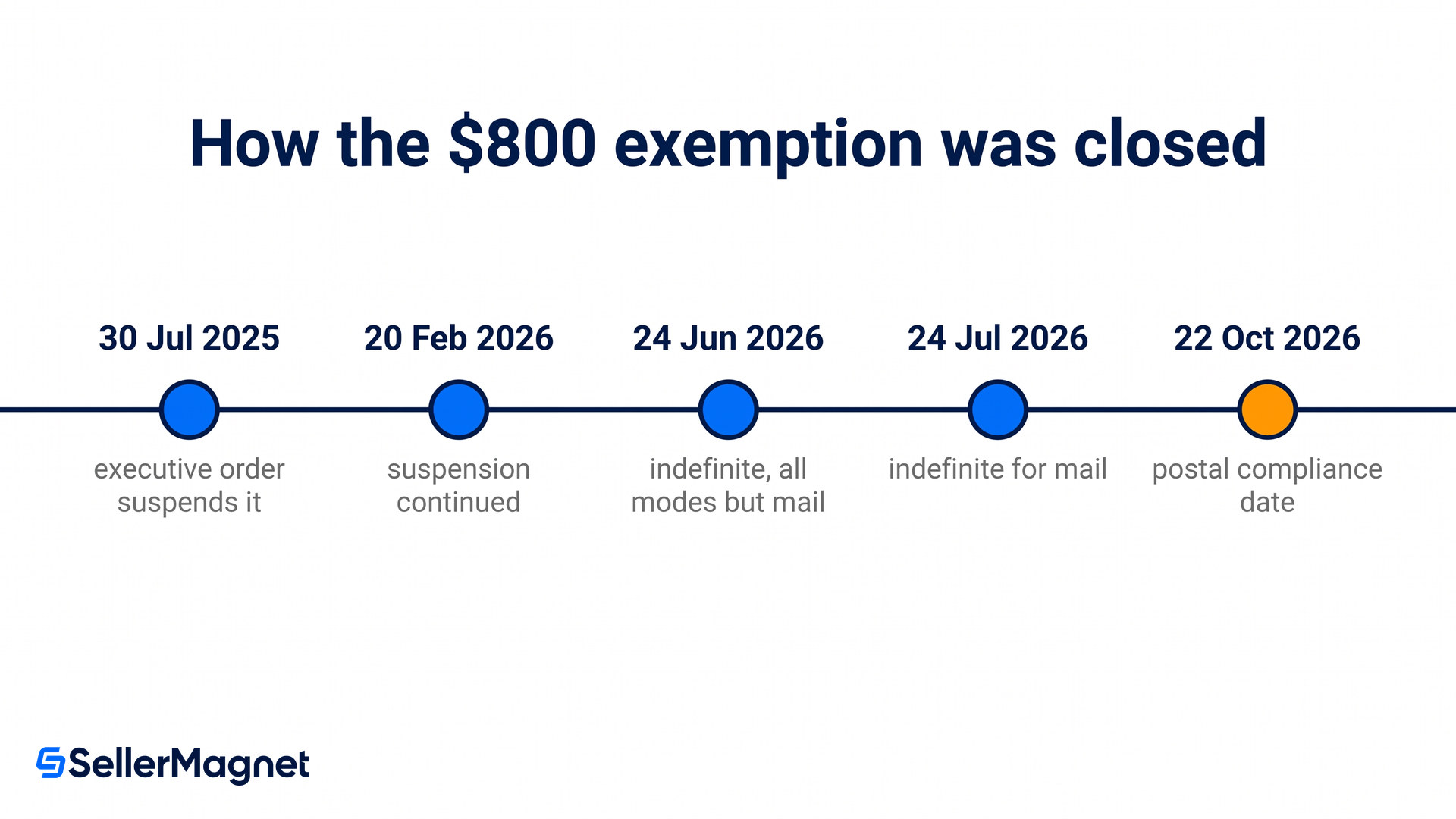
The sequence matters because each step closed a different door. Executive Order 14324 of 30 July 2025 "suspended the availability of the de minimis administrative exemption under 19 U.S.C. 1321(a)(2)(C) for most imports". Executive Order 14388 of 20 February 2026 "continued the suspension", including for postal shipments, and said CBP "should continue to inspect such goods and collect applicable duties, taxes, fees, exactions, and charges". The June rules then wrote it into 19 CFR, where it stays until a rulemaking removes it.
Date
What happened
Where it is written
30 July 2025
Executive Order 14324 suspends duty-free de minimis for all countries
E.O. 14324
20 February 2026
Executive Order 14388 continues the suspension, postal included
E.O. 14388
24 June 2026
Suspension made indefinite for all modes except mail, effective immediately
91 FR 37789
24 July 2026
Suspension made indefinite for mail, plus a new postal entry process
91 FR 37801
22 October 2026
Compliance date for 19 CFR 145.12(a)(2)(v) and (vi)
91 FR 37801
One date in this package has not passed yet
The postal rule sets out its dates precisely: "This interim final rule is effective on July 24, 2026, except for amendatory instruction 4 (19 CFR 145.31), which is effective on June 24, 2026. Compliance date: The compliance date for 19 CFR 145.12(a)(2)(v) and (vi) is on October 22, 2026." If any part of your inbound flow still moves through the international postal network, that is the date to put in the calendar rather than treating the whole story as last year's news.
What does losing de minimis actually mean for a shipment?
Losing the exemption means a customs entry, a classification and a duty payment on consignments that used to need none of them. The exemption lived in "19 CFR 10.151 and 10.153", and everything that used it now falls back to the ordinary entry rules. Informal entry is the lighter of the two remaining routes, and CBP describes it plainly: "Generally, informal entry procedures are less burdensome and complex than formal entry procedures. But CBP may require formal entry for any merchandise if deemed necessary for purposes of admissibility, revenue protection, or the efficient conduct of customs business."
Gifts and travelers keep their exemptions, and neither one helps a seller. The postal rule says explicitly that it "does not affect the availability of the exemptions for bona fide gifts under 19 U.S.C. 1321(a)(2)(A) or personal or household articles accompanying travelers under 19 U.S.C. 1321(a)(2)(B)". Commercial inventory shipped to a fulfillment center is neither a gift nor a suitcase, and labeling it as one is customs fraud rather than a workaround.
The $800 line itself was always statutory, not permanent
The cap moved twice before it was suspended. CBP's own history records the 1995 rule implementing "the legislative increase of the value cap to $200", and then that "In 2016, Section 901(d) of the Trade Facilitation and Trade Enforcement Act of 2015 (TFTEA) amended 19 U.S.C. 1321(a)(2)(C) by increasing the value cap from $200 to $800." The statute is on the books until 1 July 2027 and not after it: the One Big Beautiful Bill Act, enacted on 4 July 2025, "terminated the de minimis exemption effective July 1, 2027". Today's position is a suspension, but the ending is already written into law.
Why does mail have its own rules?
Because the post office is not a customs broker and nobody could file entries for it. The postal rule does two jobs at once: it "implements an indefinite suspension of the de minimis administrative exemption for imports valued at $800 or less arriving through the international postal network" and it "establishes a new postal informal entry process for certain merchandise entering the United States through the mail environment".
CBP is also testing the mechanism that makes it work. A separate notice the same day announced "a test of a new electronic informal entry type for merchandise entering the United States through the international mail process", describing "the new informal entry type 13 - Informal Mail Entry, the eligible participants, and the requirements for filing". Postal imports are becoming a filed, data-carrying channel rather than a bag of parcels with customs declarations stapled on.
The flat per-package fee that many sellers budgeted for in 2025 turned out to be a road nobody took. The rule records that the executive order allowed two duty methods for post, "an ad valorem duty methodology and a specific duty methodology assessed on each package", and then reports the outcome: "only qualified parties have submitted the international mail duty worksheets needed to calculate duties, and all qualified parties have chosen to pay using the ad valorem method." If you priced your imports on a fixed fee per parcel, the market moved to a percentage of value instead.
What will Amazon not do for you?
Everything that matters at the border. Amazon's import page is unusually blunt for a help article, and the list is worth reading as a set of hard limits rather than preferences.
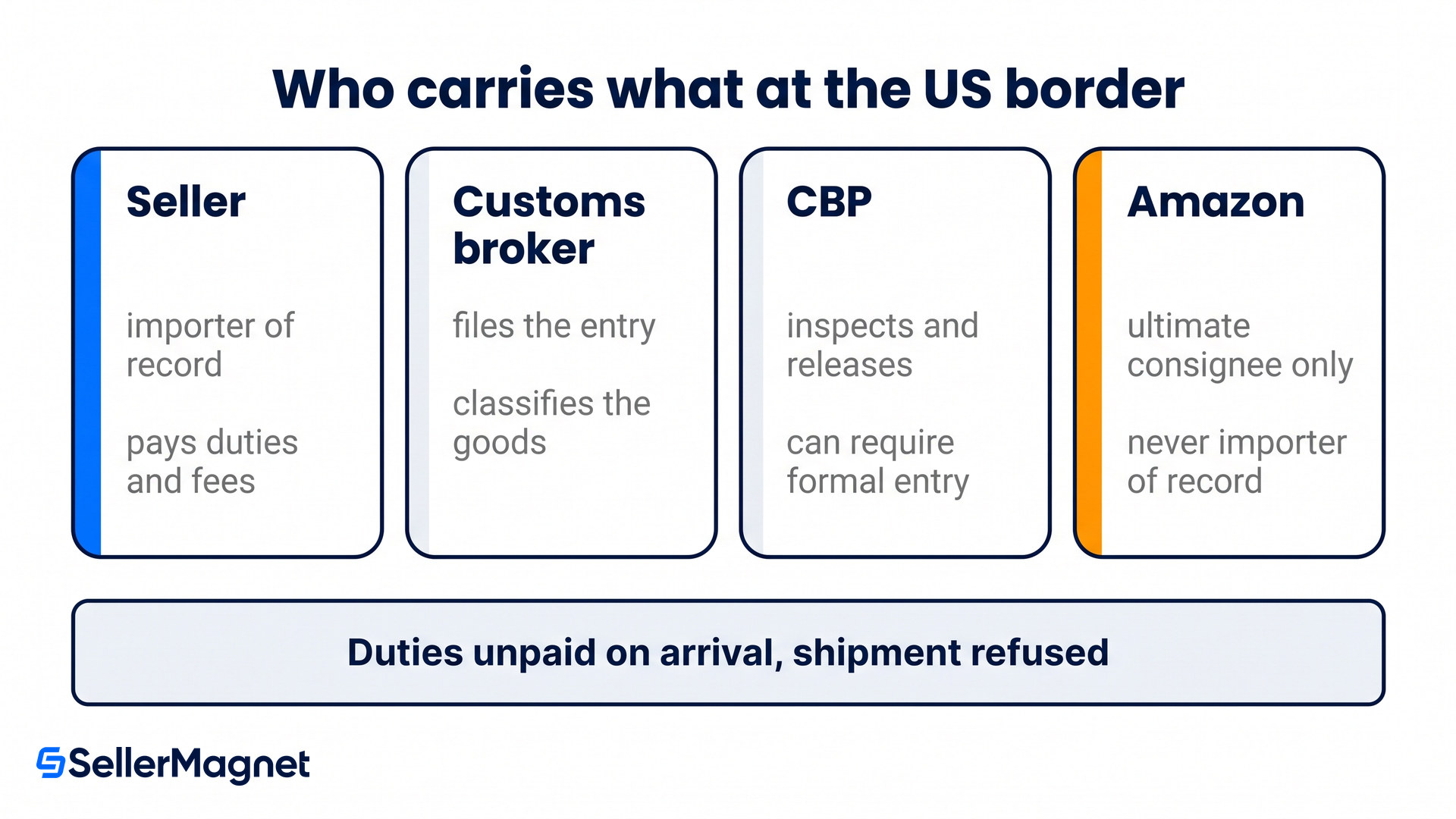
It will never be your importer of record. "Amazon, including our fulfillment centers, will not act as an IOR for any shipment of FBA inventory. This applies to shipments of any size or value, regardless of origin and product."
It will not be the government-agency importer either. Listing Amazon as the PGA importer or consignee, "or using an Amazon DUNS number, may result in detentions and seizures at the border".
It will not be your FSVP agent. Food sellers need a US agent for the Foreign Supplier Verification Program, and "Amazon will not act as the FSVP agent for your shipments".
It will not accept charges on arrival. "All shipments are required to use Delivered Duty Paid (DDP)", and any shipment arriving with collect charges "will be refused without further concession".
It cannot send stock back out of the country. Amazon "is currently unable to return inventory stored in Amazon fulfillment centers to an address outside of the United States", so a removal order needs a US address.
Why does Amazon still explain Section 321?
Good question, and it is the reason this article exists. The same help page still carries a section headed "Special Rules for duty-free (Section 321) shipments", read on 24 September 2026, three months after CBP made the suspension indefinite. It tells sellers that if they are shipping inventory "that qualifies for duty-free (Section 321) entry under U.S. law", CBP requires the merchandise owner's name in the consignee field, in the format "[Seller Legal Name] c/o FBA Fulfillment Center Address".
Instructions for a door that is shut
Nothing in that passage is wrong about formatting, and Amazon does add that "It is your responsibility to make sure that your goods meet all requirements for duty-free entry." The problem is the premise. For commercial shipments there is currently no duty-free entry to qualify for, so a seller following the page in good faith is preparing a filing type that no longer applies to them. Treat the Section 321 heading as historical and work from the CBP rules, not from the help page, until Amazon updates it.
What has to be right on the paperwork now?
Two fields catch sellers more than any others, and both sit on Amazon's import page. The first is the ultimate consignee. Amazon may be listed there, "but only if in care of FBA is listed before the name of the Amazon entity", and it publishes the number to use: "If you list Amazon as the ultimate consignee, you can use the following number as the CBP identification number: 199900-02534." It goes in "Box 26 of the customs entry form 7501", and Amazon warns that "Using the identification number for any other purpose may result in delays, detentions, and seizures at the border".
The second is country of origin, which is now a duty question rather than a labeling detail. Amazon defines it as "the country where the product was produced or manufactured", and where several countries are involved, "the country where the product underwent its last substantial transformation". Since duties depend on that answer, a guess in the listing and a different answer on the entry is a discrepancy waiting to be found.
One origin per listing, and one per store
Amazon's rule is stricter than most catalogs are built for. "Each product listing can only have one country of origin. If your product has multiple countries of origin, you have to create separate product listings and provide one origin for each listing." And it does not travel: "You must provide country of origin information for each product listing in each store separately." If you dual-source a SKU from two factories in two countries, the catalog wants two listings, not one listing with a note. The field sits in the Category Listings report, in "the COO information column in the Compliance section (row 3) of the Template tab".
How to get an inbound shipment through in 2026
Decide who the importer of record is, in writing - It will not be Amazon. Either you register as a non-resident importer, or your freight forwarder or a customs broker acts as IOR on your behalf, and that has to be agreed before the goods move. Amazon notes that shipments into the United States "may be entered by a non-resident (foreign) IOR" and points you to a broker or carrier to set one up.
Get a customs bond in place - Amazon warns you "may also be required to obtain a customs bond as security for your imported shipments to ensure that all duties, taxes, and fees owed to the government are paid". A single-entry bond covers one shipment and a continuous bond covers a year, and the choice is an arithmetic question once you know how many entries you will file.
Classify the goods properly, not approximately - Entry now requires a tariff classification for products that previously travelled without one, and the duty follows from it. This is the step where a broker earns their fee, because a wrong classification is both an overpayment risk and a penalty risk, and it is now repeated on every consignment rather than only on the large ones.
Fix country of origin in the catalog before the entry - Pull the Category Listings report, fill the country-of-origin column, and do it per store. Aligning the listing with what the entry will say removes the most common inconsistency between what Amazon shows a customer and what you told CBP.
Ship DDP and pay everything upfront - Amazon refuses collect charges outright, so duties, taxes and freight must be settled before the shipment reaches the fulfillment center. Ask the forwarder to confirm the terms in writing, because a shipment refused at the door is a return you cannot send abroad.
Check whether any of your flow still goes by post - Mail has its own rule, its own effective date and a compliance date of 22 October 2026. If a supplier still sends samples, replacement parts or small replenishments by post, that channel needs its own answer rather than being assumed to work as before.
The number that decides your sourcing
Take your landed cost per unit before August 2025 and add the duty rate that now applies to the classification, plus the per-entry cost of brokerage divided by the units on a typical consignment. That total is your real cost per unit today. Compare it against your current price and your referral and fulfilment fees, and the SKUs that no longer clear are usually the cheap, light, fast-moving ones that used to ride in under the exemption. Those are the products to reprice, reorder in larger consignments, or drop, and it is better to find them in a spreadsheet than in a quarter of flat margin.
The change punishes catalogs that were never modelled at a unit level, because the products that lost the most are the ones whose margin was thinnest to begin with. Knowing landed cost, fees and margin per ASIN is what turns this from an anxiety into a sorting exercise. A seller analytics dashboard that holds cost and fee data per ASIN answers it faster than a spreadsheet rebuild, and our guide to the EU customs and IOSS rules covers the other side of the same problem for sellers shipping into Europe.
Is the US de minimis exemption coming back?
No. The June 2026 rules implement an indefinite suspension, and Congress went further: the One Big Beautiful Bill Act of 4 July 2025 "terminated the de minimis exemption effective July 1, 2027". CBP says it "is currently suspended" and "will in 2027 be permanently terminated pursuant to a recent statute."
Does the suspension apply to every country?
Yes. Executive Order 14324 was titled Suspending Duty-Free De Minimis Treatment For All Countries, and the CBP rules apply to merchandise valued at $800 or less regardless of origin, across all modes of transport.
Can I still send samples as gifts?
The gift exemption under 19 U.S.C. 1321(a)(2)(A) was left untouched, but it covers bona fide gifts between individuals, not commercial samples or inventory. Declaring business goods as gifts is a false declaration, not a planning option.
Will Amazon clear my shipment through customs?
No. Amazon will not act as importer of record for FBA inventory of any size or value, will not be the partner government agency importer or consignee, and will not be your FSVP agent. It may appear only as ultimate consignee, in care of FBA.
What is the 22 October 2026 date?
It is the compliance date for 19 CFR 145.12(a)(2)(v) and (vi), set by the postal interim final rule. It applies to the mail channel rather than to freight or courier shipments.
What happens if my shipment arrives with duties unpaid?
Amazon refuses it. Its page requires Delivered Duty Paid terms and states that any shipment arriving with collect charges will be refused without further concession, and inventory cannot be returned to an address outside the United States.
Stop Juggling Tools. SellerMagnet Combines Everything You Need.