Amazon Black Friday Deals 2026: Which Ones Pay for Sellers
R
RenéFreelance Amazon Editor
|
12 min read
Last updated: Oct 13, 2026
Amazon Black Friday deals cost sellers $100 per promotion plus 1.5% of promotional sales (capped at $5,000) in 2026, for Best Deals, Lightning Deals and Prime Exclusive Discounts in the US store during Black Friday Week and Cyber Monday. Coupons cost $5 plus 2.5% of coupon sales, capped at $2,000. Best Deal and Lightning Deal submissions close on 20 October 2026, according to Amazon's Q4 2026 peak readiness playbook. The fee is rarely what decides whether a Black Friday deal pays, though. The discount Amazon requires, and the sales you would have made at full price anyway, cost far more.
Amazon Black Friday deals for sellers in 2026 cost $100 per Best Deal, Lightning Deal or Prime Exclusive Discount, plus 1.5% of the promotional sales, capped at $5,000. Coupons cost $5 plus 2.5% of coupon sales. US Best Deal and Lightning Deal submissions close on 20 October 2026. A deal pays only if the extra units it sells cover both the fee and the discount you give on sales you would have made anyway.
What does each Black Friday deal type cost in 2026?
Amazon kept its holiday promotion fees at Prime Day 2026 levels. Its forum post "Holiday 2026: Same fees, same eligibility, earlier deadlines" says fees for Best Deals, Lightning Deals and Prime Exclusive Price Discounts match Prime Day: a $100 upfront fee per promotion plus a variable fee of 1.5% of promotional sales, capped at $5,000. Coupons follow their own fee structure: $5 per coupon plus 2.5% of coupon sales, capped at $2,000. The rules on price and discount depth differ more than the fees do.
Deal type
Minimum discount
Price rules
Fee (US, holiday 2026)
Submission window
Best Deal
15% off the reference price
At or below the 60-day low and at least 5% below the 30-day low
$100 + 1.5% of sales, cap $5,000
Closes 20 October 2026
Lightning Deal
20% off the reference price
Same 30- and 60-day rules; runs 12 hours on main event days
$100 + 1.5% of sales, cap $5,000
Closes 20 October 2026
Prime Exclusive Discount
15% off the reference price
Same 30- and 60-day rules; Prime members only
$100 per campaign + 1.5% of sales, cap $5,000
Open since 20 July 2026
Coupon
5%
Point-of-sale discount on single products or sets
$5 + 2.5% of coupon sales, cap $2,000
Opens once event dates are public
Source for the table is Amazon's Q4 2026 playbook, and the rates are for the US store. Amazon's European stores run on different terms: Amazon's EU peak season announcement lists a Black Friday Week deal window open until 18 November and lower promotion fees, for example €16 plus 0.75% of sales in Germany. Their peak fulfilment fees are covered in the EU festive peak guide. Best Deals with discounts of 30% or more are eligible for additional merchandising during the events. All deals created for Prime Big Deal Days were made Prime-exclusive, but nothing in the playbook says the same for Black Friday Week.
Several fee mechanics catch sellers out. Amazon's deal fee page says you are charged after the deal runs, the full fee applies to a deal cancelled while it is running, and fees are not refunded if a customer returns the item. The variable fee is calculated on the price the customer paid after the discount. Running a deal and a coupon on the same product means two separate fees. For price discounts during events, the price discount fee page adds that the fee shows up as "Deal participation fee" and "Deal performance fee" in your Payments dashboard after a 10-day reconciliation period.
The upfront fee is charged even with zero sales
Amazon states it plainly for deals and for price discounts: the $100 upfront fee applies even if the promotion produces no sales. You avoid it only if you or Amazon cancel before the start time, or, for deals, if all ASINs in the deal are suppressed before it runs. If a deal is not selected for the event or shows a "Needs attention" alert, decide before it starts whether to fix it or cancel it.
Why does the discount cost more than the deal fee?
The discount applies to every unit sold during the deal, including the units that would have sold at full price anyway. Sellers usually compare the $100 fee with the extra sales they hope for. The bigger cost is the margin given away on baseline sales. Here is an illustrative example. It is not a real product and the fees are rounded.
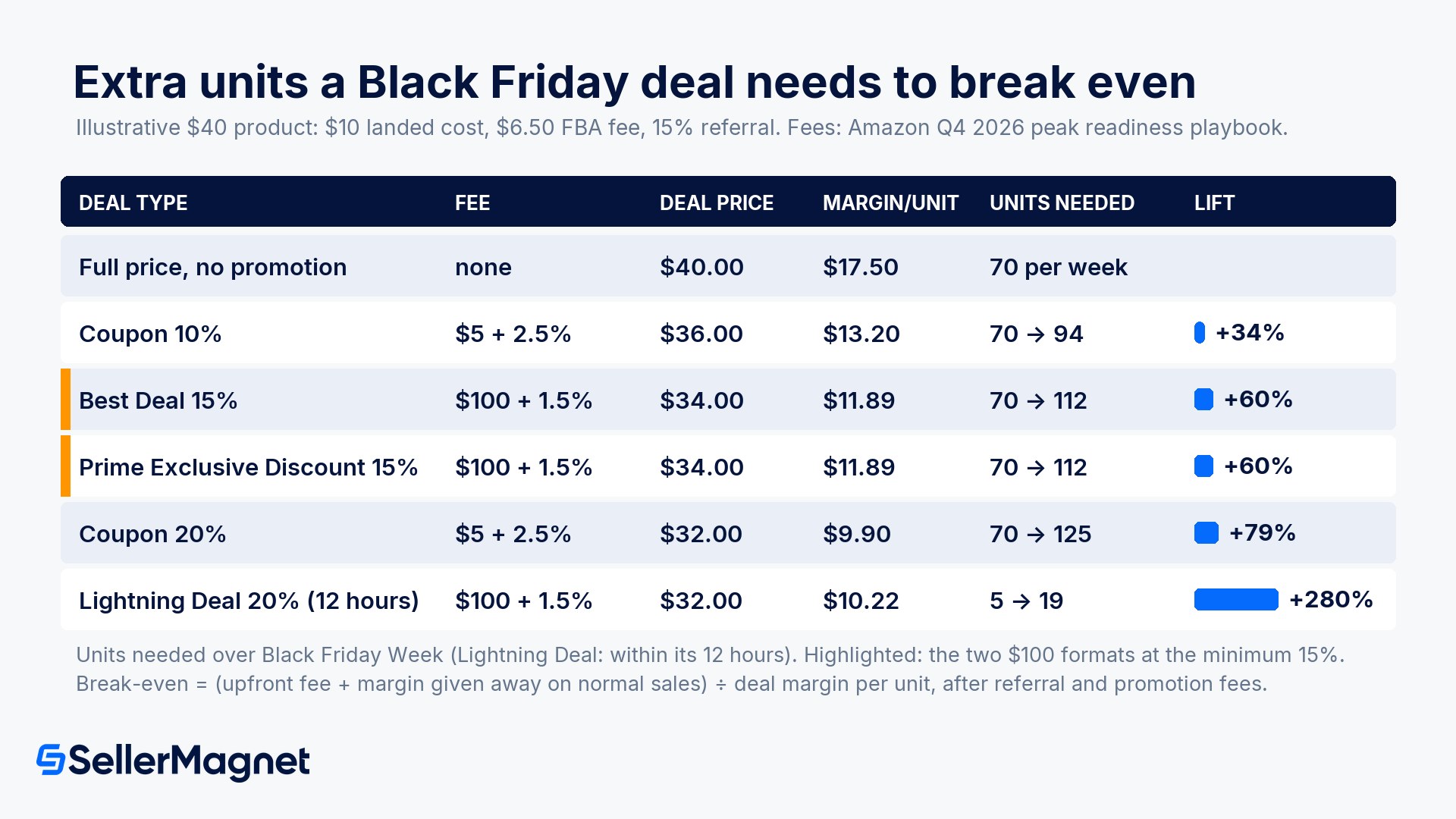
Regular price $40, landed cost $10, FBA fee $6.50 including the holiday peak increment, referral fee 15%. Margin per unit at full price: $17.50.
Normal sales during Black Friday Week without a deal: 70 units (10 per day).
A 15% Best Deal at $34 leaves $11.89 per unit after the referral fee and the 1.5% variable fee. On the 70 baseline units that is $392.70 of margin given away, plus the $100 fee: $492.70 to win back.
At $11.89 per extra unit, the deal needs about 42 extra units, or 112 units instead of 70, before it makes a single dollar more than doing nothing.
Run the same numbers for the other formats and the picture changes. A Lightning Deal at 20% off runs for 12 hours, so it gives away margin on far fewer baseline units: about 5 units in 12 hours in this example. It needs roughly 14 extra units to break even, but that means selling 19 units in 12 hours instead of 5. A coupon can be as shallow as 5%. At 10% off ($36), with the $5 fee and 2.5% variable fee, it needs about 24 extra units over the week. The same coupon at 20% off needs about 55.
Where coupons are cheaper, and where they are not
On fees alone, a coupon ($5 + 2.5%) costs less than a $100 deal format (1.5%) until promotional sales reach $9,500. Above that, the deal formats cost less in fees, until the caps come into play at very high sales. Coupon fees are also separate from the coupon budget that funds the customer discount, so set both before the event.
Your own numbers will differ, which is the point of the exercise. Put your real FBA fee, referral fee and landed cost into a calculator and work out the break-even before you commit. The free SellerMagnet Fee Calculator shows FBA and FBM fees, referral fee, profit and ROI for any ASIN from Amazon's public fee schedule, with five free lookups per day. The holiday peak fee guide lists the peak FBA rates that apply from 15 October 2026 to 14 January 2027.
Which deal type pays for which product?
The best deal type is the one whose break-even your product can realistically clear. Fast sellers with plenty of stock can carry a $100 fixed fee easily. Slow sellers often cannot, and for them a small coupon or no promotion at all is the better decision. Amazon also says deal selection is not guaranteed, and that deals with larger available quantities may have an advantage.
High-velocity products with deep stock: Best Deals spread the $100 over a full week of event traffic. A discount of 30% or more earns extra merchandising, but check the break-even at that depth first.
Products with a strong daily peak: Lightning Deals limit the discount to 12 hours. They suit products where shoppers decide quickly and the event-day traffic is high.
Prime-heavy categories: Prime Exclusive Discounts reach Prime members with a badge in search, on the product page and in the cart. They need a validated reference price to show the savings.
Slow movers, new launches and thin margins: a 5% to 10% coupon keeps the fixed cost at $5 and lets you choose a shallow discount.
Products with less than 4 to 6 weeks of stock: skip the deal or reorder first. Amazon recommends 4 to 6 weeks of inventory before a deal event to avoid the low-inventory-level fee.
A deal does not win you the Buy Box. Amazon's deal fee page says that running a deal "doesn't guarantee that you'll be the Featured Offer". On a shared listing, another seller can hold the Buy Box while your deal fee runs. The Featured Offer guide explains what decides it.
What has to be true before 20 October?
A deal only runs if the product, the price and the stock all qualify, and each of those has its own date. Check them in this order, because the inventory dates fall closest together.
Inventory arrives in time. For Prime badge eligibility during Black Friday Week and Cyber Monday, Amazon's playbook lists 14 October for AWD shipments, 21 October for FBA shipments with minimal shipment splits and 28 October for FBA shipments with Amazon-optimized splits. The Supply Chain by Amazon guide covers the AWD side.
The deal is submitted. Best Deals and Lightning Deals close on 20 October 2026. Prime Exclusive Discounts have been open since 20 July. For coupons, the playbook says submissions open once the event dates are publicly announced.
The price qualifies. The deal price has to meet the minimum discount off the reference price, sit at or below the lowest price of the past 60 days, and be at least 5% below the lowest price of the past 30 days.
The product and account qualify. For price discounts during events, Amazon requires a seller feedback rating of at least 3.5 and, for products with ratings, at least four stars. Seller-fulfilled offers must also meet limits on late shipment rate (4%), order defect rate (1%) and pre-fulfilment cancellation rate (0.5%).
An October price dip can raise your November discount
Amazon's Deals for events page bases the maximum deal price partly on the lowest sales price across all sellers in the past 30 and 60 days. Prime Big Deal Days prices are excluded from that lookback, but other price drops are not. If a repricer, a coupon or a competitor pushes the price down in late October, the deal price you need in late November falls with it. Set a repricer minimum that protects the price you want to discount from.
That last point is easy to miss. A floor set for a normal week lets the price drift down when a competitor clears stock, and three weeks later the deal requires a discount that no longer covers the margin. The SellerMagnet Repricer never sets a price outside the minimum and maximum you define, which makes it easy to hold a price steady through October for products you plan to put on a deal.
How do you know whether the deal paid off?
Compare net profit, not revenue. Take the event week's units, subtract the promotion fees once they appear after Amazon's reconciliation period, and compare the result with the same period in a normal week at full price. Check returns again a few weeks later, because the deal fee stays charged when a discounted unit comes back.
Units sold during the deal compared with your baseline for the same days.
Net margin per unit after referral fee, FBA fee, promotion fees and refunds.
Sales in the two weeks after the event, compared with the two weeks before. A deal that pulled demand forward shows a dip here.
Stock left after the event. Amazon recommends keeping 28 days of inventory for post-deal sales.
See the deal's real result per order.SellerMagnet Analytics shows net profit per order, product and marketplace after Amazon fees, COGS, shipping, VAT, refunds and your own expenses, and lists every Amazon fee and adjustment from your settlements in one Transactions view. The free tier covers up to 50 orders per month for 60 days; paid plans come with a 14-day free trial.
How to decide on a Black Friday deal in 30 minutes
Write down the full-price margin - Use the regular price, landed cost, the peak FBA fee and the referral fee to get the margin per unit at full price.
Estimate the baseline - Estimate how many units the product would sell during Black Friday Week without any promotion, using last year's event week or a recent normal week.
Price the deal - Find the lowest deal price that meets the minimum discount and the 30-day and 60-day price rules, then calculate the margin per unit at that price after the variable fee.
Calculate the break-even - Add the upfront fee to the margin given away on baseline units, then divide by the deal margin per unit to get the extra units the deal must sell.
Decide and protect the price - Submit the deal only if that many extra units is realistic and in stock, then hold the price steady until the event with a repricer minimum.
When is the deadline to submit Black Friday deals on Amazon in 2026?
In the US store, Best Deal and Lightning Deal submissions for Black Friday Week and Cyber Monday close on 20 October 2026, according to Amazon's Q4 2026 peak readiness playbook. Prime Exclusive Discounts have been open since 20 July. Coupon submissions open once the event dates are public. Amazon's EU announcement lists 18 November for European stores.
How much does an Amazon Lightning Deal cost for Black Friday 2026?
A Lightning Deal during the 2026 holiday events costs a $100 upfront fee plus 1.5% of the deal sales, capped at $5,000. The upfront fee is charged even if the deal sells nothing, unless it is cancelled before it starts. Outside peak events, Amazon charges $70 per day plus 1% of sales, capped at $2,000.
Are Amazon coupons cheaper than deals for Black Friday?
On fees, usually yes for smaller sellers. A coupon costs $5 plus 2.5% of coupon sales, while deals cost $100 plus 1.5%. The coupon is cheaper until promotional sales reach about $9,500. Coupons also allow a minimum discount of 5%, which keeps the margin given away on baseline sales much smaller than a 15% or 20% deal.
Are Amazon deal fees refunded if the customer returns the item?
No. Amazon states that deal fees and coupon fees are not refunded when a customer returns the item. The variable fee is based on the price the customer paid after the discount, and the upfront fee applies once the promotion has run. Factor expected returns into the break-even, especially for categories with high holiday return rates.
What discount does an Amazon Black Friday deal need?
Best Deals and Prime Exclusive Discounts need at least 15% off the reference price, Lightning Deals at least 20%, and coupons at least 5%. Deal prices must also be at or below the lowest price of the past 60 days and at least 5% below the lowest price of the past 30 days, which often decides the real discount.
Stop Juggling Tools. SellerMagnet Combines Everything You Need.