Amazon Shop Direct Merchant Workspace 2026 Explained
R
RenéFreelance Amazon Editor
|
15 min read
Amazon announced the Shop Direct Merchant Workspace on its own newsroom in November 2026, a free self-service portal that connects a merchant's own store catalog to Amazon's search results and to Alexa for Shopping, Amazon's agentic shopping assistant. The part of the announcement most relevant to an existing Amazon seller is easy to miss inside a program framed around outside stores: Amazon states plainly that sellers who already sell on Amazon may also be eligible to participate, specifically to list selection they do not currently sell on Amazon's own store. This guide works through what the Merchant Workspace actually does, the three-step signup flow Amazon publishes, the two different ways a customer can complete a purchase through it, and where this genuinely new distribution channel fits next to a seller's existing FBA or FBM catalog.
The Shop Direct Merchant Workspace is a free self-service portal Amazon launched in November 2026 that connects a merchant's own product catalog to Amazon search results and to Alexa for Shopping. Existing Amazon sellers can also use it to surface products they do not currently sell on Amazon itself, without building new Amazon listings for them. Signup takes three steps: create a merchant account, verify the business website, and share the catalog through a feed partner or the Selling Partner API. A Shop Direct purchase completes either on the merchant's own site, with a clear notice that the customer is leaving Amazon, or through Buy for Me, where Amazon's AI completes checkout on the merchant's site for the customer. It is US-only for now, and shipping, returns and support stay entirely with the merchant.
What is the Shop Direct Merchant Workspace?
Amazon introduced Shop Direct itself roughly a year before the Merchant Workspace, as a way to show Amazon customers products from other stores across the web directly inside Amazon search results and within Alexa for Shopping. Shop Direct items are clearly labeled "Shop Direct" so a customer knows the item is not sold or fulfilled by Amazon. Amazon's own figures describe tens of millions of customers discovering hundreds of millions of unique products from other stores through the program since launch, with Shop Direct products now appearing in hundreds of millions of searches every month. The Merchant Workspace, announced in November 2026, is the self-service piece that was missing: a portal where any eligible merchant can register for Shop Direct and connect a store without a custom integration project. From that portal, a merchant can submit and manage product feeds, and see which of their own products are currently active and showing to Amazon customers. Amazon frames the Workspace specifically around catalog reuse: a merchant that has already built a product feed for another shopping destination can connect that same feed to Amazon rather than building a second catalog from scratch.
Who can actually use Shop Direct, and why would an Amazon seller bother?
Shop Direct is built for merchants that run their own online store outside Amazon, but Amazon's announcement adds one sentence that matters for an existing seller: "Merchants who are already Amazon sellers may also be eligible to participate in Shop Direct and list selection they don't currently sell in Amazon's store." That is a narrower use case than it first sounds. It is not a way to duplicate an existing FBA or FBM listing onto a second channel, and it is not a way to avoid Amazon's normal referral and fulfillment fees on products already sold through Seller Central. The practical use case is the inventory gap: a seller's own website or another sales channel frequently carries SKUs, bundles, larger pack sizes or regional variants that were never worth the work of a full Amazon listing, a dedicated image set and PPC budget. Shop Direct lets that existing, unlisted catalog become visible to Amazon shoppers who search for it, using a feed the seller likely already maintains for another channel, instead of either building out dozens of thin Amazon listings or leaving that demand on the table entirely. Amazon directs interested sellers to a specific inbox, shopdirect@amazon.com, rather than the normal Seller Central signup flow, which is itself a signal that eligibility is being handled case by case rather than opened to every seller automatically.
This is also a different relationship to Amazon than a seller account normally has. A Seller Central account gives Amazon the listing, the fulfillment choice and a cut of every sale through referral and FBA fees; a Shop Direct listing gives Amazon only the discovery surface, a search result or an Alexa for Shopping answer that points back to a page Amazon does not host, fulfill or get paid a referral fee on. That split is why Amazon can call Shop Direct free to join: Amazon is not providing storage, pick-and-pack, customer service or payment processing for a Shop Direct order the way it does for an Amazon-fulfilled one, so there is no fee structure comparable to FBA's storage and fulfillment fees to charge for in the first place. A seller weighing whether to bother should treat the two catalogs as separate businesses sharing one Amazon-visible storefront, each with its own fee structure, its own support burden and its own conversion funnel, rather than as one combined listing count.
A normal Amazon FBA or FBM listing
A product listed through Shop Direct
Where the purchase completes
On Amazon, Amazon-fulfilled or merchant-fulfilled
On the merchant's own site, or via Buy for Me
Referral and fulfillment fees
Amazon's standard referral and FBA or FBM fees apply
No fee to participate in Shop Direct itself
Shipping, returns, support
Amazon or the seller, per the fulfillment method
Always the merchant, through their own processes
Listing work required
A full Amazon listing, images and content
Reuses an existing product feed
What are the three signup steps Amazon publishes?
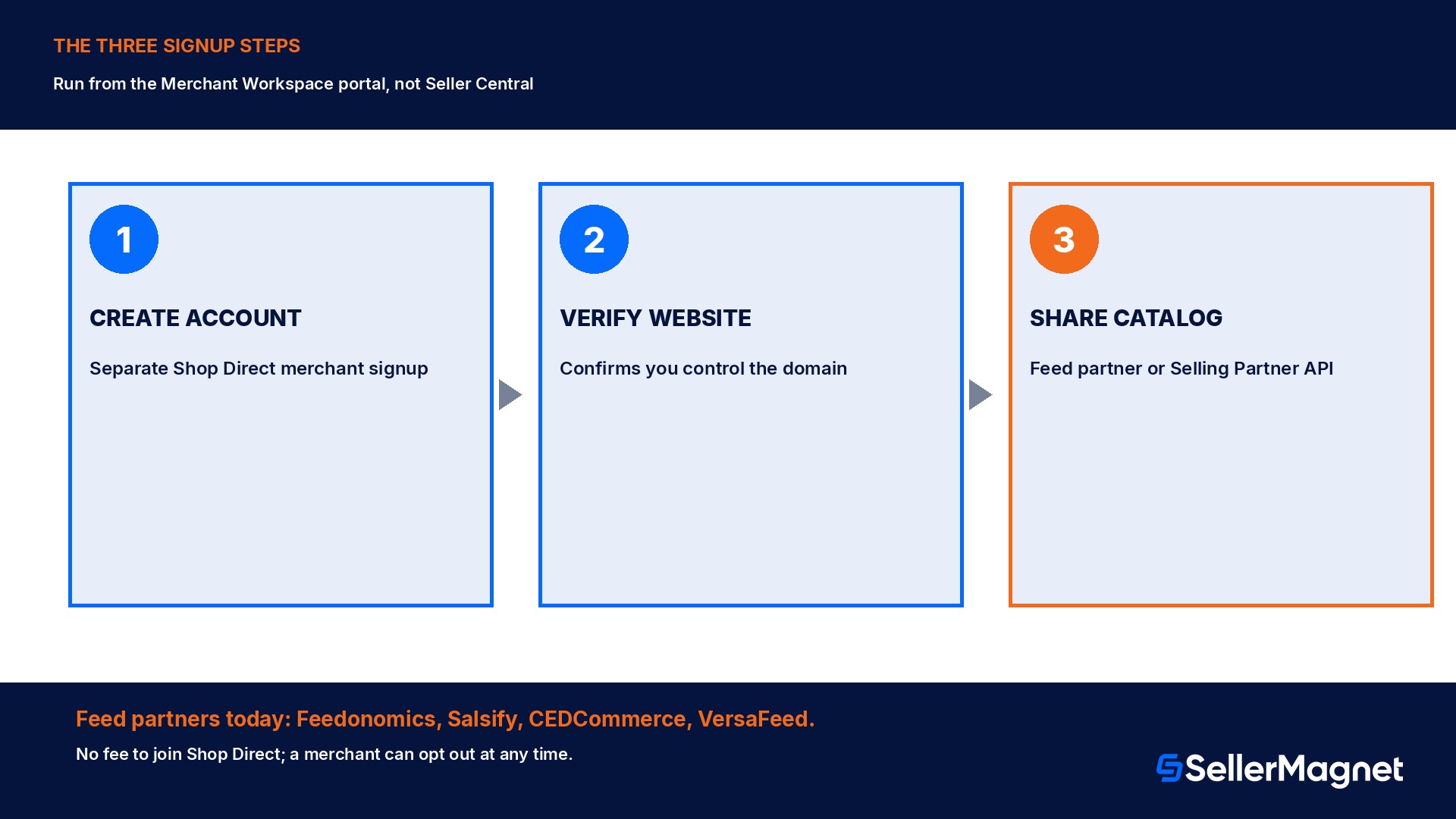
Amazon describes the Merchant Workspace signup as three steps, run from the Shop Direct Merchant Workspace portal itself rather than through Seller Central. The first step is creating a Shop Direct merchant account, separate from an existing Amazon seller account even for a merchant who already sells on Amazon. The second step is verifying the business website, confirming the merchant controls the domain the catalog will point customers to. The third step is sharing the catalog, and here Amazon gives two distinct paths rather than one mandatory format: work with a solution provider whose app connects the feed automatically, naming Feedonomics, Salsify, CEDCommerce and VersaFeed as current partners, or integrate directly with the Selling Partner API to submit and manage the feed programmatically. Amazon states that more Shop Direct integrations from other developers are expected as the Shop Direct API matures, so the four named partners are the current list, not a permanent ceiling on supported platforms.
Step
What it actually requires
1. Create a Shop Direct merchant account
A separate signup in the Merchant Workspace portal, not the existing Seller Central login
2. Verify the business website
Confirms the merchant controls the domain the catalog will send customers to
3. Share the catalog
Via a feed partner (Feedonomics, Salsify, CEDCommerce, VersaFeed) or directly via the Selling Partner API
What happens when a customer taps Shop Direct?
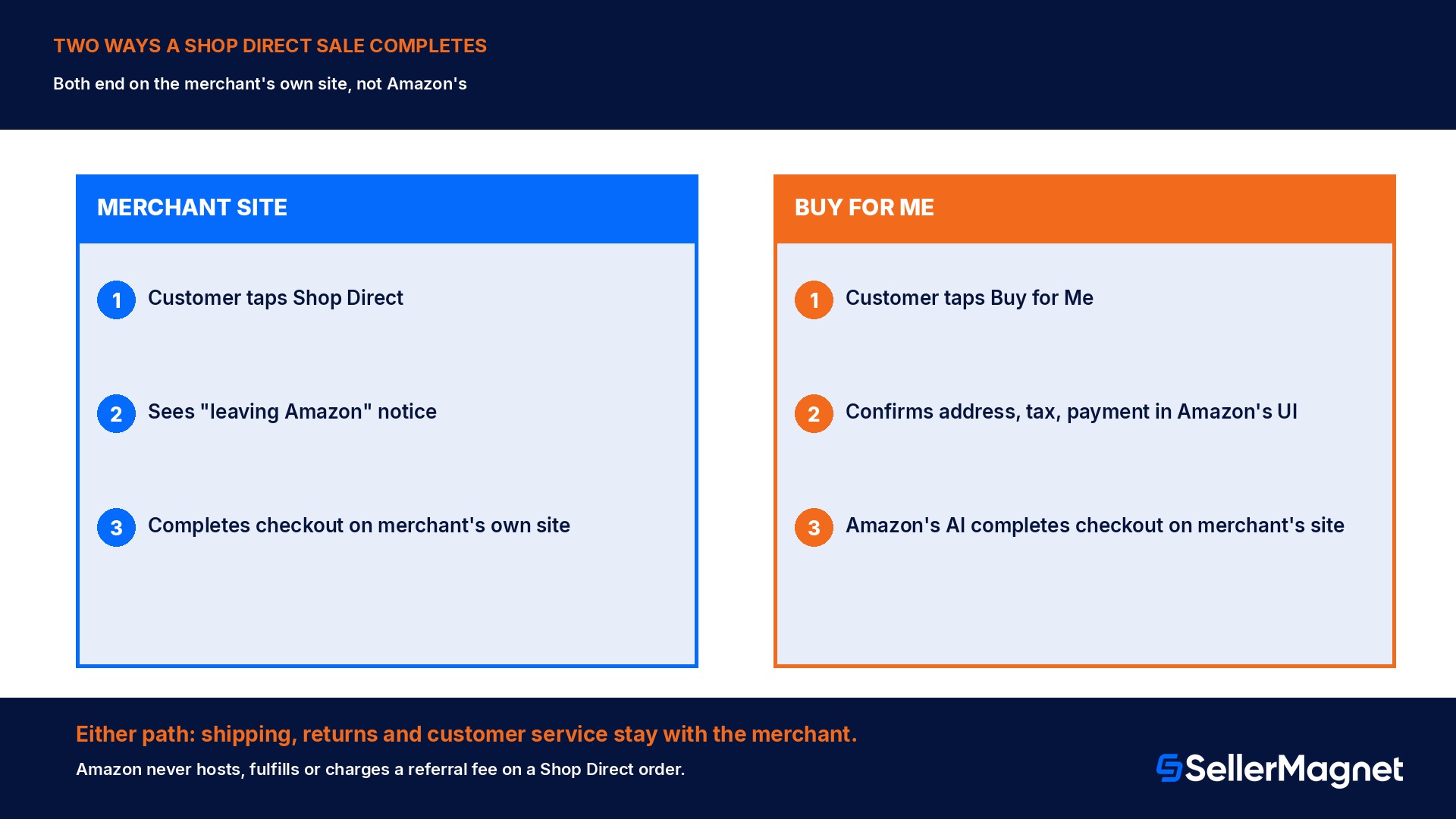
A Shop Direct product can surface to an Amazon customer in two places: a regular Amazon search results page, where it is clearly labeled "Shop Direct" alongside items sold directly by Amazon or by Amazon sellers, and within Alexa for Shopping, Amazon's agentic assistant that already handles a large share of Amazon's own shopping sessions. From there, Amazon publishes two distinct completion paths. The first is the simple version: the customer taps the Shop Direct button, sees a notification that they are leaving Amazon, and lands on the merchant's own site to see full product details and complete the purchase using whatever checkout the merchant already runs. The second is the agentic version, Buy for Me: when a product is eligible, the customer instead taps Buy for Me, confirms order details, delivery address, taxes, shipping fees and payment method inside Amazon's own familiar interface, and Amazon's AI then completes the purchase on the merchant's website on the customer's behalf, without the customer manually filling out the merchant's own checkout form at all. Either way, Amazon is explicit that shipping, delivery, returns, exchanges and customer service for that order stay with the merchant, through the merchant's existing processes, not with Amazon.
Why would a merchant, including an eligible seller, bother joining?
Amazon's own pitch for joining rests on four points stated directly in the announcement. Reach: a merchant's products may be discovered by Amazon customers who are actively searching for exactly that item, a demand source outside Amazon's own listing search entirely, and one that does not require the merchant to run advertising on Amazon to appear. No operational change: Amazon is explicit that a merchant keeps handling inventory, pricing, order fulfillment and customer service through the processes already in place, nothing about Shop Direct asks a merchant to change how they run their own store or adopt new warehouse or shipping software. Near real-time catalog data: the AI connector behind Shop Direct is built to keep Amazon's view of a merchant's stock and pricing current rather than static, so a product that sells out on the merchant's own site should stop showing as available on Amazon without a manual update on the merchant's part. Control: a merchant decides which items to include, and Amazon states plainly there are no fees to participate and a merchant can opt out at any time, which matters for a seller testing whether a secondary, non-Amazon catalog is worth surfacing at all before committing further catalog or feed-management work to it. Taken together, the four points describe a low-commitment test rather than a strategic bet: a seller can connect a feed, watch what Shop Direct actually sends in traffic and orders for a few weeks, and disconnect it again with no fee owed either way if the numbers do not justify the ongoing feed maintenance.
How is this different from Amazon's older Multi-Channel Fulfillment?
Sellers who already run an off-Amazon store often use Multi-Channel Fulfillment (MCF), where Amazon ships an order placed on a seller's own website or another marketplace out of the seller's existing FBA inventory. MCF and Shop Direct solve opposite halves of the cross-channel problem and are easy to confuse because both involve a seller's non-Amazon sales channel. MCF starts with a sale that already happened somewhere else and asks Amazon to fulfill it using FBA stock the seller already has at Amazon; the product itself is never required to appear anywhere in Amazon's own search results. Shop Direct starts with the opposite gap: a product that is not in Amazon's search results at all, and uses Amazon's own storefront and Alexa for Shopping to generate a sale that then completes and ships entirely outside Amazon, on the merchant's own site. A seller can use both at once without conflict, for example fulfilling off-Amazon website orders from FBA stock through MCF, while separately using Shop Direct to put an unrelated, Amazon-unlisted product line in front of Amazon shoppers who would otherwise never see it, since the two programs touch different ends of the order: MCF starts after a sale exists, Shop Direct exists to help create one.
Where is Shop Direct actually available today?
Amazon scopes Shop Direct narrowly in the same announcement that launches the Merchant Workspace: it is available for all U.S. customers, across Amazon.com, the Amazon Shopping app, mobile web browsers, and Alexa for Shopping. Amazon does not state a non-US rollout date or timeline for the Merchant Workspace itself in this announcement, so a seller operating primarily in the EU or UK marketplaces should treat this as a US-store feature for now rather than assume it already covers their non-US catalog.
A worked example: the catalog gap this actually closes
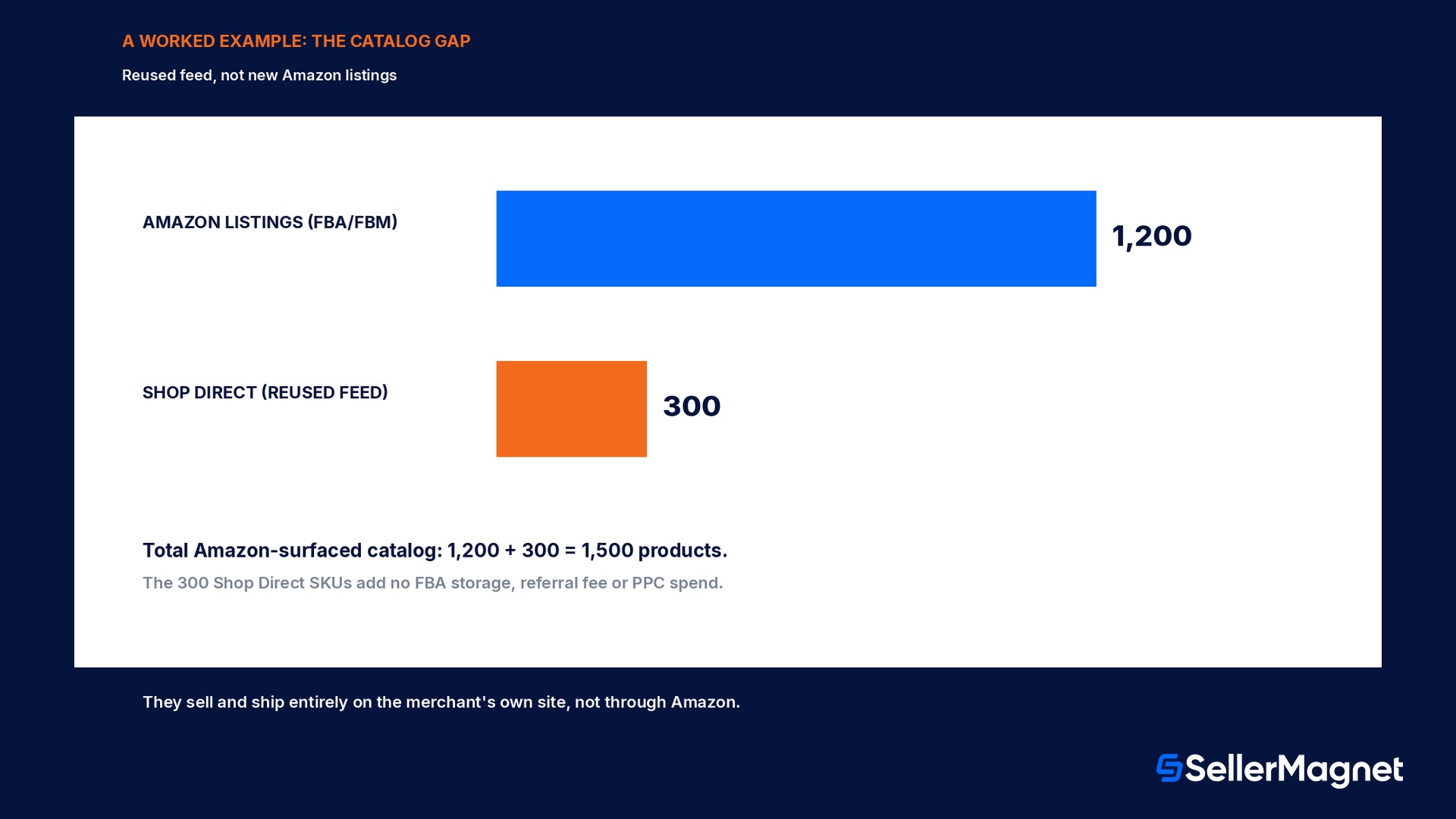
Take a seller who runs 1,200 active product listings on Amazon through a normal FBA and FBM mix, built up over several years with full images, bullet points and advertising history. That same seller's own online store carries another 300 SKUs that were never worth listing on Amazon individually: slow-moving bundle variants, a regional pack size, or a long-tail accessory line with too little search volume on Amazon's own listing search to justify the content work and PPC spend of a full listing. Before Shop Direct, those 300 SKUs are effectively invisible to the roughly 300 million Amazon items with fast, free Prime delivery and the customers searching for them there; a customer looking for one of those specific products on Amazon simply finds nothing and leaves, often landing on a competing retailer's own page instead. With the eligible-seller path into Shop Direct, those same 300 SKUs can become visible in Amazon search results, labeled Shop Direct, without the seller building 300 new Amazon listings, bringing the seller's total Amazon-surfaced catalog from 1,200 to 1,500 products: the original listings sold and fulfilled the normal way, plus the 300 reused-feed products sold and fulfilled entirely on the seller's own site. The arithmetic matters for planning, not just as a headline number: none of the 300 products changes the seller's FBA storage footprint, referral fee total or PPC spend, because none of them is ever listed, stored or advertised through Amazon's own systems in the first place; the only new cost is whatever work it takes to get the existing feed verified and connected through a partner app or the Selling Partner API.
Common mistakes sellers make when they first hear about Shop Direct
The first mistake is assuming Shop Direct is a way to list an existing Amazon FBA or FBM product twice to get extra visibility; Amazon's own eligibility wording targets products a seller does not currently sell on Amazon, not a duplicate of what is already listed, and there is no indication Amazon would treat a duplicate submission as eligible. The second is signing up expecting a Seller Central feature; the Merchant Workspace runs its own separate account creation and website verification, distinct from an existing seller login, so a seller should not go looking for it inside the normal Seller Central menu structure. The third is assuming every feed format works immediately; Amazon names exactly four current partners (Feedonomics, Salsify, CEDCommerce, VersaFeed) plus a direct Selling Partner API route, and a merchant using a different feed-management tool should confirm one of those two paths before assuming the signup is a five-minute job, since a feed in an unsupported format still needs to pass through one of the listed partners or a custom SP-API integration first. The fourth is expecting Shop Direct to behave like a normal Amazon order for support purposes; since shipping, returns and customer service stay with the merchant, a Shop Direct sale does not reduce a seller's own support workload the way an Amazon-fulfilled order can, and a seller should budget for handling that support volume themselves rather than assuming Amazon's own customer service team is involved anywhere in the process. A fifth, subtler mistake is assuming Buy for Me is available on every Shop Direct listing; Amazon describes it as available "when eligible," without publishing the exact eligibility criteria in this announcement, so a seller should not promise an agentic checkout experience to customers before confirming it actually appears on their own listings.
What SellerMagnet does and does not cover here
SellerMagnet does not create, run or connect to Shop Direct or the Merchant Workspace; both are Amazon-built features that sit entirely inside Amazon's own ecosystem, and eligibility, feed partners and the Buy for Me checkout described here all come directly from Amazon's own announcement. Where SellerMagnet is genuinely useful is on the Amazon-listed side of a seller's catalog that this guide is not about: Analytics tracks real net profit per order, product and marketplace across a seller's actual FBA and FBM listings, after Amazon's own fees, cost of goods and refunds, which stays the Amazon-side number worth watching regardless of whether a separate, unrelated catalog is also reaching customers through Shop Direct.
For the 1,200 products that are listed and sold through Amazon directly rather than reused from an outside feed, Listing Optimizer scores the listing itself against the title, bullet-point and content checks that actually move Amazon's own search ranking and conversion rate, a separate job from getting an unrelated catalog discovered through Shop Direct in the first place.
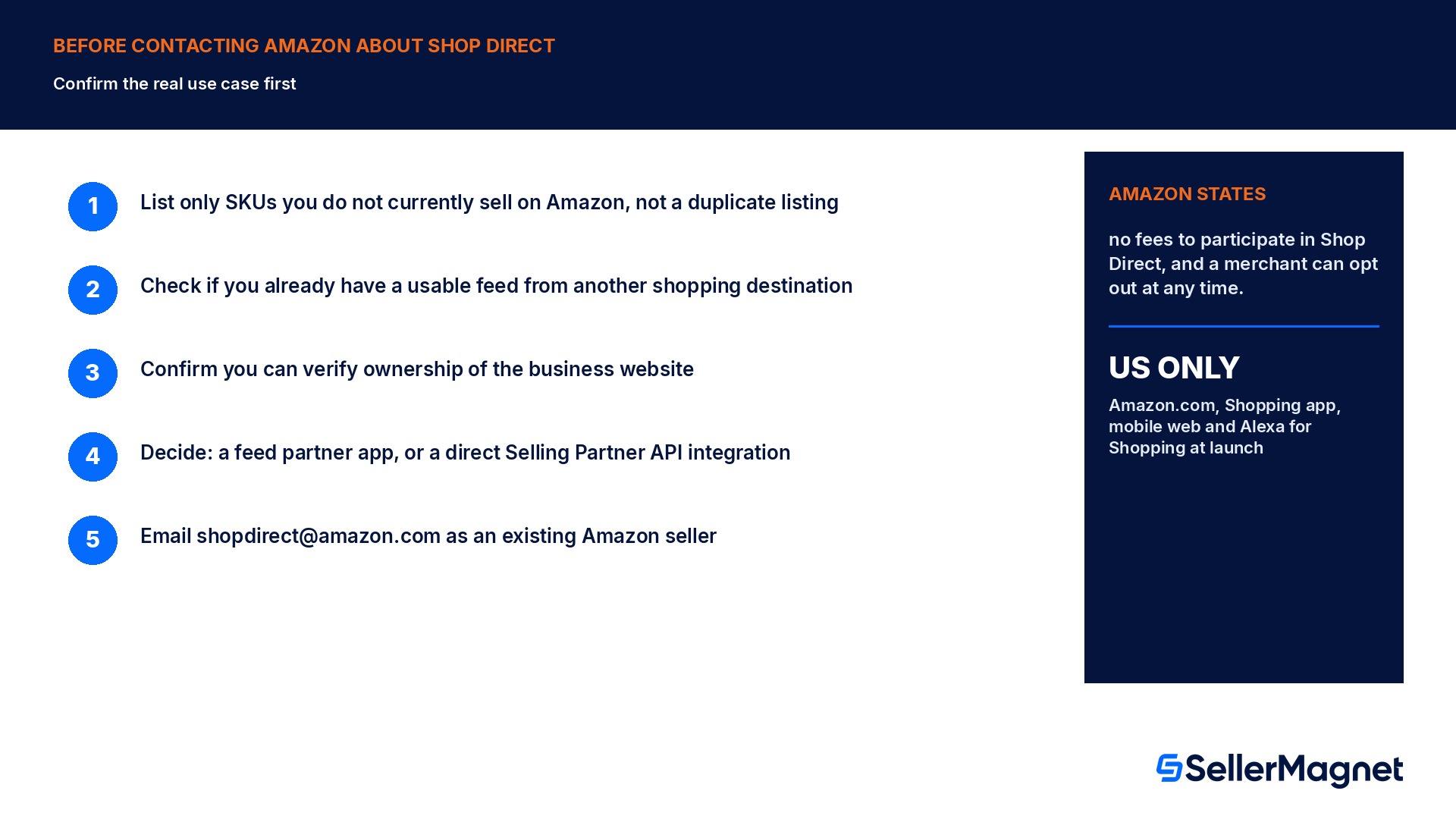
Checklist before contacting Amazon about Shop Direct
How to check whether Shop Direct fits an existing Amazon catalog
Separate the catalog in your head first - List only the SKUs you do not currently sell on Amazon at all, not a duplicate of an existing FBA or FBM listing.
Check whether you already have a usable feed - A feed already built for another shopping destination is the fastest path through Feedonomics, Salsify, CEDCommerce or VersaFeed.
Confirm you can verify the business website - Shop Direct requires proving control of the domain customers will be sent to.
Decide if the Selling Partner API route fits better - A seller with in-house development resources may prefer a direct SP-API feed over a third-party partner app.
Email shopdirect@amazon.com as an existing seller - Amazon routes eligible-seller interest through this address rather than the standard Seller Central signup.
Plan for merchant-side support from day one - Shipping, returns and customer service for a Shop Direct sale stay entirely with you, not Amazon.
What is the Amazon Shop Direct Merchant Workspace?
A free self-service portal Amazon launched in November 2026 that lets eligible merchants connect their own product catalog to Amazon search results and Alexa for Shopping, so customers can discover products that are not sold directly on Amazon's own store.
Can an existing Amazon seller use Shop Direct?
Yes, Amazon states that sellers who already sell on Amazon may also be eligible, specifically to list selection they do not currently sell on Amazon's own store, not to duplicate an existing FBA or FBM listing.
Are there fees to join Shop Direct?
No. Amazon states there are no fees to participate in Shop Direct, and a merchant can opt out at any time.
How does a customer actually buy a Shop Direct product?
Either by tapping through to the merchant's own site, with a notice that they are leaving Amazon, or through Buy for Me, where Amazon's AI completes the purchase on the merchant's site on the customer's behalf after the customer confirms order details inside Amazon's interface.
What feed formats does the Merchant Workspace support?
It accepts widely used shopping feed formats and currently lists four partner apps, Feedonomics, Salsify, CEDCommerce and VersaFeed, plus a direct integration route through the Selling Partner API.
Is Shop Direct available outside the United States?
Not at launch. Amazon scopes it to all U.S. customers across Amazon.com, the Amazon Shopping app, mobile web and Alexa for Shopping, with no non-US rollout date stated in the announcement.
Who handles shipping and returns for a Shop Direct order?
The merchant, through their own existing processes. Amazon states this applies whether the customer bought on the merchant's own site or through Buy for Me.
Stop Juggling Tools. SellerMagnet Combines Everything You Need.