Amazon Holiday Peak Fulfillment Fees 2026: What Sellers Pay
R
RenéFreelance Amazon Editor
|
10 min read
Last updated: Sep 08, 2026
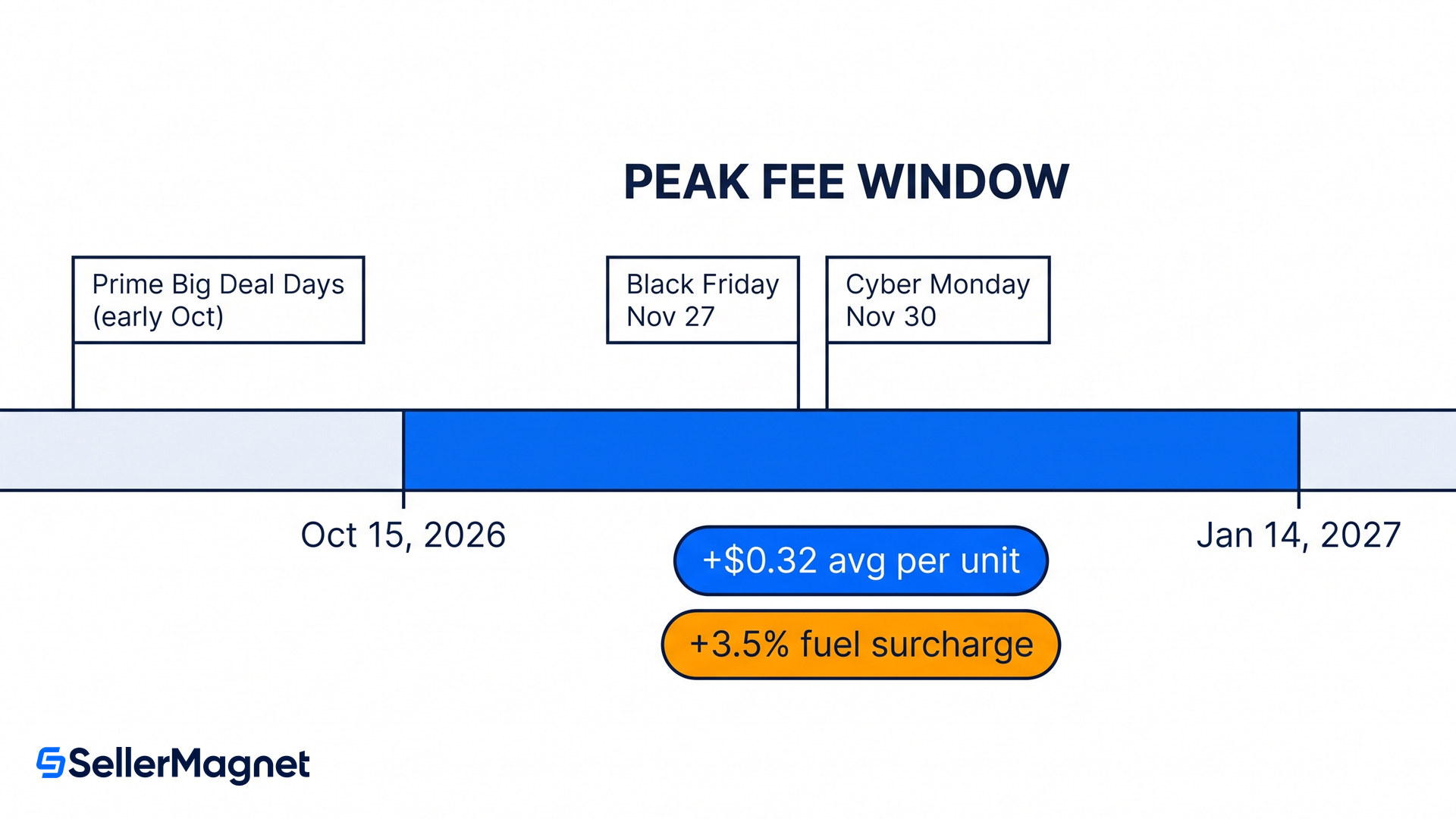
Amazon's holiday peak fulfillment fee is a temporary per-unit surcharge on FBA orders shipped between October 15, 2026 and January 14, 2027. Amazon says it averages $0.32 per unit on top of the normal fulfillment fee, and a 3.5% fuel and logistics surcharge is charged on top of that. The fee is decided by the ship date, not the order date, so it catches every Q4 sale.
Amazon charges a holiday peak fulfillment fee from October 15, 2026 to January 14, 2027. It adds roughly 32 cents per unit to the standard FBA fulfillment fee, and a separate 3.5 percent fuel surcharge sits on top. Sellers cannot opt out, so the fee has to be built into Q4 prices and deal budgets.
What is the Amazon holiday peak fulfillment fee?
The holiday peak fulfillment fee is a seasonal surcharge that Amazon adds to the standard FBA fulfillment fee for every unit shipped during its busiest quarter. Amazon introduced the fee in 2022 and has repeated it every year since, framing it as a way to recover the extra cost of holiday capacity, temporary labor and carrier peak surcharges.
Amazon announced the 2026 edition in early July 2026. According to the Seller Central announcement, the 2026 fee keeps the same per-unit increase over non-peak rates as 2025, averaging $0.32 per unit, with no change to eligibility. The only real difference from last year is the 3.5% fuel and logistics surcharge that now applies to fulfillment fees year-round, including the peak rate.
When does the 2026 peak fee apply, and to which orders?
The fee applies to units shipped from October 15, 2026 through January 14, 2027. Non-peak rates return on January 15, 2027. Amazon switched from an order-date to a ship-date rule in 2025, so an order placed on October 12 that leaves the warehouse on October 16 is charged the peak rate, as the ship-date analysis by the DAM Law Firm explains.
The surcharge covers four programs, all listed in Amazon's announcement:
Fulfillment by Amazon (FBA) orders on Amazon.com.
Remote Fulfillment with FBA, which ships US inventory to customers in Canada, Mexico and Brazil.
Multi-Channel Fulfillment (MCF), so orders from your own store or other marketplaces pay it too.
Buy with Prime orders placed on your DTC site.
Pre-sales and backorders
Any unit that ships inside the window pays the peak rate, including pre-orders taken in September and replacement shipments. If you run an early October promotion, the units that ship on or after October 15 are already peak-priced.
How much is the 2026 holiday peak fee per unit?
The headline number is an average of $0.32 per unit, but the actual increase depends on the size tier and shipping weight of the product. Amazon's 2026 base fulfillment fees already rose by an average of $0.08 per unit on January 15, 2026, per the official 2026 fee update, and the peak uplift is added to those rates.
Size tier (example)
2026 peak fee, $10 to $50 price band
Typical peak uplift vs non-peak
Small standard, 2 oz or less (phone case)
$3.51
+$0.19 to +$0.22
Small standard, 14 to 16 oz
$4.18
+$0.19 to +$0.22
Large standard, 1 to 1.25 lb (book, small kitchen tool)
$5.34
+$0.20 to +$0.41
Large standard, 3 to 20 lb
$7.51
+$0.20 to +$0.41
Small bulky, up to 50 lb
$8.59
about +$1.04
Large bulky, up to 50 lb
$10.39
about +$1.04
Extra-large, 50 to 70 lb (TV)
$40.13
about +$2.81
Extra-large, 150 lb and over
$203.46
about +$8.50
Peak fees in the $10 to $50 band come from the 2026 holiday peak rate card compiled by AMZ Prep; the per-tier uplifts match the 2025 deltas published by Seller Labs and Eightx, which Amazon confirmed are unchanged for 2026. Items under $10 use the Low-Price FBA rates, which the same rate card lists $0.86 below standard rates.
Worked example: the large standard T-shirt from Eightx's breakdown
Non-peak 2026 fulfillment fee $6.14, plus 3.5% fuel surcharge $0.21, equals $6.35 all-in. Peak fee $6.53, plus 3.5% fuel surcharge $0.23, equals $6.76 all-in. The peak window therefore costs this SKU $0.41 per unit, and against the $6.14 sticker fee most sellers still have in their spreadsheets the all-in peak cost is $0.62 higher.
What other Q4 costs stack on top of the peak fee?
The peak fee is one of four Q4 cost increases that land at the same time. Storage, the fuel surcharge and deal fees all rise together, and each one is charged on a different basis, which is why a per-unit view of Q4 profit matters more than a category view.
Cost
When it applies
2026 amount
Holiday peak fulfillment fee
Units shipped Oct 15, 2026 to Jan 14, 2027
Average +$0.32 per unit
Fuel and logistics surcharge
All fulfillment fees since April 17, 2026
3.5% of the fulfillment fee
Monthly storage, standard size
October to December
$2.40 per cubic foot (vs $0.78 Jan to Sep)
Monthly storage, oversize
October to December
$1.40 per cubic foot (vs $0.56 Jan to Sep)
Deal fee (Best Deal, Lightning Deal, Prime Exclusive Discount)
Prime Big Deal Days, Black Friday, Cyber Monday
$100 upfront plus 1.5% of promotional sales, capped at $5,000
Low-inventory-level fee
When 30-day and 90-day days of supply both fall under 28
Per-unit fee that rises as days of supply fall
Q4 storage rates come from the AMZ Prep 2026 FBA fee guide; the deal fee structure is in Amazon's holiday announcement, which also gave a $50 discount for deals submitted by August 5 (Prime Big Deal Days) or September 5 (Black Friday and Cyber Monday); both early-bird dates have passed. Storage triples at exactly the moment you hold the most inventory, so aged units that will not sell in Q4 should be removed before October 1. Our guide to Amazon coupon and deal fees covers the promotion side in detail.
Which inbound deadlines decide whether you sell in Q4 at all?
Peak fees only matter for inventory that is actually in the network. Amazon itself headlines the 2026 arrival deadlines as earlier than 2025, and they depend on the inbound option you choose. Choosing minimal shipment splits, where you pay a placement fee to ship to fewer locations, costs you a full week compared with Amazon-optimized splits, because Amazon needs that time to redistribute the units.
Event
AWD inventory
FBA, minimal shipment splits
FBA, Amazon-optimized splits
Prime Big Deal Days (October)
September 2, 2026
September 9, 2026
September 16, 2026
Black Friday (Nov 27) and Cyber Monday (Nov 30)
October 14, 2026
October 21, 2026
October 28, 2026
As of publication on September 8, 2026 the AWD date for Prime Big Deal Days has passed and the FBA dates are days away, so the Black Friday deadlines are the ones with room to plan.
Deadline basis
These dates are arrival dates at Amazon, not ship-by dates, as stated in the Seller Central peak season post. Add carrier transit and receiving time on top, and remember that inventory arriving after October 15 is stored at Q4 rates while waiting to sell.
How do you protect margin during the peak fee window?
The fee cannot be waived, so the work is in pricing, inventory mix and timing. The steps below take an afternoon with a fee report and a profit dashboard, and they decide whether Q4 volume turns into Q4 profit.
The six-step Q4 margin plan
Rebuild landed cost per SKU - Take the 2026 non-peak fulfillment fee for each SKU, add the size-tier peak uplift, then add 3.5 percent of the result. Do it per SKU, not per category, because a 15 oz item and a 17 oz item sit in different tiers.
Sort SKUs into protect, bundle and pause - Protect SKUs with margin to spare and raise nothing. Bundle low-margin items so one fulfillment fee covers two units. Pause items whose Q4 margin drops below your floor instead of advertising them.
Clear aged inventory before October 1 - Create removal or liquidation orders for units unlikely to sell in Q4. Monthly storage triples from October, and long-term storage surcharges do not stop for the holidays.
Price deals on true peak margin - Set Lightning Deal and Prime Exclusive Discount prices using the peak fee and the deal fee together. A deal priced on September margins loses the whole uplift on every unit.
Set repricer floors to the peak cost - Update the minimum price in your repricing rules on October 14 so automated price cuts never dip below the new all-in cost, then lower the floor back to the non-peak cost on January 15.
Ship to the earliest deadline you can hit - Target the AWD or minimal-split date, not the last optimized-split date. Late shipments may not be Prime-eligible in time for the event and still pay peak storage.
Quick win for today
Open your SellerMagnet profit dashboard, filter last Q4, and list every SKU whose net margin was under 15%. Those are the SKUs where a $0.32 to $1.04 uplift decides between profit and loss, so they get the first price review. Then set their floors in the Amazon repricer before October 15.
Yes, but only in two marketplaces. Amazon's European peak season announcement confirms a festive peak fulfilment fee for selected FBA orders in the UK and Germany during the same October 15, 2026 to January 14, 2027 window, with a 1.5% fuel and logistics surcharge on top.
United Kingdom: an average of £0.12 per parcel item and £0.07 per large and extra-large envelope item.
Germany: an average of €0.27 per unit on small and standard parcels fulfilled through local FBA, Pan-European FBA, the European Fulfilment Network and Remote Fulfilment from the UK to the EU.
Not charged on oversize items, Low-Price FBA items, or items delivered to buyers in other EU countries.
France, Italy and Spain have no festive peak fee on domestic orders, though a Pan-EU seller still pays the German fee on units delivered to German buyers.
European inventory deadlines follow the same logic: Prime Big Deal Days inventory must arrive by September 9, 2026 (September 16 for the UK) and Black Friday inventory by October 21, 2026 (October 28 for the UK). Deal fees are lower than in the US: the European announcement lists €16 plus 0.75% of promotional sales in Germany, capped at €1,000, and €10 plus 0.5%, capped at €300, in France, Italy and Spain.
How much is the Amazon holiday peak fulfillment fee in 2026?
Amazon quotes an average increase of $0.32 per unit over non-peak FBA fulfillment fees in the US, about CAD 0.39 in Canada, plus a 3.5% fuel and logistics surcharge. Small standard items rise about $0.19 to $0.22, bulky items about $1.04.
When do Amazon's 2026 peak fulfillment fees start and end?
They apply to units shipped from October 15, 2026 through January 14, 2027. Standard rates resume on January 15, 2027.
Is the peak fee based on the order date or the ship date?
The ship date. An order placed before October 15 that ships on or after October 15 is charged the peak rate, and the same applies at the end of the window.
Does the holiday peak fee apply to Multi-Channel Fulfillment and Buy with Prime?
Yes. Amazon lists FBA, Remote Fulfillment with FBA, Multi-Channel Fulfillment and Buy with Prime as covered programs for the 2026 window.
Can sellers avoid the Amazon peak fulfillment fee?
Not for FBA units shipped in the window. Sellers can reduce the impact by bundling low-margin items, moving some SKUs to seller-fulfilled shipping, clearing aged stock before Q4 storage rates start, and pricing deals on peak margins.
Is there a holiday peak fee on Amazon in Europe?
Only in the UK (about £0.12 per parcel item) and Germany (about €0.27 per unit) for the same October 15 to January 14 window, with a 1.5% fuel surcharge. France, Italy and Spain have no domestic festive peak fee.
Stop Juggling Tools. SellerMagnet Combines Everything You Need.