Is Amazon FBA Still Profitable in 2026? The Real Math
R
RenéFreelance Amazon Editor
|
15 min read
Last updated: Oct 17, 2026
Yes, Amazon FBA is still profitable in 2026, for sellers who price from the full fee stack instead of just subtracting their product cost from the sale price. No, it is not profitable for sellers who only look at referral fee and COGS, because the FBA fulfillment fee, monthly storage, advertising and a landed-cost line that includes freight and prep usually eat 35 to 55 cents of every sale-price dollar before any profit is left. This page runs one real product through every fee line at 2026 US rates, shows the exact gap between the margin sellers think they have and the margin that actually lands in their payout, and ends with a checklist to run against your own catalogue.
Amazon FBA is still profitable in 2026 for sellers who calculate margin from the sale price minus referral fee, FBA fulfillment fee, monthly storage, advertising cost and full landed cost. On a worked $24.99 example at 2026 US rates, true margin comes out to 22.0%, well below the 63.0% gross margin sellers get if they only subtract COGS and referral fee. The gap, not the headline margin, is what decides whether a seller feels like FBA stopped working.
What does "profitable" actually have to include in 2026?
Most profitability complaints about Amazon FBA are really a definition problem: the seller computed margin from two cost lines (product cost and referral fee) when five or six apply. The 2026 US fee stack a seller has to clear before anything counts as profit is: the referral fee (8% to 45% of sale price by category, 15% for most generalist categories, per Amazon's referral fee schedule); the FBA fulfillment fee, a flat per-unit charge by size tier and weight band, plus a 3.5% fuel and logistics surcharge in the US from 17 April 2026, per Amazon's FBA fulfillment fee page; a monthly storage fee of $0.78 per cubic foot (standard-size, non-peak) or $2.40 in peak season, per Amazon's storage fee page; advertising cost per unit sold, if the product runs PPC; and landed cost, meaning the product cost plus freight, duty and prep, not just the invoice price from the supplier.
Cost line
What it is
Where sellers usually undercount it
Referral fee
8-45% of sale price, category-dependent, $0.30 minimum
Assume 15% across a mixed catalogue instead of checking each category
FBA fulfillment fee
Flat per-unit fee by size tier and weight, plus 3.5% fuel surcharge
Use a non-peak rate for a Q4 launch, or last year's rate card
Monthly storage
$0.78/cu ft standard (non-peak), $2.40/cu ft (peak Oct-Dec)
Model storage as a one-time cost instead of every month a unit sits unsold
PPC per unit
Ad spend divided by units sold in the period
Leave ads out of margin entirely, or bury it in "marketing" at the account level
Landed cost
Product cost + freight + duty + prep, per unit
Quote the supplier's unit price alone and skip freight and prep
Name the marketplace on every number
Every rate above is the US marketplace, current for 2026. The EU, UK and other marketplaces run separate rate cards in their own currencies, not a conversion of the US figures; a seller running FBA in both the US and EU needs two fee models, not one model applied twice.
Worked example: one ASIN at 2026 US fee levels
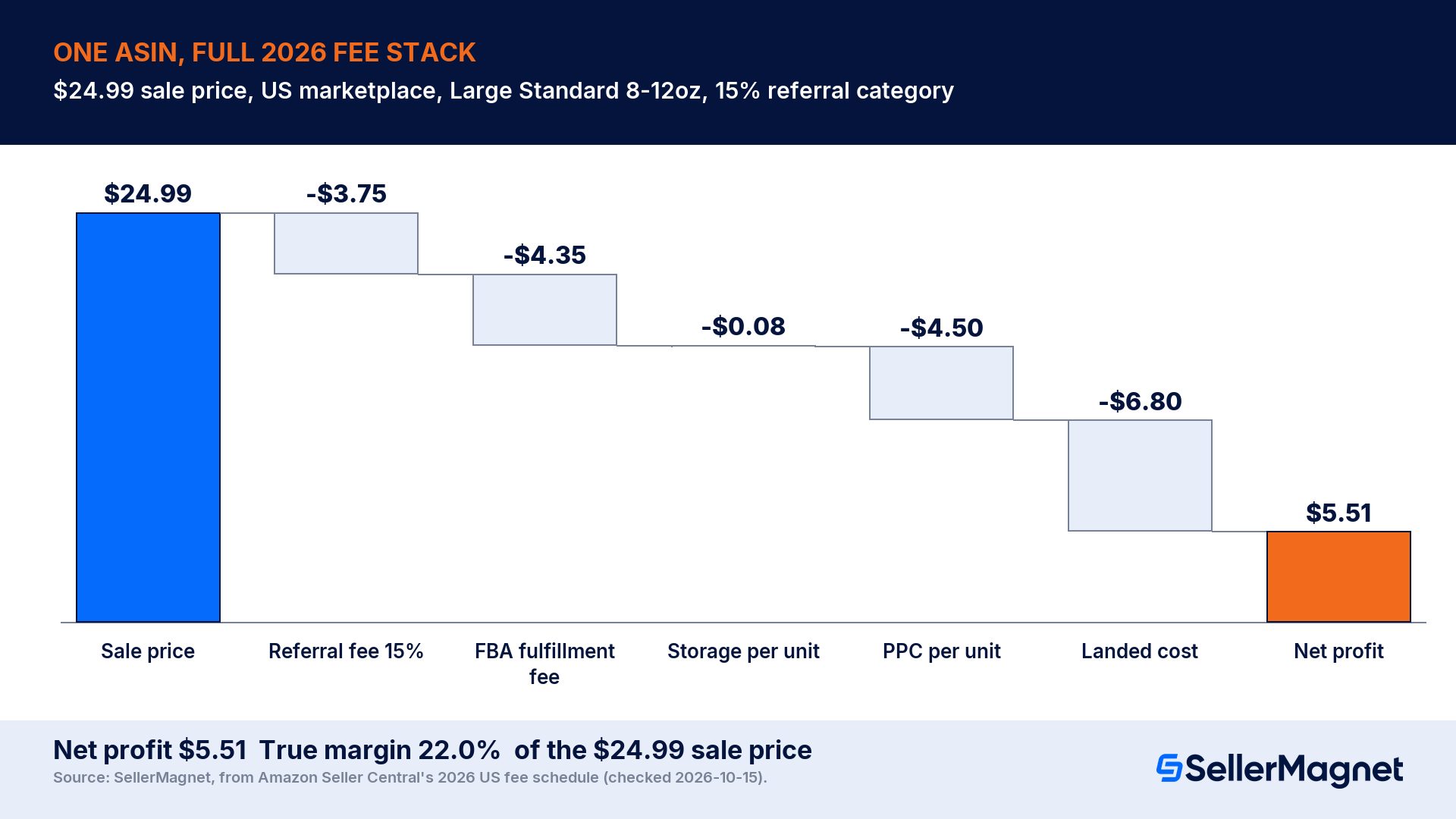
Take a real-shaped product: a $24.99 Large Standard item, 8 to 12 oz, in the "Everything Else" 15% referral category, non-apparel, sold FBA in the US, no peak-season or conditional fees. Every number below is the current 2026 rate, computed in order, so the running total can be checked against the sale price.
Check it forward: $3.75 plus $4.35 plus $0.08 plus $4.50 plus $6.80 equals $19.48, and $24.99 minus $19.48 is exactly $5.51. True margin is $5.51 divided by $24.99, which is 22.0%. That is the number that should set a reorder decision or a minimum ad bid, not the number a seller gets from subtracting only COGS and referral fee.
Recalculate this per ASIN, not once for the whole catalogue.Profit Analytics shows net profit per order, product and marketplace after Amazon fees, COGS, shipping, VAT, refunds and your own expenses, with Sponsored Products, Brands and Display costs flowing in automatically once Ads is connected, so PPC never gets left out of the margin the way it is in most spreadsheets. For a single ASIN before you commit inventory, the free Fee Calculator pulls Amazon's public fee schedule to show FBA vs FBM fees, referral fee, profit and ROI, with 5 free lookups a day and no signup.
Gross margin vs true margin: why FBA looks more profitable than it is
The same $24.99 unit above produces two very different margin numbers depending on which cost lines are counted, and that gap is the single biggest reason sellers either overestimate how healthy a product is, or conclude FBA "stopped working" when the real issue is an incomplete model. For the full line-by-line breakdown of this specific ASIN's true-margin waterfall, see our FBA true margin calculator post.
Gross margin (COGS + referral fee only)
True margin (all 5 cost lines)
Referral fee
-$3.75
-$3.75
FBA fulfillment fee
not counted
-$4.35
Monthly storage
not counted
-$0.08
PPC per unit
not counted
-$4.50
Landed cost
-$5.50 (product cost only)
-$6.80 (product + freight + prep)
Net profit
$15.74
$5.51
Margin
63.0%
22.0%
Leaving out fulfillment, storage and PPC, and quoting only a bare product cost instead of a landed cost, overstates margin by 41 points on this one unit: $15.74 of apparent profit versus $5.51 of real profit. A seller reading the 63.0% number as their actual margin will underprice against a true-margin competitor, overspend on ads relative to what the product can absorb, or be blindsided when a quarter of actual payouts come in well under plan.
This is not a rare mistake
A gross-margin model is not a sign of carelessness; it is what a spreadsheet looks like when it was built before PPC was running, before storage became a real monthly line, and before anyone added freight and prep into "cost". The fix is mechanical: add the three missing lines once, for every ASIN, and keep them updated when Amazon's rate card changes.
What moves the margin number: category, size tier, season, ad spend
The same business model, same product type, same general price point, can land anywhere from a healthy margin to a loss depending on four levers that are mostly inside a seller's own control, or at least knowable in advance.
Lever
Example swing
Why it moves margin
Referral fee category
8% (Computers) vs 45% (Amazon Device Accessories)
A 5.6x difference in referral fee alone, before any FBA fee is added
Size tier and weight
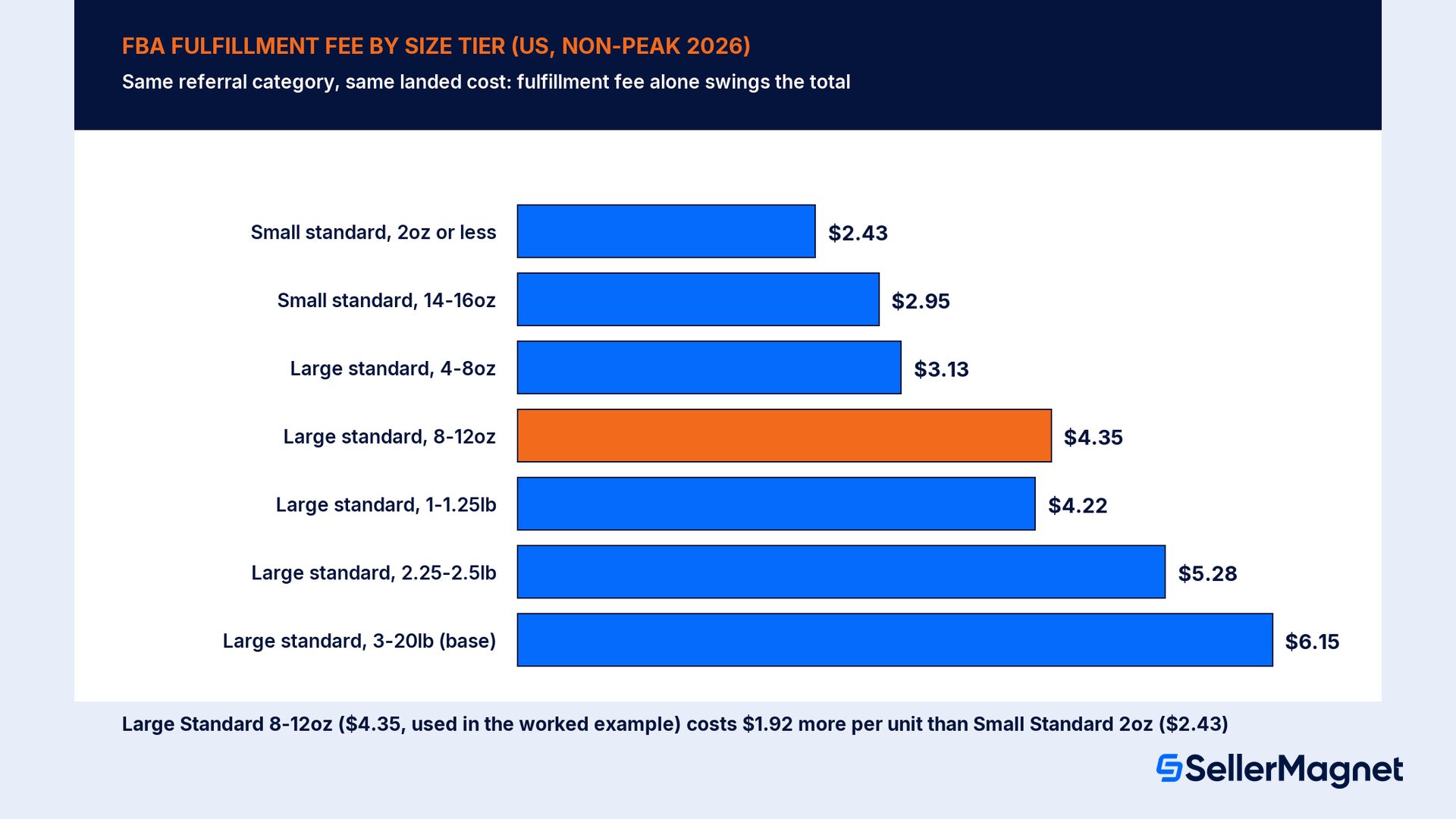
Small Standard 2oz: $2.43 fulfillment fee vs Large Standard 3-20lb: $6.15+
Fulfillment fee is a flat per-unit charge by physical size, unrelated to sale price
Season
Non-peak storage $0.78/cu ft vs peak $2.40/cu ft (Oct-Dec)
Both fulfillment and storage fees rise for the same 3-month window every year
Ad spend per unit
$0 (pure organic) vs $4.50+ (launch-phase PPC)
A new ASIN often needs ad spend to build sales velocity before organic rank takes over
Of the four, size tier is the one sellers change least often even though it is fully within their control at the sourcing stage: a product redesigned or repackaged to drop one weight band can move the fulfillment fee by a dollar or more per unit without touching the sale price at all. Referral fee category is fixed by what the product is, season is fixed by the calendar, and ad spend is a decision made weekly; size tier is a decision made once, at sourcing, that then applies to every unit sold for the life of that ASIN.
FBA vs FBM: does fulfillment method change whether a product is profitable?
Switching the same product from FBA to FBM (Fulfilled by Merchant) removes the FBA fulfillment fee and the monthly storage fee, and replaces them with your own pick, pack and shipping cost, which is rarely free even when it feels that way because it is not itemized on an Amazon invoice. On the $24.99 worked example above, an FBA seller pays $4.35 fulfillment plus $0.08 storage, a combined $4.43 per unit; an FBM seller doing their own packing and shipping a similarly sized parcel typically spends $4 to $7 per unit once box, label, packing materials, and a reasonable hourly rate for the time spent are counted, before shipping carrier cost is even added. The referral fee, landed cost and any PPC are identical either way, since those depend on the sale, not the fulfillment method.
FBA
FBM (self-fulfilled)
Referral fee
-$3.75
-$3.75
Fulfillment
-$4.35 (FBA fee)
-$4.00 to -$7.00 (packing + shipping + time, illustrative)
Storage
-$0.08/month allocation
Your own warehouse or home storage cost, rarely tracked
Prime badge and 2-day shipping
Included automatically
Only via Seller Fulfilled Prime, which has its own strict delivery requirements
Who handles returns and customer service
Amazon
You
The honest comparison is never "FBA fee vs zero"; it is FBA's flat, predictable per-unit fee against FBM's own, usually less visible, cost of doing the same job. FBA tends to win on true margin for fast-moving, standard-size products where Amazon's fulfillment network beats a seller's own shipping rates and the Prime badge lifts conversion enough to offset the fee; FBM tends to win on slow-moving, bulky or fragile items where storage fees and size-tier surcharges would otherwise erode margin faster than self-fulfillment cost does. Running both options through the same five-line model, for the specific product, is the only way to know which applies.
How to check if your own products are actually profitable
The worked example above uses rounded, illustrative figures so the arithmetic is checkable by hand. Your own catalogue needs the same five-line model run against your real sale price, your real size tier, and your real landed cost, which a worked example from a blog post cannot know.
Check whether an ASIN is profitable at 2026 rates
Pull the current referral fee rate - Look up the category on Amazon's referral fee schedule rather than assuming 15%; check for a tiered or price-split structure before using one flat percentage.
Pull the current FBA fulfillment fee - Use the Fee Preview in Seller Central, or the free SellerMagnet Fee Calculator, for the product's real size tier and weight band, separately for non-peak and peak season.
Add a monthly storage allocation - Divide the per-cubic-foot rate by the units you expect to sell from that cubic foot of space in a typical month, non-peak and peak separately.
Add real PPC cost per unit - Divide a recent period's ad spend on that ASIN by units sold in the same period; do not use an account-wide ad spend average across unrelated products.
Use landed cost, not invoice price - Add freight, duty and prep cost per unit to the supplier's unit price before subtracting it from the sale price.
Once those five numbers exist for an ASIN, true margin is a single subtraction and a division, the same two steps used in the worked example above. Profit Analytics automates all five once your Amazon account and Ads account are connected: it tracks COGS per purchase batch (FIFO) or a flat cost per unit, pulls every fee and adjustment from your settlements into one Transactions view, and flows Sponsored Products, Brands and Display spend into the same profit number, so the five-line model runs continuously instead of once as a one-off spreadsheet exercise.
Common mistakes that make FBA look unprofitable, or hide that it already is
Most of the mistakes below are not sloppiness; they are what a margin model looks like when it was built once, early, and never updated as fees, ad spend and sourcing costs changed around it. Each one below is checkable against the worked example earlier on this page.
Computing margin from COGS and referral fee only. As shown above, this can overstate margin by 40 points or more on an identical unit; it is the single biggest cause of both false confidence and false alarm.
Using a non-peak fulfillment and storage rate for a Q4 product. Both rise for 15 October 2026 to 14 January 2027; a floor price set on non-peak numbers sells at a lower real margin, or a loss, through the busiest selling season of the year.
Leaving PPC out of the per-unit margin entirely. Ad spend reported as a separate marketing line at the account level hides which specific ASINs are actually funding that spend out of their own margin and which are not.
Quoting a supplier's unit price as the full landed cost. Freight, duty and prep routinely add 15 to 40% on top of the invoice price; skipping them is the same error as skipping fulfillment fee, just on the other side of the ledger.
Averaging margin across a whole catalogue. A catalogue-wide average margin can hide several ASINs quietly running at a loss while a handful of strong sellers carry the number; check margin per ASIN, not once per account.
Reusing last year's fee numbers. The FBA fulfillment fee rose about $0.08 per unit on average in 2026, and a 3.5% fuel and logistics surcharge started mid-year; a model built before 17 April 2026 understates every fulfillment fee from that date forward.
Finding your minimum viable sale price (break-even floor)
Once true margin is known for an ASIN, the next useful number is the break-even floor: the lowest sale price at which that unit still covers referral fee, fulfillment fee, storage and landed cost, before any profit or ad spend. On the worked $24.99 example, referral fee, fulfillment fee, storage and landed cost together are $3.75 + $4.35 + $0.08 + $6.80 = $14.98, so any sale price above $14.98 covers those four fixed cost lines; the difference between the actual $24.99 price and that $14.98 floor, $10.01, is what is available to fund PPC and still leave profit. At the current $4.50 PPC cost per unit, that leaves $5.51 of true profit, matching the worked example above exactly.
This floor price matters most during a Black Friday or Lightning Deal discount, when a seller is deciding how low they can cut the price without selling at a loss. Discounting to $17.99 on this same unit still clears the $14.98 floor by $3.01, but that only covers part of a $4.50 PPC cost per unit if the deal is also running ads; discounting below $14.98 guarantees a loss on every unit sold, regardless of how much volume the deal generates. Recompute this floor per ASIN before any planned discount, using that ASIN's own referral fee, fulfillment fee and landed cost, not a round number carried over from a different product.
Checklist: is this ASIN profitable in 2026?
Confirmed the exact referral fee category and rate, not an assumed 15%.
Pulled the current FBA fulfillment fee for the real size tier and weight band, non-peak and peak separately.
Added a monthly storage allocation, not a one-time storage cost.
Included real ad spend per unit sold, from the actual ads report for that ASIN.
Used landed cost (product + freight + duty + prep), not the supplier's invoice price alone.
Recalculated true margin as net profit divided by sale price, after all five lines.
Re-run the same five lines before 15 October and again after 14 January, when peak-season rates start and end.
Is Amazon FBA still profitable in 2026?
Yes, for sellers who price in the full fee stack: referral fee, FBA fulfillment fee, storage, PPC and landed cost. A worked $24.99 example at 2026 US rates lands at 22.0% true margin, a workable number. "FBA stopped being profitable" usually traces back to a gross-margin model that left out three of those five cost lines.
What is a good profit margin for Amazon FBA in 2026?
There is no single universal number, since referral fee category, size tier and landed cost vary by product, but a true margin (all five cost lines counted) in the high teens to low 30s percent is realistic for most standard-size products. A number of 50% or higher usually means a cost line, often fulfillment fee or PPC, was left out.
How much does it cost to start Amazon FBA in 2026?
Account costs start at $39.99/month for the US Professional plan (or $0.99 per item, Individual plan, no monthly fee), plus inventory, freight and prep for the first shipment. Per-unit costs then stack on top: referral fee, FBA fulfillment fee, storage and any PPC, all of which should be priced in before launch, not discovered afterward.
Do Amazon FBA fees go up every year?
The fulfillment fee and referral fee schedule are reviewed roughly once a year; in 2026 the fulfillment fee rose about $0.08 per unit on average, and a new 3.5% fuel and logistics surcharge started 17 April 2026 in the US and Canada. Storage fees also rise every October for peak season and revert each January.
What percentage of Amazon sellers are profitable?
Amazon does not publish this figure, and no independently audited industry number exists, so treat any specific percentage elsewhere as unverified. What is measurable is the gap this page demonstrates: the same unit can show a 63.0% gross margin or a 22.0% true margin depending only on which cost lines are counted.
How do I calculate my true Amazon FBA margin?
Subtract the referral fee, FBA fulfillment fee (with any fuel surcharge after 17 April 2026), a monthly storage allocation, PPC spend per unit, and full landed cost (product plus freight, duty and prep) from the sale price, then divide by the sale price. Use a free Fee Calculator per ASIN, or Profit Analytics across a whole catalogue.
Is Amazon FBA worth it for a beginner in 2026?
It can be, provided the beginner prices from a true-margin model from day one instead of a gross-margin estimate. Products that look unprofitable within the first few months are usually ones where fulfillment fee, storage or PPC were never priced in. Running a candidate ASIN through a free Fee Calculator before committing inventory catches most of that gap early.
Stop Juggling Tools. SellerMagnet Combines Everything You Need.