Amazon Return Fraud: Patterns, SAFE-T and the Real Tradeoff
R
RenéFreelance Amazon Editor
|
15 min read
A return comes back and the box is wrong: a cheap sticker and a notebook instead of the fifty-pound bag of fertilizer that shipped, a visibly used item claimed as defective, a different model number than the one sold. Amazon's own buyer-protection return policy exists for a real reason and most returns are legitimate, but a minority are not, and the mechanics of responding to that minority, SAFE-T claims, restocking fees, the Report Abuse tool, and the documented tradeoff between the two refund paths, are scattered across help pages and seller-forum threads instead of living in one place. This guide lays out the real patterns, the exact tools Amazon gives a seller to respond, and the tradeoff every seller needs to understand before clicking refund.
Amazon return fraud or abuse means a buyer returns something other than, or in worse condition than, what was actually shipped. A seller who suspects abuse should photograph the returned package, label and contents immediately and compare them to the original shipping record, then choose between two refund paths: manually refunding with a restocking fee (up to 50% for used or damaged condition, up to 100% for opened software) under the 'materially different item returned' reason, which forfeits SAFE-T claim eligibility on that order, or letting Amazon auto-refund the buyer, which preserves SAFE-T eligibility for reimbursement but forfeits the restocking fee. A repeated pattern from the same buyer should also be reported through Account Health's Report Abuse tool.
The patterns sellers actually report
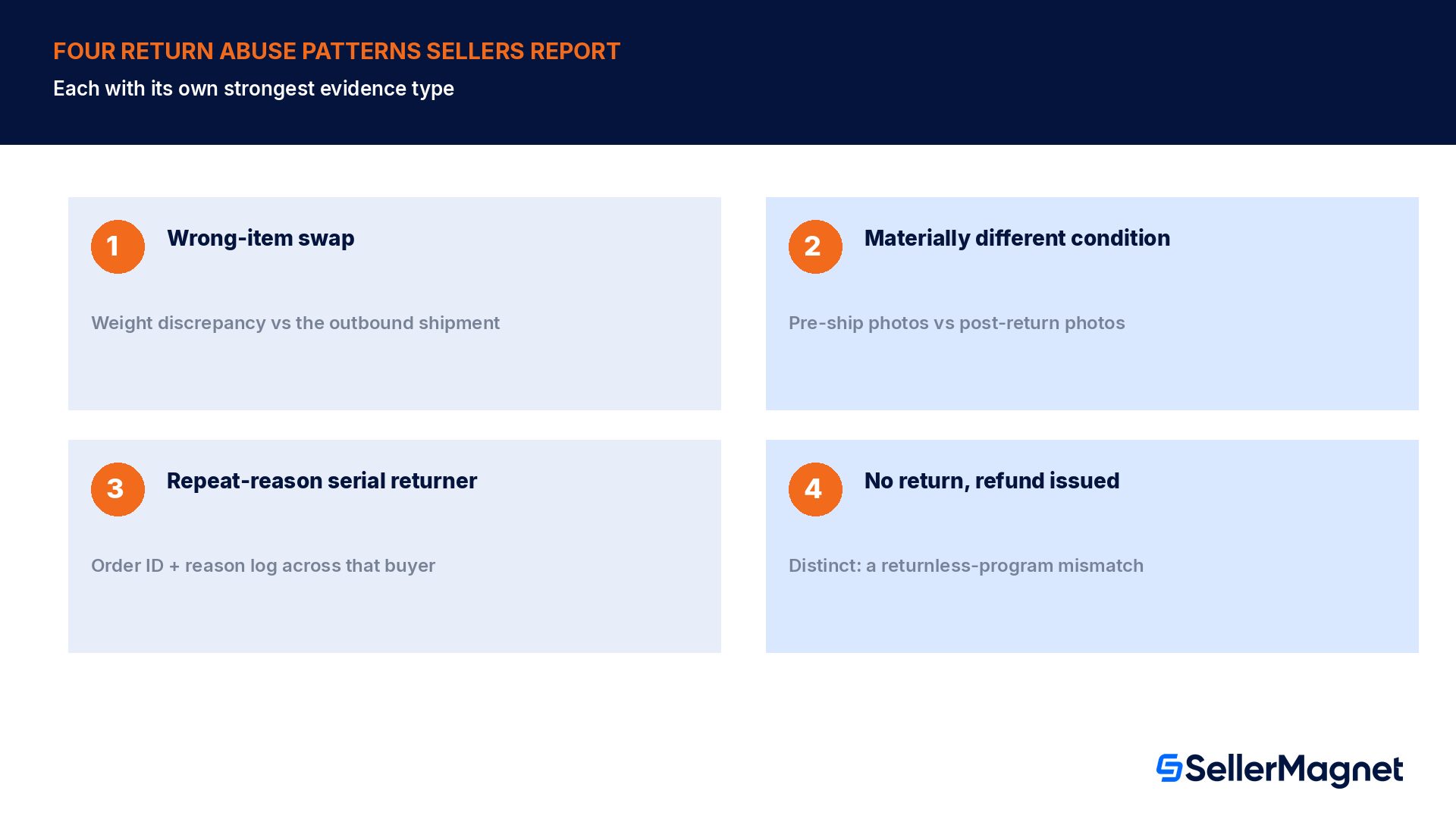
Across Seller Central's own forum, the recurring abuse patterns are narrower than 'customer lied about the product' and fall into a handful of repeatable shapes. Reading the forum threads side by side, four patterns come up again and again, each with its own evidence trail and its own best response.
Pattern
What actually comes back
Strongest evidence
Wrong-item swap
A cheap unrelated item (a sticker, a notebook, scrap material) instead of the product sold
Weight discrepancy between the outbound shipment and the returned package, compared on a scale
Materially different condition
The correct item, but visibly used, damaged, or missing components that were present at shipment
Pre-ship photos of the exact unit (serial number or batch-specific where possible) against post-return photos
Repeat-reason serial returner
The same buyer returning multiple different orders with the same stated reason (defective, wrong size, not as described)
A log of order IDs and return reasons across that buyer's order history, referenced in each new Seller Support case
No return, refund issued
Amazon auto-refunds under a program like returnless resolutions, but the item itself never actually left the buyer
Not directly disputable by the seller; distinct from the patterns above, see the returnless-resolutions guide for that program's own mechanics
The refund-path tradeoff, explained once, clearly
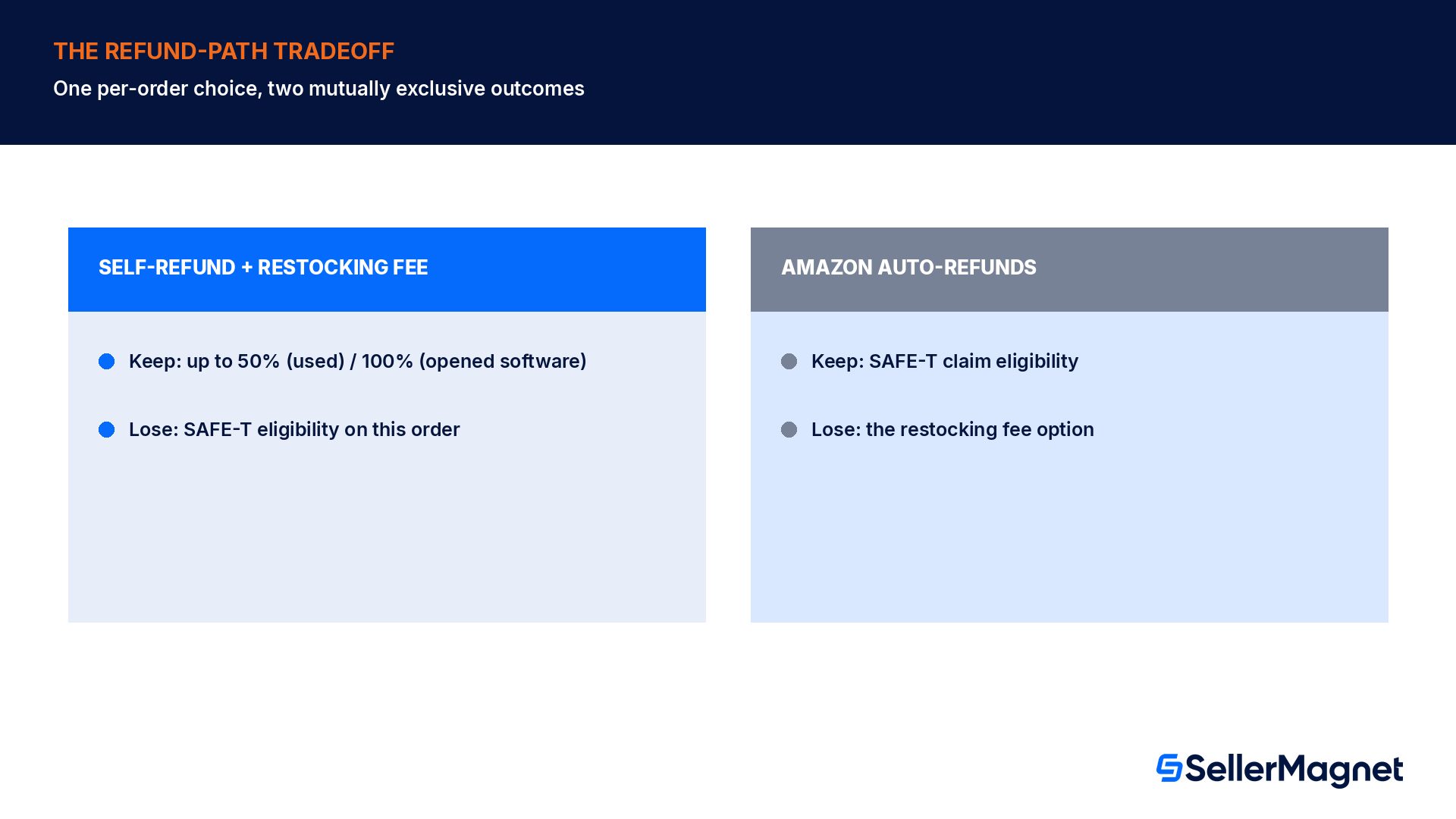
This is the single most load-bearing fact in the entire topic, and it is also the one most frequently gotten wrong in forum threads: a seller has two separate refund paths available on a disputed return, and the path chosen determines which protection stays available afterward. One Seller Support reply, quoted directly in a forum thread, states it as plainly as Amazon ever states anything: "It is either you process the refund with the restocking fee, or Amazon will issue the refund without restocking fee and you request reimbursement of it through SAFE-T."
Refund path
What you keep
What you give up
Seller manually refunds, selects 'materially different item returned', applies a restocking fee
Up to 50% (used/damaged) or 100% (opened software/games) kept from the refund
SAFE-T claim eligibility on that specific order is forfeited
Seller waits, Amazon auto-refunds the buyer
SAFE-T claim eligibility preserved, reimbursement of product value or return shipping cost possible
No restocking fee collected; the fee option is gone once Amazon has already refunded
The clock matters more than the amount
Amazon expects a seller to process a refund within 4 calendar days of receiving a return. Experienced sellers in the forums recommend resolving a disputed return in well under 48 hours of receipt rather than waiting out the full window, specifically because an unresolved return is exactly the condition under which Amazon's own automatic refund can trigger and the restocking-fee path closes on its own, not because the seller chose SAFE-T.
In practice this means the decision has to be made fast, item by item: for a low-value item where the restocking fee itself is small, letting Amazon auto-refund and filing SAFE-T is usually the lower-effort path. For a higher-value item where a meaningful restocking fee is on the table, manually refunding with the fee applied, inside the window, before Amazon's own auto-refund fires, keeps that fee, at the cost of the SAFE-T option on that order specifically.
Building the evidence file before you need it
Every successful case cited across the forum threads shares the same evidence pattern, collected the moment the disputed return is opened, not days later from memory. A seller who photographs every outbound shipment at the point of packing, as a default habit rather than a reaction, starts every disputed return already holding half the evidence a SAFE-T claim or a Report Abuse case will ask for.
High-resolution photos of the returned package exterior, the shipping label, and every item actually inside it, taken the moment it is opened.
The original outbound shipping record for that same order: weight, carrier, tracking number, and if available a photo of the exact unit shipped.
A side-by-side weight comparison when a wrong-item swap is suspected; a fertilizer bag and a notebook do not weigh the same, and that discrepancy alone is strong evidence.
Buyer-Seller Messaging correspondence, since Amazon's guidance is to inform the buyer in writing when a return arrives in materially different condition before applying a restocking fee, treating it as a possible mistake rather than an accusation.
Order IDs for every prior incident with the same buyer, referenced explicitly in each new Seller Support case so a reviewer sees the pattern, not an isolated complaint.
Reporting a repeat pattern through Report Abuse
A single disputed order is handled as a refund decision. A pattern across several orders from the same buyer is a different kind of case, and it goes through a different tool: Report Abuse, reachable from Account Health in Seller Central, or directly at Amazon's abuse-submission form. This is explicitly separate from, and in addition to, the refund decision on any individual order: reporting abuse does not refund or un-refund anything by itself, it flags the buyer's account for Amazon's own review. Seller Support's own guidance, quoted across multiple threads, is consistent: open a new case each time the pattern repeats, reference every previous case ID in the new one, and attach the same evidence standard each time, order IDs, photos, and a clear explanation of the repeated behavior. One isolated case rarely moves anything; a referenced chain of cases across multiple orders from the same buyer is what gets an account actually reviewed.
Never accuse the buyer directly in Buyer-Seller Messaging
Forum guidance from experienced sellers is consistent on tone: treat a materially-different return as a possible honest mistake in any buyer-facing message, never as an accusation, even when the evidence looks clear-cut. The accusation, if one is warranted, belongs in the Seller Support case and the Report Abuse submission, backed by evidence, not in a message the buyer reads directly.
Most returns are legitimate: why that matters for your process
Every pattern in this guide describes a minority case, and treating every disputed return as abuse is its own mistake, one that costs more in wasted Seller Support cases, damaged buyer relationships, and negative feedback than the abuse itself would have cost. A genuinely defective unit, a size that runs differently than expected, a product that simply did not suit the buyer's use case, these are the overwhelming majority of returns and Amazon's buyer-protection policy exists specifically to make that normal commerce frictionless. The evidence standard in this guide is not a reason to treat every return with suspicion; it is a reason to have a consistent, fast process so the rare genuine abuse case gets caught without slowing down or souring the many legitimate ones.
A practical split: if the returned item matches what was shipped, in a condition consistent with normal use and the stated return reason, process the refund immediately and move on, no photos needed beyond what you'd keep for any order. The evidence-gathering and SAFE-T-tradeoff decision described above is specifically for the minority of returns where the item itself, its condition, or the pattern across a buyer's order history does not add up. Reserving the slower, documentation-heavy process for genuinely disputed cases keeps both your response time on legitimate returns and your evidence quality on disputed ones where they need to be.
Marketplace differences worth knowing before you apply a fee
The restocking fee schedule and SAFE-T claim mechanics described in this guide are consistently reported for the US marketplace in the forum threads this guide draws on. A seller operating in multiple marketplaces should not assume the same fee percentages, refund windows or claim process apply identically everywhere: EU marketplaces in particular carry their own consumer-return-rights rules layered on top of Amazon's own policy, and a restocking fee that is routine in the US can be restricted or prohibited under a given country's consumer protection law for certain return reasons. Before applying a restocking fee outside the US, check that specific marketplace's current return policy page rather than assuming the US figures transfer directly; the pattern-recognition and evidence-gathering steps in this guide apply everywhere, but the fee percentages and the SAFE-T tradeoff mechanics are the part most likely to differ by marketplace.
Worked example: a wrong-item return on a $140 order
A seller ships a $140 item and receives a return package weighing a fraction of the original outbound weight. Opening it reveals a notebook and a small toy instead of the product. The seller photographs the package, label and contents immediately, pulls the original shipping record showing the correct outbound weight, and messages the buyer the same day, worded as a possible mix-up rather than an accusation, stating the return does not match what was shipped and that no refund will be issued until the correct item is returned. Because the discrepancy is clear and documented, the seller manually processes the refund decision using the 'materially different item returned' reason and applies the maximum applicable restocking fee rather than waiting for Amazon's own refund clock to run, which would have triggered an automatic full refund and closed the fee option (while opening SAFE-T, which this seller decides is worth less here than the fee on a wrong-item case this clear-cut). The seller also opens a Report Abuse case the same day with the order ID, photos, and the weight comparison, so the incident is on record if the same buyer's pattern continues on a future order.
Worked example: flagging a repeat-reason serial returner
A different seller notices the same buyer has placed and returned four separate orders over three months, each time citing a different stated reason (defective, wrong size, not as described, changed mind) but each return also arriving with the item in used condition inconsistent with the stated reason. No single return in isolation looks clearly fraudulent: a buyer is entitled to return items for genuine reasons, and four unrelated returns from one customer could plausibly be bad luck. What makes this pattern worth escalating is the combination: the volume (four in three months, well above that buyer's category-typical return rate), the inconsistency between stated reason and actual condition, and the fact that the pattern itself, not any single order, is what Seller Support needs to see to act. The seller pulls all four order IDs, the return reason and received condition for each, and photos from the two returns where photos were taken, then files one Report Abuse case referencing all four orders together rather than filing four separate, disconnected cases. Per the forum guidance in this guide, each subsequent incident with the same buyer gets a new case that references the earlier case IDs, building a chain Seller Support can follow rather than four orphaned complaints that look unrelated to a reviewer seeing each one individually.
How this connects to your account health metrics
A disputed return, handled well or badly, rarely shows up as its own line item on your Account Health dashboard, but it feeds metrics that do: a negative outcome from a mishandled dispute, an accusatory message the buyer reports, or a refund delayed past the expected window can register as a negative feedback event or a late-response signal, the same category of metric that a slow FBM response time or a high order defect rate feeds into. This is a second, independent reason to decide fast and communicate carefully: the evidence-and-tradeoff process in this guide protects the refund and the restocking fee, while a calm, prompt, non-accusatory message is what protects the account health metrics sitting alongside it. Treating the two as separate concerns, document for the money, tone for the metrics, is what keeps a legitimate dispute from also becoming an account health problem.
Common mistakes handling a disputed return
Waiting past the refund window to decide, which can let Amazon's own automatic refund fire first and close the restocking-fee option without the seller choosing that outcome.
Accusing the buyer directly in Buyer-Seller Messaging, which forum guidance consistently advises against even when the evidence is strong.
Applying a restocking fee and then still expecting SAFE-T eligibility on that same order; the two paths are mutually exclusive per order, not combinable.
Filing a Report Abuse case with only the current order's evidence, when referencing every prior case ID with the same buyer is what actually demonstrates a pattern to a reviewer.
Not photographing the outbound shipment in the first place, which leaves a seller with no comparison point once a wrong-item return shows up weeks later.
Treating a single disputed return as proof the buyer is acting in bad faith, when most returns genuinely are legitimate and the evidence standard exists precisely to separate the two.
Catching a return-abuse pattern early needs the evidence trail built automatically, not assembled from memory after the fact.Lost & Found scans Seller Central data to flag returned units eligible for reimbursement so a missed SAFE-T claim does not sit unfiled. Alerts surfaces a disputed or unusual return the moment it is logged, so the response happens inside the window instead of after Amazon's own refund clock has already run. For how Amazon's own return-rate fee works separately from abuse handling, see Amazon Returns Processing Fee 2026.
How to respond to a disputed return
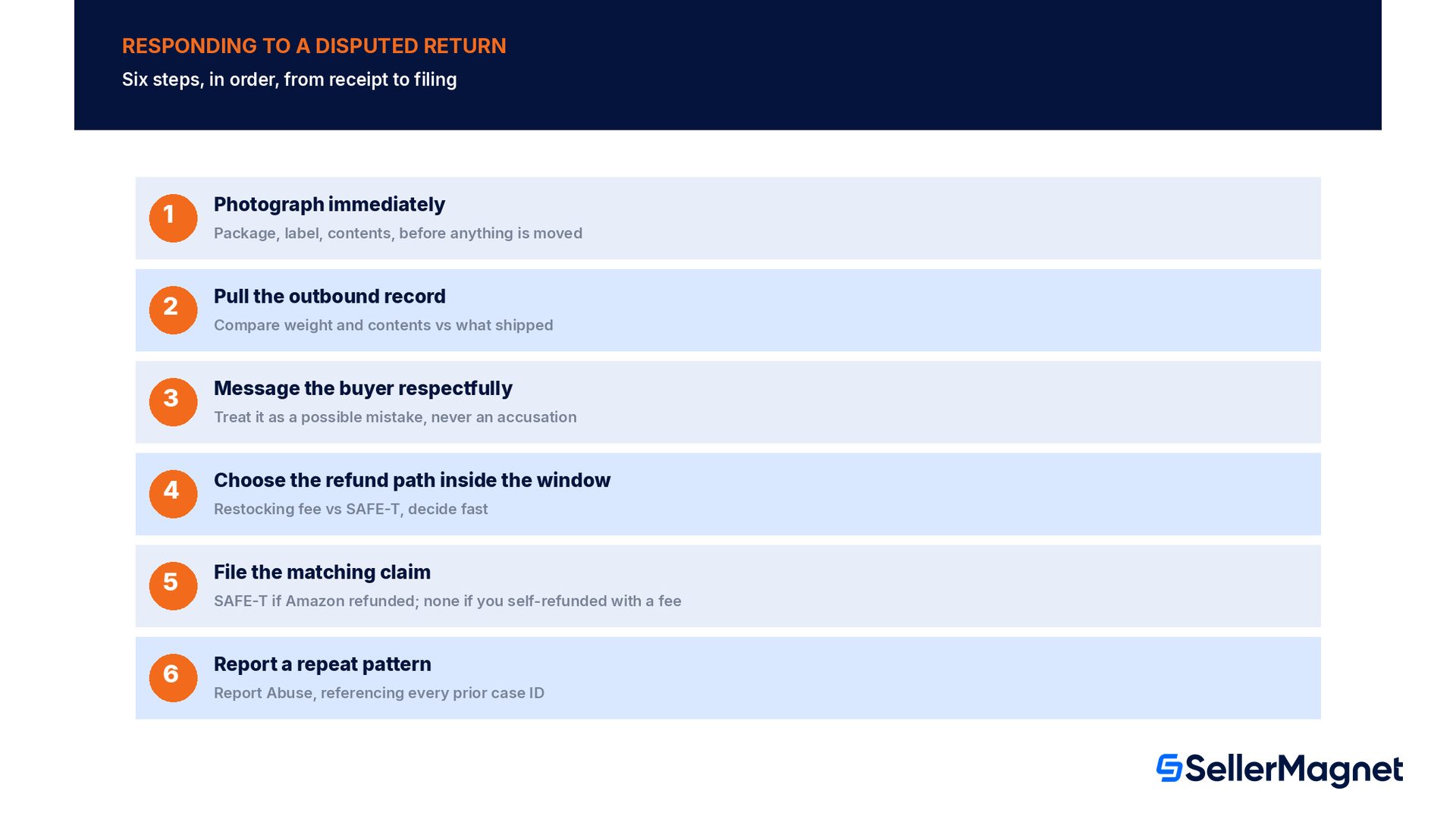
Respond to a suspected return-fraud or abuse case
Photograph immediately - Take high-resolution photos of the package, label and contents the moment the return is opened, before anything is moved or discarded.
Pull the outbound record - Compare the returned package's weight and contents against the original shipping record for that order.
Message the buyer respectfully - Inform them in writing, treating it as a possible mistake, before applying any fee or denying any refund.
Choose the refund path inside the window - Decide within the seller refund window whether to manually refund with a restocking fee or let Amazon's own refund process the order, understanding the SAFE-T tradeoff either way.
File the appropriate claim - If Amazon auto-refunds, file a SAFE-T claim with the same evidence; if you self-refunded with a fee, that specific order's SAFE-T path is closed.
Report a repeat pattern - If this is not the first incident with this buyer, file a Report Abuse case referencing every prior case ID and the full evidence set.
What is a SAFE-T claim?
SAFE-T stands for Seller Assurance for E-Commerce Transactions. It is the reimbursement path a seller can use when Amazon issues a refund to a buyer without the seller first applying a restocking fee, letting the seller request reimbursement of the product value or return shipping cost.
Can I apply a restocking fee and still file a SAFE-T claim on the same order?
No. The two paths are mutually exclusive per order. Manually refunding with a restocking fee forfeits SAFE-T eligibility on that order; letting Amazon auto-refund preserves SAFE-T eligibility but forfeits the restocking fee.
How large a restocking fee can I apply?
Per Amazon's published restocking fee schedule, up to 50% for an item returned in used or damaged condition, and up to 100% for opened software or video games, selected under the 'materially different item returned' refund reason.
How fast do I need to decide on a disputed return?
Amazon expects a refund to be processed within 4 calendar days of receiving the return. Experienced sellers recommend deciding well inside 48 hours, since an undecided return is exactly when Amazon's own automatic refund can fire first and close the restocking-fee option.
Where do I report a buyer with a repeated return-abuse pattern?
Through Report Abuse, reachable from Account Health in Seller Central or directly at Amazon's abuse-submission form. This is separate from, and in addition to, handling the individual order's refund.
Should I accuse the buyer of fraud directly in a message?
No. Forum guidance from experienced sellers and Amazon staff replies consistently recommends treating it as a possible honest mistake in any buyer-facing message, and reserving a direct allegation, backed by evidence, for the Seller Support case and Report Abuse submission.
Does photographing every outbound shipment actually help later?
Yes. The strongest evidence in every forum case cited is a comparison between the original outbound shipment and the returned package. A seller who photographs shipments by default already holds half the evidence a dispute will need, instead of trying to reconstruct it from memory weeks later.
Are the restocking fee rules the same in every Amazon marketplace?
No. The figures in this guide are consistently reported for the US marketplace. EU and other marketplaces layer their own consumer-return-rights rules on top of Amazon's policy, so check that specific marketplace's current return policy before applying a fee outside the US.
Stop Juggling Tools. SellerMagnet Combines Everything You Need.