Amazon Bundle Policy 2027: What Changes on January 11 and How to Stay Compliant
R
RenéFreelance Amazon Editor
|
15 min read
If you sell any kind of multi-product kit on Amazon under a single ASIN, a policy update buried in Seller Central's "Changes to program policies" page is worth reading before the holidays, not after. Effective January 11, 2027, Amazon is extending a rule that has only applied to Consumables since late 2024 to most other categories: hard kit bundles listed as one ASIN must be packaged by the original manufacturer or brand. At the same time, Amazon is loosening other parts of the bundling rules, adding categories that were off limits before. This post walks through exactly what changes, who is actually exempt, and how to check your own catalog with 67 days of runway before enforcement starts.
From 11 January 2027, Amazon requires most hard kit bundles listed as one ASIN to be packaged by the original manufacturer or brand, extending a rule that already applied to Consumables. Exceptions are gifting and camera bundles, bundles with a brand letter of authorization, and virtual bundles. Noncompliant listings are deactivated after the deadline and flagged on Account Health.
Hard kit vs. virtual bundle: the distinction this whole update turns on
Amazon's Product Bundling Policy splits every multi-product listing into 2 mechanics, and this update changes the rules for only one of them. A hard kit bundle is physically packaged together as a single product with its own unique external identifier (a UPC or EAN, or a GTIN exemption for the primary brand); it ships as one unit, gets returned as one unit, and the referral fee of the primary product's category applies to the whole bundle. A virtual bundle is never physically packaged together at all: it has no unique identifier, the components ship and get fulfilled individually, and a customer sees one detail page while Amazon assembles the order behind the scenes. Virtual bundles are restricted to Brand Representatives or Authorized Resellers in Brand Registry and can only combine 2 to 5 ASINs that are each separately buyable, all on the same fulfilment type. The January 2027 manufacturer-packaging requirement applies to hard kit bundles. Virtual bundles are explicitly exempt, because there is no physical packaging step for the rule to apply to.
What actually changes on 11 January 2027
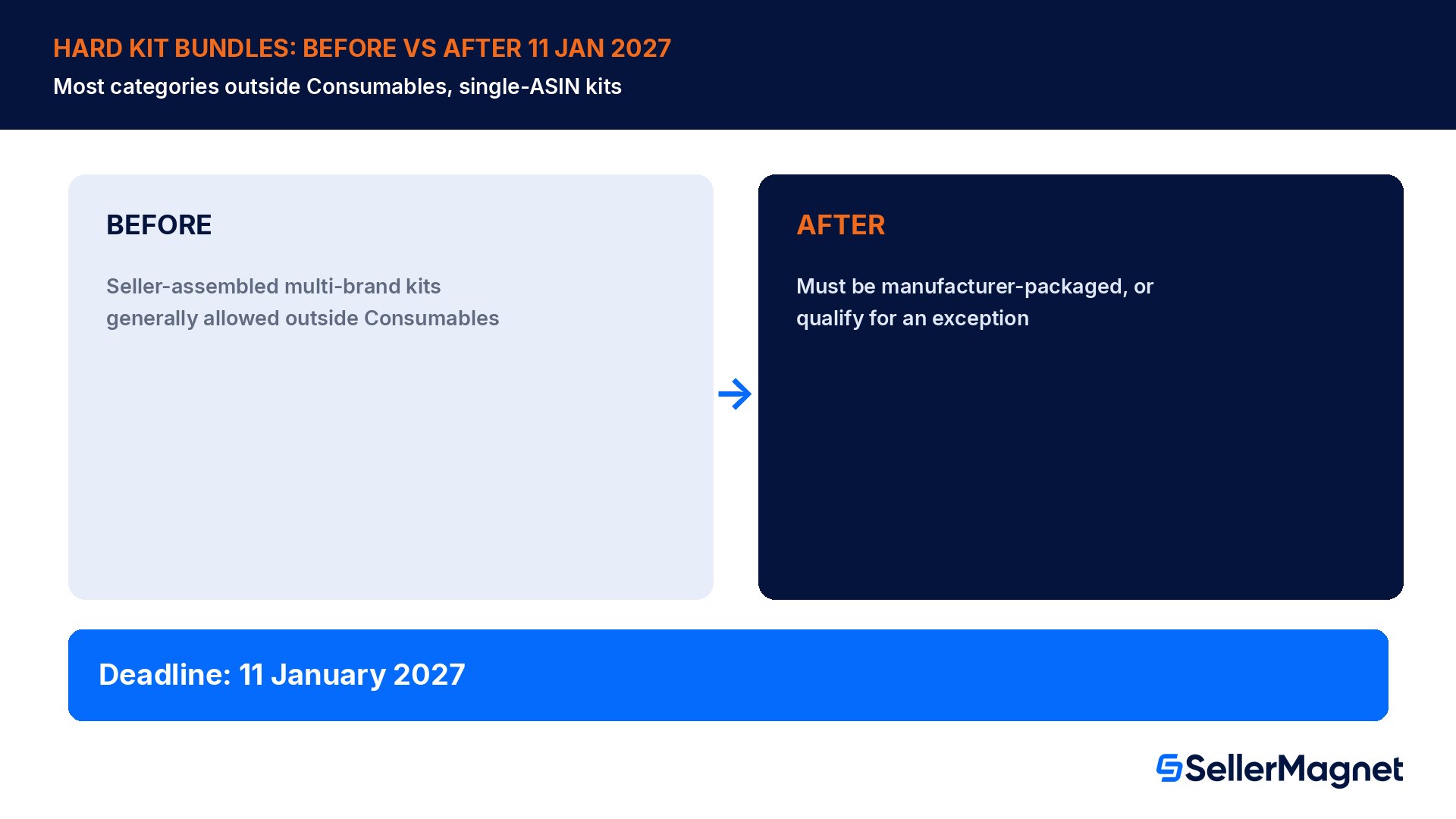
Today, the requirement that a hard kit bundle be packaged by the original manufacturer or brand already applies to the Consumables category, where Amazon has run it since late 2024 to keep food, supplement and personal-care bundles authentic and tamper-evident. From 11 January 2027, that same packaging requirement extends to most other categories. In practical terms: if you currently buy 3 separately sourced, separately branded products, shrink-wrap or box them together yourself, and list the result as one new ASIN, that listing moves from compliant to noncompliant on the effective date, unless it falls under one of the exceptions below. The policy note frames this as closing a gap, not inventing a new rule category: the mechanism already exists, it is simply being applied more broadly.
Hard kit bundle, single ASIN
Before 11 Jan 2027
After 11 Jan 2027
Consumables category
Must be packaged by the original manufacturer or brand
Unchanged, same rule as today
Most other categories
Seller-assembled multi-brand kits generally allowed
Must be packaged by the original manufacturer or brand, or qualify for an exception
Gifting browse nodes, camera product types
Allowed as seller-assembled kits
Still allowed; explicitly exempt from the manufacturer-packaging rule
Bundle with a brand letter of authorization
Not a defined exception
Permitted: upload the LOA to Account Health once a bundle is flagged noncompliant
Virtual bundles (Brand Reps/Authorized Resellers)
Never required to be manufacturer-packaged
Unchanged; the rule never applied to virtual bundles
The 3 ways to keep a hard kit bundle compliant without manufacturer packaging
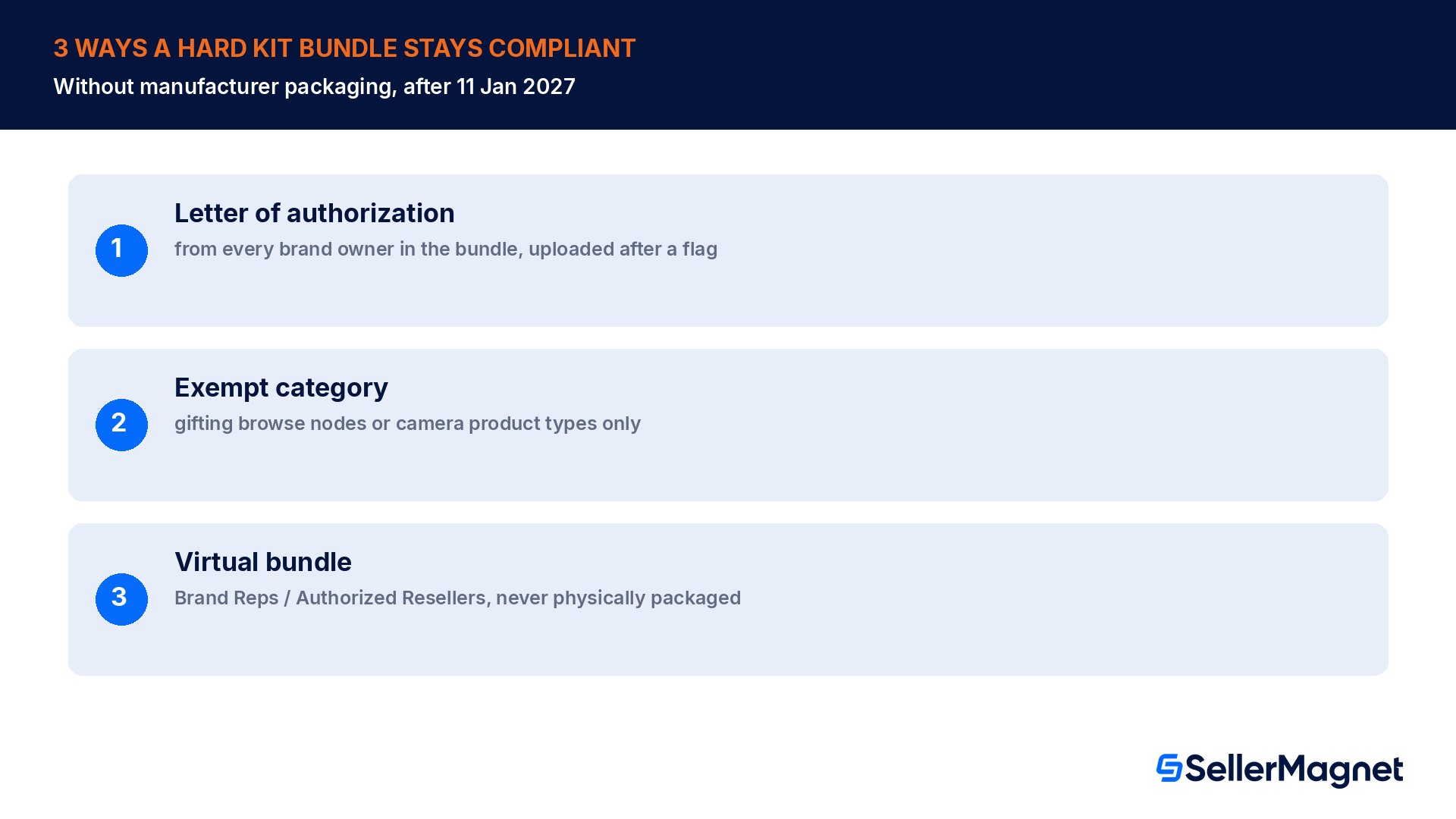
Amazon is not banning hard kit bundles outside Consumables, it is narrowing who is allowed to assemble them. 3 paths stay open for a bundle that is not packaged by the original manufacturer or brand.
Authorized repackaged products: if you hold a letter of authorization from the brand owner or manufacturer of every product in the kit, granting permission to repackage with the other included brands for sale on Amazon, the bundle stays listed. The LOA is uploaded to the Account Health dashboard after the bundle is flagged noncompliant, not before; there is no pre-emptive filing step described in the notice.
Exempt categories: bundles listed in gifting browse nodes, and bundles in camera product types, do not need to be original-manufacturer configurations at all. The exemption is tied to the browse node or product type the bundle is listed under, not to a general "this looks like a gift" judgment call.
Switch to a virtual bundle: for Brand Representatives and Authorized Resellers, a virtual bundle built with the Virtual Bundles tool is never physically packaged together, so the manufacturer-packaging rule does not apply to it by definition. This path is not available to a seller who is not a brand representative or authorized reseller for every component ASIN.
What the notice does not say
There is no published grace period beyond the deadline itself, no partial rollout by category, and no stated review queue for LOAs submitted in advance. The documented process is reactive: a bundle gets flagged noncompliant, then you upload the authorization. Waiting for an email before gathering your LOAs leaves zero buffer if a brand owner is slow to respond.
Why Amazon is doing this now, and what it tells you about enforcement
The policy note frames this as extending an existing rule, not writing a new one, which matters for how strictly it is likely to be enforced. Amazon has run automated catalog scans for bundle-type listings for years, originally to police the Consumables exception; extending the same manufacturer-packaging check to other categories is largely a configuration change to scope, not a brand-new detection system Amazon has to build from scratch. That is a signal worth taking seriously: a rule enforced by an existing automated scan tends to apply evenly and promptly from day one, unlike a policy that depends on manual review and tends to roll out unevenly over months. Sellers who assume a slow, patchy rollout because this is 'just an extension' are reading the wrong signal from that framing.
How this interacts with Brand Registry and private label sellers
If you are a Brand Registry owner bundling your own single-brand product with your own accessory, under your own brand, you are generally the manufacturer or brand of record for the whole kit, so this update changes nothing in practice; you were already the party entitled to authorize the packaging. The update bites hardest on arbitrage, wholesale and multi-brand private-label sellers who physically combine products from 2 or more brands they do not own into one new ASIN. That seller profile is exactly who the letter-of-authorization and virtual-bundle paths exist for, and exactly who should audit their catalog first, since a single-brand seller bundling only their own SKUs has close to zero exposure by definition.
Does this travel across marketplaces outside the US?
The Seller Central "Changes to program policies" notice covering 11 January 2027 is published on the US help hub; always confirm the equivalent notice on each marketplace you sell in before assuming the same date and the same exceptions apply everywhere, since Amazon has historically rolled bundling rules out on different timelines by region. The underlying Product Bundling Policy page itself, which defines hard kit bundles, virtual bundles and the exception categories, is the same global reference Amazon links from every store's help center, so the mechanics described in this post, not necessarily the exact effective date, are a safe baseline to check your EU, UK or other listings against while you wait for each marketplace's own policy-change page to confirm its local date.
What Amazon is loosening at the same time
The same update is not purely restrictive. Amazon is expanding what bundles are allowed to contain, in ways that matter if you have been turned down for a bundle request before. From 11 January 2027, sellers can create bundles in the Books, Music, Video, DVD and Video Game categories, none of which were open to bundling before. Bundles may also include a secondary generic product or a service plan, and bundles may include gift cards, 2 inclusions that were previously restricted. In the Consumables category specifically, multi-brand bundles become possible when every brand owner has supplied a letter of authorization, loosening a category that has historically been the strictest one for bundling. None of these additions change the manufacturer-packaging requirement; they change what you are allowed to put inside a compliant bundle once you have one.
Worked example: what an unreviewed catalog of bundles can be sitting on
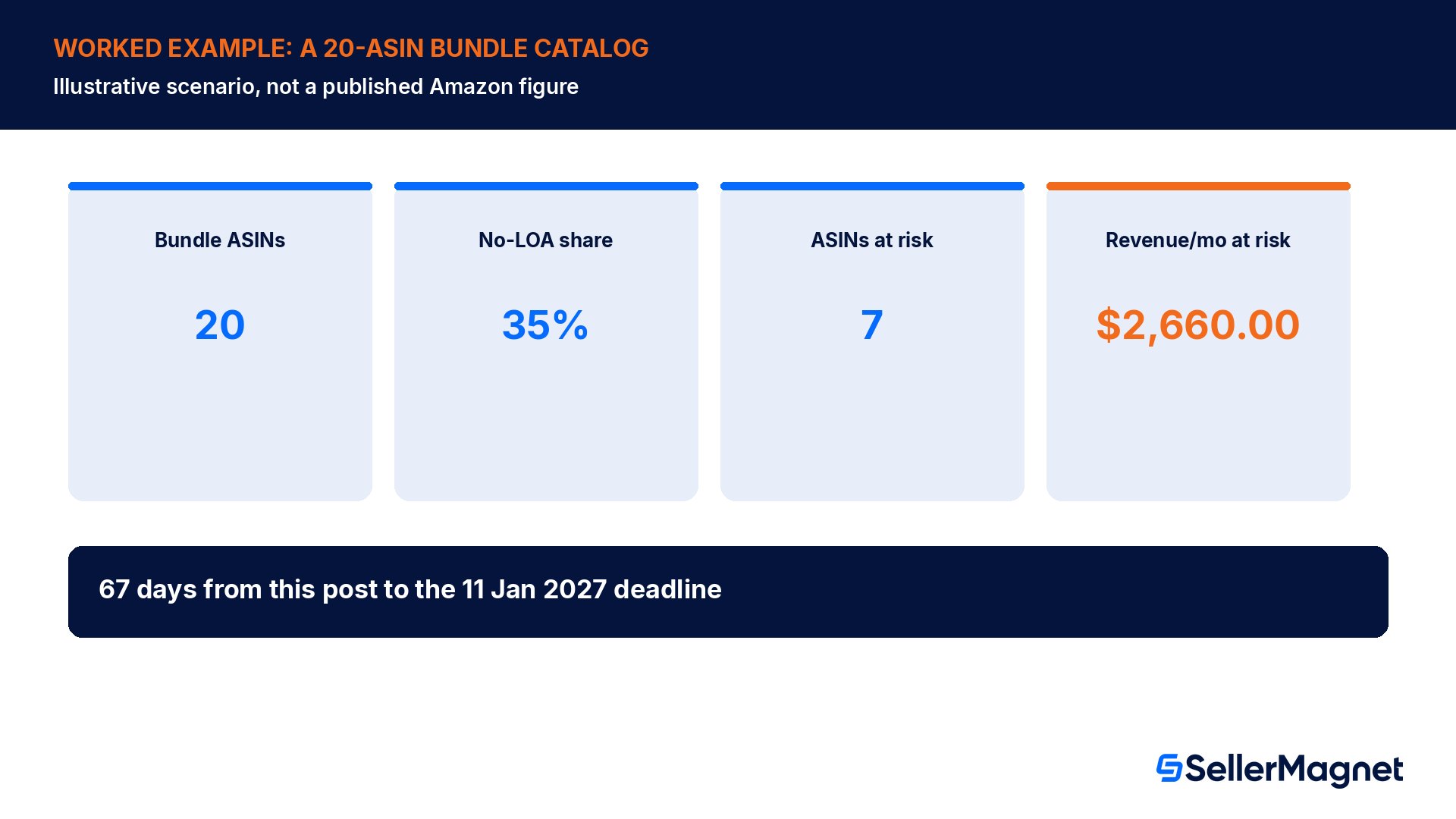
To see the shape of the exposure, take an illustrative seller running 20 hard kit bundle ASINs outside Consumables, none reviewed against this update yet. This is a built scenario to show the mechanics, not a published Amazon figure; your own bundle count, revenue per bundle and authorization status will differ.
Of the 20 bundle ASINs, an illustrative 35% (7 ASINs) are seller-packed, multi-brand kits with no letter of authorization on file for every brand involved, none in a gifting or camera exempt category, and not built as virtual bundles.
At an illustrative $380.00 of monthly revenue per bundle ASIN, those 7 ASINs represent about $2,660.00 a month that goes to zero the moment each listing is deactivated, not gradually, because a deactivated ASIN cannot take orders at all.
Publishing this on 5 November 2026 leaves 67 days to the 11 January 2027 deadline, enough time to request an LOA from a slow-to-respond brand owner once, but not enough time to chase one down twice if the first request goes unanswered.
The number that matters here is not the illustration, it is your own share of seller-packed, multi-brand, no-LOA bundles. A seller who already buys finished, manufacturer-packaged kits, or who only bundles same-brand accessories, may have close to 0% exposure; a seller who assembles kits in-house from several brands to create a gift set has the opposite profile. Running the count once, this month, is the only way to know which seller you are.
Choosing between an LOA, an exempt category and a virtual bundle
The 3 compliance paths are not interchangeable, and picking the wrong one for a given bundle wastes effort. An exempt category costs nothing to use but only applies if the bundle genuinely sits in a gifting browse node or a camera product type; you cannot move an unrelated bundle into that category just to dodge the rule, since Amazon's own catalog team assigns the browse node. A letter of authorization works for any bundle type but depends entirely on another company's paperwork turnaround, which you do not control and cannot speed up once a brand owner is slow. A virtual bundle is the only path fully inside your own control, since you build it yourself with the Virtual Bundles tool, but it is gated behind Brand Registry status as a Brand Representative or Authorized Reseller for every component ASIN, which rules it out for a seller reselling brands they have no registered relationship with.
Path
Who can use it
Turnaround you control
Exempt category (gifting, camera)
Any seller, only if the bundle genuinely qualifies
For most multi-brand private-label and wholesale sellers, the practical order of attack is: check the exempt categories first because they cost nothing to confirm, start every letter-of-authorization request this week regardless of how likely it feels to succeed, and treat the virtual bundle option as the fallback for the specific ASINs where you already hold a brand relationship and want to stop depending on someone else's paperwork entirely.
What to actually do about it before 11 January 2027
Pull a list of every ASIN you sell that is listed as a bundle (hard kit, not virtual), and sort it by category; anything outside Consumables is newly in scope for this update.
For each hard kit bundle, check whether it is already packaged by the original manufacturer or brand of the primary product. If yes, it stays compliant with no action needed.
For any bundle that is not manufacturer-packaged, check whether it is listed under a gifting browse node or a camera product type; if it genuinely qualifies there, no further action is needed either.
For everything left, start collecting a letter of authorization from every brand owner or manufacturer included in that bundle now, before the deadline, rather than after a deactivation email arrives.
If you are a Brand Representative or Authorized Reseller for every component ASIN, evaluate converting the riskiest bundles to virtual bundles instead of chasing an LOA for each one.
Keep selling through existing noncompliant inventory before 11 January 2027 if that is the better financial call for you; Amazon's notice explicitly allows this, and removing stock from a fulfillment center is the alternative if you would rather not sell it down.
Re-check any bundle that was previously rejected for Books, Music, Video, DVD, Video Game, a gift card inclusion, or a secondary generic product or service plan; several of those restrictions lift on the same date.
3 mistakes sellers make with this kind of update
Treating 'bundle' as one single rule. Hard kit bundles, virtual bundles and multi-packs of identical items are 3 different mechanics under Amazon's policy, each with its own requirements; this update only touches hard kit bundles.
Waiting for the deactivation email before gathering a letter of authorization. The documented process starts with the flag, not before it, so a brand owner who takes weeks to issue an LOA can leave a listing down for weeks if the request only starts after the deadline.
Assuming the update is only restrictive. Sellers who stopped trying to bundle Books, gift cards, or a service plan with a product because Amazon rejected it before should re-test those bundle types after 11 January 2027, since several of those restrictions are being removed on the same date.
Confusing a bundle review with a one-time task. A catalog keeps changing: a new hard kit bundle created in March 2027 is just as subject to the manufacturer-packaging rule as one created before the deadline, so the audit described above needs to run again every time a new bundle ASIN is created, not just once before 11 January 2027.
Building the audit into your normal listing workflow
Treat the bundle category check as a standing step in your listing process, not a one-off project tied to this deadline. Any time a new hard kit bundle ASIN is created, ask the same 3 questions before it goes live: is the primary brand's manufacturer the one who physically packaged it, does it sit in a gifting or camera browse node, and if neither is true, is a letter of authorization from every included brand already in hand. Building that check into the listing step itself is cheaper than discovering a violation on Account Health weeks later, after the ASIN has already sold through a season of inventory under a rule it never qualified for.
Where SellerMagnet fits
The real work here is not reading the policy, it is finding which of your own ASINs are bundles and which category each one sits in before the deadline, by hand, across a catalog that can run into hundreds of listings. Listing Optimizer surfaces every live listing with its category and attributes in one view, so filtering for bundle-type ASINs outside Consumables takes minutes instead of a manual export. Amazon Alerts can flag a listing policy violation on Account Health the moment it appears, so a deactivated bundle in January reaches you the same day instead of surfacing in a weekly revenue review. Check the current features on the website before you set either one up.
Does the 11 January 2027 update apply to virtual bundles?
No. Virtual bundles are never physically packaged together and have no unique identifier of their own, so the manufacturer-packaging requirement does not apply to them. They remain restricted to Brand Representatives and Authorized Resellers combining 2 to 5 separately buyable ASINs, each already sold individually on Amazon, all sharing the same fulfilment type across every component product.
Does this change anything for Consumables bundles?
The manufacturer-packaging requirement for Consumables is unchanged; it has applied there since late 2024 to keep food, supplement and personal-care kits authentic and tamper-evident. What is new for Consumables is that multi-brand bundles become possible from 11 January 2027 once every brand owner involved has supplied a signed letter of authorization covering the repackaging.
What happens to a noncompliant bundle after 11 January 2027?
It is deactivated outright and logged as a listing policy violation on your Account Health dashboard, with an email notification sent at the same time. Amazon's notice does not describe an automatic reinstatement window; you resolve it by qualifying for an exception, most commonly by uploading a letter of authorization once the violation appears.
Can I keep selling noncompliant bundle inventory before the deadline?
Yes. The notice explicitly allows selling through existing noncompliant inventory right up to 11 January 2027, or removing that stock from a fulfillment center instead if you would rather not sell it down. Both are stated as acceptable options ahead of enforcement, with no third, hybrid path described for inventory already committed to a specific fulfillment center.
What counts as an exempt gifting or camera bundle?
A bundle listed within a gifting browse node, or within a camera product type, does not need to be an original-manufacturer configuration under this update. The exemption is tied to the browse node or product type Amazon's catalog assigns the listing to, not to a subjective judgment that the product merely looks gift-like or camera-related.
Who can submit a letter of authorization, and when?
The brand owner or manufacturer of each product in the bundle issues the letter, granting you permission to repackage their product alongside the other included brands for sale on Amazon. You upload it to the Account Health dashboard only after Amazon flags the bundle noncompliant; no earlier, pre-emptive submission process is described in the notice.
Does this policy affect multi-packs of identical items?
No. Amazon's Product Bundling Policy explicitly excludes multi-packs, defined as 2 or more identical products sold together, from the bundle definition entirely. This update concerns bundles of complementary, non-identical products under a single ASIN, a separate mechanic with its own listing rules, its own referral-fee treatment, and its own return handling, unrelated to multi-pack pricing.
Are the new allowed bundle types available immediately on 11 January 2027?
Amazon's notice ties both the new restriction and the new allowances, Books, Music, Video, DVD and Video Game bundles, secondary generic products or service plans, and gift cards, to the same 11 January 2027 effective date. All of it takes effect together on that single date, not in a staggered category-by-category rollout spread across the following weeks or months.
Stop Juggling Tools. SellerMagnet Combines Everything You Need.