AWD vs FBA in 2026: Real Costs and When AWD Actually Pays
R
RenéFreelance Amazon Editor
|
16 min read
Amazon pitches Amazon Warehousing and Distribution (AWD) as bulk storage that is "38 percent less" than FBA in the off season and "80 percent less" during the holidays. Seller Forums tells a messier story: sellers who moved everything into AWD and came out paying more once inbound, outbound and transportation fees were added up. Both things are true at once, because AWD is not a cheaper warehouse, it is a different fee structure with its own processing and transport charges layered on top of a lower storage rate. This guide works through Amazon's own 2026 rate card for both programs, the two discount tiers AWD actually qualifies you for, and a worked four month example so you can see for yourself which profile of seller comes out ahead, and which one does not.
AWD is usually cheaper than storing directly in FBA for inventory you are deliberately staging weeks or months ahead of need, because its base storage rate is lower per cubic foot and it has no October to December peak surcharge. It is not automatically cheaper overall, because AWD adds inbound processing, outbound processing and transportation fees on top of that lower storage rate, and Seller Forums has sellers reporting the combined fees erased the saving for slow-turnover bulky products. The two discount tiers, Smart Storage and Amazon Managed Service, only apply once a SKU meets Amazon's auto-replenishment and days-of-supply thresholds, so a new or low-volume SKU pays the undiscounted base rate for its first months in the program.
What AWD actually is, in one paragraph
Amazon Warehousing and Distribution is Amazon's own bulk storage and auto-replenishment service: you send inventory to AWD distribution centers instead of (or ahead of) FBA fulfillment centers, and AWD's auto-replenishment feature moves stock into FBA for you as it is needed, rather than you managing the timing of repeated FBA inbound shipments yourself. There is no enrollment fee; you only pay once you actually send inventory. AWD pricing also covers FBA inbound placement, so a shipment that arrives at AWD and is later replenished into FBA does not get charged a separate FBA inbound placement fee on top of AWD's own transportation fee. The tradeoff is that AWD inventory is physically stored differently, optimized for bulk pallets rather than individual pick-and-pack, which is also why Amazon's own help pages are explicit that inventory cannot move from FBA back into AWD once it has arrived at a fulfillment center.
The real numbers: AWD storage vs FBA storage, 2026 rates
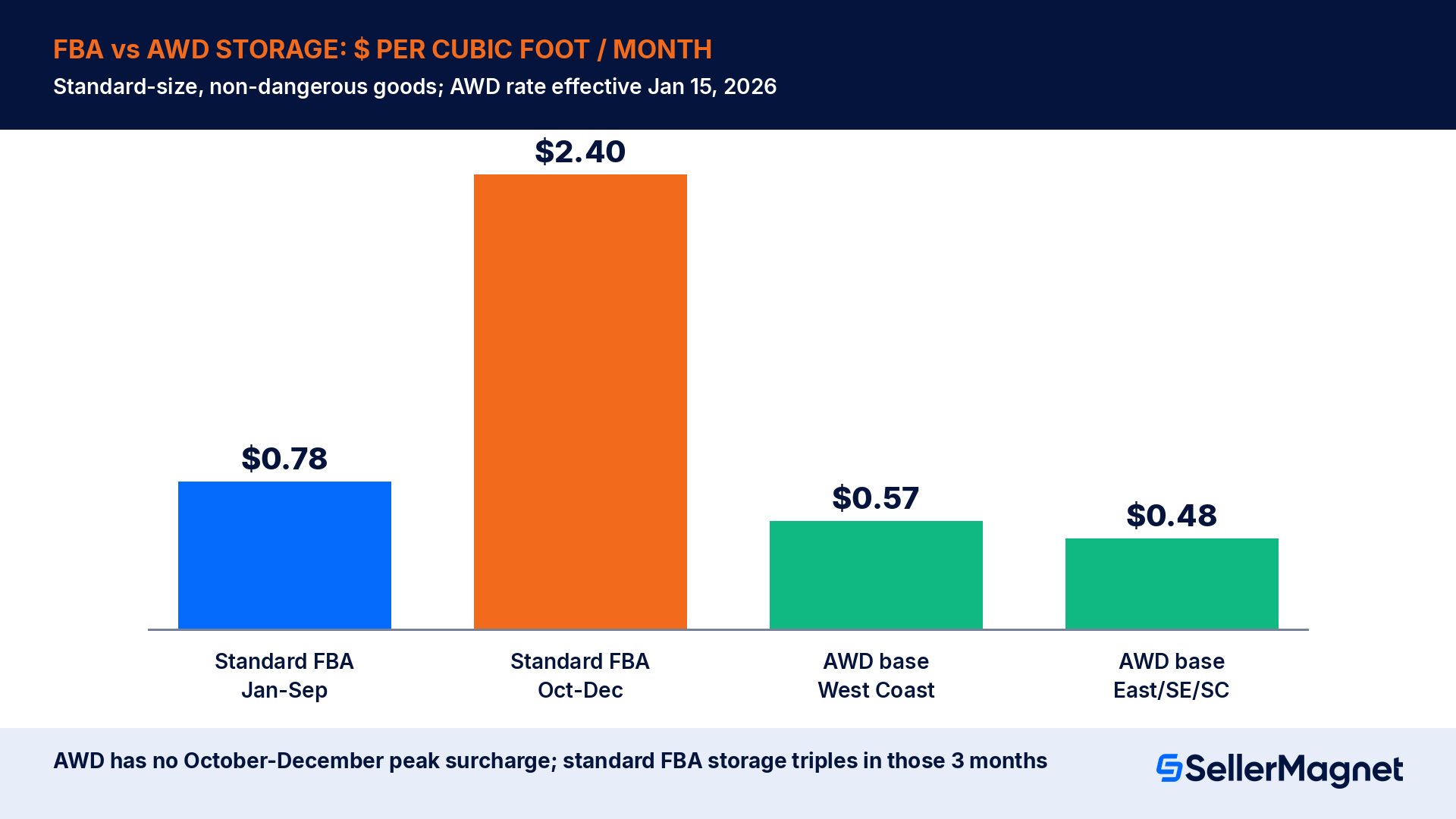
Standard FBA monthly storage fees for a standard-size, non-dangerous-goods unit are $0.78 per cubic foot from January through September, and jump to $2.40 per cubic foot from October through December, before any storage-utilization surcharge for inventory that has been sitting for 22 or more weeks is added on top. AWD's base storage rate, effective January 15, 2026, is a flat $0.57 per cubic foot per month in the West Coast region and $0.48 per cubic foot per month in the East Coast, South East and South Central regions, with no separate October to December rate at all.
Storage option
Jan-Sep rate (per cu ft/month)
Oct-Dec rate (per cu ft/month)
Source
Standard FBA, standard-size, non-dangerous
$0.78
$2.40 (plus aging surcharge from 22 weeks)
Monthly inventory storage fees help page
Standard FBA, oversize
$0.56
$1.40 (plus aging surcharge from 22 weeks)
Monthly inventory storage fees help page
AWD base rate, West Coast (incl. West Coast Palletizable)
$0.57
$0.57 (no peak surcharge)
AWD fees help page, effective Jan 15, 2026
AWD base rate, East Coast / South East / South Central
$0.48
$0.48 (no peak surcharge)
AWD fees help page, effective Jan 15, 2026
Source: Monthly inventory storage fees and Amazon Warehousing and Distribution fees, both official Amazon Seller Central help pages. Read the chart as two different shapes, not just two different numbers: FBA storage triples for the three peak months every single year, while AWD's rate is flat all year. That is the entire basis for Amazon's "up to 80 percent less in peak season" marketing claim, and it only holds for inventory that would otherwise have been sitting in FBA, racking up the peak surcharge, during those exact months.
Smart Storage and Amazon Managed Service: the two AWD discounts, and what actually qualifies
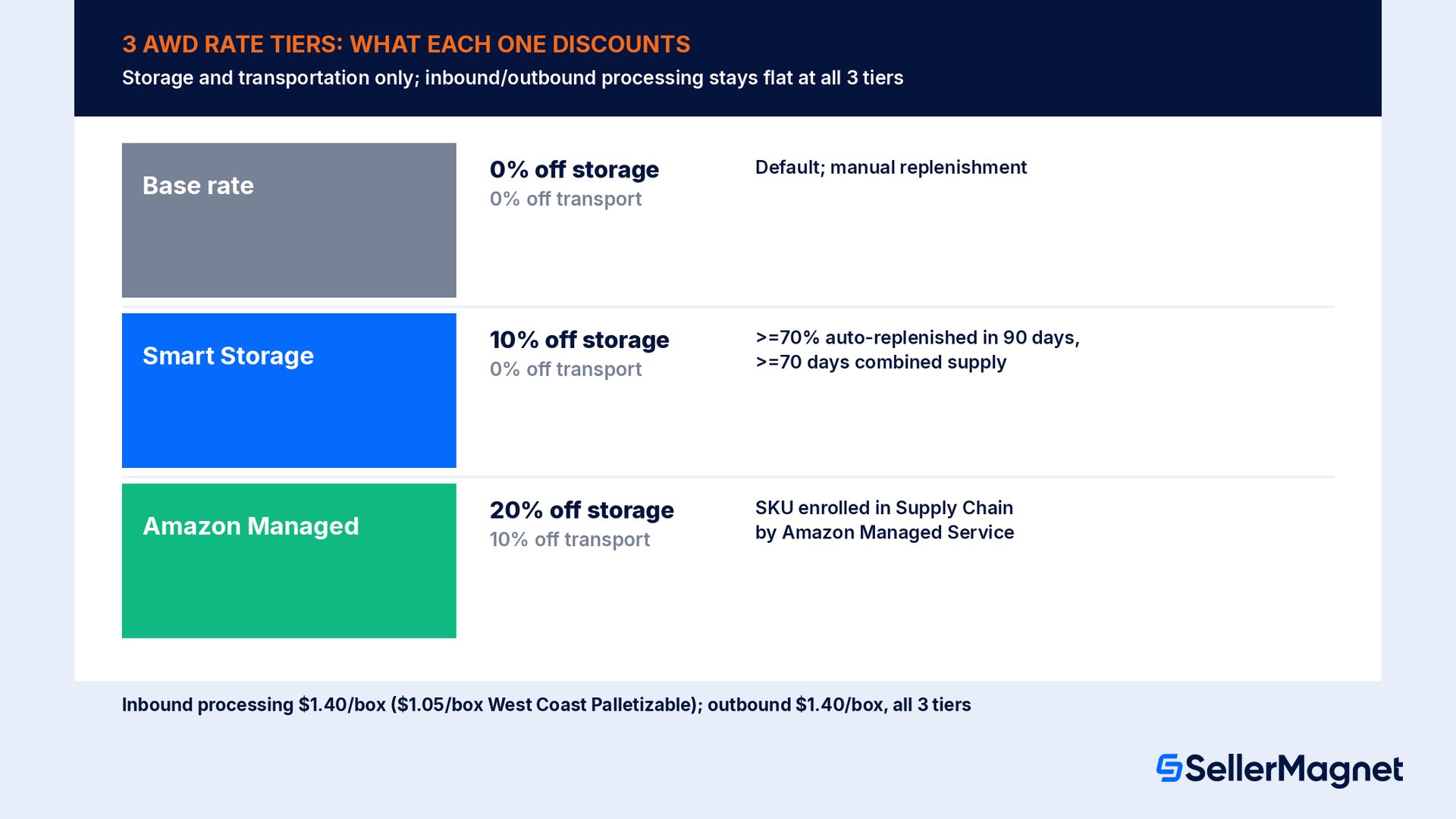
The $0.57 / $0.48 figures above are AWD's undiscounted base rate. Amazon layers two further rate tiers on top of it, each with its own qualification rule, and a SKU that does not meet either one simply pays the base rate indefinitely.
Rate tier
Storage discount
Transportation discount
How a SKU qualifies
Base rate
None (reference rate)
None (reference rate)
Default; applies when you manually manage replenishment to fulfillment centers
Smart Storage rate
10% off storage
None
At least 70% of the SKU's inventory moved from AWD to FBA via AWD auto-replenishment in the preceding 90 days, and combined AWD plus FBA inventory equal to or greater than 70 days of supply relative to historical demand
Amazon Managed rate
20% off storage
10% off transportation ($1.26/cu ft instead of $1.40/cu ft)
The SKU is enrolled in Supply Chain by Amazon Managed Service
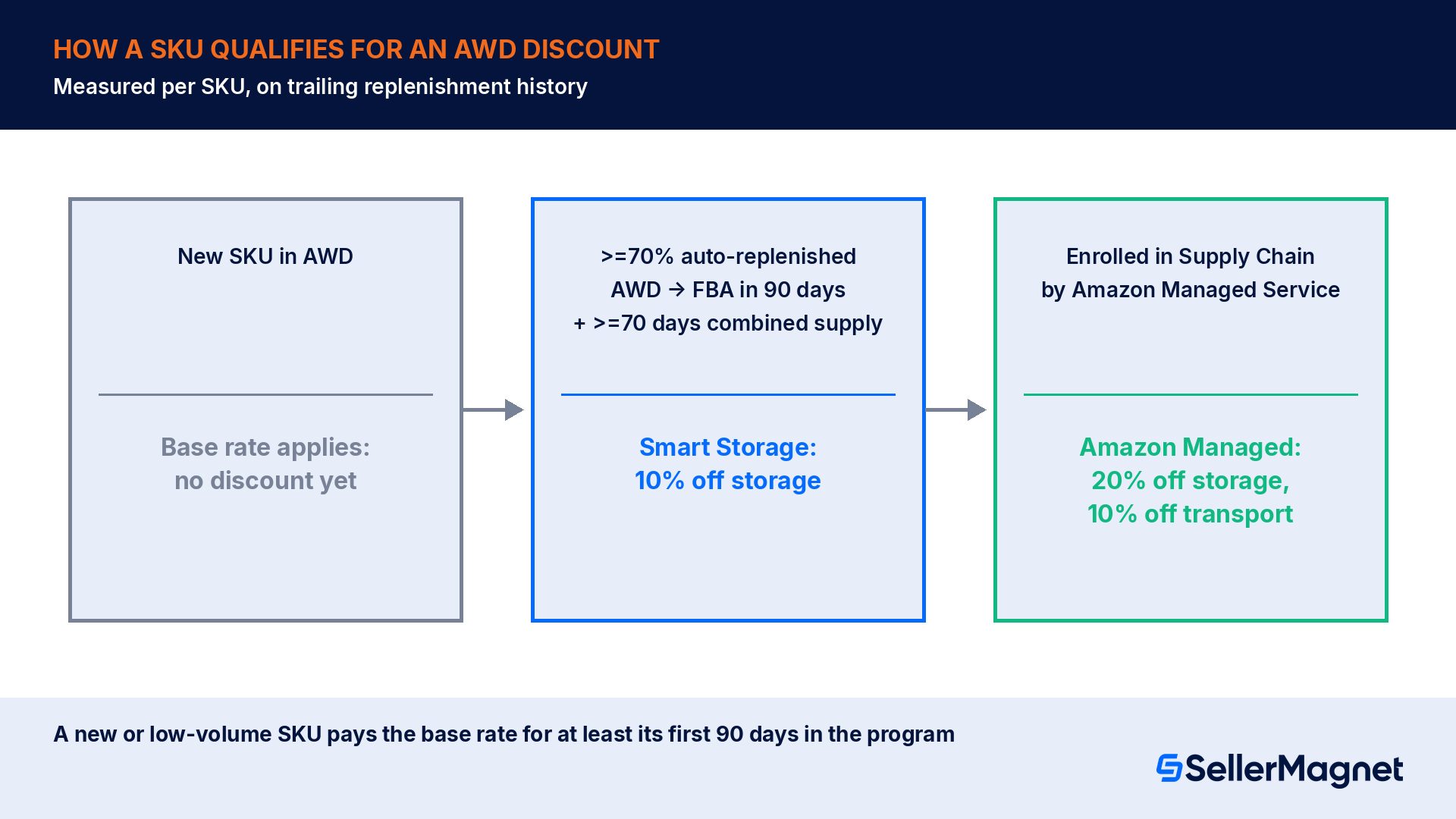
Source: AWD fees and Amazon Managed Service. Inbound processing stays flat at $1.40 per box across all three rate tiers ($1.05 per box in the West Coast Palletizable region, a 25 percent discount that also applies regardless of tier), and so does outbound processing at $1.40 per box; only storage and transportation move with the tier. The practical read is that a brand new SKU, or a SKU you have never auto-replenished through AWD before, is paying the full base rate for at least its first 90 days in the program, because the Smart Storage threshold is measured on trailing 90-day auto-replenishment history that a new SKU has not accumulated yet.
Read the diagram as a timeline, not three separate options: every SKU starts at the base rate, and only earns a discount once its own replenishment history or Managed Service enrollment clears the bar for the next tier. There is no way to request Smart Storage or Amazon Managed pricing directly; Amazon's system assigns it automatically once the SKU qualifies, and downgrades it again if the auto-replenishment ratio drops below 70 percent in a later 90-day window.
A West Coast Palletizable promotion is layered on top through 2026
Amazon's own Amazon Managed Service page adds a further note for the West Coast Palletizable region specifically: eligible shipments received through December 31, 2026 get an additional $0.35 promotional discount on the $1.40 per box inbound processing fee, on top of whatever rate tier the SKU already qualifies for. It is region- and date-specific, so confirm it still applies to your region before building it into a cost model beyond 2026.
Why Seller Forums has sellers saying AWD cost them more
Amazon's marketing page states non-holiday storage for standard-size units is 38 percent less through AWD than FBA, and 80 percent less during the holiday season. Both numbers are storage-only comparisons. Sellers on Seller Forums describing AWD as more expensive overall are almost always describing a different total: storage savings plus inbound processing, outbound processing and transportation fees that do not exist in the same form when inventory goes directly into FBA. One seller thread on AWD cost comparisons summarized the pattern plainly, describing "hidden cross-regional transfer fees and order redistribution charges" as easy to overlook, and concluding that for fast-moving small-sized products with stable daily sales AWD saves a little cost, but for slow-turnover bulky goods the extra logistics fees can exceed the storage discount outright. That lines up with how the fee structure is built: inbound and outbound processing are charged per box regardless of how long the inventory then sits, and transportation is charged per cubic foot every time stock actually moves from AWD into FBA, so a SKU that gets replenished in many small batches pays that fee repeatedly in a way a single bulk FBA shipment never does.
AWD and FBA are one-way streets, not interchangeable overflow
Amazon's AWD terms explicitly disallow sending FBA shipments to AWD facilities, sending AWD shipments directly to FBA fulfillment centers outside the auto-replenishment flow, or combining FBA and AWD shipments in one truckload. Inventory also cannot be moved back from FBA into AWD once it has arrived, because the two facility types store units differently (AWD for bulk pallets, FBA for pick-and-pack). AWD is a planning decision made before inventory ships, not a release valve for stock that is already sitting in a fulfillment center.
Worked example: staging 600 cubic feet ahead of Q4
Take a seller with 600 cubic feet of standard-size inventory (about 60 boxes at 10 cubic feet each) that arrives from the factory in August but will not be needed in FBA fulfillment until early November, ahead of the holiday selling season. Comparing three ways to hold that inventory from August through November shows exactly where AWD's saving comes from, and where it does not.
Path
Aug (off-peak)
Sep (off-peak)
Oct (peak)
Nov: transfer + peak FBA storage
4-month total
A: store directly in FBA the whole time
$468.00
$468.00
$1,440.00
$1,440.00
$3,816.00
B: hold in AWD (East/SE/SC, base rate), replenish to FBA start of November
$372.00
$288.00
$288.00
$2,364.00
$3,312.00
C: hold in AWD, Amazon Managed rate (20% off storage, 10% off transport)
$312.00
$228.00
$228.00
$2,280.00
$3,048.00
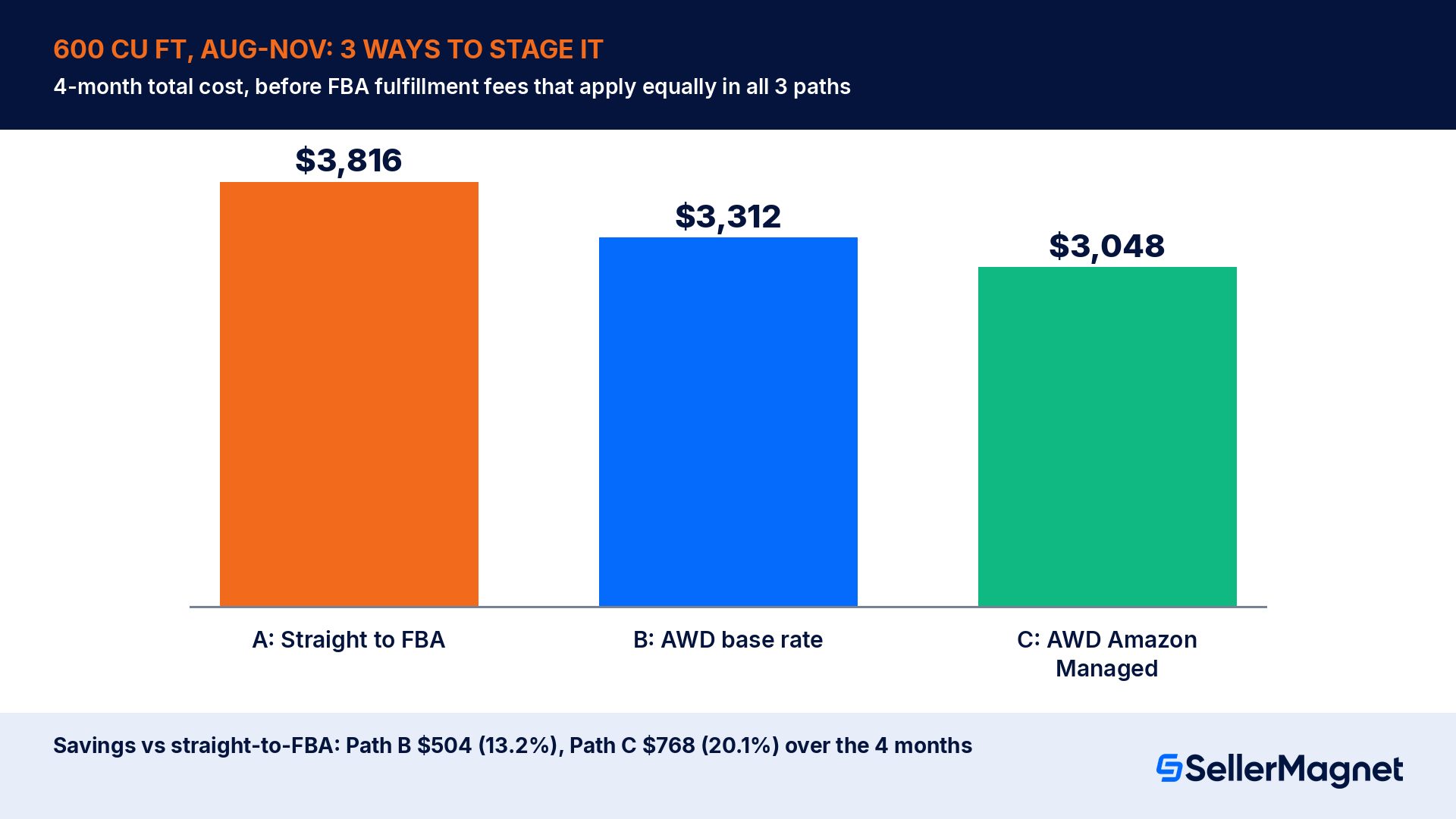
Path A is 600 cubic feet times $0.78 for August and September, then times $2.40 for October and November, all charged as standard FBA storage: $468 + $468 + $1,440 + $1,440 = $3,816. Path B holds the inventory in AWD at the East Coast base rate of $0.48 per cubic foot, with a one-time inbound processing charge of $1.40 times 60 boxes ($84) in August: August is $288 storage plus $84 inbound, or $372; September and October are $288 storage each with nothing moving; in November the full 600 cubic feet is auto-replenished into FBA, adding $1.40 times 60 boxes outbound processing ($84) plus $1.40 per cubic foot transportation ($840), for $924 on the AWD side, and then the same $1,440 October-to-December FBA storage rate applies for the month it actually sits in a fulfillment center, since that fee exists regardless of which path the inventory took to get there. November total is therefore $924 + $1,440 = $2,364, and the four month total is $372 + $288 + $288 + $2,364 = $3,312, a saving of $504, or 13.2 percent, against Path A. Path C repeats Path B with the Amazon Managed discount applied (storage at $0.38 per cubic foot instead of $0.48, transportation at $1.26 per cubic foot instead of $1.40): August is $228 storage plus $84 inbound ($312), September and October are $228 each, and November is $84 outbound plus $756 transportation plus $1,440 FBA peak storage ($2,280), for a four month total of $3,048, a saving of $768, or 20.1 percent, against Path A.
Two things fall out of that table that the flat "38 percent / 80 percent less" marketing number does not show on its own. First, the saving is concentrated in the idle months (September and October here), not spread evenly across the whole period, because November's transfer and peak-storage costs are close to equal across all three paths once the inventory is actually in FBA. Second, the gap between the base rate (Path B) and the discounted Amazon Managed rate (Path C) is itself meaningful, $264 over four months on this single 600 cubic foot example, which is why a SKU that never qualifies for a discount tier captures roughly two thirds of AWD's potential saving rather than all of it.
When AWD genuinely pays, and when it does not
AWD pays when you are intentionally staging bulk inventory weeks or months before it is needed in FBA, especially stock that would otherwise sit through the October to December peak surcharge window in FBA itself.
AWD pays when a SKU has stable, predictable demand that lets it clear the Smart Storage or Amazon Managed qualification thresholds quickly, so the discounted rate applies for most of its time in the program rather than only the base rate.
AWD pays less than it looks like it should for slow-turnover, bulky, low-velocity SKUs, because the per-box inbound and outbound processing fees and the per-cubic-foot transportation fee are charged on volume and shipment count, not on how long the item took to sell, so a product with a long AWD dwell time still pays full freight on every transfer.
AWD does not help at all for inventory you already sent straight into FBA; there is no mechanism to move it back into AWD afterward, so the decision has to be made at the point inventory ships from the factory or 3PL, not after it is already sitting in a fulfillment center.
AWD is US-only on this rate card. The UK and EU run a separate AWD fee schedule in local currency (for example a UK base storage rate of £0.36 per cubic foot and an EU base rate of EUR 12.33 per cubic metre), with their own Amazon Managed Service discount and, for October through December 2026 specifically, a storage-fee waiver limited to UK and Germany distribution centers. None of the US dollar figures in this guide carry over directly to those marketplaces.
Modeling an AWD decision by hand across a whole catalog does not scale.Profit Analytics shows real per-order profit after every Amazon fee, so you can see which SKUs are carrying enough margin to absorb an extra transportation or processing fee before you commit inventory to AWD. Inventory Forecast forecasts restock timing and days of supply per SKU, the same kind of demand signal Amazon itself uses to decide whether a SKU qualifies for the Smart Storage discount, so you can tell ahead of time which SKUs are likely to clear that 70-day threshold and which ones would sit at the undiscounted base rate the whole time. The free Fee Calculator helps sanity-check one SKU's numbers before you run a full catalog comparison.
Common mistakes sellers make comparing AWD to FBA
Comparing only the headline storage rate and ignoring inbound processing, outbound processing and transportation fees, which do not exist in the same form for inventory stored directly in FBA.
Assuming every SKU qualifies for the Smart Storage or Amazon Managed discount from day one, when both require trailing replenishment history or program enrollment a new SKU has not built up yet.
Routing slow-turnover, low-velocity, bulky SKUs through AWD expecting the same saving fast-moving, high-velocity SKUs get, when the per-shipment fees land hardest on exactly that slow-moving profile.
Treating AWD as overflow storage for stock already sitting in FBA; Amazon's own terms block shipments in that direction entirely.
Applying US AWD dollar rates to a UK or EU AWD decision, when those marketplaces run their own fee schedule in local currency with different discount rules.
Not re-checking the rate card after a fee change; AWD's West Coast storage and transportation fees both increased on January 15, 2026, alongside the discount structure staying the same, so a cost model built on the prior rate card understates the current base price.
AWD vs FBA decision checklist
List the SKU's demand pattern: stable and predictable, or slow and unpredictable? Stable demand clears the Smart Storage threshold faster and captures more of the discount.
Decide the staging window before the inventory ships, not after it has already reached a fulfillment center; there is no path back from FBA into AWD.
Add up inbound processing (per box), outbound processing (per box) and transportation (per cubic foot) on top of the storage rate, for the number of replenishment batches you actually expect, not just one.
Check which region you are shipping into (West Coast vs East/South East/South Central for the US), since the base storage rate differs by about $0.09 per cubic foot between them.
Confirm whether the SKU is, or can be, enrolled in Supply Chain by Amazon Managed Service before assuming the 20 percent storage / 10 percent transportation discount applies.
Model the comparison against the specific months the inventory will actually sit in each location, since FBA's peak surcharge only applies October through December and AWD has no equivalent peak storage charge.
For a UK or EU decision, pull that marketplace's own AWD rate card rather than converting the US dollar figures in this guide.
Is AWD always cheaper than FBA storage?
No. AWD's storage rate is lower and has no October-December peak surcharge, but it adds its own inbound, outbound and transportation fees. For inventory staged well ahead of need it is usually cheaper all-in; moved through AWD in many small batches, those fees can erase the saving.
What is the difference between the AWD base rate, Smart Storage rate and Amazon Managed rate?
Base is the default. Smart Storage gives 10 percent off storage once a SKU auto-replenishes 70 percent of inventory from AWD to FBA in the preceding 90 days with 70-plus days of supply. Amazon Managed gives 20 percent off storage and 10 percent off transport when enrolled in Supply Chain by Amazon Managed Service.
Can I move inventory from FBA back into AWD if I change my mind?
No. Amazon's AWD terms state that FBA shipments cannot be sent to AWD facilities and items cannot be moved between the two once they have arrived, because AWD and FBA store units differently (bulk pallet storage vs pick-and-pack). The AWD decision has to be made before inventory ships.
Does AWD have a peak season storage surcharge like FBA?
No. AWD's base storage rate is flat year-round ($0.57/cu ft West, $0.48/cu ft East, South East and South Central as of January 15, 2026), with no October-to-December rate, while standard FBA storage rises from $0.78 to $2.40 per cubic foot in that window. This is the main source of AWD's advertised peak-season savings.
Are AWD fees the same in the UK and EU as in the US?
No. The UK and EU run a separate AWD fee schedule in local currency (for example GBP 0.36 per cubic foot in the UK, EUR 12.33 per cubic metre in the EU for base storage), with their own discount structure and a UK/Germany-only storage fee waiver running October 1 through December 31, 2026.
Does AWD charge a separate FBA inbound placement fee when inventory is replenished from AWD into FBA?
No. Amazon states AWD pricing already covers FBA inbound placement, so inventory moving from AWD into FBA through auto-replenishment is not charged an additional FBA inbound placement fee on top of AWD's own transportation fee.
Is there a fee to enroll in AWD?
No. Amazon's own program page states there is no fee to enroll in AWD; sellers are only charged once they actually send inventory to an AWD distribution center.
How do I know which rate tier a SKU actually received?
Download the AWD storage and AWD transportation monthly reports and check the Rate type column, or check the AWD Fee discount eligibility column on the AWD Inventory dashboard, which shows whether a SKU has met the combined days-of-supply and auto-replenishment requirements.
Stop Juggling Tools. SellerMagnet Combines Everything You Need.