Supply Chain by Amazon: Three Dates Decide Your Q4
R
RenéFreelance Amazon Editor
|
11 min read
Last updated: Oct 18, 2026
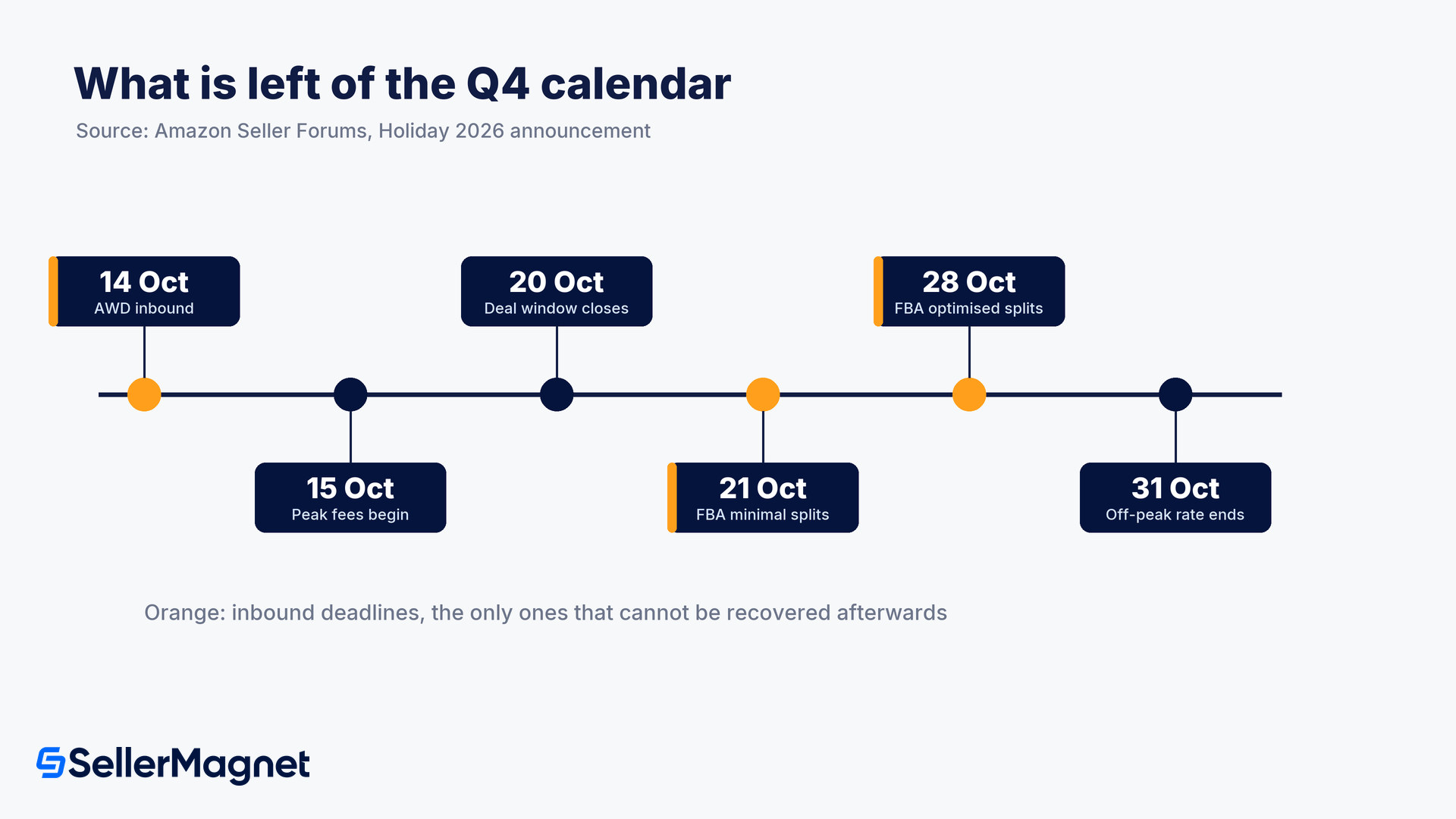
Supply Chain by Amazon is usually introduced as a list of nine service names, which is the least useful way to meet it in October. Only one of those services changes what this quarter costs, and it is Amazon Warehousing and Distribution. It carries three dates change what this quarter costs, and the rest of the calendar sits in the table below: 14 October for AWD inbound ahead of Black Friday Week, 15 October when holiday peak fulfilment fees begin, and 31 October when the off-peak storage exemption for AWD auto-replenishment runs out.
Supply Chain by Amazon is Amazon's bundle of logistics services, covering transport from the factory, customs, bulk storage, replenishment and delivery. Its storage arm is Amazon Warehousing and Distribution, which holds reserve inventory more cheaply than a fulfilment centre and refills FBA automatically. In the 2026 US holiday season, sellers using AWD with automatic replenishment keep the off-peak storage rate until the thirty-first of October, while holiday peak fulfilment fees start on the fifteenth of October.
What is actually expiring this month?
Three separate things, and they are easy to run together because they all fall before the end of the month. The clearest is the storage exemption. In its Holiday 2026 announcement, posted in July, Amazon writes: "if you send inventory through AWD and enable automatic replenishment to FBA, you'll keep paying the off-peak monthly storage rate through October 31, 2026." That is a storage concession, and it is conditional on automatic replenishment being switched on rather than on simply holding stock in AWD.
The inbound deadline is the one that cannot be recovered
Amazon published the arrival dates needed for Prime-badge eligibility during the events: for Black Friday Week and Cyber Monday, "October 14: AWD shipments", "October 21: FBA shipments with 'minimal shipment splits' option selected" and "October 28: FBA shipments with 'Amazon-optimized shipment splits' option selected (most sellers select this option)". The Prime Big Deal Days dates, 2, 9 and 16 September, have passed. A storage rate can be optimised after the fact; a shipment that lands in November cannot be made eligible retrospectively.
What does AWD change about peak, exactly?
AWD separates where stock sits from what Amazon charges to hold it. Holiday peak fulfilment fees "will apply again from October 15, 2026, to January 14, 2027, for Fulfillment by Amazon (FBA), Remote Fulfillment with FBA, Multi-Channel Fulfillment (MCF), and Buy with Prime", at "the same per unit increase over non-peak rates as last year, averaging $0.32 per unit", and Amazon adds that "the 3.5% fuel and logistics-related surcharge will apply on top of holiday peak fulfillment fees". Those are fulfilment fees, charged when a unit ships. Storage is the separate line, and it is the one AWD moves.
Date
What happens
Applies to
2 September
AWD inbound deadline for Prime Big Deal Days
AWD shipments
9 September
FBA inbound deadline for Prime Big Deal Days, minimal splits
FBA shipments
16 September
FBA inbound deadline for Prime Big Deal Days, optimised splits
FBA shipments
14 October
AWD inbound deadline for Black Friday Week and Cyber Monday
AWD shipments
15 October
Holiday peak fulfilment fees begin, averaging $0.32 more per unit
FBA, Remote Fulfillment, MCF, Buy with Prime
20 October
Deal submission window closes for Black Friday Week and Cyber Monday
Last day of the off-peak storage rate for AWD with automatic replenishment
AWD inventory
14 January 2027
Holiday peak fulfilment fees end
FBA, Remote Fulfillment, MCF, Buy with Prime
Read that list and the sequencing logic becomes visible. Amazon wants reserve stock in the network before the fulfilment centres switch from receiving to picking, and it says so plainly: "Our fulfillment center teams focus on receiving holiday shipments in September and October, then shift to processing customer orders in November and December. So, you may see lower capacity limits during this time." The off-peak storage concession and the earlier AWD inbound date are both ways of pulling inventory in sooner, which is why AWD gets the earliest deadline and the only storage break.
Amazon's own number for its own programme
In the same post Amazon reports that "sellers who enrolled in AWD in the fourth quarter of 2025 experienced an increase of over 13% in shipped units and greater than 30% reduction in out-of-stock days during the quarter." Treat it as what it is: a vendor statistic about its own service, published without a methodology or a control group, and measured on sellers who chose to enrol. The out-of-stock figure is the more believable half, because keeping reserve stock closer to the network is mechanically likely to reduce stockouts.
What does the discount ladder actually pay?
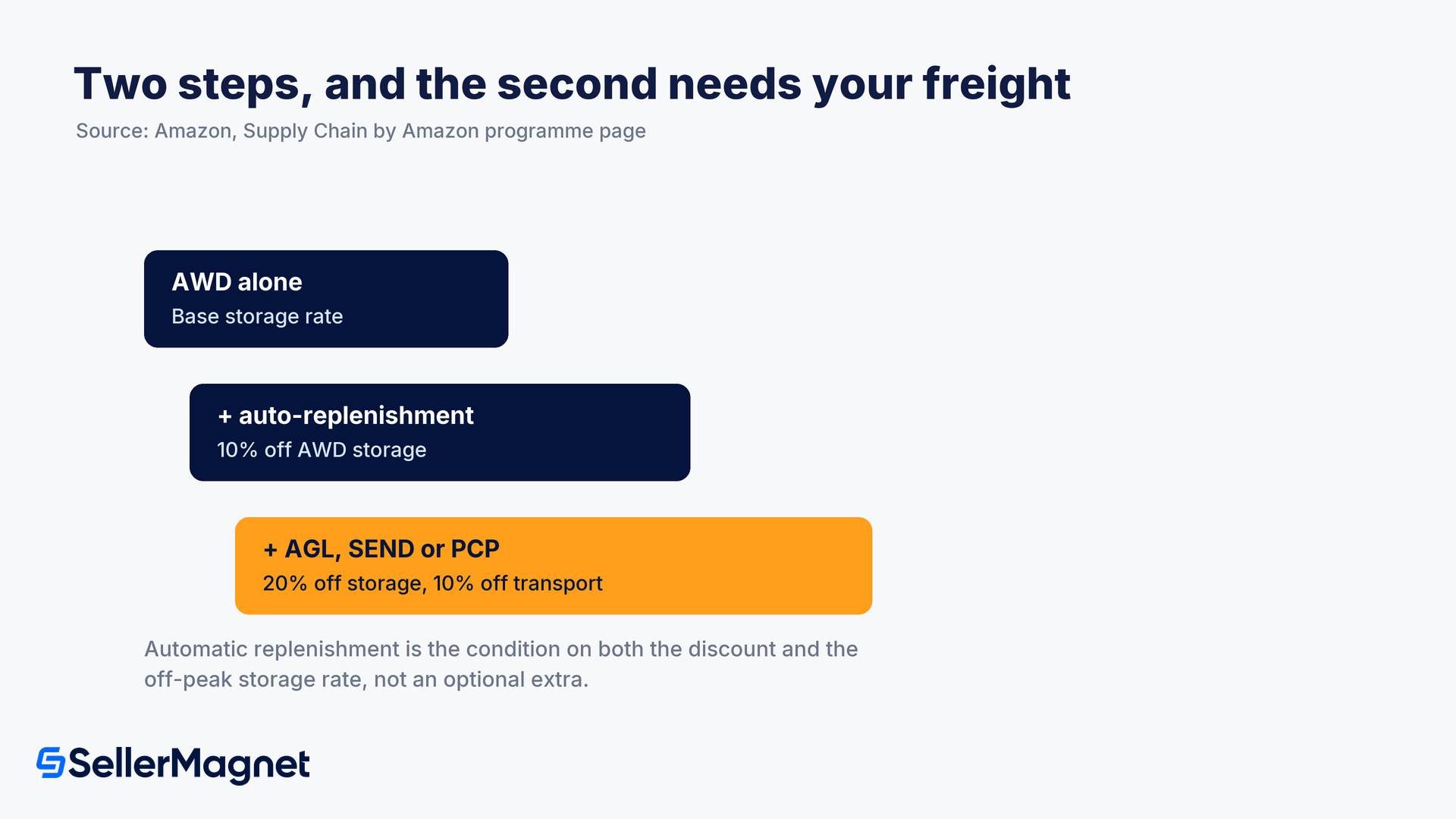
Two steps, and the second one requires you to hand Amazon your freight as well as your storage. On its Supply Chain by Amazon page Amazon offers "save 10% on AWD storage" for using AWD automatic replenishment, then "save 20% on AWD storage" and "10% on transportation" for sellers who also move goods with Amazon Global Logistics, Seller Export & Delivery or the Partnered Carrier program. The ladder is the actual product here: the nine service names exist so that each one you adopt discounts the next.
The bundle is transport, storage and delivery. Amazon describes it as picking up "inventory from your manufacturing facilities", shipping it "across borders", handling "customs clearance and ground transportation", storing "inventory in bulk", managing "replenishment across Amazon and other sales channels", and delivering "directly to customers".
Auto-replenishment is the condition, not a feature. Both the 10% storage discount and the off-peak storage date are tied to automatic replenishment being enabled.
The storage comparison Amazon prints on that page is $0.78 per cubic foot per month for standard-size FBA from January to September against $0.48 for AWD, and $2.40 against $0.48 from October to December.
Those are marketing-page figures for the US store, not a quote for your account. Amazon points sellers to the Revenue Calculator, the Profit Analytics dashboard and the Fee and Economics Preview Report for rates that reflect their own products.
A 15% sales uplift is also claimed on the same page, footnoted "Calculated April - June 2023" - a three-year-old measurement window attached to a current offer.
The October to December line is where the arithmetic gets loud, because the FBA figure roughly triples while the AWD figure does not move. That is the structural case for reserve storage: peak pricing is designed to push slow-moving units out of fulfilment centres, and AWD is the officially sanctioned place to put them. It is also why the 31 October date matters more than it looks. After that point the concession stops and you are choosing between AWD's rate and a fulfilment-centre rate that has already stepped up.
What changed structurally in 2026?
Amazon moved the warehouse to the factory's country. In an April announcement it launched Global Warehousing & Distribution: "Starting April 9, 2026, you can store your inventory in bulk at a lower cost in our new Global Warehousing & Distribution (GWD) facility in Shenzhen, China, and seamlessly replenish to our US fulfillment network when needed." The claims are "Reduce storage costs by up to 45% compared to US Amazon Warehousing and Distribution (AWD)" and "Get inventory to US fulfillment centers up to seven days faster when paired with Amazon Global Logistics (AGL)". Both are "up to" figures. Amazon frames GWD as "the first step in our Next Generation of Global Selling vision - where you list once, bring your inventory to the warehouse at origin, and sell it globally from day one".
The other 2026 change is a penalty rather than a discount, and it outlived the promotion it arrived with. When Amazon opened palletisable AWD centres in California and Arizona it ran an introductory inbound processing rate of $1 per box against a base of $1.35, but only for shipments received by 14 January 2026, so that offer is gone. What remains is the downside: "Shipments that don't meet our palletizable region requirements or don't match your order details will be charged a processing fee of $2.50 per box, instead of the base rate of $1.35 per box", and Amazon adds that it "may reject shipments that contain mixed products on one pallet". Choosing the West Coast Palletizable region and then sending mixed pallets nearly doubles the per-box rate.
These are the US store's dates. Europe is a different calendar
Everything above comes from Amazon's US holiday announcement and its US programme page, and the surcharge quoted on top of peak fulfilment fees is the 3.5% US one. European FBA carries a separate 1.5% fuel and logistics surcharge introduced on 17 April 2026, and the European festive peak runs to its own schedule. If you sell in both, treat them as two plans rather than one with a translated calendar, and check our guide to Amazon Warehousing and Distribution in Europe for the European side.
How to use what is left of October
Confirm automatic replenishment is actually enabled - The off-peak storage rate through 31 October is conditional on sending inventory through AWD and enabling automatic replenishment to FBA. Holding stock in AWD without the replenishment setting does not meet the condition Amazon stated, so check the setting rather than assuming the inventory location is enough.
Work backwards from 28 October, not from Black Friday - The last FBA inbound date for Black Friday Week eligibility is 28 October for Amazon-optimised shipment splits, which Amazon notes is what most sellers select, and 21 October for minimal splits. The AWD date, 14 October, is earlier than both. Pick the lane that matches what you can physically ship, then book against that date.
Decide what should not be in a fulfilment centre on 15 October - Peak fulfilment fees run from 15 October to 14 January and add an average of $0.32 per unit before the 3.5% surcharge. Slow sellers held in FBA through that window pay peak storage without the sales to justify it, which is the case AWD exists to answer.
Check your deal submissions before 20 October - The submission window for Black Friday Week and Cyber Monday closes on 20 October. The early-submission discount that saved $50 on the upfront fee required a 5 September submission and has passed, so the remaining cost is $100 upfront plus 1.5% of promotional sales, capped at $5,000.
Match your pallets to the region you selected - If you are inbounding to the West Coast Palletizable region, a shipment that does not meet the pallet requirements is charged $2.50 per box instead of $1.35, and mixed-product pallets may be rejected outright. Confirm single-SKU pallets before booking rather than after the shipment is scanned.
The number that tells you whether AWD is worth it
Take the cubic feet you expect to be holding in fulfilment centres between 15 October and 14 January, and price it twice: once at the peak fulfilment-centre storage rate and once at the AWD rate plus the transport cost of replenishing from it. AWD wins on slow-moving bulk and loses on anything that turns fast enough to never sit still, because every replenishment leg is a cost that a unit already in the fulfilment centre does not pay.
The honest difficulty with a bundle like this is that the savings and the costs land in different places: storage falls on one line, transport and processing rise on others, and the net effect only exists per SKU. Tracking fulfilment fees, storage and margin per ASIN in one view is what turns a discount ladder into a decision you can check a month later. SellerMagnet's profit analytics break those lines out per marketplace and per product.
When do Amazon's holiday peak fulfilment fees start in 2026?
15 October 2026, running to 14 January 2027, for FBA, Remote Fulfillment with FBA, MCF and Buy with Prime. The increase averages $0.32 per unit, with the 3.5% US fuel and logistics surcharge on top.
How long does the off-peak AWD storage rate last?
Through 31 October 2026, for sellers who send inventory through AWD and enable automatic replenishment to FBA. The condition is the replenishment setting, not simply storing in AWD.
What are the Q4 2026 inbound deadlines?
For Black Friday Week and Cyber Monday: 14 October for AWD, 21 October for FBA with minimal shipment splits and 28 October for FBA with Amazon-optimised splits. The Prime Big Deal Days dates were 2, 9 and 16 September.
What discounts does Supply Chain by Amazon offer?
Amazon publishes 10% off AWD storage for using automatic replenishment, rising to 20% off storage and 10% off transportation for sellers who also use Amazon Global Logistics, SEND or the Partnered Carrier program.
What is Global Warehousing and Distribution?
A bulk storage facility at origin, launched in Shenzhen on 9 April 2026, that replenishes the US network. Amazon claims storage costs up to 45% below US AWD and inventory arriving up to seven days faster when paired with AGL.
Do these dates apply to European sellers?
No. These are the US store's deadlines and the 3.5% surcharge is the US one. European FBA carries a separate 1.5% surcharge from 17 April 2026 and its own festive peak calendar.
Stop Juggling Tools. SellerMagnet Combines Everything You Need.